Exhibition | Napoleon’s Three Sisters in Italy
Now on view in Paris (with thanks to Hélène Bremer for noting it) . . .
Les Soeurs de Napoléon: Trois Destins Italiens
Musée Marmottan Monet, Paris, 3 October 2013 — 26 January 2014
Curated by Maria Teresa Caracciolo
 Le musée Marmottan Monet consacre, du 3 octobre 2013 au 26 janvier 2014, une exposition exceptionnelle et inédite à Elisa, Pauline et Caroline, soeurs de Napoléon Ier, princesses et reines d’Italie. Grâce à des prêts d’exception provenant des plus grands musées d’Europe et des collections des descendants de la famille, italiens et français, 140 oeuvres sont réunies pour recréer l’univers prestigieux de la vie privée et publique des soeurs Bonaparte. Leurs trois destins hors du commun sont présentés pour la première fois, de leur genèse dans le Paris consulaire à leurs règnes italiens sous l’Empire.
Tableaux, sculptures, mobilier, accessoires, bijoux et parures de cour matérialisent sous nos yeux les destins extraordinaires d’Elisa (1777–1820), princesse de Piombino et de Lucques, puis grande-duchesse de Toscane, de Pauline (1780–1825) épouse du prince romain Camille Borghèse et de Caroline (1782–1839), mariée au général Joachim Murat et qui régna avec lui sur Naples avec un faste inégalé : trois femmes, trois personnalités différentes, l’une primant par la beauté, les deux autres par l’énergie, le charme et l’intelligence. Elles ont été les témoins privilégiés et les actrices de leur époque.
Autour de l’événement-charnière du sacre de Napoléon renaissent à la fois l’intime : leurs rôles de mères et d’épouses, comme l’officiel : leurs vies de princesses et reines d’Italie, dans les cours de Florence, Rome et Naples qui feront des trois soeurs des symboles de l’Europe en construction.
Cette exposition qui bénéficie de l’engouement remarquable de nombreuses institutions, collections particulières et musées prestigieux voit le jour aujourd’hui dans l’écrin idéal du musée Marmottan Monet, coeur de l’univers de Paul Marmottan (1856–1932) son fondateur, collectionneur passionné par le Premier Empire. Sont réunies, entre autres, des pièces des musées nationaux des châteaux de Versailles, Fontainebleau, Malmaison, du musée Fesch d’Ajaccio, du musée Fabre de Montpellier, de l’Ambassade de Grande-Bretagne à Paris, du Musée de l’armée, de celui de la Légion d’honneur, des Fondations Napoléon et Dosne-Thiers, du Musée des Beaux-Arts de Liège, du Palazzo Pitti de Florence, du Museo Napoleonico, du Museo Praz, des Musei di Arte Medievale e Moderna de Rome, des musées de Turin, Naples, Lucques, Caserte et de l’Ile d’Elbe, sans omettre les fonds propres de la bibliothèque Marmottan et du musée Marmottan Monet.
◊ ◊ ◊ ◊ ◊
The catalogue, in French and English, is published by Hazan:
Maria Teresa Caracciolo, ed., Les soeurs de Napoléon: Trois Destins Italiens (Paris: Hazan, 2013), 216 pages, ISBN: 978-2754107112, 29€.
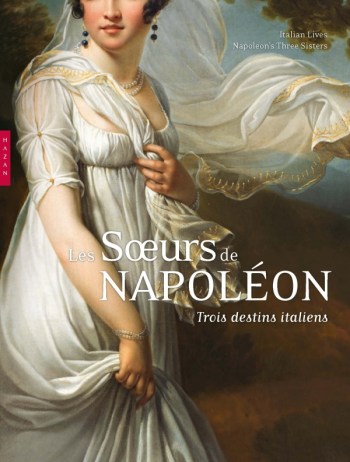 Exposition « Les sœurs de Napoléon. Trois destins italiens », au musée Marmottan Monet à Paris, du 03 octobre 2013 au 02 février 2014. Les sœurs de Napoléon Ier, Élisa, Pauline et Caroline, eurent toutes trois un destin italien : la première fut élevée par son frère au rang de princesse de Lucques, puis de grande-duchesse de Toscane, représentante de l’Empereur en Italie. La deuxième épousa un prince romain, Camille Borghèse, et vécut avec lui entre Paris et Rome, en s’attirant dans les deux villes le titre de reine de la beauté. Enfin la cadette, mariée au général Joachim Murat, régna avec lui sur Naples avec un faste inégalé. L’exposition évoque les trois destins des sœurs Bonaparte, forgés dans le Paris consulaire et brillamment parachevés en Italie sous l’Empire. Comme les autres membres de la famille Bonaparte, les sœurs de Napoléon appréciaient les belles résidences et pratiquèrent un mécénat éclairé. A Paris et en Italie, elles laissèrent la marque de leur passage par la création de décors, de peintures, de sculptures et d’objets d’art. La grande-duchesse de Toscane et la reine de Naples stimulèrent la production des manufactures de leurs Etats et encouragèrent dans leurs cours le théâtre, la musique et les arts de la mode, en menant en Italie une politique de conquête pacifique, la conquête par la culture et les idées. L’exposition réunit des portraits des trois sœurs, seules ou en groupe, avec leurs familles et leurs amis, dans les lieux où elles vécurent et qui furent métamorphosés par leur goût. Elle rassemble des œuvres d’art créées sous leur impulsion, des objets et des accessoires de leur vie quotidienne, des bijoux qui relevaient leurs somptueuses tenues de cour. Ces œuvres sont aujourd’hui partagées entre les plus grands musées d’Europe et les collections des descendants de la famille, italiens et français. Leur réunion dans les salles de l’ancien hôtel de Paul Marmottan, devenu musée Marmottan Monet, ressuscite une page d’histoire et la splendeur d’une époque. Elle nous fait entrer dans la vie privée d’une famille qui partagea le destin exceptionnel de l’empereur Napoléon Ier. Version bilngue français/anglais.
Commissaire de l’exposition et auteur du catalogue, Maria Teresa Caracciolo est Historienne de l’art, chargée de recherche au CNRS, spécialiste de la peinture européenne du XVIIIe et du XIXe siècle et des relations franco-italiennes sous la Révolution et l’Empire. Elle est l’auteur, parmi d’autres ouvrages, de Giuseppe Cades (1750–1799) et la Rome de son temps (Paris, Arthena, 1992, ouvrage issu d’une thèse de doctorat); du Romantisme (Citadelles et Mazenod, 2013); du catalogue de l’exposition Jean-Baptiste Wicar: Ritratti della famiglia Bonaparte (Roma, Museo Napoleonico-Napoli, Museo Diego Aragona Pignatelli Cortes, 2004); et du catalogue de l’exposition Lucien Bonaparte (1775–1840): un homme libre, (Ajaccio, Musée Fesch, 2010).
New Book | Exhibiting Englishness: John Boydell’s Shakespeare Gallery
From Yale UP:
Rosie Dias, Exhibiting Englishness: John Boydell’s Shakespeare Gallery and the Formation of a National Aesthetic (London: The Paul Mellon Centre for Studies in British Art, 2013), 288 pages, ISBN: 978-0300196689, $85.
 In the late 18th century, as a wave of English nationalism swept the country, the printseller John Boydell set out to create an ambitious exhibition space, one devoted to promoting and fostering a distinctly English style of history painting. With its very name, the Shakespeare Gallery signaled to Londoners that the artworks on display shared an undisputed quality and a national spirit. Exhibiting Englishness explores the responses of key artists of the period to Boydell’s venture and sheds new light on the gallery’s role in the larger context of British art.
Tracking the shift away from academic and Continental European styles of history painting, the book analyzes the works of such artists as Joshua Reynolds, Henry Fuseli, James Northcote, Robert Smirke, Thomas Banks, and William Hamilton, laying out their diverse ways of expressing notions of individualism, humor, eccentricity, and naturalism. Exhibiting Englishness also argues that Boydell’s gallery radically redefined the dynamics of display and cultural aesthetics at that time, shaping both
an English school of painting and modern exhibition
practices.
Rosie Dias is associate professor in the history of art at
the University of Warwick.
Exhibition | Yoga: The Art of Transformation
From the exhibition press release:
Yoga: The Art of Transformation
Smithsonian’s Arthur M. Sackler Gallery, Washington, D.C., 19 October 2013 — 26 January 2014
San Francisco Asian Art Museum, 21 February — 25 May 2014
Cleveland Museum of Art, 22 June — 7 September 2014

Krishna Vishvarupa (detail), ca. 1740. India, Himachal Pradesh, Bilaspur. Collection of Catherine and Ralph Benkaim.
◊ ◊ ◊ ◊ ◊
Yoga: The Art of Transformation, the first exhibition about the visual history of yoga explores yoga’s rich diversity and historical transformations during the past 2,000 years.
On view through January 26, 2014, The Art of Transformation examines yoga’s fascinating meanings and histories through more than 130 objects from 25 museums and private collections in India, Europe and the U.S. Highlights include three monumental stone yogini goddesses from a 10th-century south Indian temple, reunited for the first time, 10 folios from the first illustrated compilation of asanas (yogic postures) making their U.S. debut, and a Thomas Edison film, Hindoo Fakir (1906), the first movie produced about India.
“This exhibition looks at yoga’s ancient roots, and how people have been trying to master body and spirit for millennia,” said Julian Raby, The Dame Jillian Sackler Director of the Arthur M. Sackler Gallery and Freer Gallery of Art. “By applying new scholarship to both rarely seen artworks and recognized masterpieces, we’re able to shed light on practices that evolved over time—from yoga’s ancient origins to its more modern emergence in India, which set the stage for today’s global phenomenon.
 A free public festival, Diwali and the Art of Yoga, Saturday, October 26, will mark both the opening of the exhibition and Diwali, the Indian festival of lights. Visitors can discover exhibition highlights through spotlight tours, play games from across Asia, attempt intricate rangoli (rice powder) drawings and make their own yoga-inspired art in hands-on workshops. Indian classical musician K. Sridhar will demonstrate the yoga of sound, and storyteller Louise Omoto Kessel will share tales of Indian deities. Free yoga classes will be offered throughout, and the day will conclude with a traditional lamp-lighting ceremony and a classical Indian music concert.
In conjunction with The Art of Transformation, the Freer and Sackler galleries will also host Yoga and Visual Culture, a free interdisciplinary symposium for scholars and yoga enthusiasts November 21–23. Seventeen scholars from a range of disciplines will present cutting-edge research on diverse aspects of yoga’s visual culture, organized around such topics as “Yoga and Place” and “Yoga and Print Culture.” A full schedule and registration is available at asia.si.edu/events/yoga-symposium/.
Yoga classes in the galleries will be offered through “Art in Context,” an interactive 90-minute workshop combining tours of the exhibition with the practice of yoga. Led by a teaching team of a museum docent and guest yoga teachers, the workshops will be held on Wednesdays and Sundays throughout the exhibition, with special sessions offered for ages 50-plus, teens and families. Advance registration is required, and visitors can find a full schedule at asia.si.edu/events/workshops.asp.
These programs are made possible in part due to the Smithsonian’s first major crowdfunding campaign, “Together We’re One.” Launched in May 2013, the campaign raised more than $174,000 over 6 weeks to support public programs, yoga classes in the galleries, and an exhibition catalogue, as well as the behind—the—scenes aspects of the exhibition. Campaign donors and exhibition ambassadors, called “Yoga Messengers,” are invited to be special guests during the October 26 “Art of Yoga” festival, and will be featured in exhibition signage.
Following its Washington, D.C., debut, The Art of Transformation will travel to the San Francisco Asian Art Museum and the Cleveland Museum of Art.
Support for the exhibition is provided by the Friends of the Freer|Sackler, Whole Foods Market, Art Mentor Foundation Lucerne, the Alec Baldwin Foundation, the Ebrahimi Family Foundation, IndiaTourism, Catherine Glynn Benkaim, media partner Yoga Journal, and “Together We’re One” donors.
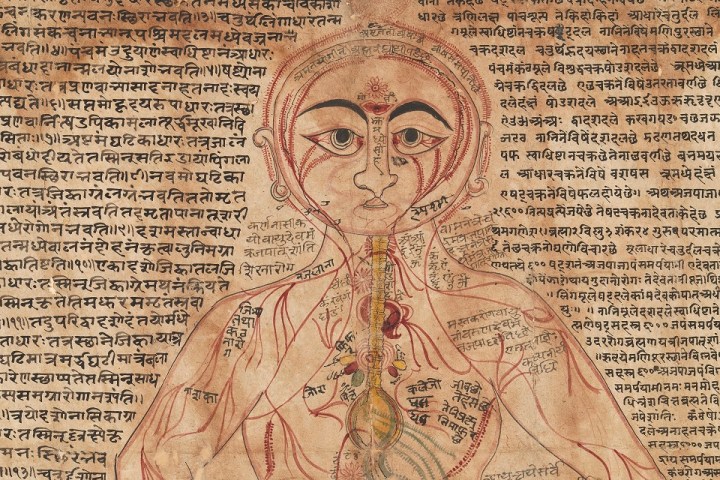
Anatomical Body, 18th century, India, Gujarat (Wellcome Library, London, Asian Collections, MS Indic Delta 74).
◊ ◊ ◊ ◊ ◊
Debra Diamond, ed., Yoga: The Art of Transformation (Washington, D.C.: Smithsonian Books, 2013), 360 pages, ISBN-13: 978-1588344595, $55.
An exploration of yoga’s meanings and transformations over time; the discipline’s goals of spiritual enlightenment, worldly power, and health and well-being; and the beauty and profundity of Indian art.
Debra Diamond is Associate curator of South and Southeast Asian art, Freer Gallery of Art and Arthur M. Sackler Gallery. Her exhibition catalogue for Garden and Cosmos (fall 2008) received two major awards for scholarship: the College Art Association’s Alfred H. Barr award and the Smithsonian Secretary’s Award for Research. She has published on yoga imagery, new methods in Indian art history, contemporary Asian art, and various aspects of the Freer|Sackler collections.
New Book | Breast Cancer in the Eighteenth Century
In the U.S., October is National Breast Cancer Awareness Month, and Friday, October 18th, is National Mammography Day. From the publisher:
Marjo Kaartinen, Breast Cancer in the Eighteenth Century (London: Pickering & Chatto, 2013), 256 pages, ISBN: 978-1848933644, £60 / $99.
 Early modern physicians and surgeons tried desperately to understand breast cancer, testing new medicines and radically improving operating techniques. In this study, the first of its kind, Marjo Kaartinen explores the emotional responses of patients and their families to the disease in the long eighteenth century.
Using a wide range of primary sources, she examines the ways in which knowledge about breast cancer was shared through networks of advice that patients formed with fellow sufferers. By focusing on the women who struggled with the disease as well as the doctors that treated them, much is revealed about early modern attitudes to cancer and how patients experienced – and were considered to experience – the cancerous body.
C O N T E N T S
Preface
‘One of the Most Grievous and Rebellious Diseases’: Defining, Diagnosing and the Causes of Cancer
2 ‘But Sad Resources’: Treating Cancer in the Eighteenth Century
3 Women’s Agency and Role in Choice of Treatment
4 ‘So Frightful to the Very Imagination’: Pain, Emotions and Cancer in the Breast
Epilogue
New Book | Ornamenting the Cold Roast
Distributed by Columbia University Press:
Dorothee Wagner von Hoff, Ornamenting the Cold Roast: The Domestic Architecture and Interior Design of Upper-Class Boston Homes, 1760–1880 (Bielefeld: Transcript-Verlag, 2013), 340 pages, ISBN: 978-3837622768, $62.
 This book presents the meticulous case studies of three individual houses from different eras, which serve to depict the social, political, and cultural effects that domestic architecture and interior design had on the upper class, the city of Boston, and a national American identity. It takes the reader on a journey to 18th- and 19th-century Boston and provides insight into the lives of these prominent men and women as seen through the perspective of their homes. It is a novel examination of the cultural significance of domestic architecture and interior design; and, because of its story-telling character and extensive attention to detail, it is fascinating for curious readers and cultural historians alike.
Dorothee Wagner von Hoff received her PhD at the University of Munich. Her research interests include Colonial and Victorian Architecture and interior design, as well as urban studies and American literature.
New Book | Making of a Cultural Landscape: The English Lake District
From Ashgate:
John K. Walton and Jason Wood, eds., The Making of a Cultural Landscape: The English Lake District as Tourist Destination, 1750–2010 (Aldershot: Ashgate, 2013), 292 pages, 978-1409423683, £70 / $135.
 For centuries, the English Lake District has been renowned as an important cultural, sacred and literary landscape. It is therefore surprising that there has so far been no in-depth critical examination of the Lake District from a tourism and heritage perspective. Bringing together leading writers from a wide range of disciplines, this book explores the tourism history and heritage of the Lake District and its construction as a cultural landscape from the mid eighteenth century to the present day.
It critically analyses the relationships between history, heritage, landscape, culture and policy that underlie the activities of the National Park, Cumbria Tourism and the proposals to recognise the Lake District as a UNESCO World Heritage Site. It examines all aspects of the Lake District’s history and identity, brings the story up to date and looks at current issues in conservation, policy and tourism marketing. In doing so, it not only provides a unique and valuable analysis of this region, but offers insights into the history of cultural and heritage tourism in Britain and beyond.
Professor John K. Walton is IKERBASQUE Research Professor at the Department of Contemporary History, University of the
Basque Country, Leoia, Bilbao, Spain. Jason Wood, is Director
of Heritage Consultancy Services, Lancaster, UK.
◊ ◊ ◊ ◊ ◊
C O N T E N T S
List of Figures and Tables, vii
List of Contributors, xi
Foreword, xiii
Preface and Acknowledgements, xv
Part I: Lake District History and Identity
1 Susan Denyer, The Lake District Landscape: Cultural or Natural?, 3
2 John K. Walton, Setting the Scene, 31
3 Angus J. L. Winchester, The Landscape Encountered by the First Tourists, 49
4 John K. Walton, Landscape and Society: The Industrial Revolution and Beyond, 69
5 Melanie Hall, American Tourists in Wordsworthshire: From ‘National Property’ to ‘National Park’, 87
Part II: Lake District Tourism Themes
6 Keith Hanley, The Imaginative Visitor: Wordsworth and the Romantic Construction of Literary Tourism, 113
7 Adam Menuge, ‘Inhabited by Strangers’: Tourism and the Lake District Villa, 133
8 Jonathan Westaway, The Origins and Development of Mountaineering and Rock Climbing Tourism in the Lake District, c. 1800–1914, 155
Part III: Lake District Tourism Case Studies
9 Mike Huggins and Keith Gregson, Sport, Tourism and Place Identity in the Lake District, 1800–1950, 181
10 Sarah Rutherford, Claife Station and the Picturesque in the Lakes, 201
11 Jason Wood, Furness Abbey: A Century and a Half in the Tourists’ Gaze, 1772–1923, 219
12 David Cooper, The Post-Industrial Picturesque? Placing and Promoting Marginalised Millom, 241
Select Bibliography
Index
Exhibition | Naples’s Treasure: The Museum of Saint Januarius
Press release from the Museo Fondazione:
Naples’s Treasure: Masterpieces of the Museum of Saint Januarius
Il Tesoro Di Napoli: I Capolavori del Museo di San Gennaro
Museo Fondazione, Palazzo Sciarra, Rome, 30 October 2013 — 16 February 2014
Musée Maillol, Paris, 19 March — 20 July 2014
Curated by Paolo Jorio and Ciro Paolillo

Michele Dato, Necklace of Saint Januarius, gold, silver,
and precious stones, 1679, with additions made in the
eighteenth, nineteenth, and twentieth centuries.
◊ ◊ ◊ ◊ ◊
Never before have such masterpieces from the most important collection of goldsmith art in the world, together with original documents, paintings, drawings, vestments and church plate, been exhibited beyond the walls of Naples. This exhibition offers an opportunity to investigate the inestimable artistic and cultural value of the treasure of Saint Januarius from a scientific point of view.
The exhibition, curated by Paolo Jorio, Director of the Museo del Tesoro di San Gennaro, and Ciro Paolillo, a professional gemmologist and professor of history, economics and the production of jewellery in the Sapienza University of Rome, with the advice of Franco Recanatesi, will be an event of great historic and artistic importance: over seventy works belonging to one of the most important collections of goldsmith’s art will be displayed for the first time beyond the walls of the Parthenopean city, beside original documents, paintings, drawings, vestments and church plate. The exhibition will offer an opportunity to investigate the inestimable artistic and cultural worth of the treasure of Saint Januarius from a scientific point of view, in order to rediscover, pass down and re-experience Naples on a journey through time and to protect its name, history, artists and, above all, this priceless heritage that has been collected over seven centuries.
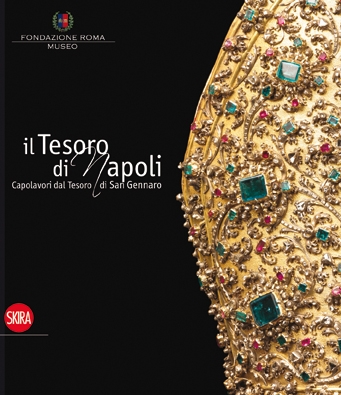 With twenty-five million devotees scattered throughout the globe, Januarius is the most famous Roman Catholic Saint in the world. Amidst devotion and prejudice, faith and disbelief, his long history is closely connected to Naples, the citizens of which – periodically threatened by natural catastrophes and historical events – even closely identify themselves with their patron saint. The exhibition to be held in Palazzo Sciarra will have both a scientific and an emotional approach, in order to explain the evolution of the cult of Saint Januarius in Naples, why the Treasure belongs to a secular institution and how Parthenopean goldsmithery was perfected over the centuries, thus creating most of the masterpieces on show.
In order to understand the impact of this event, suffice it to say that the historical value of the Treasure of Saint Januarius, formed throughout seven centuries of donations from Popes, Emperors, Kings and popular ex-votos, is higher than that of the Crown Jewels of the United Kingdom and those of the Tsar of Russia, as found during a research project conducted by a team of gemmologists led by Professor Ciro Paolillo, curator of the exhibition, the results of which were published in 2010. The team investigated several precious jewels donated to the Saint, which will be exhibited in Rome, for three years. Moreover, unlike other dynastic and ecclesiastical heritages, the Treasure has remained in tact ever since it was formed and has never endured spoliation, nor have the jewels ever been sold to fund wars. It has constantly been increased by means of acquisitions and accessions.

Matteo Treglia, Mitre in gilded silver, 3326 diamonds, 164 rubies, 198 emeralds and 2 garnets, 1714.
Professor Emmanuele F. M. Emanuele, Chair of the Fondazione Roma, says, “I believe it is essential to spread knowledge of this priceless heritage belonging to our country, the preservation and enhancement of which constitutes a strategic asset for the culture market. It is precisely due to its commitment in this field that the Fondazione Roma, by means of the activities performed by Fondazione Roma-Arte-Musei, has, in time, become a point of reference for the balance of the demand and supply of culture in the Eternal City. The exhibition devoted to Saint Januarius fully qualifies to be included in the cultural project promoted by our institution, which aims to spread all forms of art as an element of social development. The attention we pay to the relationship between culture and the community constitutes the link between the activities performed by the Foundation and those of the Museo di San Gennaro, which has led to the accomplishment of this important exhibition that will allow the public to admire, for the first time, works which, due to their preciousness and strong connotations of identity, have never been shown beyond the walls of Naples.”
 Paolo Jorio says that, “Each work of art belonging to the Treasure of Saint Januarius expresses its intrinsic artistic wealth, fruit of the unequaled craftsmanship of sculptors, silversmiths, chasers, welders and ‘put togetherers’ (as the assemblers were called in those days) who were capable of creating masterpieces of rare beauty using their technical know-how and creativity, and also tells the extraordinary story of a people and its ancient civilization. An account that places the Neapolitan people and European monarchs on the same level, since they all paid homage to Saint Januarius in a secular way and donated priceless masterpieces to the city of Naples.”
The exhibition will revolve around the two most extraordinary masterpieces of the Treasure: the Necklace of Saint Januarius, in gold, silver and precious stones created by Michele Dato in 1679, and the Mitre, in gilded silver, 3326 diamonds, 164 rubies, 198 emeralds and 2 garnets, created by Matteo Treglia in 1714, the
Tricentennial of which is celebrated this year.
The Necklace of Saint Januarius is one of the most precious jewels in the world and its history inextricably interweaves with the trail of constant devotion the city and monarchs have paid to this saint over the centuries. In 1679, the Members of the Deputation decided to use several jewels (crosses studded with sapphires and emeralds hanging from thirteen large solid gold links) in order to create a magnificent ornament for the bust, appointing Michele Dato, with the aid of other craftsmen, to enable the execution of such an exacting piece of work in only five months. The necklace is now comprised of other jewels of illustrious provenance created by various craftsmen at different times: a cross donated by Charles de Bourbon in 1734, a cross offered by Maria Amalia of Saxony, a three piece clasp with diamonds and emeralds, a cross with diamonds and sapphires dated 1775 bestowed by Maria Carolina of Austria, a crescent shaped broach dated 1799 donated by the Duchess of Casacalenga, a cross and a broach with diamonds and chrysolite offered by Victor Emmanuel II of Italy and other artefacts. Interestingly, Queen Marie Josè, consort of Umberto II of Italy, was attending a private visit to the Chapel of San Gennaro in 1933 and having nothing to donate, she removed the ring she was wearing and offered it to the saint. This regal gift is now to be found on the necklace.
When landing in Naples, even Napoleon, who plundered everywhere, not only refrained from stealing but, for once in his life, actually donated. In fact, when entering Naples in 1806 Joseph Bonaparte donated, as advised by his brother, a cross of diamonds and emeralds of rare beauty which the Deputation then included amongst the jewels bestowed by sovereigns that compose the priceless Necklace of Saint Januarius. Napoleon’s brother-in-law, Joachim Murat, who married beautiful Caroline Bonaparte, also paid heed to the advice of the French Emperor and donated a monstrance in gold and silver with precious stones in 1808. Both masterpieces will be exhibited in Rome. The arrival of the French in Naples is witnessed in only one known artwork: a painting by the French artist, Hoffman, depicted in 1800 and retrieved in Paris by the Deputation, in which the high altar in the Dome may be distinguished. The armed and threatening French troops, commanded by Championnet and Macdonald, stand on the altar ‘demanding’ Saint Januarius to perform the miracle of the liquefaction of his blood in front of the people. This painting will also be exhibited in Rome, as likewise the canvas of Saint Januarius depicted in 1707 by Solimena, the most famous authentic chromatic masterpiece in the world since, as from that year, all the holy pictures of the patron saint of Naples have been inspired by this painting.
The Mitre, the Tricentennial of which is celebrated this year, was commissioned by the Deputation in order to be placed on the bust during the festive procession held in April 1713. It was created in the Antico Borgo Orefici, established by the Anjou monarchs, which was an authentic mine of talents including the author, the maestro goldsmith, Matteo Treglia. The Mitre has an enormous material and symbolic value. The Mitre is adorned with 3964 precious stones including diamonds, rubies and emeralds, according to the traditional construction of ecclesiastical items in relation to the symbolic meaning of the gems: emeralds represented the union between the sanctity of the Saint and the emblem of eternity and power; rubies the blood of martyrs and diamonds an irreprehensible faith. The gemstones also reveal another fascinating affair. Several gems have been found to come from the ancient quarries in Latin America. Ciro Paolillo affirms that “thanks to Treglia’s devotion, today we are looking at one of the world’s most beautiful collections of emeralds belonging to the ancient people of South America; consequently, these gems are valuable both for their preciousness and history.” (more…)
New Book | The Decoration of a Palace in Genoa
Anne Perrin Khelissa, Gênes au xviiie siècle. Le décor d’un palais (Paris: INHA/CTHS, Collection L’art et l’essai, 2013), 400 pages, ISBN : 978-2735508013, 33€.
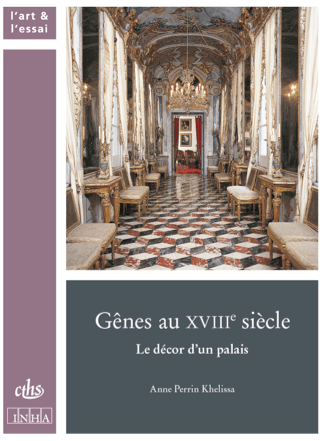 Au xviiie siècle, au cœur d’évènements qui mettent à mal la souveraineté et le prestige de Gênes, l’aristocratie parvient à maintenir sa place économique et politique. Les palais que les familles de la noblesse de l’époque meublent et donnent à voir au public en sont la preuve incontestable : le décor installé dans ces demeures répond au décorum et à une stratégie qui vise à consolider l’établissement des familles par le moyen de l’héritage.
Le palais Spinola à Pellicceria est paradigmatique de ces stratégies. Cet ouvrage éclaire les usages que l’aristocratie fait du décor, en analysant les meubles et les objets qui le composent, sous un angle à la fois social, juridique et esthétique. Il met aussi en évidence la cohérence des collections, enjeu majeur pour les familles, contraintes potentielles pour les artistes et artisans auxquels elles passent commande.
Anne Perrin Khelissa est maître de conférences en histoire de l’art moderne à l’Université Toulouse II – Le Mirail.
◊ ◊ ◊ ◊ ◊
S O M M A I R E
Remerciements
Préface de Peter Fuhring
Introduction
Première Partie: Hériter, transmettre
I. Le palais Spinola à Pellicceria et ses propriétaires
II. Pérennité des valeurs du clan
III. La sauvegarde du patrimoine
Deuxième Partie: Dépenser, commander
I. L’élaboration du décor
II. L’organisation du chantier
III. Aux origines de la commande : le mariage du fils aîné
IV. Les changements opérés par les héritiers
Troisième Partie: Habiter, séjourner
I. La distribution des intérieurs
II. Permanence et changements dans l’ameublement
III. Un parangon des styles européens
IV. Échapper au décorum de la résidence urbaine
Conclusion
Annexes
Les passages de propriété du palais à Pellicceria
Lexique
Sources manuscrites
Bibliographie
Index
Forthcoming Book | Painting in Latin America, 1550–1820
Available in December from Yale UP:
Luisa Elena Alcala and Jonathan Brown, ed., Painting in Latin America, 1550–1820: From Conquest to Independence (New Haven: Yale University Press, 2013), 480 pages, ISBN: 978-0300191011, $75.
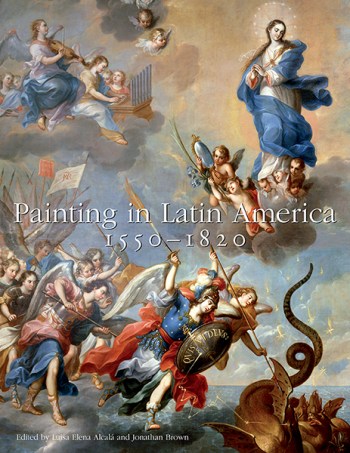 Painting in Latin America, 1550–1820: From Conquest to Independence surveys the diverse styles, subjects, and iconography of painting in Latin America between the 16th and 19th centuries. While European art forms were widely disseminated, copied, and adapted throughout Latin America, colonial painting is not a derivative extension of Europe. The ongoing debate over what to call it—mestizo, hybrid, creole, indo-hispanic, tequitqui—testifies to a fundamental yet unresolved question of identity.
Comparing and contrasting the Viceroyalties of New Spain, with its center in modern-day Mexico, and Peru, the authors explore the very different ways the two regions responded to the influence of the Europeans and their art. A wide range of art and artists are considered, some for the first time. Rich with new photography and primary research, this book delivers a wealth of new insight into the history of images and the history of art.
Luisa Elena Alcala is a professor titular at the department of history and theory of art, Universidad Autónoma of Madrid. Jonathan Brown is Carroll and Milton Petrie Professor of Fine Arts at New York University.
Re-Released Title | American Indians in British Art, 1700–1840
While the book appeared in hardback in 2005, a paperback edition (priced extraordinarily enough at just $22) was published earlier this year by the University of Oklahoma Press:
Stephanie Pratt, American Indians in British Art, 1700–1840 (Norman: University of Oklahoma Press, 2013), 240 pages, ISBN: 978-00806142005, $22.
 Ask anyone the world over to identify a figure in buckskins with a feather bonnet, and the answer will be “Indian.” Many works of art produced by non-Native artists have reflected such a limited viewpoint. In American Indians in British Art, 1700–1840, Stephanie Pratt explores for the first time an artistic tradition that avoided simplification and that instead portrayed Native peoples in a surprisingly complex light.
During the eighteenth century, the British allied themselves with Indian tribes to counter the American colonial rebellion. In response, British artists produced a large volume of work focusing on American Indians. Although these works depicted their subjects as either noble or ignoble savages, they also represented Indians as active participants in contemporary society.
Pratt places artistic works in historical context and traces a movement away from abstraction, where Indians were symbols rather than actual people, to representational art, which portrayed Indians as actors on the colonial stage. But Pratt also argues that to view these images as mere illustrations of historical events or individuals would be reductive. As works of art they contain formal characteristics and ideological content that diminish their documentary value.










 Enfilade
leave a comment