Exhibition | Witches and Wicked Bodies
Press release (10 December 2012) from the Scottish National Gallery of Modern Art:
Witches and Wicked Bodies
Scottish National Gallery of Modern Art, Edinburgh, 27 July — 3 November 2013
 The fascination for witches, which has gripped many Western artists from the sixteenth century to the present, will be the subject of a major new exhibition at the Scottish National Gallery of Modern Art this summer. Witches and Wicked Bodies, will delve into the dark and cruel origins of the classic image of the witch, and demonstrate how the now familiar old woman on a broomstick is just one part of a rich and very diverse visual tradition.
Witches and Wicked Bodies will highlight the inventive approaches to the depiction of witches and witchcraft employed by a broad range of artists over the past 500 years, with striking examples by famous names such as Albrecht Dürer, Lucas Cranach, Salvator Rosa, Francisco de Goya, Henry Fuseli, John William Waterhouse and William Blake. The selection will also include more recent interpretations of the subject, by twentieth-century and contemporary artists including Paula Rego, Kiki Smith and Edward Burra. The exhibition has been curated by the National Galleries of Scotland with artist and writer Deanna Petherbridge and will contain major works on loan from the British Museum; the National Gallery (London); the Ashmolean Museum, Oxford; Tate; and the Victoria & Albert Museum, to be shown alongside key images from the Royal Scottish Academy and the Galleries’ own collections.
John Leighton, Director General of the National Galleries of Scotland, said: “We look to offer our public a world-class yet very distinctive programme of exhibitions. I believe that this is the first time that witchcraft across the ages has been the subject of a major art exhibition in the UK and we are delighted to be partners with the British Museum on this truly fascinating and compelling show.”
Europe has a long history of witchcraft and the persecution of witches was particularly widespread in the sixteenth and seventeenth centuries, accounting for thousands of deaths of women and even children. Prints and drawings dating from this period will form a key part of the exhibition, showing how the advent of the printing press gave artists as well as writers the means to share ideas, myths and fears about witches from country to country. Engravings by Albrecht Dürer will be shown alongside woodcuts by Hans Baldung Grien and many other printmakers including Bruegel and de Gheyn.

Paul Sandby, The Flying Machine from Edinburgh in One Day Performed by Moggy Mackenzie at the Thistle and Crown, etching, 1762. The print satirizes Scottish emigration to England.
Photograph: National Galleries of Scotland
The exhibition will focus on six key themes. The centrepiece of Witches’ Sabbaths and Devilish Rituals is one of the most famous images of witches of all time – Salvator Rosa’s Witches at their Incantations on loan from the National Gallery (London). Unnatural Acts of Flying will include the origins of the image of the witch as an old woman riding a broomstick against a night sky, but rather than the cloaked figure wearing a pointy hat that has become so widely known to adults and children alike, this section features more sinister images of flying witches attending black masses.
In Magic Circles, Incantations and Raising the Dead, visitors will encounter glamorous witches cooking up spells as in Frans Francken’s 1606 painting Witches’ Sabbath. This powerful section also includes the luscious 1886 painting by John William Waterhouse, The Magic Circle. Hideous Hags and Beautiful Witches will include the medusa-like witch with snakes for hair in John Hamilton Mortimer’s drawing Envy and Distraction. This introductory section will also feature unsettling works depicting old crones by Francisco de Goya – the exhibition contains a significant group of works by this major Spanish artist. Some of the images are genuinely frightening and disturbing, whereas others will reveal the negative attitudes towards women in periods when they were very much seen as the second sex. Due to the particular association of women with witchcraft, these works will highlight the ways in which a largely male-dominated European society has viewed female imperfections, highlighting the concerns created by women laying claim to special powers, or simply behaving in the ‘wrong’ way.

Daniel Gardner, The Three Witches from Macbeth (Elizabeth Lamb, Viscountess Melbourne; Georgiana, Duchess of Devonshire; Anne Seymour Damer), pastel on paper, 1775 (London: NPG)
Works depicting the various appearances of the witches in Shakespeare’s Macbeth, in Unholy Trinities and The Weird Sisters from Macbeth, will range from John Martin’s theatrical large-scale painting of Banquo and Macbeth lost on the blasted heath, with the turbulent skies swirling over exaggerated mountains, through to John Runciman’s striking drawing which here is interpreted as the Three Witches conspiring over Macbeth’s fate.
This fascinating thematic survey will culminate with The Persistence of Witches. Works by Kiki Smith and Paula Rego mark a sea-change with these high-profile contemporary artists’ own take on a subject that had previously been almost exclusively male-dominated. In Smith’s study Out of the Woods, the artist herself explores the expressions and attitudes of the ‘witch’, whereas Rego’s 1996 work Straw Burning relates to the famous Pendle Witch trials which took place in 1612 in Lancaster, 400 years ago.
The exhibition has been organised in partnership with the British Museum, whose loans will include William Blake’s magnificent drawing The Whore of Babylon which will be shown alongside the National Galleries’ own Blake drawing, once thought to depict Hecate, the classical witch of the crossroads. Witches and Wicked Bodies will be an investigation of extremes, exploring the highly exaggerated ways in which witches have been represented, from hideous hags to beautiful seductresses who ‘bewitch’ unwary men.
Writing for The Guardian (22 March 2013), Charlotte Higgins provides a useful introduction»
◊ ◊ ◊ ◊ ◊
From ACC Distribution:
Deanna Petherbridge, Witches & Wicked Bodies (Edinburgh: National Galleries of Scotland, 2013), 112 pages, ISBN: 978-1906270551, £15.
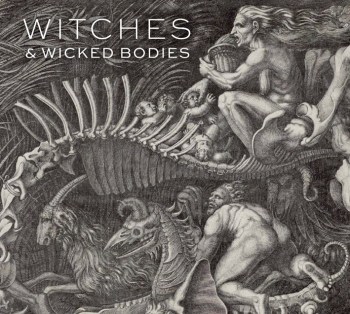 Witches & Wicked Bodies provides an innovative, rich survey of images of European witchcraft from the sixteenth century to the present day. It focuses on the representation of female witches and the enduring stereotypes they embody, ranging from hideous old crones to beautiful young seductresses. Such imagery has ancient precedents and has been repeatedly re-invented by artists over the centuries, to include scenes with corpses and cauldrons, caverns and kitchens, and the dead being raised through demonic or satanic rites – all inversions of an ordered and religious social world.
Petherbridge introduces this fascinating subject and includes catalogue entries on each of the exhibited works. The illustrations primarily feature drawings and prints as well as a group of important paintings. A wide range of artists is represented including Dürer, Goya, Fuseli, Blake, Burra and Rego.
Deanna Petherbridge CBE is an artist, curator and writer. Her book The Primacy of Drawing: Histories and Theories of Practice (Yale University Pres)s, was published June 2010. She was Visiting Professor of Drawing at the University of the Arts London from 2009 to 2012 and was Professor of Drawing at the Royal College of Art from 1995 to 2001 where she launched the Centre for Drawing Research. Between 2002 and 2006 Petherbridge held a post as Arnolfini Professor of Drawing at the University of the West of England, Bristol and a two year Research Professorship at the University of Lincoln from 2007 to 2009.
Exhibition | Northern Vision: Master Drawings
From the Soane’s Museum:
Northern Vision: Master Drawings from the Tchoban Foundation
Sir John Soane’s Museum, London, 21 June – 28 September 2013
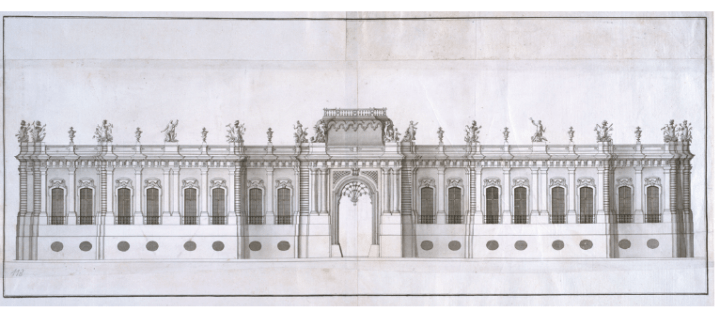
Matthäus Daniel Pöppelmann (1662–1736), Project for the Orangerie
of the Peterswalsky von Peterswald Palace, Silesia, undated
(Berlin: Tchoban Foundation)
◊ ◊ ◊ ◊ ◊
From Schinkel’s earliest attributed drawing to designs for the Palace of the Soviets, Moscow, this exhibition draws on the highlights of the Tchoban Foundation collection, Museum für Architekturziechnunung, Berlin. Amongst the architects represented will be seldom seen works by Matthias Daniel Pöppelmann (1662–1736), Leo von Klenze (1784–1864), Herman Giesler (1898–1987) and Boris Iofan (1891–1976). The Tchoban Foundation has been set up by the Russian Berlin-based architect Sergei Tchoban and the collections reflect his personal, architectural interests.
The exhibition includes drawings by Sergei Tchoban illustrating his practice’s interest in the continued use of architectural draughtsmanship. Many of these drawings also reflect the distinctive and historical cityscapes of Berlin and Sergei Tchoban’s native St Petersburg.
The 41-page guide (with wall text and images) is available as a PDF file here»
The catalogue is available from the museum shop»
Eighteenth-Century Studies 46 (Summer 2013)
Eighteenth-Century Studies 46 (Summer 2013)
A R T I C L E S
 Patrick C. Fleming, “The Rise of the Moral Tale: Children’s Literature, the Novel, and The Governess,” pp. 463–77.
Sarah Fielding’s The Governess has been called the first children’s novel. But by conflating two separate genres, critics risk oversimplifying both the novel and children’s literature. This article brings together children’s literature studies and novel studies in order to address the narrative form of The Governess, and to suggest that the term “moral tale” better captures the complex origins of the eighteenth-century children’s novel.
Mark Koch, ” ‘A Spectacle Pleasing to God and Man’: Sympathy and the Show of Charity in the Restoration Spittle Sermons,” pp. 479–97.
In the 1670s the long-standing Spittle sermons became almost exclusively charity sermons, many of which argued that almsdeeds are accompanied with a sensual pleasure and articulated principles of sympathetic response involving an affective theatricality. This paper considers the place of these sermons and their ancillary children’s processions in the London public sphere, how they worked as spectacle to evoke pity from spectators, and how, despite the Latitudinarian tendency toward rationalism, they often contained elements of what was deemed an empirically nebulous “show” or “fiction.”
Catherine Packham, “Cicero’s Ears, or Eloquence in the Age of Politeness: Oratory, Moderation, and the Sublime in Enlightenment Scotland,” pp. 499–512.
This paper argues that Hume’s essay, “Of Eloquence,” should be read as part of a Scottish Enlightenment attempt to accommodate the sublime to commercial modernity. Hume inherits the sublime of ancient oratory not as a matter for narrow stylistic regulation—to be rejected in a new age of politeness, as some have argued—but as a moral problem at the heart of modern subjectivity. Hume looks to taste to regulate and contain the sublime, but it is Adam Smith who solves the problem of the sublime by recouping its excess as a mark of the possibilities for virtue in the modern age.
Lisa T. Sarasohn, ” ‘That Nauseous Venomous Insect’: Bedbugs in Early Modern England,” pp. 513–30.
Bedbugs were perceived as a new entry in the rich range of vermin that plagued eighteenth-century England, and the way they were viewed and treated reveals much about the mentality, prejudices, assumptions and aspirations of society at that time. Their presence increasingly elicited repugnance and even hysteria. The reaction to bedbugs during the eighteenth century serves as an indicator of modernity and emerging attitudes towards the body, class, nature and science.
Ryan Whyte, “Exhibiting Enlightenment: Chardin as tapissier,” pp. 531–54.
This essay addresses the work of Jean-Baptiste Chardin as tapissier to show his design of the Salon du Louvre functioned as an ideological system that derived meaning from Enlightenment discourses of epistemology and taxonomy. First, this essay explores how the Salon design answered the Académie’s need to represent its structure to the Salon public, and to guide the public in judging the individual works comprising it. Second, this essay examines points of contact between Chardin, the Académie, Carl Linnaeus and the authors of the Encyclopédie of Diderot and Jean le Rond d’Alembert as intellectual context for the Salon design.
Abigail Zitin, “Thinking Like an Artist: Hogarth, Diderot, and the Aesthetics of Technique,” pp. 555–70.
In The Analysis of Beauty, William Hogarth advocated an unusual kind of formalism based in artistic practice: not form distilled into a rule for judgment but rather derived from the artist’s techniques for perception and composition. Denis Diderot, too, embraced an aesthetics of technique, particularly in the Paradoxe sur le comédien, in which he contends that what appears impassioned in an affecting dramatic performance is in fact calculated. Diderot, however, had the extra burden of reconciling the ideal of illusion with his demystification of the practitioner’s perspective, a reconciliation he could only conceive as a paradox.
R E V I E W S
Mark K. Fulk “Travel And/As Enigma: Review of Ian Warrell, ed., Turner Inspired in the Light of Claude (National Gallery Company, 2012) and Yaël Schlick, Feminism and the Politics of Travel After the Enlightenment (Bucknell University Press, 2012),” pp. 571–73.
Recent work on travel by scholars Nicola Watson (The Literary Tourist: Readers and Places in Romantic and Victorian Britain [2008]), Zoë Kinsley (Women Writing the Home Tour, 1682–1812 [2008]), and Ann C. Colley (Victorians in the Mountains [2010]) has added markedly to our understanding of British travel in the latter eighteenth and the nineteenth centuries through its foregrounding of issues of class, gender, and the changing understanding of landscape aesthetics and theories of the sublime. The books in this review supplement this discussion by their emphasis on Anglo-French experiences of travel in the period. . .
Jennifer Milam, “Review of Michael Yonan, Empress Maria Theresa and the Politics of Habsburg Imperial Art (The Pennsylvania State University Press, 2011),” pp. 575–77.
. . . Thanks to Yonan’s interpretive approach, Empress Maria Theresa and the Politics of Habsburg Imperial Art is a ground-breaking study in the history of Austrian art and architecture. His book is a substantial contribution to the study of women as powerful agents in the production and reception of visual culture in European court circles during the eighteenth century. Moreover, Yonan’s wide-ranging choice of material—portraiture, decorative objects, architecture, interior decoration, and garden sculpture—provides the reader with a comprehensive understanding of Maria Theresa’s individualized approach to the representation of her personal authority in the visual arts. This is complemented by a number of quality illustrations that allow readers to consider the details of many works that are rarely discussed in depth. . .
Mark K. Fulk, “Review of Adrian J. Wallbank, Dialogue, Didacticism and the Genres of Dispute: Literary Dialogue in an Age of Revolution (Pickering and Chatto, 2012),” pp. 578–79.
In his postscript, Adrian J. Wallbank explains that his project was meant to “open up multiple avenues for further research . . . into this seriously neglected literary genre” of the written dialogue, gesturing toward the beginnings of a history of “dialogic didacticism” in the Romantic era (217). The book meets these expectations well by revealing in elaborate detail this overlooked genre, and suggesting ways that Wallbank’s readings can help complement our approach to already canonical markers of the period. . .
Recent TLS Reviews (5 July 2013)
The eighteenth century in The Times Literary Supplement (5 July 2013). . .
Angus Trumble, “Six Half-Lengths: Review of James Stourton and Charles Sebag-Montefiore, The British as Art Collectors, From the Tudors to the Present (Scala, 2012),” TLS (5 July 2013), pp. 3-4.
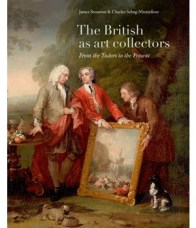 . . . The British as Art Collectors, liberally and beautifully illustrated, sets out the history of the art-collecting impulse in Britain from the beginning of the sixteenth century to the present. Shaping it into four densely packed, chronological sections, James Stourton and Charles Sebag-Montefiore deal, first, with “Royalty” (in other words, collecting at Court, above all the assembly and dispersal of the superb collection of King Charles I at Whitehall); “Aristocracy” (the principally eighteenth-century Whig Grand Tour and country-house phenomena which Quatremère de Quincy had in mind); “Plutocracy” (the transitional period brought about by the displacement effects of the French Revolution and the Napoleonic Wars); and, finally, “Democracy” (which concerns the arrival of the public art museum in the early nineteenth century, its proliferation, and the gradual institutionalization, professionalization and broadening of the collecting impulse into our time).
But this is an over-simplification, for the history of collecting is really the history of individual shoppers, and, occasionally, partnerships or syndicates such as that of the coal and canal magnate the third Duke of Bridgewater, with budgets ranging from the merely large to the positively obscene, and not necessarily husbanded with corresponding degrees of wisdom. It is also the history of sweatypalmed acquisitiveness, of rapacious greed, and also of processes of dissolution and loss – an invariably human story in which mostly anonymous crate-makers, removalists and shipping agents must figure prominently, while debt, disease, dispossession and death often interrupted grand schemes. . .
Perhaps the principal pleasure of The British as Art Collectors . . is the intelligence and effectiveness with which a mass of contemporary illustrative material is marshalled to open a window onto cultural worlds. If at times the text is weighed down by lengthy descriptions of who owned what when, there is also a wealth of information, current and historical, in purely visual form. . .
The full review is available here (subscription required)
◊ ◊ ◊ ◊ ◊
Albert Rivero, “Truths to Life: Review of John Bender, Ends of Enlightenment (Stanford University Press, 2012),” TLS (5 July 2013), p. 12.
 The publication of Imagining the Penitentiary in 1987 established John Bender as a compelling critic of eighteenth-century British literature and culture. That book, written in imitation of Michel Foucault, connected novels by Daniel Defoe and Henry Fielding to the panoptic model of incarceration that was then emerging. Since then, Bender has published a number of important and groundbreaking essays, ranging widely and often brilliantly over various topics and disciplines. Ends of Enlightenment gathers ten of those essays, grouped under three headings (Enlightenment Knowledge, Enlightenment Novels and Enlightenment Frameworks), with a framing introduction elucidating their common themes and concepts. . .
Novelistic realism has a dark ideological side, but not all essays here cast a suspicious eye on Enlightenment. In its ideal quest for universal and objective knowledge, available in conversation and in print to men and women from every walk of life (Jürgen Habermas’s “public sphere,” a construct Bender invokes frequently), the Enlightenment had many salutary effects. Some of these, in fragmentary and surprising ways – Bender regards the democratically composed Wikipedia as today’s version of Diderot and d’Alembert’s Encyclopédie – are still very much with us.
It is in fact the sceptical David Hume who has displaced Foucault as Bender’s principal point of reference, and who inspires the modes of inquiry and ordering knowledge in Ends of Enlightenment. . .
The full review is available here (subscription required)
◊ ◊ ◊ ◊ ◊
James Hall, “Fade to Grey: Review of the exhibition Paper Palaces: The Topham Collection as a Source for British Neo-Classicism, Eton College Library,” TLS (5 July 2013), pp. 17-18.
 . . . Expertly curated by Lucy Gwynn and Adriano Aymonino, Paper Palaces explores the influence exerted on architect-designers by illustrations of antique decorative painting commissioned by Richard Topham (1671-1730), Old Etonian antiquary and MP for Windsor. . .
The exhibition suggests Topham was rather more single-minded and original than Pope would have us believe, even if he did use agents in Italy to amass his roughly 2500 documentary drawings of Roman antiquities. Topham’s was the largest and most systematic collection of its kind in England, unique in being organized by location like a tourist guidebook, with every drawing clearly indexed in his own
hand. . .
Exhibition | The Male Nude: Drawings from the Paris Academy
From Paul Holberton Publishing:
The Male Nude: Eighteenth-Century Drawings from the Paris Academy
The Wallace Collection, London, 24 October 2013 – 19 January 2014
 Including artists such as Rigaud, Boucher, Nattier, Pierre, Carle van Loo, Gros and Jean-Baptiste Isabey, this catalogue of nearly forty French drawings of male nude figures, all drawn between the late seventeenth and the late eighteenth centuries, accompanies an exhibition that is unprecedented in Britain. All from France’s equivalent of the Royal Academy, the École nationale supérieure des Beaux-Arts in Paris, many of the extraordinary drawings are by artists represented in the Wallace Collection.
Painting in eighteenth-century France before the Revolution was centred on the Royal Academy of Painting and Sculpture, which had been founded in 1648. The purpose of the Academy was to train the most important artists and to provide them with the raw materials for successful history painting, which was by far the most esteemed genre for an artist to practise. Budding painters or sculptors would be apprenticed to a master, but much of their training would take place at the Academy where the drawing of the male human figure was at the core of the curriculum. Only after mastering the copying of drawings and engravings, and then casts of antique sculptures, would the student be allowed to progress to drawing the nude figure in the life class. The drawings they produced there were so associated with the Academy that they came to be known as ‘académies’.
The male human figure was regarded as the very foundation of painting and sculpture; it had to be mastered by any aspiring artist of the highest class. No female artists were admitted to the Academy and all models were male. This practice in itself went on to create problems for artists, who lacking the necessary training to portray the female form, were compelled to search out models, not always in the most respectable and salubrious settings. Classes were complemented by courses on anatomy, perspective, geometry, literature and history. The Academy’s training was learned and structured, and, although it was sometimes criticized for its rigour and its insistence on discipline and uniformity, it produced superb draughtsmen. Some of the artists featured became painting Masters of their generation, focusing on historical and allegorical pictures. Others utilised their training in a variety of artistic fields, including Bachelier, who went on to assume the role of Director of Design and Decoration at the Sèvres porcelain factory, influencing many of the pieces exhibited in the Wallace Collection.
Variety and beauty are omnipresent in The Male Nude. The works show figures – sometimes single, sometimes two together – in an enormous variety of poses and in various degrees of light and shade. The study of physiognomic expression was also taught at the Academy, and the facial expressions of the figures always complement the poses they adopt, whether they show, say, serenity, exertion, pleasure or anger.
As a descendant of the French Royal Academy of Painting and Sculpture, the École nationale supérieure des Beaux-Arts owns an incomparable collection of these académies which have come down to it directly from the Academy’s teaching classes. It also owns an outstanding collection of drawings, second only to the Louvre in France, comprising not only a superb group of French drawings, but many works by some of the other great draughtsmen of European art, such as Raphael, Dürer and Michelangelo. This exhibition at the Wallace Collection will be an excellent opportunity for collections at ENSBA – which are open to anyone to visit – to become much better known to a British audience, as well as allowing visitors an insight into this influential, but now non-existent world.
The Wallace Collection displays one of the greatest collections of eighteenth-century French paintings in the world, and these drawings from Paris will make an excellent complement to them. The Hertfords collected almost no academic, or historical, works for which these drawings were the basis, favouring ‘pleasing pictures’: portraits and landscapes. In many ways, The Male Nude will offer the visitor a new dimension and complete the jigsaw. Seen alongside our world-class holdings of eighteenth-century furniture and decorative arts, they will provide a thorough understanding of the period.
Catalogue edited by Emmanuelle Brugerolles with Georges Brunel and Camille Debrabant, The Male Nude: Eighteenth-Century Drawings from the Paris Academy (London: Paul Holberton Publishing, 2013), 144 pages, £25.
Exhibition | Shunga: Sex and Pleasure in Japanese Art, 1600–1900
Press release from The British Museum:
Shunga: Sex and Pleasure in Japanese Art, 1600–1900
The British Museum, London, 3 October 2013 — 5 January 2014
Curated by Tim Clark

Torii Kiyonaga, Sode no maki (Handscroll for the Sleeve), ca. 1785
(London: British Museum)
◊ ◊ ◊ ◊ ◊
In early modern Japan, 1600–1900, thousands of sexually explicit paintings, prints, and illustrated books with texts were produced, known as ‘spring pictures’ (shunga). Official life in this period was governed by strict Confucian laws, but private life was less controlled in practice. Often tender, funny and beautiful, shunga were mostly done within the popular school known as ‘pictures of the floating world’ (ukiyo-e), by celebrated artists such as Kitagawa Utamaro (died 1806) and Katsushika Hokusai (1760–1849). This was very different from the situation in contemporary Europe, where religious bans and prevailing morality enforced an absolute division between ‘art’ and ‘pornography’.
 Early modern Japan was certainly not a sex-paradise. However, the values promoted in shunga are generally positive towards sexual pleasure for all participants. Women’s sexuality was readily acknowledged and male-male sex recognised in particular social contexts.
Shunga is in some ways a unique phenomenon in pre-modern world culture, in terms of the quantity, the quality and the nature of the art that was produced. This exhibition — which features some 170 works of explicit shunga paintings, sets of prints and illustrated books drawn from collections in the UK, Japan, Europe and USA — explores some key questions about what is shunga, how it circulated and to whom, and why was it produced. In particular it begins to establish the social and cultural contexts for sex art in Japan.
During the late nineteenth and twentieth centuries, shunga was all but removed from popular and scholarly memory in Japan and became taboo. The ambition of the exhibition is to reaffirm the importance of shunga in Japanese and world history. In conjunction with the exhibition, British Museum Press will publish a lavish scholarly catalogue of some 550 pages and with 400 colour illustrations, edited by Timothy Clark (British Museum), C. Andrew Gerstle (SOAS, University of London), Akiko Yano (SOAS) and Aki Ishigami (Ritsumeikan University, Kyoto), and with contributions from more than thirty authors worldwide.
The exhibition is part of Japan400, a nationwide UK series of events celebrating 400 years of Japan-British relations.
◊ ◊ ◊ ◊ ◊
Timothy Clark, C. Andrew Gerstle, Aki Ishigami, and Akiko Yano, eds., Shunga: Sex and Pleasure in Japanese Art (London: The British Museum Press, 2013), 560 pages, ISBN: 978-0714124766, £50.
As reported by AFP, the exhibition includes an age limit requiring visitors under 16 to be accompanied by an adult.
New Book | Daniells’ India: Views from the Eighteenth Century

◊ ◊ ◊ ◊ ◊
From ACC Distribution:
Thomas and William Daniell, Daniells’ India: Views from the Eighteenth Century, introduction and foreword by B. N. Goswamy (New Delhi: Niyogi Books, 2013), 184 pages, ISBN: 978-9381523636, $200.
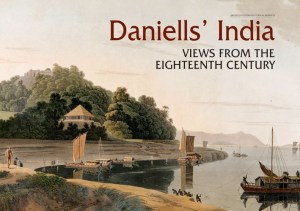 Thomas Daniell was thirty-six years old when he and his nephew William, barely sixteen, sailed out from Gravesend in April 1785, headed for the East. They arrived in Calcutta via China the next year. The Daniells traveled across India, painting oriental scenery wherever they went. Their views were widely appreciated and are representative of that fascinating period. The Daniells returned to England in September 1794. This special book presents a selection of their work in India, bringing alive the scenery and architecture of that age.
Additional images are available here»
B. N. Goswamy, distinguished art historian and author of several books on Indian Art, is Professor Emeritus of Art History at the Punjab University, Chandigarh. His work covers a wide range and is regarded, especially in the area of Indian painting, as having influenced much thinking. The recipient of many honors, Professor Goswamy has taught as Visiting Professor at several universities across the world.
Exhibition | Sacred Stitches: Ecclesiastical Textiles at Waddesdon Manor
Paul Holberton published the catalogue for this exhibition now on view at Waddesdon Manor:
Sacred Stitches: Ecclesiastical Textiles in the Rothschild Collection at Waddesdon Manor
Waddesdon Manor, Buckinghamshire, 27 March – 27 October 2013
Curated by Rachel Boak
 Sacred Stitches accompanies an exhibition that assembles together for the first time fragments of opulent and unique ecclesiastical textiles drawn from the stored collections at Waddesdon Manor, the astonishing Renaissance-style château that is one of the rare survivors of the splendour of the ‘goût Rothschild’. Dating from c. 1400 to the late 1700s, the textiles were acquired by several members of the Rothschild family, the greatest collectors of the 19th century, who sought the highest quality of workmanship with a keen sense of historical importance.
Although it might seem strange for a Jewish family to collect objects associated with the Christian Church, the textiles were prized for their technical and artistic brilliance. Parts of altar frontals, vestments and other church furnishings, they survive as fragments, cushions, banners, hangings and furniture upholstery, as their original purposes were altered to suit tastes and interior styles of the late 1800s. Baron Ferdinand de Rothschild used them in the Bachelors’ Wing at Waddesdon, the first part of the house to be completed in 1880. His sister, Alice, also had an eye for the finest ecclesiastical embroideries, displayed as decorative hangings in her own house nearby. A passionate collector of costume and textiles, Ferdinand and Alice’s niece, Baroness Edmond de Rothschild, shared their interest and added to the collection.

Dress fabric, now a chalice veil, ca. 1745-50, (Rothschild Collection at Waddesdon Manor, acc. #523). Photo by Mike Fear.
Rachel Boak, Curator at Waddesdon Manor, first considers the changing manufacture and style of vestments and furnishings for the Church in the Medieval and early Renaissance period, as well as the impact of the Reformation and the French Revolution, when many vestments and textile furnishings became redundant, were destroyed and their precious metal threads melted down. Her main focus, however, is the collecting habits of Ferdinand, Alice and Baroness Edmond in the context of 19th-century Britain, where George IV’s historicizing coronation of 1821, at which guests wore Tudor-style dress, had brought about a renewed interest in Medieval and Renaissance collecting, design and costume, and the Oxford Movement in 1833 meant a revival of vestments associated with the celebration of the Eucharist.
Each Waddesdon object – its iconography, manufacture and history – is considered individually, illustrated with beautiful new photography that captures all the detail, texture and intricate stitching.
Rachel Boak, Sacred Stitches: Ecclesiastical Textiles in the Rothschild Collection at Waddesdon Manor (London: Paul Holberton, 2013), 80 pages, ISBN: 978-0954731038, £15.
Display and New Catalogue | Printed Books and Bookbindings
Now on view at Waddesdon Manor:
 A Celebration of Books and Bindings
Waddesdon Manor, Buckinghamshire, 10 July — 27 October 2013
To mark the publication this year of Giles Barber’s magisterial catalogue of the French 18th-century books and bindings at Waddesdon, a number of highlights of the collection will be on display in the Morning Room at the Manor. The books were collected by Baron Ferdinand de Rothschild towards the end of his life, partly to complement the collections of 18th-century paintings and decorative arts, but also as works of art in their own right thanks to their intricately decorated gold-stamped bindings. The Waddesdon collection is one of the finest in the world, and the publication of the catalogue marks the first time which many of these treasures have been revealed in public.
◊ ◊ ◊ ◊ ◊
Press release from Waddesdon Manor:
Giles Barber, Catalogue of Printed Books and Bookbindings: The James A. de Rothschild Bequest at Waddesdon Manor (London: The Rothschild Foundation, 2013), 1162 pages, ISBN: 978-0954731083, £300.
A new catalogue of Printed Books and Bookbindings marks the completion of the important Waddesdon Catalogue Series, and the final publication of eminent author and book specialist, Giles Barber. The James A. de Rothschild Bequest: Printed Books and Bookbindings, published by the Rothschild Foundation, 2013, presents a scholarly analysis of Waddesdon’s outstanding collection of largely 18th-century French books. These were collected by Baron Ferdinand de Rothschild towards the end of his life, partly to complement the collections of 18th-century paintings and decorative arts, but also as works of art in their own right thanks to their intricately decorated gold-stamped bindings. The Waddesdon collection is one of the finest of its kind in the world, and the publication of the catalogue allows many of these treasures to be revealed to public for the first time. A monumental work in two volumes, the first offers a series of essays, which chart the history of bookbinding, from the materials and techniques used, the histories of the binders themselves, the role of the patron and collector and the fluctuations of the market. One unique feature is the photographic index of every tool used on each book in the catalogue. All the books have been scanned and the individual tools isolated reprographically and reproduced at actual size. As many as 50 separate tools could be used in the creation of a prestigious binding, and being able to identify each one precisely allows comparisons with books in other collections and attributions to particular workshops to be made more accurately than ever before.
The Books and Bookbindings catalogue is also the final publication in the thirteen-volume Waddesdon Catalogue series, which covers the James A. de Rothschild Collection at the Manor as bequeathed to the National Trust. Waddesdon holds one of the most significant collections of 18th-century works of art in the world, comparable with similar holdings in the V&A, the Louvre, the Metropolitan Museum and the Wallace Collection. The impetus to create the catalogue series arose when, on the death of James de Rothschild, the house was bequeathed to the National Trust and the need to make the collections accessible to the public and scholars became pressing. James’s widow, Dorothy, who took over the management of the house and ran Waddesdon until her death in 1988, set up a Catalogue Committee, headed initially by Anthony Blunt, then Director of the Courtauld Institute of Art. He was succeeded as General Editor of the series by Geoffrey de Bellaigue, later Director of the Royal Collection. The first volume, Paintings, by Ellis Waterhouse, appeared in 1967, and over the ensuing half century all the major subject areas of the Collections have been covered, each catalogue written by an eminent specialist in the field. The result is an exemplar in art publishing, with many of the titles, in which world-class objects benefit from exhaustive expert research, setting the standard in their fields.
This tradition of inviting eminent specialists to write the catalogues was especially true of Giles Barber, an internationally acknowledged expert with an unique encyclopaedic knowledge of the French bookbinders’ art. Barber’s career encompassed the Bodleian and the Taylor Institution at Oxford alongside independent writing and research, and included this last extensive catalogue for Waddesdon. Very sadly, Giles died unexpectantly in 2012, leaving the overseeing of the final editorial stages to the former Keeper of the Collections at Waddesdon, Rosamund Griffin, a role she has carried out on almost all the previous catalogues.
Exhibition | An Indiscreet Look at the Mechanics of Fashion
Sarah Moroz provides a summary of the exhibition for The Daily Beast (5 July 2013). From the Musée des Arts Décoratifs:
La Mécanique des Dessous: Une Histoire Indiscrète de la Silhouette
Behind the Seams: An Indiscreet Look at the Mechanics of Fashion
Musée des Arts Décoratifs, Paris, 5 July — 24 November 2013
Bard Graduate Center, New York, 3 April — 26 July 2015
Curated by Denis Bruna

Panier à coudes articulé, vers 1770, et corps à baleines, vers
1740-60, Paris, Les Arts Décoratifs, Collection Mode et
Textile et dépôt du musée de Cluny, © Patricia Canino
◊ ◊ ◊ ◊ ◊
This exhibition explores the ‘underworld’ of female and male undergarments such as the fly, the pannier, the corset, the crinoline, the bustle, the pouf, the stomach belt, the bra and other vestimentary devices fashioning the body by means of whalebones, hoops and cushions according to the changing dictates of fashion. Modelling the body sometimes to extremes, these ‘mechanical garments’ enabled the wearer to artificially attain the ideal of beauty of the time. This exploration is full of surprising discoveries since, contrary to common belief, these artifices were by no means a 19th-century speciality. Recourse to these concealed architectures has been constant since at least since the 14th century until the present day. Illustrating the diversity of artifices and their mechanics with museum pieces rarely shown to the public, this exhibition – the first of its kind – takes us ‘backstage’, into another, behind-the-scenes history of clothing and fashion.
La Mécanique des dessous. Une histoire indiscrète de la silhouette (Paris, Musée des Arts Décoratifs, 2013), 272 pages, ISBN : 978-2916914428, 55€.
◊ ◊ ◊ ◊ ◊
Exhibition Press release:

Robe de cour, vers 1760, Lyon, musée des Tissus, achat, 1913
© Lyon, musée des Tissus, photo Pierre Verrier.
L’exposition La mécanique des dessous, une histoire indiscrète de la silhouette présentée aux Arts Décoratifs du 5 juillet au 24 novembre 2013 se propose d’explorer les artifices utilisés par les femmes et les hommes, du XIVe siècle à nos jours, pour dessiner leur silhouette. Ce projet original peut être appréhendé comme une longue histoire des métamorphoses du corps soumis aux diktats des modes successives. Quels sont les mécanismes qui ont contraint les corps des femmes afin d’obtenir des tailles resserrées jusqu’à l’évanouissement, des gorges pigeonnantes contrebalançant un fessier rehaussé à l’extrême, des hanches elargies, ou bien applati des seins et des ventres ?
Comment les hommes eux-mêmes ont-ils poussé leur virilité en bombant artificiellement les torses, en rajoutant des formes aux mollets, ou aux braguettes ? Toutes ces structures faites de fanons de baleine, de cerceaux de rembourrage, mais plus encore de laçages, de charnières, de tirettes, de ressorts ou de tissus élastiques dissimulés sous l’habit sont exposés dans une scénographie de Constance Guisset. Près de deux cents silhouettes rassemblant paniers, crinolines, ceintures d’estomac, faux-cul, gaines, « push up » issus des collections publiques et privées françaises et étrangères permettent, pour la première fois, d’aborder une lecture insolite de la mode liée au corps.
Tout d’abord, l’univers masculin et sa quête de la virilité sont évoqués avec les pourpoints étonnamment rembourrés du XIVe au XVIe siècle ainsi qu’avec les braguettes proéminentes de la Renaissance. Le XVIIIe siècle est caractérisé par les vestes matelassées provoquant des torses arqués. Les amplificateurs de mollets, les ceintures d’estomac et les slips-gaines sont révélateurs de la période XIXe-XXIe siècles. Les femmes, quant à elles, ont de tout temps rivalisé d’imagination et d’artifices avec les premiers corsages baleinés, les vertugadins (premières jupes renforcées de cerceaux de rotin ou de métal), les paniers, les crinolines, les tournures, les corsets, les gaines et les push-up d’aujourd’hui. Cet insolite défilé de mode n’oublie pas non plus les enfants qui ont porté des corsets au moins depuis le XVIIe siècle. Renforcées d’armatures et d’autres mécanismes, toutes ces pièces de vêtement permettaient la rectitude, la verticalité tant attendue par une aristocratie, puis par une puissante bourgeoisie, toutes deux soucieuses d’un idéal de supériorité.
Le parcours tant insolite que didactique donnera la part belle au XIXe siècle. En effet, sous le Second Empire et la Troisième République principalement, le corset règne en tyran pour répondre à l’exigence de la « taille de guêpe » accentuée par l’évasement excessif des crinolines. Après 1870, ce jupon à baleines disparaît et se voit remplacé par la tournure – dite aussi le « fauxcul », la « queue d’écrevisse » ou encore le strapontin – qui donne aux femmes un étrange et sinueux profil d’oie. Au XIXe siècle, les sous-vêtements n’ont jamais été aussi abondants et cachés à la fois. Si, au fil de l’histoire de la mode, les formes évoluent et les techniques s’affinent, le dessein du vêtement mécanique est récurrent : effacer le ventre, comprimer la taille jusqu’à la creuser, maintenir la poitrine, rehausser les seins – parfois les aplatir –, arrondir les hanches. Bref, le confort a souvent cédé le pas à l’apparence jusqu’à ce que, vers 1900, Nicole Groult, Paul Poiret et Madeleine Vionnet instaurent, pour un temps, le goût de la ligne «naturelle».
L’exposition se poursuit avec le soutiengorge, la gaine (et ses exemples masculins). Si le souci du soutiengorge n’est plus de comprimer ou de rehausser les seins mais de les emboîter et les séparer, a-t-il perdu pour autant le rôle essentiel des vêtements baleinés d’autrefois : modeler la silhouette ? De nos jours, les soutiens-gorge « ampliformes » et pigeonnants en vue de créer un effet plongeant même sur les silhouettes les plus menues, répondent encore aux diktats des canons de beauté à une époque où l’on façonne moins son corps par des vêtements que par des régimes, le body building et la chirurgie.
Toutefois, l’histoire du corset, de la crinoline ou de la tournure n’est pas révolue pour autant puisque des créateurs comme Thierry Mugler, Jean Paul Gaultier, Rei Kawakubo pour Comme des Garçons, Christian Lacroix ou Vivienne Westwood, etc. ont livré d’étonnants exemples permettant de clamer que les XXe et XXIe siècles ont fait du dessous d’autrefois un dessus expérimental.
Parallèlement aux deux-cents dessous présentés – et habits complets formés grâce à ces structures dissimulées –, l’exposition montre des mannequins couverts de reconstitutions de paniers, de crinolines ou de tournures, etc., toutes animées afin de saisir l’ingéniosité des mécanismes. De plus, un espace du parcours est spécialement dédié à l’essayage de corsets, de paniers du XVIIIe ou de crinolines, tous spécialement faits à l’identique, afin que le visiteur puisse porter et comprendre ces structures qui ont joué un rôle essentiel dans l’histoire de la mode et des usages vestimentaires.
◊ ◊ ◊ ◊ ◊
Note (added 14 January 2015) — The Bard Graduate Center venue was not part of the original posting; more information is available here»










 Enfilade
leave a comment