Exhibition | Historias Naturales: A Project by Miguel Ángel Blanco
Press release from The Prado:
Historias Naturales: Un Proyecto de Miguel Ángel Blanco
Museo Nacional del Prado, Madrid, 19 November 2013 — 27 April 2014
Curated by Miguel Ángel Blanco; coordinated by Javier Portús

Miguel Ángel Blanco, A Leviathan Swallows a Goddess (Room 74)
Roman workshop, Venus with a Dolphin, MN; Dolphin skeleton, MNCN- CSIC.
Photo: Pedro Albornoz / Museo Nacional del Prado
◊ ◊ ◊ ◊ ◊
The Museo del Prado is presenting the exhibition Historias Naturales: A Project by Miguel Ángel Blanco, organised with the collaboration of the Higher Council for Scientific Research (CSIC) and the support of the Region of Madrid. 150 objects from the natural world make up the twenty-two interventions installed in the Museum’s galleries by this Madrid-born artist. Most of the objects — animals, plants and minerals — have been loaned by the Museo Nacional de Ciencias Naturales of the CSIC, displayed alongside 25 works from the Museum’s own collection. The result is a close dialogue with these 25 works of art and also with the building itself and the urban setting of the Paseo del Prado.
Through this exhibition the Prado is paying tribute to its own history and to the origins of its building, originally designed as a Natural History museum. On 19 November 1819 the Prado opened its doors to the public for the first time as the Museo Nacional de Pinturas y Esculturas (National Museum of Paintings and Sculptures). However, the Neo-classical building designed by Juan de Villanueva that now houses the Prado was originally designed as the Royal Natural History Cabinet on the orders of Charles III in 1785.

Miguel Ángel Blanco, The Anteater’s Cruel Winter (Room 90)
Antón Mengs worskshop (?), His Majesty’s Anteater, MNP; Anteater skeleton, MNCN-CSIC (Photo: Pedro Albornoz / Prado).
To celebrate the anniversary of the Museum’s first opening to the public on 19 November 1819, the Prado will be introducing visitors to a lesser known aspect of its history, namely that of its origins as a natural history museum prior to its inauguration as the Museo de Pintura y Escultura. The building that now houses the Museum was designed by the architect Juan de Villanueva in 1785 as the Natural History Cabinet on the orders of Charles III. Now, for a period of almost six months the galleries of the Permanent Collection will display objects including some of those that the monarch acquired from the collector and naturalist Pedro Franco Dávila for his new natural history museum, which was previously located in the Palacio de Goyaneche (now the headquarters of the Academia de Bellas Artes de San Fernando).
The Exhibition
Natural Histories: A Project by Miguel Ángel Blanco consists of twenty-two interventions in the Prado’s galleries, made up of 150 objects from the natural world (minerals, stuffed or preserved animals, skeletons and insects), the majority from the Museo Nacional de Ciencias Naturales, shown alongside twenty-five works from the Museum’s collection. The result is to establish a close relationship between them and also with the building itself and the surrounding urban context of the Paseo del Prado. Visitors will thus be able to see the realisation of Charles III’s desire to house a Natural History museum in the Villanueva Building. Due to the circumstances of history, the arts and sciences coexisted under the same roof on two occasions: in 1827 and during the Civil War when objects from the collections of the Real Jardín Botánico and the Museo de Ciencias were moved to the Prado for greater safety.
In order to bring about this reencounter with the Museum’s history and origins, the artist Miguel Ángel Blanco has not set out to reconstruct the Natural History Cabinet three hundred years later. Rather, as he explains, “What I have done in the Museo del Prado is to evoke that collection, the ghost of which inhabits the Villanueva Building. The twenty-two artistic interventions create a collection for the future, incorporating a creative viewpoint, interacting with the Permanent Collection and encouraging a new way of looking at the works which helps to increase the significance of the images.”
The first intervention is to be seen in the Ariadne Rotunda in the Museum, in which the preeminent work is the large-scale, recently restored sculpture of the Sleeping Ariadne (anonymous sculptor, 150–175AD). Next to it is the sculpture of Venus with a Dolphin (anonymous sculptor, 140–150AD), who now becomes the principal focus of this space. From the room’s ceiling Blanco has suspended a dolphin’s skeleton from the Museo Nacional de Ciencias Naturales, explaining that “the marble-like bones of the skeleton resemble the ivory-like marble of the sculptures.” The skeleton projects its shadow over Venus, “leaping like a Leviathan to swallow up the goddess ….”
Another of the works that sums up Blanco’s work in the Museum is his intervention based on Joachim Patinir’s celebrated painting Charon Crossing the Styx. Patinir’s work, which is among those that has most fascinated Blanco, ceases to be a painting and becomes an extension of the lake. It is transformed into pigment by the placement immediately in front of it of a giant piece of azurite (Museo Nacional de Ciencias Naturales), the source of the copper carbonate that Patinir used as a pigment in his painting, “which we can imagine as the result of the lake drying up, assisted by the similarity between the shape of its outline and that of the stone.”
Room 55B in the Prado is another space transformed into a natural history collection by Blanco through his introduction of the skeleton of a snake wound round itself, located next to Dürer’s two panels of Adam and Eve. The skeleton is one of the most beautiful objects in the Museo de Ciencias Naturales’ reptile collection. Through this juxtaposition, Dürer’s two nude studies remind us even more forcefully of the subject of human proportions, which Blanco considers “a scientific endeavour.” Here he reveals an aesthetic intent in his placement of the skeleton, while “the snake’s flexibility resulting from its numerous vertebrae echoes the sinuosity of Dürer’s figures.”
Blanco’s twenty-two installations are completed with one of his own works, Book-box no. 1072, which is part of the work for which he is best known, the Forest Library. It consists of 1131 book-boxes housing natural elements, each one forming a micro-landscape. The book-box that he has chosen for this intervention acquires meaning in front of Lucas van Valckenborch’s Landscape with an Iron Works of 1595. According to Blanco, this is one of his boxes most oriented towards landscape and can be visually related to the landscape paintings in the Room 57 of the Museum: “Among these Flemish painters I feel close to Lucas van Valckenborch, who depicted himself in some of his works with a sketchbook on his lap, reflecting the practice of observing the landscape at first hand … Of all natural environments, the forest is my place and the tree my equal.” (www.bibliotecadelbosque.net)
Miguel Ángel Blanco (born Madrid, 1958)
Miguel Ángel Blanco is among the best known of Spanish artists associated directly with nature. For some years he lived in the Sierra de Guadarrama, which has been his preferred artistic terrain and was the subject of an exhibition he held at La Casa Encendida in Madrid in 2006 entitled Visions of Guadarrama: Miguel Ángel Blanco and the pioneering artists of the Sierra. In that event his book-boxes established a dialogue with works by the leading Spanish landscape painters who visited this mountainous area in the 19th century with the aim of depicting it in their works.
Miguel Ángel Blanco has exhibited different selections from the Forest Library, his most important project, at the Biblioteca Nacional de España, the Museo Nacional de la Estampa in Mexico City, the Fundación César Manrique in Lanzarote, the Calcografía Nacional, Madrid, and the Abbey of Santo Domingo de Silos (Museo Nacional Centro de Arte Reina Sofía), among other venues. In 2008 the Ministry of Culture commissioned a project from him in memory of the dead beech tree in the garden of the Fundación Lázaro Galdiano, which presented the temporary exhibition Fallen Tree, focusing on the relationship between the tree and time.
The Catalogue
The catalogue that accompanies the exhibition includes a text by Miguel Ángel Blanco, the creator of this project, entitled “The Call of the Bird of Paradise” and another, entitled “From Wunderkammern to Enlightenment Collections,” by Javier Ignacio Sánchez Almazán, curator of the collection of invertebrates at the Museo Nacional de Ciencias Naturales. The catalogue also includes a portfolio with photographs and texts by the artist of each of the exhibition’s twenty-two interventions with technical details on all the works on display, in addition to the artist’s biography
New Book | Magnificent Entertainments
From Yale UP:
Melanie Doderer-Winkler, Magnificent Entertainments: Temporary Architecture for Georgian Festivals (London: The Paul Mellon Centre for Studies in British Art, 2013), 270 pages, ISBN: 978-0300186420, $75.
 A thoroughly original study of ephemeral architecture and design, Magnificent Entertainments examines the spectacular displays created for large-scale public celebrations in the Georgian period. The book focuses on a number of specific events—including royal weddings, coronations, battle victories, and birthday fêtes—that employed elaborate decorative measures to outshine the typical festivities of the day. Some of these elements, ranging from floral displays and scenery to music and light shows, transformed existing venues into unfamiliar marvels; other times, completely new settings were devised for short-lived occasions.
Drawing on primary sources such as commemorative prints, newspaper accounts, and diary entries, the book investigates just how essential these fanciful designs were in creating events with lasting impact and popular appeal. The author also delves into the various materials used for construction and embellishment: applications of sugar, sand, marble dust, or chalk lent luster and color to surfaces, while stand-alone firework temples and temporary reception rooms were often crafted of little more than wood, canvas, paint, and paste.
Melanie Doderer-Winkler is an art historian and former furniture specialist at Christie’s, London. She writes and lectures about the splendour and pageantry of eighteenth-century entertaining.
Exhibition | Junípero Serra and the Legacies of the California Missions
Press release from The Huntington:
Junípero Serra and the Legacies of the California Missions
The Huntington Library, Art Collections, and Botanical Gardens, San Marino, 17 August 2013 — 6 January 2014
Curated by Catherine Gudis and Steven Hackel

◊ ◊ ◊ ◊ ◊
The life of Junípero Serra (1713–1784)—and his impact on Indian life and California culture through his founding of missions—is the subject of an unprecedented, comprehensive, international loan exhibition opening August 17, 2013, and remaining on view through January 6, 2014, exclusively at The Huntington Library, Art Collections, and Botanical Gardens. Junípero Serra and the Legacies of the California Missions coincides with the 300th anniversary of Serra’s birth and includes about 250 objects from The Huntington’s collections and those of 61 lenders in the United States, Mexico, and Spain. The exhibition examines Serra’s early life and career in Mallorca, Spain; his mission work in Mexico and California; the diversity and complexity of California Indian cultures; and the experiences of the missionaries and Indians who lived in the missions.
Junípero Serra also delves into the preservation and reconstruction of the missions as physical structures; the persistence of Indian culture from before the mission period to the present; the missions’ enduring place in California culture today; and a wide variety of perspectives—some of them irreconcilable—on Serra and the meaning of his life.
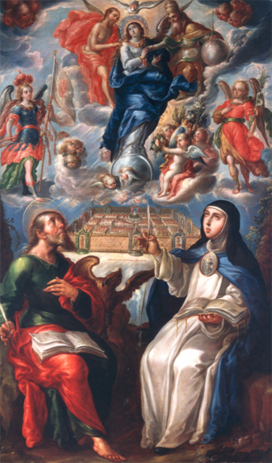
Cristóbal de Villalpando, La Mística Ciudad de Dios (The Mystical City of God), 1706. Museo regional de Gaudalupe/CONACULTA– INAH, Guadalupe, Zacatecas Nacional del Virreinato, Mexico.
“It’s a rich, complex, and multi-faceted story, and one that has not been told before in an exhibition of this magnitude,” said Steven Hackel, co-curator of the exhibition, professor of history at the University of California, Riverside, and Serra biographer (Junípero Serra: California’s Founding Father, 2013). “Serra was 55 years old and had had a very full life by the time he came to California in 1769. In this show, we are working to move beyond the standard polemic that often surrounds Serra and the missions. We present a picture that is equally rich in its portrayal of not only Serra’s life but the meaning of the missions for a range of California Indians.” The general tendency is to think that Serra’s life work began with the California missions, Hackel added, and that Indian culture disappeared with the onset of those missions. “The exhibition challenges both of these assumptions.”
Contemporary art, including a video work created expressly for the exhibition by James Luna (Luiseño), and first-person narratives by descendants of the missions “defy any presumptions that Native Americans ‘vanished’ or that they hold a monolithic view about the mission past,” said Catherine Gudis, co-curator of the exhibition and professor of California and public history at the University of California, Riverside. “Rather, the show represents a range of responses—including resistance and resilience—as the result of a period of painful disruption and devastating change.”
Among key items in the exhibition are a host of rare paintings and illustrations documenting the history of the Spanish island of Mallorca, Serra’s life, 18th-century Catholic liturgical art, and New Spain, as well as several sketches and watercolors that are among the first visual representations of California and California Indians by Europeans. “These images are not only beautiful,” says Hackel, “but they are among the most important ethnographic representations of California Indian life at the onset of the missions and of Indian life in the missions.”
Also on view are Serra’s baptismal record from Mallorca, his Bible and lecture notes from Mallorca, and the diary he composed as he traveled from Baja California to San Diego in 1769. Notable and unique items documenting Indian culture in California include a textile fragment that is thousands of years old, woven by California Indians from seaweed and fiber, as well as beads, tools, baskets, and written documents from the colonial period. “Like the Spaniards, these were people who had a significant history and culture well before the Europeans showed up, and it was a history and culture that would persevere, although not without huge changes, in and after the missions,” said Gudis.
 Junípero Serra provides a sweeping examination of where Serra came from, including the history and culture of Mallorca well before his time and during his early life; where Serra traveled, including his early adult years performing missionary work from central Mexico to Baja; and finally, his work to establish a system of missions along the California coastline from south to north.
At the same time, it provides the backdrop against which the missions emerged: early California was populated by numerous and diverse groups of Indians. Culture and customs varied from village to village; more than 100 languages were spoken; and in the parts of California colonized by Spain, the Indians numbered nearly 70,000.
Serra, under the auspices of the Catholic Church and the Spanish flag, believed his mission was to convert them to Christianity. However, his dream of encouraging Indians to relocate to the missions ultimately led many to an early grave, as diseases killed thousands of Indians who lived there.
“The mission period was a defining one in California’s history—and Serra is the most visible symbol of that period,” said Hackel. “But in taking this story all the way through—from before Indians and Europeans made contact, through the construction and collapse of the mission system, and then to the present day—it is, in fact, a story of conflicting, blending, and overlapping cultures, of imperial expansion and human drama and loss, and then, finally, of the perseverance and survival of not only European institutions in California, but the California Indians who were the focus of Serra’s missions.”
E X H I B I T I O N F L O W (more…)
Exhibition | America: Painting a Nation
The exhibition, organized by several American institutions including the Terra Foundation for American Art, debuted as Art Across America at the National Museum of Korea, in Seoul, and then traveled to Korea’s Daejeon Museum of Art. From the press materials of the Art Gallery of New South Wales:
America: Painting a Nation
Art Gallery of New South Wales, Sydney, 8 November 2013 — 9 February 2014

Portrait of a Black Sailor (Paul Cuffe?), ca. 1800 (LACMA)
This exhibition is a voyage through American history, across the American landscape and into the minds of the American people. It begins in the 18th century, among pious farmers and republican merchants. It traverses the continent, alongside Native Americans and frontiersman. It explores the great cities, and the lives of workers and bohemian artists. Answering the question, ‘What makes Americans American?’ is complex, but these paintings are a guide, revealing the self-reliance and communal beliefs, optimism and anxieties, that makes America tick.
Chris McAuliffe, Curatorial consultant
America: Painting a Nation is the most expansive survey of American painting ever presented in Australia. It is part of the Sydney International Art Series which brings the world’s outstanding exhibitions to Australia, exclusive to Sydney, and has been made possible with the support of the NSW Government through Destination NSW. Over 80 works, ranging from 1750 to 1966, cover more than 200 years of American art, history and experience. The exhibition sets a course from New England to the Western frontier, from the Grand Canyon to the burlesque theatres of New York, from the aristocratic elegance of colonial society to the gritty realism of the modern metropolis. This exhibition will reveal the breadth of American history, the hardy morality of the frontier, the intimacy of family life, the intensity of the 20th-century city, the epic scale of its landscape and the diversity of its people. The works being presented – many by American masters – are the works Americans love and works that represent the stories they have grown up with.
◊ ◊ ◊ ◊ ◊
From the Art Gallery of NSW:
Angela Miller and Chris McAuliffe, America: Painting a Nation (Sydney: Art Gallery of New South Wales, 2013), 264 pages, ISBN 978-1741741018, $45.
Spectacular landscapes, epic stories and diverse peoples feature in this expansive historical survey of American painting. The 89 artworks by some 74 artists traverse over 200 years of rich history, from the colonial era to the mid 20th century. Readers will encounter the sublime poetry and drama of the land, the ambition and optimism of the country’s pioneers, the challenges of the frontier, the intimacy of family life and the intensity of the modern city. The roots of the American character and nation will be revealed through images ranging from the Grand Canyon to the Brooklyn Bridge, from classic portraits to modern abstraction.
America: Painting a Nation includes works by artists such as Mary Cassatt, Winslow Homer, Edward Hopper, Georgia O’Keeffe, Jackson Pollock, Mark Rothko, John Singer Sargent and James McNeill Whistler from the collections of some of the finest art museums in the USA: The Terra Foundation, Chicago; the Philadelphia Museum of Art; the Museum of Fine Arts, Houston; the Los Angeles County Museum of Art; and The Virginia Museum of Fine Arts.
Essays by Angela Miller and Chris McAuliffe, combined with entries on each of the artworks and biographies on each artist, illuminate this fascinating survey of American painting from 1750 to 1967.
New Book | Slavery and the British Country House
From English Heritage, with free download (admirably!) available:
Madge Dresser and Andrew Hann, eds., Slavery and the British Country House (English Heritage, 2013), 180 pages, ISBN: 978-1848020641, £50. Available for free download at English Heritage»
 The British country house has long been regarded as the jewel in the nation’s heritage crown. But the country house is also an expression of wealth and power, and as scholars reconsider the nation’s colonial past, new questions are being posed about these great houses and their links to Atlantic slavery.
This book, authored by a range of academics and heritage professionals, grew out of a 2009 conference on Slavery and the British Country House: Mapping the Current Research organised by English Heritage in partnership with the University of the West of England, the National Trust and the Economic History Society. It asks what links might be established between the wealth derived from slavery and the British country house and what implications such links should have for the way such properties are represented to the public today.
Lavishly illustrated and based on the latest scholarship, this wide-ranging and innovative volume provides in-depth examinations of individual houses, regional studies and critical reconsiderations of existing heritage sites, including two studies specially commissioned by English Heritage and one sponsored by the National Trust.
In order to improve access to this research, a complete copy of the text is free to download from English Heritage.
◊ ◊ ◊ ◊ ◊
C O N T E N T S
Foreword
List of contributors
Acknowledgements
Notes on measurements
Introduction
1. Nicholas Draper, Slave ownership and the British country house: the records of the Slave Compensation Commission as evidence
2. Madge Dresser, Slavery and West Country houses
3. Jane Longmore, Rural retreats: Liverpool slave traders and their country houses
4. Roger H. Leech, Lodges, garden houses and villas: the urban periphery in the early modern Atlantic world
5. Simon D. Smith, Slavery’s heritage footprint: links between British country houses and St Vincent, 1814–34
6. Nuala Zahedieh, An open elite? Colonial commerce, the country house and the case of Sir Gilbert Heathcote and Normanton Hall
7. Sheryllynne Haggerty and Susanne Seymour, Property, power and authority: the implicit and explicit slavery connections of Bolsover Castle and Brodsworth Hall in the 18th century
8. Laurence Brown, Atlantic slavery and classical culture at Marble Hill and Northington Grange
9. Victoria Perry, Slavery and the sublime: the Atlantic trade, landscape aesthetics and tourism
10. Natalie Zacek, West Indian echoes: Dodington House, the Codrington family and the Caribbean heritage
11. Caroline Bressey, Contesting the political legacy of slavery in England’s country houses: a case study of Kenwood House and Osborne House
12. Cliff Pereira, Representing the East and West India links to the British country house: the London borough of Bexley and the wider heritage picture
13. Rob Mitchell and Shawn Sobers, Reinterpretation: the representation of perspectives on slave trade history using creative media
Notes
Index
Exhibition | Napoleon’s Three Sisters in Italy
Now on view in Paris (with thanks to Hélène Bremer for noting it) . . .
Les Soeurs de Napoléon: Trois Destins Italiens
Musée Marmottan Monet, Paris, 3 October 2013 — 26 January 2014
Curated by Maria Teresa Caracciolo
 Le musée Marmottan Monet consacre, du 3 octobre 2013 au 26 janvier 2014, une exposition exceptionnelle et inédite à Elisa, Pauline et Caroline, soeurs de Napoléon Ier, princesses et reines d’Italie. Grâce à des prêts d’exception provenant des plus grands musées d’Europe et des collections des descendants de la famille, italiens et français, 140 oeuvres sont réunies pour recréer l’univers prestigieux de la vie privée et publique des soeurs Bonaparte. Leurs trois destins hors du commun sont présentés pour la première fois, de leur genèse dans le Paris consulaire à leurs règnes italiens sous l’Empire.
Tableaux, sculptures, mobilier, accessoires, bijoux et parures de cour matérialisent sous nos yeux les destins extraordinaires d’Elisa (1777–1820), princesse de Piombino et de Lucques, puis grande-duchesse de Toscane, de Pauline (1780–1825) épouse du prince romain Camille Borghèse et de Caroline (1782–1839), mariée au général Joachim Murat et qui régna avec lui sur Naples avec un faste inégalé : trois femmes, trois personnalités différentes, l’une primant par la beauté, les deux autres par l’énergie, le charme et l’intelligence. Elles ont été les témoins privilégiés et les actrices de leur époque.
Autour de l’événement-charnière du sacre de Napoléon renaissent à la fois l’intime : leurs rôles de mères et d’épouses, comme l’officiel : leurs vies de princesses et reines d’Italie, dans les cours de Florence, Rome et Naples qui feront des trois soeurs des symboles de l’Europe en construction.
Cette exposition qui bénéficie de l’engouement remarquable de nombreuses institutions, collections particulières et musées prestigieux voit le jour aujourd’hui dans l’écrin idéal du musée Marmottan Monet, coeur de l’univers de Paul Marmottan (1856–1932) son fondateur, collectionneur passionné par le Premier Empire. Sont réunies, entre autres, des pièces des musées nationaux des châteaux de Versailles, Fontainebleau, Malmaison, du musée Fesch d’Ajaccio, du musée Fabre de Montpellier, de l’Ambassade de Grande-Bretagne à Paris, du Musée de l’armée, de celui de la Légion d’honneur, des Fondations Napoléon et Dosne-Thiers, du Musée des Beaux-Arts de Liège, du Palazzo Pitti de Florence, du Museo Napoleonico, du Museo Praz, des Musei di Arte Medievale e Moderna de Rome, des musées de Turin, Naples, Lucques, Caserte et de l’Ile d’Elbe, sans omettre les fonds propres de la bibliothèque Marmottan et du musée Marmottan Monet.
◊ ◊ ◊ ◊ ◊
The catalogue, in French and English, is published by Hazan:
Maria Teresa Caracciolo, ed., Les soeurs de Napoléon: Trois Destins Italiens (Paris: Hazan, 2013), 216 pages, ISBN: 978-2754107112, 29€.
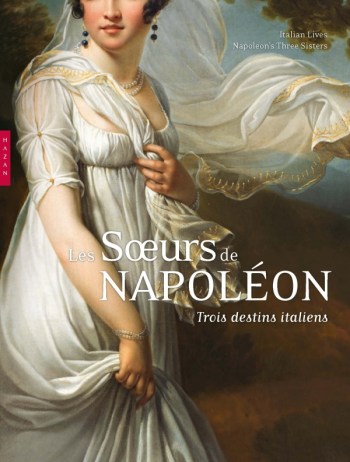 Exposition « Les sœurs de Napoléon. Trois destins italiens », au musée Marmottan Monet à Paris, du 03 octobre 2013 au 02 février 2014. Les sœurs de Napoléon Ier, Élisa, Pauline et Caroline, eurent toutes trois un destin italien : la première fut élevée par son frère au rang de princesse de Lucques, puis de grande-duchesse de Toscane, représentante de l’Empereur en Italie. La deuxième épousa un prince romain, Camille Borghèse, et vécut avec lui entre Paris et Rome, en s’attirant dans les deux villes le titre de reine de la beauté. Enfin la cadette, mariée au général Joachim Murat, régna avec lui sur Naples avec un faste inégalé. L’exposition évoque les trois destins des sœurs Bonaparte, forgés dans le Paris consulaire et brillamment parachevés en Italie sous l’Empire. Comme les autres membres de la famille Bonaparte, les sœurs de Napoléon appréciaient les belles résidences et pratiquèrent un mécénat éclairé. A Paris et en Italie, elles laissèrent la marque de leur passage par la création de décors, de peintures, de sculptures et d’objets d’art. La grande-duchesse de Toscane et la reine de Naples stimulèrent la production des manufactures de leurs Etats et encouragèrent dans leurs cours le théâtre, la musique et les arts de la mode, en menant en Italie une politique de conquête pacifique, la conquête par la culture et les idées. L’exposition réunit des portraits des trois sœurs, seules ou en groupe, avec leurs familles et leurs amis, dans les lieux où elles vécurent et qui furent métamorphosés par leur goût. Elle rassemble des œuvres d’art créées sous leur impulsion, des objets et des accessoires de leur vie quotidienne, des bijoux qui relevaient leurs somptueuses tenues de cour. Ces œuvres sont aujourd’hui partagées entre les plus grands musées d’Europe et les collections des descendants de la famille, italiens et français. Leur réunion dans les salles de l’ancien hôtel de Paul Marmottan, devenu musée Marmottan Monet, ressuscite une page d’histoire et la splendeur d’une époque. Elle nous fait entrer dans la vie privée d’une famille qui partagea le destin exceptionnel de l’empereur Napoléon Ier. Version bilngue français/anglais.
Commissaire de l’exposition et auteur du catalogue, Maria Teresa Caracciolo est Historienne de l’art, chargée de recherche au CNRS, spécialiste de la peinture européenne du XVIIIe et du XIXe siècle et des relations franco-italiennes sous la Révolution et l’Empire. Elle est l’auteur, parmi d’autres ouvrages, de Giuseppe Cades (1750–1799) et la Rome de son temps (Paris, Arthena, 1992, ouvrage issu d’une thèse de doctorat); du Romantisme (Citadelles et Mazenod, 2013); du catalogue de l’exposition Jean-Baptiste Wicar: Ritratti della famiglia Bonaparte (Roma, Museo Napoleonico-Napoli, Museo Diego Aragona Pignatelli Cortes, 2004); et du catalogue de l’exposition Lucien Bonaparte (1775–1840): un homme libre, (Ajaccio, Musée Fesch, 2010).
New Book | Exhibiting Englishness: John Boydell’s Shakespeare Gallery
From Yale UP:
Rosie Dias, Exhibiting Englishness: John Boydell’s Shakespeare Gallery and the Formation of a National Aesthetic (London: The Paul Mellon Centre for Studies in British Art, 2013), 288 pages, ISBN: 978-0300196689, $85.
 In the late 18th century, as a wave of English nationalism swept the country, the printseller John Boydell set out to create an ambitious exhibition space, one devoted to promoting and fostering a distinctly English style of history painting. With its very name, the Shakespeare Gallery signaled to Londoners that the artworks on display shared an undisputed quality and a national spirit. Exhibiting Englishness explores the responses of key artists of the period to Boydell’s venture and sheds new light on the gallery’s role in the larger context of British art.
Tracking the shift away from academic and Continental European styles of history painting, the book analyzes the works of such artists as Joshua Reynolds, Henry Fuseli, James Northcote, Robert Smirke, Thomas Banks, and William Hamilton, laying out their diverse ways of expressing notions of individualism, humor, eccentricity, and naturalism. Exhibiting Englishness also argues that Boydell’s gallery radically redefined the dynamics of display and cultural aesthetics at that time, shaping both
an English school of painting and modern exhibition
practices.
Rosie Dias is associate professor in the history of art at
the University of Warwick.
Exhibition | Yoga: The Art of Transformation
From the exhibition press release:
Yoga: The Art of Transformation
Smithsonian’s Arthur M. Sackler Gallery, Washington, D.C., 19 October 2013 — 26 January 2014
San Francisco Asian Art Museum, 21 February — 25 May 2014
Cleveland Museum of Art, 22 June — 7 September 2014

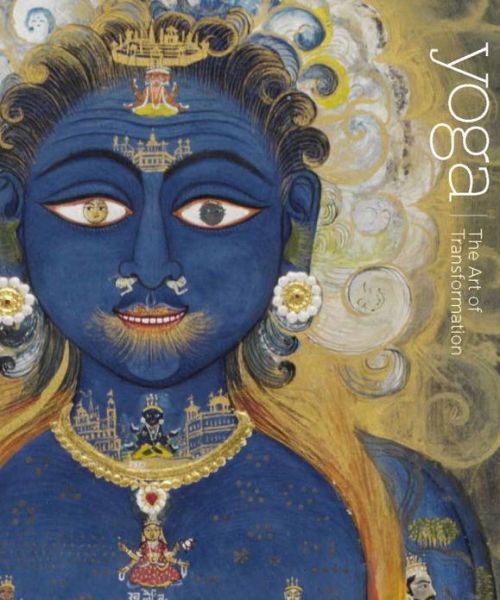
Krishna Vishvarupa (detail), ca. 1740. India, Himachal Pradesh, Bilaspur. Collection of Catherine and Ralph Benkaim.
◊ ◊ ◊ ◊ ◊
Yoga: The Art of Transformation, the first exhibition about the visual history of yoga explores yoga’s rich diversity and historical transformations during the past 2,000 years.
On view through January 26, 2014, The Art of Transformation examines yoga’s fascinating meanings and histories through more than 130 objects from 25 museums and private collections in India, Europe and the U.S. Highlights include three monumental stone yogini goddesses from a 10th-century south Indian temple, reunited for the first time, 10 folios from the first illustrated compilation of asanas (yogic postures) making their U.S. debut, and a Thomas Edison film, Hindoo Fakir (1906), the first movie produced about India.
“This exhibition looks at yoga’s ancient roots, and how people have been trying to master body and spirit for millennia,” said Julian Raby, The Dame Jillian Sackler Director of the Arthur M. Sackler Gallery and Freer Gallery of Art. “By applying new scholarship to both rarely seen artworks and recognized masterpieces, we’re able to shed light on practices that evolved over time—from yoga’s ancient origins to its more modern emergence in India, which set the stage for today’s global phenomenon.
 A free public festival, Diwali and the Art of Yoga, Saturday, October 26, will mark both the opening of the exhibition and Diwali, the Indian festival of lights. Visitors can discover exhibition highlights through spotlight tours, play games from across Asia, attempt intricate rangoli (rice powder) drawings and make their own yoga-inspired art in hands-on workshops. Indian classical musician K. Sridhar will demonstrate the yoga of sound, and storyteller Louise Omoto Kessel will share tales of Indian deities. Free yoga classes will be offered throughout, and the day will conclude with a traditional lamp-lighting ceremony and a classical Indian music concert.
In conjunction with The Art of Transformation, the Freer and Sackler galleries will also host Yoga and Visual Culture, a free interdisciplinary symposium for scholars and yoga enthusiasts November 21–23. Seventeen scholars from a range of disciplines will present cutting-edge research on diverse aspects of yoga’s visual culture, organized around such topics as “Yoga and Place” and “Yoga and Print Culture.” A full schedule and registration is available at asia.si.edu/events/yoga-symposium/.
Yoga classes in the galleries will be offered through “Art in Context,” an interactive 90-minute workshop combining tours of the exhibition with the practice of yoga. Led by a teaching team of a museum docent and guest yoga teachers, the workshops will be held on Wednesdays and Sundays throughout the exhibition, with special sessions offered for ages 50-plus, teens and families. Advance registration is required, and visitors can find a full schedule at asia.si.edu/events/workshops.asp.
These programs are made possible in part due to the Smithsonian’s first major crowdfunding campaign, “Together We’re One.” Launched in May 2013, the campaign raised more than $174,000 over 6 weeks to support public programs, yoga classes in the galleries, and an exhibition catalogue, as well as the behind—the—scenes aspects of the exhibition. Campaign donors and exhibition ambassadors, called “Yoga Messengers,” are invited to be special guests during the October 26 “Art of Yoga” festival, and will be featured in exhibition signage.
Following its Washington, D.C., debut, The Art of Transformation will travel to the San Francisco Asian Art Museum and the Cleveland Museum of Art.
Support for the exhibition is provided by the Friends of the Freer|Sackler, Whole Foods Market, Art Mentor Foundation Lucerne, the Alec Baldwin Foundation, the Ebrahimi Family Foundation, IndiaTourism, Catherine Glynn Benkaim, media partner Yoga Journal, and “Together We’re One” donors.
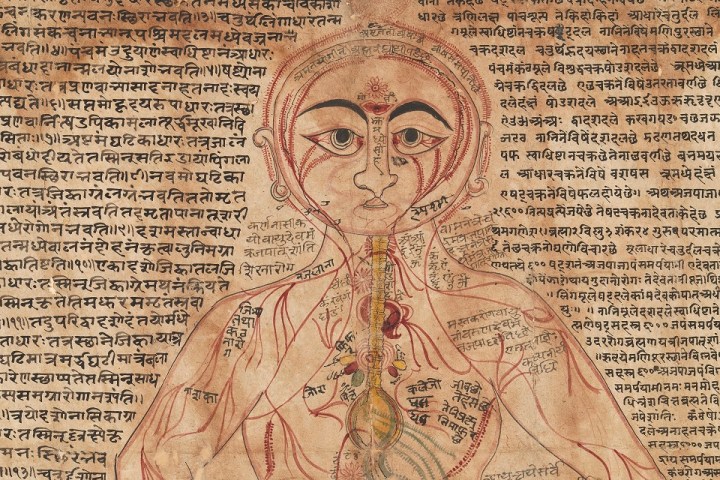
Anatomical Body, 18th century, India, Gujarat (Wellcome Library, London, Asian Collections, MS Indic Delta 74).
◊ ◊ ◊ ◊ ◊
Debra Diamond, ed., Yoga: The Art of Transformation (Washington, D.C.: Smithsonian Books, 2013), 360 pages, ISBN-13: 978-1588344595, $55.
An exploration of yoga’s meanings and transformations over time; the discipline’s goals of spiritual enlightenment, worldly power, and health and well-being; and the beauty and profundity of Indian art.
Debra Diamond is Associate curator of South and Southeast Asian art, Freer Gallery of Art and Arthur M. Sackler Gallery. Her exhibition catalogue for Garden and Cosmos (fall 2008) received two major awards for scholarship: the College Art Association’s Alfred H. Barr award and the Smithsonian Secretary’s Award for Research. She has published on yoga imagery, new methods in Indian art history, contemporary Asian art, and various aspects of the Freer|Sackler collections.
New Book | Breast Cancer in the Eighteenth Century
In the U.S., October is National Breast Cancer Awareness Month, and Friday, October 18th, is National Mammography Day. From the publisher:
Marjo Kaartinen, Breast Cancer in the Eighteenth Century (London: Pickering & Chatto, 2013), 256 pages, ISBN: 978-1848933644, £60 / $99.
 Early modern physicians and surgeons tried desperately to understand breast cancer, testing new medicines and radically improving operating techniques. In this study, the first of its kind, Marjo Kaartinen explores the emotional responses of patients and their families to the disease in the long eighteenth century.
Using a wide range of primary sources, she examines the ways in which knowledge about breast cancer was shared through networks of advice that patients formed with fellow sufferers. By focusing on the women who struggled with the disease as well as the doctors that treated them, much is revealed about early modern attitudes to cancer and how patients experienced – and were considered to experience – the cancerous body.
C O N T E N T S
Preface
‘One of the Most Grievous and Rebellious Diseases’: Defining, Diagnosing and the Causes of Cancer
2 ‘But Sad Resources’: Treating Cancer in the Eighteenth Century
3 Women’s Agency and Role in Choice of Treatment
4 ‘So Frightful to the Very Imagination’: Pain, Emotions and Cancer in the Breast
Epilogue
New Book | Ornamenting the Cold Roast
Distributed by Columbia University Press:
Dorothee Wagner von Hoff, Ornamenting the Cold Roast: The Domestic Architecture and Interior Design of Upper-Class Boston Homes, 1760–1880 (Bielefeld: Transcript-Verlag, 2013), 340 pages, ISBN: 978-3837622768, $62.
 This book presents the meticulous case studies of three individual houses from different eras, which serve to depict the social, political, and cultural effects that domestic architecture and interior design had on the upper class, the city of Boston, and a national American identity. It takes the reader on a journey to 18th- and 19th-century Boston and provides insight into the lives of these prominent men and women as seen through the perspective of their homes. It is a novel examination of the cultural significance of domestic architecture and interior design; and, because of its story-telling character and extensive attention to detail, it is fascinating for curious readers and cultural historians alike.
Dorothee Wagner von Hoff received her PhD at the University of Munich. Her research interests include Colonial and Victorian Architecture and interior design, as well as urban studies and American literature.










leave a comment