New Book | Images of the Plant Humanities
From Bloomsbury:
Danielle Sands and Daniel Whistler, eds., Images of the Plant Humanities: Theory, Art, and the Botanic Gaze (London: Bloomsbury Academic, 2026), 352 pages, ISBN: 978-1350502611, $120. Also available as an ebook.
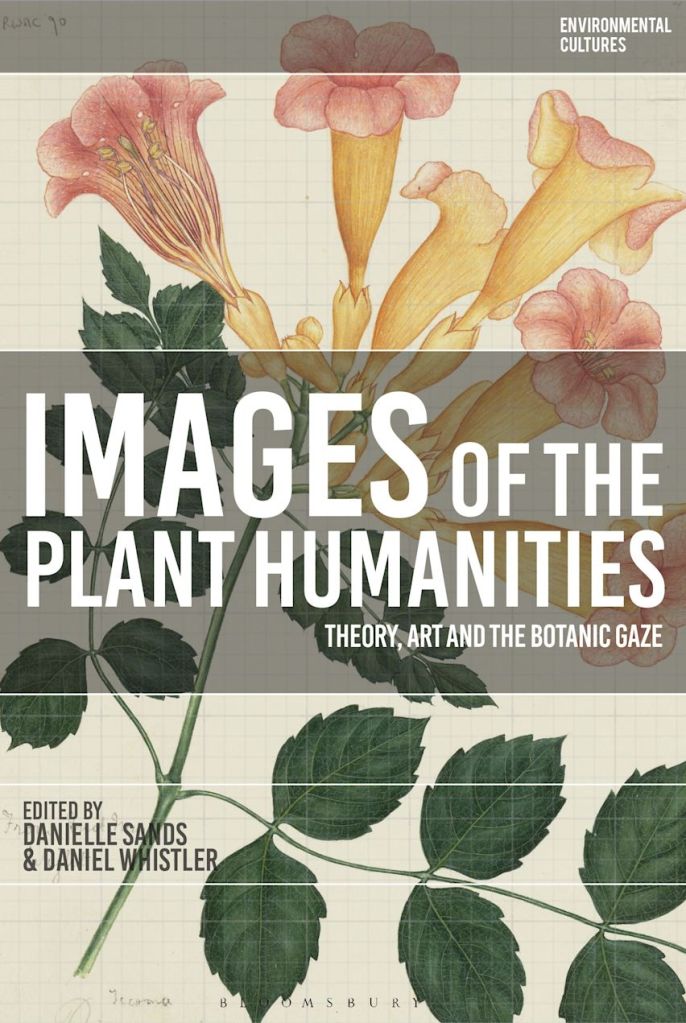 Exploring the words and images used to represent plants, this interdisciplinary book examines how vegetal life has been theorised both in the contemporary plant humanities, a developing field of research which aims to rectify the traditional neglect of plants as a model for thinking, and in Western modernity more generally.
Focusing on the varied ways that the vegetal has been represented, misrepresented, or even hidden, during modernity, it studies how philosophical, scientific and environmental theories, as well as colonial histories, have determined these representations, as well as how these representations have themselves influenced theory. Bringing aesthetic depictions of plant life into conversation with philosophical, cultural, literary, and scientific thinking, it looks to return our attention to vegetal life, and to challenge traditional assumptions regarding plant intelligence, agency, and communication.
Danielle Sands is Associate Professor of Comparative Literature and Culture at Royal Holloway, University of London.
Daniel Whistler is Professor of Philosophy, Royal Holloway, University of London. He is author of Schelling’s Theory of Symbolic Language: Forming the System of Identity (2013) and co-author of The Right to Wear Religious Symbols (2013).
c o n t e n t s
Part One | Understanding Plant Monsters
1 ‘What a Strange Prodigy’: The Welwitschia mirabilis — Katherine Arnold (University of Liverpool)
2 No Monsters Here: Vegetable Teratology and Plant Horror — Stella Sandford (Manchester Metropolitan University)
3 Abnormal Plants and Anomalous Arts: Troubling the Non/Human Norm — Aliya Say (Independent scholar)
4 The ‘Plant Horror’ of Turpin’s Urpflanze and Hooker’s Welwitschia: Narratives of Monstrous Proliferation and Grotesque Hybridity — Caroline Harris (Royal Holloway, University of London)
Part Two | Narrating Plant Desires
5 Thinking Sex with Plants: The Speculative Sexualities of Enlightenment Botany — Natania Meeker (University of Southern California)
6 Fern Tongues: A Pteridomaniac’s Imagination of Vegetal Time and Desire — Solvejg Nitzke (Ruhr-University Bochum)
7 Dragon Arum: A Phytopoetic Gaze on Vegetal Violence and Eroticism — Joela Jacobs (University of Arizona)
8 The Quest for the Blue Flower: The Legacy of German Romanticism in Three Contemporary Novels — Isabel Kranz (University for Applied Arts, Vienna)
Part Three | Rediscovering Plant Agency
9 The Temporality of Titan Arum — John C. Ryan (University of Notre Dame, Australia)
10 Prickly-Pairs: On Humans, Plants, and Technicity — Ed Thornton (Independent Researcher)
11 Extending the Botanical: Agency, Abstraction, and Contemporary Plant Drawing — Danielle Sands (Royal Holloway, University of London)
Part Four | Resituating Plants Ecologically
12 Undoing the Hollow Space of Representation: Margaret Mee’s Plant Portraits in the Kew Collection — Yota Batsaki (Dumbarton Oaks, Harvard University)
13 Papa and Kuka: A Biocultural Exploration of Two Andean Crops — Nataly Allasi Canales (University of Copenhagen, Denmark/Royal Botanic Gardens, Kew) and Kim Walker (Royal Holloway, University of London/Royal Botanic Gardens, Kew)
14 Lacebark and the Interior Décor of the Jamaican Slave Cottage — Steeve Buckridge (Grand Valley State University)
15 Humboldt and Bonpland’s Essay on the Geography of Plants: The Other Side of the Physical Tableau of the Andes — Quentin Hiernaux (Université libre de Bruxelles)
Part Five | Redrawing Plant Boundaries
16 ‘Here Nature stopped half-way’: Waterlilies and the Foliar Theory of the Flower — Ulrich Stegmann (University of Aberdeen)
17 The Place of Algae in Experimental Natural Histories — Joan Steigerwald (University of York)
18 A ‘Funeral Oration’ for Lichenology? — Lydia Azadpour (University of Nottingham)
Part Six | Representing Plants Otherwise
19 This Is Not a Brugmansia — Giovanni Aloi (Independent Researcher)
20 Ginkgo and Dark Botany — Prudence Gibson (University of New South Wales, Sydney) and Maya Martin-Westheimer (University of New South Wales)
21 Anna Atkins’ Cyanotypes: Gestures for Hands Driven by Sunlight — Redell Olsen (Royal Holloway, University of London)
22 The Ecology of Plant Iconography — Laurence Hill (Independent Artist)
Part Seven | Reimagining Plant Forms
23 Blue So Deep — Ben Woodard (Independent Researcher)
24 Containing Nature in the Leaves of a Book: Botany, Bibliography, and the Embodiment of Thought — Thomas Moynihan (University of Cambridge)
25 Drawing the Urpflanze: Goethe, Arber, Grothendieck — Sophie Gerber (University of Bordeaux)
Afterword: The Library and Archives at the Royal Botanic Gardens, Kew — Julia Buckley (Royal Botanic Gardens, Kew)
Call for Papers | Home/Work: Constructing Domesticities
From the Call for Papers:
Home/Work: Constructing Domesticities
The Mary L. Cornille Annual Boston University Graduate Symposium
Boston University and the Museum of Fine Arts, Boston, 9–10 April 2027
Organized by Isabella Dobson and Megan Horn
Proposals due by 8 January 2027
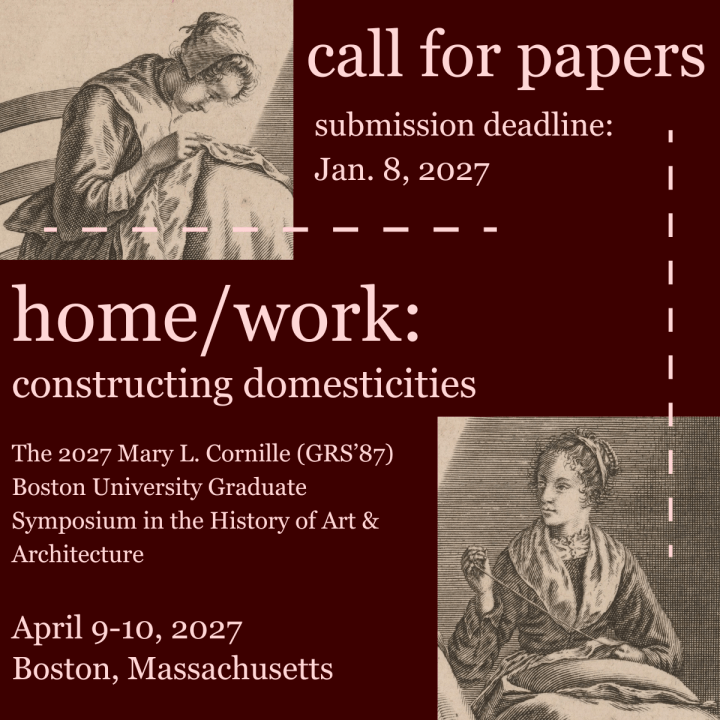 The Mary L. Cornille (GRS’87) 43rd Annual Boston University Graduate Symposium in the History of Art & Architecture invites submissions which explore how homes and domestic cultures are imagined and constructed through material and visual culture.
A home is more than just a residence, location, or a building. Architects and designers might design houses and housing to structure domestic life, but to call a place ‘home’ often indicates individual senses of belonging, identity, and private experience. Homes are also related to work, whether as sites of labor or as imagined reprieves from it. Inhabitants, including families, communities, and laborers, construct domestic life through the work of creating, acquiring, or routinely using visual and material objects. However, homes and their domestic visual and material cultures are not immune from outside influence. Ideologies regarding nationality, citizenship, gender, class, or race shape ideas about what kinds of people, objects, and activities belong at home. Furthermore, visual and material culture and representations of domestic life also provide insight into how the idea of home has been negotiated, reimagined, and challenged over time.
Possible subjects include, but are not limited to, the following:
• Domestic roles: parenthood, caregiving, childhood, servitude, labor, enslavement, animal domestication, multigenerational families, communal living
• Domestic objects: furniture, textiles, clothing, dining wares, decorative arts, jewelry, technology (TVs, radio, laundry machine, etc.), ephemera (magazines, newspapers, advertisements, etc.)
• Domestic space: architecture, vernacular architecture, kitchens, bedrooms, bathrooms, dining rooms, gardens, suburban/urban/rural, speculative or imagined blueprints/plans, design styles (Bauhaus, minimalism, Arts and Crafts movement, etc.), public vs. private, house museums
• Domestic ideologies: labor, race, gender, sexuality, ethnicity, nationality, femininity, masculinity, immigration, politics, citizenship, faith/religion
We welcome submissions from graduate students at all stages of study and from any area of study. Papers must be original and previously unpublished. Please send an abstract (300 words or fewer), a paper title, and a CV to artsymp@bu.edu. The deadline for submissions is 8 January 2027. Selected speakers will be notified by early February. Papers should be no longer than 15 minutes in length and will be followed by a question and answer session. The symposium will be held at Boston University on Friday, 9 April and at the Museum of Fine Arts, Boston on Saturday, 10 April 2027. Please note that we do not cover travel costs for speakers.
This event is generously sponsored by Mary L. Cornille (GRS’87). For additional information, please visit our website.










leave a comment