Conference | Faces of Physiognomy, 1750–1850
From ArtHist.net:
Gesichter der Physiognomik, 1750–1850
Goethe-Universität Frankfurt, Frankfurt am Main, 27 November 2026
Organized by Léna Pican and Mechthild Fend
Die deutsch-französische Tagung, die am 27. November 2026 an der Goethe-Universität Frankfurt stattfindet, widmet sich der Physiognomik – von ihrer Ausformulierung im 18. Jahrhundert um Johann Caspar Lavaters Physiognomische Fragmente bis zu ihren späteren Wiederaufnahmen. Sie untersucht ihre Entstehungsbedingungen und ihre Rezeption in Frankreich, ihre kritische Auseinandersetzung bei Kant, die Materialien und Bildtechniken, die sie tragen – vom Porträt bis zur Silhouette –, sowie ihre Aneignungen bis ins 20. Jahrhundert. Die Tagung bringt Forscherinnen und Forscher aus verschiedenen Disziplinen zusammen (Kunstgeschichte, Philosophie, Rechtsgeschichte und Wissensgeschichte). Die Vorträge werden auf Französisch, Deutsch oder Englisch gehalten.
Organisation: Léna Pican und Mechthild Fend, mit Unterstützung des IFRA-SHS und der Goethe-Universität Frankfurt.
p r o g r a m m
9.30 Begrüßung / Accueil
9.45 Einführung / Introduction — Léna Pican
10.00 Panel 1 | La physiognomonie et la France
Moderation: Andreas Mayer (CNRS / Centre Alexandre-Koyré, EHESS)
• Edern de Barros (Université de Mayotte, online) — Du tempérament à la « physionomie nationale ». Lire le caractère sur les corps et sur les peuples dans la pensée française (1746–1802)
• Nina Eckhoff-Heindl (Universität Bonn) — Jacques-Louis Moreau de la Sarthes Anmerkungen zur Physiognomik kognitiver Behinderung
11.30 Panel 2 | Kant und die Physiognomik
Moderation: Mirja Beck (Goethe-Universität Frankfurt)
• Luc-Étienne de Boyer (Saint-Étienne) — L’attitude de Kant envers la physiognomonie : de la tentation naturaliste à la disqualification esthétique
• Ousmane Mballo (Toulouse) — Kant et la physiognomonie : les limites et la fonction pragmatique de la connaissance de l’être humain
12.40 Mittagspause / Déjeuner
14.15 Panel 3 | Les matériaux de la physiognomonie
Moderation: Mechthild Fend (Goethe-Universität Frankfurt)
• Martina Sitt (Universität Kassel) — Kontur gewinnen: Lavaters Physiognomien und Tischbeins Porträts 1781/1782
• Bulkhia Panalondong, M.A. (Oldenburg) — From Silhouette to Silver Gelatin: The 18th-Century Physiognomic Gaze in Fedor Jagor’s Reisen in den Philippinen
15.45 Panel 4 | Appropriations et physiognomonies
Moderation: Andreas Häckermann (IFRA-SHS, Frankfurt)
• Alice Vincent (Université de Franche-Comté / IFRA-SHS, Frankfurt) — Adorno et la physiognomonie
16.30 Abschlussdiskussion / Discussion générale et synthèse
Attingham Courses in 2027
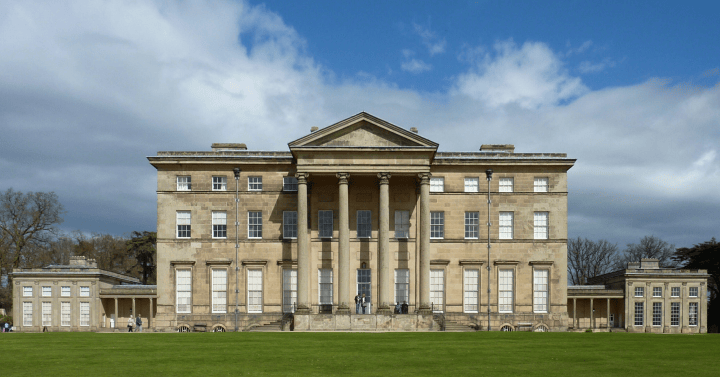
Attingham Park, Shropshire
(Wehha, CC BY-SA 3.0, via Wikimedia Commons)
◊ ◊ ◊ ◊ ◊
As the Attingham Trust marks its 75 anniversary in 2027, they are delighted to announce three courses taking place throughout the year, with a limited number of scholarships. Applications are welcomed from academics and museum professionals worldwide.
The Study Programme | The Historic House in Wales
Led by Elizabeth Jamieson with Rita Grudzień , 5–11 June 2027
Applications due by 29 January 2027
Wales’s country houses and estates have distinctive stories to tell, yet their place in the wider history of the British country house has often been overlooked. This intensive seven-day programme, based in North Wales, explores their rich heritage through visits, lectures and discussion, examining the architecture, landscapes, collections, patronage and people that shaped them. Highlights include Penrhyn Castle, Plas Newydd, Portmeirion, and the gardens of Plas Cadnant. Directed by Elizabeth Jamieson and coordinated by Rita Grudzień, the programme offers fresh perspectives on the history and significance of the Welsh country house.
◊ ◊ ◊ ◊ ◊
The Attingham Summer School
Led by David Adshead and Tessa Wild, 26 June — 11 July 2027
Applications due by 29 January 2027
Founded in 1952, the Attingham Summer School celebrates its 75th anniversary in 2027. This renowned 16-day residential programme offers an in-depth study of Britain’s historic houses, collections, gardens and landscapes, exploring their architectural and social history through visits, lectures, and discussion, alongside the opportunity to exchange ideas and perspectives with fellow participants and build connections with heritage professionals from around the world. Directed by David Adshead and Tessa Wild, the programme will visit houses across seven English counties, including Petworth House, Parham, Hardwick Hall, Chatsworth, Boughton House, Weston Park, and Attingham Park, where the first Summer School took place in 1952.
◊ ◊ ◊ ◊ ◊
Royal Collection Studies
Led by Helen Jacobsen, 5–14 September 2027
Applications due by 12 February 2027
Organised in partnership with the Royal Collection Trust, this 10-day residential course offers a rare opportunity to explore one of the world’s great collections of fine and decorative art at close quarters. Through visits to royal palaces, lectures, tutorials and object study, participants will discover five centuries of royal collecting, gaining insight into the remarkable works of art, the architecture and interiors of the palaces, and the evolving questions of display, interpretation and stewardship. Directed by Dr Helen Jacobsen, the programme brings together heritage professionals from around the world, offering a valuable opportunity to exchange ideas and perspectives, learn from leading curators and specialists, and forge new professional connections.
Call for Papers | Colonial Objectscapes, ISECS 2027
From ArtHist.net (with more information about the 2027 ISECS Congress available here) . . .
Colonial Objectscapes of the Global 18th Century
Panel at the 17th International Society for Eighteenth-Century Studies Congress
Zaragoza, Spain, 12–16 July 2027
Proposals due by 30 November 2026
Expanding on Martin Pitts and Miguel John Versluys’ (2021) concept of an objectscape as “the material and stylistic properties of a repertoire of objects in a given period or geographic range,” this session explores the material cultures generated and shaped by European colonial networks, exploitation, ideologies, and resistance over the long eighteenth century. Though the globalisation of many commodities and artistic traditions has occurred since long before this period, the eighteenth century saw marked changes to the nature and scale in the movement of objects. Such changes resulted from various factors including but not limited to the establishment of new trade routes; the reorganisation of labour via African and indigenous American chattel slavery; and technological developments relating to transport, farming, and manufacturing. Without discounting pre-colonial histories as well as concurrent local and indigenous histories of objects affected by the shifting dynamics of the early modern period, the framework of the objectscape takes as a point of departure the connected or shared cultural meanings and identities that are accrued within a specific context—here being the colonial.
We invite papers that consider how materials and objects function within their historical context as an assemblage, rather than individual units of analysis. In practice, this involves studying interactions between different objects and materials as well as with their makers and consumers, the spaces they inhabit, or the ways that they are visually and aesthetically represented. This framework approaches material culture studies holistically by combining object-based research with art, labour, and environmental histories among others. The panel especially emphasises the global scope of such objectscapes, involving a multitude of agents beyond the elite, European, and human. We thus also welcome ecocritical perspectives which ask how objectscapes are shaped by indigenous ecologies and environmental agencies.
Panel convenor: Alisha Ma (London School of Economics and Political Science). Please submit a 200-word abstract and/or any questions to the panel convenor at: a.e.ma@lse.ac.uk.










leave a comment