New Book | D’Eon: The Wonder of Her Sex
From Bloomsbury (with 20% off for a limited time with discount code GLR BD8) . . .
Jonathan Conlin, D’Eon: The Wonder of Her Sex (London: Bloomsbury Academic, 2026), 256 pages, ISBN: 979-8216493648 (hardback), $175 / ISBN: 979-8216493655 (paperback), $44. Also available as an ebook.
Jonathan Conlin, “States of Transition: The Chevalière d’Eon and Her Portrait Prints, 1764–91,” Eighteenth Century Studies 59.4 (2026). Open-access for a limited time only, via this link.
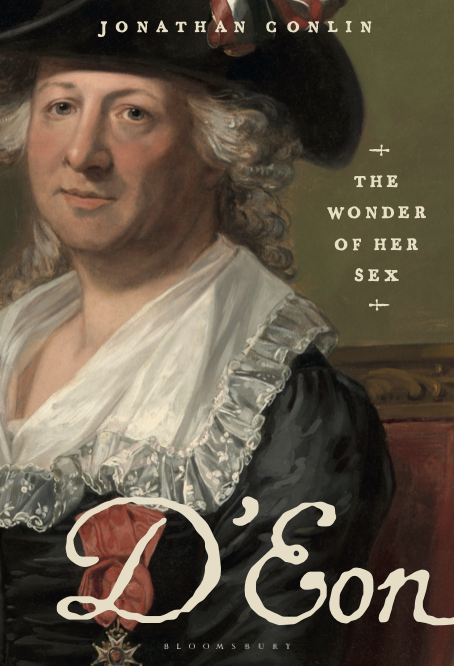 Author, envoy, soldier, spy, the Chevalière d’Eon (1728–1810) crossed boundaries of sex and nation, moving between Britain and France, presenting as a man and as a woman. For fifty years, in peace and in war, the Chevalière served the French crown as secret agent, censor, dragoon officer and diplomat. She spent the following thirty years as a celebrity, famed for giving virtuoso displays of swordswomanship wearing her signature black dress.
D’Eon presented as a woman forced by her parents and Louis XV to adopt male costume. After her transition contemporaries hailed d’Eon as “the wonder of her sex”, impressed by her achievements on the battlefield and in the chancelleries of Europe. As Mary Wollstonecraft and Olympe de Gouges both noted, d’Eon showed what emancipated women could do. Within weeks of d’Eon’s death, however, curious Londoners could buy coloured stipple engravings of her genitalia. For many observers, then and since, d’Eon’s identity was reduced to this post-mortem encounter with her anatomy. The mystery of her sex (now “solved”) replaced the wonder of her sex.
D’Eon was the subject of many prints during her lifetime. Until recently it was assumed that she was the passive victim of these representations. As Conlin reveals in a new article in the journal Eighteenth Century Studies, however, d’Eon had a hand in the production of several of these mezzotints and engravings. His article explores how d’Eon used prints to experiment with new female avatars (including that of a latter-day Pallas emerging bare-breasted from her tent), several years before d’Eon wore female-coded costume in public, at her 1777 presentation to Marie Antoinette and Louis XVI.
D’Eon was just as eager to shape how she was presented in text, feeding articles to the press and pursuing public querelles with Beaumarchais and others. A prolific author, she sold her life story to two publishers, yet failed to submit a manuscript. This was not for want of effort: D’Eon wrote her life story, over and over, in a variety of genres: as Rousseau-style confession, as dialogue, as epistolary exchange and as galanterie. Her story is a picaresque masquerade of the ancien régime. It is a Christian conversion narrative. It is a chapter in a new history of femmes fortes and trans saints. Aware of the tensions between these stories, unable or unwilling to let one version define her, d’Eon spent thirty years in a labyrinth of her own construction. No trans woman has left us such a large archive of life writings, or lived her life on such an epic scale.
Professor of History at the University of Southampton, Jonathan Conlin began working on the Chevalier d’Eon in 2001, exploring the analogies between d’Eon and the English journalist and radical, John Wilkes. He co-edited The Chevalier d’Eon and His Worlds (Bloomsbury, 2010) with Simon Burrows, Valerie Mainz and Russell Goulbourne. More recent books include the authorized bicentenary history of the National Gallery (London) and The Met: A History of a Museum and Its People (Columbia University Press, 2025). He is currently organizing a play, exhibition, and digitisation project intended to commemorate d’Eon’s tercentenary in 2028.










leave a comment