New Book | Women and Gender in Early Modern Europe
From Ashgate:
Allyson Poska, Jane Couchman, and Katherine McIver, The Ashgate Research Companion to Women and Gender in Early Modern Europe (Aldershot: Ashgate, 2013), 572 pages, ISBN: 978-1409418177, $150.
 Over the past three decades scholars have transformed the study of women and gender in early modern Europe. This Ashgate Research Companion presents an authoritative review of the current research on women and gender in early modern Europe from a multi-disciplinary perspective. The authors examine women’s lives, ideologies of gender, and the differences between ideology and reality through the recent research across many disciplines, including history, literary studies, art history, musicology, history of science and medicine, and religious studies. The book is intended as a resource for scholars and students of Europe in the early modern period, for those who are just beginning to explore these issues and this time period, as well as for scholars learning about aspects of the field in which they are not yet an expert. The companion offers not only a comprehensive examination of the current research on women in early modern Europe, but will act as a spark for new research in the field.
Allyson M. Poska is Professor of History at the University of Mary Washington, USA and co-editor of Ashgate’s ‘Women and Gender in the Early Modern World’ book series. Jane Couchman is Professor Emerita of French Studies, Women’s Studies and Humanities at Glendon College, York University, Toronto. Katherine A. McIver is Professor Emerita of Art History at the University of Alabama at Birmingham.
◊ ◊ ◊ ◊ ◊
C O N T E N T S
Introduction, Allyson M. Poska, Jane Couchman and Katherine A. McIver
Part I | Religion
The permeable cloister, Elizabeth A. Lehfeldt
Literature by women religious in early modern Catholic Europe and the New World, Alison Weber
Convent creativity, Marilynn Dunn
Convent music: an examination, Kimberlyn Montford
Lay patronage and religious art, Catherine E. King
Female religious communities beyond the convent, Susan E. Dinan
Protestant movements, Merry Wiesner-Hanks
Protestant women’s voices, Jane Couchman
Part II | Embodied Lives
Maternity, Lianne McTavish
Upending patriarchy: rethinking marriage and family in early modern Europe, Allyson M. Poska
The economics and politics of marriage, Jutta Gisela Sperling
Before the law, Lyndan Warner
Permanent impermanence: continuity and rupture in early modern sexuality studies, Katherine Crawford
Women and work, Janine M. Lanza
Old women in early modern Europe: age as an analytical category, Lynn Botelho
Women on the margins, Elizabeth S. Cohen
Women and political power in early modern Europe, Carole Levin and Alicia Meyer
Part III | Cultural Production
The Querelle des femmes, Julie D. Campbell
Intellectual women in early modern Europe, Diana Robin
Women in science and medicine, 1400-1800, Alisha Rankin
Early modern women artists, Sheila ffolliott
Beyond Isabella and beyond: secular women patrons of art in early modern Europe, Sheryl E. Reiss
Material culture: consumption, collecting and domestic goods, Katherine A. McIver
Images of women, Andrea Pearson
Women, gender, and music, Linda Phyllis Austern
2012-13 Clifford Prize | Messbarger on the Florentine Anatomical Venus
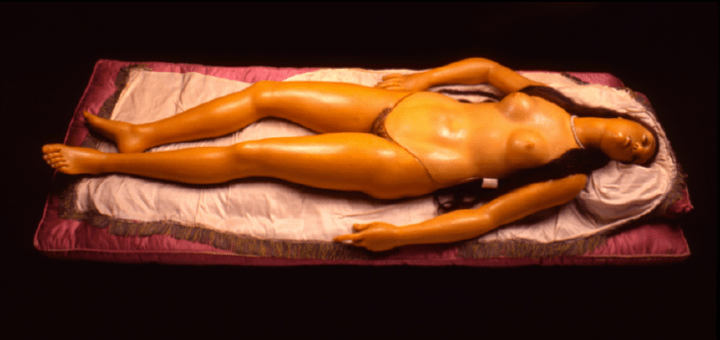
Anatomical Venus, ca. 1780, wax, Museum of Natural History in Florence
(Photo: Saulo Bambi)
◊ ◊ ◊ ◊ ◊
ASECS recently announced that the 2012-13 James L. Clifford Prize was awarded to Rebecca Messbarger for her article “The Re-Birth of Venus in Florence’s Royal Museum of Physics and Natural History” published by the Journal of the History of Collections (May 2012): 1-21.
Messbarger is the author of The Lady Anatomist: The Life and Work of Anna Morandi Manzolini (Chicago: University of Chicago Press, 2010).
New Book | Une Facétie de Fragonard
From the publisher:
Carole Blumenfeld, Une Facétie de Fragonard: Les révélations d’un dessin retrouvé (Paris: Editions Gourcuff-Gradenigo, 2013), 80 pages, ISBN: 978-2353401475, 20€.
 L’ouvrage de Carole Blumenfeld apporte un éclairage nouveau sur les talents de portraitistes de Fragonard et lève le voile sur l’identité de chacun des personnages qui se cachent derrière Diderot, La Guimard, L’Inspiration, L’étude…
Les Figures de fantaisie de Fragonard comptent parmi les œuvres les plus éblouissantes, les plus célèbres et les plus énigmatiques de l’histoire de la peinture française. La découverte d’un dessin inédit de l’artiste vient bouleverser aujourd’hui tout ce que nous savions de ces silhouettes peintes en « une heure de temps ». Il apporte la preuve indubitable qu’elles sont des portraits et non des figures imaginaires. Fragonard a en effet esquissé au crayon, sur une feuille, dix-huit de ses tableaux en marquant les noms de chacun de ses modèles. Dans de nombreux cas, il s’agit de révélations étonnantes qui contredisent des certitudes acquises au cours des années.
Available from ArtBooks.com
◊ ◊ ◊ ◊ ◊
Didier Rykner reported on the book’s discoveries for The Art Tribune (4 December 2012). . .
The Fragonard portrait which has, almost, always been known as Portrait of Diderot is in fact not a likeness of the philosopher as proven by the drawing recently auctioned off and published for the first time on 17 July on The Art Tribune by Marie-Anne Dupuy-Vachey.
However, she was not alone in immediately recognizing the probable importance of the sheet. Hubert Duchemin, a Parisian expert and dealer, along with his collaborator Lilas Sharifzadeh, also guessed its likely pedigree. At the auction, Hubert Duchemin made the final bid, a high price given the uncertainty still surrounding the work. After the sale, he turned it over for study to Carole Blumenfeld, the art historian. Now, a small book will appear on 13 December [2012] at Editions Gourcuff-Gradenigo and will reveal the very fruitful results of this research. . .
The full article is available here»
New Book | The Hermit in the Garden
From Oxford UP:
Gordon Campbell, The Hermit in the Garden: From Imperial Rome to Ornamental Gnome (New York: Oxford University Press, 2013), 272 pages, ISBN: 978-0199696994, £17 / $30.
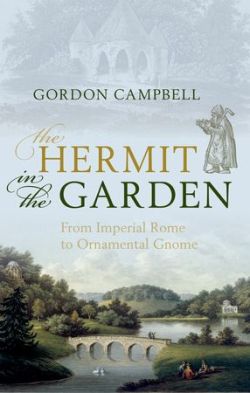 Tracing its distant origins to the villa of the Roman emperor Hadrian in the second century AD, the eccentric phenomenon of the ornamental hermit enjoyed its heyday in the England of the eighteenth century. It was at this time that it became highly fashionable for owners of country estates to commission architectural follies for their landscape gardens. These follies often included hermitages, many of which still survive, often in a ruined state.
Landowners peopled their hermitages either with imaginary hermits or with real hermits – in some cases the landowner even became his own hermit. Those who took employment as garden hermits were typically required to refrain from cutting their hair or washing, and some were dressed as druids. Unlike the hermits of the Middle Ages, these were wholly secular hermits, products of the eighteenth-century fondness for ‘pleasing melancholy’.
Although the fashion for them had fizzled out by the end of the eighteenth century, they had left their indelible mark on both the literature as well as the gardens of the period. And, as Gordon Campbell shows, they live on in the art, literature, and drama of our own day – as well as in the figure of the modern-day garden gnome.
This engaging and generously illustrated book takes the reader on a journey that is at once illuminating and whimsical, both through the history of the ornamental hermit and also around the sites of many of the surviving hermitages themselves, which remain scattered throughout England, Scotland, and Ireland. And for the real enthusiast, there is even a comprehensive checklist, enabling avid hermitage-hunters to locate their prey.
Gordon Campbell is Professor of Renaissance Studies at the University of Leicester. He is the author of the best-selling Bible: The Story of the King James Bible and of many other books on literature, art, history, and biography. A fellow of the British Academy and a former chair of the Society for Renaissance Studies, in 2012 he was awarded the Longman – History Today Trustees Award for a lifetime contribution to History. In this book his interests in cultural history, architectural history, and designed landscapes converge in a pioneering study of the phenomenon of the English ornamental hermit and his hermitage.
◊ ◊ ◊ ◊ ◊
C O N T E N T S
Introduction
1: Origins and Antecedents
2: The Idea of the Hermit
3: The Hermits
4: The Hermitage in Georgian England
5: The Celtic lands and the Continent
6: The Afterlife of the Hermit: from gnomes to Arcadia
Appendix: a Catalogue of Hermitages
Works Consulted
Index
New Book | A Taste for China
From Cambridge UP:
Eugenia Zuroski Jenkins, A Taste for China: English Subjectivity and the Prehistory of Orientalism (New York: Cambridge University Press, 2013), 304 pages, ISBN: 978-0199950980, $74.
 Challenging existing narratives of the relationship between China and Europe, this study establishes how modern English identity evolved through strategies of identifying with rather than against China. Through an examination of England’s obsession with Chinese objects throughout the long eighteenth century, A Taste for China argues that chinoiserie in literature and material culture played a central role in shaping emergent conceptions of taste and subjectivity.
Informed by sources as diverse as the writings of John Locke, Alexander Pope, and Mary Wortley Montagu, Zuroski Jenkins begins with a consideration of how literature transported cosmopolitan commercial practices into a model of individual and collective identity. She then extends her argument to the vibrant world of Restoration comedy-most notably the controversial The Country Wife by William Wycherley-where Chinese objects are systematically associated with questionable tastes and behaviors. Subsequent chapters draw on Defoe, Pope, and Swift to explore how adventure fiction and satirical poetry use chinoiserie to construct, question, and reimagine the dynamic relationship between people and things. The second half of the eighteenth century sees a marked shift as English subjects anxiously seek to separate themselves from Chinese objects. A reading of texts including Aphra Behn’s Oroonoko and Jonas Hanway’s Essay on Tea shows that the enthrallment with chinoiserie does not disappear, but is rewritten as an aristocratic perversion in midcentury literature that prefigures modern sexuality. Ultimately, at the century’s end, it is nearly disavowed altogether, which is evinced in works like Charlotte Lennox’s The Female Quixote and Jane Austen’s Northanger Abbey.
Eugenia Jenkins is Assistant Professor of English and Cultural Studies at McMaster University.
◊ ◊ ◊ ◊ ◊
C O N T E N T S
Introduction: ‘China’ and The Prehistory of Orientalism
1. The Cosmopolitan Nation, ‘Where Order in Variety We See’
2. The Chinese Touchstone of the Tasteful Imagination
3. Defoe’s Trinkets: Fiction’s Spectral Traffic
4. ‘Nature to Advantage Drest’: The Poetry of Subjectivity
5. How Chinese Things Became Oriental
6. Disenchanting China: Orientalism and the English Novel
Afterword: Rethinking Modern Taste
Happy Arbor Day
I posted notice of this collection last September, but I’m reposting it in honor of National Arbor Day. From SVEC (formerly Studies on Voltaire and the Eighteenth Century), available from the Voltaire Foundation:
Laura Auricchio, Elizabeth Heckendorn Cook and Giulia Pacini, eds., Invaluable Trees: Cultures of Nature, 1660-1830 — SVEC 2012:08 (Oxford: Voltaire Foundation, 2012), 360 pages, ISBN 9780729410489, £65 / €95 / $110.
 Trees and tree products have long been central to human life and culture, taking on intensified significance during the long eighteenth century. In this interdisciplinary volume, contributors trace changes in early modern theories of resource management and ecology across European and North American landscapes, and show how different and sometimes contradictory practices were caught up in shifting conceptions of nature, social identity, physical health and moral wellbeing.
◊ ◊ ◊ ◊ ◊
C O N T E N T S
Introduction
• Laura Auricchio — Elizabeth Heckendorn Cook and Giulia Pacini, Invaluable trees
I. Arboreal Lives
• Hamish Graham — ‘Alone in the forest’? Trees, charcoal and charcoal burners in eighteenth-century France
• J. L. Caradonna — Conservationism avant la lettre,? Public essay competitions on forestry and deforestation in eighteenth-century France
• Paula Young Lee — Land, logs and liberty: the Revolutionary expansion of the Muséum d’histoire naturelle during the Terror
• Peter Mcphee — ‘Cette anarchie dévastatrice’: the légende noire of the French Revolution
• Paul Elliott — Erasmus Darwin’s trees
• Giulia Pacini — At home with their trees: arboreal beings in the eighteenth-century French imaginary
II. Strategic Trees
• Elizabeth Heckendorn Cook — The vocal stump: the politics of tree-felling in Swift’s ‘On cutting down the old thorn at Market Hill’
• Michael Guenther — Tapping nature’s bounty: science and sugar maples in the age of improvement
• Meredith Martin — Bourbon renewal at Rambouillet
• Susan Taylor-Leduc — Assessing the value of fruit trees in the marquis de Fontanes’s poem Le Verger
• Elizabeth Hyde — Arboreal negotiations, or William Livingston’s American perspective on the cultural politics of trees in the Atlantic world
• Lisa Ford — The ‘naturalisation’ of François André Michaux’s North American sylva: patriotism in early American natural history
III. Arboreal Enlightenments
• Tom Williamson — The management of trees and woods in eighteenth-century England
• Steven King — The healing tree
• Nicolle Jordan — ‘I writ these lines on the body of the tree’: Jane Barker’s arboreal poetics
• Waltraud Maierhofer — Goethe and forestry
• Paula R. Backscheider — Disputed value: women and the trees they loved
• Aaron S. Allen — ‘Fatto di Fiemme’: Stradivari’s violins and the musical trees of the Paneveggio
Summaries
Bibliography
Index
◊ ◊ ◊ ◊ ◊
Laura Auricchio is Associate Professor of Art History and Chair of Humanities at The New School in New York. Her current research addresses Franco-American cultural exchanges in the Age of Revolution.
Elizabeth Heckendorn Cook is Associate Professor of English at the University of California, Santa Barbara. She studies the history of environmental ethics and early modern representations of trees and forests.
Giulia Pacini is Associate Professor of French at The College of William & Mary. Her current research focuses on the political and material significance of trees in early modern France.
Book and Conference | The Chesapeake House
The following conference takes place next month at Williamsburg:
The Chesapeake House
Colonial Williamsburg, 19-21 May 2013
 To mark the publication of The Chesapeake House: Architectural Investigation by Colonial Williamsburg by the University of North Carolina Press, the Colonial Williamsburg Foundation will offer a three-day conference focusing on the methods used by architectural historians at Colonial Williamsburg to investigate buildings as well as review new discoveries in the field. The Chesapeake House is a major scholarly landmark that will set the standard for the analysis and history of early Virginia and Maryland architecture for the coming decades. The seventeen essays are based on the collective scholarship of nine authors who have been involved in research in this field for the past three decades. Participants in the conference will receive a copy of the book as part of their registration.
Through a series of lectures, conversations, and specialized tours of the Historic Area of Colonial Williamsburg, The Chesapeake House conference provides an insider’s view of how Colonial Williamsburg’s experts examine historic buildings. The program will appeal to teachers, students, preservationists, and other professionals in the field as well as friends of Colonial Williamsburg and members of the general public with interests in old houses, American history, restoration, and historic preservation. Presentations will explore the practice of architectural fieldwork, the nature of regionalism in building design, and the development of a distinctive framing system in the colonial period. Specialists will discuss the latest techniques of dendrochronoly and paint analysis.
There will be a special audience participation session entitled “How old is your house?” Often, it is one of the first questions homeowners ask and it is always essential for architectural historians to determine. Yet, such a basic query is often hard to answer. Assessing the age and alterations made to buildings is challenging since the process involves piecing together disparate kinds of evidence found in many different parts of a house, from the attic to the cellar. How was the frame constructed? What kind of bonding pattern does the chimney have? What sort of hinges are on the doors? Some details provide solid diagnostic clues while others are less helpful. However, when combined, they can provide plausible dates to within a few years or decades.
Curious about the age of your old house or one you know? Here is your chance to start the process of figuring it out. “Making Sense of the Evidence” will provide an interactive opportunity to review and analyze the material you submit with other participants. This session will demonstrate how the experts read the evidence from the field to make a reasonable estimate of the age of a house based on its form, construction, and style of various features.
◊ ◊ ◊ ◊ ◊
Cary Carson and Carl R. Lounsbury, eds., The Chesapeake House: Architectural Investigation by Colonial Williamsburg (Chapel Hill: University of North Carolina Press, 2013), 488 pages, ISBN: 978-0807835777, $60.
◊ ◊ ◊ ◊ ◊
S U N D A Y , 1 9 M A Y 20 1 3
4:00 Welcome, Colin G. Campbell, president and CEO, Colonial Williamsburg Foundation
4:15 “Publishing The Chesapeake House,” David Perry, editor-in-chief and assistant director, (retired), University of North Carolina Press, Chapel Hill
4:30 “Rendering The Chesapeake House,” Jeffrey Klee, architectural historian, Colonial Williamsburg
M O N D A Y , 2 0 M A Y 2 0 1 3
8:30 The Art Museums of Colonial Williamsburg open for conference participants
9:00 “Why Architectural Fieldwork?,” Edward Chappell, director, architectural and archaeological research department, Colonial Williamsburg
9:45 Coffee
10:15 “What makes Chesapeake Architecture Regional?,” Carl Lounsbury, senior architectural historian, Colonial Williamsburg
11:00 “Timber Framing: The DNA of Chesapeake Architecture,” Willie Graham, curator, architecture, Colonial Williamsburg
1:15 Revolutionary City programming. Looking at Architectural Details. Participants will be divided into four groups and will rotate around in order to participate in all four sessions:
• Timber Framing, Willie Graham, Booker Tenement
• Brickwork, Carl Lounsbury, Wythe House, Cole House, and Courthouse
• Hardware, Edward Chappell, Ken Schwarz, Armoury
• Architectural Elements, Jeffrey Klee, Hennage Auditorium
4:30 “Making Sense of the Evidence, or Stump the Chumps,” Cary Carson, Edward Chappell, Willie Graham, Jeffrey Klee, Carl Lounsbury, and members of the audience. Review of images of buildings and details submitted by members of the audience
6:30 Reception at the home of Margaret Pritchard
T U E S D A Y , 2 1 M A Y 2 0 1 3
8:30 The Art Museums of Colonial Williamsburg open for conference participants
9:00 “How Dendrochronology has Changed Architectural Research,” Michael Worthington, dendrochronologist, Oxford Tree-Ring Laboratory, Baltimore
9:45 “Paint Analysis in Architectural Investigations,” Susan Buck, conservator and paint analyst, Williamsburg
10:15 Coffee
10:45 “Off the Wall: Textile and Paper Hangings in the Chesapeake House,” Margaret Pritchard, curator, prints, maps, and wallpaper, Colonial Williamsburg
11:30 “Furnished Lives,” Cary Carson, vice president of research (retired), Colonial Williamsburg
New Book | Suffering and Sentiment in Romantic Military Art
Due out in June from Ashgate:
Philip Shaw, Suffering and Sentiment in Romantic Military Art (Aldershot: Ashgate, 2013), 260 pages, ISBN: 978-0754664925, $105.
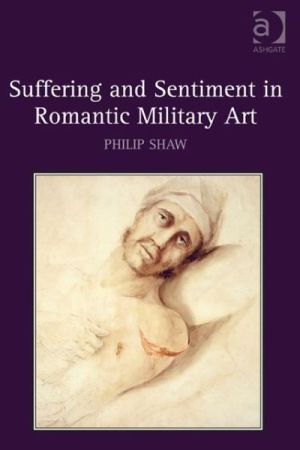 In a moving intervention into Romantic-era depictions of the dead and wounded, Philip Shaw’s timely study directs our gaze to the neglected figure of the common soldier. How suffering and sentiment were portrayed in a variety of visual and verbal media is Shaw’s particular concern, as he examines a wide range of print and visual media, from paintings to sketches to political prose and anti-war poetry, and from writings on culture and aesthetics to graphic satires and early photographs.
Whilst classical portraiture and history painting certainly conspired with official ideologies to deflect attention from the true costs of war, other works of art, literary as well as visual, proffered representations that countered the view that suffering on and off the battlefield is noble or heroic. Shaw uncovers a history of changing attitudes towards suffering, from mid-eighteenth century ambivalence to late eighteenth- and early nineteenth-century concepts of moral sentiment. Thus, Shaw’s story is one of how images of death and wounding facilitated and queried these shifts in the perception of war, qualifying as well as consolidating ideas of individual and national unanimity. Informed by readings of the letters and journals of serving soldiers, surgeons’ notebooks and sketches, and the writings of peace and war agitators, Shaw’s study shows how an attention to the depiction of suffering and the development of ‘liberal’ sentiment enables a reconfiguring of historical and theoretical notions of the body as a site of pain and as a locus of violent national imaginings.
Contents: Introduction; Seeing through tears I; Seeing through tears II; ‘Complicated woe’: British military art of the 1790s; All the news that’s fit to paint; Disgusting objects; images of wounding in the aftermath of war; Conclusion; Bibliography; Index.
Philip Shaw is Professor of Romantic Studies in the School of English at the University of Leicester, UK. His publications include Waterloo and the Romantic Imagination (2002) and, as editor, Romantic Wars: Studies in Culture and Conflict, 1793-1822 (2000).
Forthcoming Book | Roman Fever
Schedule for June release from Yale UP:
Richard Wrigley, Roman Fever: Influence, Infection, and the Image of Rome, 1700-1870 (New Haven: Yale University Press, 2013), 330 pages, ISBN: 978-0300190212, $75.
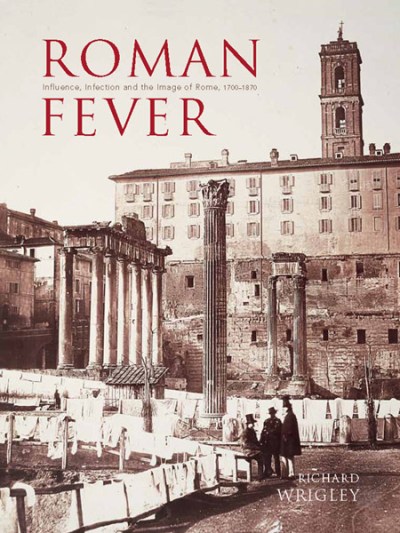 During the 18th and 19th centuries, artists and travellers were lured to Rome, the home of civilized values and artistic beauty. But the history of visiting Rome had a pathological side—not only crisis and disorientation but repulsion at its filth and stink. Rome’s air was considered to contain a chronic source of disease. This book argues that “bad air” (mal’aria) is a neglected aspect of thinking about the city’s history and as a destination for artists, visitors, and Romans both ancient and modern. These problems interfered with exploring Rome, its art and architecture, and representing its landscape. Atmospheric contamination made plein air painting and investigating antique ruins challenging activities.
Roman Fever invites an original and alternative perspective on the city and its countryside, revisiting the history of Rome in terms of ideas about climate and the role of the environment. Beautifully illustrated with unfamiliar images, it focuses on the interplay between enthusiasm and inspiration, and debilitation and mortality, all an integral part of discovering and engaging with the Eternal City’s landscape.
Richard Wrigley is professor of art history at the University of Nottingham.
New Title | The Oglethorpe Plan
From the University of Virginia Press:
Thomas D. Wilson, The Oglethorpe Plan: Enlightenment Design in Savannah and Beyond (Charlottesville: University of Virginia Press, 2012), 272 pages, ISBN 978-0813932903, $35.

ISBN 978-0813932903
The statesman and reformer James Oglethorpe was a significant figure in the philosophical and political landscape of eighteenth-century British America. His social contributions—all informed by Enlightenment ideals—included prison reform, the founding of the Georgia colony on behalf of the “worthy poor,” and stirring the founders of the abolitionist movement. He also developed the famous ward design for the city of Savannah, a design that became one of the most important planning innovations in American history. Multilayered and connecting the urban core to peripheral garden and farm lots, the Oglethorpe Plan was intended by its author to both exhibit and foster his utopian ideas of agrarian equality.
In his new book, the professional planner Thomas D. Wilson reconsiders the Oglethorpe Plan, revealing that Oglethorpe was a more dynamic force in urban planning than has generally been supposed. In essence, claims Wilson, the Oglethorpe Plan offers a portrait of the Enlightenment, and embodies all of the major themes of that era, including science, humanism, and secularism. The vibrancy of the ideas behind its conception invites an exploration of the plan’s enduring qualities. In addition to surveying historical context and intellectual origins, this book aims to rescue Oglethorpe’s work from its relegation to the status of a living museum in a revered historic district, and to demonstrate instead how modern-day town planners might employ its principles. Unique in its exclusive focus on the topic and written in a clear and readable style, The Oglethorpe Plan explores this design as a bridge between New Urbanism and other more naturally evolving and socially engaged modes of urban development.










 Enfilade
leave a comment