Exhibition | Behind Closed Doors: Art in the Spanish American Home
Now on view at the Brooklyn Museum:
Behind Closed Doors: Art in the Spanish American Home, 1492–1898
Brooklyn Museum, New York, 10 September 2013 — 12 January 2014
Albuquerque Museum of Art and History, New Mexico, 16 February — 18 May 2014
New Orleans Museum of Art, 20 June — 21 September 2014
The John and Mable Ringling Museum of Art, Sarasota, Florida, 17 October 2014 — 11 January 2015
Curated by Richard Aste
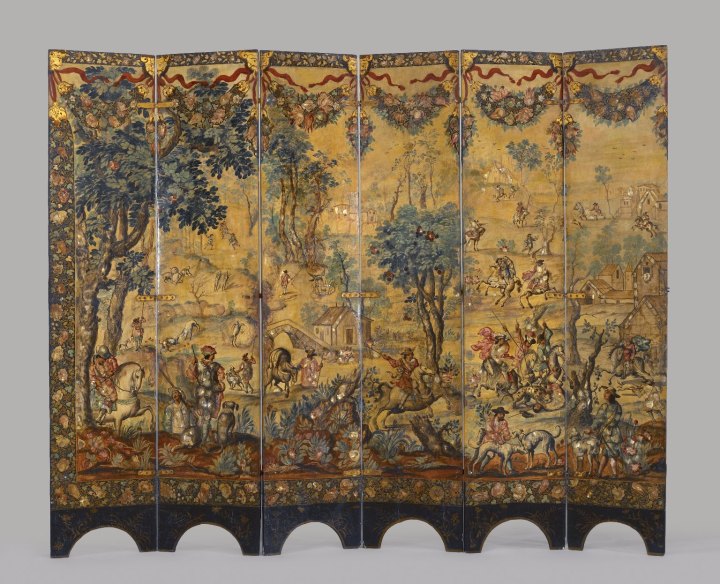
Screen with the Siege of Belgrade (front) and Hunting Scene (reverse,
as shown above). Mexico, ca. 1697–1701. Oil on wood, inlaid
with mother-of-pearl, 90 x 108 inches (Brooklyn Museum)
◊ ◊ ◊ ◊ ◊
The first major exhibition in the United States to explore the private lives, power struggles, and collecting practices of Spain’s New World elite brings together approximately 160 exceptional works in a wide range of media that illuminate conspicuous consumption and domestic display in the colonial era. Behind Closed Doors: Art in the Spanish American Home, 1492–1898 debuted at the Brooklyn Museum, where it will be on view through January 12, 2014, before traveling to three additional venues.
Included are paintings, manuscripts, prints, sculpture, decorative-arts objects, and textiles. The material demonstrates how colonial Spanish America’s new moneyed classes—including Spaniards, Creoles (Spaniards born in the New World), individuals of mixed race, and indigenous people—secured their social status through the spectacular private display of luxury goods from all over the world. The exhibition invites the visitor into an elite Spanish colonial home, beginning with more public reception rooms, hung with elaborately costumed family portraits and filled with fine imported and locally produced luxury goods, and ending with more private rooms, displaying objects that also spoke to the racial and social identity of their owners.
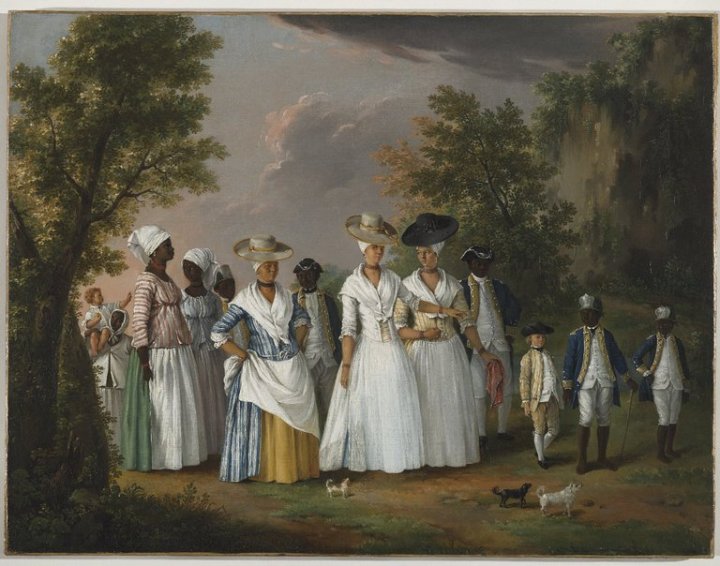
Agostino Brunias, Free Women of Color with Their Children
and Servants in a Landscape, ca. 1770–96. Oil on canvas,
20 x 26 inches (Brooklyn Museum)
◊ ◊ ◊ ◊ ◊
When the Spanish empire first expanded its borders into the Americas, the early conquistadors brought with them a rich artistic tradition, along with a monotheistic religion and an obsession with racial purity. Within a hundred years, fabulous fortunes had been amassed in the New World, thanks to the region’s abundant natural resources and robust market economy. Although Spanish America’s newly privileged class consisted of some of the wealthiest people in the world, the crown consistently favored those born in Spain for prominent local government and church positions, and political reforms in the eighteenth century further limited Creole power. In defiance, American-born elites responded by acquiring and ostentatiously displaying luxury goods from around the world in their dress and in their homes as pointed reminders of the crown’s reliance on New World resources. Their collections became more eclectic, including works by local artists and indigenous craftsmen as well as European masters.
Most of the objects in the exhibition are drawn from the Brooklyn Museum’s superb Spanish colonial holdings, supplemented by additional selections from the American, European, Asian, and Islamic collections as well as loans from public and private collections. For the first time in an exhibition in this country, Spanish colonial objects destined for the home will be paired with British American counterparts for purposes of comparison. The exhibition, which encompasses all of the New World under Spanish domination, calls attention to the Caribbean’s pivotal but, surprisingly, often overlooked role in Spanish American history.

José Joaquín Bermejo, Doña Mariana Belsunse y Salasar, ca. 1780 (Brooklyn Museum)
Among the exhibition highlights is a group of luxury objects from the viceroyalty of New Spain, which comprised present-day Mexico and Central America. One is a shell-inlaid and painted folding screen, or biombo enconchado, commissioned expressly for Mexico City’s viceregal palace about 1700 by Viceroy José Sarmiento de Valladares. This extremely rare, massive six-panel screen will be a focal point of the exhibition, along with a newly discovered late eighteenth-century neoclassical portrait by the mixed-race Puerto Rican painter José Campeche. Depicting twenty-one-year-old Doña Maria de los Dolores Gutiérrez del Mazo y Pérez, the painting commemorated her marriage to the future viceroy of New Granada.
Other objects in the exhibition include a pair of painted leather Peruvian chests from about 1690 decorated with allegories of the four elements, symbols of the zodiac, and a scene of a merry company dining outdoors; eighteenth-century Chinese export porcelain bearing the coat of arms of one of colonial Mexico’s leading families; an early sixteenth-century medallion Ushak carpet from Turkey of the type recorded in South American women’s sitting rooms; a late eighteenth-century polychromed wood portable tabernacle, adorned with the Virgin Mary and mirrors to reflect candlelight; Free Women of Color with Their Children and Servants in a Landscape, a portrait from about 1764–96 of members of the mixed-race elite in the British colony of Dominica by Italian painter Agostino Brunias; and Francisco de Goya’s monumental portrait of Peruvian-born Don Tadeo Bravo de Rivero, painted in Madrid in 1806.
The Brooklyn Museum began acquiring domestic Spanish colonial art in earnest in 1941 when Herbert J. Spinden, Curator of American Indian Art and Primitive Cultures, purchased approximately fourteen hundred art works from eight Latin American countries. The collection, which now ranks among the country’s finest, has been augmented with important recent acquisitions that are included in the exhibition.
◊ ◊ ◊ ◊ ◊
Programming at the Brooklyn Museum includes an afternoon roundtable:
Roundtable Discussion: Behind Closed Doors
Brooklyn Museum, Saturday, 16 November 2013, 11:30 a.m.–4 p.m.

Water Heater (Pava). Bolivia, 18th century, silver (Brooklyn Museum)
Join us for a day-long, bilingual roundtable discussion about calculated collecting practices in the colonial Americas, in celebration of the exhibition Behind Closed Doors: Art in the Spanish American Home, 1492–1898. The program begins with a morning session, in Spanish, on collecting for the home, moderated by Jorge F. Rivas Pérez, Curator of Colonial Art at the Colección Patricia Phelps de Cisneros. The afternoon session, in English, explores adorning the colonial body and will be moderated by Richard Aste, Curator of European Art at the Brooklyn Museum.
Collecting and signaling status through dress also connect with our fall exhibition The Fashion World of Jean Paul Gaultier: From the Sidewalk to the Catwalk.
Speakers include:
· Gustavo Curiel, Research Fellow, Instituto de Investigaciones Estéticas, Universidad Nacional Autónoma de México
· Maria Del Pilar Lopez Perez de Bejarano, Associate Professor, Instituto de Investigaciones Estéticas, Universidad Nacional de Colombia
· Barbara E. Mundy, Associate Professor of Art History, Fordham University
· Linda Rodríguez, Postdoctoral Fellow, Art History Department, New York University
· Caroline Weber, Associate Professor of French, Barnard College
· Luis Eduardo Wuffarden, independent Lima scholar and curator
This event is co-sponsored by the Brooklyn Museum and the Colección Patricia Phelps de Cisneros. Additional support provided by PAMAR’s eighth annual Latin American Cultural Week.
A box lunch will be available on the day of the event for $15. Museum Members receive free admission; call the Membership Hotline at (718) 501-6326 or email us for reservations.
◊ ◊ ◊ ◊ ◊
From Monacelli Press:
Richard Aste, ed., Behind Closed Doors: Art in the Spanish American Home, 1492–1898 (Monacelli Press, 2013), 224 pages, ISBN: 978-1580933650, $50.
 A critical contribution to the burgeoning field of Spanish colonial art, Behind Closed Doors reveals how art and luxury goods together signaled the identity and status of Spanish Americans struggling to claim their place in a fluid New World hierarchy.
By the early sixteenth century, the Spanish practice of defining status through conspicuous consumption and domestic display was established in the Americas by Spaniards who had made the transatlantic crossing in search of their fortunes. Within a hundred years, Spanish Americans of all heritages had amassed great wealth and had acquired luxury goods from around the globe. Nevertheless, the Spanish crown denied the region’s new moneyed class the same political and economic opportunities as their European-born counterparts. New World elites responded by asserting their social status through the display of spectacular objects at home as pointed reminders of the empire’s
dependence on silver and other New World resources.
The private residences of elite Spaniards, Creoles (American-born white Spaniards), mestizos, and indigenous people rivaled churches as principal repositories for the fine and decorative arts. Drawing principally on the Brooklyn Museum’s renowned colonial holdings, among the country’s finest, this book presents magnificent domestic works in a broad New World (Spanish and British) context. In the essays within, the authors lead the reader through the elite Spanish American home, illuminating along the way a dazzling array of both imported and domestic household goods. There, visitors would encounter European-inspired portraiture, religious paintings used for private devotion and also as signifiers of status, and objects that spoke to the owner’s social and racial identity.
◊ ◊ ◊ ◊ ◊
Karen Rosenberg reviewed the exhibition for The New York Times (19 September 2013)
New Book | The Museum of French Monuments 1795–1816
From Ashgate:
Alexandra Stara, The Museum of French Monuments 1795–1816: ‘Killing art to make history’ (Aldershot: Ashgate, 2013), 198 pages, ISBN: 978-1409437994, $100.
 The first volume in two centuries on Alexandre Lenoir’s Museum of French Monuments in Paris, this study presents a comprehensive picture of a seminal project of French Revolutionary cultural policy, one crucial to the development of the modern museum institution. The book offers a new critical perspective of the Museum’s importance and continuing relevance to the history of material culture and collecting, through juxtaposition with its main opponent, the respected connoisseur and theorist Quatremère de Quincy. This innovative approach highlights the cultural and intellectual context of the debate, situating it in the dilemmas of emerging modernity, the idea of nationhood, and changing attitudes to art and its histories.
Open only from 1795 to 1816, the Museum of French Monuments was at once popular and controversial. The salvaged sculptures and architectural fragments that formed its collection presented the first chronological panorama of French art, which drew the public; it also drew the ire of critics, who saw the Museum as an offense against the monuments’ artistic integrity. Underlying this localized conflict were emerging ideas about the nature of art and its relationship to history, which still define our understanding of notions of heritage, monument, and the museum.
Alexandra Stara is Reader in the History and Theory of Architecture at Kingston University, London.
Forthcoming Book | New Approaches to Naples, 1500–1800
Scheduled for November publication from Ashgate:
Melissa Calaresu and Helen Hills, eds., New Approaches to Naples c.1500–c.1800: The Power of Place (Aldershot: Ashgate, 2013), 264 pages, ISBN: 978-1409429432, $120.
 Early modern Naples has been characterized as a marginal, wild and exotic place on the fringes of the European world, and as such an appropriate target of attempts, by Catholic missionaries and others, to ‘civilize’ the city. Historiographically bypassed in favour of Venice, Florence and Rome, Naples is frequently seen as emblematic of the cultural and political decline in the Italian peninsula and as epitomizing the problems of southern Italy. Yet, as this volume makes plain, such views blind us to some of its most extraordinary qualities, and limit our understanding, not only of one of the world’s great capital cities, but also of the wider social, cultural and political dynamics of early modern Europe.
As the centre of Spanish colonial power within Europe during the vicerealty, and with a population second only to Paris in early modern Europe, Naples is a city that deserves serious study. Further, as a Habsburg dominion, it offers vital points of comparison with non-European sites which were subject to European colonialism. While European colonization outside Europe has received intense scholarly attention, its cultural impact and representation within Europe remain under-explored. Too much has been taken for granted. Too few questions have been posed.
In the sphere of the visual arts, investigation reveals that Neapolitan urbanism, architecture, painting and sculpture were of the highest quality during this period, while differing significantly from those of other Italian cities. For long ignored or treated as the subaltern sister of Rome, this urban treasure house is only now receiving the attention from scholars that it has so long deserved.
This volume addresses the central paradoxes operating in early modern Italian scholarship. It seeks to illuminate both the historiographical pressures that have marginalized Naples and to showcase important new developments in Neapolitan cultural history and art history. Those developments showcased here include both theoretical or methodological innovation and new empirical approaches. Thus this volume illuminates new models of cultural history designed to ask new questions of Naples and tell new stories that have implications beyond the Kingdom of Naples for the study of early modern Italy and, indeed, early modern Europe.
Melissa Calaresu is Lecturer in History at Gonville and Caius College, Cambridge; Helen Hills is Professor of the History of Art at the University of York.
◊ ◊ ◊ ◊ ◊
C O N T E N T S
Introduction
• Melissa Calaresu and Helen Hills, Between Exoticism and Marginalization: New Approaches to Naples
I: Disaster and Decline
• John Marino, Myths of Modernity and the Myth of the City: When the Historiography of Pre-modern Italy Goes South
• Helen Hills, Through a Glass Darkly: Material Holiness and the Treasury Chapel of San Gennaro in Naples
• Rose Marie San Juan, Contaminating Bodies: Print and the 1656 Plague in Naples
II: Topographies
• Harald Hendrix, Topographies of Poetry: Mapping Early Modern Naples
• Dinko Fabris, The Collection and Dissemination of Neapolitan Music, c.1600–1790
• Helena Hammond, Landed Identity and the Bourbon Neapolitan State: Claude-Joseph Vernet and the Politics of the ‘siti reali’
III: Exceptionality
• Paola Bertucci, The Architecture of Knowledge: Science, Collecting, and Display in 18th-Century Naples
• Melissa Calaresu, Collecting Neapolitans: The Representation of Street Life in Late 18th-Century Naples
• Anna Maria Rao, ‘Missed Opportunities’ in the History of Naples
Bibliography
Index
New Book | Collecting Chinese and Japanese Porcelain in Paris
Scheduled to appear in November from Getty Publications:
Stéphane Castelluccio, Collecting Chinese and Japanese Porcelain in Pre-Revolutionary Paris (Los Angeles: Getty Publications, 2013), 224 pages, ISBN 978-1606061398, $60.
 This beautifully illustrated volume traces the changing market for Chinese and Japanese porcelain in Paris from the early years of the reign of Louis XIV (1643–1715) through the eighteenth century. The increase in the quantity and variety of East Asian wares imported during this period spurred efforts to record and analyze them, resulting in a profusion of inventories, sales catalogues, and treatises. These contemporary sources—many never published before—provide a comprehensive picture of porcelains: when they were first available; what kinds were most admired during various periods; where and at what price they were sold; who owned them; and how they were displayed and used.
Over the course of these two centuries, a preference for blue-and-white Chinese works arranged in crowded, asymmetrical groupings gave way to symmetrical presentations of polychrome and monochrome Japanese pieces on brackets, tables, and mantelpieces, often mixed with bronzes, marble vases, and paintings. Some porcelains now received elaborate silver or gilt-bronze mounts. The illustrated pieces, which include pitchers, vases, lidded bowls, and writing sets, are drawn from the collections of the J. Paul Getty Museum, the Victoria and Albert Museum, and the Musée des Arts Décoratifs in Paris. Also included are exquisite porcelains from the Musée Guimet in Paris, many published here for the first time.
Stéphane Castelluccio is chargé de recherche at Le Centre National de la Recheche Scientifique (CNRS), Centre André Chastel, Paris. He is the author of Le Commerce du Luxe à Paris aux XVIIe et XVIIIe (Peter Lang, AG, 2009) and Les Fastes de la Galerie des Glaces (Payot, 2007).
Exhibition | A Queer History of Fashion
From The Museum at FIT:
A Queer History of Fashion: From the Closet to the Catwalk
The Museum at FIT, New York, 13 September 2013 — 4 January 2014
Curated by Fred Dennis and Valerie Steele

Man’s three piece silk velvet suit, 1790–1800, France
Museum purchase, 2010.98.1. Photo by Eileen Costa
A Queer History of Fashion: From the Closet to the Catwalk features approximately 100 ensembles, from 18th-century menswear styles associated with an emerging gay subculture to 21st-century high fashion. This is the first museum exhibition to explore in depth the significant contributions to fashion made by LGBTQ (lesbian-gay-bisexual-transgender-queer) individuals over the past 300 years.
Exhibition curators Fred Dennis, senior curator of costume, and Valerie Steele, director and chief curator of The Museum at FIT, spent two years researching and curating the exhibition. They worked with an advisory committee of eminent scholars, including professors George Chauncey (author of Gay New York), Shaun Cole (author of Don We Now Our Gay Apparel), Jonathan Katz (author/curator of Hide and Seek), Peter McNeil (co-editor of The Men’s Fashion Reader), and Vicki Karaminas (co-editor of the forthcoming Queer Style), as well as FIT faculty and fashion professionals.
“This is about honoring the gay and lesbian designers of the past and present,” said Dennis. “By acknowledging their contributions to fashion, we want to encourage people to embrace diversity.”
“We also hope that this exhibition will transform our understanding of fashion history,” added Steele. “For many years, gays and lesbians were hidden from history. By acknowledging the historic influence of gay designers, and by emphasizing the important role that fashion and style have played within the LGBTQ community, we see how central gay culture has been to the creation of modern fashion.”
From Cristobal Balenciaga and Christian Dior to Yves Saint Laurent and Alexander McQueen, many of the greatest fashion designers of the past century have been gay. Organized in roughly chronological order, the exhibition explores the history of modern fashion through the lens of gay and lesbian life and culture, addressing subjects including androgyny, dandyism, idealizing and transgressive aesthetic styles, and the influence of subcultural and street styles, including drag, leather, and uniforms.
The exhibition will trace how the gay vernacular styles changed after Stonewall, becoming increasingly “butch.” Lesbian style also evolved, moving from the ‘butch-femme’ paradigm toward an androgynous, anti-fashion look, which was, in turn, followed by various diversified styles that often referenced subcultures like punk. The AIDS crisis marks a pivotal mid-point in the exhibition. Clothing by a number of designers who died of AIDS, including Perry Ellis, Halston, and Bill Robinson, will be featured, as will a wide range of activist T-shirts for ACT UP, Queer Nation, the Lesbian and Gay Rights March in Washington and the iconic Read My Lips. Emphasizing that gay rights are human rights, the exhibition concludes with a section on gay wedding fashions as the sartorial expression of the issue of marriage equality.
Exhibition design is by Joel Sanders, well-known architect and author of Stud: The Architecture of Masculinity.
◊ ◊ ◊ ◊ ◊
From Yale UP:
Valerie Steele, ed., A Queer History of Fashion: From the Closet to the Catwalk (New Haven: Yale University Press, 2013), 248 pages, ISBN: 978-0300196702, $50.
 From Christian Dior to Yves Saint Laurent and Alexander McQueen, many of the greatest fashion designers of the past century have been gay. Fashion and style have played an important role within the LGBTQ community, as well, even as early as the 18th century. This provocative book looks at the history of fashion through a queer lens, examining high fashion as a site of gay cultural production and exploring the aesthetic sensibilities and unconventional dress of LGBTQ people, especially since the 1950s, to demonstrate the centrality of gay culture to the creation of modern fashion.
Contributions by some of the world’s most acclaimed scholars of gay history and fashion – including Christopher Breward, Shaun Cole, Vicki Karaminas, Jonathan D. Katz, Peter McNeil, and Elizabeth Wilson – investigate topics such as the context in which key designers’ lives and works form part of a broader ‘gay’ history; the ‘archeology’ of queer attire back to the homosexual underworld of 18th-century Europe; and the influence of LGBTQ subcultural styles from the trouser suits worn by Marlene Dietrich (which inspired Yves Saint Laurent’s ‘Le Smoking’) to the iconography of leather. Sumptuous illustrations include both fashion photography and archival imagery.
Valerie Steele is director and chief curator of The Museum at the Fashion Institute of Technology, New York.
New Book | From Marie-Antoinette’s Garden
As noted at Style Court and distributed by Rizzoli:
Élisabeth De Feydeau, edited by Alain Baraton with a foreword by Catherine Pegard, From Marie-Antoinette’s Garden: An Eighteenth-Century Horticultural Album (Paris: Flammarion, 2013), 240 pages, ISBN: 978-2080201423, $50.
 A horticultural tour of Marie-Antoinette’s domain, the lavishly constructed gardens at Versailles, accompanied by eighteenth-century archival illustrations. Plants, flowers, and trees were Marie-Antoinette’s passion; she transformed the Petit Trianon’s gardens into an enchanted escape from the oppressive shackles of Versailles. Based on archival documents, this book meanders through Marie-Antoinette’s estate as the queen herself would have walked it: traversing hyacinths, buttercups, and anemones in the French Gardens, via winding paths in the Anglo-Chinese Gardens, through the conifers of the Belvedere Gardens—where fabulous nocturnal parties were hosted—past the entrancing aromas of the shrubs surrounding the Temple of Love, to the wildflowers of the Garden of Solitude. This fascinating reconstruction includes descriptions of the cosmetic and medicinal uses of the garden’s plants, anecdotes from the royal court, and watercolors of the herbarium.
Historian and perfume specialist Élisabeth de Feydeau has published books on perfume. She teaches at the École des Parfumeurs in Versailles. Catherine Pégard is the president of the Établissement Public du Château, du Musée, et du Domaine National de Versailles.
New Book | Travel, Collecting, and Museums of Asian Art
While addressing the nineteenth century, Ting Chang’s new book will be of interest to many dix-huitièmistes, particularly in connection with Edmond de Goncourt; in chapter four, Chang explores how Goncourt’s collection of Asian art and his writings on the subject supported his larger vision of an eighteenth-century revival. It’s part of Ashgate’s series on the Histories of Material Culture and Collecting, 1700–1950:
Ting Chang, Travel, Collecting, and Museums of Asian Art in Nineteenth-Century Paris (Aldershot: Ashgate, 2013), 210 pages, ISBN: 978-1409437765, $100 / £55.
 Travel, Collecting, and Museums of Asian Art in Nineteenth-Century Paris book examines a history of contact between modern Europe and East Asia through three collectors: Henri Cernuschi, Emile Guimet, and Edmond de Goncourt. Drawing on a wealth of material including European travelogues of the East and Asian reports of the West, Ting Chang explores the politics of mobility and cross-cultural encounter in the nineteenth century. This book takes a new approach to museum studies and institutional critique by highlighting what is missing from the existing scholarship — the foreign labours, social relations, and somatic experiences of travel that are constitutive of museums yet left out of their histories. The author explores how global trade and monetary theory shaped Cernuschi’s collection of archaic Chinese bronze. Exchange systems, both material and immaterial, determined Guimet’s museum of religious objects and Goncourt’s private collection of Asian art. Bronze, porcelain, and prints articulated the shifting relations and frameworks of understanding between France, Japan, and China in a time of profound transformation. Travel, Collecting, and Museums of Asian Art in Nineteenth-Century Paris thus looks at what Asian art was imagined to do for Europe. This book will be of interest to scholars and students interested in art history, travel imagery, museum studies, cross-cultural encounters, and modern transnational histories.
Ting Chang teaches art history at the University of Nottingham. She has published in The Art Bulletin, Oxford Art Journal, and Les Cahiers Edmond et Jules de Goncourt.
C O N T E N T S
Introduction
1: The historical terms of Euro-Asian object acquisition
2: Gold, silver, and bronze: Cernuschi’s collection and re-appraisals of Europe and Asia
3: The labour of travel: Guimet and Régamey in Asia
4: Equivalence and inversion: France, Japan and China in Goncourt’s cabinet
Conclusion
Bibliography
Index
Exhibition | The Nude Male in Art
Press release masculin (1 July 2013) from the Musée d’Orsay:
Masculin / Masculin: L’homme nu dans l’art de 1800 à nos jours
Musée d’Orsay, Paris, 24 September 2013 — 2 January 2014
Curated by Ophélie Ferlier, Xavier Rey, Ulrich Pohlmann, and Tobias G. Natter

Pierre et Gilles, Mercury, 2001 © Pierre et Gilles (Courtesy Galerie Jérôme de Noirmont, Paris)
Jean-Baptiste Frédéric Desmarais, The Shepherd Paris, 1787 (Ottawa, National Gallery of Canada)
While it has been quite natural for the female nude to be regularly exhibited, the male nude has not been accorded the same treatment. It is highly significant that until the show at the Leopold Museum in Vienna in the autumn of 2012, no exhibition had opted to take a fresh approach, over a long historical perspective, to the representation of the male nude. However, male nudity was for a long time, from the 17th to 19th centuries, the basis of traditional Academic art training and a key element in Western creative art. Therefore when presenting the exhibition Masculine / Masculine, the Musée d’Orsay, drawing on the wealth of its own collections (with several hitherto unknown sculptures) and on other French public collections, aims to take an interpretive, playful, sociological and philosophical approach to exploring all aspects and meanings of the male nude in art. Given that the 19th century took its inspiration from 18th-century classical art and that this influence still resonates today, the Musée d’Orsay is extending its traditional historical range in order to draw a continuous arc of creation through two centuries down to the present day. The exhibition will include the whole range of techniques: painting, sculpture, graphic arts and, of course, photography, which will have an equal place in the exhibition.
To convey the specifically masculine nature of the body, the exhibition, in preference to a dull chronological presentation, takes the visitor on a journey through a succession of thematic focuses, including the aesthetic canons inherited from Antiquity, their reinterpretation in the Neo-Classical, Symbolist and contemporary eras where the hero is increasingly glorified, the Realist fascination for truthful representation of the body, nudity as the body’s natural state, the suffering of the body and the expression of pain, and finally its eroticisation. The aim is to establish a genuine dialogue between different eras in order to reveal how certain artists have been prompted to reinterpret earlier works. In the mid-18th century, Winckelmann examined the legacy of the divine proporzioni of the body inherited from Antiquity, which, in spite of radical challenges, still apply today having mysteriously come down through the history of art as the accepted definition of beauty. From Jacques-Louis David to George Platt-Lynes, LaChapelle and Pierre et Gilles, and including Gustave Moreau, a whole series of connections is revealed, based around issues of power, censorship, modesty, the boundaries of public expectation and changes in social mores.
Winckelmann’s glorification of Greek beauty reveals an implicit carnal desire, relating to men as well as women, which certainly comes down through two centuries from the “Barbus” group and from David’s studio, to David Hockney and the film director James Bidgood. This sensibility also permeates the turn of the 19th and 20th centuries as it questions its own identity, as we see in the extraordinary painting École de Platon [School of Plato], inexplicably purchased by the French state in 1912 from the Belgian artist Delville. Similarly, the exhibition will reveal other visual and intellectual relationships through the works of artists as renowned as Georges de La Tour, Pierre Puget, Abilgaard, Paul Flandrin, Bouguereau, Hodler, Schiele, Munch, Picasso, Bacon, Mapplethorpe, Freud and Mueck, while lining up some surprises like the Mexican Angel Zarraga’s Saint Sébastien [Saint Sebastian], De Chirico’s Les Bains mystérieux [Mysterious Baths] and the erotica of Americans Charles Demuth and Paul Cadmus.
This autumn therefore, the Musée d’Orsay will invite the visitor to an exhibition that challenges the continuity of a theme that has always interested artists, through unexpected yet productive confrontations between the various revivals of the nude man in art. The exhibition has been organised by the Musée d’Orsay in collaboration with the Leopold Museum in Vienna.
◊ ◊ ◊ ◊ ◊
The catalogue is published jointly by by the Musée d’Orsay and Flammarion:
Guy Cogeval, Claude Arnaud, Philippe Comar, Damien Delille, Ophélie Ferlier, Ulrich Pohlmann, Xavier Rey, Masculin / Masculin: L’homme nu dans l’art de 1800 à nos jours (Paris: Musée d’Orsay / Flammarion, 2013), 304 pages, ISBN: 978-2081310094, 40€.
 Masculin/Masculin montre combien les professions de foi esthétiques, dogmes et prises de position plastiques du XIXe siècle en matière de nudité masculine puisent leurs origines au classicisme du XVIIIe siècle et demeurent encore présents aujourd’hui. Les oeuvres y sont envisagées sous l’angle de l’histoire sociale et culturelle, ou des enjeux de politique actuelle concernant la redéfinition de la perception du corps, la permissivité dans sa représentation et son usage, son pouvoir et son intimité, ou encore du rapport entre les sexes et de l’évolution de la masculinité.
Véritable dialogue entre peintures, sculptures, arts graphiques et photographies, le catalogue tisse des liens entre les époques grâce à d’inattendues et fécondes confrontations, les oeuvres contemporaines apportant un éclairage nouveau sur les siècles précédents. L’éclectisme revendiqué dans le choix des oeuvres, sans pour autant occulter les représentations les plus douloureuses de l’homme nu, aboutit à une célébration de la beauté qui ne dissimule pas sa joie et à un plaisir trop longtemps passé sous silence alors même qu’il est indissociable du genre. L’originalité n’est donc pas recherchée pour elle-même, mais davantage érigée en sésame ouvrant à un renouvellement du regard porté sur des oeuvres parfois extrêmement célèbres, visant à bousculer des lectures et à créer des correspondances.
◊ ◊ ◊ ◊ ◊
Note (added 12 October 2013) — Doreen Carvajal, “With Money Tight, Museums Embrace Nudes,” The New York Times (11 October 2013).
. . . the crowds are coming [to the Musée d’Orsay], averaging more than 4,500 people a day, triple the amount for a show at the same time last year, according to museum figures. The exhibition — which includes works by Picasso and Edvard Munch as well as more contemporary nudes by David Hockney, Andy Warhol and Robert Mapplethorpe — has provoked a wide range of responses inside and outside France. “A confused show” the French daily newspaper Le Monde weighed in, “devoid of any historical reflection.” But the show still was the buzz of Paris Fashion Week. And Marie Claire, a women’s beauty magazine, anointed it the “hottest event” of autumn. And sizzle is what a number of major European institutions seek this fall, hoping that a focus on sex will entice visitors and broaden their appeal to younger generations and a demographic who are more likely to read Marie Claire than Le Monde. . .
The full article is available here»
New Book | Life in an Eighteenth-Century Country House
From Amberley:
Peter and Carolyn Hammond, Life in an Eighteenth-Century Country House (Stroud,
Gloucestershire: Amberley, 2012) 160 pages, ISBN 978-1445608655, £13.
 Grove House and its extensive estate in Chiswick were owned in the eighteenth century by Humphrey Morice, a not very successful politician and an animal lover. The story of the house has been reconstructed by Carolyn and Peter Hammond who have studied the country home for almost a decade.
A wealth of period detail comes from the rare survival of letters written by the head groom to the lord of the house while he was in Italy for his health. They are a window into the daily life on the estate, describing the rather turbulent relationships between the servants in the house and the sometimes exciting events from the outside world. There was an attempted armed robbery, the theft of the walnut crop and the arrival of the Poor Law officers from a neighbouring parish to attempt to force one of the stable lads to pay for an illegitimate child he had apparently fathered…
Here is real life in the country house during the period of English history, immortalized by the fiction of Jane Austen.
Forthcoming Book | The Pantheon: From Antiquity to the Present
Due next year from Cambridge UP:
Tod A. Marder and Mark Wilson Jones, eds., The Pantheon: From Antiquity to the Present (New York: Cambridge University Press, 2014), 350 pages, ISBN: 978-0521006361, $120.
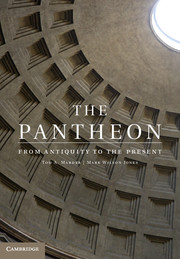 The Pantheon is one of the most important architectural monuments of all time. Thought to have been built by Emperor Hadrian in approximately 125 AD on the site of an earlier, Agrippan-era monument, it brilliantly displays the spatial pyrotechnics emblematic of Roman architecture and engineering. The Pantheon gives an up-to-date account of recent research on the best preserved building in the corpus of ancient Roman architecture from the time of its construction to the twenty-first century. Each chapter addresses a specific fundamental issue or period pertaining to the building; together, the essays in this volume shed light on all aspects of the Pantheon’s creation, and establish the importance of the history of the building to an understanding of its ancient fabric and heritage, its present state, and its special role in the survival and evolution of ancient architecture in modern Rome.
C O N T E N T S
1. Introduction, Tod A. Marder and Mark Wilson Jones
2. Agrippa’s Pantheon and its origin, Eugenio La Rocca
3. Dating the Pantheon, Lise M. Hetland
4. The conception and construction of drum and dome, Giangiacomo Martines
5. Sources and parallels for the design and construction of the Pantheon, Gene Waddell
6. The Pantheon builders: estimating manpower for construction, Janet DeLaine and Christina Triantafillou
7. Building on adversity: the Pantheon and problems with its construction, Mark Wilson Jones
8. The Pantheon in the Middle Ages, Erik Thunø
9. Impressions of the Pantheon in the Renaissance, Arnold Nesselrath
10. The Pantheon in the seventeenth century, Tod A. Marder
11. Neo-classical remodelling and reconception, 1700–1820, Susanna Pasquali
12. A nineteenth-century monument for the state, Robin B. Williams
13. The Pantheon in the modern age, Richard Etlin










leave a comment