New Book | Giambattista Crosato: Pittore del Rococò Europeo
From Artbooks.com:
Denis Ton, Giambattista Crosato: Pittore del Rococò Europeo (Verona: Scripta, 2013), 460 pages, ISBN: 9788896162385, $98.
 Giambattista Crosato (1697-1758) è stato pittore, frescante e scenografo operoso tra la Serenissima e il Piemonte sabaudo, attivo in alcuni dei luoghi simbolo della civiltà settecentesca europea: dalla palazzina di caccia di Stupinigi, al salone di Ca’ Rezzonico, alle ville venete. Autore di pannelli per boiseries come di grandi cicli ad affresco, Crosato è stato, fra i grandi veneziani di quel tempo, colui che meglio ha saputo interpretare in chiave personale lo stile del rococò internazionale, dialogando parimenti con la cultura piemontese negli anni di Beaumont e Giaquinto e proponendo una pittura “risoluta e bizzarra” – per riprendere le parole dei suoi contemporanei, fra le poche a proporsi quale alternativa alla grande maniera del genio del secolo, Giambattista Tiepolo.
Exhibition | Edges of Books
I regret that notice of this exhibition at RIT’s Cary Graphic Arts Collection slipped by me, but the catalogue is still available. -CH
◊ ◊ ◊ ◊ ◊
Edges of Books
Rochester Institute of Technology, Rochester, New York, 1 October — 14 December 2012
 Edges of Books examines a familiar form from an unfamiliar perspective. When books are on display it is usually their spines, covers, text, or illustrations that are featured. These are the familiar parts of the books—the parts that modern readers have come to interact with the most. Edges of Books takes a different approach, uncovering a tradition that extends back centuries in which the edges of books were important sites for information and decoration. A selection of artifacts from 1518 to the present will inspire visitors to view books in new and exciting ways.
Steven K. Galbraith, Edges of Books: Specimens of Edge Decoration from RIT Cary Graphic Arts Collection (Rochester: RIT Press, 2012), 74 pages, ISBN: 978-1933360690, $17.
Steven K. Galbraith is Curator of the Melbert B. Cary, Jr. Graphic Arts Collection. He has a Ph.D. in English Literature from Ohio State University and an M.L.S. from the University at Buffalo. Prior to coming to RIT, he was the Andrew W. Mellon Curator of Books at the Folger Shakespeare Library in Washington, D.C. and the Curator of Early Modern Books and Manuscripts at the Ohio State University. He is the author of works on early English printing, English Renaissance literature, rare book librarianship, and book conservation and digitization.
Exhibition | British Drawings from the Cleveland Museum of Art
Some of the offerings for those of you who will be in Cleveland next month for ASECS. From the museum’s website:
British Drawings from the Cleveland Museum of Art
Cleveland Museum of Art, 8 February — 26 May 2013
The British drawings at the Cleveland Museum of Art have received less attention than the renowned Italian and French drawings but are eminently worthy of such. The collection includes works by some of the best-known artists in the history of English art, such as Thomas Gainsborough, William Blake, J. M. W. Turner, and Edward Burne-Jones. Important recent acquisitions include a highly finished wash drawing exemplary of John Flaxman’s neoclassical style, an 18th-century double-portrait in pastel by Daniel Gardner, and a watercolor in pristine condition describing the Surrey countryside at sunset by Samuel Palmer. The exhibition features approximately 50 works from the collection along with a small group of loans from private collections, ranging from the 18th century through the Edwardian period, and will be accompanied by a collection catalogue. This is the inaugural exhibition of a new series exploring highlights from the Cleveland Museum of Art’s collection of drawings.
◊ ◊ ◊ ◊ ◊
From the publisher:
Heather Lemonedes, British Drawings: The Cleveland Museum of Art (London: D. Giles, 2013), 152 pages, 978-1907804229, $45.
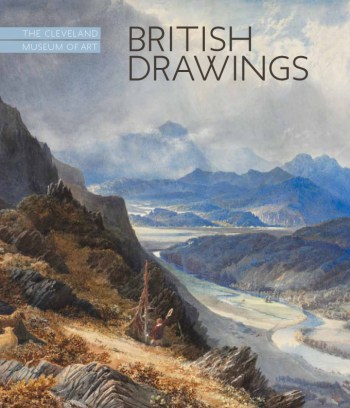 This volume, the first in a new series, presents outstanding drawings from the permanent collection of works on paper at the Cleveland Museum of Art. It features 50 highlights, along with a small group of loans from private collections, ranging from the 18th century through to the Edwardian period. Fragile and light sensitive, opportunities to see such treasures are rare and for that reason are all the more to be celebrated. Many are published here for the first time, such as Francis Cotes’s breathtaking portrait of Lady Mary Radcliffe and an exquisite female nude drawn in coloured chalk by William Mulready.
Heather Lemonedes is curator of Drawings at the Cleveland Museum of Art. Prior to her arrival at the museum in 2002, she worked as a specialist in the Print Department at Christie’s, New York and supervised the Print Study Room at the Metropolitan Museum of Art, New York. She was awarded a Samuel H. Kress
Foundation Travel Fellowship in the History of Art for
research on her dissertation, “Paul Gauguin’s Volpini
Suite,” in 2004.
Exhibition | Stradivarius at the Ashmolean
From the Ashmolean Museum:
Stradivarius
Ashmolean Museum, Oxford, 13 June — 11 August 2013

Ashmolean Museum, Oxford. Photo by Merlin Cooper, 2005, Wikimedia Commons
Antonio Stradivari (c.1644–1737) – or Stradivarius as he is usually known – is the only maker of musical instruments whose name ranks alongside those of the great composers. For the first time will twenty of his instruments, from guitar to cello to violin, be on display together in the UK. While the details of his life are not as familiar as those of Vivaldi or Mozart, his name succeeds in evoking a creative genius in the popular imagination. The Ashmolean’s summer 2013 exhibition will feature twenty of the world’s most important musical instruments, some of which have never been shown in public, on loan from international collections: from the early Silvestre violin of 1666, to the Fountaine violino piccolo, the Boissier-Sarasate of 1713, to his later violins of the 1730s. It will also show a recreation of Stradivarius’s workshop where visitors will be able to follow the creation of a violin from a log of spruce through to the finished instrument.
◊ ◊ ◊ ◊ ◊
From ACC Distribution:
Charles Beare, Peter Beare and Jon Whiteley, Stradivarius (Oxford: Ashmolean Museum, 2013), 200 pages, ISBN:
9781854442758, $40.
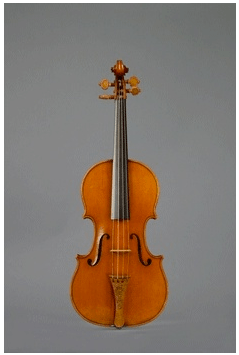 Antonio Stradivari is, perhaps, the only maker of violins who ranks alongside Van Gogh and Turner as an artist. A household name to many, he is associated with secret formulae and mystical processes ensuring his instruments are sought after by the world’s greatest soloists. He excites controversy, although none of his violins have raised so much heated debate as the Ashmolean’s Messiah, making headline news some ten years ago when doubt was cast on its age. Stradivari’s birthplace is unknown, he may have been born in 1644, and even his apprenticeship to Nicola Amati is uncertain. He died rich and famous in Cremona in 1737. Since then his instruments have increased in fame and are now regarded as supreme examples of the violin-maker’s craft. Despite the great fame of Stradivari’s violins, there has never been a monographic exhibition of his work in the UK. It will include 30 instruments, representative of Stradivari’s range and output across the years, alongside exceedingly rare examples of stringed instruments other than those of the violin family.
The prize items to be featured in the exhibition are already in the Ashmolean: The Potter, The Messiah and the guitar of 1688, all works of the greatest rarity. The exhibition and the accompanying catalogue will allow the public to see the work of one of the greatest violin makers of all time. Stradivarius also presents the most recent research on Stradivarius’ instruments.
Contents: Introduction by James Ehnes; essay on Stradivarius by Charles Beare; essay on Stradivarius’ work including dendrachronology of the instruments; “The luthier’s perspective: How Stradivari violins are built and what makes them so good?” by Peter Beare; catalogue entries; technical information.
Charles and Peter Beare are directors at the successful violin dealers Beares. Peter is a qualified luthier. Jon Whiteley is the Senior Assistant Keeper in the Department of Western Art, specializing in paintings drawings and musical instruments.
◊ ◊ ◊ ◊ ◊
From Music at Oxford:
The Dawn of the Stradivarius with James Ehnes and La Serenissima
Sheldonian Theatre, Oxford, 14 June 2013
 In association with The Ashmolean Museum’s extraordinary forthcoming exhibition of the world’s finest Stradivarius instruments, Music at Oxford is proud to present this collaborative concert. Canadian virtuoso and Stradivarius player James Ehnes will perform unaccompanied music by Bach and Paganini on a number of Stradivarius violins and discuss what’s unique about them and the sound they produce. This will be the first time one player has ever had the opportunity to do so in a concert setting. Award-winning period ensemble La Serenissima will follow this by performing a programme of music from the age of Stradivarius by Vivaldi, Valentini and their contemporaries.
This event will open the exhibition, a fascinating exploration of the master maker’s work featuring the largest collection of Stradivarius instruments ever assembled as well as audiovisual footage featuring James Ehnes. Don’t miss this exciting event, our 2012-13 season closer. Tickets are bound to be in great demand so please do book early.
Thoughts on Paper: A Blog and a Book
Those of you taken by the materiality of paper may be interested in Lucy Vivante’s blog posting from 15 January 2013 on Paper and Watermarks, in which she interviews Neil Harris and Peter Bower. And if the distance between those traditions of making and our own dependence upon screens leaving you feeling elegiac, you might have a look at Ian Sansom’s new book. -CH
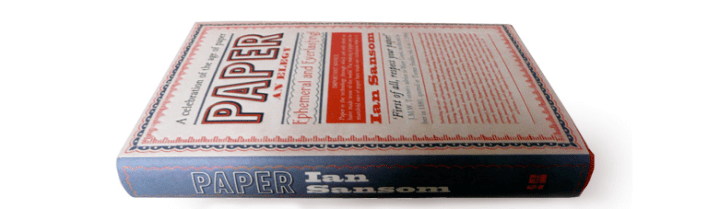
Ian Sansom, Paper: An Elegy (London: Fourth Estate, 2012), 224 pages, ISBN: 978-0007480265, $25.
The history of civilization is bound up with — and bound in — the history of paper. Paper is the technology through which and with which we make sense of the world: knowledge and information is arranged in words, images and numbers on paper; values and ideas are exchanged and transmitted by paper. The making of paper, the trade in it, the use of it, brought about a new era in human civilization.
That era is coming to an end. In 2010, Amazon announced that for the first time it was selling more e-books than paper books. According to Nicholas Negroponte, founder of MIT′s Media Lab, the paper book has five years left to live before becoming extinct. The world we know was made from paper: yet everywhere you look, paper is dying, its influence literally disintegrating.
In Paper: An Elegy Ian Sansom traces the history of paper-making from the 7th-century Chinese workmen who made paper from the inner bark of plants and trees, to the 17th-century vatmen and couchers who dipped and shook and dried paper moulds to make folios and quartos, to today′s billion-dollar paper industry; from papyrus to e-books. Both a cultural overview and a series of warm, personal meditations on the history and meaning of paper in all its forms – as both a means of communication and as an artefact in itself – this book is a lively valediction to the paper it′s printed on.
Forthcoming Book | Stretch: America’s First Family of Clockmakers
From ACC Distribution:
Donald L. Fennimore & Frank L. Hohmann with Onie Rollins, Stretch: America’s First Family of Clockmakers (Winterthur Museum, 2013), 376 pages, ISBN: 978-0912724706, $75.
 This volume presents the definitive history of the UK-born Stretch family of clockmakers who emigrated to Philadelphia in 1703 and played an influential role in the city’s early clockmaking, civic, and Quaker communities. Initial essays discuss the family and the importance of their Quaker beliefs; time-telling and the clockmaking community in pre-1750 Philadelphia; innovative mechanical advances made by the Stretches; and their notable civic and cultural contributions to the city.
The catalog section of the book features 84 of the 133 Peter, Thomas, and William Stretch clocks discovered during the course of the project, illustrating and fully describing both the cases and the works. The majority of the clocks, passed down through the generations and still in private collections, are being published for the first time.
C O N T E N T S
Foreword, Acknowledgments, Introduction
Chapter 1 – Time and Telling Time in Early Philadelphia
Chapter 2 – Peter Stretch and Family
Chapter 3 – Stretch Clocks and the Philadelphia Clockmaking Community before 1750
Catalogue: Peter Stretch Clocks, Nos. 1 – 62; Thomas Stretch Clocks, Nos. 63 – 78; William Stretch Clocks, Nos. 79 – 84
Appendix 1 – Peter Stretch Will and Inventory
Appendix 2 – Thomas Stretch Will and Inventory
Appendix 3 – Samuel Stretch Will and Inventory
Appendix 4 – Clock Owners in Philadelphia, 1684 – 1750
Appendix 5 – Stretch Signature Plates: A Comparison
Appendix 6 – Stretch Clocks: A Comparison
Appendix 7 – Identified Stretch Clocks
Appendix 8 – Genealogy
Endnotes, Bibliography, Index
Donald L. Fennimore, Curator Emeritus, served as metalwork specialist at Winterthur Museum, Delaware, for 34 years. The list of his numerous publications includes Metalwork in Early America (Winterthur, 1996); Iron at Winterthur (Winterthur, 2004); and Silversmiths to the Nation: Thomas Fletcher and Sidney Gardiner (ACC, 2007).
Frank L. Hohmann III, a retired Wall Street executive, is a collector of 18th-century furniture, with a concentration on brass dial clocks. He co-authored and published the volume Timeless: Masterpiece American Brass Dial Clocks (2009). He is a Trustee of Winterthur Museum, Delaware and a Liveryman in the Worshipful Company of Clockmakers.
New Book | Le Ciseau et la Tiare: Les Sculpteurs dans la Rome des Papes
From Publications de l’École Française de Rome:
Anne-Lise Desmas, Le ciseau et la tiare : les sculpteurs dans la Rome de Benoît XIII, Clément XII et Benoît XIV, 1724-1758 (Rome: École Française de Rome, 2012), 471 pages, ISBN: 978-2728309405, 50€ / $95. [available from Artbooks.com]
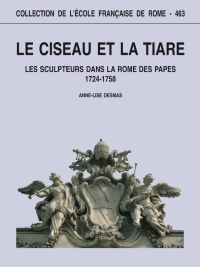 L’image monumentale de la Ville éternelle, des statues de la fontaine de Trevi ou de la façade du Latran à celles des fondateurs d’ordres dans la nef de Saint-Pierre, a été largement façonnée par les sculpteurs des pontificats de Benoît XIII, Clément XII et Benoît XIV. Pourtant, ces artistes, tels Maini, Bracci et Della Valle, restent méconnus.
C’est ce grand atelier et ses acteurs que cet ouvrage fait revivre, entrelaçant recherches monographiques et études sociales, reconstitutions de carrières, enquêtes sur les institutions artistiques et examen stylistique des œuvres.
Cette approche globale prend en compte tous les rouages de ce vaste chantier sculptural, du transport du marbre à la composition des décors éphémères, de la restauration d’antiques aux concours, des commandes privées de monuments funéraires à l’organisation des grands chantiers, souvent dominés par la figure de l’architecte. Elle examine aussi différents milieux, dont celui de l’Académie de France où brillent Adam et Bouchardon, et retrace le parcours romain de sculpteurs italiens, tels le Napolitain Benaglia, le Florentin Cornacchini ou le Vénitien Corradini.
Ces années, entre Rusconi et Canova, restent dominées par le poids de la tradition héritée du siècle de Bernin. Or c’est l’un des paradoxes que cherche à élucider cette étude : pourquoi la Rome des Lumières n’a-t-elle pas laissé émerger l’un de ces artistes qui, incontestablement talentueux, lui assurèrent une abondante et remarquable production sculpturale ?
The table of contents is available as a PDF here»
New Book | Architecture & Tradition Académique au Temps des Lumières
Basile Baudez, Architecture & tradition académique au temps des Lumières (Presses Universitaires de Rennes, 2013), 390 pages, ISBN: 978-2753521223, 24€.
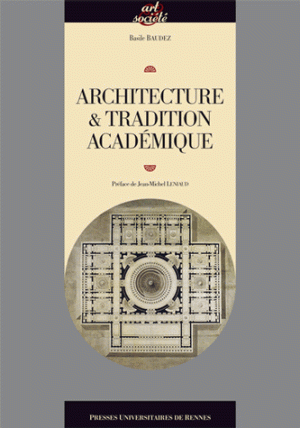 Dans le système des beaux-arts, l’architecture, en tant qu’art utile, a toujours occupé une place singulière. Issue des arts du dessin, elle côtoyait sur un pied d’égalité la peinture et la sculpture dans les premières académies fondées par les humanistes de la Renaissance. Ces institutions connurent leur âge d’or au siècle des Lumières dans le domaine des sciences, des lettres et des arts. Les académies artistiques d’Europe se définissaient comme des cercles professionnels, des organes de consultation pour le pouvoir politique et des écoles visant à transmettre un certain nombre de principes esthétiques.
Elles jouèrent un rôle crucial pour la structuration de la profession architecturale, l’établissement de normes théoriques et la diffusion de la pratique de l’expertise dans l’Europe classique. Cet ouvrage examine pour la première fois la manière dont ce modèle propre au monde occidental, si décrié à la fin du XIXe siècle, a donné naissance dans la seconde moitié du XVIIIe siècle à la profession moderne d’architecte et à une façon de concevoir l’art de bâtir qui est encore la nôtre.
Basile Baudez, archiviste paléographe, agrégé d’histoire, est maître de conférences en histoire du patrimoine moderne et contemporain à l’université Paris-Sorbonne. Ses recherches portent sur l’histoire de l’architecture européenne de l’époque classique.
A full description is available at Le Blog de L’ApAhAu.
Exhibition | Journeys to New Worlds: Spanish and Portuguese Art
Now on at the Philadelphia Museum of Art:
Journeys to New Worlds: Spanish and Portuguese
Colonial Art from the Roberta and Richard Huber Collection
Philadelphia Museum of Art, 16 February — 19 May 2013
Curated by Mark A. Castro and Joseph J. Rishel
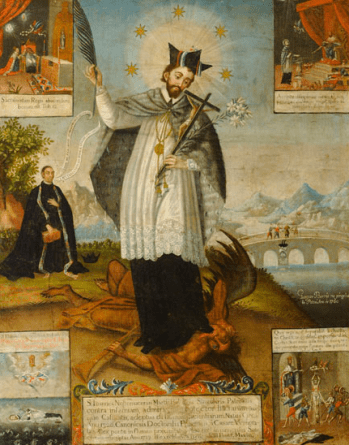
Gaspar Miguel de Berrío, Saint John of Nepomuk, 1760, oil on canvas, 40 x 32 inches (103 x 82 cm)
With a rare group of paintings, decorative arts, and sculptures from the collection of Roberta and Richard Huber, Journeys to New Worlds explores the artistic exchanges between Spain and Portugal and their colonies in the Americas and Asia during the seventeenth and eighteenth centuries. This unique combination of rich visual traditions offers viewers a glimpse into the fascinating history and global influence of Iberian colonial art.
The exhibition includes paintings by Melchor Pérez Holguín (c. 1665–after 1724) and Gaspar Miguel de Berrío (1706–after 1764), two prolific artists from the city of Potosí, Bolivia. Berrío’s Our Lady of Mount Carmel with Bishop Saints of 1764 displays the artist’s ability to present European imagery in a new regional style, emphasizing sumptuous textiles and lush colors. Other paintings on view feature objects of popular devotion, among them the anonymously painted Our Lady of Pomata, which depicts a dressed sculpture of the Virgin Mary housed in a sanctuary on the shores of Lake Titicaca, Peru.

Coquera (Coca Box), Bolivia, first half of the eighteenth century; silver, repoussé, chased and burnished, 9 x 11 x 10 inches (23 x 29 x 26 cm) Roberta and Richard Huber Collection
Potosí sits at the foot of the Cerro Rico (Rich Hill), known for its abundant silver mines, which funded the Spanish empire for many years. The mines also fueled a great metalworking tradition that produced decorative objects for church, public, and domestic use. Among the silver works included in this show are an eighteenth-century coquera (a box used for storing coca leaves) and an elaborately decorated altar plaque.
Sophisticated ivory sculptures created in the Iberian colonies in Asia (the Portuguese colonies of Goa, on the western shores of India, and Ceylon, the modern nation of Sri Lanka; as well as the Spanish-controlled Philippines) are another integral part of the Huber collection. These carved works depict Catholic themes, yet the refined, Asiatic features of the figures show the direct influence of native artistic traditions.
Roberta and Richard Huber began collecting in the 1970s, when the study of Iberian colonial art was in its infancy in the United States. They have purchased works over the years based on their own changing interests, enjoying the thrill of discovering new objects as much as the works themselves. Embodying the passionate interests of two individuals, their collection is one of a handful focused on this material in the country. Journeys to New Worlds celebrates their enthusiasm and reflects the Philadelphia Museum of Art’s continuing commitment to promoting the arts of Latin America.
The exhibition is generously supported by The Annenberg Foundation Fund for Exhibitions, the Arlin and Neysa Adams Endowment, Paul K. Kania, and Mr. and Mrs. Reinaldo Herrera. The catalogue is made possible by The Andrew W. Mellon Fund for Scholarly Publications at the Philadelphia Museum of Art and by Furthermore: a program of the J.M. Kaplan Fund.
Curated by Mark A. Castro, Exhibition Coordinator, and Joseph J. Rishel, The Gisela and Dennis Alter Senior Curator of European Painting before 1900, and Senior Curator of the John G. Johnson Collection and the Rodin Museum.
◊ ◊ ◊ ◊ ◊
From Yale UP:
Edited by Suzanne L. Stratton-Pruitt, with Mark A. Castro, Journeys to New Worlds: Spanish and Portuguese Colonial Art in the Roberta and Richard Huber Collection (New Haven: Yale University Press, 2013), 204 pages, ISBN: 978-0300191769, $60.
Contributions by Luisa Elena Alcalá, David L. Barquist, Mark A. Castro, Margarita M. Estella Marcos, Enrique Quispe Cueva, Joseph J. Rishel, Jorge F. Rivas P., and Suzanne L. Stratton-Pruitt
 This beautifully illustrated catalogue showcases 120 Spanish and Portuguese artworks from the seventeenth and eighteenth centuries, all highlights from the dazzling collection of Roberta and Richard Huber. Featuring works in a variety of mediums and from far-flung places, including paintings, silver, and furniture from South America and sculptures in ivory from the Spanish Philippines and from Portuguese territories in India. Distinguished experts shed light on these significant objects, many of which have not been previously published and which illustrate the unparalleled artistic exchanges between and within these colonial empires. The Andean painters Melchor Pérez Holguín and Gaspar Miguel de Berrío inventively interpreted European iconographies, while similar adaptations took place in Asia, where native craftsmen, carved Christian images in ivory. These works traveled along the trade routes connecting Europe to Asia and the Americas, thus influencing the development of a new visual culture.
Suzanne L. Stratton-Pruitt is an independent scholar specializing in Spanish and Spanish colonial art. Mark A. Castro is an Exhibition Coordinator at the Philadelphia Museum of Art.
Forthcoming | Rediscovering the Ancient World on the Bay of Naples
From Yale UP:
Carol C. Mattusch, ed., Rediscovering the Ancient World on the Bay of Naples, 1710-1890 (New Haven: Yale University Press, 2013), 292 pages, ISBN: 9780300189216, $70.
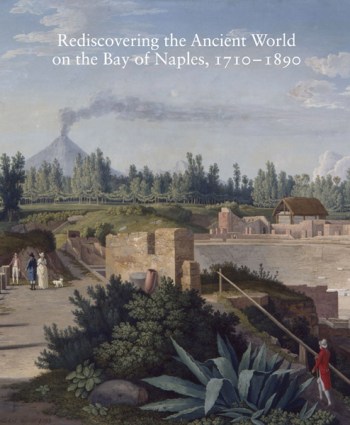 The ancient Roman cities of Pompeii and Herculaneum, buried by the eruption of Mount Vesuvius in 79 C.E., drew international attention when excavations commenced in the 1730s. As a result, the nearby city of Naples became a nexus of scholarship, cultural diplomacy, and tourism. This fascinating book examines responses to the excavations by 18th- and 19th-century monarchs, statesmen, scholars, and archaeologists, as well as by artists, architects, designers, writers, and tourists.
Essays by leading art historians and archaeologists chronicle the exploitation of the sites through excavation, publication, and museum display, and discuss the wider influence of the recovered objects and architectural remains on art and design in Italy, France, Germany, and Britain. Unlike other publications that focus on the archaeological artifacts and their documentation, this extensively illustrated book presents the discoveries from
the standpoint of how they were understood at the time.
Carol C. Mattusch is Mathy Professor of Art History in the Department of History and Art History at George Mason University.
◊ ◊ ◊ ◊ ◊
C O N T E N T S
Elizabeth Cropper, Preface
Carol C. Mattusch, Introduction
Alain Schnapp, The Antiquarian Culture of Eighteenth-Century Naples as a Laboratory of New Ideas
Jens Daehner, The Herculaneum Women in Eighteenth-Century Europe
Christopher Parslow, The Sacrarium of Isis in the Praedia of Julia Felix in Pompeii in Its Archaeological and Historical Contexts
Carlo Knight, Politics and Royal Patronage in the Neapolitan Regency: The Correspondence of Charles III and the Prince of San Nicandro, 1759–1767
John E. Moore, “To the Catholic King” and Others: Bernardo Tanucci’s Correspondence and the Herculaneum Project
Steffi Roettgen, German Painters in Naples and Their Contribution to the Revival of Antiquity, 1760–1799
Sophie Descamps-Lequime, The Ferdinand IV Donation to the First Consul and His Wife: Antiquities from the Bay of Naples at Malmaison
Nancy H. Ramage, Flying Maenads and Cupids: Pompeii, Herculaneum, and Eighteenth-Century Decorative Arts
Bruce Redford, Grecian Taste and Neapolitan Spirit: Grand Tour Portraits of the Society of Dilettanti
Eric M. Moormann, Literary Evocations of Herculaneum in the Nineteenth Century
Mary Beard, Taste and the Antique: Visiting Pompeii in the Nineteenth Century
John Pinto, “Speaking Ruins”: Piranesi and Desprez at Pompeii
Eugene J. Dwyer, Pompeii versus Herculaneum










 Enfilade
1 comment