Exhibition | Piranesi’s Paestum: Master Drawings Uncovered
Press release for the exhibition Piranesi’s Paestum, now on at the Soane Museum:
Piranesi’s Paestum: Master Drawings Uncovered
Sir John Soane’s Museum, London, 15 February — 18 May 2013
Tchoban Foundation, Museum for Architectural Drawing, Berlin, 1 June – 31 August 2013
The Morgan Library and Museum, New York, 23 January – 17 May 2015
Curated by Jerzy Kierkuć-Bieliński
 An exhibition of Giovanni Battista Piranesi’s last great graphic project, the highly finished Paestum drawings, is now on view at Sir John Soane’s Museum, London, deepening understanding of the graphic artist whose work has influenced designers from Escher to the makers of the Harry Potter films, and shedding new light on the considerable impact of his work on 18th-century architectural taste. For the very first time since Piranesi’s death, all seventeen drawings will be shown together, uniting the fifteen drawings from Sir John Soane’s Collection with those from the collections of the Bibliothèque nationale de France, Paris, and Amsterdam’s Rijksmuseum. The Paestum drawings were the preparatory work for Piranesi’s Différentes Vues de Pesto finished by his son Francesco and published posthumously in 1778. They depict views of the three great Doric temples in the former Greek colony of Poseidonia, colonised by the Romans and re-named Paestum.
Left abandoned, and later cut off by a malarial swamp, the ruins of the colony were rediscovered in 1746 during the construction of a new road. Its massive and well-preserved Doric temples dedicated to Poseidon, Hera and Athena sparked renewed interest among artists and architects including the celebrated Giovanni Battista Piranesi and inspired drawings, prints, paintings and models which revolutionised understanding of early Greek Classical architecture.
As well as exploring Piranesi’s complex perspectives, the Master Drawings Uncovered exhibition will examine Soane’s relationship with the artist, architect and antiquarian and the influence that visiting Paestum and experiencing Piranesi’s work had on his architecture and teaching. Those wishing to explore Piranesi’s techniques for themselves, will also be able to participate in an evening course and a range of Piranesi-inspired workshops, running alongside the exhibition.

The Paestum drawings are highly unusual in Piranesi’s portfolio. Although the artist usually made preparatory drawings for his famous etchings, much of the composition was often worked directly on to the copper plate at the engraving stage. These drawings contain a level of detail very close to the finished prints, and it is thought that perhaps, aware of his failing health, Piranesi included as much detail as possible for his son Francesco to finish the work he had begun. He uses the full repertoire of his draughtsmanship to create images that both accurately describe the architecture of the Paestum temples and bring out their evocative, rustic setting. Multi-layering of pencil, brown and grey washes and pen and ink, sometimes with the addition of red chalk or white chalk highlights, creates a layered effect which can be compared to the repeated bitings in the resulting etchings. The rough paper used by Piranesi is analogous with the travertine used to construct the temples – echoing its pitted and eroded texture. He also uses the scena per angolo – a feature of Ferdinando Bibiena’s theatrical scenery designs – to give a unique perspective to the drawings; replacing the traditional, central vanishing point with diagonal axes to heighten the three-dimensionality of the temples and add to their dramatic impact.
The Paestum drawings in the Soane collection were purchased by Sir John Soane at auction in March 1817 for £14.5.0, as part of a sale by antiquarian Charles Lambert. It is not known how they came to be in his collection. Dr Jerzy Kierkuć-Bieliński, curator of Master Drawings Uncovered, looks forward to welcoming visitors to a significant exhibition of Piranesi’s work: “We’re delighted to be able to present a focused exhibition which celebrates the impeccable quality and influence of a small selection of drawings. Although six of the Soane drawings have been exhibited in the Die Graber von Paestum exhibition (2007–08) in Hamburg and Berlin, they have never been viewed by the public un-framed, and no exhibition has ever been devoted to their display as a discrete grouping. The fifteen drawings in Soane’s collection have been displayed in the Picture Room of No.13 Lincoln’s Inn Fields, but their position, in Soane’s ingenious picture planes, has not allowed close scrutiny. We hope that the conservation and academic research resulting from the exposure of the drawings will throw considerable light on their history and the architectural legacy left by Giovanni Battista Piranesi.”
Images courtesy of the Trustees of Sir John Soane’s Museum
Top: Exterior of the Temple of Neptune from the North-East
Bottom: Interior of the Temple of Neptune from the West
◊ ◊ ◊ ◊ ◊
From the Soane Museum’s shop:
John Wilton-Ely, Piranesi, Paestum, & Soane (London: Prestel, 2013), 112 pages, ISBN: 978-3791348063, £25.
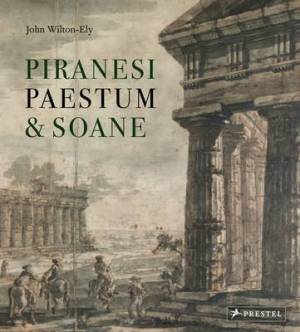 To celebrate the launch of our exhibition Piranesi’s Paestum: Master Drawings Uncovered, the Soane is proud to bring you the accompanying exhibition book, Piranesi Paestum & Soane, beautifully produced in hardback with full colour pictures and illustrations. This newly reprinted and updated book by John Wilton-Ely [the first edition of which appeared in 2002] examines Soane’s extensive collection of Piranesi’s work which Soane incorporated into his theatrical displays at his Lincoln’s Inn home, connecting Piranesi’s own dramatic visions of Paestum with his revivalist architectural practice.
Architect and printmaker, Giovanni Battista Piranesi was a lifelong champion of Rome, publishing more than 1000 etchings of the Eternal City and it’s ancient monuments. When Sir John Soane and Piranesi met they formed a profound and complex, creative and intellectual relationship that nurtured Soane’s later career. Among Soane’s greatest legacies are the preparatory drawings Piranesi developed for a publication on the Greek temples at Paestum.
Mantel on “Royal Bodies”
From the Editor
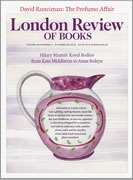 Hilary Mantel’s talk, “Undressing Anne Boleyn,” at the British Museum (4 February 2013), published as “Royal Bodies” in the London Review of Books (21 February 2013), has occasioned considerable discussion in the UK, thanks to the comments of the two-time Booker Prize recipient regarding the role of Kate Middleton, Duchess of Cambridge, and her body in British society. With no intentions of fanning the flames of the controversy, I thought it might nonetheless be of interest to Enfilade readers, particularly since Marie Antoinette serves as one source for the argument (whatever one makes of Mantel’s engagement with history, I’m repeatedly gobsmacked by her writing and the views offered into the past). From the LRB article:
Marie Antoinette was a woman eaten alive by her frocks. She was transfixed by appearances, stigmatised by her fashion choices. Politics were made personal in her. Her greed for self-gratification, her half-educated dabbling in public affairs, were adduced as a reason the French were bankrupt and miserable. It was ridiculous, of course. She was one individual with limited power and influence, who focused the rays of misogyny. She was a woman who couldn’t win. If she wore fine fabrics she was said to be extravagant. If she wore simple fabrics, she was accused of plotting to ruin the Lyon silk trade. . . .
 Mantel’s first novel, A Place of Greater Safety — finished in 1979 but not published until 1992 — addresses not Tudor England but Revolutionary France, imagining the lives of Georges-Jacques Danton, Maximilien Robespierre, and Camille Desmoulins. Larissa MacFarquhar brilliantly profiled Mantel in the fall in “The Dead Are Real,” for The New Yorker (15 October 2012). And in terms of the current controversy, Jenny Hendrix, writing for The Los Angeles Times Books (19 February 2013), offers a sampling of the response in the British media. Here, I give the last words to Mantel:
It may be that the whole phenomenon of monarchy is irrational, but that doesn’t mean that when we look at it we should behave like spectators at Bedlam. Cheerful curiosity can easily become cruelty. It can easily become fatal. We don’t cut off the heads of royal ladies these days, but we do sacrifice them, and we did memorably drive one to destruction a scant generation ago. History makes fools of us, makes puppets of us, often enough. But it doesn’t have to repeat itself. In the current case, much lies within our control. I’m not asking for censorship. I’m not asking for pious humbug and smarmy reverence. I’m asking us to back off and not be brutes. . .
New Book | Portraiture and British Gothic Fiction
From Johns Hopkins University Press:
Kamilla Elliott, Portraiture and British Gothic Fiction: The Rise of Picture Identification, 1764–1835 (Baltimore: Johns Hopkins University Press, 2012), 352 pages, ISBN: 978-1421407173, $60.
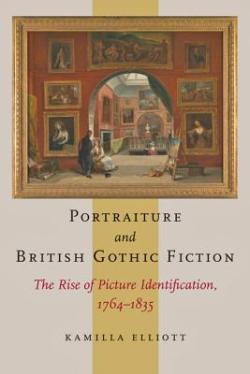 Traditionally, kings and rulers were featured on stamps and money,the titled and affluent commissioned busts and portraits, and criminals and missing persons appeared on wanted posters. British writers of the eighteenth and nineteenth centuries, however, reworked ideas about portraiture to promote the value and agendas of the ordinary middle classes. According to Kamilla Elliott, our current practices of “picture identification” (driver’s licenses, passports, and so on) are rooted in these late eighteenth- and early nineteenth-century debates.
Portraiture and British Gothic Fiction examines ways writers such as Horace Walpole, Ann Radcliffe, Mary Shelley, and C. R. Maturin as well as artists, historians, politicians, and periodical authors dealt with changes in how social identities were understood and valued in British culture—specifically, who was represented by portraits and how they were represented as they vied for social power.
Elliott investigates multiple aspects of picture identification: its politics, epistemologies, semiotics, and aesthetics, and the desires and phobias that it produces. Her extensive research not only covers Gothic literature’s best-known and most studied texts but also engages with more than 100 Gothic works in total, expanding knowledge of first-wave Gothic fiction as well as opening new windows into familiar work.
Kamilla Elliott is senior lecturer at Lancaster University and is author of Rethinking the Novel/Film Debate.
Exhibition | Beauty and Revolution: Neoclassicism 1770-1820

Press release from the Städel Museum:
Beauty and Revolution: Neoclassicism 1770-1820
Städel Museum, Frankfurt, 20 February — 26 May 2013
Curated by Eva Mongi-Vollmer and Maraike Bücklingy
A comprehensive special exhibition presented by Frankfurt’s Städel Museum from 20 February to 26 May 2013 will highlight the art of Neoclassicism and the impulses it provided for Romanticism. Developed in collaboration with the Liebieghaus Skulpturensammlung, the show Beauty and Revolution will assemble about one hundred works of the period from 1770 to 1820 by such artists as Anton Raphael Mengs, Thomas Banks, Antonio Canova, Jacques-Louis David, Bertel Thorvaldsen, Johann Gottfried Schadow, and Jean-August-Dominique Ingres. The major survey, whose range also comprises a number of impressive examples of ‘Romantic Neoclassicism’, will be the first in Germany to convey an idea of the variety of the different and sometimes even contradictory facets of this style.
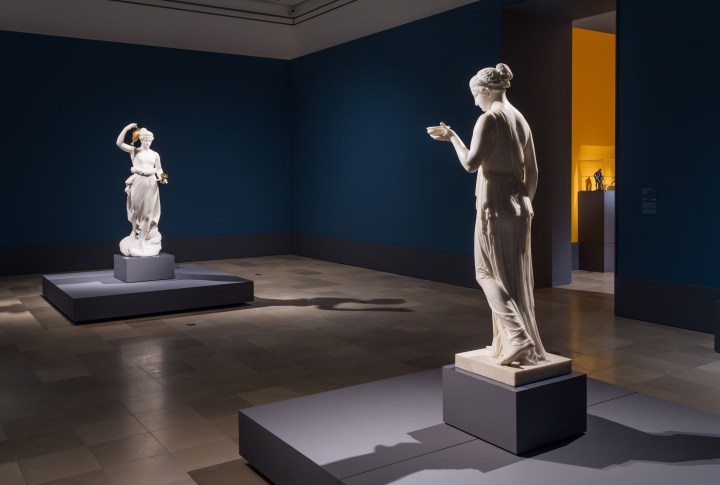 Based on significant sculptures, paintings, and prints from collections in many countries, the exhibition will explore the decisive influence of classical antiquity on the artists of the era. Struggling for a socially relevant art, the artists directed their attention to the aesthetics of Greek and Roman art as well as to their virtues and moral standards conveyed by history and mythology. It will become evident how the viewer could be addressed in many different ways. Two famous marble sculptures of the Greek goddess Hebe, for example, will be confronted with each other in Frankfurt for the first time: a variant by Antonio Canova (1796, The State Hermitage Museum, Saint Petersburg) and another by Bertel Thorvaldsen (designed in 1806, Thorvaldsens Museum, Copenhagen). The two masterpieces have again and again been compared and judged, yet never exhibited together since their creation.
Assembling a wide range of works from Gavin Hamilton’s and Henry Fuseli’s innovative solutions to central works by Antonio Canova and Jacques-Louis David as well as Bertel Thorvaldsen’s masterpieces of ‘Romantic Neoclassicism’, the Städel Museum’s major spring exhibition offers an extensive survey of Neoclassicist art and demonstrates the unexpected vitality of an era often classified as static.
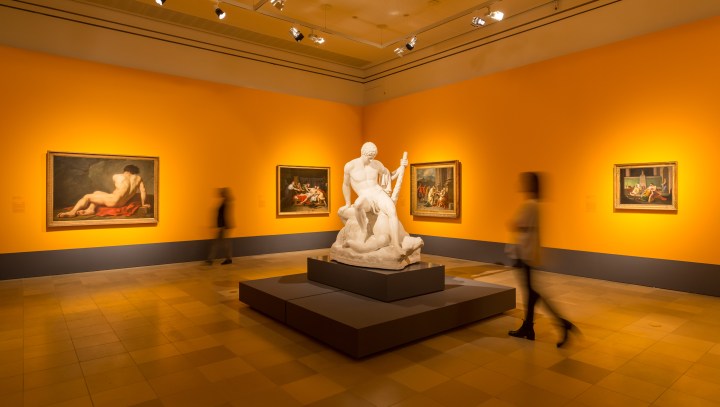 The various aspects of Neoclassicism will be explored along three lines in the Städel’s exhibition. Disregarding a few exceptions, the selection of numerous loans focuses on the production of art in the city of Rome that was considered the first address for studying the ancient world by many artists, writers, and theorists around 1800 and became a center of the art world of that time. The second emphasis of the show is on representations of historical and mythological scenes. In search of a model for moral standards of behavior, the artists fathomed the core of what features as human in the ancient world’s myths, which they read as poetry without religious implications. Jacques-Louis David’s painting The Oath of the Horatii, for example – of which an oil sketch from the holdings of the Louvre in Paris will be presented in the exhibition – upholds a timelessly valid moral code, yet also relates to current political events. The show exemplifies how contemporary motifs increasingly found their way into the range of themes dealt with by Neoclassicist art. The third chapter explores an issue connected with this development, namely how feelings and passions were depicted in Neoclassicist works of art. Artists like Canova or David rendered emotions and pathos in a way unfamiliar to their contemporaries, a way which manifested itself mainly in their figures’ body language. Contrary to the Baroque era, it was not the representation of affectations that artists were primarily concerned with any longer, but internalized emotions in which the viewer was to immerse himself. The artists also clearly detached themselves from the pathos of the ancient world in this way: Canova’s sculpture Theseus and the Minotaur (1783, Museo e Gipsoteca Antonio Canova, Possagno), for example, primarily deals with the aspect of reflection after Theseus’s victory and the hero’s moral consciousness.
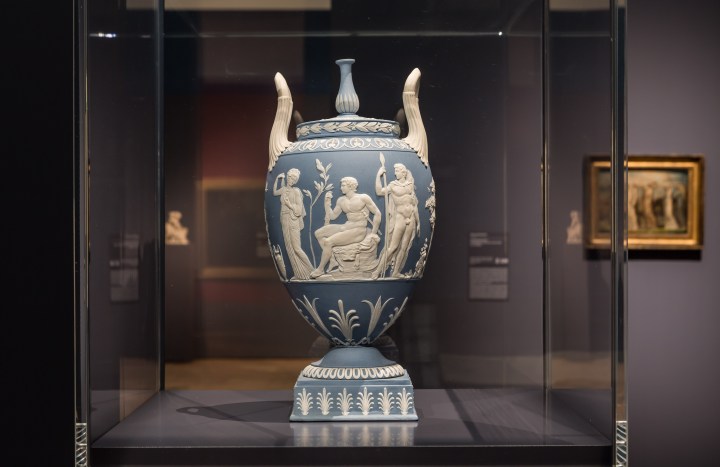
Extending across the Städel’s entire Exhibition House, the generously conceived special exhibition begins with the imposing confrontation of the two famous representations of the goddess Hebe by Antonio Canova (1800–05) and Bertel Thorvaldsen (1815–23) on the ground floor. The difference between Canova’s cupbearer hurrying near on a cloud and involved in what is going on and Thorvaldsen’s introverted musing female illustrates the whole stylistic range of Neoclassicist art at the very beginning. Picking up the thread of this confrontation, the presentation in the large ground floor hall impressively visualizes the turbulent development of Neoclassicism until about 1870. The tour starts with a selection of plaster cast and bronze reproductions of antique sculptures dating from the late eighteenth and early nineteenth centuries; these reproductions particularly illustrate the canon of classical antiquity emphasized by the archaeologist and art historian Johann Joachim Winckelmann (1717–68). Artists staying in Rome initially incorporated these famous reproductions into their works as directly as possible. In those years, the return to the ancient world frequently implied a criticism of contemporary systems of rule, especially of the courtly and ecclesiastical formal language of the Baroque age. Anton Raphael Mengs’s appropriation of classical antiquity was of such an extreme degree that the artist was even able to deceive Winckelmann who described Mengs’s fresco Jupiter Kissing Ganymede (1758–59, Galleria Nazionale d’Arte Antica, Palazzo Barberini, Rome) as an original of classical antiquity in one of his writings.
The following section comprises the rebellious works of a group of artists who also lived in Rome for some time, yet felt not inclined to follow Winckelmann’s credo of “noble simplicity and quiet grandeur” – though they too thoroughly studied the antique models. They aimed at capturing the viewer’s attention by dramatizing their subjects, even if this meant putting up with exaggeration and distortion. The English sculptor Thomas Banks (1735–1805) – see his The Falling Titan (1786, Royal Academy of Arts, London) – was one this group’s artists as was the Swiss-born Henry Fuseli (1741–1825), whose Achilles Sacrificing his Hair on the Funeral Pyre of Patroclus (1800–05) from the Kunsthaus in Zurich is included in the exhibition.
The shown works by Antonio Canova (1757–1822) and Jacques-Louis David (1748–1825) and his pupils then ushered in a definitely calmer approach to the motifs rendered. They are characterized by formal austerity and a deliberately pointed dramatic composition. However, both the sculptor Canova and the painter David relied on completely new pictorial and iconographic means for drawing on antique subjects and attitudes – means that were to inform subsequent generations of artists all over Europe.
The presentation on the second floor of the Exhibition House highlights how the new iconography developed not least in response to the political context of the time and particularly the French Revolution. Jacques-Louis David immortalized the dead Marat as the revolution’s first martyr, for example: the exhibition comprises a version by David and his workshop (Musée national des châteaux de Versailles et de Trianon, Versailles) as well as by Joseph Roques (1793, Musée des Augustins, Toulouse).
The works in the following room strikingly illustrate that the young art also held a revolutionary potential in terms of form: the sophisticatedly simplified scenes visualized by the sculptor John Flaxman (1755–1826) in his drawings and engravings, for example, are based on an astounding abstraction. Their reduction to mere contours was to create a furore all over Europe.
The adjacent room sheds light on the slow, yet far-reaching change in the artists’ attitude toward the ancient world that occurred around 1800. The unreachability of its ideal made itself felt with increasing weight. This implied a growing abandonment of its norms on the part of the artists, whereas the viewer was granted more leeway for interpretation. The protagonist’s internalization also came to play a more important role in what was going on in the picture. Consequently, masterpieces such as Bertel Thorvaldsen’s Ganymede (1819–21, Thorvaldsens Museum, Copenhagen) are categorized as works of ‘Romantic Neoclassicism’ today.
The various tendencies brought forth by Neoclassicism within the first decades after 1800 become increasingly clear in the last room of the exhibition. In spite of all discrepancies between the various artists’ decisions, they shared a common denominator in looking for new ways to leave Neoclassicism behind. The idea of the ancient world was regarded with increasing detachment, unconventionally transformed, and largely ignored by more and more nineteenth-century artists. All in all, the exhibition unfolds the age of Neoclassicism as a surprisingly manifold and lively stylistic epoch whose unconditional desire for renewal and improvement became a breeding ground for Romanticism in its return to classical antiquity.
Exhibition photos by Norbert Miguletz
◊ ◊ ◊ ◊ ◊

Maraike Bückling and Eva Mongi-Vollmer, eds., Schönheit & Revolution: Klassizismus 1770-1820 (Munich: Hirmer, 2013), 392 pages, ISBN: 978-3777470115, €40 / $85. — available from Artbooks.com.
A comprehensive catalogue edited by Maraike Bückling and Eva Mongi-Vollmer will be published by Hirmer to accompany the exhibition. It will include contributions by Sergej Androsov, David Bindman, Maraike Bückling, Werner Busch, Christian M. Geyer, Alexander Kaczmarczyk, Thomas Kirchner, Eva Mongi-Vollmer, Johannes Myssok, and Marjorie Trusted. German.
Forthcoming | European Painted Cloths, 1400-2000
While most of the papers from this June 2012 Courtauld conference addressed earlier material, there were some eighteenth-century offerings. The collection of essays is due out in June.
◊ ◊ ◊ ◊ ◊
From ACC Distribution:
Christina Young and Nicola Costaras, European Painted Cloths, 1400-2000: Pagentry, Ceremony, Theatre and Domestic (Archetype Publications, 2013), 196 pages, ISBN: 9781904982906, $140.
 The conference papers in this volume explore the use of painted cloths in religious ceremony, pageantry, domestic interiors and scenic art, focussing on their change of context and significance from the fourteenth to the twenty-first centuries and examining their different function, materials, and method of creation. The potential for large sizes, portability, and versatility for religious objects including banners, hangings, altarpieces, and palls was the impetus for the emergence of fabrics as a painting support in Western art in the Middle Ages. The functionality of the works explains the survival of relatively few examples. One of the most common forms of interior decoration for centuries, painted cloths have received less attention from art historians and historians than they deserve in part due to their poor survival. Scenic backcloths were once commissioned for court functions, part of an elaborate display of royal power and magnificence. The same methods and materials continued to be used for theatrical cloths.
New Book | The Cast Gallery of the Ashmolean Museum
Though the Ashmolean’s collection of plaster casts was assembled in the late nineteenth century, some pieces date to the eighteenth century. Anyone interested in the subject should also consult Donna Kurtz, The Reception of Classical Art in Britain: An Oxford Story of Plaster Casts from the Antique (British Archaeological Reports, 2000).
◊ ◊ ◊ ◊ ◊
From ACC Distribution:
R.R.R. Smith and Rune Frederiksen, The Cast Gallery of the Ashmolean Museum: Catalogue of Plaster Casts of Greek and Roman Sculpture (Oxford: Ashmolean Museum, 2013), 360 pages, ISBN: 9781854442666, $30.
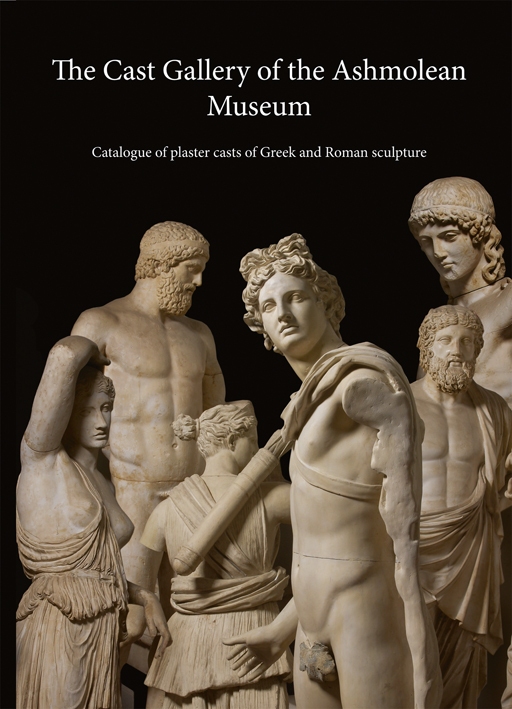 The Cast Gallery of the Ashmolean Museum contains the premier collection of plaster casts of Greek and Roman sculpture in the UK, formed over more than a century, from 1884 to the present. The collection has recently been re-displayed and integrated with the Museum, and this book is its first complete and illustrated catalogue. It presents 1,000 casts of monuments from all over the ancient world, from 600 BC to AD 500, from small bronzes to iconic monuments such as the Laokoon and the Augustus of Prima Porta.
Exhibition | Italian Soup Tureens
Notice of this exhibition at the Hotel Villa Zuccari slipped by me last year, but I see that the catalogue is available from artbooks.com. Eighteenth-century pieces are the minority, but February has me thinking about soup! -CH
◊ ◊ ◊ ◊ ◊
From Good Morning Umbria:
Le Zuppiere dal XVIII al XX Secolo: Collezione Paolo Zuccari
Villa Zuccari, San Luca di Montefalco (Perugia), 22 June — 30 September 2012
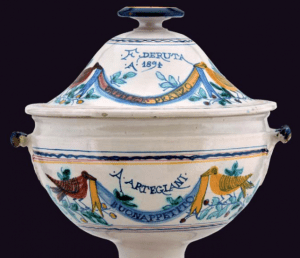 Negli ultimi anni il collezionismo privato ha avuto un notevole sviluppo e gioca un ruolo importante nella nostra cultura e società, in quanto consente di salvaguardare beni di valore artistico, storico e culturale. E’ proprio questo il caso della Collezione di zuppiere di Paolo Zuccari che annovera oltre 500 esemplari alcuni dei quali sono pezzi della fine del ‘700 ed altri –il nucleo principale- dell’800 e del ‘900 di provenienza tutta italiana, dalla Lombardia, all’Emilia Romagna, dalla Toscana all’Umbria alle Marche , agli Abruzzi, dalla Campania al Molise ed alla Puglia. Collezione questa molto originale se si pensa che il collezionista , dopo aver trasformato la sua residenza in un relais a quattro stelle, si è dedicato alla catalogazione di questa sua passione. “Tutti mi chiedono perché, come e quando ho iniziato a collezionare zuppiere.” afferma Paolo Zuccari. “La risposta è semplice, dopo aver vissuto per trenta anni in questa casa, ora Hotel Villa Zuccari, dopo aver sposato Daniela ed avere avuto la prima figlia Federica, ho deciso di andare a vivere a Spoleto dove è nata Lorenza. In occasione di tale trasferimento, per la verità un po’ sofferto, ho portato con me solo poche cose e pochi ricordi della mia casa natale, ma fra queste poche cose c’erano alcune zuppiere. Da queste prime zuppiere, forse per nostalgia, è iniziato il desiderio o la mania di comperarne altre e via via ho iniziato a collezionarle” . Ce ne sono di bellissime e di particolarissime, per esempio la zuppiera realizzata nel 1894 da Angelo Artegiani di Deruta, in cui si legge un cartiglio con l’iscrizione “Buon Appetito” , sicuramente eseguita per qualche ricorrenza speciale. (more…)
Exhibition | Antoine Watteau: The Music Lesson
From the exhibition press materials:
Antoine Watteau (1684–1721): The Music Lesson
BOZAR (Palais des Beaux-Arts), Brussels, 8 February — 12 May 2013
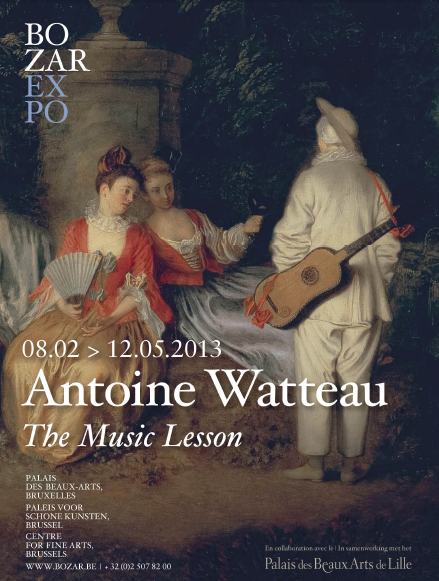 BOZAR EXPO presents, in cooperation with the Palais des Beaux-Arts de Lille, a major interdisciplinary project consisting of an ambitious exhibition, various concerts and debates, devoted to a great French master of the early 18th century, Antoine Watteau, with a particular focus on the musical scenes frequently depicted in the painter’s work. The exhibition’s general curator, the renowned orchestral conductor William Christie, is also at the heart of a cycle of eight concerts that will evoke the sensual atmosphere of Watteau’s canvases.
In the spring of 2013 BOZAR is presenting the first exhibition in Belgium to be devoted to Antoine Watteau (1684–1721). This not only offers an opportunity to see a number of his works; moreover, it sets his pictures to music; it also highlights the correspondence between the arts that was at the heart of his work as an artist. Almost a third of Watteau’s works feature musicians. Born to a humble family, he was a short-lived star of French 18th-century painting, dying at the early age of 37. Despite his short life and limited oeuvre, Watteau’s elegance and
genius left their mark on European art.
Antoine Watteau, father of the fêtes galantes
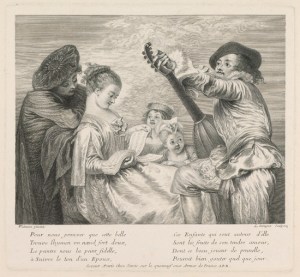
Louis Surugue after Antoine Watteau, The Music Lesson, etching. © Bibliothèque nationale de France
Little is known about his years of training in his native Valenciennes, a town that was open to both Flemish and French influences, as it only became attached to France in 1678. We can, however, be sure of the importance of his master, Claude Gillot (1673–1722). It was through him that Watteau, the “fils du Nord,” discovered Italian painting and the Commedia dell’Arte, which meant so much to him, even though he would never make the journey to Italy.
Watteau passed the bulk of his career in Paris, towards the end of the reign of the Sun King and during the Regency, a period in which the French capital experienced an aesthetic ferment and a renewed commercial enthusiasm for art. It was in that context that, in the 1720s, Watteau became a protégé of Pierre Crozat (1661–1740), one of his great patrons. Crozat helped to bring into being a musical circle in which both Italian and French music were acclaimed. His collection also helped Watteau to find himself as an artist, as he enthusiastically copied drawings it contained by Flemish and Venetian masters (Rubens, Van Dyck, Titian, and Campagnola). Their attention to colour, movement, and sensuality fascinated the young artist, who drew on those qualities to create a new style, less grandiloquent and less formal, imbued with a feigned lightness and an unprecedented elegance.
So there is nothing fortuitous about the presence of other disciplines – theatre, dance, and music, in particular – in Watteau’s paintings. They are very much present in the figures depicted in the fêtes galantes, whose language he invented: scenes of intimacy, conversation, and music set in an enclosed natural setting in which the human condition plays with appearances. Are we looking at aristocrats who have put on the costumes of actors or at theatrical scenes reconstructed in a bucolic setting? Watteau explores, as no one had done before him, a free combination of theatrical characters, whom he places away from the stage, somewhere between life and playing a role. Music is never far away in these fêtes galantes. The titles of works such as La Leçon de musique, Le Concert amoureux, and L’Accord parfait are highly evocative in this context.

Antoine Watteau, L’Enchanteur Huile sur cuivre (Troyes: Musée
des Beaux-Arts) © RMN-Grand Palais – © Jean Schormans
Antoine Watteau (1684–1721): The Music Lesson
The exhibition, which has a particular focus on the musical aspect of Watteau’s painting, brings together a unique selection of fifteen of the artist’s canvases and thirty of his drawings, some of which have not been seen by the European public for more than 50 years. It also presents fifty engravings by his contemporaries, including François Boucher, Benoît Audran II, and Charles-Nicolas Cochin, who produced the finest engravings of the 18th century and spread Watteau’s art throughout Europe. Thanks to them, we have reproductions of paintings of his that have since been lost and it is possible to offer an almost complete overview of his work. This unprecedented combination of original paintings, drawings, and engravings, as well as archival material, scores, and musical instruments of the same period, is a first. The exhibition itinerary is organised chronologically and thematically. The visitor first discovers the silent dimension of Watteau’s art and is thus better placed to appreciate its various musical tones later in the exhibition. The aesthetic experience is heightened as the visitor is immersed in the music of the time thanks to the audioguides and several listening points throughout the exhibition circuit. A special room is set aside for free concerts given by students of various Belgian and French conservatories on Thursday evenings. The intervention by Dirk Braeckman, leading Belgian photographer with an international reputation, establishes connections between Watteau’s work and contemporary art.
For additional information, including lenders, room texts, and programming details, see the 28-page press booklet (PDF).
◊ ◊ ◊ ◊ ◊
Note (added 20 March 2013): The catalogue is available through Artbooks.com:
Florence Raymond, ed., Antoine Watteau (1684-1721): La leçon de musique (Paris: Skira Flammarion, 2013), 272 pages, ISBN: 978-2081295834, $87.50.
New Book | A History of Eighteenth-Century German Porcelain
From ACC Distribution:
Christina Nelson with Letitia Roberts, A History of Eighteenth-Century German Porcelain: The Warda Stevens Stout Collection (Hudson Hills Press, 2013), 568 pages, ISBN: 978-1555953881, $95.
 A History of Eighteenth-Century German Porcelain is a descriptive catalog of the remarkable holdings of the Dixon Gallery and Gardens in Memphis—holdings donated by Warda Stevens Stout and considered to be among the most important in the world. The book is one of the first in English to describe in captivating detail the artisans, aesthetics, social and political intrigue, financial arrangements, and courtly ambitions that resided in porcelain factories at Ansbach, Frankenthal, Fürstenberg, Höchst, Ludwigs-burg, Meissen, Nymphenburg, and Thüringen.
Contents: Foreword – Kevin Sharp; Acknowledgments – Christina Nelson; The Collector Warda Stevens Stout – Letitia Roberts; A History of Eighteenth-Century German Porcelain – Christina Nelson; Introduction; Meissen; Ansbach; Berlin; Frankenthal; Fürstenberg; Fulda; Höchst; Ludwigsburg; Nymphenburg; Thuringia; Overview – Closter Veilsdorf; Gotha; Limbach; Volkstedt; Vienna; Selected List of German Porcelain from The Warda Stevens Stout Collection; Bibliography.
Christina H. Nelson is an independent scholar based in Champaign, Illinois. She has been a curator at Greenfield Village and the Henry Ford Museum in Deerfield, Michigan, the Saint Louis Art Museum, and the Nelson-Atkins Museum of Art in Kansas City. She is the author of numerous catalogues, articles, and reviews.
Letitia Roberts is an independent scholar and consultant based in New York City. She was a department head at Sotheby’s for many years and has been a member, director and former president of the American Ceramics Circle. She has written extensively on American and European ceramics.
Exhibition | Life and Death in Pompeii and Herculaneum
If today has you thinking about ashes . . . The exhibition includes, incidentally, an exceptional bit of programming: the first live cinema event ever produced by a museum, offering an exclusive private view of the major exhibition on the 18 and 19 of June:
The British Museum will stage two unique live broadcasts to cinema audiences across the UK and Ireland with a special offer to school groups. Introduced by British Museum director Neil MacGregor this event will use a line-up of expert presenters to create a one-off experience including contributions from historian Mary Beard, Rachel de Thame revealing life in the garden, Giorgio Locatelli in the kitchen and Bettany Hughes in the bedroom. . .
◊ ◊ ◊ ◊ ◊
Press release from the British Museum:
Life and Death in Pompeii and Herculaneum
British Museum, London, 28 March — 29 September 2013
 In Spring 2013 the British Museum will present a major exhibition on the Roman cities of Pompeii and Herculaneum, sponsored by Goldman Sachs. This exhibition will be the first ever held on these important cities at the British Museum, and the first such major exhibition in London for almost 40 years. It is the result of close collaboration with the Archaeological Superintendency of Naples and Pompeii, will bring together over 250 fascinating objects, both recent discoveries and celebrated finds from earlier excavations. Many of these objects have never before been seen outside Italy. The exhibition will have a unique focus, looking at the Roman home and the people who lived in these ill-fated cities.
Neil MacGregor, director of the British Museum said “This will be a major exhibition for the British Museum in 2013, made possible through collaboration with the Archaeological Superintendency of Naples and Pompeii which has meant extremely generous loans of precious objects from their collections, some that have never travelled before. I am delighted that Goldman Sachs is sponsoring this important exhibition and am extremely grateful to them for their support.”
“It is a privilege to be partnering with the British Museum for this incredibly exciting exhibition, which offers a fascinating insight into daily life at the heart of the Roman Empire”, said Richard Gnodde, Co Chief executive of Goldman Sachs International. “We recognize the importance of supporting cultural platforms such as this and we are delighted to offer our support to help bring this unique experience to London.”
Pompeii and Herculaneum, two cities on the Bay of Naples in southern Italy, were buried by a catastrophic volcanic eruption of Mount Vesuvius in just 24 hours in AD 79. This event ended the life of the cities but at the same time preserved them until rediscovery by archaeologists nearly 1700 years later. The excavation of these cities has given us unparallelled insight into Roman life.
Owing to their different locations Pompeii and Herculaneum were buried in different ways and this has affected the preservation of materials at each site. Herculaneum was a small seaside town whereas Pompeii was the industrial hub of the region. Work continues at both sites and recent excavations at Herculaneum have uncovered beautiful and fascinating artefacts. These include treasures many of which will be displayed to the public for the first time, such as finely sculpted marble reliefs, intricately carved ivory panels and fascinating objects found in one of the main drains of the city.
 The exhibition will give visitors a taste of the daily life of the people of Pompeii and Herculaneum, from the bustling street to the family home. The domestic space is the essential context for people’s lives, and allows us to get closer to the Romans themselves. This exhibition will explore the lives of individuals in Roman society, not the classic figures of films and television, such as emperors, gladiators and legionaries, but businessmen, powerful women, freed slaves and children. One stunning example of this material is a beautiful wall painting from Pompeii showing the baker Terentius Neo and his wife, holding writing materials showing they are literate and cultured. Importantly their pose and presentation suggests they are equal partners, in business and in life.
The emphasis on a domestic context also helps transform museum artefacts into everyday possessions. Six pieces of wooden furniture will be lent from Herculaneum in an unprecedented loan by the Archaeological Superintendency of Napels and Pompeii. These items were carbonized by the high temperatures of the ash that engulfed the city and are extremely rare finds that would not have survived at Pompeii – showing the importance of combining evidence from the two cities. The furniture includes a linen chest, an inlaid stool and even a garden bench. Perhaps the most astonishing and moving piece is a baby’s crib that still rocks on its curved runners.
The exhibition will include casts from in and around Pompeii of some of the victims of the eruption. A family of two adults and their two children are huddled together, just as in their last moments under the stairs of their villa. The most famous of the casts on display is of a dog, fixed forever at the moment of its death as the volcano submerged the cities.
Follow updates on the exhibition via Twitter on #PompeiiExhibition and the Museum’s Twitter account @britishmuseum.
◊ ◊ ◊ ◊ ◊
Paul Roberts, Life and Death in Pompeii and Herculaneum (New York: Oxford University Press, 2013), 320 pages, ISBN: 978-0199987436, £16 / $45.










 Enfilade
leave a comment