Happy Mardi Gras
If today has you thinking about food and drink . . .
From the University of Chicago Press:
E. C. Spary, Eating the Enlightenment: Food and the Sciences in Paris, 1670-1760 (Chicago: University of Chicago Press, 2012), 368 pages, ISBN: 978-0226768861, $45.
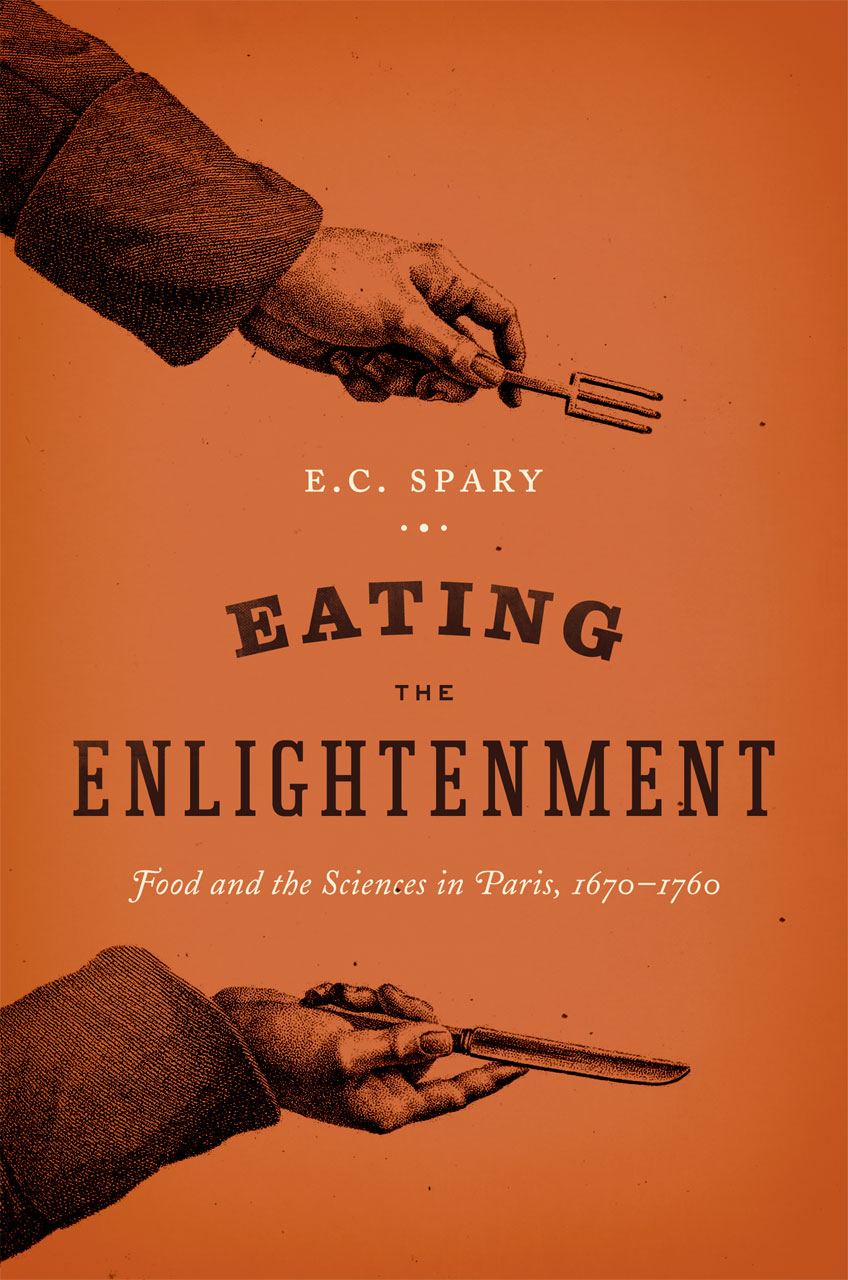 Eating the Enlightenment offers a new perspective on the history of food, looking at writings about cuisine, diet, and food chemistry as a key to larger debates over the state of the nation in Old Regime France. Embracing a wide range of authors and scientific or medical practitioners—from physicians and poets to philosophes and playwrights—E. C. Spary demonstrates how public discussions of eating and drinking were used to articulate concerns about the state of civilization versus that of nature, about the effects of consumption upon the identities of individuals and nations, and about the proper form and practice of scholarship. En route, Spary devotes extensive attention to the manufacture, trade, and eating of foods, focusing upon coffee and liqueurs in particular, and also considers controversies over specific issues such as the chemistry of digestion and the nature of alcohol. Familiar figures such as Fontenelle, Diderot, and Rousseau appear alongside little-known individuals from the margins of the world of letters: the draughts-playing café owner Charles Manoury, the “Turkish envoy” Soliman Aga, and the natural philosopher Jacques Gautier d’Agoty. Equally entertaining and enlightening, Eating the Enlightenment will be an original contribution to discussions of the dissemination of knowledge and the nature of scientific authority.
◊ ◊ ◊ ◊ ◊
From ACC Distribution:
Robin Butler with Noel Riley, Great British Wine Accessories, 1550-1900 (Brown & Brown Books, 2013), 288 pages, ISBN: 978-0956349804, £65 / $125.
 Great British Wine Accessories 1550-1900 covers all domestic wine accessories from corkscrews and bin labels to coasters and decanters – and so much more besides during the period of its title. While there are monographs on decanters, corkscrews and other disciplines within the subject, this book not only gives a good overview of these areas, but also sets the whole subject in context. The easy style of writing belies the in-depth knowledge imparted within this book.
Contents: Bottles; Bin Labels; Corkscrews; Tasters; Coolers and Cisterns; Wine Funnels; Decanters and Carafes; Wine Jugs; Wine Labels; Coasters and Decanter Trolleys; Glasses Goblets & Cups Misc; Fakes & Problems.
Robin Butler has been an antiques dealer and lecturer since 1963. This is his fourth book, following The Arthur Negus Guide to English Furniture (1976), The Book of Wine Antiques (1986), and The Albert Collection (2009). Robin has made antique wine accessories a separate subject within the antiques world, following his exhibition in 1978 as part of the BADA 60 festival of exhibitions. His Internet business, Butler’s Antiques solely deals in antique wine accessories.
New Book | Anton Maria Maragliano (1664-1739)
From Sagep:
Daniele Sanguineti, Anton Maria Maragliano (1664-1739): Insignis Sculptor Genue (Genoa: Sagep, 2012), 480 pages, ISBN: 978-8863731989, €100 / $160.
 Il nome di Anton Maria Maragliano, per un caso di eccezionale fortuna critica, è diventato sinonimo di scultura in legno a Genova e in Liguria. La nuova monografia dedicata a questo protagonista del Barocco genovese, attivo tra la fine del Seicento e il 1739, indaga nel dettaglio l’intero percorso artistico, soffermandosi, grazie a numerosi documenti inediti, sulla fase della formazione, sul contesto culturale di riferimento, sulla diversificata committenza (confraternite, famiglie aristocratiche, ordini religiosi) e sulla prassi gestionale di una bottega assai complessa e fitta di allievi. Il corpus delle opere raccoglie, attraverso schede articolate, l’intera produzione nota, suddivisa in quattro sezioni che danno conto delle numerose aggiunte: le opere scolpite dal maestro, i bozzetti (attraverso un nuovo nucleo recentemente scoperto), le opere della bottega e quelle disperse. Il regesto e la trascrizione dei documenti costituiscono un importante approfondimento, mentre una sezione finale è dedicata, nello specifico, agli aspetti della tecnica scultorea e della stesura della policromia. Bellissime immagini a colori accompagnano la lettura del testo.
Daniele Sanguineti è funzionario Storico dell’Arte presso il Ministero per i Beni e le Attività Culturali, con il ruolo di Conservatore del Museo di Palazzo Reale di Genova.
Available from Artbooks.com»
New Book | Autour des Van Loo
From PURH:
Christine Rolland, ed., Autour des Van Loo: Peinture, commerce des tissus et espionnage en Europe (1250-1830), (Mont-Saint-Aignan: Publications des Universités de Rouen et du Havre, 2012), 402 pages, ISBN: 9782877755016, 49€/ $95.
 Puissante dynastie de peintres qui s’est constituée au cours des XVIIe et XVIIIe siècles, les Van Loo ont été au cœur des grands événements culturels de leur temps. Jacob Van Loo (1614-1670) a fréquenté Vermeer et Rembrandt, avant de s’enfuir vers la France et d’y devenir membre de l’Académie royale de peinture. On retrouve ses descendants dans toutes les cours et les académies de peinture d’Europe. Les Van Loo ne s’en tiennent cependant pas à la peinture. Louis-Michel Van Loo (1707-1771), premier peintre du roi d’Espagne, représentait en même temps l’une des grandes entreprises textiles lyonnaises : il avait pour clients la famille royale, des aristocrates, des ambassadeurs et des agents secrets. À partir de l’exemple de Louis-Michel, sont mis en lumière les liens entre les réseaux des artistes, des marchands, des diplomates et des espions, du Moyen Âge au début du XIXe siècle. Ce volume est surtout la première étude moderne portant sur l’ensemble de la dynastie des Van Loo, de 1617 à 1830, depuis Jacob, le pater familias, jusqu’à Jules-César-Denis, le « peintre des neiges ». Les principales œuvres de chacun des peintres y sont reproduites, souvent pour la première fois. On y trouve aussi un arbre généalogique complet de la famille, des notices biographiques sur chacun de ses membres et des documents issus des archives familiales, sans oublier des tissus et des costumes jamais vus du XVIIIe siècle.
Ont collaboré à ce volume : Cinzia Maria Sicca, Bruna Niccoli, David Mandrella, Christophe Henry, Lesley Ellis Miller, Serge Chassange, Gérard Gayot, Alain Becchia, Simonne Abraham-Thisse, Sjoukje Colenbrander, Corine Maitte, Jean-Paul Leclercq, Ulrich Leben, Fabienne Camus, Michel Van de Laar, Arie Wallert, Cyrille Sciama, Michelle Sapori, Françoise Thelamon.
The full list of contents is provided here»
Exhibition | Eighteenth-Century Book Illustration in the Veneto
The exhibition presents 115 illustrated books and as many loose prints from the likes of Tiepolo, Piazzetta, Novelli, Fontebasso, and Balestra. From Padova Cultura:
Tiepolo, Piazzetta, Novelli: L’Incanto del Libro Illustrato nel Settecento Veneto
Musei Civici agli Eremitani and Palazzo Zuckermann, Padua, 24 November 2012 — 7 April 2013
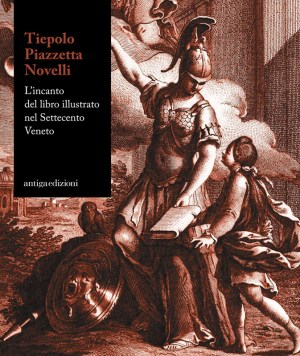 A Padova una meravigliosa galleria cartacea: 115 volumi illustrati del Settecento esposti accanto ad altrettanti fogli sciolti e incisioni, dipinti e disegni di grandi Maestri. Ecco la più completa mostra mai realizzata sul tema.
E’ dal connubio tra intelligenti editori come Giambattista Albrizzi e Antonio Zatta – per citarne solo alcuni – grandi e celeberrimi artisti come Tiepolo, Piazzetta, Novelli, Fontebasso o Balestra, e di abili incisori capaci di tradurre i segni e lo stile di questi in stampe di straordinaria complessità e varietà luministica, che nascono alcuni dei maggiori capolavori dell’editoria illustrata del Settecento. Un fenomeno ben sviluppato anche nel Seicento ma che nel XVIII secolo raggiunge nel Veneto vertici assoluti d’eleganza e raffinatezza, ammirati a livello internazionale.
Un fenomeno che, dal 24 novembre 2012 al 7 aprile 2013 a Padova, nelle sedi del Museo Civico agli Eremitani e di Palazzo Zuckermann, sarà esplorato e reso accessibile al grande pubblico in una mostra assolutamente unica per vastità e completezza di trattazione e certamente tra le più importanti esposizioni del genere mai realizzate in Italia: un viaggio affascinante e sorprendente, alla scoperta di quello che fu un aspetto fondamentale della vita culturale della Serenissima, ma anche di una produzione artistica spesso parallela a quella più appariscente della pittura da cavalletto o ad affresco, ma non meno suggestiva.
Oltre 115 volumi prodotti in Veneto o che hanno visto la collaborazione d’importanti artisti veneziani del Settecento – edizioni rare e preziose, arricchite da antiporte, incisioni, cornici, testatine, vignette o preziosi finalini – saranno dunque esposti accanto a quasi 120 tra stampe sciolte tratte dagli stessi volumi e incisioni autonome, in modo da favorire un’ampia documentazione della ricchezza illustrativa di questi volumi e dell’attività degli artisti ai quali si deve l’invenzione grafica delle opere. Maestri che saranno ricordati in mostra, ciascuno, anche attraverso uno dei loro significativi dipinti, a sottolineare e rimarcare la stretta connessione esistente tra la produzione artistica dei pittori coinvolti e i disegni da questi approntati per l’editoria: “una comune attitudine per il libero dispiegarsi della fantasia, applicata ora alle pagine di un libro invece che ai cieli dei soffitti affrescati o alle tele di grandi quadri di storia, una medesima audacia compositiva, un precoce interesse per forme di ornato rococò.”
Una mostra dunque ricchissima – realizzata grazie alle opere della Biblioteca Civica, dei Musei Civici agli Eremitani e della Biblioteca Universitaria, oltre a quelli di un’importante collezione privata e di alcuni selezionati istituti culturali del Veneto – che si sviluppa in 9 sezioni, adottando punti di vista diversificati e privilegiando, di volta in volta, un approccio cronologico, monografico e tematico.
The press release (a PDF file) is available here»
◊ ◊ ◊ ◊ ◊
The catalogue is available from ArtBooks.com»
Vincenza Cinzia Donvito and Denis Ton, Tiepolo, Piazzetta, Novelli: L’Incanto del Libro Illustrato nel Settecento Veneto (Crocetta del Montello: Antiga Edizioni, 2012), 480 pages, ISBN: 978-8888997940, $67.50.
Exhibition | Salvaging the Past: Georges Hoentschel
From the BGC:
Salvaging the Past: Georges Hoentschel and French Decorative
Arts from The Metropolitan Museum of Art
Bard Graduate Center, New York, 4 April — 11 August 2013
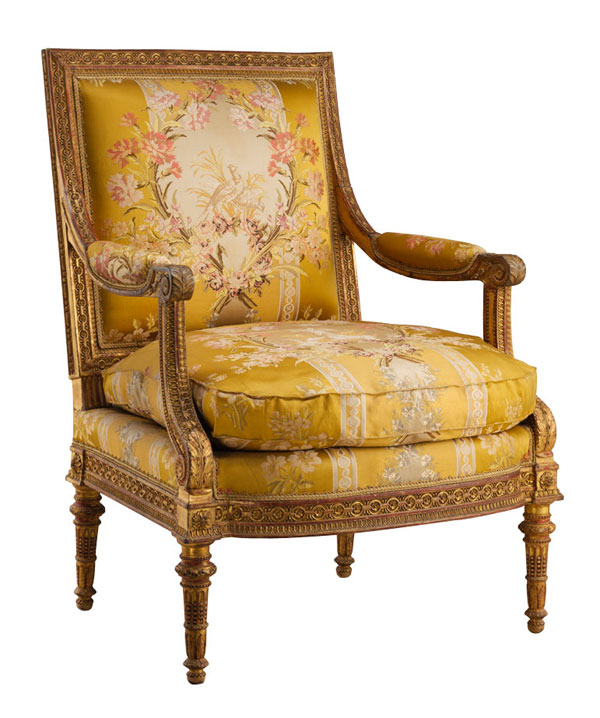
Georges Jacob; gilder: Louis–François Chatard. Armchair from Louis XVI’s Salon des Jeux, Château de Saint-Cloud, 1788. Carved and gilded walnut; gold brocaded silk (New York: The Metropolitan Museum of Art, Gift of J. Pierpont Morgan, 1906 — 07.225.107)
Focusing on a remarkable but little-known collection that entered the Metropolitan Museum as a gift of J. Pierpont Morgan in the early twentieth century, Salvaging the Past: Georges Hoentschel and French Decorative Arts from The Metropolitan Museum of Art features more than 200 objects of primarily medieval art and French eighteenth-century paneling, furniture, metalwork, textiles, paintings, and sculpture, as well as late nineteenth-century art pottery, most of which have rarely been viewed since the 1950s. The fourth in a series of collaborations between The Metropolitan Museum of Art and the BGC, the exhibition provides the first comprehensive examination of Georges Hoentschel—a significant figure in the history of collecting—and illuminates an understudied and critical chapter of the Metropolitan’s history.
Drawn primarily from the Metropolitan Museum’s holdings, with loans from other public and private collections in the United States and France, the exhibition tells the story of this unique collection in four sections. The first introduces Georges Hoentschel, who was an enterprising and successful decorator during the late nineteenth and early twentieth centuries, when France witnessed a great scientific, industrial, and social transformation and the newly moneyed bourgeoisie adopted a lifestyle based on an aristocratic model. As director of the Parisian decorating firm Maison Leys, Hoentschel catered to these affluent clients, creating for them interiors in historic French styles. In this section of the exhibition, ephemera, family papers, photographs, and a film presentation will outline his story within the context of Belle Époque Paris.
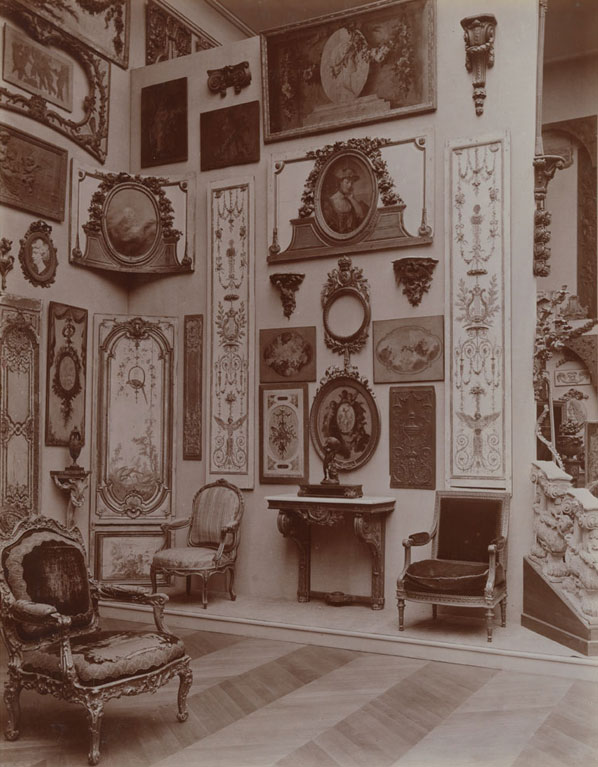
Section of the interior of 58 Boulevard Flandrin, Paris (ca. 1906) to be recreated in the Bard Graduate Center exhibition.
The second and largest section presents selections from the eighteenth-century holdings of the collection in installations inspired by historic photographs of Hoentschel’s densely arranged showroom-museum in Paris, where the objects served as models for his interior decorating business. Delicately carved woodwork, decorative paintings, and exquisitely chased gilt-bronze mounts are featured here. Highlights include a chair made for Louise-Élisabeth of Parma, daughter of Louis XV; an armchair made for Louis XVI; and a panel from shutters originally installed in a room outside the chapel at Versailles.
The third section displays medieval artworks, including sculpture, ivories, and metalwork, and includes one of the finest surviving examples of French Limoges enamelwork—a twelfth-century reliquary container, or chasse. Also shown here is Jean Barbet’s Ange du Lude, on loan from the Frick Collection, a rare bronze angel dated 1475, one of the most remarkable works from Hoentschel’s collection.
The final section presents examples of Hoentschel’s stoneware and those of his friend the sculptor and potter Jean-Joseph Carriès (1855–1894). Some of these ceramics were originally exhibited in the Union Centrale des Arts Décoratifs’ pavilion at the 1900 Exposition Universelle in Paris, for which Hoentschel created interiors in art nouveau style, unique in his oeuvre. A chair from this pavilion, loaned by the Musée des Arts décoratifs, Paris, is displayed, along with a selection of furnishing textiles used by Hoentschel in interior design commissions.
The exhibition is organized by the Bard Graduate Center: Decorative Arts, Design History, Material Culture and The Metropolitan Museum of Art.
◊ ◊ ◊ ◊ ◊
From Yale UP:
Daniëlle Kisluk-Grosheide, Deborah L. Krohn, and Ulrich Leben, eds., Salvaging the Past: Georges Hoentschel and French Decorative Arts from The Metropolitan Museum of Art (New Haven: Yale University Press, 2013), 320 pages, ISBN: 9780300190243, $85.
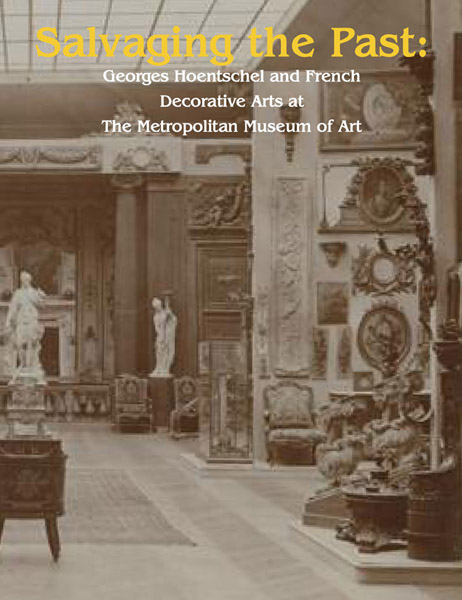 Georges Hoentschel (1855–1915) was a leading French interior designer in historic styles, head of a decorating firm, and ceramicist during the Belle Epoque. He found inspiration for his designs in medieval and 18th-century French art, which he avidly collected, amassing more than 4,000 pieces of furniture, woodwork, metalwork, sculpture, paintings, and textiles. After visiting Hoentschel in Paris, the American financier J. Pierpont Morgan acquired the collection and bequeathed it to the Metropolitan Museum of Art in 1906 and 1916–17. These works greatly enriched the museum’s medieval art department and became the nucleus of its decorative arts department, profoundly influencing American tastes in the early 20th century. Through texts, early documentary photographs, and images of newly conserved works, Salvaging the Past goes behind the scenes to explore the history and influence of this remarkable collection.
Daniëlle Kisluk-Grosheide is curator of European sculpture and decorative arts at The Metropolitan Museum of Art, New York. Deborah L. Krohn is associate professor of Italian Renaissance decorative arts at Bard Graduate Center. Ulrich Leben is a visiting professor and special exhibitions curator at Bard Graduate Center and associate curator for the furniture collection at Waddesdon Manor, Buckinghamshire.
New Book | The Pleasure Garden, from Vauxhall to Coney Island
Released in December from U of Pennsylvania Press:
Jonathan Conlin, ed., The Pleasure Garden, from Vauxhall to Coney Island (Philadelphia: University of Pennsylvania Press, 2012), 352 pages, cloth ISBN 978-0812244380 / ebook ISBN 978-0812207323, $70 / £46.
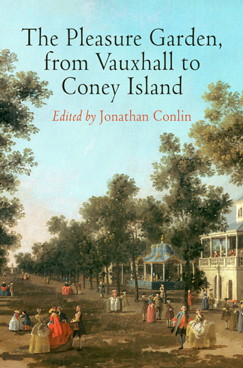 Summers at the Vauxhall pleasure garden in London brought diverse entertainments to a diverse public. Picturesque walks and arbors offered a pastoral retreat from the city, while at the same time the garden’s attractions indulged distinctly urban tastes for fashion, novelty, and sociability. High- and low-born alike were free to walk the paths; the proximity to strangers and the danger of dark walks were as thrilling to visitors as the fountains and fireworks. Vauxhall was the venue that made the careers of composers, inspired novelists, and showcased the work of artists. Scoundrels, sudden downpours, and extortionate ham prices notwithstanding, Vauxhall became a must-see destination for both Londoners and tourists. Before long, there were Vauxhalls across Britain and America, from York to New York, Norwich to New Orleans.
This edited volume provides the first book-length study of the attractions and interactions of the pleasure garden, from the opening of Vauxhall in the seventeenth century to the amusement parks of the early twentieth. Nine essays explore the mutual influences of human behavior and design: landscape, painting, sculpture, and even transient elements such as lighting and music tacitly informed visitors how to move within the space, what to wear, how to behave, and where they might transgress. The Pleasure Garden, from Vauxhall to Coney Island draws together the work of musicologists, art historians, and scholars of urban studies and landscape design to unfold a cultural history of pleasure gardens, from the entertainments they offered to the anxieties of social difference they provoked.
Jonathan Conlin is Senior Lecturer in Modern History at the University of Southampton and author of Civilisation and The Nation’s Mantelpiece: A History of the National Gallery.
◊ ◊ ◊ ◊ ◊
C O N T E N T S
Introduction
Jonathan Conlin 1
Chapter 1. Theaters of Hospitality: The Forms and Uses of Private Landscapes and Public Gardens
John Dixon Hunt 29
Chapter 2. Pleasure Gardens and Urban Culture in the Long Eighteenth Century
Peter Borsay 49
Chapter 3. Guns in the Gardens: Peter Monamy’s Paintings for Vauxhall
Eleanor Hughes 78
Chapter 4. Performance Alfresco: Music-Making in London’s Pleasure Gardens
Rachel Cowgill 100
Chapter 5. Pleasure Gardens of America: Anxieties of National Identity
Naomi Stubbs 127
Chapter 6. Pleasure Gardens in Nineteenth-Century New Orleans: ”Useful for All Classes of Society”
Lake Douglas 150
Chapter 7. Night and Day: Illusion and Carnivalesque at Vauxhall
Deborah Epstein Nord 177
Chapter 8. ”Strange Beauty in the Night”: Whistler’s Nocturnes of Cremorne Gardens
Anne Koval 195
Chapter 9. Edwardian Amusement Parks: The Pleasure Garden Reborn?
Josephine Kane 217
Notes 247
Select Bibliography 299
List of Contributors 303
Index 307
Acknowledgments 315
Exhibition | A Handsome Cupboard of Plate: Early American Silver
From ACC Distribution:
A Handsome Cupboard of Plate Early American Silver in the Cahn Collection
Minneapolis Institute of Arts, 1 December 2012 — 24 March 2013
Nelson-Atkins Museum of Art, Kansas City, 20 April — 3 November 2013
Missouri History Museum, St Louis, 23 November 2013 — 2 March 2014
The DeWitt Wallace Decorative Arts Museum, Colonial Williamsburg, 3 May 2014 — 25 May 2015
Deborah Dependahl Waters, A Handsome Cupboard of Plate Early American Silver in the Cahn Collection (Cambridge: John Adamson, 2013), 128 pages, ISBN: 978-1898565116, $40.
 Strength in design and fineness of craftsmanship unify the early American domestic and presentation silver assembled by Paul and Elissa Cahn and published together for the first time. Beginning in Boston with a caudle cup marked by Jeremiah Dummer, America’s first native-born silversmith, and objects from the shop of patriot silversmith Paul Revere, the book then focuses on New York, where a distinctive style reflecting the Dutch heritage of that region emerged, and afterward on Philadelphia, where generations of the Quaker Richardson family supplied goods of the “best sort, but plain.”
Pride of place is given to the work of New York Jewish silversmith Myer Myers and his shop, including a presentation waiter made for Theodorus Van Wyck. Accompanying a touring exhibition of the Cahn collection, the book encapsulates some of the ethnic, religious, and political diversity of early America and sets
the silver in its social and historical context.
C O N T E N T S
Foreword by Kaywin Feldman, Director and President, Minneapolis Institute of Arts
The Cahn Collection of Early American Silver – An Appreciation by David L. Barquist, The H. Richard Dietrich Jr. Curator of American Decorative Arts, Philadelphia Museum of Art
A Handsome Cupboard of Plate: Early American Silver and Silversmiths – An Introductory Essay
Catalogue
I: Boston
II: New York
III: Philadelphia
Frequent Bibliographical References and Note on Digital Resources
Index
Deborah Dependahl Waters is an independent historian of American decorative arts, specializing in silver and furniture of the Mid-Atlantic region. Since 1987 she has been a member of the part-time teaching faculty for the Parsons-Cooper-Hewitt M.A. Program in the History of Decorative Arts and Design, and is currently president of New York Silver Society, Inc. She is the editor and an author of Elegant Plate: Three Centuries of Precious Metals in New York City (2000), and a contributor to Art in the Empire City: New York, 1825-1861 (2000), and Silversmiths to the Nation: Thomas Fletcher and Sidney Gardiner, 1808-1842 (2007), as well as lead author of The Jewelry and Metalwork of Marie Zimmermann (2011).
Exhibition | Charles Jennens: The Man behind Handel’s ‘Messiah’
From The Handel House Museum:
Charles Jennens: The Man behind Handel’s Messiah
The Handel House Museum, London, 21 November 2012 — 14 April 2013
Curated by Ruth Smith
 In a major new exhibition the Handel House Museum explores the life, work and character of Handel’s great collaborator Charles Jennens.
An enigmatic character, Jennens had an enormous influence on Handel’s life and work. As librettist for the oratorios Saul and Belshazzar, he provided the composer with words that inspired some of his most challenging and exciting music. His carefully chosen scripture selection for Messiah was to inspire Handel to even greater creative heights, and together these two men created one of the greatest musical works of all time.
The exhibition examines this relationship in detail, alongside other elements of Jennens’s life as a great landowner; the builder of a fine country house with extensive grounds; a major art collector; a Christian philanthropist; a devout defender of revealed religion; an encourager of other authors and composers; a loyal friend; and a forward-looking editor of Shakespeare.
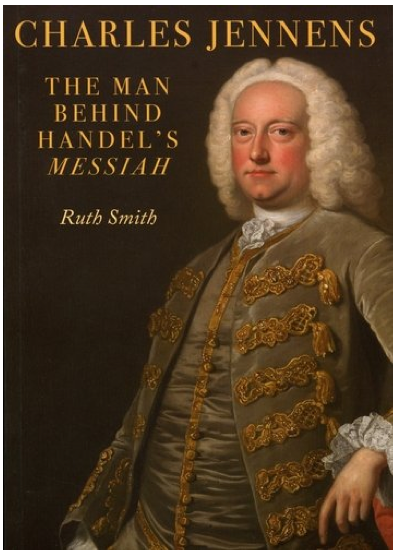
Bringing together exhibits from throughout the UK and beyond, for the first time this landmark exhibition unites all known oil portraits of Jennens to stand beside Handel House’s own magnificent portrait by Thomas Hudson.
The exhibition’s curator is Dr Ruth Smith, author of Handel’s Oratorios and Eighteenth-Century Thought (Cambridge University Press), who has made a particular study of the life and work of Charles Jennens.
Ruth Smith, Charles Jennens: The Man behind Handel’s Messiah (London: Gerald Coke Handel Foundation, 2012), 71 pages, ISBN: 978-0956099822, £8.50.
◊ ◊ ◊ ◊ ◊
Jonathan Keates provides a review for the TLS (11 January 2013):
. . . Unfolding the mystery of Charles Jennens for us, this fine new exhibition, which also has a related walking tour and a series of talks and concerts, is the best so far within the Handel House’s limited space; it was mounted under the guidance of Ruth Smith, whose illuminating survey of his achievement accompanies the show. Besides evoking our admiration for him as aesthete, connoisseur, charitable patron, landscape gardener or devoted friend, she celebrates his work as the earliest variorum editor of Shakespeare’s plays. . . .
New Book | Atlas De Wit City Atlas of the Low Countries, 1698
From ACC Distribution:
Marieke van Delft and Peter van der Krogt, Atlas De Wit City Atlas of the Low Countries, 1698 (Tielt: Lannoo Publishers, 2013), 304 pages, ISBN: 978-9401401890, $175.
 Discover the Google Earth of the Dutch Golden Age
• A historical atlas from 1698 with 151 city maps from the Northern and Southern Netherlands, from Groningen to Lille
• A book of great cultural and artistic importance. Only 5 copies of the original atlas are known worldwide
• Contains beautiful, originally hand-colored maps, drawn from a bird’s eye view
• A facsimile on true scale with a new introduction and a detailed description per map by Marieke van Delft and Peter van der Krogt
Atlas De Wit is a unique, historical atlas of cartographer Frederick de Wit with 158 city maps, city views and engravings from the Northern and Southern Netherlands (today’s Netherlands, Belgium and French Flanders). This facsimile contains full-size images of the beautiful, original hand-colored cards, which are drawn in perspective. The maps provide a visual perspective on the history of the 17th century, from Groningen to Cambrai. This title is completed with introductory and detailed descriptions that make this historical atlas map accessible to all lovers of history and old maps. Text in English, French & Dutch.
◊ ◊ ◊ ◊ ◊
New Book | Seeing Satire in the Eighteenth Century
From the Voltaire Foundation:
Elizabeth C. Mansfield and Kelly Malone, eds., Seeing Satire in the Eighteenth Century, SVEC 2013:02 (Oxford: Voltaire Foundation, 2013), 320 pages, ISBN-978-0729410632, £65 / €80 / $106.
 A moment in history when verbal satire, caricature, and comic performance exerted unprecedented influence on society, the Enlightenment sustained a complex, though now practically invisible, culture of visual humor. In Seeing Satire in the Eighteenth Century contributors recapture the unique energy of comic images in the works of key artists and authors whose satirical intentions have been obscured by time.
From a decoding of Gabriel de Saint-Aubin’s Livre de caricatures as a titillating jibe at royal and courtly figures, a reinterpretation of the man’s muff as an emblem of foreignness, foppishness and impotence, a reappraisal of F. X. Messerschmidt’s sculpted heads as comic critiques of Lavater’s theories of physiognomy, to the press denigration of William Wilberforce’s abolitionist efforts, visual satire is shown to extend to all areas of society and culture across Europe and North America. By analysing the hidden meaning of these key works, contributors reveal how visual comedy both mediates and intensifies more serious social critique. The power of satire’s appeal to the eye was as clearly understood, and as widely exploited in the Enlightenment as it is today.
Elizabeth C. Mansfield’s research encompasses modern and early modern European art. Her publications include an award-winning book on the classical legend of Zeuxis ‘Selecting Models’. She is currently Vice-President of Scholarly Programs at the National Humanities Center. Kelly Malone is a scholar of the literature and culture of eighteenth-century England. She is currently Associate Professor of English at Sewanee, the University of the South.
◊ ◊ ◊ ◊ ◊
C O N T E N T S
Introduction, Elizabeth C. Mansfield and Kelly Malone — Seeing satire in the Age of Reason
1. Emmanuel Schwartz — Satire unmasked by reading
2. Eric Rosenberg — The impossibility of painting: the satiric inevitability of John Singleton Copley’s Boy with a Squirrel
3. Julie-Anne Plax — Watteau’s witticisms: visual humor and sociability
4. Emily Richardson — ‘Tu n’as pas tout vü!’: seeing satire in the Saint-Aubin Livre de Caricatures
5. Melissa Lee Hyde — Needling: embroidery and satire in the hands of Charles-Germain de Saint-Aubin
6. Kimberly Chrisman-Campbell — ‘He is not dressed without a muff’: muffs, masculinity, and la mode in English satire
7. Trevor Burnard — ‘A compound mongrel mixture’: racially coded humor, satire, and the denigration of white Creoles in the British Empire 1784-1834
8. Reva Wolf — Seeing satire in the peepshow
9. Steven Minuk — Swift’s satire of vision
10. Michael Yonan — Messerschmidt, the Hogarth of sculpture
11. Katherine Mannheimer — Anatomizing print’s perils: Augustan satire’s textual bodies
12. Marcus C. Levitt — ‘Women’s wiles’ in Mikhail Chulkov’s The Comely Cook
List of illustrations
Summaries
Bibliography
Index










 Enfilade
leave a comment