Exhibition | Drawings from the Christian and Isabelle Adrien Collection
Didier Rykner reviewed the exhibition for The Art Tribune in May (with an English version available). From the museum’s website:
Une Collection Particulière: Les Dessins de la Collection Christian et Isabelle Adrien
Le Musée des Beaux-Arts de Rennes, 21 March — 26 August 2012
 Le musée des Beaux-Arts de Rennes présentera, à partir du 21 mars, les plus belles feuilles de la collection de dessins de Christian et Isabelle Adrien. Au hasard des rencontres, à la lumière de quelques intuitions fulgurantes, M. Adrien a inlassablement cherché et étudié, tout au long de sa vie, les feuilles dessinées par les grands maîtres du passé. C’est à Rennes que ce collectionneur d’origine bretonne invite aujourd’hui le public à venir partager sa passion pour le dessin ancien. La découverte de près de quatre-vingt dessins français (La Hyre, Poussin, Boucher), italiens (Bandinelli, Salviati, Carraci) et nordiques (Bloemaert, Rubens), dont beaucoup sont encore inédits, marquera l’un des temps fort de la Semaine du dessin 2012 et de la programmation culturelle rennaise du printemps et de l’été prochain. Le catalogue de l’exposition, qui rassemble les notices des plus grands spécialistes de
chaque artiste, est dirigé par Monsieur Rosenberg, de l’Académie française.
◊ ◊ ◊ ◊ ◊
Catalogue: Francis Ribemont and Pierre Rosenberg, Dessins de la collection Christian et Isabelle Adrien (Paris: Editions Chaudun, Musée des beaux-arts de Rennes, 2012), 207 pages, ISBN: 9782350391281, $77.50. [Available from ArtBooks.com]
Exhibition | Messerschmidt and Modernity
Press release (16 April 2012) from The Getty:
◊ ◊ ◊ ◊ ◊
Messerschmidt and Modernity
The J. Paul Getty Museum, Getty Center, Los Angeles, 24 July — 14 October 2012

The Getty Celebrates the Modern and Contemporary Legacy of Franz Xaver Messerschmidt’s Distinctive Character Heads
◊ ◊ ◊ ◊ ◊

Ken Gonzales-Day, Untitled (Franz Xaver Messerschmidt, The Vexed Man, The J. Paul Getty Museum, Los Angeles, CA), 2008. Light jet print. Courtesy of Ken Gonzales-Day and Fred Torres Collaborations, N.Y.C. © Ken Gonzales-Day
The intriguing series of heads that are collectively known as Character Heads, created by the German Baroque artist Franz Xaver Messerschmidt (1736–1783) during the last 13 years of his life, have become increasingly popular with the general public through a series of recent exhibitions and books devoted to these expressive works. Furthermore, the sculptures, depicting various states of emotion and expression, have also captured the imaginations of generations of artists—especially during the 20th and 21st centuries.
Messerschmidt and Modernity, on view at the J. Paul Getty Museum from July 24 through October 14, 2012, is the first exhibition to explore the contemporary legacy of these surprisingly modern-looking sculptures, which were carved in alabaster, or cast in a lead or tin alloy. Along with Messerschmidt’s works, the exhibition will feature a selection of modern and contemporary works of art that testify to the lasting impact of these astonishing heads. Eight Character Heads will be exhibited—among them the Getty’s own Vexed Man— along with a newly discovered reduced variation of a now-lost Character Head known as A Cheeky Nitpicky Mocker, which has never before been exhibited publicly. Contemporary artists featured in the exhibition include Tony Bevan, Tony Cragg, Ken Gonzales-Day, Bruce Nauman, Pierre Picot, Arnulf Rainer, Cindy Sherman, and Emily Young.
“Messerschmidt’s Character Heads have appealed to audiences since they were first produced. They were especially popular in turn-of-the-century Vienna and subsequently inspired modern artists of the 20th century,” explains Antonia Boström, senior curator of sculpture and decorative arts at the J. Paul Getty Museum. “Now, this unparalleled series of sculptures is enjoying a renewed popularity—not only fascinating to museum audiences and scholars, but compelling for contemporary artists.”
The exhibition demonstrates how Messerschmidt’s heads are linked to the 18th and 19th centuries’ fascination with expression and the “passions,” as well as with the pseudosciences of physiognomy and pathognomy. It also traces how this series has influenced the work of artists in fin-de-siècle Vienna and contemporary artists in Austria, Great Britain, and the United States.
Messerschmidt
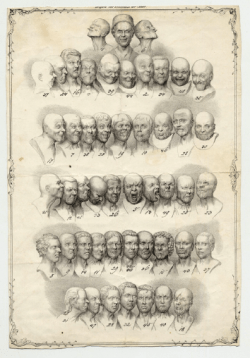
Matthias Rudolph Toma, Messerschmidt’s ‘Character Heads’, 1839. Lithograph. Courtesy of the Museum of Fine Arts, Budapest.
The German-born Messerschmidt led a successful career in Vienna in the mid-18th century, receiving many important commissions from the Habsburg empress Maria Theresa and her consort, Francis Stephen of Lorraine. Messerschmidt’s circumstances changed dramatically around 1770 when he began to show signs of mental instability, leading to the loss of prestigious commissions and conflicts with colleagues and friends. He eventually left Vienna and, in 1777, he settled in Pressburg (now Bratislava), and remained there until his death in 1783, focusing obsessively on the production of the heads as well as more conventional portraits. Messerschmidt called the dozens of heads he created between 1770 and 1783 Kopfstücke (head pieces) and intended them to represent the full range of human expressions, which he believed there are sixty-four. In 1793, ten years after his death, the heads were exhibited at the Citizen’s Hospital in Vienna, when, despite their misrepresentation, they also received the often incongruous titles by which they are still referred to today. They were only referred to as “Character Heads” after Messerschmidt’s death.
Just Rescued from Drowning belongs to a group of alabaster Character Heads probably depicting the same man, but differentiated by the arrangement of the hair. The title suggests that he has just been submerged in water, and his lank hair (or a wig) hangs down over his forehead, but the hairstyle may actually reflect those featured on Gothic sculptures of southern Germany, which would have been familiar to Messerschmidt from his youth.
Another head on view, The Ill-Humored Man, belongs to a group of middle-aged bald men within the series of Character Heads. The man’s tightly squeezed eyes and the flat strip covering his mouth contribute to a strong sense of alienation and interiority and we sense his extreme discomfort. The object covering the mouth may relate to the magnets that the German physician Franz Anton Mesmer (1734–1815) applied to patients during his therapeutic sessions. They formed part of his “animal magnetism” theory that a universal magnetic fluid coursing through the human body could be manipulated by magnets for curative purposes. Mesmer and Messerschmidt were known to be friends and these experimental procedures were of great interest to the artist.
The French artist Joseph Ducreux (1735–1802) was a contemporary of Messerschmidt, and as a painter at the court in Vienna he was probably familiar with his sculpture. Like Messerschmidt, Ducreux was interested in the pseudoscience of physiognomy, and his Self-Portrait, Yawning (by 1783, Getty Museum’s permanent collection) is an example of his experiments with the expressive possibilities of portraiture.
Some forty-nine of the sixty-nine heads Messerschmidt created are accounted for today. A lithograph on view in the exhibition has been a key element in reconstructing the series of Messerschmidt’s heads. Created by Matthias Rudolph Toma after a drawing by Josef Hasslwander, this print (from Budapest) depicts forty-nine of the heads and was made four years after the heads were publicly exhibited in 1835 by their then-owner, Josef Jüttner.
The psychological theme of Messerschmidt’s sculptures and their uncompromising aesthetic colored their public reception in Vienna. After his death and throughout the early 19th century the Character Heads were viewed as oddities and exhibited in Vienna for popular entertainment. Over time, this perception changed and by the end of the 19th century the heads were seen as useful examples of expression and emotion for art students to copy, and for students of anatomy and psychology to study. Some of the heads found their way into art-school storerooms in Vienna, while others were collected both by preeminent medical professionals and by art collectors. By the turn of the century the Character Heads found favor with Vienna’s Jewish cultural elite, which supported avantgarde art movements such as the Viennese Secession and the Wiener Werkstätte, and also had links to Sigmund Freud. Their interests in unconventional contemporary art and the science of psychiatry combined to create a new culture of support for Messerschmidt’s heads in Vienna.
Modernity and Beyond
The works created since 1900 on view in the exhibition represent a wide range of responses to the Character Heads. Modern and contemporary artists have been drawn to Messerschmidt’s heads for their perceived departure from the confines of academic convention. But it is also the combination of a reductive style, refined modeling and carving,
and exaggerated expression that make these sculptures resonate with modern audiences. By the early 20th century, Messerschmidt’s heads were well known in Vienna, and prized by collectors and artists as distinctive and affecting works of art. Anton Josef Trčka’s renowned 1914 portrait photograph of Egon Schiele (1890–1918) reflects the visual and psychological impact of Messerschmidt’s grimacing heads. The camera focuses closely on the artist’s head and hands; his anxious expression and interlocked fingers hint at his angst-ridden mood.
Contemporary artists such as Arnulf Rainer (b. 1929) and Tony Bevan (b. 1951) directly quote Messerschmidt’s sculptures, while others, including Bruce Nauman (b. 1941) and Cindy Sherman (b. 1954), incorporate their body, human expression, and self-portraiture into their work in a way that prompts comparison with Messerschmidt. The sculptures of Tony Cragg (b. 1949) and Emily Young (b. 1951) are more indirectly related, though the sculptors’ grounding in a figurative tradition and their exploration of the material’s expressive potential can be paralleled in Messerschmidt’s works. The juxtaposition of works from different time periods in this section of the exhibition illustrates the psychological power that Messerschmidt’s Character Heads continue to have for the contemporary viewer.
Expression Lab
The final gallery of the exhibition is designed to encourage visitors to consider and respond to Messerschmidt’s sculptures and the contemporary works focused on expression. The gallery is installed with mirrors, art reproductions, and an interactive “photo booth” for those who wish to actively explore and record their own facial expressions. For example, Rainer practiced “pulling faces” in the mirror, performing and documenting a series of contorted expressions as a means of investigating his own image. Using mirrors, visitors will be able to try these exercises themselves. In the photo booth, participants will be invited to replicate the intense facial expression of the Vexed Man or other character heads, or to invent an expression of their own choosing. Visitors may then share their photo on video screens in the gallery. A related video will be shown and reference books will be on hand for those who wish to learn more about Messerschmidt and expression, and about the other artists represented in the exhibition.
An audio tour, narrated by Boström and guest contributor Professor Eric Kandel, a Nobel-prize winning neuroscientist and author of The Age of Insight: The Quest to Understand the Unconscious in Art, Mind, and Brain, from Vienna 1900 to the Present, will accompany the exhibition. Messerschmidt and Modernity will also be accompanied by a richly illustrated book of the same name, written by Antonia Boström and published by Getty Publications.
◊ ◊ ◊ ◊ ◊
From the Getty Store:
Antonia Boström, Messerschmidt and Modernity (Los Angeles: Getty Publications, 2012), 80 pages, ISBN: 9780892369744, $20.
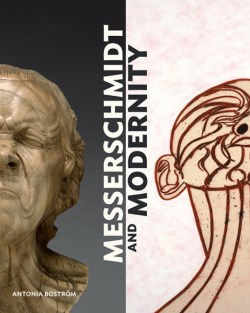 An astonishing group of sixty-nine “Character Heads” by German sculptor Franz Xaver Messerschmidt (1736–1783) has fascinated viewers, artists, and collectors for more than two centuries. The heads, carved in alabaster or cast in lead or tin alloy, were conceived outside the norm of conventional portrait sculpture and explore the furthest limits of human expression. Since their first exposure to the public in 1793, artists, including Egon Schiele (1890–1918), Francis Bacon (1909–1992), Arnulf Rainer (born 1929), and, more recently, Tony Cragg (born 1949) and Tony Bevan (born 1951), have responded to their over- whelming visual power.
Lavishly illustrated, Messerschmidt and Modernity presents remarkable works created by and inspired by Messerschmidt, an artist both of and ahead of his time. The Character Heads situate the artist’s work squarely within the eighteenth-century European Enlightenment, with its focus on expression and emotion. Yet their uncompromising style stands in sharp contrast to the florid Baroque style of Messerschmidt’s earlier sculptures for the court of Empress Maria Theresa of Austria. With their strict frontality and narrow silhouettes, the Character Heads appear to contemporary eyes as having been conceived in a “modern” aesthetic. Their position at the apparent limits of rational art have made them compelling to successive generations of artists working in a variety of media. An exhibition of the same name will be on view at the Getty Center from July 24 through October 14, 2012.
Antonia Boström is senior curator of sculpture and decorative arts at the J. Paul Getty Museum and the editor of The Fran and Ray Stark Collection of 20th-Century Sculpture in the J. Paul Getty Museum (Getty, 2008).
Catalogue for a New Museum | Simone Handbag Museum
This new book from Yale UP is published in conjunction with the new Simone Handbag Museum in Seoul, opening 16 July 2012 (the catalogue is scheduled to appear in September). Yuri Chong writes about the museum for The New York Times Magazine (12 June 2012).
◊ ◊ ◊ ◊ ◊
Judith Clark, ed., Handbags: The Making of a Museum (New Haven: Yale University Press, 2012), 272 pages, ISBN: 9780300186185, $50.
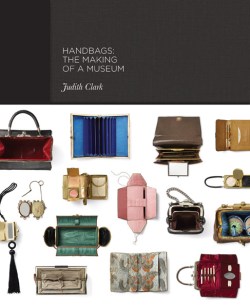 The history of the handbag—its design, how it has been made, used, and worn—reveals something essential about women’s lives over the past 500 years. Perhaps the most universal item of fashionable adornment, it can also be elusive, an object of desire, secrecy, and even fear. Handbags explores these rich histories and multiple meanings.
This book features specially commissioned photographs of an extraordinary, newly formed collection of fashionable handbags that date from the 16th century to the present day. It has been acquired for exhibition in the first museum devoted to the handbag, in Seoul, South Korea. The project is a commission undertaken by experimental exhibition-maker Judith Clark, whose innovative practices are revealed in Handbags.
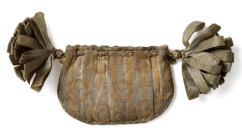
Sweetmeat purse, French, ca. 1670–80. Silk and metal brocade, braid and ribbon.
Essays by leading fashion historians and an acclaimed psychoanalyst investigate the history of gesture, the psychoanalysis of bags, and the museum’s state-of-the-art mannequins and archive cabinets. In order to preserve the words that describe the unique qualities of each bag, a terminology of handbags has been compiled.
Judith Clark is professor of fashion and museology at London College of Fashion. Caroline Evans is professor of fashion history and theory at Central St. Martin’s College of Art & Design. Amy de la Haye is professor of dress history and curatorship, Rootstein Hopkins Chair, at London College of Fashion. Adam Phillips is a psychoanalyst and writer. Claire Wilcox is senior fashion curator at the Victoria and Albert Museum.
Exhibition | Renaissance to Goya: Prints and Drawings in Spain
From The British Museum:
Renaissance to Goya: Prints and Drawings Made in Spain
The British Museum, London, 20 September 2012 — 5 January 2013
The Art Gallery of New South Wales, Sydney, 31 August — 24 November 2013
New Mexico Museum of Art, Santa Fe, 14 December — 9 March 2014
Curated by Mark McDonald
Spanish prints and drawings is a subject that is little known outside Spain. It is generally assumed these were marginal arts practiced only by a few well-known artists, including José de Ribera, Bartolomé Murillo and Francisco de Goya. The aim of this project is to explore the largely unchartered territory of the origins, form and function of prints and drawings in Spain. It will present for the first time a coherent study, largely based on the collections of the British Museum, that looks at their history from around 1400 through to and including Goya (died 1828). It will also present new research on the subject of the graphic arts in Spain. The material will be published in a monograph to accompany an exhibition at the British Museum in late 2012.
It is the first time prints and drawings made in Spain have been studied together. A critical aspect of the project will be to consider the presence of foreign artists working in Spain and how they contributed to the artistic landscape. Particular attention will be given to the different types of prints and drawings and their many functions to convey the role they played in artistic practice and visual culture in Spain (architectural prints and drawings, reproductive prints, landscape, religious subjects, prints made for commemorative purposes, fans, playing cards and more).
◊ ◊ ◊ ◊ ◊
Due out in October from Ashgate:
Catalogue: Mark McDonald, Renaissance to Goya: Prints and Drawings Made in Spain (Aldershot: Lund Humphries, 2012), 320 pages, ISBN: 9781848221185.
 The rich tradition of printmaking and drawing in Spain has rarely been examined, in part because of the misapprehension that Spanish artists did not draw and few turned their hand to printmaking. This spectacular study of prints and drawings will for the first time examine the history of graphic practice in Spain, providing an overview of more than 400 years of artistic production.
The story begins in the late 15th century with convergence of foreign artists in Spain who introduced new techniques and ideas. The most significant changes were brought about through the building of Philip II’s monastery of the Escorial near Madrid. Large numbers of foreign artists arrived to decorate the monastery. They included the Italians Pellegrino Tibaldi and Federico Zuccaro and the Flemish printmaker Pedro Perret, whose engravings of the Escorial are among the most remarkable architectural prints of the period. At the Escorial the international influences formed the basis of artistic practice and contributed to the distinctive appearance of art produced in Spain.
The ‘Golden Age’ — a dramatic flourishing of artistic and literary endeavour in Spain during the 17th century — is celebrated through discussion of key works by the most important visual artists of the period: Alonso Berruguete; the Carducho brothers; Murillo; Ribera; Zurbarán and the extraordinary drawings of Velázquez, about which very little is known. Each region of Spain is explored separately as independent centres of artistic activity during this time with prints and drawings examined together to demonstrate how their production was closely linked.
The book concludes with the Enlightenment and the 18th century, with a study of remarkable prints and drawings by Francisco de Goya. Goya’s important Spanish contemporaries are examined alongside the works of foreign artists who continued to come to Spain, such as the Tiepolo family who worked in Madrid.
Contents
Introduction
1. Prints and Drawings in Spain: Attitudes and Evidence
2. Drawings and Prints before 1500 and Early Collecting in Spain
3. Importing Graphic Practices: Castile 1550–1600
4. Madrid as Artistic Capital 1600–1700
5. Andalusia 1500–1700
6. Valencia 1500–1700 and Ribera in Naples
7. The Eighteenth-Century Reinvention of the Graphic Arts
8. Francisco de Goya
Appendix by Clara de la Peña McTigue, Spanish Paper and Papermaking
Bibliography
Mark McDonald is curator of Old Master prints and Spanish drawings at the British Museum. He has published widely on the subject of Old Master prints from the 15th to the 18th centuries, with special interest in the Renaissance period. He is the author of The Print Collection of Ferdinand Columbus (1488–1539): A Renaissance Collector in Seville (winner of the Mitchell Prize 2005).
◊ ◊ ◊ ◊ ◊
Note (added 1 September 2013) — The original posting did not include the Sydney venue; more information is available here»
Note (added 21 December 2013) — Earlier versions did not include Santa Fe venue; more information is available here».
New Title | Plumes et Pinceaux: Discours de femmes sur l’art en Europe
This new collection of essays, with a number of contributions from HECAA members, is published in memory of Anne Schroder and Angela Rosenthal. Now available in hard copy, it’s scheduled to appear online in three years, joining the second volume, an anthology of primary sources, already online at the INHA website.
◊ ◊ ◊ ◊ ◊
From the publisher:
Edited by Mechthild Fend, Melissa Hyde, and Anne Lafont, Plumes et Pinceaux: Discours de femmes sur l’art en Europe (1750-1850) – Volume 1 (Dijon: Les Presses du Réel, 2012), 336 pages, ISBN: 9782840664574, €28.

Introduction
• Mary D. Sheriff — Portrait de l’artiste en historienne de l’art : à propos des Souvenirs de Mme Vigée-Lebrun
• Noémie Étienne — La pensée dans la pratique : le cas de Marie-Jacob Godefroid, restauratrice de tableaux au XVIIIe siècle
• Sarah Betzer — Marie d’Agoult : une critique d’art « ingriste »
• Anne L. Schroder — « Elle était née pour peindre les héros ! » : l’éducation artistique des filles et les femmes peintres vue par Mme de Genlis
• Isabelle Baudino — Les voyageuses britanniques à Paris : un point de vue féminin sur l’art ?
• Satish Padiyar — Les lettres de Mme Récamier à Canova (1813-1819) : une écriture féminine entre grâce et exil
• Heather Belnap Jensen — Quand la muse parle : Julie Candeille sur l’art de Girodet
• David Blankenstein, Nina Struckmeyer et Malte Lohman — Helmina von Chézy, une historienne de l’art (?) berlinoise à Paris sous l’Empire
• Susan L. Siegfried — Expression d’une subjectivité féminine dans les journaux pour femmes, 1800-1840
• Charlotte Foucher — Le bas-bleu artistique : portrait au vitriol de la femme critique d’art
• France Nerlich — Johanna von Haza, alias Heinrich Paris. De la critique d’art comme critique sociale
Index
Crédits photographiques
◊ ◊ ◊ ◊ ◊
The second volume, as described at Les presses du réel:
Edited by Anne Lafont, with Charlotte Foucher and Amadine Gorse, Plumes et Pinceaux: Discours de femmes sur l’art en Europe (1750-1850) – Volume 2, Anthologie (Dijon: Les Presses du Réel, 2012), 560 pages, ISBN: 9782840664581, €32.
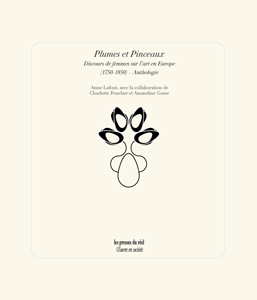 Si Germaine de Staël et Marceline Desbordes-Valmore sont connues pour leurs réflexions sur l’art, d’autres écrits et pensées de femmes des années 1750-1840 en France, mais aussi en Angleterre et en Allemagne, le sont moins, ou pas du tout. C’est un florilège de ces voix qui est donné à lire dans ces pages : de Mme de Beaumer à Edmée de Syva, en passant par Félicité de Genlis (dont sont publiés ici deux textes inédits, Essai sur les arts et Catalogue pittoresque du cabinet de tableaux de Monsieur le comte de Sommariva), Élisabeth Vigée-Lebrun, Helmina von Chézy, Anne Plumptre, parmi une quinzaine d’autres. Journalistes, critiques d’art, artistes ou voyageuses curieuses et averties visitant les musées européens avec passion, elles usent de tous moyens littéraires, pour faire entendre des positions esthétiques, morales, voire politiques sur l’art et
son histoire. Elles portent un regard aigu, mais pourtant jamais univoque, sur les grands événements de leur temps – de la Révolution
française à la conquête napoléonienne et à ses conséquences –, et sur
l’art et la création artistique.
Exhibition | The Horse: From Arabia to Royal Ascot
While you probably wouldn’t know it from the description provided below, the eighteenth century is a major theme for this exhibition on horses at The British Museum — with a good showing of Stubbs, including Letitia, Lady Lade from the Royal Collection, but other treats, too. I found it immensely instructive, one of the most interestingly layered exhibitions I recall seeing in a long time. There’s something for everyone — antiquity and the role of the horses in early civilizations and empires of Mesopotamia and Egypt, extraordinary Persian and Mughal miniatures, textiles, equestrian rock art (photographed in stunning detail), paintings, books, portraiture, agrarian history, and sport. The challenge, however, is not simply putting together a varied exhibition but imparting coherence, and given just how much is covered in this relatively modest sized show, it succeeds brilliantly, appropriately acknowledging both the Diamond Jubilee and the Olympics without being obsequious to either one. It also offers, I think, an example of how projected photographs and video can be used effectively in an exhibition without taking over or supplanting the objects on display. For better or worse, I’m guessing we’ll see lots more moving images in the exhibitions of the future. Integrating that technology thoughtfully into the larger intellectual program of a show is a tall order. The Horse: From Arabia to Royal Ascot offers a start and plenty else besides.
-Craig Hanson
◊ ◊ ◊ ◊ ◊
From The British Museum:
The Horse: From Arabia to Royal Ascot
The British Museum, London, 24 May — 30 September 2012
Curated by John Curtis and Nigel Tallis
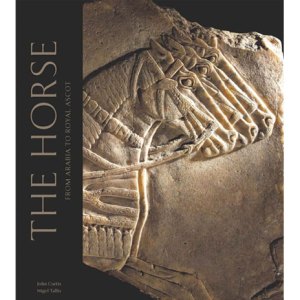 The history of the horse is the history of civilisation itself. The horse has had a revolutionary impact on ancient civilisations and this major exhibition explores the influence of horses in Middle Eastern history, from their domestication around 3,500 BC to the present day. Britain’s long equestrian tradition is examined from the introduction of the Arabian breed in the 18th century to present day sporting events such as Royal Ascot and the Olympic Games.
Important loans from the British Library, the Fitzwilliam Museum and the Royal Armouries, as well as rare material from Saudi Arabia, will be seen alongside objects from the British Museum’s exceptional collection, including famous pieces such as the Standard of Ur and Achaemenid Persian reliefs. Supported by the Board of Trustees of the Saudi Equestrian Fund, the Layan Cultural Foundation and Juddmonte Farms. In association with the Saudi Commission for Tourism & Antiquities. (more…)
Enfilade at Three — Buy a Book and Open a Door
From the Editor
 Enfilade turns three today, and to celebrate, I’m announcing a campaign to establish June 22 as Buy-an-Art-Book Day. As I’ve said repeatedly, you deserve credit for making this site so much more than I could have possibly envisioned when I stepped on-board several years ago as newsletter editor. With more than 220,000 hits on some 1300 posts, Enfilade attests to the global depth of interest in eighteenth-century art — both among scholars and a wider, engaged public. The site now receives around 10,000 hits each month with some 1500 from returning visits. In short, there are hundreds of you who read Enfilade on a regular basis, and the site’s success depends on you. Thank you!
With these numbers in mind, it seems to me that Enfilade readers could mobilize to make an impact — modest perhaps but still an impact. In transitioning from traditional print formats to the digital realm, academic publishing, particularly art historical publishing, faces tremendous challenges. With the ‘business’ of the academy more generally plagued by questions of sustainability, it’s easy to see how hard decisions about budgets have wreaked havoc on the sales of books (when major universities are cutting whole departments, declining library budgets may seem relatively benign, but in both cases, fewer books will be sold). For most of us, such gloomy observations are all too familiar, and you don’t turn to Enfilade for more bad news. Today is after all a birthday celebration!
So as a gesture of positive action, I’m asking all of you to buy a book today (and fellow bloggers to spread the word). It’s easy to think that it won’t matter, but it does. Most people are astounded to learn just how small the circulation numbers are for art history books published by university presses. However humbling it may be for those of us who spend years of our lives producing a book, it’s not uncommon for only 400 or 500 copies to be sold. Surpass 1000 and you’re a superstar. There’s a tendency to assume that university presses receive generous funding from their host universities. It’s almost never the case. If they’re not in the business to turn huge profits, they must still be economically viable. Several years ago, I heard Susan Bielstein, executive editor at the University of Chicago Press, give a talk on the nuts and bolts of publishing. How did she begin? By asking members of her audience (almost entirely composed of art historians) to go buy a book. She was entirely serious. So am I.

Many of you buy lots of art history books already. Bravo! Buying a book today won’t be any major change for you. As I think about my own buying habits, they tend to go something like this: I buy discounted display copies at conferences, I buy things I need for an upcoming talk, I buy remaindered copies of books I should have bought a year or two earlier, or I buy used copies I need for an article via Amazon. None of that’s what I have in mind in launching Buy-an-Art-Book Day. Those used books do nothing to help the authors or the university presses who produced them. For that matter, new purchases through Amazon often result in smaller royalties than buying from the publisher directly. Ever wonder who shoulders the expense of that reduced price? Yes, the publisher and the writer.
If 200 or 300 of you buy an art history book this week — ideally one treating the eighteenth century and, better yet, one written by a HECAA member — it would send a strong message that there is an eager audience for such books. Whether you spend $6 or $1000, buy a book.
I like the metaphor of an enfilade because of the way it suggests an open — almost limitless — vista, with each room leading to a deeper, more intimate experience. But such a vision is premised on those doors being opened. Reading a book — buying a book — is one way we turn the handle, one way we open doors to the eighteenth century.
-Craig Hanson
Exhibition | Canaletto: The Venetian Notebook
Thanks to Stacey Sloboda for noting this one that almost slipped by me (a brief English description is available here). From the Palazzo Grimani:
Canaletto: Il Quaderno Veneziano
Palazzo Grimani, Venice, 1 April — 1 July 2012
Curated by Annalisa Perissa Torrini
 Apre a Venezia il 1 aprile, nella cornice straordinaria delle sale di Palazzo Grimani, la mostra Canaletto. Il Quaderno veneziano dedicata al celebre Quaderno di schizzi di Canaletto, un unicum nella storia dell’arte del Settecento, codice mai visibile al pubblico, ora presentato assieme a ventiquattro disegni di antica provenienza veneziana, appartenenti a collezioni pubbliche e private, per la prima volta insieme.
Il progetto espositivo è a cura del Direttore del Gabinetto dei Disegni delle Gallerie dell’Accademia, Annalisa Perissa Torrini, programmato nell’ambito della valorizzazione del fondo grafico, promosso dalla Soprintendenza Speciale per il Patrimonio storico, artistico ed etnoantropologico e per il Polo Museale della città di Venezia e dei comuni della Gronda lagunare e prodotto da Venezia Accademia con il contributo di Save Venice Inc.
La mostra indaga il modus operandi dell’artista, definendone la concreta operatività nella fase di costruzione grafica e stabilisce il ruolo svolto dalla camera ottica nell’ideazione e realizzazione delle vedute di Venezia.
Il Quaderno di Canaletto è un prezioso piccolo volume (mm 175×235) formato da 7 fascicoli, rilegati nell’Ottocento, ma in origine sciolti, ricolmo di schizzi realizzati probabilmente in un breve arco di tempo, poi riutilizzato dal pittore veneziano negli anni. Ogni fascicolo racconta il processo creativo del suo lavoro: le tipiche annotazioni sui colori, sui materiali e sui luoghi ritratti, le correzioni e abrasioni, i cambi di inchiostro e di penna, lo sporadico uso del righello e l’impiego della punta metallica, la cui presenza è stata osservata nel corso degli studi e delle analisi delle tecniche e della carta.
Insieme al Quaderno, vengono esposti otto fogli, tra cui il cosiddetto “scarabotto” con il Canal Grande di fronte alla Salute e il Traghetto di San Moisé, della raccolta delle Gallerie, sette fogli della Galleria Nazionale d’Arte Antica di Trieste, sette fogli poco noti di collezione privata italiana di provenienza Corniani-Algarotti, il foglio della Fondazione Cini e quello del Museo Correr di Venezia. Importanti dipinti di collezioni pubbliche e private mostreranno poi la realizzazione pittorica di alcuni disegni esposti in mostra: capolavori delle Gallerie dell’Accademia, di Ca’ Rezzonico, degli Uffizi, di Castello Sforzesco e di importanti collezioni private italiane, mentre alcune incisioni, di Visentini e Smith, documentano l’importanza delle stampe sia nell’iter creativo dell’artista, che nella diffusione della sua opera.
In occasione della mostra verrà pubblicato un fac-simile del Quaderno di Canaletto, edito da Marsilio Editori, accompagnato da un saggio storico interpretativo di Annalisa Perissa Torrini e seguito da uno studio sulla fascicolazione e rilegatura condotto da Barbara Biciocchi, da un testo sulla camera ottica a cura di Dario Maran, e documenti sulla vita di Canaletto trovati da Alessandra Schiavon all’Archivio di Stato di Venezia.
Il progetto di allestimento, curato da Annunziata Genchi, comprende supporti audiovisivi e multimediali didattici, fra i quali una riproduzione digitale del Quaderno, realizzata da Mauro Tarantino, che permetterà al visitatore di sfogliare virtualmente tutte le pagine del prezioso codice, mentre diversi filmati illustreranno l’utilizzo e le finalità della camera ottica, i modi di fascicolazione del volume e le tecniche grafiche di esecuzione, un filmato in 3D con il confronto tra i disegni e i dipinti ed un altro sul funzionamento della camera ottica. Un modello funzionante di camera ottica, inoltre, è stato realizzato in collaborazione con il Musée Maillol di Parigi, dove il visitatore potrà guardare le “vedute” come faceva lo stesso Canaletto.
◊ ◊ ◊ ◊ ◊
From Marsilio:
Annalisa Perissa Torrini, ed., Canaletto. Il Quaderno veneziano (Marsilio, 2012), 236 pages, ISBN: 9788831713009, €33.
 In occasione della mostra Canaletto. Il Quaderno veneziano, in programma a Venezia nella splendida cornice di Palazzo Grimani dall’1 aprile all’1 luglio, verrà pubblicato un fac-simile dell’affascinante manufatto, un unicum nella storia dell’arte del Settecento, solitamente non visibile al pubblico. Il prezioso volume formato da sette fascicoli, rilegati nell’Ottocento ma in origine sciolti, ricolmo di schizzi realizzati probabilmente in un breve arco di tempo, venne riutilizzato negli anni da Canaletto come strumento di lavoro. Ogni fascicolo racconta l’operare del maestro veneziano: racchiude le tipiche annotazioni sui colori, sui materiali e sui luoghi raffigurati, le correzioni e le abrasioni, i cambi di inchiostro e di penna, tutte quelle tracce che rappresentano la sua memoria grafica, la registrazione di dati veri, oggettivi, esatti da interpretare e rielaborare nella fase creativa della composizione della veduta. In apparato al fac-simile saranno inseriti, oltre agli interessanti risultati delle recenti analisi sulle cosiddette informazioni “nascoste” – non visibili a occhio nudo – e su fascicolazione e rilegatura dell’opera, anche un saggio storico interpretativo di Annalisa Perissa e un testo di Dario Maran che stabilisce il ruolo svolto dalla camera ottica nell’ideazione e realizzazione delle vedute di Venezia.
◊ ◊ ◊ ◊ ◊
Exhibition | Expanding Horizons: Lusieri and the Panoramic Landscape
From the National Galleries of Scotland, as noted by Hélène Bremer:
Expanding Horizons: Giovanni Battista Lusieri and the Panoramic Landscape
Scottish National Gallery, Edinburgh, 30 June — 28 October 2012
Curated by Aidan Weston-Lewis

Giovanni Battista Lusieri, The Monument to Philopappos, Athens, ca. 1805-07
Giovanni Battista Lusieri (1754–1821) was hailed during his lifetime as one of the most gifted of all living landscape artists and his exquisitely crafted works were eagerly sought by collectors. But within a few years of his death his reputation descended into an obscurity from which it has only recently begun to re-emerge. His name will still be unfamiliar to all but a few specialists, a neglect which this exhibition, the first ever devoted to the artist, aims to redress.
Lusieri was one of very few Italian artists to have adopted watercolour as their favoured medium. From the outset his work exhibits the meticulous detail, precision and faultless perspective that remained the hallmarks of his style throughout his career, combined with a panoramic breadth of vision and an astonishing ability to render brilliant effects of light. The latter part of Lusieri’s career was spent mainly in Athens as Lord Elgin’s resident artist and agent. In that capacity he was closely involved in supervising the removal and shipping of the celebrated marbles from the Acropolis, now in the British Museum.
◊ ◊ ◊ ◊ ◊
Catalogue: Aidan Weston-Lewis with Fabrizia Spirito, Kim Sloan, and Dyfri Williams, Giovanni Battista Lusieri and the Panoramic Landscape: Expanding Horizons (Edinburgh: National Galleries of Scotland, 2012), 236 pages, ISBN: 9781906270469, £25 / $63 — available from Artbooks.com in August
 This is the first publication in English devoted to the extraordinary work of the Italian landscape watercolourist Giovanni Battista Lusieri (1754-1821). His career took him from his native Rome to Naples, then to Sicily and finally to the eastern Mediterranean, where he spent twenty years in the service of the 7th Earl of Elgin as his resident artist and agent in Athens. In that capacity he was closely involved in the removal of the celebrated marbles from the Parthenon and other monuments in Greece. Lusieri’s watercolours combine a broad, panoramic vision, an uncanny ability to capture brilliant Mediterranean light and a meticulous, almost photographic attention to detail. He was widely acclaimed as one of the most accomplished landscape artists of his day, and his works were eagerly sought by British Grand Tourists, but after his death he was soon forgotten, and only recently have his exceptional gifts begun to be recognised once again.
Contents
Foreword
Acknowledgements
Aidan Weston-Lewis — ‘The most exact and eloquent transcriptions of nature I ever saw’: Giovanni Battista Lusieri, Life, and Work
Fabrizia Spirito — Lusieri and his Contemporaries | Drawing on the Spot around Rome and Naples
Aidan Weston-Lewis — Rome | An Early Patron: Philip Yorke; entries 1-13
Kim Sloan — Naples | ‘Naples, where the landscape painter is most truly in his element’; entries 14-59
Fabrizia Spirito — Sicily | Lusieri in Sicily; entries 60-66
Dyfri Williams — Greece | Lusieri in the Eastern Mediterranean, 1800-1821; entries 67-92
Bibliography
Notes and References
◊ ◊ ◊ ◊ ◊
Aidan Weston-Lewis is Chief Curator at the Scottish National Gallery with responsibility for the Italian and Spanish collections. He has organised numerous exhibitions at the Gallery and been closely involved with many major acquisitions. He has a particular interest in north Italian painting and drawing of the sixteenth and seventeenth centuries and has published widely in this area.
Forthcoming | French Funerary Arts and Tomb Cult, 1750-1870
Due out in September from Ashgate:
Suzanne Glover Lindsay, Funerary Arts and Tomb Cult: Living with the Dead in France, 1750–1870 (Aldershot: Ashgate, 2012), 260 pages, ISBN: 9781409422617.
Even before the upheaval of the Revolution, France sought a new formal language for a regenerated nation. Nowhere is this clearer than in its tombs, some among its most famous modern sculpture-rarely discussed as funerary projects. Unlike other art-historical studies of tombs, this one frames sculptural examples within the full spectrum of the material funerary arts of the period, along with architecture and landscape. This book further widens the standard scope to shed new and needed light on the interplay of the funerary arts, tomb cult, and the mentalities that shaped them in France, over a period famous for profound and often violent change. Suzanne Glover Lindsay also brings the abundant recent work on the body to the funerary arts and tomb cult for the first time, confronting cultural and aesthetic issues through her examination of a celebrated sculptural type, the recumbent effigy of the deceased in death. Using many unfamiliar period sources, this study reinterprets several famous tombs and funerals and introduces significant enterprises that are little known today to suggest the prominent place held by tomb cult in nineteenth-century France. Images of the tombs complement the text to underline sculpture’s unique formal power in funerary mode.
Contents
Introduction: Revisiting 18th- and 19th-Century French Tombs
1. Reforming Funerary Cult in France, 1750–1870
2. 18th-Century France: Rethinking Sculpture and the Body
3. The Bonchamps Project: Reinventing the Effigy Tomb
4. Louis-Philippe’s Tombs: Burying a Modern Royal Family
5. The Poetics of the Exhumed Corpse I: A Tomb for Napoléon
6. The Poetics of the Exhumed Corpse II: The Cavaignac Tomb
Bibliography
Index










 Enfilade
leave a comment