Exhibition | Paris, 1793–1794
Opening at the Musée Carnavalet:
Paris, 1793–1794: A Revolutionary Year
Musée Carnavalet, Paris, 16 October 2024 — 16 February 2025
Musée de la Révolution française, Vizille, 27 June — 23 November 2025
Curated by Valérie Guillaume, Philippe Charnotet, and Anne Zazzo
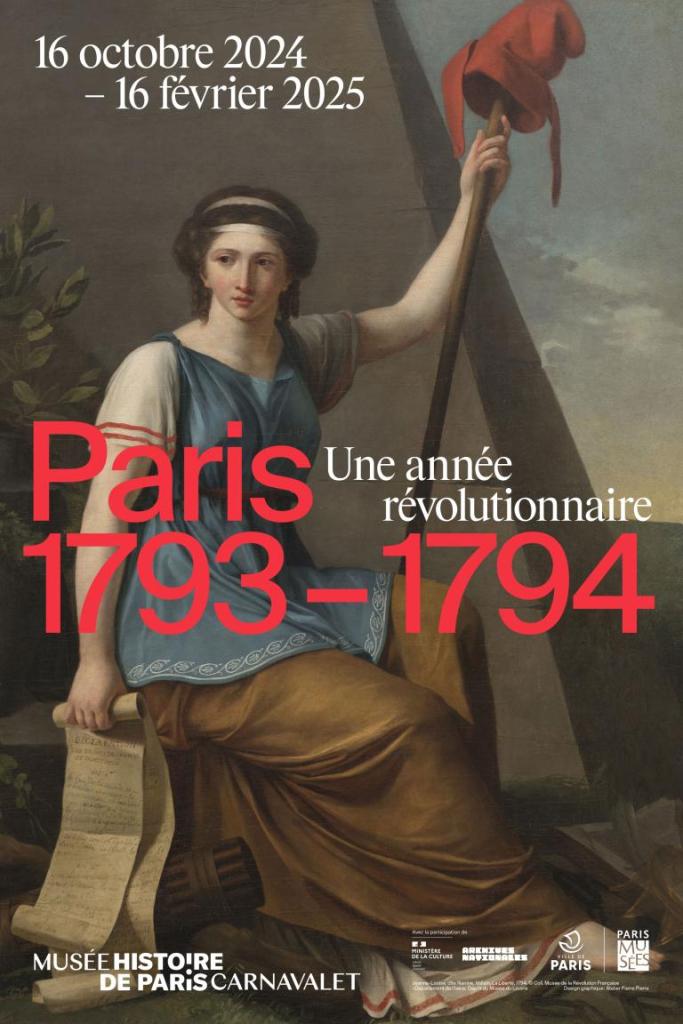 For the first time, the Musée Carnavalet – Histoire de Paris, renowned for its collections on the French Revolution, will single out one key year in the revolution—without a doubt the most complex: ‘Year II’ of the Republican calendar, covering the period from 22 September 1793 to 21 September 1794.
1789, the year of the Storming of the Bastille and The Declaration of the Rights of Man and of the Citizen, is often considered to be the glorious year of the Revolution and even to embody the French Revolution in its entirety. It is the year during which Paris established itself as the capital of the Enlightenment and Revolutions. But compared to the clarity of ’89’, ’93’ appears much darker and thornier. As it was just coming to an end, this long political year spanning from the spring of 1793 to the summer of 1794 had already found a name: the ‘Terror’. Fabricated for political reasons, the word points to the authoritarian transition that the republican regime had undergone. And yet, the years 1793–94 are also the years that some, confident in their ability to reinvent history, called ‘Year II’: a year defined by its breaking with the past and its revitalising of revolutionary utopias. The exhibition is a collection of more than 250 works of all kinds: paintings, sculptures, objects of decorative arts, historical and memorial objects, wallpaper, posters, pieces of furniture… And all translate collective histories and incredible individual fates. These varied objects reveal a context imbued with collective fears and state violence, but also with extraordinary daily activities, feasts, and celebrations.
Paris, 1793–1794: Une année révolutionnaire (Paris Musées, 2024), 224 pages, ISBN: 978-2759605903, €39.
Scientific commission
• Valérie Guillaume, director of the Musée Carnavalet – Histoire de Paris
• Philippe Charnotet, assistant curator and head of the numismatic collection at the Musée Carnavalet
• Anne Zazzo, chief curator, head of the historical and memorial objects collection at the Musée Carnavalet
Scientific committee
• Jean-Clément Martin, professor emeritus of History of the French Revolution at the University Paris I
– Panthéon-Sorbonne
• Alain Chevalier, director of the Musée de la Révolution Française – Domaine de Vizille
• Aurélien Larné, archivist at the Ministry of Justice – Department of the Archives, Documentation and Cultural Heritage
• Marisa Linton, professor of Modern History at the University of Kingston – London
• Guillaume Mazeau, senior lecturer of Modern History at the Université Paris I – Panthéon-Sorbonne
• Allan Potofsky, professor of Modern History at the Université Paris-Cité
• Charles Eloi Vial, curator of the Libraries for the Department of Manuscripts at the Bibliothèque Nationale de France
◊ ◊ ◊ ◊ ◊
Note (added 7 July 2025)— The posting was updated to include the second venue, the Musée de la Révolution française, where the exhibition is titled 1793–1794: Un Tourbillon Révolutionnaire.
Exhibition | Figures of the Fool
Opening next month at the Louvre:
Figures of the Fool: From the Middle Ages to the Romantics
Musée du Louvre, Paris, 16 October 2024 — 3 February 2025
Curated by Élisabeth Antoine-König and Pierre-Yves Le Pogam
 Fools are everywhere. But are the fools of today the same as the fools of yesteryear? This fall, the Musée du Louvre is dedicating an unprecedented exhibition to the myriad figures of the fool, which permeated the pictorial landscape of the 13th to the 16th centuries. Over the course of the Middle Ages and the Renaissance, the fool came to occupy every available artistic space, insinuating himself into illuminated manuscripts, printed books and engravings, tapestries, paintings, sculptures, and all manner of objects both precious and mundane. His fascinating, perplexing and subversive figure loomed large in the turmoil of an era not so different from our own.
The exhibition examines the omnipresence of fools in Western art and culture at the end of the Middle Ages, and attempts to parse the meaning of these figures, who would seem to play a key role in the advent of modernity. The fool may make us laugh, with his abundance of frivolous antics, but he also harbours a wealth of hidden facets of an erotic, scatological, tragic or violent nature. Capable of the best and of the worst, the fool entertains, warns or denounces; he turns societal values on their head and may even overthrow the established order.

Francisco José de Goya y Lucientes, Yard with Madmen, 1794 (Dallas: Meadows Museum).
Within the newly renovated Hall Napoléon, this exhibition, which brings together over 300 works from 90 French, European and American institutions, brings us on a one-of-a-kind journey through Northern European art (English, Flemish, Germanic, and above all French), illuminating the profane aspects of the Middle Ages and revealing a fascinating era of surprising complexity. The exhibition explores the disappearance of the figure of the fool with the Enlightenment and the triumph of reason, and its resurgence at the end of the 18th century and all throughout the 19th. The fool then became a figure with which artists identified, wondering: ‘What if I were the fool?’
The exhibition is curated by Élisabeth Antoine-König, Senior Curator in the Department of Decorative Arts, and Pierre-Yves Le Pogam, Senior Curator in the Department of Sculptures, Musée du Louvre.
With the support of the Cercle des Mécènes du Louvre, the Fondation Etrillard and the New York Medieval Society.
Élisabeth Antoine-König and Pierre-Yves Le Pogam, eds., Figures du Fou: Du Moyen Âge aux Romantiques (Paris: Musée du Louvre éditions / Gallimard, 2024), 448 pages, ISBN: 978-2073073037, €45.
Exhibition | An Actor with No Lines — Pierrot

Watteau, Pierrot, also known as Gilles, detail, ca. 1718–19, oil on canvas, 1.84 × 1.56 meters
(Paris: Musée du Louvre).
◊ ◊ ◊ ◊ ◊
This exhibition opens in October at The Louvre in conjunction with the The Fool . . .
A New Look at Watteau: An Actor with No Lines — Pierrot, Known as Gilles
Musée du Louvre, Paris, 16 October 2024 — 3 February 2025
Curated by Guillaume Faroult
Watteau’s Pierrot, formerly known as Gilles, is one of the most famous masterpieces in the Louvre’s collection. This enigmatic work, which has long raised questions for art historians, is currently undergoing conservation treatment at the Centre for Research and Restoration of the Museums of France, after which time it will be the focus of a spotlight exhibition.

Louis Crépy after Antoine Watteau, Self-Portrait (Paris: Bibliothèque nationale de France).
Nothing is known about the painting before it was discovered by the artist and collector Dominique Vivant Denon (1747–1825), Director of the Louvre under Napoleon. It soon came to be regarded as a Watteau masterpiece and garnered praise from renowned writers and art historians. It has often been seen as reflecting a certain image of the 18th century—mischievous, cynical, or melancholy, depending on the author and the era. Its fame boosted the return to favour of 18th-century art in the age of Manet and Nadar.
The exhibition will present the findings of the conservation project, approaching this wholly original work—whose attribution to Watteau has sometimes been questioned—both as part of the artist’s oeuvre and in the cultural and artistic context of the time. Alongside many other paintings and drawings by Watteau, there will be works by his contemporaries: painters, draughtsmen, engravers (Claude Gillot, Antoine Joseph Pater, Nicolas Lancret, Jean Baptiste Oudry, Jean Honoré Fragonard, etc.), and writers (Pierre de Marivaux, Alain-René Lesage, JeanFrançois Regnard, Evaristo Gherardi), with special emphasis on the rich theatrical repertoire of the time.
As soon as the painting entered the Louvre in 1869, via the bequest of Louis La Caze (1798–1869), it became a favourite with generations of viewers. Its powerful appeal is partly due to its outstanding quality, but also to its originality for the period and to the mystery surrounding its production.
The exhibition will also explore the painting’s rich and varied critical reception and its far-reaching artistic legacy. This powerful, enigmatic image has greatly inspired French writers, including Théophile Gautier, Charles Baudelaire, Paul Verlaine, George Sand, the Goncourt brothers, and Jacques Prévert. The painting has also influenced photographers, filmmakers, and musicians (Nadar, Marcel Carné, Arnold Schoenberg), as well as visual artists (Edouard Manet, Gustave Courbet, Pablo Picasso, André Derain, Juan Gris, James Ensor, Georges Rouault, and Jean-Michel Alberola), driving them to new creative heights.
The show will explore the fascinating conversations between these great creative minds and Watteau’s enigmatic painting, even as it resonates harmoniously with the Figures of the Fool exhibition scheduled for the same dates in the Hall Napoléon.
Guillaume Faroult, Revoir Watteau: Un comédien sans réplique. Pierrot, dit le Gilles (Musée du Louvre Éditions and Liénart Éditions, 2024), 240 pages, €40.
Exhibition | André Charles Boulle
Closing soon at the Musée Condé:
André Charles Boulle
Musée Condé, Château de Chantilly, 8 June — 6 October 2024
Curated by Mathieu Deldicque, with Sébastien Evain and William Iselin

Writing Table of the Prince of Condé, long-term lease from the Château de Versailles to the Condé Museum (RMN-Grand Palais / A. Didierjean)
The collection of the Condé Museum in Chantilly features two desks by one of the greatest French cabinetmakers of all time, André Charles Boulle. From June to October 2024, the Grands Appartements of the Princes of Condé at the Château de Chantilly will host the first-ever exhibition in France to explore Boulle’s life and work.
The show brings together this ingenious designer’s most significant pieces, commissioned by the most illustrious patrons in France—the King, the Grand Dauphin, the Prince of Condé, and the Duchess of Burgundy—in a celebration of French furniture-making excellence, its techniques, and unrivalled grace. The life and long career of André Charles Boulle (1642–1732) need little introduction. Cabinetmaker, artist, and artisan, Boulle worked for the Bâtiments du roi, the department of the King’s Household responsible for building works, for more than half a century, and he and his workshop produced pieces for the Royal Family and the French nobility. He achieved high technical perfection, particularly in metal-and-tortoiseshell marquetry, which he raised to new heights. An ingenious bronzesmith, Boulle established the use of gilt-bronze in furniture and gave his creations a unique look. He was also a curious collector and a talented draughtsman who took pains to bring his production to a broader audience, notably through engravings. Synonymous with the sumptuousness of French art under Louis XIV, he achieved recognition in his lifetime, and his name has been celebrated ever since.
André Charles Boulle was a leading figure in the development of French furniture in the late 17th and early 18th centuries. Besides the commode, one of his most influential designs at the end of Louis XIV’s reign was the flat-topped writing table (bureau plat). Besides producing desks on six legs and desks with several drawers on each side supported by eight legs, Boulle invented a new type of desk, with a single row of three drawers in the frieze, resting on four legs. This flat writing table made his reputation, and brass-and-tortoiseshell marquetry, rich gilt-bronze mounts, and slender, curved shapes became the hallmark of elegance in furniture and the ultimate symbol of power. They were produced in increasingly large numbers from the second decade of the eighteenth century until the early years of the Régence. The innovations made by Boulle defined the shape of the French writing table for more than half a century.
The exhibition charts developments in desk design, shape, and decoration through a large and varied display of desks by Boulle, each with a long-established provenance. Furniture with ‘part’ and ‘counterpart’ marquetry is presented side by side in a way that reveals their beauty and helps visitors learn more about them. Key pieces produced by the same workshop will complete this fascinating survey and put this unparalleled production into its broader context. Bookcases, consoles, stands, torchères, caskets, chandeliers, medal cabinets, and bookbindings—all of illustrious provenance—remind us of this ingenious artist’s versatile talent and creativity.
The exhibition is curated by Mathieu Deldicque, Lead Heritage Conservator, Director of the Conde museum, in collaboration with Sébastien Evain, conservator and independent expert, a specialist in French 18th-century furniture and objets d’art, and William Iselin, an expert in French 18th-century furniture and objets d’art. In partnership with the Château de Versailles, the Château de Vaux-le-Vicomte, and the Bibliothèque nationale de France.
Mathieu Deldicque, ed., André Charles Boulle (Saint-Rémy-en-l’Eau: Éditions d’art Monelle Hayot, 2024), 304 pages, ISBN: 979-1096561452, €39.
New Book | Réseaux et académies d’art au Siècle des lumières en province
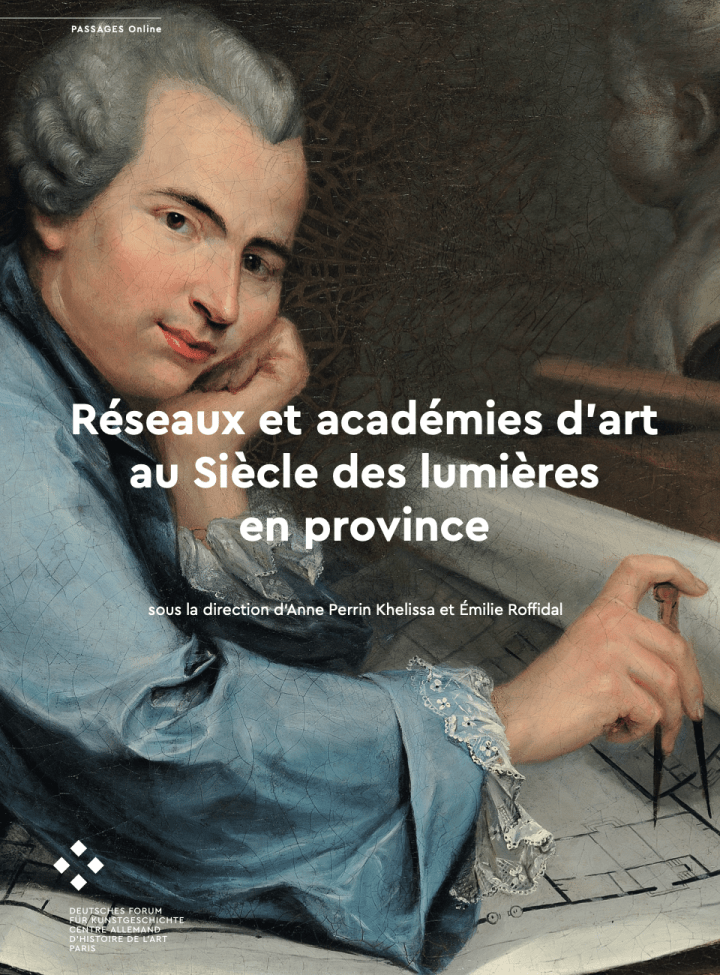
We are delighted to announce the publication of Réseaux et académies d’art au Siècle des lumières en province by Editions de l’Université d’Heidelberg, a partnership between the Université de Toulouse Jean Jaurès and the Deutsches Forum für Kunstgeschichte. The book is the result of seven years of research conducted by the ACA-RES program (Les académies d’art et leurs réseaux dans la France préindustrielle), giving rise to several study days and publications, a vast archival and digital survey, a virtual exhibition, and a concluding colloquium on the theme of circulations, as well as numerous collaborations between universities, museums, and researchers from diverse horizons. To celebrate, there will be a presentation of the book followed by a drinks reception on Wednesday, October 16, starting at 6pm at the Centre allemand d’histoire de l’art (45 rue des Petits Champs).
–Anne Perrin Khelissa and Émilie Roffidal
The full volume is available for free here»
Anne Perrin Khelissa and Émilie Roffidal, eds., Réseaux et académies d’art au Siècle des lumières en province (Heidelberg: arthistoricum.net-ART-Books, 2024), 428 pages, ISBN: 978-3985010790 (hardcover) / ISBN: 978-3985010783 (PDF).
c o n t e n t s
Remerciements
 Introduction générale
• Anne Perrin Khelissa, Émilie Roffidal — Le progrès par les arts : l’émergence du phénomène académique
Partie I | Dynamique des réseaux interpersonnels et interinstitutionnels
• Anne Perrin Khelissa, Émilie Roffidal — Introduction
• Lesley Miller — L’École gratuite de dessin et la production textile à Lyon au XVIIIe siècle : réévaluer l’utilité et l’application d’un enseignement
• Hélène Rousteau-Chambon — L’école de dessin de Nantes, un creuset pour les architectes ?
• Stéphanie Trouvé — Les cercles académiques bordelais dans la trajectoire du peintre Pierre Lacour (1745–1814)
• Catherine Voiriot — Les femmes académiciennes en province : l’exemple de l’Académie de peinture et de sculpture de Marseille
• Joëlle Raineau-Lehuédé — Nicolas Ponce (1746–1831) : la trajectoire d’un graveur au sein des académies de province
• Maël Tauziède-Espariat — Les artistes de Paris et les écoles de dessin provinciales au XVIII e siècle : les cas de Bordeaux, Reims et Rouen
• Gaëtane Maës — Enseignement du dessin et perspectives transnationales : réflexions à partir du cas de Jean-Baptiste Descamps (1715–1791)
Partie II | Mobilité des collections et des savoirs artistiques
• Anne Perrin Khelissa, Émilie Roffidal — Introduction
• Flore César — Les collections des écoles de dessin et des académies d’art en province : entre intentions et institutionnalisation
• Pierre Marty — Expositions de peintures et académies artistiques provinciales : vers une structuration du marché de l’art
• Nelly Vi-Tong — Les collections pédagogiques des établissements de Reims, Valenciennes et Dijon
• Tara Cruzol — Le traité de sculpture d’Antoine-Michel Perrache (1726–1779) à Lyon, ou la culture d’un professeur
• Fabienne Sartre — Le « ciseau statuaire » et la sculpture académique à l’épreuve du terrain. L’expérience montpelliéraine (1770-1800)
• Catherine Isaac — Le rôle des académies des sciences et des arts dans la création et l’essor du corps des ingénieurs du Languedoc
• Marion Amblard — Des arts manufacturés aux beaux- arts : l’importance des modèles romains et français dans le développement des académies écossaises
• Anne Perrin Khelissa, Émilie Roffidal — Conclusion générale | Entre utopie et réalité des arts : de l’échelle régionale à l’échelle mondiale
• Pierre-Yves Beaurepaire — Ouverture | Historiographie et linéaments des sociabilités des Lumières
Notices historiques des académies d’art
Carte des principales villes avec une école de dessin ou une académie d’art
Sources manuscrites, imprimées et visuelles des académies d’art
Liste des publications ACA-RES
Bibliographie générale
Index
Crédits photographiques
◊ ◊ ◊ ◊ ◊
Note (added 11 September 2024) — The original posting mistakenly gave the reception date as Thursday, October 17. It has been corrected above as Wednesday, October 16.
Print Quarterly, September 2024
The long eighteenth century in the latest issue of Print Quarterly:
Print Quarterly 41.3 (September 2024)
a r t i c l e s
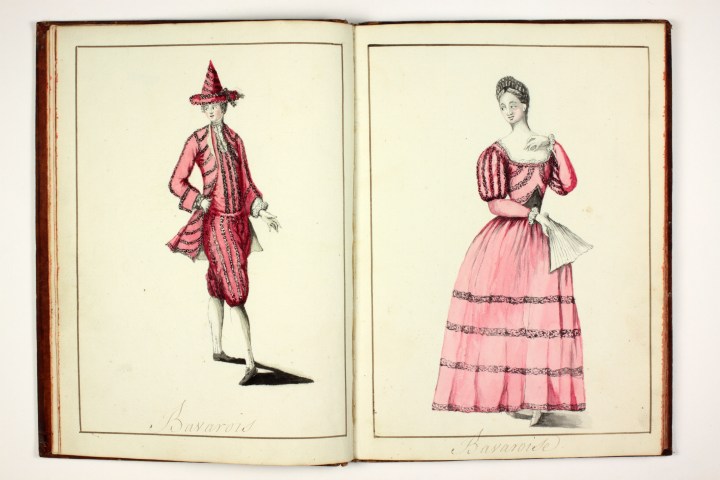
Anonymous artist, A Bavarian Man and A Bavarian Woman, ca. 1759, watercolour, 269 × 190 mm (Welbeck, Nottinghamshire: Welbeck Abbey).
• Derek Adlam and Maureen Cassidy-Geiger, “The Duke of Portland’s Album of Masquerade Costumes Worn in Warsaw in 1759”, pp. 268–84.
This article examines an album of watercolours in the library of the Dukes of Portland at Welbeck Abbey near Worksop, Nottinghamshire, depicting costumed figures and the print sources that inspired them. Seemingly related to the Polish masked balls and banquets mounted in Warsaw on 26 and 27 February 1759 by Jerzy August Mniszech (1715–78), King August III, the album is closely related to imagery seen in Abraham a Sancta Clara’s Neu-eröffnete Welt-Galleria (Nuremberg, 1703), among others, listed in an Appendix at the end of the article. Its commission and creator remain unknown.
n o t e s a n d r e v i e w s
• Daniel Godfrey, Review of Anna Marie Roos, Martin Lister and his Remarkable Daughters: The Art of Science in the Seventeenth Century (Bodleian Library, 2019), pp. 313–16.
• Antoinette Friedenthal, Review of Erminia Gentile Ortona, Le Lettere di Pierre-Jean Mariette ‘Eccellente nella Intelligenza delle Tre Arti’ a Giovanni Gaetano Bottari. Il Codice 1606 (32-E-27) della Biblioteca dell’Accademia Nazionale dei Lincei e Corsiniana (Bardi Edizioni and Accademia Nazionale dei Lincei, 2022), pp. 316–19.

Letitia Byrne, Title-Page to the series ‘Animals’, 1795, etching, 145 × 181 mm (London: British Museum).
• Andaleeb Badiee Banta, Review of Artemis Alexiou and Rose Roberto, eds., Women in Print 1: Design and Identities (Peter Lang, 2022) and Caroline Archer-Parré, Christine Moog and John Hinks, eds., Women in Print 2: Production, Distribution and Consumption (Peter Lang, 2022), pp. 319–20.
• Antony Griffiths, Review of Nigel Tattersfield, Dealing in Deceit: Edwin Pearson of the ‘Bewick Repository Bookshop’, 1838–1901 (The Bewick Society, 2020), pp. 320–21.
• Suzanne Boorsch, Review of Arianna Quaglio, Linda Schädler and Patrizia Keller, eds., From Albrecht Dürer to Andy Warhol: Masterpieces from the Graphische Sammlung ETH Zürich (MASI Lugano and Graphische Sammlung ETH Zürich, 2023) and Elizabeth Nogrady and Alyx Raz, eds., Making & Meaning: The Frances Lehman Loeb Art Center / Vassar College (Hirmer, 2023), pp. 327–30.
• Rena Hoisington, Review of Edouard Kopp, Elizabeth Rudy and Kristel Smentek, eds., Dare to Know: Prints and Drawings in the Age of the Enlightenment (Harvard Art Museums, 2022), pp. 346–50.
• Tim Clayton, Review of Allison Stagg, Prints of a New Kind: Political Caricature in the United States, 1789–1828 (Pennsylvania State University Press, 2023), pp. 351–54; recipient of Ewell L. Newman Book Award from the American Historical Print Collectors Society.
b o o k s r e c e i v e d
• Clarissa von Spee and Yiwen Liu, eds., China’s Southern Paradise: Treasures from the Lower Yangzi Delta (Cleveland Museum of Art, 2024), pp, 340–41.
• Iris Brahms, ed., Marginale Zeichentechniken: Pause, Abklatsch, Cut&Paste als ästhetische Strategien in der Vormoderne (De Gruyter, 2022), p. 341. The book explores ‘marginal drawing practices’ through a collection of essays focusing on works on paper from the sixteenth to eighteenth centuries.
Exhibition | Jean-Baptiste Oudry and the Royal Hunts of Louis XV
From the press release for the exhibition:
Peintre de courre: Jean-Baptiste Oudry et les Chasses royales de Louis XV
Château de Fontainebleau, 12 October 2024 — 27 January 2025
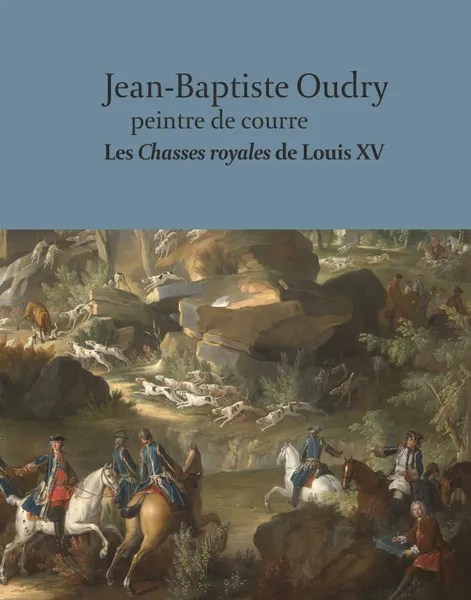 Cette exposition valorisera des trésors méconnus du château : les cartons préparatoires au tissage de la tenture des Chasses de Louis XV, dont quatre cartons tout récemment restaurés.
À l’automne 2024, le château de Fontainebleau mettra en lumière le travail du peintre Jean-Baptiste Oudry, célèbre pour ses représentations des chasses du roi Louis XV et ses portraits animaliers. Peintures, ouvrages, porcelaines, dessins, habits et tapisseries plongeront les visiteurs dans l’univers de la chasse, activité favorite du roi, qu’il souhaita fixer pour l’éternité en passant la commande à Oudry à partir de 1733 d’un ensemble de tapisseries. Cette exposition présentera pour la première fois, côte à côte, les dessins préparatoires, les cartons d’Oudry (œuvres préparatoires à l’échelle réelle qui servent ensuite au lissier à tisser les tapisseries), conservés à Fontainebleau et dont quatre ont été récemment restaurés et les tapisseries qui en sont issues, tissées par la manufacture royale des Gobelins.
Par ailleurs, l’exposition illustrera le goût pour les scènes de chasse dans la peinture et le décor intérieur des demeures royales et aristocratiques du XVIIIe siècle , ainsi que l’« Oudrymania », c’est-à-dire la diffusion des créations de l’artiste dans divers domaines des arts décoratifs, tels que les illustrations de beaux livres, la porcelaine et l’orfèvrerie. L’exposition invite les visiteurs à (re)découvrir la résidence de chasse favorite des rois de France que fut le château de Fontainebleau au fil des siècles.
Un colloque Jean-Baptiste Oudry et la peinture animalière sera co-organisé avec la Fondation François Sommer et se tiendra à Paris et à Fontainebleau mi-décembre 2024.
Vincent Cochet et Oriane Beaufils, eds., Peintre de courre: Jean-Baptiste Oudry et les Chasses royales de Louis XV (Paris: Réunion des Musées Nationaux, 2024), 229 pages, ISBN: 978-2711880423, €49.
The full press release is available here»
Exhibition | Oudrymania
Now on view at the Château de Chantilly:
Oudrymania: Fables, Hunts, Fights
Musée Condé, Château de Chantilly, 8 June — 6 October 2024
Curated by Baptiste Roelly with Oriane Beaufils
 Depicted in hunting scenes, portraiture, and combat, animals feature among the most striking images produced by Jean-Baptiste Oudry (1686–1755). A gifted artist with an unrivalled mastery of his technique, he brings us face-to-face with the animal repertoire as it existed in the 18th century, including in a series of three hunting scenes painted for the Château de Chantilly, works that were scattered after the French Revolution but which have now been brought back together.
Animal scenes were extremely popular with the leading collectors of the 18th century, including the princes of Condé, who commissioned them from the artist. A set of exquisite drawings by Oudry loaned from a private collection feature in the exhibition alongside works from Chantilly’s collections, allowing visitors to see pieces never before displayed in public. These include a large number of illustrations for La Fontaine’s fables, showing how the fabulist and the artist use the animal kingdom to help us laugh at and reflect on human nature. These illustrations were so effective they were copied by the arts and crafts industry and included in their decorative production, examples of which can also be admired in the exhibition. Through paintings, drawings, objets d’art, and rare books, this show shines a light into every corner of the Oudrymania that has gripped art lovers for centuries.
The exhibition is organized by Baptiste Roelly, curator at the Condé museum, in collaboration with Oriane Beaufils, curator and director of collections at the Villa Ephrussi de Rothschild.
Baptiste Roelly and Oriane Beaufils, eds, Oudrymania: Fables, Chasses, Combats (Éditions Faton, 2024), 128 pages, ISBN: 978-2878443585, €22. With contributions by Oriane Beaufils, Claire Betelu, Lucile Brunel-Duverger, Laurence de Viguerie, Juliette Debrie, Mathieu Deldicque, Nicole Garnier-Pelle, François Gilles, Maxime Georges Métraux, Roberta J.M. Olson, and Baptiste Roelly,
The press release (in French) is available here»
Exhibition | The King’s Horses: The Marly Horses
From the press release for the exhibition (a companion to the show Horse in Majesty on view at Versailles):
The King’s Horses: The Marly Horses, Masterpieces of Equestrian Art
Musée du Domaine Royal de Marly, 7 June — 3 November 2024
Curated by Karen Chastagnol
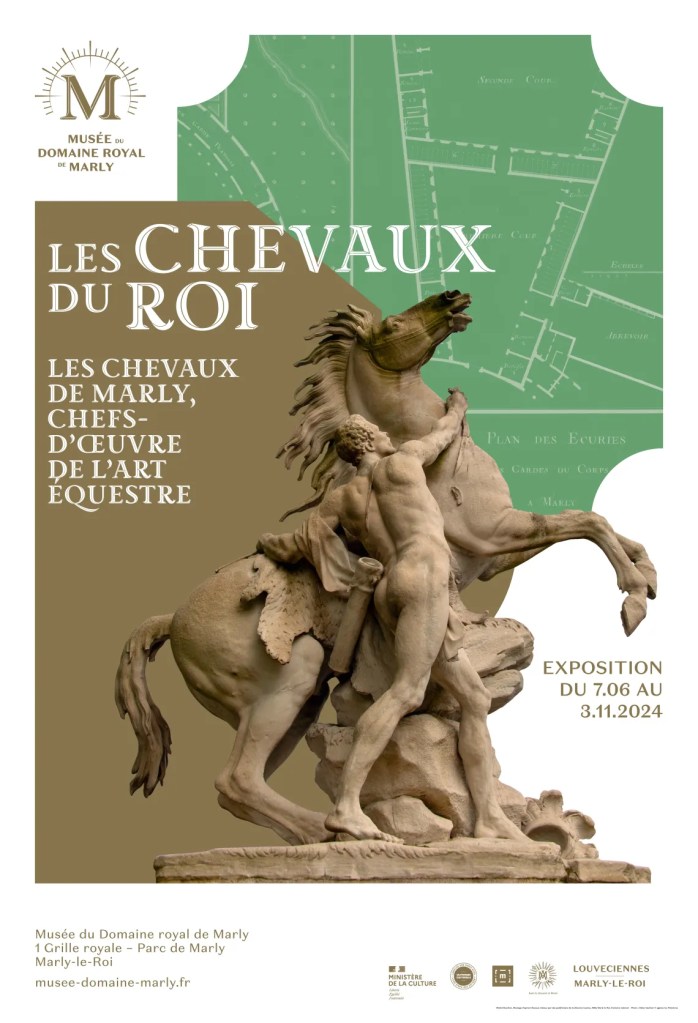 The Royal Estate of Marly, once a hunting residence of kings and the setting for the monumental Marly Horses, has always given an essential role to the horse. From transportation and aristocratic entertainments to military activities, equestrian buildings and artistic representations, horses have taken over the estate in various forms. Through a hundred paintings, sculptures, drawings, engravings, accessories, and archival documents, the Museum of the Royal Estate of Marly presents, on the occasion of the equestrian events of the Paris 2024 Olympic and Paralympic Games, an original exhibition dedicated to the role of the horse at the Estate of Marly, from Louis XIV to the French Revolution.
Karen Chastagnol, ed., Les chevaux du roi: Les chevaux de Marly, chefs-d’œuvre de l’art équestre (Milan: Silvana Editoriale, 2024), 104 pages, ISBN: 978-8836657919, €28. With contributions by Ambre Bozec, Valérie Carpentier-Vanhaverbeke, Annick Heitzmann, Carlos Pereira, and Benjamin Ringo.
The full press release is available here»
The Burlington Magazine, August 2024
The long 18th century in the August issue of The Burlington—and special thanks to The Burlington for making Rosalind Savill’s article available to Enfilade readers for free.
The Burlington Magazine 166 (August 2024) — Decorative Arts
a r t i c l e s

Unidentified artist, Portrait of Paul Crespin, ca.1726, oil on canvas laid on board, 114 × 90 cm (London: Victoria and Albert Museum).
• Lucy Wood and Olivia Fryman, “The 1st Duke of Devonshire’s ‘Queen Mary’ Beds at Devonshire House, Chatsworth, and Hardwick Hall,” pp. 780–809.
In 1696 the 1st Duke of Devonshire purchased two beds that had belonged to Mary II, one of which was made by Louis XIV’s upholsterer, Simon Delobel. Documents and fragments of its crimson velvet embroidered hangings record a lost example of Stuart state furniture of the highest quality.
• Stefano Rinadli, “Six Horses for the King of Poland: Making and Staging a Diplomatic Gift at the Court of Louis XIV,” pp. 810–25.
In July 1715 Augustus the Strong of Saxony-Poland received a splendid present from the Sun King: a team of six Spanish stallions, each equipped with embroidered trappings and a pair of elaborate flintlock holster pistols. Documents published here for the first time help establish the gift’s political context and chronology and provide detailed insight into the payment and the identity of all the craftsmen involved.
• Teresa Leonor M. Vale, “Eighteenth-Century English Silver for King João V of Portugal,” pp. 826–33.
João V of Portugal acquired works of art from Rome and Paris; analysis of diplomatic correspondence illustrates how he also commissioned objects from Britain in the 1720s, notably spectacular examples of silverware. These included and exceptionally large and renowned silver-gilt bath by Paul Crespin, the Huguenot silversmith who lived and worked in Soho, London.

Detail of the bottom tray of worktable mounted with two trays, attributed to Bernard II van Risenburgh, ca.1761–63. Table: wood, green varnish and gilt-bronze mounts, 68.6 × 36.8 × 30.5 cm; trays: Sèvres soft-paste porcelain, green ground, enamel colours and gilding, 32 × 26 cm (New York: Metropolitan Museum of Art, 58.75.45).
• Rosalind Savill, “From Storeroom to Stardom: The Revelations of Two Sèvres Porcelain Trays,” pp. 834–47.
Two porcelain trays set into a Rococo table in the early 1760s, now in the Metropolitan Museum of Art, New York, are reassessed and here confirmed as Sèvres. Their subjects are probably the family of the Marquis de Courteille, Louis XV’s representative at the porcelain factory, and their intimate representation in this manner is almost unique in eighteenth-century Sèvres.
The full article is available for free here»
r e v i e w s
• Elizabeth Savage, Review of two exhibition catalogues: Edina Adam and Julian Brooks, with an essay by Matthew Hargraves, William Blake: Visionary (J. Paul Getty Museum, 2020); and David Bindman and Esther Chadwick, eds., William Blake’s Universe (Philip Wilson Publishers, 2024), pp. 862–65.
• John Pinto, Review of the exhibition catalogue, John Marciari, Sublime Ideas: Drawings by Giovanni Battista Piranesi (Paul Holberton Publishing, 2023), pp. 865–67,
• Gauvin Alexander Bailey, Review of the exhibition catalogue, Rosario Inés Granados, ed., Painted Cloth: Fashion and Ritual in Colonial Latin America (University of Texas Press, 2022), pp. 867–69.
• Camilla Pietrabissa, Review of the exhibition catalogue, Anita Viola Sganzerla and Stephanie Buck, eds., Connecting Worlds: Artists and Travel (Paul Holberton Publishing, 2023), pp. 870–72.
• Giullaume Kientz, Review of the exhibition catalogue, Víctor Nieto Alcaide, ed., Goya: La ribellione della ragione (ORE Cultura, 2023), pp. 872–74.
• Timothy Wilson, Review of Marino Marini, Maiolica and Ceramics in the Museo Nazionale del Bargello, translated by Anna Moore Valeri (Allemandi, 2024), pp. 876–77.
• J. V. G. Mallet, Review of Caterina Marcantoni Cherido, Maioliche italiane del Rinascimento (Fondazione Musei Civici di Venezia, 2022), pp. 877–79.
• Aurora Laurenti, Review of Esther Bell, Pauline Chougnet, Sarah Grandin, Charlotte Guichard, Corinne Le Bitouzé, Anne Leonard, and Meredith Martin, Promenades on Paper: Eighteenth-Century French Drawings from the Bibliotheque nationale de France / Promenades de papier: Dessins du XVIIIe siècle des collections de la Bibliothèque nationale de France (Clark Art Institute and BnF Editions, 2023), pp. 883–84.
• Clare Hornsby, Review of Christopher M.S. Johns, Tommaso Manfredi, and Karin Wolfe, eds., American Latium: American Artists and Travelers in and around Rome in the Age of the Grand Tour (Accademia Nazionale di San Luca, 2023), pp. 884–86.
• Lydia Hamlett, Review of John Laycock, William Kent’s Ceiling Paintings at Houghton Hall (Houghton Arts Foundation, 2021), p. 887.
• Lin Sun, Review of Shane McCausland, The Art of the Chinese Picture-Scroll (Reaktion Books, 2023), pp. 887–88.










 Enfilade
leave a comment