Exhibition: Paper Dresses of Isabelle de Borchgrave
From the Legion of Honor Museum:
Pulp Fashion: The Art of Isabelle de Borchgrave
Legion of Honor, Fine Arts Museums of San Francisco, 5 February — 5 June 2011
Curated by Jill D’Alessandro
 Belgian artist Isabelle de Borchgrave is a painter by training, but textile and costume are her muses. Working in collaboration with leading costume historians and young fashion designers, de Borchgrave crafts a world of splendor from the simplest rag paper. Painting and manipulating the paper, she forms trompe l’oeil masterpieces of elaborate dresses inspired by rich depictions in early European painting or by iconic costumes in museum collections around the world. The Legion of Honor is the first American museum to dedicate an entire exhibition to the work of Isabelle de Borchgrave, although her creations have been widely displayed in Europe.
Pulp Fashion draws on several themes and presents quintessential examples in the history of costume—from Renaissance finery of the Medici family and gowns worn by Elizabeth I and Marie-Antoinette to the creations of the grand couturiers Frederick Worth, Paul Poiret, Christian Dior, and Coco Chanel. Special attention is given to the creations and studio of Mariano Fortuny, the eccentric early-20th-century artist who is both a major source of inspiration to de Borchgrave and a kindred spirit.
Catalogue: Jill D’Alessandro, Pulp Fashion: The Art of Isabelle de Borchgrave (Prestel, 2011), 104 pages, ISBN: 9783791351056, $29.95.
◊ ◊ ◊ ◊ ◊
From the artist’s website (worth visiting for lots more amazing images). . .
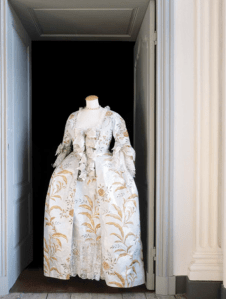
Isabelle de Borchgrave, "Madame de Pompadour paper dress," inspired by a 1755 painting by Maurice Quentin de la Tour, 85 cm x 65 cm x 165 cm, 2001 (Photo: René Stoeltie).
. . . . Following a visit to the Metropolitan Museum in New York in 1994, Isabelle dreamed up paper costumes. While keeping her brushes in hand and her paintings in mind, she worked on four big collections, all in paper and trompe l’œil, each of which set the scene for a very different world. “Papiers à la Mode” (Paper in Fashion), the first, takes a fresh look at 300 years of fashion history from Elizabeth I to Coco Chanel. “Mariano Fortuny” immerses us in the world of 19th century Venice. Plissés, veils and elegance are the watchwords of that history. “I Medici” leads us through the streets of Florence, were we come across famous figures in their ceremonial dress. Figures who made the Renaissance a luminous period. Gold-braiding, pearls, silk, velvet … here, trompe l’œil achieves a level of rediscovered sumptuousness. As for the “Ballets Russes”, they pay tribute to Serge de Diaghilev. Pablo Picasso, Léon Bakst, Henri Matisse, … all designed costumes for this ballet company, which set the world of the 20th century alight. These dancing paper and wire figures play a very colourful and contemporaneous kind of music for us.

Isabelle de Borchgrave, "Madame de Pompadour paper dress," detail
It’s true that, today, Isabelle de Borchgrave has become a name that is readily associated with fashion and paper. But her name is also closely linked to the world of design. By working together with Caspari, the potteries of Gien, Target, and Villeroy and Boch, Isabelle has turned her imagination into an art that’s accessible to anyone who wants to bring festivity into their home. Painted fabrics and paper, dinner services, curtains, sheets, decor with a personal touch for parties and weddings,… All this tells of the world in which she has always loved to move.
But in a 40-year career, she has never put to one side the thing that has always guided her in her life: painting. She still exhibits her paintings and her large folded paper works all over the world. With an imagination increasingly stimulated by her knowledge and interpretation of art, Isabelle, a follower of the Nabis movement, has a fresh perspective of a world that flies around her like a dream.
Reviewing for Enfilade
From the Editor
I recently received three books with requests that I consider publishing reviews of them here at Enfilade. Given that expanding the site’s original content is one goal, I’m certainly open to the idea. Consequently, I’m writing to solicit reviewers. In many ways, Enfilade remains a work-in-progress, and I would imagine this new direction (even if it succeeds) will call for adjustments along the way. I would like to propose the following ideas as a starting point. I welcome any feedback or advice readers might have.
A. Reviewers must be HECAA members in good standing.
B. Given that Enfilade is intended to serve as a newsletter for those interested in eighteenth-century art and architecture — as opposed to serving as an academic journal in its own right — it seems that the goal of a review at Enfilade is different than a review published in an academic journal. Description of contents and assessment of potential audiences are probably more important, for instance, than teasing out the nuances of a particular argument. An informed characterization premised on the scholarly expertise of the reviewer should still be an important goal, but the model for emulation might be more akin to a brief notice in The New York Review of Books or the TLS than The Art Bulletin or Eighteenth-Century Studies.
C. The blog format lends itself to relatively brief postings: 400-800 words might be an appropriate length. Prompt turn-around seems especially important for a newsletter format, and again the brevity should help in this regard.
D. One big problem: HECAA has no budget to fund the logistics of reviewing books (Enfilade costs absolutely nothing to produce). If publishers send me books, I have no money to send out copies to reviewers. In the case of the three books at hand, I’m happy to haul them to New York with me for CAA and distribute copies there (likewise with ASECS in Vancouver). Otherwise, I think the cost of shipping would have to be paid by the reviewer. It’s less than ideal, but given the cost of art books (easily ranging from $50 to 125), paying several dollars for shipping is perhaps not unreasonable.
The three books I presently have address two current exhibitions in the United States and the topic of eighteenth-century furniture. If you would like to be added to the list of potential reviewers, please send me an email outlining your particular areas of expertise (a brief CV would be helpful, too). Graduate students are encouraged to contribute, though any member of HECAA should feel free to volunteer. Again, I welcome your suggestions. -C.H.
YCBA Lecture: Fordham on ‘British Art and the Seven Years’ War’
Lecture and Book Signing: Douglas Fordham, British Art and the Seven Years’ War
Yale Center for British Art, New Haven, 26 January 2011, 5:30pm
 Between the Jacobite Rebellion of 1745 and the American Declaration of Independence, London artists transformed themselves from loosely organized professionals into one of the most progressive schools of art in Europe. In British Art and the Seven Years’ War, Douglas Fordham argues that war and political dissent provided potent catalysts for the creation of a national school of art. Over the course of three tumultuous decades marked by foreign wars and domestic political dissent, metropolitan artists — especially the founding members of the Royal Academy, including Joshua Reynolds, Paul Sandby, Joseph Wilton, Francis Hayman, and Benjamin West — creatively and assiduously placed fine art on a solid footing within an expansive British state. Copies of British Art and the Seven Years’ War signed by the author will be available for purchase.
Exhibition: The Landscape of Tivoli in the Eighteenth Century
Tivoli: Variations sur un paysage au XVIIIe siècle
Cognacq-Jay Museum, Paris, 18 November 2010 — 20 February 2011

Joseph Vernet, "La cascade," ca. 1748 (Photo: Roger Viollet)
L’exposition Tivoli. Variations sur un paysage au XVIIIe siècle propose une réflexion originale sur l’évolution du paysage, de 1720 à 1830, autour d’un motif particulier : le site de Tivoli et son célèbre temple dit de la Sibylle.
Lieu de villégiature fameux depuis l’Antiquité, Tibur (le nom latin de Tivoli) fut mise à la mode par l’empereur Auguste et par Mécène, le fastueux ami des arts, et célébrée par les poètes Horace et Catulle (Ier s. av. J.-C.). La Sibylle Albunea y exerçait son art divinatoire. Le site est exceptionnel : bâtie sur les premiers contreforts des Apennins, à une trentaine de kilomètres à l’est de Rome, Tivoli se présente comme une ville à flanc de montagne, dominant la plaine qui s’étend de là jusqu’à la mer. Une rivière, l’Aniene, s’y précipite en multiples cascades. Une petite acropole s’élève au bord du gouffre : les ruines de deux temples sont encore conservées, l’un quadrangulaire, l’autre rond. Ce dernier surtout est devenu célèbre, sous le nom de temple de la Sibylle ou de Vesta.

ISBN : 9782759601462, 30€
Au XVIIIe siècle, Tivoli et son temple sont progressivement devenus l’un des motifs les plus représentés dans l’histoire de la peinture, singulièrement dans la peinture française. La perfection architecturale du monument, son emplacement au coeur d’un paysage sublime et terrifiant, la richesse incomparable de son histoire, de ses légendes, en ont fait un motif adulé par les peintres et leurs collectionneurs. C’est aussi l’époque où l’on décline le temple de Tivoli sous forme de fabriques édifiées dans les jardins.
En cinquante oeuvres, peintures, dessins et gravures, l’exposition propose de confronter le regard porté par les plus grands artistes de l’époque sur ce motif : une brève introduction présente l’origine de son succès, au début du XVIIe siècle, dans l’entourage de Paul Bril et de Gaspard Dughet. Pour le XVIIIe siècle, Vanvitelli, Boucher, Vernet, Hubert Robert, Piranèse… se succèdent autour du même motif. Puis Valenciennes, Simon Denis ou Granet qui furent en France les précurseurs du paysage moderne. Composées ou plus spontanées, caprices, variations poétiques, études faites en plein air, les oeuvres présentées posent de manière contradictoire la question du sujet dans la peinture de paysage. Le plus singulier est sans doute qu’un même motif ait intéressé tous les artistes sur une période aussi longue, des plus traditionnels aux plus modernes.
L’exposition sera accompagnée par un catalogue en couleurs. En plus de notices détaillées sur chaque oeuvre, des essais confiés à plusieurs auteurs traiteront notamment du site de Tivoli, de sa fortune dans l’histoire de l’art ou dans les récits de voyageurs, et de l’importance de certains artistes particulièrement associés à Tivoli (Joseph Vernet, Hubert Robert).
◊ ◊ ◊ ◊ ◊
Didier Rykner’s review of the exhibition (in French) for La Tribune de l’Art (30 November 2010) is available here»
New Title: ‘Interior Portraiture and Masculine Identity in France’
From Ashgate:
Temma Balducci, Heather Belnap Jensen, and Pamela Warner, eds., Interior Portraiture and Masculine Identity in France, 1789–1914 (Aldershot: Asghate, 2010), 300 pages, ISBN: 9780754667841, $119.95.
 Focusing specifically on portraiture as a genre, this volume challenges scholarly assumptions that regard interior spaces as uniquely feminine. Contributors analyze portraits of men in domestic and studio spaces in France during the long nineteenth century; the preponderance of such portraits alone supports the book’s premise that the alignment of men with public life is oversimplified and more myth than reality.
The volume offers analysis of works by a mix of artists, from familiar names such as David, Delacroix, Courbet, Manet, Rodin, and Matisse to less well-known image makers including Dominique Doncre, Constance Mayer, Anders Zorn and Lucien-Etienne Melingue. The essays cover a range of media from paintings and prints to photographs and sculpture that allows exploration of the relation between masculinity and interiority across the visual culture of the period. The home and other interior spaces emerge from these studies as rich and complex locations for both masculine self-expression and artistic creativity. Interior Portraiture and Masculine Identity in France, 1789–1914 provides a much-needed rethinking of modern masculinity in this period.
Contents: “Introduction,” Temma Balducci, Heather Belnap Jensen and Pamela J. Warner; “The revolution at home: masculinity, domesticity and political identity in family portraiture, 1789–1795,” Amy Freund; “Picturing paternity: the artist and father-daughter portraiture in post-Revolutionary France,” Heather Belnap Jensen; “Public and private identities in Delacroix’s Portrait of Charles de Mornay and Anatole Demidoff,” Jennifer W. Olmsted; “At home with the camera: modeling masculinity in early French photography,” Laurie Dahlberg; “The artist in his studio: dress, milieu, and masculine identity,” Heather McPherson; “Cézanne, Manet, and the portraits of Zola,” Andre Dombrowski; “At home in the studio: two group portraits of artists by Bazille and Renoir,” Alison Strauber; “In bed with Marat: (un)doing masculinity,” James Smalls; “The competing dialectics of the cabinet de travail: masculinity at the threshold,” Pamela J. Warner; “Anders Zorn’s etched portraits of American men, or the trouble with French masculinity,” S. Hollis Clayson; “Auguste Rodin, photography, and the construction of masculinity,” Natasha Ruiz-Gómez; “Matisse and self, the persistent interior,” Temma Balducci; Selected bibliography; Index.
About the Editors: Temma Balducci is an Assistant Professor of Art History at Arkansas State University. She has published on the gaze and spectacle in nineteenth-century French art and on feminist art of the 1970s. Her manuscript in progress, “Beyond the Flâneur: Gender, Space and the Gaze in Post-Haussmann Visual Culture,” challenges the ubiquity of the Baudelairean flâneur in theorizations of gender and space in early Third Republic Paris.
Heather Belnap Jensen is Assistant Professor of Art History at Brigham Young University. Her research and publications examine women’s contributions to early nineteenth-century culture. She is currently co-editing a volume on women, bourgeois femininity and public space with Temma Balducci, as well as working on a book manuscript titled “Art, Fashion and the Modern Woman in Post-Revolutionary France.”
Pamela J. Warner is Assistant Professor of Art History at the University of Rhode Island. Her research focuses on art criticism in France during the nineteenth century, and she has published articles in Nineteenth-Century Art Worldwide, Studies in the Decorative Arts and the Cahiers Edmond et Jules de Goncourt. Her book in progress focuses on the critical reception of Realism and its ties to materialist philosophy.
Reviewed: ‘The Marlborough Gems’
From the December issue of Apollo Magazine:
John Boardman, The Marlborough Gems: Formerly at Blenheim Palace, Oxfordshire (New York: Oxford University Press, 2009), ISBN: 9780199237517, $325.
Reviewed by Lucia Pirzio Biroli Stefanelli; posted 1 December 2010.

In the February 2008 issue of ‘Apollo’, Sir John Boardman described how he was devoting himself to the reconstruction of the most important 18th-century English private collection of cameos and intaglios, that of George Spencer, 4th Duke of Marlborough (1739–1817). The result of this vast labour is a splendid and wonderfully rich volume written with the collaboration of Erika Zwierlein-Diehl, Claudia Wagner and Diana Scarisbrick, who contributed an analysis of the jewelled settings.
The Marlborough collection, comprising 800 intaglios and cameos covering all periods from antiquity to the late 18th century, became – along with telescopes – the duke’s main interest after he became disillusioned with the world of politics,
and retired. He kept his collection close at hand in Blenheim
Palace, where it remained until 1875 . . .
The full review is available here»
Chardin Exhibition in Ferrara and Madrid
Roderick Conway Morris reviews the Chardin exhibition currently in Ferrara for The New York Times, 22 December 2010, “Chardin’s Enchanting and Ageless Moments” . . .
Chardin: The Painter of Silence
Ferrara, Palazzo dei Diamanti, Ferrara, 17 October 2010 — 30 January 2011
Museo Nacional del Prado, Madrid, 1 March — 29 May 2011
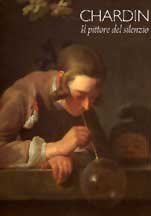
ISBN: 9788889793107, $90
“We stop in front of a Chardin as if by instinct,” wrote Diderot in his review of the Paris Salon of 1767, “like a traveler weary of the road choosing, almost without realizing, a place that offers a grassy seat, silence, water and cool shade.”
Jean-Siméon Chardin’s small still lifes and genre scenes have been working their magic ever since the 18th century. And trying to explain how Chardin created his enchanting effects has never ceased to exercise writers on art.
The Louvre has the world’s largest collection of Chardins, and Pierre Rosenberg, formerly the director of the museum, has made a lifelong study of the painter. He is now the curator of “Chardin: Painter of Silence,” the first exhibition devoted to the French artist ever to be staged either in Italy or Spain (the show will travel on to the Prado in February). The event brings together 52 pictures (with four additional works and a few substitutions in the Madrid version). . . .
The full article is available here. Didier Rykner reviewed the exhibition for The Art Tribune in October. The catalogue is available at artbooks.com.
Punch’s Golden Age
The following feature drawn from David Wondrich’s new book on punch aired on NPR’s Morning Edition on 30 December 2010.
David Wondrich, Punch: The Delights (and Dangers) of the Flowing Bowl (London: Perigee, 2010), ISBN: 978-0399536168, $23.95.
. . . The punch cocktail has a long history that starts with British sailors (who drank a lot), says liquor historian David Wondrich. Sailors were entitled to 10 pints of beer per day — but when they sailed into the tropics, the beer spoiled, and that’s when they turned to punch.
“They made it with local ingredients in India and Indonesia in the early 1600s,” Wondrich tells NPR’s Linda Wertheimer. “They were 13,000 miles away from any source of English beer or wine, and they had nothing to drink. And English sailors . . . respond very poorly to that.”
Wondrich, who is also a mixologist, has paid homage to what he calls “the monarch of mixed drinks”; his book, ‘Punch: The Delights (and Dangers) of the Flowing Bowl’, features 40 historical punch recipes for the ambitious drink mixer. . . .
But even for Dickens in the mid-1800s, punch was something of a throwback. “By his day,” Wondrich explains, “punch had gotten kind of old-fashioned. Queen Victoria was very opposed to the lax moral standards that the upper classes in particular had held to in her predecessor’s days. And she didn’t like their habit of getting grossly drunk on punch and champagne and wine.”
So punch was out of style — but that was part of the fun. “[Dickens] was a great antiquarian,” Wondrich says. “He liked to collect all the old customs and habits of old England.” So he’d invite his friends over, concoct a big bowl of punch, and then describe the punch-making process for his guests.
The Dickens punch in Wondrich’s book (see the recipe here) is taken from a detailed letter the novelist wrote to his friend’s sister — and it’s a “classic 18th-century brandy rum punch,” Wondrich says. “This is punch from its golden age.” . . .
The full feature (including the audio version) is available at NPR’s website. In addition, Eileen Reynolds offers a charming discussion with the author for the online edition of The New Yorker (15 December 2010), while New York Magazine profiled Wondrich’s food and drink consumption for a week back in November for the feature “New York Diet.”
Exhibition: Napoleon and Europe
From the Bundeskunsthalle’s website:
Napoleon and Europe: Dream and Trauma (Traum und Trauma)
Art and Exhibition Hall of the Federal Republic of Germany, Bonn, 17 December 2010 — 25 April 2011
Musée de l’Armée, Paris, March — June 2012
The source of all great mistakes and thence of all the great suffering of our time was that Napoleon was
perceived either as a demigod or as a monster or, more often than not, as both at the same time.
Friedrich von Gentz, 1814
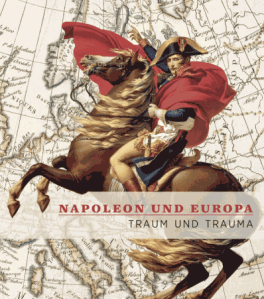
Exhibition catalogue, 368 pp, ISBN 9783791350882
During the nearly sixteen years of his reign, Napoleon Bonaparte (1769–1821), more than any other historical figure, redrew the very foundations of European history. and wrought changes that can be felt to this day – both positively and negatively. The exhibition, which has been panned and organised by the Art and Exhibition Hall of the Federal Republic of Germany, draws on a selection of high-calibre loans from all over Europe to present a comprehensive picture of Napoleon and his time. Painting and sculpture reached new heights of excellence in the Napoleonic era – both in the propaganda paintings by David, Gérard and Ingres and in the work of those who opposed the French emperor, among them Goya and the German Romanticists. Staying clear of well-worn clichés that paint Napoleon as a warmonger or a larger than life political genius, the exhibition aims to draw a more differentiated picture of the Napoleonic era between war, politics, administration, art theft and
cultural prosperity.
The exhibition is held under the patronage of Federal Chancellor Angela Merkel and the President of the French Republic, Nicolas Sarkozy. The exhibition was planned by the Art and Exhibition Hall of the Federal Republic of Germany, Bonn, in cooperation with the Musée de l’Armée in Paris and will be shown in Paris from March to June 2012.
The exhibition is subdivided into the following thematic chapters, which are explained in a microsite NAPOLEON:
- Generation Bonaparte
- Fascination and Revulsion
- Physical and Symbolic Birth
- The Dream of a Great Empire
- Blood and Sex: Europe, a Family Business
- Space, Law, Religion: New Ways of Controlling Space and the Mind
- Objects of Desire: Napoleon and the Appropriation of European Art and Heritage
- The Empire of Symbols
- Duels
- Nations – Emotions
- Symbolic and Physical Death
- Projections: A ‘Divided’ Icon
Additional information about the exhibition is available at ArtDaily. An article from The Wall Street Journal (12 November 2010) by J. S. Marcus addresses the show within the larger context of Bonn’s emergence as “a cultural hub.”
Reviewed: ‘Lustrous Images from the Enlightenment’
From Histara-les comptes rendus (a site useful, in particular, for reviews of European publications) . . .
William Eisler, Lustrous Images from the Enlightenment: The Medals of the Dassiers of Geneva (Milan: Skira, 2010), ISBN: 9788857205076, $60.
Reviewed by Jan Blanc, University of Geneva; posted 22 November 2010.
Ce livre, consacré aux artistes-médailleurs Jean Dassier (1676-1763) et à ses deux fils, Jacques-Antoine (1715-1759) et Antoine (1718-1780), représente sans nul doute une contribution essentielle à l’histoire des arts à Genève, au XVIIIe siècle, mais aussi, plus largement, à celle des arts européens, durant le Siècle des Lumières. Comme ne cessent de le souligner les auteurs de ce livre, William Eisler, assistant scientifique au Musée monétaire cantonal de Lausanne, et Matteo Campagnolo, conservateur du Cabinet de numismatique de Genève et chargé d’enseignement à l’Université de Genève, les Dassier ont construit une véritable carrière internationale qui, tout au long du XVIIIe siècle, les a amené à Genève, Paris, Amsterdam, Londres et Rome. L’édition bilingue (français et anglais) de cet ouvrage permettra, il faut l’espérer, une large diffusion et réception d’un ouvrage, qui s’ingénie, avec succès, à souligner la dimension européenne du travail des Dassier, et dont l’importance, de ce fait, dépasse, de loin, le strict cadre genevois des productions artistiques du XVIIIe siècle. . . .
The full review is available here»










 Enfilade
leave a comment