New Title: Cultural Aesthetics of Porcelain

ISBN: 978-0-7546-6386-7
Alden Cavanaugh and Michael E. Yonan, eds., The Cultural Aesthetics of Eighteenth-Century Porcelain (Aldershot: Ashgate, 2010), ISBN: 9780754663867, $99.95
During the eighteenth century, porcelain held significant cultural and artistic importance. This collection represents one of the first thorough scholarly attempts to explore the diversity of the medium’s cultural meanings. Among the volume’s purposes is to expose porcelain objects to the analytical and theoretical rigor which is routinely applied to painting, sculpture and architecture, and thereby to reposition eighteenth-century porcelain within new and more fruitful interpretative frameworks. The authors also analyze the aesthetics of porcelain and its physical characteristics, particularly the way its tactile and visual qualities reinforced and challenged the social processes within which porcelain objects were viewed, collected, and used.
The essays in this volume treat objects such as figurines representing British theatrical celebrities, a boxwood and ebony figural porcelain stand, works of architecture meant to approximate porcelain visually, porcelain flowers adorning objects such as candelabra and perfume burners, and tea sets decorated with unusual designs. The geographical areas covered in the collection include China, North Africa, Spain, France, Italy, Britain, America, Japan, Austria, and Holland.
Contents: “Introduction,” Alden Cavanaugh and Michael E. Yonan; “Rethinking the Arcanum: porcelain, secrecy, and the 18th-century culture of invention,” Glenn Adamson; “The nature of artifice: French porcelain flowers and the rhetoric of the garnish,” Mimi Hellman; “Igneous architecture: porcelain, natural philosophy, and the rococo cabinet chinois,” Michael Yonan; “Marketing celebrity: porcelain and theatrical display,” Heather McPherson; “Balancing act: Andrea Brustolon’s ‘La Forza’ and the display of imported porcelain in 18th-century Venice,” Erin J. Campbell; “The Queen’s nécessaire,” Alden Cavanaugh; “Porcelain, print culture and mercantile aesthetics,” Dawn Odell; “Sugar boxes and blackamoors: ornamental blackness in early Meissen porcelain,” Adrienne L. Childs; “Ties that bind: relations between the Royal Academy of San Fernando and the royal porcelain factory of the BuenRetiro,” Andrew Schulz; Selected bibliography; Index.
About the Editors: Alden Cavanaugh is Associate Professor of Art History at Indiana State University; Michael E. Yonan is Assistant Professor of Eighteenth- and Nineteenth-Century Art at the University of Missouri-Columbia.
Collection of Early Drawing Instruments
The following 2007 press release from Columbia University regarding the Alpern Collection of drawing instruments notes that “an exhibition and catalogue are in preparation.” Well, here they are (nearly so anyway). . .
◊ ◊ ◊ ◊ ◊
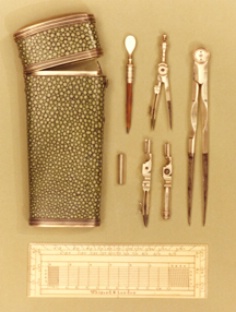
A pocket set of silver instruments with an ivory scale/protractor, housed in a silver-mounted case covered in shagreen – the skin of a sting ray. English, 2nd half of the 18th c.
February 28, 2007 An outstanding collection of early architectural drawing instruments has been donated to the Avery Architectural and Fine Arts Library at Columbia University by noted New York architectural historian Andrew Alpern.
The collection comprises 170 English, Continental and American sets and individual pieces spanning over 250 years of exquisite craftsmanship in silver, ivory, steel and brass. Sets range from small portable sharkskin or tortoise-shell cases containing the architect’s essential tools – pen, scales, dividers, compass and protractor – to large mahogany cases containing every aid imaginable for the aspiring draftsman. Assembled over a 40-year span, the collection is fully functional. According to Alpern, “Preparing construction drawings (as I have) employing 18th-century solid silver instruments of superb quality is vastly more satisfying than using ordinary modern ones.”
“We are tremendously grateful to Andrew Alpern for his gift of these rare and precious instruments” said Avery Library’s Director, Gerald Beasley, who added that “Computer-aided design has entirely supplanted their manufacture and use, but this only increases their research value to historians of architectural design.”
The collection, which also includes numerous trade catalogues and other rare books about the instruments, is available to researchers by appointment at Avery Library’s Department of Drawings and Archives. An exhibition and catalogue are in preparation.
◊ ◊ ◊ ◊ ◊
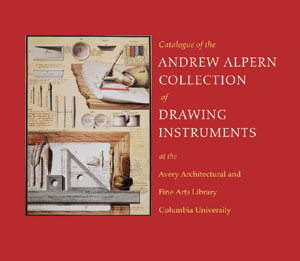 This elegant volume documents three hundred years of exquisite drawing tools, richly photographed and described, for architects, draftsmen, and engineers. Crafted in silver, ivory, steel, and brass, the instrument sets catalogued here range from small silver-mounted tortoiseshell pocket étuis to multitiered mahogany cases housing every professional aid imaginable. Computers have supplanted their manufacture and use, yet these exquisite traditional instruments are still fully functional. ISBN 9780978903732, $60 (September 2010).
Exhibition Marks the 300th Birthday of Johann Evangelist Holzer
The following comes from the website of the Domschatz- und Diözesanmuseum; there’s also a fine site dedicated to the exhibition (I’m sorry that all are only in German). . .
Johann Evangelist Holzer (1709-40), Painter of Light
Augsburg, 28 March — 20 June 2010
Eichstätt, 14 July — 31 October 2010
Innsbruck, 3 December — 13 March 2011
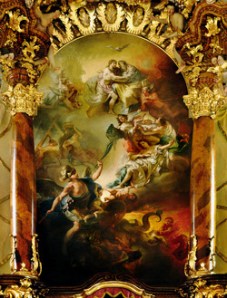
- Johann Evangelist Holzer, altarpiece in Eichstätt Schutzengelkirche
Johann Evangelist Holzer (1709-1740) gehört zu den großen Meistern des 18. Jahrhunderts. Kirchen und Klöster in Süddeutschland stattete er mit prächtigen Fresken und Altarblättern aus. Nach nur wenigen Schaffensjahren hatte der in Burgeis in Südtirol geborene Künstler, der lange in Augsburg wirkte und mit nur 31 Jahren in Clemenswerth an der niederländischen Grenze starb, ein bedeutendes Werk hinterlassen.
Seine Zeitgenossen setzten Holzer gar dem italienischen Maler Raffael gleich, heute ist sein Werk eine wahre Entdeckung. Vier Museen in Deutschland und Österreich haben sich das gemeinsame Ziel gesetzt, mit unterschiedlichen Schwerpunkten Leben und Werk dieses Malers und Grafikers des Spätbarock in einer Werkschau mit etwa 160 Exponaten erstmals umfassend vorzustellen.
In der barocken Residenzstadt Eichstätt wird die Kunst Holzers in ihrer ursprünglichen städtebaulichen und künstlerischen Atmosphäre besonders gut erlebbar. In der ehemaligen Jesuitenkirche präsentieren sich dem Besucher frisch restauriert, drei Altarblätter Holzers, darunter der Hochaltar als sein größtes Leinwandgemälde. Weitere Altarbilder sowie eine Computersimulation der Kuppel von Münsterschwarzach sind im Kuppelraum der ehemaligen Klosterkirche Notre Dame zu besichtigen. Im Festsaal der ehemaligen fürstbischöflichen Sommerresidenz bildet das zauberhafte Deckengemälde Holzers einen weiteren Höhepunkt.
 Das Domschatz- und Diözesan als zentrale Anlaufstelle in Eichstätt präsentiert eine reiche Schau zu Holzers Früh- und graphischem Werk. Ein vielfältiges Veranstaltungsprogramm rundet die Werkschau ab, zu der ein umfangreicher Katalog erscheint.
New Title: Summer is for Fireworks
Simon Werrett, Fireworks: Pyrotechnic Arts and Sciences in European History (University of Chicago Press, 2010), ISBN: 978-0226893778, $45.
 Fireworks are synonymous with celebration in the twenty-first century. But pyrotechnics—in the form of rockets, crackers, wheels, and bombs—have exploded in sparks and noise to delight audiences in Europe ever since the Renaissance. Here, Simon Werrett shows that, far from being only a means of entertainment, fireworks helped foster advances in natural philosophy, chemistry, mathematics, and many other branches of the sciences.
Fireworks brings to vibrant life the many artful practices of pyrotechnicians, as well as the elegant compositions of the architects, poets, painters, and musicians they inspired. At the same time, it uncovers the dynamic relationships that developed between the many artists and scientists who produced pyrotechnics. In so doing, the book demonstrates the critical role that pyrotechnics played in the development of physics, astronomy, chemistry and physiology, meteorology, and electrical science. Richly illustrated and drawing on a wide range of new
sources, Fireworks takes readers back to a world where pyrotechnics were both
divine and magical and reveals for the first time their vital contribution to the
modernization of European ideas.
From Blog to Book
 Lucy Inglis, the author of the blog Georgian London, has just announced that she has a book deal with Penguin. The book Georgian London is due out in hardback in the spring of 2012. It’s another example of how digital publishing formats are shaping the larger publishing industry, and I think it’s a safe bet that lots of customers will be reading Inglis’s book in an electronic format rather than the promised hardback.
There have been plenty of examples of blogs that have led to deals in media formats with larger circulation numbers. Julie Powell’s Julie and Julia began as a blog in 2002, became a book in 2005, and finally a film in 2009. Scott Schuman began writing The Sartorialist in 2005. By the time the book appeared in 2009 (also, incidentally, from Penguin), Schuman had already made his career well beyond the immediate domain of the blog, though in many ways it still anchors his professional presence/persona.
What’s interesting in Inglis’s case, however, is that we’re now seeing the same pattern play out in terms of the field of history (as opposed to food or style genres). Georgian London will clearly be a trade publication, but it promises to be a smart book, too. A friend of mine who works in media studies and disability studies approached an agent not long ago with a proposal for a trade volume. What was the agent’s first question? Not do you have a blog? but how many readers follow your blog?
Enfilade is, of course, published under the auspices of HECAA as a newsletter for the organization, functioning largely as an aggregator for news related to eighteenth-century art and architectural history. Still, the larger digital domain raises the question of what ‘intellectual content’ might consist of within the medium of the blog. Inglis’s Georgian London might provide one glimpse at an answer. At least the editors at Penguin seems to think so.
Current Issue of ‘Eighteenth-Century Studies’
Selections from Eighteenth-Century Studies 43 (Summer 2010):
Stacey Sloboda, “Displaying Materials: Porcelain and Natural History in the Duchess of Portland’s Museum,” pp. 455-72.
Abstract: Porcelain in eighteenth-century aristocratic collections was associated with both the curious and the foreign. The Duchess of Portland’s Museum contained large amounts of porcelain along with thousands of natural history specimens. The material and geographic plurality of the collection mirrored its totalizing claims to have a comprehensive display of the world’s natural and artificial materials. This essay explores the relationship between porcelain and natural history, arguing that Portland’s collection attempted to bridge conceptual distinctions between science and art in the eighteenth century, and that this project was particularly important to making sense of eighteenth-century female collecting practices and their sociable display.
Dorothy Johnson, “Review Article — The Matter of Sculpture,” pp. 505-08.
- Erika Naginski, Sculpture and Enlightenment (Los Angeles: Getty Research Institute, 2009).
- Martina Droth and Penelope Curtis, eds., Taking Shape: Finding Sculpture in the Decorative Arts (Leeds and Los Angeles: Henry Moore Institute and the J. Paul Getty Museum, 2008-09).
- Anne Betty Weinshenker, A God or a Bench: Sculpture as a Problematic Art during the Ancien Régime (Bern: Peter Lang, 2008).
Clorinda Donato, “Review Article — Fresh Legacies: Giovanni Battista Piranesi’s Enduring Style and Grand Tour Appeal,” 508-11.
- Mario Vevilacqua, Fabio Barry, and Heather Hyde Minor, eds., The Serpent and the Stylus: Essays on G. B. Piranesi (Ann Arbor: University of Michigan Press, 2006).
- Andelka Galic and Vladimir Malekovic, eds. Piranesi: Vasi candelabri cippi sarcofagi tripodi lucerne ed ornamenti antichi, exhibition catalogue, translated into Italian by William Klinger (Zagreb: Museum of Arts and Crafts, 2007).
Engraving Watteau
Antoine Watteau et l’art de l’estampe / Antoine Watteau and the Art of Engraving
Musée du Louvre, Paris, 8 July — 11 October 2010

Exhibition catalogue by Marie-Catherine Sahut and Florence Raymond, ISBN: 9782847421521 ($50)
A hundred engravings from the oeuvre of Antoine Watteau, mostly from the Edmond de Rothschild collection, illustrate the art of engraving in the 18th century. Before his premature death at age thirty-seven, the painter, engraver, and tireless draftsman Antoine Watteau (1684–1721) set his seal on the 18th century with the grace and spontaneity of his art. The oeuvre was engraved almost at once—between 1724 and 1735—on the initiative of his friend and protector Jean de Julienne. This remarkable venture—four volumes totaling some six hundred plates after his drawings and paintings—was entrusted to fifty engravers. A crucible for young talents including François Boucher and Laurent Cars, the project played its part in the Europe-wide development of the Rocaille style, of which Watteau was one of the main instigators.
Curators: Marie-Catherine Sahut (Department of Paintings) and Pascal Torres-Guardiola (Department of Prints and Drawings)
◊ ◊ ◊ ◊ ◊
N.B. — The catalogue is available through artbooks.com (a full description, in English, is available here). The latest mailing from Artbooks.com also includes the forthcoming title edited by Christiane Naffah, Watteau et la fête galante (Paris: Musées nationaux, 2010), ISBN: 9782711856541 ($90).
Thomas Lawrence Exhibition and Conference
Thomas Lawrence: Regency, Power and Brilliance
A Conference at the National Portrait Gallery and The Paul Mellon Centre, London, 18-19 November 2010
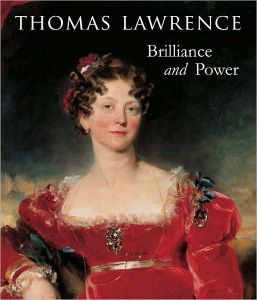
Ed. by Cassandra Albinson, Peter Funnell, Lucy Peltz ISBN: 9780300167184 (YCBA, 2010), $70
This conference accompanies the exhibition Thomas Lawrence: Regency, Power and Brilliance at the National Portrait Gallery, London (20 October 2010–23 January 2011) which will be shown at the Yale Center for British Art, New Haven, (24 February–5 June 2011). This will be the first exhibition in the United Kingdom since 1979 to examine Lawrence’s work and the first substantial presentation of this artist in the United States. It will present Lawrence as the most important British portrait painter of his generation and will explore his development as one of the most celebrated and influential European artists of the late eighteenth and early nineteenth centuries. By his untimely death in 1830 Lawrence had achieved the greatest international reach and reputation of any British artist. Based on new research and fresh perspectives, this exhibition will introduce Lawrence to a new generation of museum visitors and students. It will also contextualise his work in the light of recent scholarship on the art, politics and culture of the period. The exhibition will include the artist’s greatest paintings and drawings alongside lesser known works in order to provide a fresh understanding of Lawrence and his career. It will contrast his approach to sitters according to age and gender, juxtapose the power and impact of his public works with the intimacy and intensity of those portraits of his friends and family, trace his innovations as a draughtsman and painter, and place him within the broader contexts of the aesthetic debates, networks of patronage and international politics of his day.
Thursday, 18 November 2010, National Portrait Gallery (2:00pm–8:30pm)
Session One will address issues relating to Lawrence, gender and representation, and will include papers by Marcia Pointon (Professor Emerita, University of Manchester), Shearer West (Arts and Humanities Research Council and the University of Birmingham) and Sarah Monks (School of World Art Studies and Museology, University of East Anglia).
Evening: At 6pm, delegates are invited to attend a guest lecture by Richard Holmes, the biographer and author of The Age of Wonder: How the Romantic Generation Discovered the Beauty and Terror of Science (2008) and formerly Professor of Biographical Studies at the University of East Anglia. The lecture will be followed by a wine reception hosted by the curators, and free admission to the exhibition.
Friday, 19 November 2010, Paul Mellon Centre (9:15am–7:15pm)
Session Two, devoted to Lawrence and his contemporaries, will include papers by Viccy Coltman (University of Edinburgh) and Martin Myrone (Tate).
Session Three will explore technical aspects of Lawrence’s career, particularly his studio practice and relationship with engravers, and will include papers by Jacob Simon (National Portrait Gallery) and Sally Doust (Independent Scholar).
Session Four will address Lawrence’s reputation and historiography into the later nineteenth century, and will include papers by Philippa Simpson (Tate) and Pat Hardy (Walker Art Gallery, National Museums Liverpool).
The conference will conclude with a roundtable discussion, including Mark Hallett (University of York), Ludmilla Jordanova (King’s College, London), David Solkin (Courtauld Institute of Art), and the curators of the exhibition, which will consider themes arising from this exhibition and conference. The discussion will be followed by a wine reception at 5:45pm.
Full conference fee for both days, including coffee, lunch and tea on 19 November, and receptions: £40. Student and Senior concessions £20. To register for the conference please check availability with Ella Fleming at The Paul Mellon Centre: Email: events@paul-mellon-centre.ac.uk, Tel: 020 7580 0311, Fax: 020 7636 6730.
200th Anniversary of Napoleon’s Second Marriage
Press release (PDF) from the Musée national du château de Compiègne:
1810: The Politics of Love — Napoleon I and Marie-Louise in Compiègne
Musée national du château de Compiègne, 28 March — 19 July 2010

Exhibition catalogue, ISBN: 9782711857029
This first exhibition in France to evoke Marie-Louise, Empress of the French, intends to celebrate the two hundredth anniversary of the second marriage of Napoleon I to the young Archduchess of Austria, Marie-Antoinette’s grand-niece. It describes the extraordinary preparations for the arrival of the new Empress at the Palace of Compiègne, the splendours of the wedding ceremonies in Paris and the subsequent honeymoon in Compiègne. More than 200 works, wedding gifts, commissions for the sovereign’s trousseau and items of furniture, have been brought together: paintings, drawings, prints, sculptures, objets d’art, clothes, silks and jewellery. The exhibition has special loans from French museums (Louvre, Versailles, Fontainebleau, Fondation Napoléon and Fondation Thiers, etc) as well as international loans (Italy, Switzerland, Germany etc).
Napoleon I chose to receive his second wife at the Palais de Compiègne, just as Marie-Antoinette had been received here in 1770 by Louis XV and the Dauphin, the future Louis XVI. This event took place on 27 March 1810 and, on the orders of the Emperor who in his impatience brushed aside all protocol, the official meeting planned for Soissons was cancelled. 1810: la politique de l’amour: Napoléon Ier & Marie-Louise à Compiègne sets out to show the sumptuous refurbishment of the palace and the park before 1810.
The works started in 1807 under the direction of the architect Louis-Martin Berthault, and were hurried forward for the arrival of the Archduchess. Large portraits of the great figures of the Empire were presented in the new Galerie des Ministres (Prud’hon, Fabre, Lefèvre, etc), paintings by great masters from many different schools (Le Dominiquin, Patel, Flinck, etc) were brought together in the new Galerie des Tableaux de l’Impératrice, and Canova’s famous marbles on the theme of Psyche and Love (the standing version of this is on special loan from the Louvre), were placed at the entrance to the imperial apartments. The furniture, made by cabinetmakers Jacob-Desmalter and Marcion, as well as the Sèvres porcelain ordered for the palace, illustrates one of the high point of decorative art at a time when the Empire style was at its peak.
The grandeur of the civil and religious wedding celebrations at the Palace of Saint-Cloud then in the Salon Carré of the Louvre, together with the festivities organised in Paris up to 1st July 1810, reflecting an Emperor at the height of his power, created a wealth of iconographic images (Rouget’s painting inspired by David’s Coronation of Napoleon, drawings by Zix and Prud’hon, portraits by Gérard, Isabey, etc). (more…)
Canaletto Exhibition in London and D.C.
Press release from the National Gallery in London:
Venice: Canaletto and His Rivals
National Gallery, London, 13 October 2010 — 16 January 2011
National Gallery, Washington D.C., 20 February — 30 May 2011
 This exhibition presents the finest assembly of Venetian views, by Canaletto and all the major practitioners of the genre, to be held since the much-celebrated display in Venice in 1967. Remarkably, considering the dominant role of British patronage in this art form, Venice: Canaletto and His Rivals is also the first exhibition of its kind to be organised in the UK.

Canaletto, "The Stonemason's Yard," 1727-28 (London: National Gallery)
Bringing together approximately 55 major loans from public and private collections of the UK, Europe and North America, the exhibition highlights the rich variety of Venetian view painting, representing Canaletto alongside major rivals such as Luca Carlevarijs, Gaspar van Witell, Michele Marieschi, Bernardo Bellotto, and Francesco Guardi. Also represented are less well-known painters such as Antonio Joli, Pietro Bellotti, Francesco Tironi and Giambattista Cimaroli, each responding to the market driven largely by the British Grand Tour.
Featured works span the 18th century, from the first accurately datable Venetian view by Luca Carlevarijs in 1703 to the death of Francesco Guardi in 1793 and Napoleon’s invasion and the fall of the Republic in 1797.
 In each room, major works by Canaletto are juxtaposed by those of his rivals and associates, to demonstrate their different approaches to the same or similar views of the city. The exhibition features many of Canaletto’s greatest masterpieces, including The Riva degli Schiavoni, looking West, 1736 (Sir John Soane’s Museum, London), The Stonemason’s Yard, 1727–28 (The National Gallery, London), and four of the finest works from the Royal Collection. A catalogue edited by Charles Beddington will accompany the exhibition (ISBN-13: 9781857094183), $50.
◊ ◊ ◊ ◊ ◊
For additional coverage, see the posting at Artdaily.org (16 June 2010).










 Enfilade
leave a comment