‘Eye for the Sensual’ in Los Angeles
Press release from LACMA:
Eye for the Sensual: Selections from the Resnick Collection
Los Angeles County Museum of Art, 2 October 2010 — 2 January 2011
Curated by J. Patrice Marandel and Bernard Jazzar
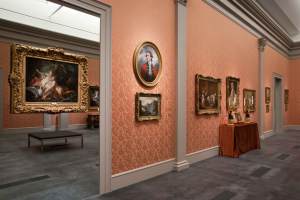
Photo © 2010 Museum Associates/LACMA
The Los Angeles County Museum of Art (LACMA) presents Eye for the Sensual: Selections from the Resnick Collection, which features more than 100 paintings, sculptures, and decorative arts from the collection of Lynda and Stewart Resnick, long-time patrons of the museum. Since the early 1980s, the Resnicks have collected in many areas ranging from European to American and modern art. This exhibition reflects their interest in European painting, sculpture, and decorative arts from the sixteenth to the early twentieth century. Eye for the Sensual is one of three inaugural exhibitions to open the new Lynda and Stewart Resnick Exhibition Pavilion, named in honor of the Resnicks’ generous donation to LACMA’s ongoing Transformation campaign. The exhibition — designed by Pier Luigi Pizzi– beautifully illuminates the Resnicks’ broad taste and great love for collecting.

Installation of "Eye for the Sensual" at LACMA, Photo © 2010 Museum Associates/LACMA
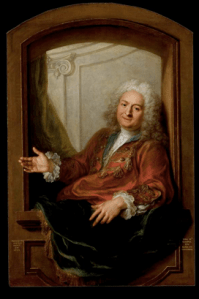
Charles-Antoine Coypel, "Portrait of Monsieur Dupillé," 1733 Photo © 2010 Museum Associates/LACMA
The Resnick collection is rich in eighteenth-century French paintings including portraits, landscapes, still lifes, and mythological scenes. François Boucher and his pupil, Jean-Honoré Fragonard, are particularly well represented with three paintings each. Two of the paintings by Boucher—both sensuous representations of Venus—were originally commissioned by the artist’s greatest patron, Madame de Pompadour, for one of her many residences. The third work, Leda and the Swan (1742), was known only through a second version at the Nationalmuseum in Stockholm before the Resnicks acquired the original. Fragonard’s paintings display the artist’s versatile talent and reveal, in turn, a world of playful eroticism, deep passion, and domestic intimacy.
The feminine aspect of the Resnick collection has often been noted: on one hand, many of the paintings’ subjects, whether allegorical or mythological, glorify the female form. On the other, numerous female artists are represented in the collection: Anne Vallayer-Coster with a still life of flowers; Elisabeth Louise Vigée Lebrun whose imposing Portrait of Marie Antoinette, Queen of France (1783), commissioned by the sitter, evokes the doomed splendor of the last days of the French monarchy; and Marguerite Gérard, who, under the guidance of her brother-in-law Fragonard, achieved fame in late eighteenth century for her portraits and genre scenes. Two of the Gérard works on view are small, intimate portraits of sitters who belonged to the artist’s enlightened circle of friends. A larger genre scene shows a female artist in her studio, a personification of Gérard’s own success and social status in the changing art world of early nineteenth-century France.
The Resnick collection also includes important Italian, Flemish, Dutch, and French paintings from the seventeenth and eighteenth centuries. Francesco Guardi’s Ridotto at Palazzo Dandolo (1750s), a recent addition to the collection, is a vivid image of gambling and masquerade in eighteenth-century Venice that evokes the risqué world of Casanova. Among the Northern paintings, the vigorous Revel of Bacchus and Silenus (c. 1615) executed by Jacob Jordaens while still in his twenties exudes verve and passion, and a rare pair of decorative tondos by the little–known Dirk van der Aa reveals an unexpected aspect of late eighteenth-century Dutch painting. Two French masterpieces frame the core group of late eighteenth-century works: Simon Vouet’s dignified representation of the goddess Diana and her companions from around 1640, and Jean Auguste Dominique Ingres’s magisterial The Virgin with the Host (1860). Both paintings, in spite of being worlds apart, lend a note of pure and austere classicism to the collection.
European sculpture has been a long-standing interest of the Resnicks. The couple has assembled a collection that spans more than 400 years and includes Italian and French marble busts, English full-length neoclassical figures, French eighteenth-century terracottas, as well as bronzes dating from the Renaissance to the twentieth century. Some of the best-known sculptors in the collection include Barthélemy Prieur, Giambologna, Claude Michel (Clodion), Jean-Antoine Houdon, and Aristide Maillol.
Eye for the Sensual also includes a selection of Art Deco furniture and decorative arts, a more recent interest of the Resnicks. The couple has favored the elegant creations of such artists as Emile-Jacques Ruhlmann and Jules Leleu, as well as numerous pieces by Italian designer Gio Ponti, whose ceramic plates and vessels include depictions of the female figure in various activities. These modern touches gracefully enhance the setting and set the stage for this engaging and evocative exhibition.
Eye for the Sensual is curated by J. Patrice Marandel, LACMA’s Robert H. Ahmanson Chief Curator of European Art, and Bernard Jazzar, Curator of the Lynda and Stewart Resnick Collection. The installation for the exhibition was designed by the world-famous Studio Pier Luigi Pizzi-Massimo Pizzi Gasparon. Recognized as one of the leading designers of opera productions in the world, Pier Luigi Pizzi’s work has graced all of the great opera stages, including those of the Teatro La Fenice, Venice, and the Teatro alla Scala, Milan. Pizzi has designed many installations, such as those for the 2009 Florence Biennale and Seicento: La Peinture italienne dans les musées de France, a major exhibition of seventeenth-century Italian paintings in French museums held at the Grand Palais in 1992. The presentation for Eye for the Sensual will be the designer’s first project in Los Angeles.
◊ ◊ ◊ ◊ ◊
Eye for the Sensual: Selections from the Resnick Collection, by Pierre Rosenberg, Scott Schaefer, and Bernard Jazzar with contributions by Antonia Boström, Anne-Lise Desmas and Anne Woollett (2010), $39.95.
 Published in conjunction with the exhibition Eye for the Sensual: Selections from the Resnick Collection at LACMA, this catalog presents a selection of eighty-three European paintings and sculptures from the renowned collection of Lynda and Stewart Resnick. Comprised of Old Master paintings and sculpture from the sixteenth century to the late nineteenth, each work is discussed in a scholarly entry. The emphasis of the collection is on French eighteenth-century paintings, including works by François Boucher, Jean-Honoré Fragonard, Nicolas Lancret, Élisabeth-Louise Vigée-Lebrun, and Marguerite Gérard. Other works by Flemish and Italian masters are also included: Jacob Jordaens, Hendrick de Clerck, Francesco Albani, and Francesco Guardi. Among the sculptures represented in the Resnick collection are Renaissance works by Giambologna and Barthélemy Prieur, eighteenth-century French figures by Jean-Antoine Houdon and Clodion and Neoclassical sculpture by John Gibson and Joseph Gott. Also included are photographs illustrating the works as they are displayed in the Resnick’s magnificent home in Beverly Hills.
Newly Installed Galleries at Nuremberg
The newly installed galleries of the Germanischen Nationalmuseums in Nuremberg opened this past spring. A catalogue with 39 essays is now available from artbooks.com. From the museum’s website:
Renaissance, Barock, Aufklärung: Kunst und Kultur vom 16. bis zum 18. Jahrhundert
Germanischen Nationalmuseums, Nuremberg — The new galleries opened in March 2010
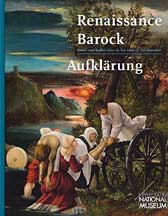
ISBN: 9783936688474 ($95)
Die neue Schausammlung lädt zu einem kulturhistorischen Gang durch drei Jahrhunderte ein. Er führt von der Entdeckung der neuen Welt um 1500 bis zur Entwicklung eines neuen Menschenbildes im 18. Jahrhundert. Rund tausend Objekte in 33 thematisch ausgerichteten Räumen erschließen zentrale Aspekte der Kunst- und Kulturgeschichte des 16. bis 18. Jahrhunderts im deutschen Sprachraum. Zu sehen sind neben Gemälden und Skulpturen auch Glasgemälde, Textilien, Kunsthandwerk, Schmuck, Medaillen, Möbel und Musikinstrumente sowie zwei historische Zimmer aus Nürnberger Bürgerhäusern der Renaissance. Meisterwerke von Albrecht Dürer, Peter Vischer, Rembrandt oder Franz Xaver Messerschmidt erscheinen in ihrem kulturgeschichtlichen Kontext. Im Dialog der Künste werden Themen wie Sammeln und Repräsentieren, Antikenrezeption und Naturstudium lebendig, wie auch die Wechselwirkung von Kunst und Glauben
sowie das sich wandelnde Bild vom Menschen.
Canaletto Exhibition To Open Soon in London
Press release from the National Gallery in London:
Venice: Canaletto and His Rivals
National Gallery, London, 13 October 2010 — 16 January 2011
National Gallery, Washington D.C., 20 February — 30 May 2011
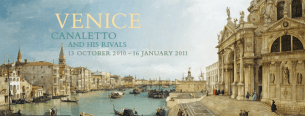 This exhibition presents the finest assembly of Venetian views, by Canaletto and all the major practitioners of the genre, to be held since the much-celebrated display in Venice in 1967. Remarkably, considering the dominant role of British patronage in this art form, Venice: Canaletto and His Rivals is also the first exhibition of its kind to be organised in the UK.
Additional information can be found here»
Exhibition: The Lake District
From the Wordsworth Museum:
Savage Grandeur and Noblest Thoughts, Discovering the Lake District, 1750 — 1820
The Wordsworth Museum & Art Gallery, Grasmere, England, 1 June 2010 — 12 July 2011
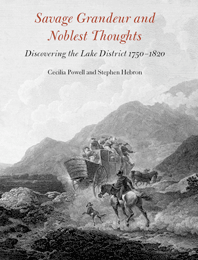
Catalogue by Cecilia Powell and Stephen Hebron, ISBN: 9781905256426, £19.95
From the mid 1700s until the early 1800s, British people who would normally have travelled abroad for recreation were confined to these shores. The French Revolution and the Napoleonic Wars made it dangerous for the British to travel in Europe and the conflicts created an upsurge in patriotic feeling. Artists and writers began to explore areas of natural beauty in Britain and their discoveries inspired a wide range of drawings, watercolours, oil paintings and engravings as well as prose and poetry of the highest quality. This work resulted in prints of the pictures and eventually what we might now call coffee table books, containing descriptions and pictures. These inspired more enthusiasm for the British landscape and an increasing number of people made their way to The Lake District.
Horrors like these at first alarm,
But soon with savage grandeur charm,
And raise to noblest thoughts the mind.
-from Dr John Dalton’s Descriptive Poem, first published in the 1750s
It became fashionable to travel through areas of wild and rugged scenery and visitors delighted in the thrilling experiences that the Lake District offered and its beauty and interest were ever more enthusiastically proclaimed. The Wordsworth Trust’s new exhibition explores the ways in which artists and writers discovered, portrayed and celebrated the Lake District in the years 1750-1820, a period of radical developments in both art and literature. The exhibition includes over 100 pictures and books from the period and shows how the British were inspired to invent the ‘staycation’. Savage Grandeur is the first exhibition which draws its content entirely from the Wordsworth Trust’s own collection. The exhibition will be complemented by a computer-generated guide to the scenery depicted in selected exhibits.
Vasi Exhibition Opens at the University of Oregon
The following is an edited version of the UO press release:
Giuseppe Vasi’s Rome: Lasting Impressions from the Age of the Grand Tour
Jordan Schnitzer Museum of Art, University of Oregon, Eugene, 25 September 2010 — 3 January 2011
Princeton University Art Museum, 2011
Curated by James Tice and James Harper
 Giuseppe Vasi’s Rome: Lasting Impressions from the Age of the Grand Tour opens this fall at the Jordan Schnitzer Museum of Art at the University of Oregon. Vasi was an eighteenth-century Italian engraver and architect who is best known for his cityscapes of Rome. The exhibition is curated by UO faculty members James Tice and James Harper. Tice is an architecture professor and a research fellow at Studium Urbis, an international study center in Rome devoted to study of the city’s urban history. Harper is associate professor of art history. He worked at the Philadelphia Museum of Art, the National Gallery of Art and the Fogg Art Museum at Harvard University before joining the UO faculty in 2000.
Giuseppe Vasi’s Rome is the first major exhibition to be devoted solely to Vasi’s work. Coinciding with the 300th anniversary of his birth, the exhibition combines graphic imaging technology with new research on how he observed and documented his city. Vasi lived and worked in Rome, where he was a contemporary of such other notable vedutisti as Giovanni Paolo Panini, his student Giovanni Battista Piranesi, and cartographer Giovanni Battista Nolli.
The exhibition traces the emergence of Vasi’s graphic chronicles within their cartographic and artistic traditions, and explores their impact on ways of seeing and interpreting the city as a work of art. Also featured in the exhibition is a new media component that builds on two websites designed by Tice and Erik Steiner, who was assistant director of the InfoGraphics Lab in the UO Department of Geography at the time he worked on the sites. The exhibition invites viewers to use touch screens and iPads to view Vasi’s work, compare them to those of other artists of the period and explore Rome, then and now, through georeferencing.
A 200-page catalogue features essays from Mario Bevilacqua, Vincent Buonanno, Allan Ceen, Adrianne Hamilton, Read McFaddin, John Moore, John Pinto, and the curators. In conjunction with a series of educational programs, the museum will host a symposium on November 12; “Una Roma Visuale: New Research on Giuseppe Vasi and the Art, Architecture and Urbanism of Rome” will bring together scholars to address the topics of prints, painting, sculpture, architecture, urbanism and cartography. John Pinto will deliver the keynote address.
Following its presentation at the Schnitzer Museum, the exhibition will be on view at the Princeton University Art Museum.
Manuscript Prize Competition
From the University of Virginia Press:
2010 Walker Cowen Manuscript Prize Competition in Eighteenth-Century Studies
Proposals due by 1 November 2010
We invite submissions for the Walker Cowen Memorial Prize. The prize is awarded to the author of a scholarly book-length manuscript in eighteenth-century studies, including the Americas and the Atlantic world. Submissions may be in history (including history of science), literature, philosophy, or the arts. The competition is held annually. The winner of the Cowen Prize will receive a $5,000 award and will be offered an advance publishing contract by the University of Virginia Press. The prize honors the late Walker Cowen, second Director of the Press from 1969 until his death in 1987. Click here for an official application form
Request an application form or send queries to:
Angie Hogan
The University of Virginia Press
PO Box 400318
Charlottesville, VA 22904-4318
arh2h@virginia.edu
To be considered for the 2010 award, manuscripts should be submitted no later than November 1, 2010. Manuscripts will not be returned. Foreign-language works first published in Europe will also be considered for the prize and for translation into English. Announcement of the winning manuscript will be made in March 2011.
At The Frick Next Summer: The French Court à la Turc
Press release (PDF) from The Frick:
Turkish Taste at the Court of Marie-Antoinette
The Frick Collection, New York, 8 June — 11 September 2011
Curated by Charlotte Vignon

Small Console Table with Supporting Figures of Nubians (one of a pair), c.1780, gilded and painted wood and marble slab (NY: The Frick Collection), photo by Michael Bodycomb
By the late eighteenth century, France had long been fascinated by the Ottoman empire. Trade with Turkish territories had gone on for centuries, bringing precious velvets, brocades, carpets, arabesque-decorated leathers, and metalwork to the Continent. In the fall of 1776, a performance of Mustapha and Zeangir, a tragedy in five acts by Sebastien-Roch Chamford that played in Paris, seems to have launched a taste for interiors “à la Turc,” or “in the Turkish style.” Soon after, boudoirs turcs were created in several royal residences, especially in the circle of Marie-Antoinette and the comte d’Artois, Louis XVI’s younger brother. This taste seems to have been confined largely to the royal court and the French aristocracy, and few objects from such rooms survive today. In the summer of 2011, the Frick will present a dossier exhibition on the subject, bringing together several examples that have rarely—or, in some cases never—been on view in New York City.
This exhibition was inspired by a pair of French console-tables at the Frick, whose exceptional quality suggests a royal origin. The tabletops are supported by two Nubian slaves who wear pearl-bedecked turbans; each figure holds a floral garland surrounding a medallion depicting a Sultan. The Turkish iconography is complemented by a frieze of crossed crescents, a symbol of the Ottoman empire. Such objects were not literal copies of Turkish models. Rather, they were created by interior decorators, architects, designers, and craftsmen inspired by an imaginary Ottoman empire, such as that depicted in A Thousand and One Nights and in the aforementioned tragedy Mustapha and Zeangir. Although the objects often featured turbaned figures, camels, palm trees, cornucopias, arabesques, crossed crescents, pearls and jewel-like ornaments, elaborate draperies, and heavy garlands of fruits and flowers, their form and function remained essentially French. Having been made for the royal family or wealthy aristocrats, the objects were usually of the highest quality, and can be attributed to the best artists and craftsmen of the time. Turkish Taste at the Court of Marie-Antoinette is being organized by Charlotte Vignon, the Frick’s Associate Curator of Decorative Arts.
◊ ◊ ◊ ◊ ◊
The exhibition might bring to mind the forthcoming book by Nebahat Avcioglu, Turquerie and the Politics of Representation, 1728-1876 (Aldershot: Ashgate, 2011), a description of which is available here»
Raphael Tapestries and Cartoons Briefly Reunited at V&A
 For the implications of the Raphael cartoons during the eighteenth century, see Arline Meyer, Apostles in England: Sir James Thornhill & the Legacy of the Raphael’s Tapestry Cartoons, exhibition catalogue (New York: Columbia University, 1996); and more recently, Cathleen Hoeniger, The Afterlife of Raphael’s Paintings (Cambridge: Cambridge University Press, 2010), especially chapter 5, “The English Reception and Restoration of Raphael’s Cartoons, c. 1525-1800” (this latter text is also useful for Raphael’s reception in France and Germany). The following description of the exhibition in London comes from the V&A’s website:
◊ ◊ ◊ ◊ ◊
Raphael: Cartoons and Tapestries for the Sistine Chapel
Victoria & Albert Museum, London, 8 September — 17 October 2010
This is a display of four of the ten tapestries designed by Raphael for the Sistine Chapel in Vatican City. These are the original tapestries from the only series designed by Raphael of which examples survive, and are comparable with Michelangelo’s Sistine Chapel Ceiling as masterpieces of High Renaissance art. The tapestries are displayed alongside the full-size designs for them – the famous Raphael Cartoons . This is the first time that the designs and tapestries have been displayed together – something Raphael himself never witnessed. The tapestries have not been shown before in the UK.
The tapestries of the Acts of St Peter and St Paul, The Miraculous Draught of Fishes, Christ’s Charge to Peter, The Healing of the Lame Man, and The Sacrifice at Lystra, were made for the Sistine Chapel almost 500 years ago. Raphael was commissioned by Pope Leo X to design these great tapestries, which were woven in Brussels, Europe’s leading centre for tapestry-weaving, and then sent to Rome for display. As the cartoons remained in Brussels, Raphael himself never saw the cartoons beside the tapestries woven from them. Several European monarchs, including Henry VIII, later commissioned copies of the tapestries which were made from the cartoons in Brussels. In 1623 Charles I, while Prince of Wales, had the Cartoons brought to England to have his own set woven in the Mortlake tapestry workshops, and they have remained in England ever since. (more…)
Reviewed: ‘The Pygmalion Effect’
Recently added to caa.reviews:
Victor I. Stoichita, The Pygmalion Effect: From Ovid to Hitchcock, translated from the French by Alison Anderson (Chicago: University of Chicago Press, 2008), 232 pages, ISBN: 9780226775210, $45.
Reviewed by Alison Syme, Department of Art, University of Toronto; posted 26 August 2010.
In ‘The Pygmalion Effect’ Victor Stoichita makes the astonishing claim that there is a libidinal component to mimetic production. Western art history—taken here to be a history of mimesis, of copies—has a dark, disavowed, erotic heart: the simulacrum. The simulacrum differs from the copy in that it is magical rather than mimetic, invites touch rather than merely looking, and is autonomous rather than merely derived from a model; Pygmalion’s statue is its founding myth. Arguing that “the simulacrum was not completely banished by Platonism” (3), Stoichita explores the “reverberations” (5) of the Pygmalion myth through Western art, paying close attention to shifts in iconography, animating tropes, and materials. Unsurprisingly he finds echoes of the work of one great male artist after another (van Eyck, Leonardo, Raphael, Michelangelo, etc.) in the work of lesser artists in a triumphal tale of the legacy of original creation. The author’s contention that “the ‘evolution’ of the Pygmalion Effect duplicates, in a significant way, the path taken by various methods for simulating movement, or even life” (6), while hardly new (this idea has been explored in the work of Kenneth Gross, Hillel Schwartz, Michael Cole, and Allison Muri, for example), is certainly borne out by the examples he uses. But Stoichita does not deliver on his claim that he is concerned “with the ‘imaginary woman’ and her place in a phallocentric universe” (6). . .
Chapter 5, “The Nervous Statue,” is devoted to the eighteenth century, a period “haunted” by the Pygmalion myth (111), which is explored in dance, literature, painting, and sculpture. Rather than the blush or the pulse, which had hitherto dominated Pygmalionian iconography, in the Enlightenment the statue’s power of movement becomes the key proof of life. The statue moves and even dances. Stoichita argues that its steps must be considered “in dialectical relation” to the plinth (113), for the sculpted works depicting the Pygmalion myth that appear are faced with a challenge unique to the medium: how can animate, inanimate, and becoming-animate figures be differentiated in sculpture? Falconet solved the problem with a double plinth. The contemporary understanding of the nervous system also informs representations of the myth. Louis Lagrenée’s 1770s paintings emphasize the characters’ actions and reactions—their responsiveness to physical stimuli and the circulation of vital energy through a network of touch and sight—which create “a veritable interaction” (143). Later, Girodet’s 1819 ‘Pygmalion in Love with His Statue’ takes “the idea of a network of energies already authoritatively suggested by someone like Lagrenée” (151) and extends it to the idea of magnetism: the importance of touch gives way to the idea of mesmeric fluids. Such changes in the representation of the myth reflect the materialism of the age, but religious iconography does not vanish from the scene: following Rousseau’s conflation of “artistic creation and religious adoration” (120) . . . .
For the full review, click here» (CAA membership required)
Enlightenment Art in China
It’s interesting to see the politics of the Enlightenment play out two centuries later. From the the Staatliche Kunstsammlungen Dresden:
Art of the Enlightenment
National Museum of China, Beijing, 1 March 2011 — 31 March 2012
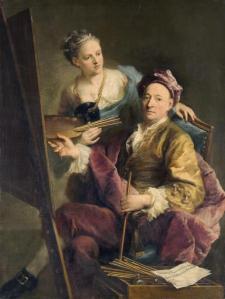
Georg Desmarées "The Artist with His Daughter, Antonia," 1750-1774 © Bayerische Staatsgemäldesammlungen München
The Staatliche Museen zu Berlin, the Staatliche Kunstsammlungen Dresden, and the Bayerische Staatsgemäldesammlungen Munich are to collaborate in presenting the largest exhibition on European art from the Enlightenment period ever to go on show in Asia. In the spring of 2011 the three museums will be exhibiting more than 350 works of art in an area covering 2,700 square metrers at the National Museum of China. The focus will be on major works of art which demonstrate the great ideas of this period, their influence on the fine arts and the history of their reception from the artistic revolutions of the 18th century down to the present day.
The exhibition presents the image world of a period on the threshold of modernity, the ideas of which are of programmatic significance for art today. Paintings, drawings, prints, costumes, furniture and spatial art, sculptures and books will bring all the various facets of the Enlightenment period and its reception history to life for a Chinese audience. Among the masterpieces on display will be works by Watteau, Boucher, Pesne, Piranesi, Chodowiecki, Hogarth and Goya, thus illustrating the wide range of works and the themes which informed the culture of this era, from the Ancien Régime to the Modern period.
The catalogue, which will be published in Chinese and English, will present the latest research findings concerning the art of the Enlightenment and other aspects of this period. This joint exhibition is being financed primarily by the German Foreign Office. It marks the high point of the programme of German-Chinese cultural exchange that was agreed in 2005.
The exhibition Art of the Enlightenment at the National Museum of China will be on display for 18 months. The National Museum on Tiananmen Square in Beijing is currently being refurbished and expanded according to plans drawn up by the Hamburg firm of architects Gerkan, Marg and Partners (gmp). When completed, it will have a total floor area of approximately 200,000 square metres. With its redesigned building, the museum is intended to become a centre for the world’s cultures, a venue in which outstanding guest exhibitions from all over the world will be presented.
◊ ◊ ◊ ◊ ◊
One hint of the politics at work surrounding the exhibition (at least on the German side) can be gleaned from the efforts of Stiftung Mercator (for information on the group, see below) . . .
Stiftung Mercator is currently planning a series of events to officially accompany the “Art in Enlightenment” exhibition which is to be shown in the National Museum of China in Beijing in 2011. In cooperation with the Berlin State Museums, the Dresden State Art Collections, the Bavarian State Painting Collections in Munich and the Federal Foreign Office, Stiftung Mercator will be organizing a series of events entitled “Enlightenment in Dialogue” within the framework of the National Museum of China exhibition “The Art in Enlightenment” in Beijing.
The events will comprise a number of dialogue blocks which will continue for the entire duration of the exhibition. The dialogue blocks will take place in parallel to the exhibition, addressing various facets of a contemporary examination of the subject of enlightenment. Each dialogue consists of a lecture and a panel discussion.
The objective of the series of events is to perceive enlightenment as part of a universal “global heritage of ideas” and to stimulate an open dialogue on the importance of enlightenment in modern times. Stiftung Mercator wishes to bring together Chinese and European scholars, writers and artists and, in particular, to highlight the value of enlightenment for key questions relating to identity and the future.
As described on the foundation’s website:
Stiftung Mercator is one of the largest private foundations in Germany. It pursues clearly defined objectives in its thematic clusters of integration, climate change and arts education and it achieves these objectives with a combination of socio-political advocacy and practical work. Stiftung Mercator implements its own projects and supports external projects in its centres for science and humanities, education and international affairs. It takes an entrepreneurial, professional and international approach to its work.
◊ ◊ ◊ ◊ ◊
This recap comes from ArtDaily.com (note added 1 April 2012) . . .
With a joint ceremony on March 25th 2012, Cornelia Pieper, Minister of State in the Foreign Office, and Zhao Shaohua, Deputy Minister of Culture for the People’s Republic of China, officially concluded the exhibition The Art of the Enlightenment at the National Museum of China. For the past year the exhibition has been on view in Beijing. So far, more than 450,000 visitors have attended. . . .
The full article is available here»










leave a comment