New Book | Italian Art, Spectacle, and Politics at the Paris Opéra
From Liverpool University Press:
Elisa Cazzato, Italian Art, Spectacle, and Politics at the Paris Opéra: Ignazio Degotti, 1758–1824 (Liverpool: Voltaire Foundation, Oxford University Studies in the Enlightenment, 2026), 304 pages, ISBN: 978-1805969198, $115. Also available digitally.
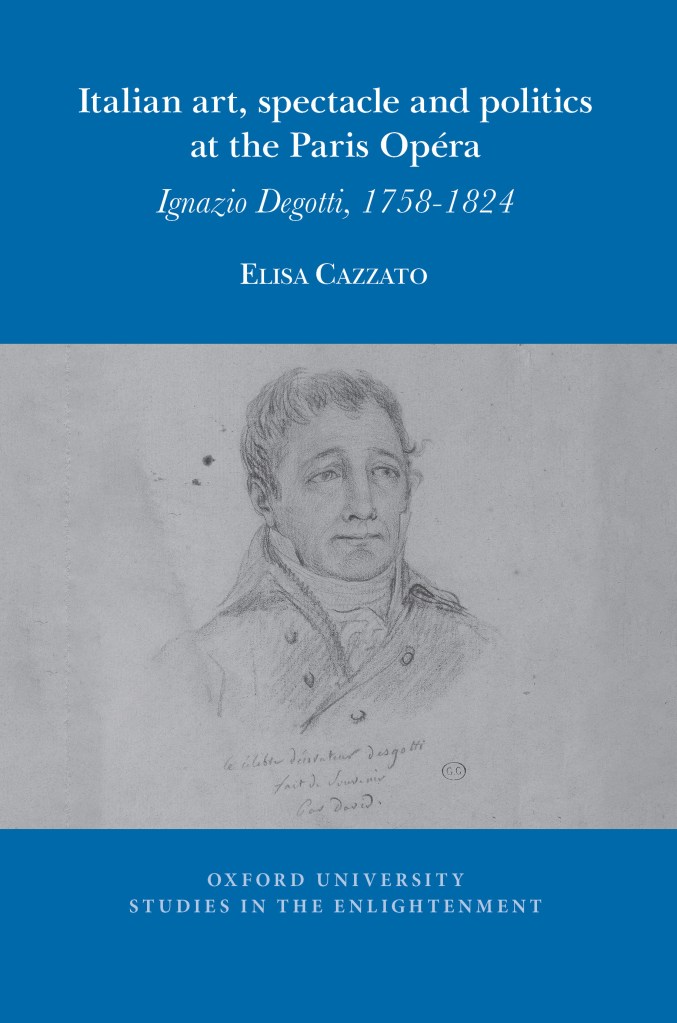 Ignazio Degotti (1758–1824) was one of the most influential scenographers working in Paris during the Revolution and Empire. As peintre en chef at the Paris Opéra for more than two decades, he worked at the centre of an institution where visual spectacle became a powerful instrument of artistic innovation and political representation. Drawing on extensive archival research in Italy and France, this book reconstructs Degotti’s career and situates his activity within the broader transformation of theatrical culture in the long eighteenth century. It shows how scenography functioned not merely as decoration but as a form of visual dramaturgy capable of structuring space, guiding the spectator’s gaze and giving political meaning to the performance.
Through case studies ranging from Revolutionary theatre to the grand operatic spectacles under Napoleon, the book reveals collaborative networks behind these performances. It also examines Degotti’s artistic relationships with figures such as Jacques-Louis David and the Greuze family, illuminating how sociability, friendship and artistic exchange shaped visual ideas in Napoleonic Paris. By placing scenography at the centre of Enlightenment visual culture, this study offers a new perspective on spectacle, artistic collaboration and the politics of performance while highlighting one of the least studied scenographers of the period.
Based at the University of Naples Federico II, Elisa Cazzato holds a PhD in Art History from the University of Sydney. Her research encompasses scenography, ephemeral art, spectacle, and artistic networks in the long eighteenth century. A former Marie Skłodowska-Curie Fellow, she collaborated with New York University and Sorbonne Université.
c o n t e n t s
Preface
Opening the curtain: An introduction
Scenography as visual dramaturgy
The challenge of ephemerality
An interdisciplinary approach
1 Sceneography in the Age of the Enlightenment
Setting the scene: Scenography as an evolution of prospettiva, a Renaissance legacy
Seventeenth-century Italian paths: Machinery and perspective as illusion
Diverging tastes: Resisting change on seventeenth-century French stages
Key terms: Scénographie and Décoration, a lexical and Encyclopedic shift
Reform under the Enlightenment: The tableau as a spatial and emotional configuration of the stage
2 Ignazio Degotti (1758–1824): The Italian Milieu
The Degotti family in Turin: Origins and background
Models of ambitions: The Galliari family
Knowledge of the Classics and Roman encounters
The establishment of a staging identity
Mapping the last Italian journey: Naples
3 An Italian Artist in Paris: Works under the Revolution (1790–1797)
The power of hometown networks in a French environment
The experimental enterprise of the Théâtre de Monsieur: A Franco-Italian repertoire
A controversial example of pastiche: Le Retour aux isles des amis, ou le capitaine Cook (1790)
Lodoïska (1791): Fire, scenography and Revolutionary resonance
Visual challenges and changing aesthetics: Eliza (1792) and Médée (1797)
Degotti at the Théâtre de la République: the exotic décor of Abufar ou la Famille Arabe (1795)
4 Power and Spectacle at the Théâtre de l’Opéra: The Napoleonic Years (1795–1810)
From monarchy to empire: The Opéra’s institutional shifts and theatrical infrastructure
A missed opportunity for a functional atelier de peinture (1795)
Scenographic tableau in the making
Between image and order: Degotti and the politics of theatrical production
Staging the myth of Rome: Le Triomphe de Trajan (1807)
Napoleon’s self-promotion: La Mort d’Adam (1809)
The tortuous path to marketing imperialism: Fernand Cortez (1809)
5 Networks of the Napoleonic Period
Domestic stages: Collective ventures in private scenography
Standing together: Degotti and David
Intimate networks: Degotti, Louise-Gabrielle Greuze, and the private legacy
6 Afterlives of a Scenographer: Restoration, Transmission, and Loss (1814–1825)
Familiar faces, familiar problems: Degotti’s continued battles at the Opéra
Exeunt Degotti: The final years
Transmitting light: Degotti’s influence on Daugerre
A quiet dispersal of an artist’s life: A brother’s role
Closing the curtain: A conclusion
Appendices










leave a comment