Recent Acquisitions at The Met: Paret and Villers
Glad here to highlight three recent Met acquisitions, as noted by David Pullins. –CH
◊ ◊ ◊ ◊ ◊
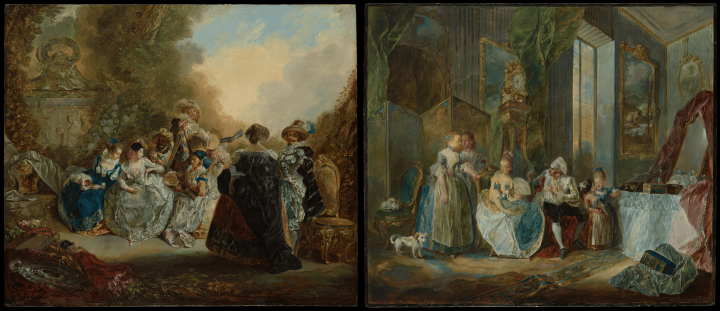
Left | Luis Paret y Alcázar, The Fête Galante, ca. 1772, oil on wood, 49.2 × 57.2 cm
(New York: The Metropolitan Museum of Art, Purchase, Florence and Herbert Irving Acquisitions Fund; Louis V. Bell, Harris Brisbane Dick, Fletcher, and Rogers Funds and Joseph Pulitzer Bequest; Victor Wilbour Memorial Fund; and funds from various donors, 2025.300).
Right | Luis Paret y Alcázar, The Toilette, 1772, oil on wood, 49.5 × 57.2 cm
(New York: The Metropolitan Museum of Art, Purchase, Florence and Herbert Irving Acquisitions Fund; Bequest of Lillian S. Timken, by exchange; Marquand Fund; The Alfred N. Punnett Endowment Fund; and funds from various donors, 2025.301).
These two paintings engage a complex cultural situation: in 1714, the French-descended Bourbons took control of the Spanish throne, ruling a country proud of its rich artistic heritage under the previous dynasty.
In The Fête Galante, Paret has adapted French painter Watteau’s amorous garden scenes to Spain by including a strolling couple that references a famous painting by Rubens and a majo, the folk character playing a bandurria that would later be one of the stereotypical images of Spain popularized by Goya.
With The Toilette, Paret has adapted French painter Jean François de Troy’s subjects of contemporary life to Spain. The woman known as a petimetra—an archetype vilified for overly eager consumption of non-Spanish luxury fashions—is depicted with a disfigured, rich, older man. Goya would later develop such social critique. The distinctive gold signature with crown affirms that this painting was executed for the king’s younger brother.
The two paintings were made at the height of Paret’s success at court, just before a political misstep led to his exile in Puerto Rico, where he taught his idiosyncratic enamel-like technique to José Campeche, the country’s first painter in the European tradition.
◊ ◊ ◊ ◊ ◊
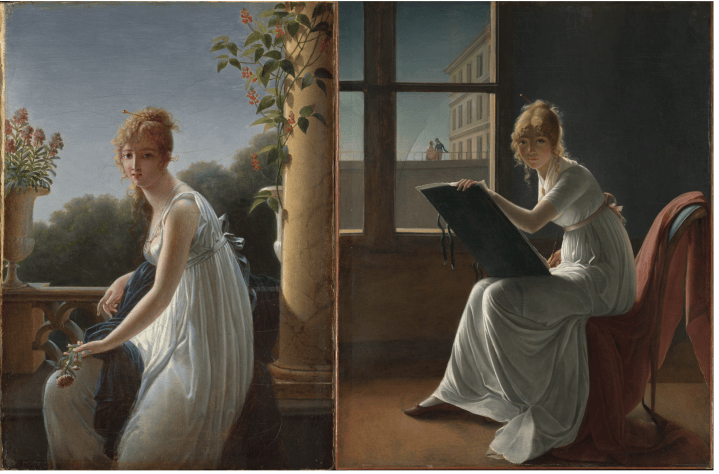
Left | Marie Denise Villers, A Woman Seated on a Balustrade, ca. 1801, oil on canvas, 26 × 18.5 cm
(New York: The Metropolitan Museum of Art, Gift of Dick Wolf, 2026.360.3).
Only about five paintings by Villers are known today, one of the most important being The Met’s famous image of a draftswoman, known as Marie Joséphine Charlotte du Val d’Ognes (pictured at right). Villers showed that portrait at the Salon of 1801 alongside the lifesize version of this composition, for which this is the artist’s rare oil study. Villers perfected the simple arrangement of fashionable dress, interiors, and architecture, often innovatively back-lit in a manner that imbues her figures with an incandescent glow.










leave a comment