Finding the Perfect Gift
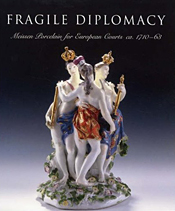
Edited by Maureen Cassidy-Geiger
Just Published
The Court Historian 14.2 (December 2009), published by The Society for Court Studies
Special Issue: Gift-Giving in Eighteenth-Century Courts — Papers from the conference Fragile Diplomacy: Meissen Porcelain for European Courts, c. 1710-1763, held at the Bard Graduate Center, New York, 17 November 2007, in conjunction with the eponymous exhibition (reviewed at artnet by N. F. Karlins).
◊ ◊ ◊ ◊ ◊
Table of Contents
 Andrew Morrall (Bard Graduate Center), Introduction
- Cordula Bischoff (State Art Collections, Dresden), Complicated Exchanges: The Handling of Authorised and Unathorised Gifts
- Christopher M. S. Johns (Vanderbilt University) The ‘Good Bishop’ of Catholic Enlightenment: Benedict XIV’s Gifts to the Metropolitan Cathedral of Bologna
- John Whitehead, Royal Riches and Parisian Trinkets: The Embassy of Saïd Mehmet Pacha to France in 1741-42 and Its Exchange of Gifts
- Michael Yonan (University of Missouri-Columbia), Portable Dynasties: Imperial Gift-Giving at the Court of Vienna in the Eighteenth Century
- Guy Walton, Emeritus (New York University), Ambassadorial Gifts: An Overview of Published Material
- Maureen Cassidy-Geiger (Cooper-Hewitt Museum/Parsons School of Design), Afterthoughts on Fragile Diplomacy: Meissen Porcelain for European Courts, c. 1710-1763
- Book Reviews / Exhibition Reviews

Looking Ahead: Art of the Austrian Table
From the Met’s website:
Vienna Circa 1780: An Imperial Silver Service Rediscovered
Metropolitan Museum of Art, New York, 13 April — 7 November 2010
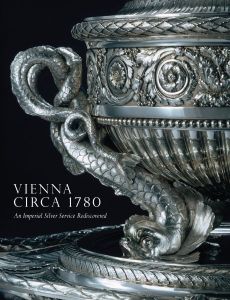
Wolfram Koeppe, ISBN-10: 0300155182 ($35)
Following the acquisition in 2002 of two Viennese silver wine coolers from the Sachsen-Teschen Service, most of the set’s surviving parts were discovered in a French private collection. This superb ensemble was last displayed at the beginning of the twentieth century. Wine coolers, tureens, cloches, sauceboats, candelabra, candlesticks, dozens of plates, porcelain-mounted cutlery, and other kinds of tableware totaling over 350 items, represent the splendor of princely dining during the ancien régime. It was made for Duke Albert Casimir of Sachsen-Teschen (1738-1822), and his consort, Archduchess Maria Christina of Austria (1742-1798) by the Imperial court goldsmith Ignaz Josef Würth. The Sachsen-Teschen Silver Service, an embodiment of Viennese neo-classicism, will be shown in the context of contemporary silver from other countries.
Accompanied by a catalogue to be published by the MMA.
Worth Talking About: Before and After Zoffany
Buckingham Palace offers an immensely satisfying show anchored by Zoffany (works include the The Academicians of the Royal Academy and The Tribuna of the Uffizi). From the website of the Royal Collection:
The Conversation Piece: Scenes of Fashionable Life
Palace of Holyroodhouse, Edinburgh, 27 March — 20 September 2009
Queen’s Gallery at Buckingham Palace, London, 30 October 2009 — 14 February 2010
 The Conversation Piece: Scenes of Fashionable Life is now on view at The Queen’s Gallery, Buckingham Palace. The exhibition presents a fascinating insight into high-society fashions, interiors and manners from the time of Charles I to the reign of Queen Victoria. While a portrait primarily records the sitter’s appearance, the Conversation Piece depicts their way of life, often conveying the impression that the subject has been caught off-guard. Typically a work shows a family group or a gathering of friends participating in informal activities. The genre was popular amongst Dutch painters in the seventeenth century and was subsequently developed in England. It is best known through the work of artists William Hogarth and George Stubbs during the eighteenth century and Sir Edwin Landseer in the nineteenth century. The exhibition brings together outstanding paintings by the greatest exponents of the Conversation Piece. The centrepiece is a remarkable series of portraits produced by Johan Zoffany for his royal patron George III, including the artist’s masterpiece The Tribuna of the Uffizi, 1772-7. The exhibition is accompanied by the catalogue The Conversation Piece: Scenes of Fashionable Life by Desmond Shawe-Taylor, the first publication on the subject for over 30 years.
◊ ◊ ◊ ◊ ◊
An informative exhibition microsite accompanies The Conversation Piece. In the London Times and Sunday Times, the show is reviewed by Anna Burnside, Rachel Campbell-Johnston, and Waldemar Januszczak, while Richard Cork supplies a summary for The Financial Times.
Paul Sandby’s Bicentenary
From the website of the National Gallery of Scotland:
Paul Sandby: Picturing Britain
Nottingham Castle Museum and Art Gallery, 25 July — 18 October 2009
National Gallery of Scotland, Edinburgh, 7 November 2009 — 7 February 2010
Royal Academy of Arts, London, 13 March — 13 June 2010
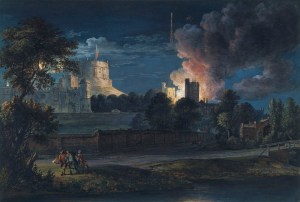
Paul Sandby, "Windsor Castle from Datchet Lane on a Rejoicing Night," Photograph: The Royal Collection © 2009 Her Majesty Queen Elizabeth II
Paul Sandby: Picturing Britain looks at all aspects of Sandby’s career and includes studies of rural and urban views, street scenes, royal parks and ancient castles. Sandby explored a broader range of subject matter than any previous artist in Britain and was integral in refining the use of watercolour. This exhibition features over one hundred loans, including oil paintings, watercolours, gouaches, prints and sketchbooks, coming from all the major collections which house his work: The Royal Collection, The British Museum, The British Library, The Victoria and Albert Museum, and The Yale Center for British Art. It also showcases outstanding works from private collections.
◊ ◊ ◊ ◊ ◊
Addressing the exhibition in The Gaurdian (7 November 2009), Linda Colley describes Sandby’s standing in British society, then and now:
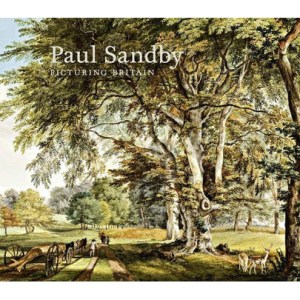
Stephen Daniels, et al (London: Royal Academy of Arts), ISBN: 978-1905711482, 216 pages, $55
. . . As George III’s remark illustrates, this view of him has always been coloured by varieties of snobbery. To this extent, the portrait of Sandby by Francis Cotes, showing him leaning out of a country house window, sketchbook in hand, can be seen as a calculated puff by a close friend. It accurately conveys Sandby’s good looks and pleasant temperament. But the portrait gives a flatteringly deceptive impression of a man as much at ease in polite and leisured interiors as he is with nature. In reality, Sandby’s family background was considerably more humble than that of Gainsborough or John Constable. Unlike his fellow academician Joshua Reynolds, Sandby was never a fashionable, expensive portrait painter. Nor was he a practitioner of academically prestigious history painting. And, crucially, unlike JMW Turner or Thomas Girtin, Sandby was not a metropolitan.
The son of a framework knitter, he was baptised in Nottingham in 1731; and this exhibition is very much a Nottingham achievement, where it was first displayed. The show, opening today at the National Gallery of Scotland in Edinburgh, and at the Royal Academy of Arts in London in March, was conceived by Stephen Daniels of Nottingham University. It is exactly the sort of deeply researched and ambitious regional art exhibition that is likely to be rendered increasingly impracticable because of government, municipal and corporate spending cuts. . . .
Sandby’s vision then is substantially (not entirely) loyalist and conventionally patriotic, and this may be another reason why his work is sometimes passed over. Morning, an extraordinary painting of a massive, venerable beech tree set firm in a Shropshire landscape, is, for instance, a powerfully loyalist testament. Exhibited at the Royal Academy in 1794, five years after the fall of the Bastille and in the midst of war, the painting would have been understood as an allusion to contemporary conservative celebrations of an ancient, organic British constitution as against the recent republican outgrowths of revolutionary France. As the exhibition catalogue argues, Sandby’s vision was also increasingly a Britannic one. Like Turner, Sandby made repeated tours throughout Wales and Scotland, representing not just their scenic and cultural differences, but also the ways in which these countries were undergoing change and becoming in some respects far more closely linked with England. . . .
For the full article, click here»
Newly Restored Dutch Panel Paintings
From the Museum Van Loon website:
Jurriaan Andriessen (1742-1819): A Beautiful View
Museum Van Loon, Amsterdam, 2 October 2009 — 4 January 2010

Jurriaan Andriessen, 1780
The exhibition Jurriaan Andriessen (1742-1819): een schoon vergezicht . . . is the very first solo exhibition of this famous eighteenth-century wall panel painter, with works from — amongst others — the Rijksmuseum, the City Archives, and the Archive of the Royal Household, many of which have not been on display earlier. The occasion of this exhibition is the . . . completed restoration of the six Andriessen wall panels in the collection of the Museum Van Loon. Andriessen manufactured the paintings in 1780 for Drakensteyn Castle, where Princess Beatrix lived before her accession to the throne. Professor Maurits van Loon acquired the panels in the 1970s as a result of the special relationship between Drakensteyn Castle and the Van Loon house. Since those days, they embellish the wall of the ‘Drakensteyn Room’ in the museum. It is the only Andriessen ensemble presently open to the public.
In the eighteenth century, wall panels were a true trend in Dutch interiors. Contrary to present day wallpaper, they were actual paintings, mostly landscapes with wall-to-wall displays that made people feel ‘outside on the inside’. Jurriaan Andriessen was particularly popular in his day and had many commissions both in Amsterdam and the country. With the exhibition comes a publication: Richard Harmanni, Tonko Grever, and Laura Smeets, Jurriaan Andriessen (1742-1819): A Beautiful View (Zwolle, Waanders, 2009), ISBN: 9789040076534, $29.
American Stories at the Met
From the Met’s press release:
American Stories: Paintings of Everyday Life, 1765-1915
Metropolitan Museum of Art, New York, 12 October 2009 – 24 January 2010
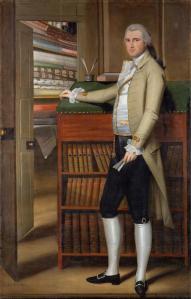
Ralph Earl, "Elijah Boardman," 1789 (NY: Met)
From the decade before the Revolution to the eve of World War I, many of America’s most acclaimed painters captured in their finest works the temperament of their respective eras. They recorded and defined the emerging character of Americans as individuals, citizens, and members of ever-widening communities. American Stories: Paintings of Everyday Life, 1765–1915 brings together for the first time more than 100 of these iconic pictures that tell compelling stories of life’s tasks and pleasures. The first overview of the subject in more than 35 years, the exhibition includes loans from leading museums and private lenders—and many paintings from the Metropolitan’s own distinguished collection. American Stories features masterpieces by John Singleton Copley, Charles Willson Peale, William Sidney Mount, George Caleb Bingham, Winslow Homer, Thomas Eakins, John Singer Sargent, Mary Cassatt, William Merritt Chase, John Sloan, and George Bellows, and notable works by some of their key colleagues.
The exhibition examines stories based on familiar experience and the means by which painters told their stories through their choices of settings, players, action, and various narrative devices. The artists’ responses to foreign prototypes, travel and training, changing exhibition venues, and audience expectations are examined, as are their evolving styles and standards of storytelling in relation to the themes of childhood, marriage, the family, and the community; the production and reinforcement of citizenship; attitudes towards race; the frontier as reality and myth; and the process and meaning of art making.
 The exhibition is arranged in four chronological sections. The first—Inventing American Stories, 1765–1830—begins with artists who told stories through portraits. Serving their sitters’ self-conscious interest in how they appeared in the eyes of others, American portraitists often emulated British compositions. Although these artists focused on individuals and particular locales and relationships, the cleverest of them responded to broader narrative agendas and to the natural impulse to tell stories. In his portrait of his colleague Paul Revere (1768, Museum of Fine Arts, Boston), John Singleton Copley embedded subtle narrative into a traditional single-figure format, with the silversmith’s gestures and gaze conveying volumes about the time in which he lived. As their patrons learned to read portraits for more than likeness and to appreciate artistic license, portraitists began to gratify their sitters by telling subtle personal stories in increasingly elaborate compositions. In his ingenious double-likeness of Benjamin and Eleanor Ridgely Laming (1788, National Gallery of Art, Washington), for instance, Charles Willson Peale implied the sexual bond that defined the Lamings’ marriage. Later in this period, some painters told grand stories in pictures produced for public exhibition, rather than purely for private enjoyment. In Gallery of the Louvre (1831–33, Terra Foundation for American Art, Chicago), Samuel F. B. Morse proposed that his compatriots must achieve cultural independence from Europe even while they learned from the Old World’s greatest artistic achievements.
◊ ◊ ◊ ◊ ◊
In addition to the materials contained at the Met’s website, there is an exhibition blog that’s updated regularly. The November 2009 issue of The Magazine Antiques includes an instructive article by Carrie Barratt and H. Barbara Weinberg, “American Artists as They Saw Themselves.”
CAA Distinguished Scholar: Jules David Prown
Jules David Prown, a devoted teacher of the history of American art and material culture and Paul Mellon Professor Emeritus of the History of Art at Yale University, has been selected as the CAA Distinguished Scholar for 2010. A special session in his honor will be held at the CAA annual conference in Chicago on 11 February 2010.
Bryan Wolf, professor of American art and culture at Stanford University, underscores the importance of Prown’s work in an essay for CAA, available through the association’s website:
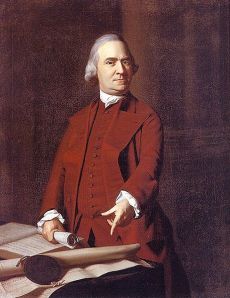
John Singleton Copley, "Samuel Adams," ca. 1772 (Boston: MFA)
His remarkable career marks the coming of age of American art history. His two-volume study of the painter John Singleton Copley (Cambridge, MA: Harvard University Press, 1966) overturned the usual concerns of positivistic biography. His growing focus during the next several decades on the formal properties of objects, together with what he termed the system of cultural “belief” embedded within them, led to a methodological revolution that still resonates loudly in classrooms wherever American art and material culture are taught. . . .
Scholarship on American art in the 1960s tended to divide into two camps: those eager to claim an “American exceptionalism” for artists of virtually all eras of American history, and those determined to prove the former wrong, largely by tracing the European antecedents for traits otherwise labeled “American.” Prown’s two-volume Copley book, which grew from his dissertation on English Copley, coincided with the catalogue he authored for a comprehensive exhibition of Copley’s work at the National Gallery of Art in Washington, DC, the Metropolitan Museum in New York, and the Museum of Fine Arts in Boston. Prown’s approach to Copley was to replace what in fact was a cold-war battle over American exceptionalism with science and statistics. He used a computer—I believe that he was the first art historian to do so—to “analyze data on 240 of Copley’s American sitters, correlating such factors as religion, gender, occupation, place of residence, politics, age, marital status, wealth, size of canvas, date, and medium.” An early paper he presented at CAA describing the project began with a slide of an IBM punch card. The audience “hissed,” as Prown later recounted, albeit with humorous intent. “The chairman of my department at the time advised me to remove the computer-analysis section from my book manuscript because its publication would jeopardize my chances for tenure.”

Yale UP, 2002 ($60)
The Copley book provided readers with a magisterial overview of this painter as a citizen of the British trans-Atlantic. Prown’s vision deftly sidestepped both sides of the American exceptionalism debate by insisting—decades before transnationalism would emerge as a focus of scholarly studies—on the complicated and hybrid relations between English-speaking cultures on either side of the Atlantic. . . .
For Wolf’s complete article (also available in the November 2009 issue of CAA News), click here»
Yinka Shonibare in DC
Yinka Shonibare, MBE
Smithsonian National Museum of African Art, Washington D.C., 10 November 2009 — 7 March 2010
Curated by Rachel Kent
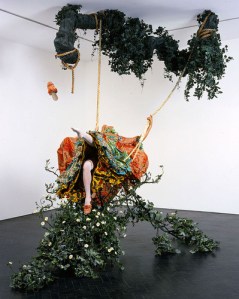
Yinka Shonibare, "The Swing (After Fragonard)," 2001
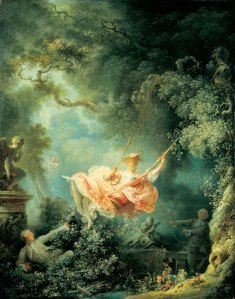
Jean-Honoré Fragonard, "The Swing," 1767 (London: Wallace Collection)
This morning on NPR’s Morning Edition, Susan Stamberg profiled the Yinka Shonibare exhibition now on display at the Smithsonian National Museum of African Art (it was organized by the Museum of Contemporary Art in Sydney). Writing in The New York Times (17 June 2009) of the show when it was at the Brooklyn Museum this past summer, Deborah Sontag described Shonibare as an “erudite and wide-ranging” artist, whom

Rachel Kent
at 47, is a senior figure in the British art world but one who intentionally eludes easy categorization. A disabled black artist who continuously challenges assumptions and stereotypes — “That’s the point of my work really,” he said — Mr. Shonibare makes art that is sumptuously aesthetic and often wickedly funny. When he deals with pithy matters like race, class, disability, colonialism and war, he does so deftly and often indirectly. “I don’t produce propaganda art,” he said. “I’m more interested in the poetic than the didactic.”
While many of the works address contemporary issues through Victorian conventions, there are intriguing eighteenth-century references, too — including this reworking of Fragonard’s Swing.
Etc, Etc.
 Umberto Eco served as guest-curator for the Louvre’s current exhibition Vertige de la Liste (Vertigo of Lists), on view until December 13. The scholar’s celebrity status has garnered lots of attention for the show (in addition to being taken up by the Associated Press, it’s been covered by Spiegel, Salon, and L’Express). The publisher’s description of the book accompanying the show, calls Eco “a modern-day Diderot,” explaining that here he “examines the Western mind’s predilection for list-making and the encyclopedic.” With material ranging from ancient and medieval lists (Homeric catalogues and lists of saints) to early modern “catalogues of plants [and] collections of art,” the eighteenth century would seem like a crucial period, and there is apparently at least one painting by Panini included. Still, for all of the talk of lists, one that seems to be missing (even from the Louvre’s site) is an exhibition checklist. Those of us who are unable to see the show should, however, have a better sense of its contents soon enough; the English edition of The Infinity of Lists: An Illustrated Essay is schedule for publication on November 17.
◊ ◊ ◊ ◊ ◊
Vertige de la Liste
Musée du Louvre, Paris, 2 November — 13 December 2009
The following account of the exhibition comes from Cristina Carrillo De Albornoz’s coverage in The Art Newspaper:
After Robert Badinter, Toni Morrison, Anselm Kiefer and Pierre Boulez, Umberto Eco is the next special guest curator of the Louvre. A noted historian and semiotician before he brought these sensibilities to bear on major novels such as The Name of the Rose and Foucault’s Pendulum, Eco has spent almost two years in residence at the Louvre. His chosen subject is “The Infinity of Lists”, a tour through art, literature and music based on the theme of lists and motivated by his fascination with numbers (until 13 December). “The subject of lists has been a theme of many writers from Homer onwards. My great challenge was to transfer it to painting and music and to see whether I could find equivalents in the Louvre, because frankly when I suggested the subject I had no idea how I would write about visual lists,” says Eco.
“The starting point for my ‘list of lists’ was Homer’s Iliad: firstly the creation of Achilles’ shield by Hephaestus, which not only symbolises perfect form but is in itself a work of art on which is engraved what is considered an allegory of the creation of the universe, an overall vision of Homer’s world. And secondly, the part where he lists all the ships leaving for the Trojan war.” Eco plays with these two opposing dimensions—perfect form and the list—in an attempt to rationalise the world. “The shield of Achilles is the epiphany of form, and every picture in an artist’s search for that form is a shield of Achilles,” concludes Eco. “Behind each list is the sense of ineffability.”
This impulse has recurred through the ages from music to literature to art. Eco refers to this obsession itself as a “giddiness of lists” but shows how in the right hands it can be a “poetics of catalogues.” From medieval reliquaries to Andy Warhol’s compulsive collecting, Umberto Eco reflects in his inimitably inspiring way on how such catalogues mirror the spirit of their times. . . .
For the full article, click here»
French Drawings in D.C.
It’s shaping up to be quite an autumn for French drawing exhibitions in the United States. In addition to the shows at the Getty, the Frick, and the Morgan, the National Gallery presents a sampling from its permanent collection. As noted in a press release from the museum’s website:
Renaissance to Revolution: French Drawings from the National Gallery of Art, 1500–1800
National Gallery, Washington D.C., 1 October 2009 — 31 January 2010

Margaret Grasselli, ISBN 978-1848220430
Some 135 of the most significant and beautiful drawings made over a period of three centuries by the best French artists working at home and abroad and by foreign artists working in France will be on view in Renaissance to Revolution: French Drawings from the National Gallery of Art, 1500–1800 in the Gallery’s West Building from October 1, 2009, through January 31, 2010. This is the first comprehensive exhibition and catalogue to focus on the Gallery’s permanent collection of French old master drawings, which is remarkable for its breadth, depth, and individual masterpieces. “One of the true glories of the National Gallery of Art’s holdings of graphic art is its outstanding collection of French old master drawings,” said Earl Powell, director, National Gallery of Art. “The exhibition Renaissance to Revolution and the accompanying catalogue celebrate the singular originality, elegance, and spirit of French draftsmanship.”

Antoine Coypel, "Seated Faun," 1700/1705, red and black chalk heightened with white chalk on blue paper, 16 x 11 inches (DC: NGA)
Among the National Gallery of Art’s extensive holdings of approximately 100,000 works on paper, the collection of 6,000 European drawings includes more than 900 French old master drawings which stand out as a particular treasure. The French group has deep roots in the earliest days of the museum’s existence, with the first of these works arriving in 1942, just a year after the Gallery opened its doors to the public. Over the next 67 years, thanks to the generosity of innumerable donors, the collection has evolved into one the Gallery’s strongest and most comprehensive, and one of the finest in the Western Hemisphere.
Organized chronologically, Renaissance to Revolution presents a visual journey through the development of drawing in France, from its first flowering during the Renaissance through its neoclassical incarnation during the political and social upheavals of the French Revolution at the end of the eighteenth century. Lorrain, and Antoine Watteau, as well as many less well-known artists. All major stylistic trends and many of the greatest and best-known artists from these centuries are represented by a rich array of works executed in a variety of styles and media and covering a wide range of functions, subjects, and genres. . . .

François-André Vincent, "The Drawing Lesson," 1777, brush and brown wash over graphite, 13 x 15 inches (DC: NGA)
Within the exceptionally rich collection of eighteenth-century drawings, the major artists—Boucher, Fragonard, Jean-Baptiste Greuze, Gabriel de Saint-Aubin, Hubert Robert, and Watteau, among others—are each represented by several works of outstanding quality. Some magnificent pieces by less familiar masters are featured as well, including François-André Vincent’s Drawing Lesson (1777), arguably the most perfect representation of eighteenth-century French elegance, taste, and gallantry; Étienne-Louis Boullée’s monumental neoclassical design for a metropolitan church from 1780/1781; and a large and beautiful pastoral scene executed in pastel and gouache, Shepherds Resting by a Stream (1779) by Jean-Baptiste Pillement. Also noteworthy is a striking group of portraits by several of the leading pastellists of the period, including outstanding examples by Maurice-Quentin de La Tour and Jean-Baptiste Perronneau, as well as a particularly dashing portrait of a young woman by Adélaïde Labille-Guiard from 1787. One of the youngest drawings in the exhibition is the neoclassical portrait Thirius de Pautrizel (1795) by David, an active participant in the revolution, made when he was imprisoned for his radical politics.
A particular strength within the Gallery’s collection of French drawings is the genre of book illustration. This is represented throughout the exhibition beginning with the work by Poyet and includes distinctive pieces by such famous masters as Boucher, Fragonard, Jean-Michel Moreau the Younger, and Saint-Aubin, as well as outstanding examples by other supremely gifted but less widely known artists, such as Hubert-François Gravelot and Charles Eisen.
Margaret Morgan Grasselli, curator of old master drawings, National Gallery of Art, is curator of the exhibition. Published by the National Gallery of Art in association with Lund Humphries, Renaissance to Revolution: French Drawings from the National Gallery of Art, 1500-1800 features an introductory essay and comprehensive entries on the exhibited drawings with 260 full-color illustrations.
On Sunday, 13 December 2009, at 2pm, Grasselli will deliver the lecture Playing Favorites: A Personal Selection of French Drawings from the National Gallery of Art and sign copies of the catalogue.










 Enfilade
leave a comment