New Book | Noble Beasts
From Yale UP:
Amy Freund, Noble Beasts: Hunters and Hunted in Eighteenth-Century French Art (New Haven: Yale University Press, 2026), 248 pages, ISBN: 978-0300282702, $75.
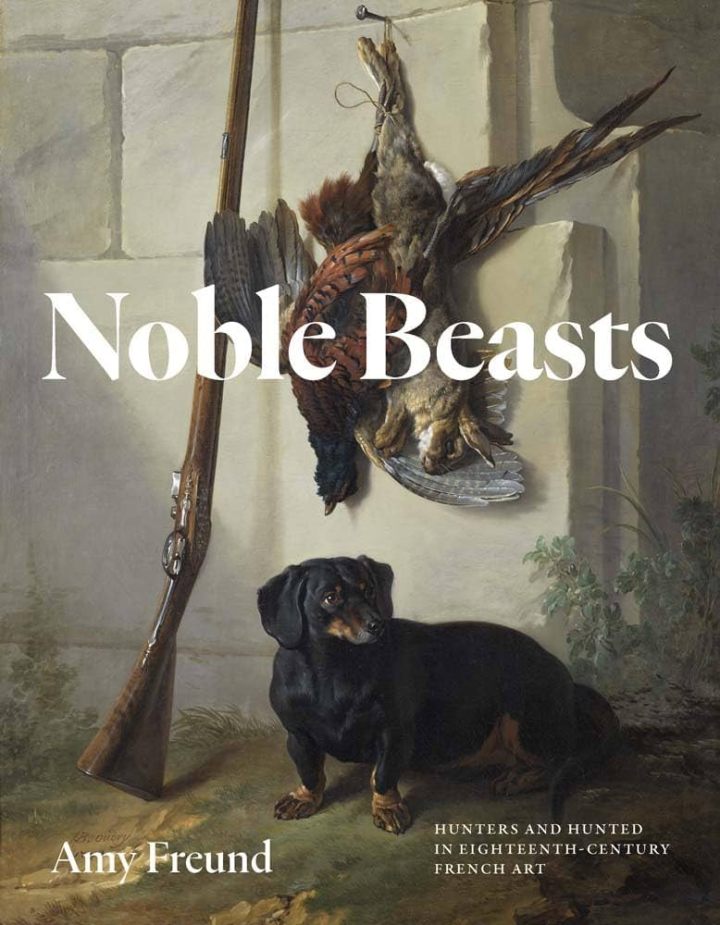 How visual fantasies of violence, animality, and political agency offered an alternative image of masculinity during the Enlightenment.
Centering on animal bodies and assertive masculinity, the visual strategies of hunting art may appear incongruent with our understanding of Rococo aesthetics and the early Enlightenment. But these themes, embraced with enthusiasm by artists and patrons, inspired artworks in every genre and medium in eighteenth-century France. As the country expanded its colonial empire, the absolute monarchy existed in tension with ambitious elites, and the Enlightenment eroded old certainties about selfhood and society, hunting art provided a visual language of personal and national sovereignty written with bodies of men and animals. Amy Freund revises our received notions of eighteenth-century French art and culture, confronting us with a visual culture of animality, violence, and death: a Rococo of dogs and guns.
Noble Beasts highlights the work of François Desportes, Jean-Baptiste Oudry, and others who, operating from the heart of institutions such as the Royal Academy and the Gobelins manufactory, produced an astonishing volume of highly accomplished work. The book draws on the critical frameworks of human-animal studies and on Enlightenment philosophical debates to explore how and why hunting art’s aesthetic and political claims blurred the lines between human and animal.
Amy Freund is associate professor and Kleinheinz Family Endowment for the Arts and Education Endowed Chair in Art History at Southern Methodist University.
New Book | The Anatomy of the Horse
The paperback edition appeared in 2024; the hardback is scheduled for publication in April:
George Stubbs, The Anatomy of the Horse (London: Pallas Athene, 2024), 76 pages, ISBN: 978-1843682479 (paperback) / ISBN: 978-1843682486 (hardback), $30. With essays by Constance-Anne Parker and Oliver Kase.
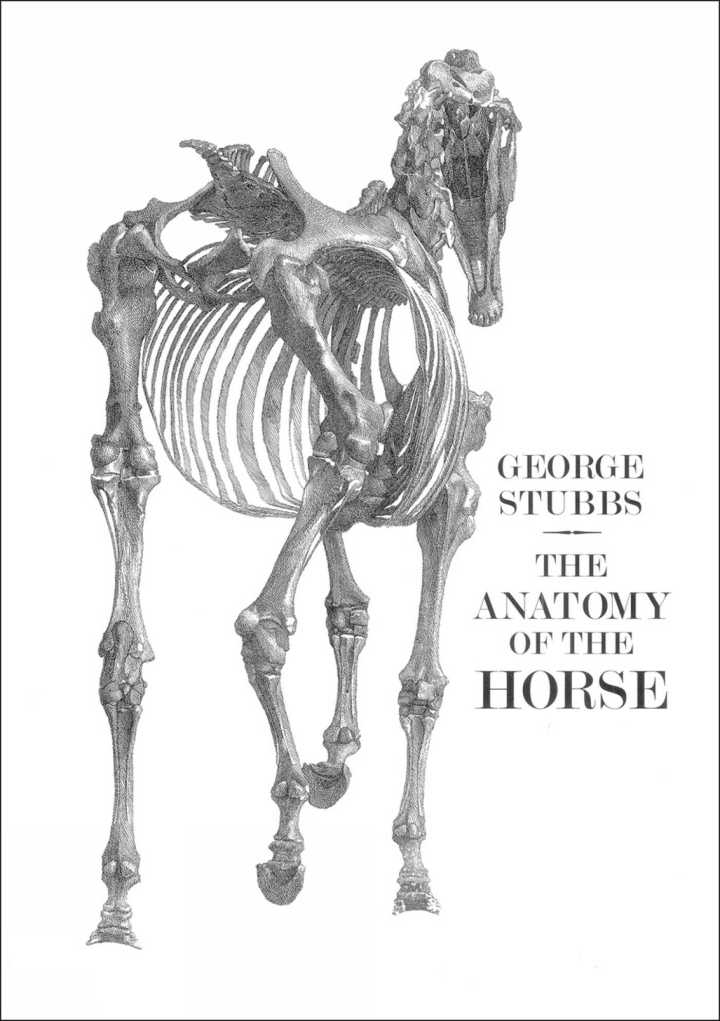 George Stubbs (1724–1806) was one of the most original artists Britain has produced, and it is easy to forget how much his success was based on rigorous scientific observation. In 1756 he rented a farmhouse where he erected scaffolding to hold the cadavers of horses as he dissected and drew. After eighteen months, Stubbs produced the drawings for The Anatomy of the Horse, which he later etched. The result was sensational. Scientists from all over Europe sent their congratulations, amazed at the perfection of the work. The Anatomy remained a textbook for artists and scientists for over a century, and its strange, spare beauty continues to fascinate. This edition is taken from the 1853 printing, the last to use Stubbs’s original plates. The artist’s full commentary is included for the veterinarially minded. Essays by Constance-Anne Parker and Oliver Kase place Stubbs’s work in the context of his life and times, and of 18th-century medical science.
Constance-Anne Parker (1921–2016), a distinguished sculptor and painter, was the Librarian and Archivist of the Royal Academy, where she also lectured. She was the author of Mr. Stubbs, the Horse Painter (1971) and George Stubbs: Art, Animals, and Anatomy (1984).
Oliver Kase is Director of Collections at the Pinakothek der Moderne in Munich where he oversees the Max Beckmann Archive. In 2011–12 he was assistant curator for The Art of Enlightenment, a major international exhibition organized between Germany and China. He lectures at the Ludwig-Maximilians-Universität München and is the author of numerous publications on the art of the 18th to 21st centuries.
New Book | Animal Modernities
From Leuven University Press, with distribution by Cornell UP:
Daniel Harkett and Katie Hornstein, eds., Animal Modernities: Images, Objects, Histories (Leuven: Leuven University Press, 2025), 320 pages, ISBN: 978-9462704589, €60 / $69.
 Animal Modernities challenges the traditional human-centered focus of art history and explores how modern art, visual culture, and modernity itself emerge from relationships between humans and animals. The essays in this volume reveal histories of exploitation and domination, as well as confusion and ambivalence, and occasional moments when affinities between humans and animals have been embraced, and animal agency asserted and acknowledged. The authors collectively point to the importance of thinking about animal–human relations for addressing today’s ecological challenges.
This book will be made open access within three years of publication thanks to Path to Open, a program developed in partnership between JSTOR, the American Council of Learned Societies (ACLS), University of Michigan Press, and The University of North Carolina Press to bring about equitable access and impact for the entire scholarly community, including authors, researchers, libraries, and university presses around the world. Learn more here.
Daniel Harkett is associate professor in the Department of Art at Colby College.
Katie Hornstein is professor in the Department of Art History at Dartmouth College.
c o n t e n t s
List of Illustrations
Acknowledgments
Introduction — Daniel Harkett and Katie Hornstein
1 Rethinking the Animal in Art History: Charles Darwin, Karl Woermann, and the Bowerbird — Nina Amstutz
2 Photography Needs Animals: Materials, Processes, and the Colonial Supply Chains of Gelatine Dry Plates — Rosalind Hayes
3 Shooting Elephants and the Performance of Imperial Power — Niharika Dinkar
4 A Tale of Two Serpents — Laura Nüffer
5 Mourning across Species: Ivory Miniatures and Elephant Death — Katherine Fein
6 War Horses, Commemoration, and Mutilation: Copenhagen (1808–1836) and Marengo (ca. 1793–1831) — Katie Hornstein
7 To Fool a Fish: Exploring Interspecies Aesthetics in Nineteenth-Century Fly-Fishing — Emily Gephart
8 Feline Creativity on the Eve of Modernity — Amy Freund and Michael Yonan
9 The Bird that Cuts the Airy Way: William Blake’s Avian Modernity — Alysia Garrison
10 Bovine Ubiquity — Maura Coughlin
11 Against the Visual: Seals, Indigenous-Settler Relations, and the Material Culture of Sealing since 1697 — Catherine Girard
12 Mr. Crowley’s Signature: Race, Resistance, and the Queerness of American Animal Portraiture — Annie Ronan
13 Memory and Materiality: Commemorating Canine Companions in Eighteenth-Century Britain — Sean Weiss
14 Herd Mentality: Animal Relationality and QueerKinships in the Life and Work of Anton Braith — Stephanie Triplett
Selected Bibliography
Contributors
Index
New Book | Pictures of Cotton in Eighteenth-Century China
From Routledge:
Roslyn Lee Hammers, Pictures of Cotton in Eighteenth-Century China (New York: Routledge, 2025), 170 pages, ISBN: 978-1032888019, $160. Also available as an ebook.
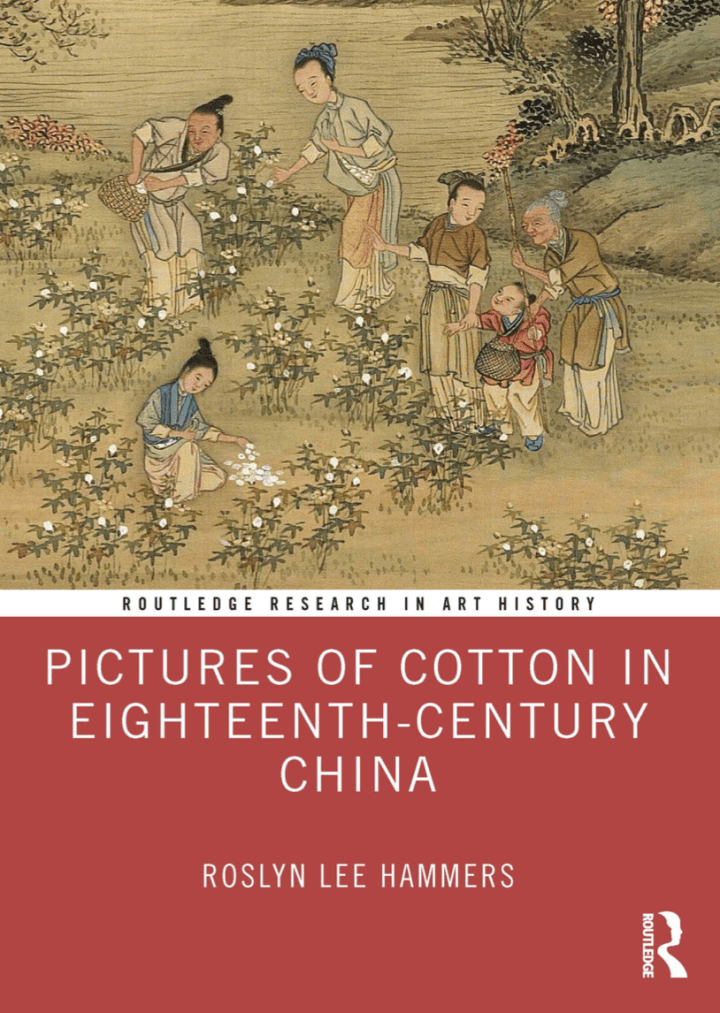 Pictures of Cotton in Eighteenth-Century China narrates cotton’s journey from a little understand material to a cherished commodity ennobled by associations with the classical heritage of China. In the 12th century, cotton, an imported crop, was plucked from the fields and entered the margins of agricultural treatises. The material was eventually ‘acknowledged’ as cotton, an object distinct from silk, worthy of representation. By the late 16th century, representations of the plant and of the labor used to process it were incorporated into agricultural publications. During the 18th century, cotton imagery and discussions were situated in imperial encyclopaedias, further consolidating its classical legacy. Governor-general Fang Guancheng (1696/8–1768) deemed cotton a worthy subject for ambitious painting. In 1765, he designed the Pictures of Cotton, a series of sixteen paintings complete with commentary that delineated the processes of growing cotton and manufacturing fabric. He presented the Pictures of Cotton to the Qianlong emperor (r. 1735–1796) who inscribed his imperial verse on each scene. Knowledge about the fiber became a means to collaborate at the highest level of the court and bureaucracy. Fang replicated the series, complete with imperial verses into carved stone to enable replication. The Jiaqing emperor (r.1796–1821) likewise published the series as woodblock prints. Upon domestication, cotton advanced political legitimacy, becoming a commodity that attained canonical status. Cotton was represented in a scopic regime formulated by the Qing imperium, and in the process, the Imperially Inscribed Pictures of Cotton became the authoritative vision of cotton.
Roslyn Lee Hammers is Associate Professor at the University of Hong Kong.
c o n t e n t s
List of Figures
Acknowledgements
Introduction: Coming to Terms with Cotton in Chinese Visual Culture and Literature
1 Bringing Cotton into the Fold of Ming-dynasty Visual Culture
2 The Qing Imperium and the Classified Production of Knowledge
3 Presenting the Pictures of Cotton
4 Recasting the Qing Reign: Imagining Cotton in a Scopic Regime
Coda to the Imperially Inscribed Pictures of Cotton: Speculations on Visualizing Cotton
Appendix: Texts and Poems of the Yu Ti Mian Hua Tu (Imperially Inscribed Pictures of Cotton) and of the Qin Ding Shou Yi Guang Xun (Imperially Approved Magisterial Guidance on the Bestowing of Clothes)
Selected Bibliography
Index
Exhibition | Satirical Prints in Georgian London and Dublin
The exhibition recently closed in Dublin with the catalogue available from Churchill House Press and Centro Di:
Artists and Pirates: Satirical Prints in Georgian London and Dublin
Irish Architectural Archive, Dublin, 13 November 2025 — 8 January 2026
The Driehaus Museum, Chicago, 15 May — 13 September 2026
Curated by Silvia Beltrametti and William Laffan
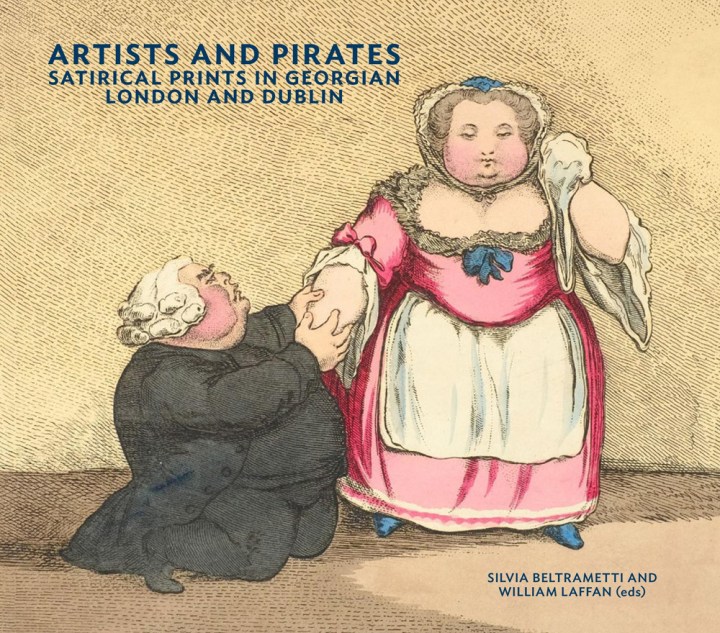 Single-sheet satire emerged in the louche milieu where politics and high society of late Georgian London intersected. Artists such as James Gillray (1756–1815) and Thomas Rowlandson (1757–1827) combined devastating wit with graphic brilliance to lampoon the great and the good, the vain and the vacuous, creating timeless images inspired by moments of fleeting controversy or scandal. Availing of a legal loophole under which copyright law protecting images did not apply to Ireland, a business of pirating caricatures by London satirists also flourished in Regency Dublin. The work of these Dublin plagiarists—which though derivative is paradoxically inventive and vibrant—as well as prints of Irish subject matter by English caricaturists such as Gillray, is the subject of this exhibition and the accompanying publication. Caricature dealt with the great political issues of the day, including religious toleration and contested concepts of liberty, but was also a vehicle to explore less elevated and often risqué (sometimes scatological or pornographic) subject matter. Single-sheet satire, Georgian England’s greatest artistic innovation, and its smaller but still dynamic offshoot in early nineteenth-century Dublin offer a fascinating—and very funny—chronicle of the human comedy.
Silvia Beltrametti and William Laffan, eds., Artists and Pirates: Satirical Prints in Georgian London and Dublin (Fenit, County Kerry: Churchill House Press with Centro Di, 2025), 184 pages, ISBN: 978-8870385939, €30. With additional contributions by James Kelly (Professor of History at Dublin City University), David Fleming (Professor of History at the University of Limerick), and Ben Casey (PhD candidate, University of Maynooth).
◊ ◊ ◊ ◊ ◊
Note (added 15 February 2026) — The original posting omitted the Chicago venue, though a note suggested the possibility, with reference to the Centro Di website. At The Driehaus Museum, the show will be titled Ink and Outrage: 18th-Century Satirical Prints in London and Dublin.
New Book | Let the Oppressed Go Free
From Penn Press:
Nicholas Wood, Let the Oppressed Go Free: Abolitionism in Colonial and Revolutionary America (Philadelphia: University of Pennsylvania Press, 2025), 384 pages, ISBN: 978-1512828320, $45.
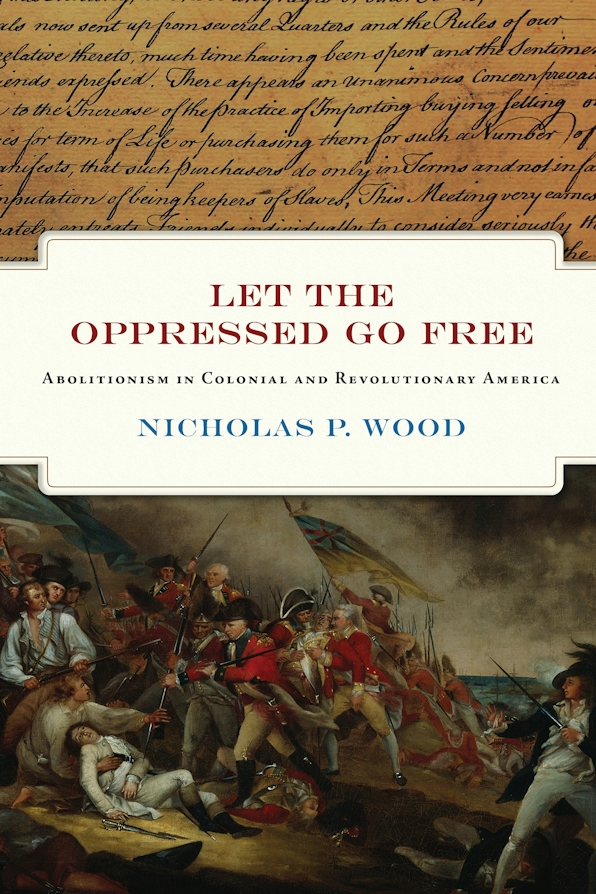 Tenacious activism by Quakers, African Americans, and antislavery evangelicals made antislavery central to the American Revolution.
In Let the Oppressed Go Free, Nicholas P. Wood presents the opponents of slavery who sustained and expanded the antislavery movement during the American Revolution in the face of widespread hostility. These early abolitionists were inspired by antislavery theology: the view that slavery was a sinful form of oppression that would provoke God’s wrath against slaveholding societies. These principles were first advanced by a handful of Quakers and Puritans as early as the 1600s, but they did not become widespread until the second half of the eighteenth century. Quakers embraced antislavery theology during the French and Indian War, which they interpreted as divine chastisement for the sin of colonial slavery. Citing the prophet Isaiah, they pledged to please the Lord by letting the oppressed go free.
Antislavery theology became even more prominent during the American Revolution. When Parliament provoked an imperial crisis in the 1760s, abolitionists argued it was further evidence of God’s anger over slavery. The outbreak of war in 1775 made these arguments increasingly persuasive. Let the Oppressed Go Free demonstrates that antislavery activism during the Revolution by Quakers, African Americans, and evangelical patriots was more sophisticated and influential than historians have recognized. The northern states that began abolishing slavery during the Revolution did so in response to tenacious agitation and generally described their actions as designed to earn God’s blessing.
Let the Oppressed Go Free challenges many common assumptions about abolitionism and the American Revolution. Wood demonstrates that religion remained central to abolitionism rather than being displaced by ‘secular’ arguments about natural rights. And whereas some have argued that the Revolutionary War hindered antislavery progress and fueled racism, Wood shows that the war accelerated reform.
Nicholas P. Wood is Associate Professor of History at Spring Hill College.
New Book | The Centrality of Slavery
From Penn Press:
John Craig Hammond, The Centrality of Slavery: Empire and Enslavement in Colonial Illinois and Missouri (Philadelphia: University of Pennsylvania Press, 2025), 288 pages, ISBN: 978-1512828429, $45. Early American Studies Series.
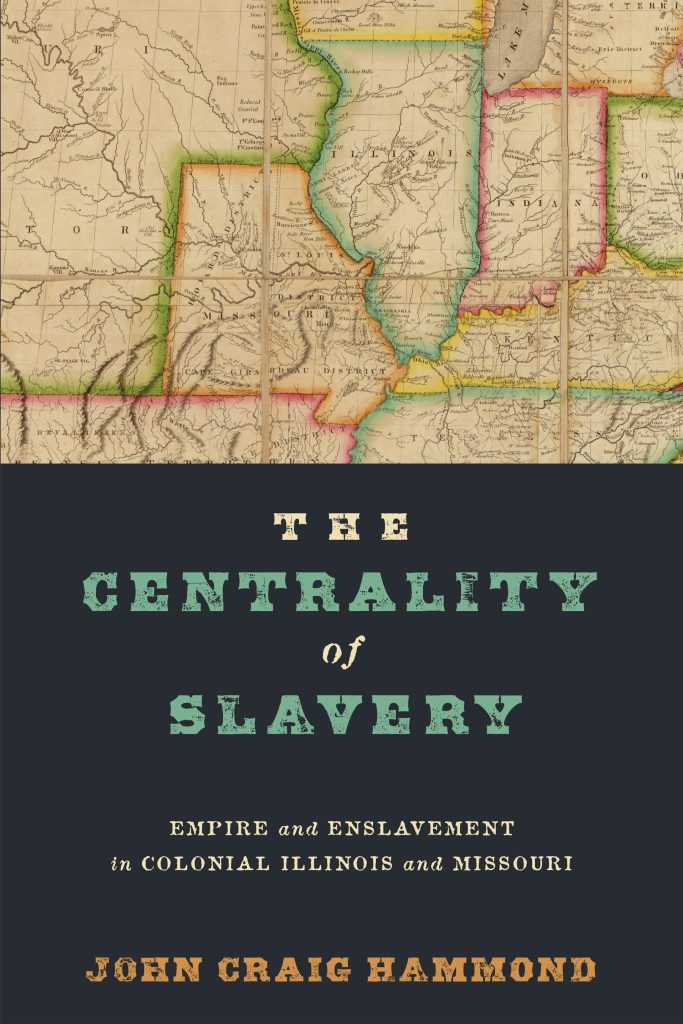 How French and American colonizers created systems of enslavement in the Middle Mississippi Valley.
The Centrality of Slavery examines how French and American colonizers used the powers of various imperial regimes to create slave societies in present-day Missouri and Illinois from the 1720s through the 1820s. The first book-length study of slavery and empire in both Illinois and Missouri, it begins with the origins of Native American and African American enslavement in the region. It then traces how successive French, Spanish, British, and American regimes shaped the development of slavery over the course of a century, examines the significance of the Northwest Ordinance’s ban on slavery in Illinois, and then analyzes the diverging histories of slavery in Illinois and Missouri in the early 1800s. The book concludes with an analysis of the Missouri Crisis and the compromise of 1820, along with the Middle Mississippi Valley’s significance in the road towards disunion and civil war in the late 1850s. More broadly, The Centrality of Slavery argues that the Middle Mississippi Valley sat astride the crossroads of imperial North America. The practices of empire and enslavement forged and fought over there exerted an outsized influence on the history of slavery in North America and the United States. Rather than treating the region’s eighteenth-century past as a prologue to the rise of the United States, John Craig Hammond analyzes the colonial history of the region on its own terms, through the European colonizers, American settlers, and enslaved people of Indigenous and African descent who shaped the development of slavery in the Middle Mississippi Valley.
John Craig Hammond is Associate Professor of History at Penn State University, New Kensington.
New Book | The Household War
From Penn Press:
John Blanton, The Household War: Property, Personhood, and the Domestication of Anglo-American Slavery, 1547–1729 (Philadelphia: University of Pennsylvania Press, 2025), 400 pages, ISBN: 978-1512828306, $55.
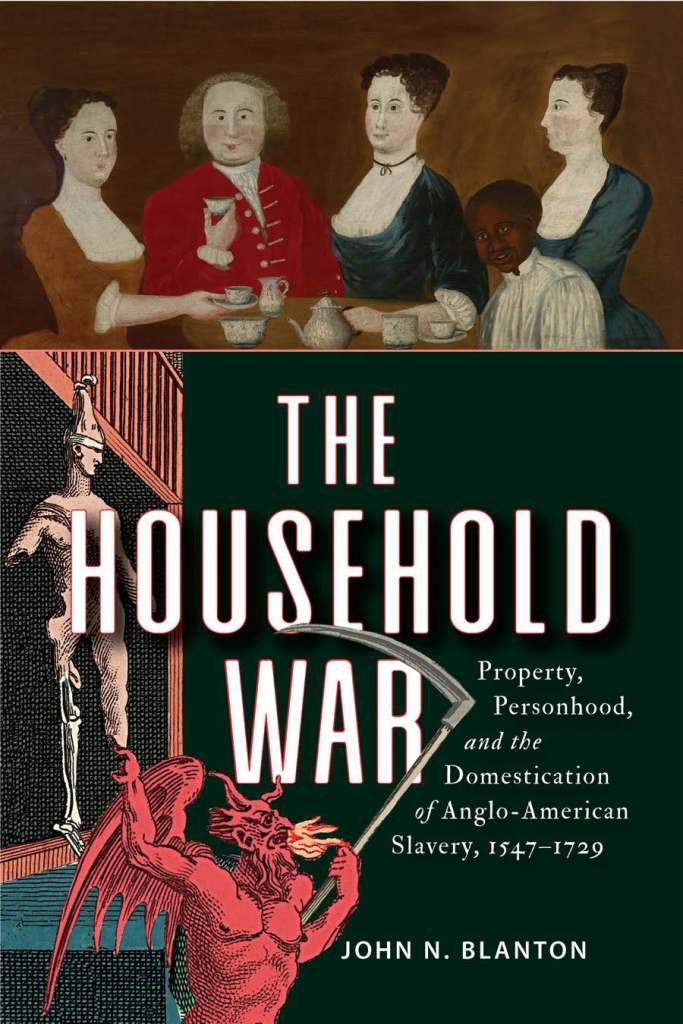 A bold reinterpretation of perennial debates over the origins and development of slavery in colonial English North America.
The Household War offers a bold reinterpretation of perennial debates over the origins and development of slavery in colonial English North America. John N. Blanton argues that the law and practice of slavery in the empire’s earliest American colonies were shaped by a tension between two competing definitions of the institution. One strand of thought, war-slavery ideology, claimed that the power of life and death transformed war captives into chattel slaves. The power to kill defined both war and slavery. But bringing war captives into enslavers’ private households was a dangerous proposition, and so a parallel ‘domestication’ ideology emerged calling for limitations on the power of enslavers and the recognition of the enslaved as persons held to labor in a variant of English servitude.
The Household War examines how the tensions between war-slavery and domestication ideologies, along with crucial political, economic, and cultural differences, shaped the development of slavery in Virginia and Massachusetts from their founding through 1729, creating distinct systems of bondage in England’s flagship mainland colonies. In Massachusetts, where a diversified and dynamic commercial economy afforded opportunities for mobility and access to material resources, the dominance of domestication ideology enabled enslaved people to negotiate their bondage, attain free status, and build free Black households and communities. Virginia, however, committed itself to war-slavery early in its development, with enslaved people defined as articles of property subject to enslavers’ power of life and death while the extreme inequality of plantation society made free Black household formation nearly impossible. Long before American independence highlighted their differences, then, Massachusetts and Virginia were already on distinct trajectories, laying the foundation for a future house divided on the question of slavery.
John N. Blanton is Assistant Professor of History at City College of New York.
New Book | Death, Disease. and Mystical Experience in Early Modern Art
From Routledge:
Michael Hill and Jennifer Milam, eds., Death, Disease. and Mystical Experience in Early Modern Art (New York: Roultedge, 2025), 452 pages, ISBN: 978-9463729185 (hardback), $180 / ISBN: 978-1003693741 (ebook), $57.
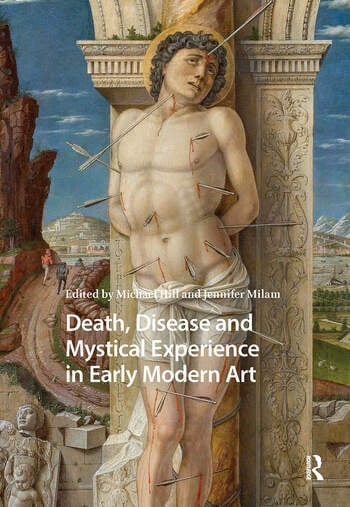 Fear of death and disease preoccupied the European consciousness throughout the early modern era, becoming most acute at times of plague and epidemics. In these times of heightened anxieties, images of saints and protectors served to reassure the faithful of their religious protection against infection. Modes of visual engagement and devotional subject matter were coupled in new ways to reinforce the emotive impact of art works and to reaffirm the perceived reality of the afterlife. In this context, a visual language of mystical devotion, which overcame the limits of the body and even eroticised its suffering, could serve the needs of the desolate and the pained. In this series of essays focused on spiritual sensibilities in Renaissance art and its legacies, authors present original ideas about the themes of death, disease, and mystical experience, based primarily on the study of objects and their documented historical contexts. Methodologically wide-ranging in approach, the resulting volume provides novel insights into the interplay between suffering and art making in the Western world.
Michael Hill is Head of Art History and Theory at the National Art School in Sydney. His research focuses on the art and architecture of the Italian Baroque, Australian sculpture, and art historiography. Michael has also written with Peter Kohane a number of articles of the idea of decorum in architectural theory. Jennifer Milam is Professor of Art History and Deputy Vice Chancellor (Academic) at the University of Newcastle in Waikato. Her research focuses on art, architecture, and garden design during the eighteenth century. Her publications include A Cultural History of Plants in the Age of Enlightenment (Bloomsbury, 2022), Making Ideas Visible in the Eighteenth Century (University of Delaware Press, 2022), Beyond Chinoiserie: Artistic Exchanges Between China and the West during the Late Qing Dynasty (Brill, 2018), Historical Dictionary of Rococo Art (Scarecrow Press, 2011), Fragonard’s Playful Paintings. Visual Games in Rococo Art (University of Manchester Press, 2007), and Women, Art and The Politics of Identity in Eighteenth-Century Europe (Ashgate Press, 2003).
c o n t e n t s
Introduction: Manipulating the Sacred — Jennifer Milam and Michael Hill
1 Mary as Model for Trecento Mourning — Judith Steinhoff
2 Pacem meam do vobis: Earthly Suffering and Celestial Redemption in the Trecento Fresco Program by Vitale da Bologna at Pomposa Abbey — Catherine Blake
3 Dying to be Born Again: Death in the Florentine Sacre Rappresentazioni — Nerida Newbigin
4 The Visual Transformations of St Anthony the Abbot: From Protector of the Sick to Victor over Sexual Desire — Charles Zika
5 Giovanni Cariani’s Woman Reclining in a Landscape: The Erotic Subverted — Carolyn Smyth
6 Touching Visions: Female Mystics Interacting with the Christ Child and with Mary — Patricia Simons
7 Queering Mysticism and the Lactating Virgin: The Madonna delle Grazie with Souls in Purgatory and its Audience of Nuns — Christina Neilson
8 Securing Heavenly Protection in Apocalyptic Times: A Series of Fresco Votives in the Oratory of San Giovanni Battista in Urbino — Di Haskell
9 The Long Goodbye: Resurrecting Rome’s Apostolic Past in The Final Embrace of Saints Peter and Paul — Barbara Wisch
10 The Beautiful Death of the Count of Orgaz: Andrés Núñez, El Greco, and the Making of a Counter Reformation Saint — Karen McCluskey
11 A Vessel to be Filled: Caravaggio’s Conversion of St. Paul in Santa Maria del Popolo — Michael Hill
12 Lo Strascino’s Lamento and the Visual Culture of the French Pox around 1500 — John Gagne
13 Whiz King: Urination as Divination in Prints for Louis XIV — Mark de Vitis
14 David’s Saint Roch: Plague Painting in the Age of Enlightenment — Jennifer Milam
15 Blake’s Petworth House Last Judgment and Female Anatomy — Anthony Apesos
16 Cocteau’s London Elegy: Re-purposed Renaissance Imagery in a Twentieth-Century Crucifixion — Stephen Holford
Index
Exhibition | The Count of Artois, Prince and Patron

Château de Maisons, in Maisons-Laffitte, a northwest outer suburb of Paris, about 12 miles from the city center
(Photo: © EPV / Thomas Garnier)
◊ ◊ ◊ ◊ ◊
From the Château de Versailles:
The Count of Artois, Prince and Patron: The Youth of the Last King of France
Château de Maisons, Maisons-Laffitte, 14 November 2025 — 2 March 2026
The result of a partnership between the Centre des Monuments Nationaux and the Palace of Versailles, this exhibition traces the life of the Count of Artois (1757–1836), brother of Louis XVI and the future Charles X, through his residences, his artistic projects, and his passions. From the splendor of the Château de Maisons to the count’s exile in 1789, it reveals the journey of a refined prince at the heart of the 18th century.
The exhibition begins with a presentation of the Château de Maisons in the 18th century and then traces the life of the Prince of Artois from his birth to his exile. The prince’s personality, his life, his patronage, and his taste are explored through a great variety of objects: graphic arts, paintings, objets d’art, sculptures, furniture, curiosities, and books. The exhibition also highlights the prince’s interest in architecture, as he was the last owner of the Château de Maisons under the Ancien Régime. Sourced primarily from the collections of the Palace of Versailles, the exhibition benefits from additional prestigious loans from the National Archives, the National Library of France, the Louvre Museum, the Mobilier National, the Château de Fontainebleau, the Carnavalet Museum, the Musée de l’Armée – Invalides, the municipal library of Versailles, and the Fine Arts Museums of Amiens and Reims, as well as from private collections.
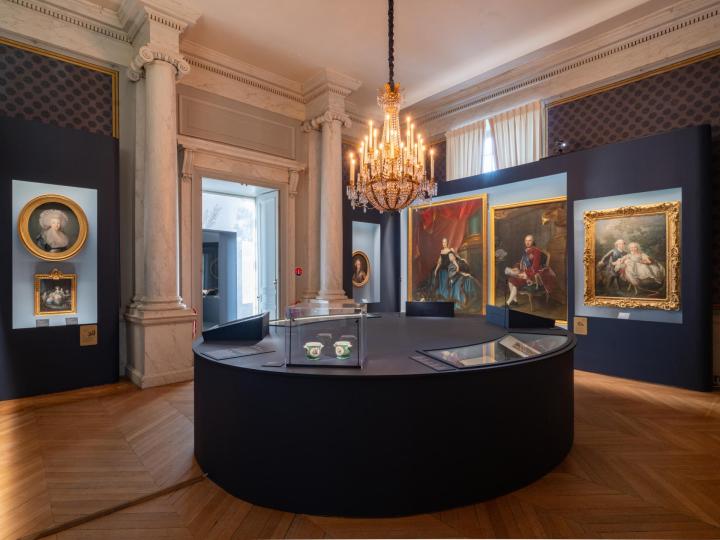
The exhibition as installed at the Château de Maisons
(Photo: © EPV / Thomas Garnier)
◊ ◊ ◊ ◊ ◊
The Count of Artois, Future Charles X
Reputed for his frivolous spirit and taste for luxury, the Count of Artois was both an attractive and controversial figure, eccentric yet conservative. Charles-Philippe of France, known under the title Count of Artois, was born in Versailles on 9 October 1757. He was the grandson of Louis XV and the brother of Louis XVI and the future Louis XVIII. He became King of France upon the death of the latter in 1824, under the name Charles X, and soon emerged as the representative of the most uncompromising Catholic faction. He was consecrated at Reims the following year. The July Ordinances of 1830, which restricted freedom of the press and dissolved the Chamber, triggered an uprising that became known as the Three Glorious Days. Faced with the revolt, Charles X abdicated and left France. His exile led him first to Scotland, then to Prague, and finally to Istria (a peninsula shared by Slovenia, Croatia, and Italy), where he died on 6 November 1836.
A Taste for Innovation
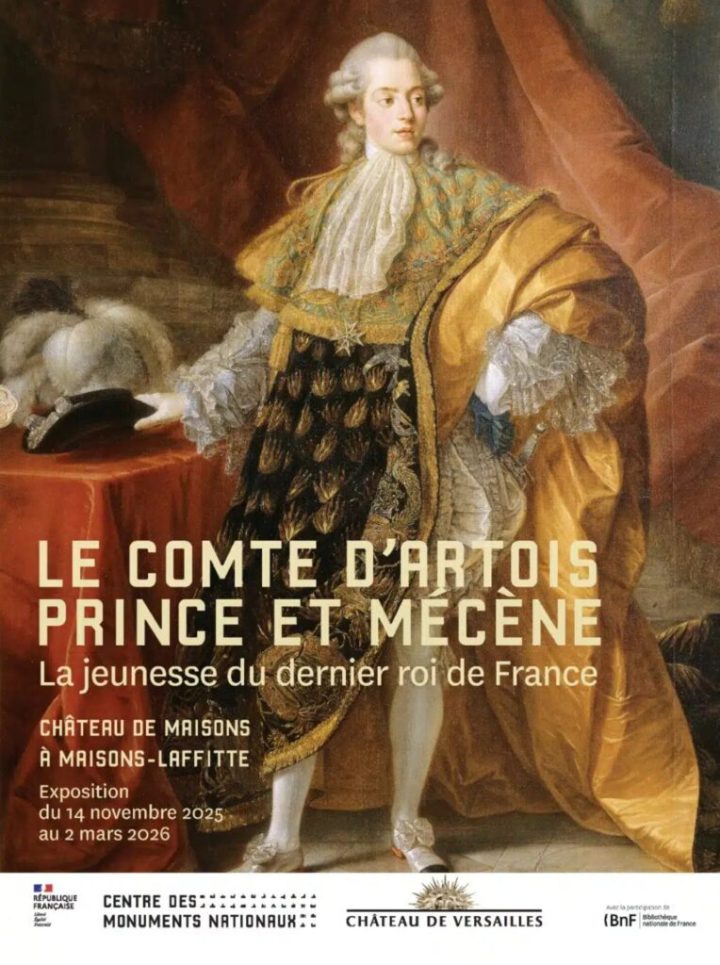 From an early age, the Count of Artois distinguished himself through his marked interest in splendor and refinement, coupled with an unrestrained passion for the modern currents of art and fashion. He was very close to Marie-Antoinette at the beginning of her reign, and they shared this common enthusiasm. However, unlike the queen, constrained by the demands of court etiquette, the Count of Artois enjoyed far greater freedom to adopt and promote the latest trends.
The château de Maisons, a masterpiece by François Mansart, was built from 1633 onward for René de Longueil, a magistrate of the Parliament of Paris. Designed as a pleasure residence, it became, as early as the 17th century, a place admired by the court. King Louis XIV himself visited it several times. In the following century, the estate entered a new era of splendor when, in 1777, the Count of Artois acquired it. He commissioned the architect François-Joseph Bélanger to transform the château with ambitious embellishment projects, refined interior decoration, and modern gardens. The count intended to make it both a setting for entertainment and a symbol of aristocratic refinement. But the upheavals of 1789 brought the work to a halt, and the prince’s property was confiscated.
After the Revolution, the château passed through various hands, from Marshal Lannes under the Empire to the banker Jacques Laffitte, who subdivided the park. The château was saved from ruin at the beginning of the 20th century thanks to its listing as a historic monument and its acquisition by the State. Today, restored and open to the public, the Château de Maisons remains a jewel of the Grand Siècle and still bears the mark of the Count of Artois’s lavish ambitions, whose tenure constitutes one of the most brilliant episodes in its history.
A Dialogue between Collections
The partnership established in 2013 between the Centre des Monuments Nationaux and the Palace of Versailles creates a dialogue between collections that are too often overlooked and major landmarks of France’s national heritage. Temporary exhibitions allow both institutions to pool their resources in order to offer as many people as possible the opportunity to discover, or rediscover, chapters of French history within the prestigious setting of national monuments. The CMN and the Palace of Versailles have concluded a deposit agreement that will allow the return and presentation, in situ, of works that were once at Maisons during the time of the Count of Artois, seized during the Revolution, and later kept at Versailles.
Curators
• Laurent Salomé, director of the National Museum of the Palaces of Versailles and Trianon
• Vincent Bastien, scientific collaborator at the Palace of Versailles
• Benoît Delcourte, chief curator at the Palace of Versailles
• Raphaël Masson, chief curator at the Palace of Versailles
• Clotilde Roy, responsible for enriching the collections of the Centre des Monuments Nationaux
• Gabriel Wick, doctor of history
Vincent Bastien, Benoît Delcourte, and Clotilde Roy, eds., Le Comte d’Artois, Prince et Mécène: La Jeunesse du Dernier Roi de France (Paris: Éditions du patrimoine, 2025), 96 pages, ISBN: 978-2757710821, €16.










 Enfilade
leave a comment