Exhibition | Olympus on the Lake: Canova, Thorvaldsen, Hayez
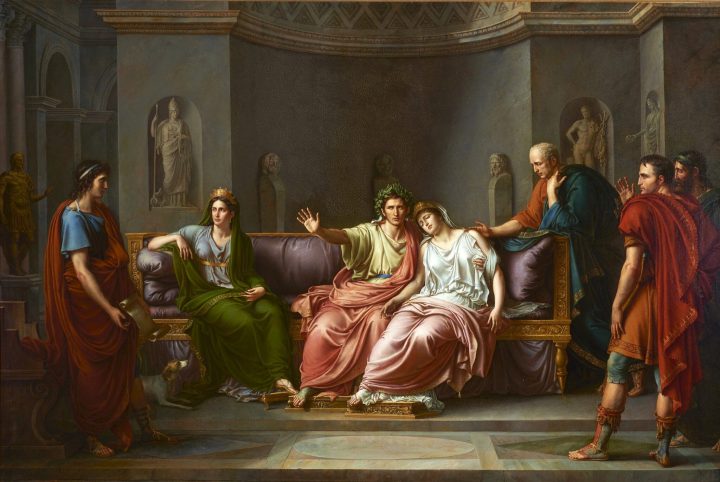
Jean-Baptiste Joseph Wicar, Virgil Reading the Sixth Canto of the Aeneid, 1818–21, oil on canvas
(Tremezzo: Museo di Villa Carlotta)
◊ ◊ ◊ ◊ ◊
Now on view at Villa Carlotta (with an English description available here) . . .
Olympus on the Lake: Canova, Thorvaldsen, Hayez, and the Treasures of the Sommariva Collection
Villa Carlotta, Tremezzo (on Lake Como), 22 June – 30 September 2024
Abile politico e potente braccio destro di Napoleone a Milano, Giovanni Battista Sommariva (1762–1826) è stato uno dei maggiori e più celebri collezionisti tra l’Impero e la Restaurazione. Approfittando di quei tempi di rapidi e radicali cambiamenti, nel 1802—quando si interruppe la sua breve ma fulminante carriera—era ormai riuscito a costruirsi una immensa fortuna.
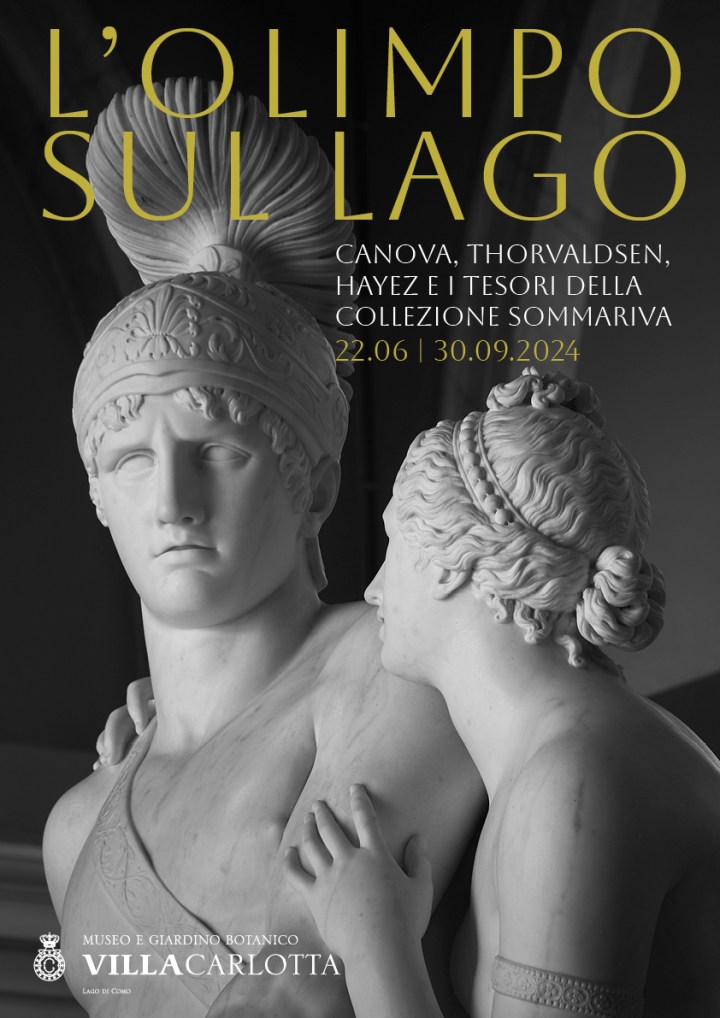 La sua leggendaria raccolta era una delle più importanti dell’epoca, insieme a quelle dei familiari di Napoleone, in particolare dell’imperatrice Josephine. Divisa tra il suo palazzo a Parigi, in uno dei quartieri più alla moda della città, e la villa di Tremezzo sul Lago di Como (oggi Villa Carlotta), vantava dipinti antichi e capolavori dei maggiori artisti dell’epoca—David, Prud’hon, Girodet, Wicar, Appiani, Bossi, Hayez—oltre a una infinità di preziosi oggetti d’arte. Soprattutto per la presenza a Villa Sommariva delle opere di Canova e degli splendidi marmi di Thorvaldsen, accorrevano viaggiatori da tutto il mondo, tra cui personaggi illustri come Stendhal, Lady Morgan, Flaubert. Attraverso una selezione delle opere più famose di quella straordinaria collezione—sculture, dipinti, stampe, gioielli e miniature—Villa Carlotta celebra un magnifico protagonista della propria storia e un grande mecenate di statura europea.
Per tutta la durata della mostra L’Olimpo sul lago, è possibile visitare presso il Museo del Paesaggio del Lago di Como (Tremezzina) l’esposizione Paesaggio sublime: Il Lago di Como all’epoca di Giovanni Battista Sommariva (1801–1826) che esporrà incisioni, tempere e acquerelli della prima a metà del XIX secolo con il proposito di evocare l’aspetto del lago e dei suoi borghi al tempo di Giovanni Battista Sommariva.
Fernando Mazzocca, Maria Angela Previtera, and Elena Lissoni, eds., L’Olimpo sul lago: Canova, Thorvaldsen, Hayez e i tesori della Collezione Sommariva (Milan: Silvana Editoriale, 2024), 352 pages, ISBN 978-8836658336, €35.
Exhibition | Belle da Costa Greene: A Librarian’s Legacy
Opening in October at The Morgan:
Belle da Costa Greene: A Librarian’s Legacy
The Morgan Library & Museum, New York, 25 October 2024 — 4 May 2025
Organized by Philip Palmer and Erica Ciallela
 The incredible story of the first director of the Morgan Library: a visionary Black woman who walked confidently in an early 20th-century man’s world of wealth and privilege
To mark the 2024 centenary of its life as a public institution, the Morgan Library & Museum will present a major exhibition devoted to the life and career of its inaugural director, Belle da Costa Greene (1879–1950). Widely recognized as an authority on illuminated manuscripts and deeply respected as a cultural heritage executive, Greene was one of the most prominent librarians in American history.
She was the daughter of Genevieve Ida Fleet Greener (1849–1941) and Richard T. Greener (1844–1922), the first Black graduate of Harvard College, and was at birth known by a different name: Belle Marion Greener. After her parents separated in the 1890s, her mother changed the family surname to Greene, Belle and her brother adopted variations of the middle name da Costa, and the family began to pass as White in a racist and segregated America.
Greene is well known for the instrumental role she played in building the exceptional collection of rare books and manuscripts formed by American financier J. Pierpont Morgan, who hired her as his personal librarian in 1905. After Morgan’s death in 1913, Greene continued as the librarian of his son and heir, J.P. Morgan Jr., who would transform his father’s Library into a public institution in 1924. But her career as director of what was then known as the Pierpont Morgan Library―a leadership role she held for twenty-four years―is less well understood, as are aspects of her education, private collecting, and dense social and professional networks.
The exhibition will trace Greene’s storied life, from her roots in a predominantly Black community in Washington, D.C., to her distinguished career at the helm of one of the world’s great research libraries. Through extraordinary objects―from medieval manuscripts and rare printed books to archival records and portraits―the exhibition will demonstrate the confidence and savvy Greene brought to her roles as librarian, scholar, curator, and cultural executive, and honor her enduring legacy.
This exhibition is organized by Philip Palmer, Robert H. Taylor Curator and Department Head of Literary and Historical Manuscripts, and Erica Ciallela, Exhibition Project Curator.
Erica Ciallela and Philip Palmer, eds., Belle da Costa Greene: A Librarian’s Legacy (New York: DelMonico Books, 2024), 304 pages, ISBN: 978-1636811352, $50. With a foreword by Colin Bailey, an afterword by Tamar Evangelestia-Dougherty, and contributions by Araceli Bremauntz-Enriquez, Julia Charles-Linen, Erica Ciallela, Rhonda Evans, Anne-Marie Eze, Daria Rose Foner, Jiemi Gao, Juliana Amorim Goskes, Gail Levin, Philip Palmer, Deborah Parker, and Deborah Willis.
New Book | J. Pierpont Morgan’s Library
From Scala:
Colin Bailey, Barry Bergdoll, Andrew Dolkart, Daria Rose Foner, Christine Nelson, and Brian Regan, J. Pierpont Morgan’s Library: Building the Bookman’s Paradise (London: Scala Arts Publishers, 2023), 256 pages, ISBN: 978-1785513992, £35 / $50.
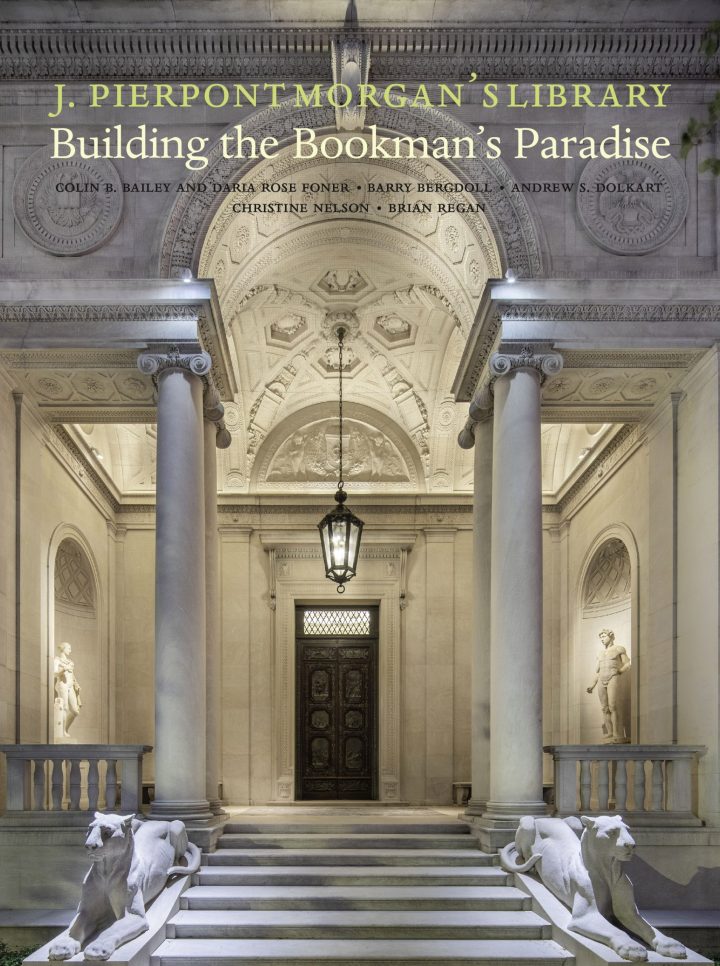 This beautifully illustrated book celebrates the first-ever restoration of the exterior of J. Pierpont Morgan’s Library—the historic heart of the Morgan Library & Museum.
Morgan’s Library has stood as a significant cultural landmark ever since it was commissioned by J. Pierpont Morgan for personal use at the start of the twentieth century. Its transition to a public institution in the twenties has lent to an even greater flood of admiration and patronage, by both local and international audiences. The elegant design by Charles Follen McKim stands as one of the finest examples of neoclassical architecture in the United States, significant for its distinctive Italian Renaissance style and its opulent interior period rooms. The site has been designated both a National Historic Landmark and a New York City landmark, and it is listed on the National Register of Historic Places. The book, following on the heels of the completed restoration, will punctuate this latest milestone in the building’s storied history.
Colin B. Bailey, Director of the Morgan Library & Museum, is a specialist in eighteenth-century French art.
Barry Bergdoll is the Meyer Schapiro Professor of Art History at Columbia University and the former chief curator in the Department of Architecture and Design at the Museum of Modern Art, New York.
Andrew Dolkart is a professor of historic preservation at the Columbia University Graduate School of Architecture, Planning and Preservation.
Daria Rose Foner is the former Research Associate to the Director of the Morgan Library & Museum and is now with the Old Masters Department at Sotheby’s, New York.
Christine Nelson is the former Drue Heinz Curator of Literary and Historical Manuscripts, The Morgan Library & Museum, now Fellowships Manager, the Library Company of Philadelphia.
Brian Regan is the architectural advisor to the Morgan Library & Museum.
New Book | Morgan―The Collector
From Arnoldsche Art Publishers:
Vanessa Sigalas and Jennifer Tonkovich, eds., Morgan―The Collector: Essays in Honor of Linda Roth’s 40th Anniversary at the Wadsworth Atheneum Museum of Art (Stuttgart: Arnoldsche Verlagsanstalt, 2023), 288 pages, ISBN: 978-3897906792, $65.
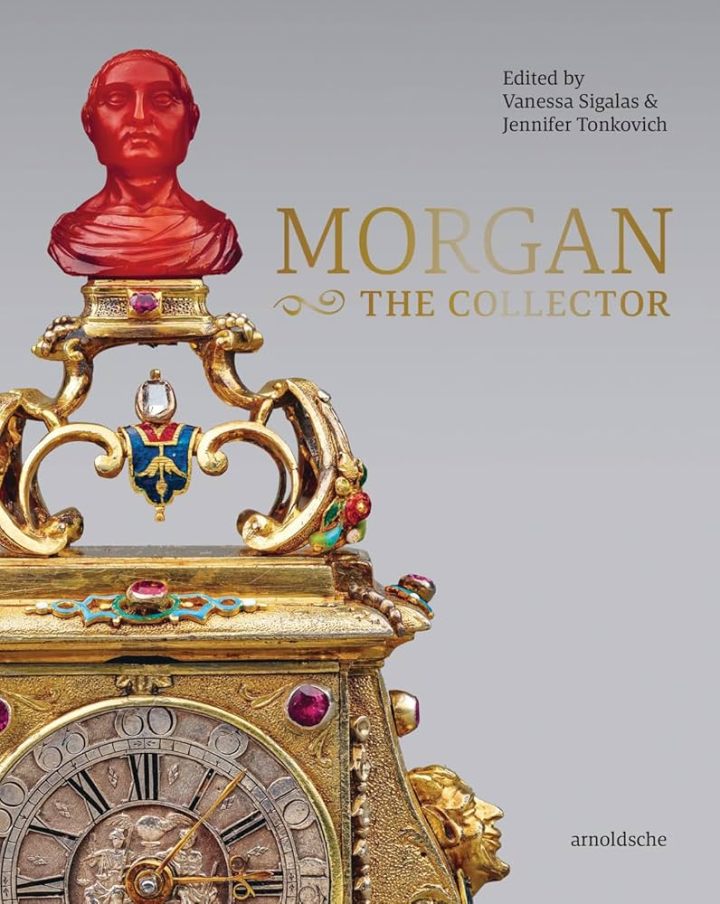 The essays in this lavishly illustrated volume offer a multi-faceted portrait of American financier J. Pierpont Morgan (1837–1913) as a collector of art.
A riveting exploration of Morgan’s acquisitions from antiquities to medieval manuscripts, to Old Master paintings, and European decorative arts, Morgan―The Collector introduces the reader to how and why he amassed his vast collection. The book also serve as a tribute to Linda Roth, curator at Wadsworth Atheneum Museum of Art, Hartford, Connecticut, who dedicated much of her forty-year career to researching Morgan and the over 1,500 works from his collection now in the museum. This volume is directed at both a scholarly audience and general readers interested in the history of collecting, European art, and America during the Gilded Age.
New Book | The Radical Print
Distributed by Yale University Press:
Esther Chadwick, The Radical Print: Art and Politics in Late Eighteenth-Century Britain (London: Paul Mellon Centre for Studies in British Art, 2024), 248 pages, 9781913107437, $60.
 The Radical Print argues for printmaking in Britain as the most exciting, innovative, and critically engaged field of artistic production in the late eighteenth century. Moving the print from the margins to the centre of the study of art history, this new critical study demonstrates how print responded to the acceleration of historical events, the polarisation of public discourse, and the sense of a world turned upside down in ways that traditional artistic media could not. Across five chapters, this book brings printmakers James Barry, John Hamilton Mortimer, James Gillray, Thomas Bewick, and William Blake together as artists of the ‘Paper Age’ for the first time. From Barry’s experiments in aquatint at the time of the American Revolution to Blake’s visionary engravings of the post-Napoleonic period, Esther Chadwick shows how the print medium provided artists with special purchase on the major political issues of their age. The Radical Print assembles a rich array of material, from the period’s best-known prints to unpublished ephemera, revealing print’s dynamic role in one of the most turbulent periods of British history.
Esther Chadwick is Lecturer in Art History at the Courtauld Institute of Art.
New Book | Comfortable Everyday Life at Näs Manor
From Amsterdam UP:
Carolina Brown, Comfortable Everyday Life at the Swedish Eighteenth-Century Näs Manor (Amsterdam: Amsterdam University Press, 2024), 320 pagers, ISBN: 978-9048562374, €136.
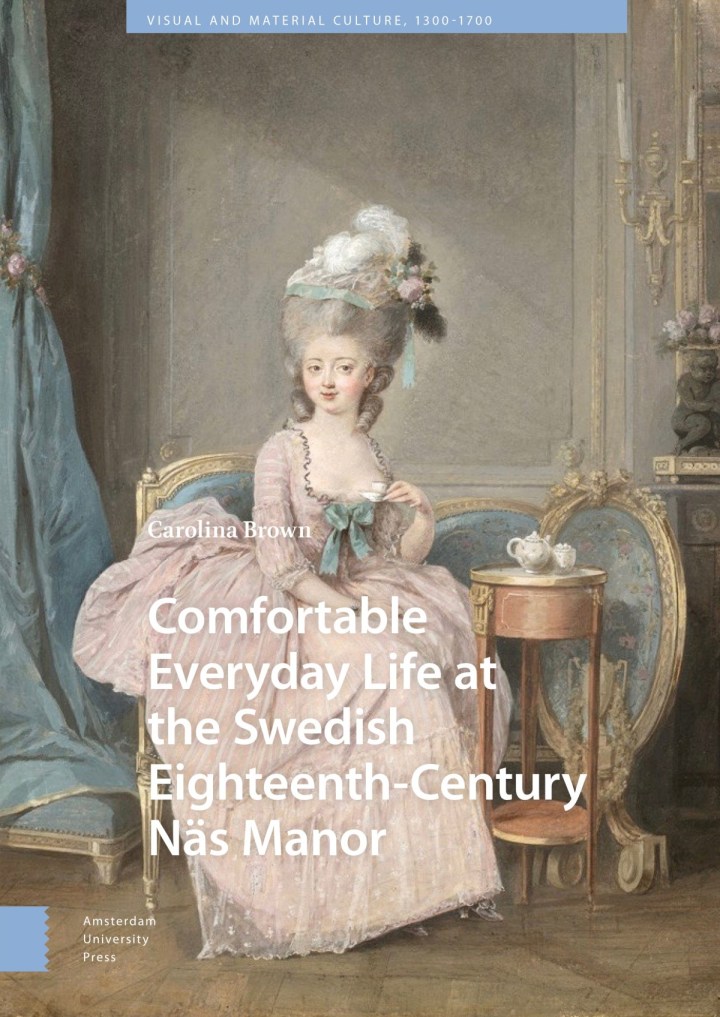 During the eighteenth century, comfortable everyday life becomes a new ideal. The good life was no longer about grand representation or the manifestation of material opulence. The new luxury was instead the comfortably arranged life at home. This book is about the traces of this change, its approach and consequences, and its anchoring in the material and social life of the Swedish manor. The comfort revolution of the eighteenth century was clearly associated with both new types of furniture and new ways of furnishing. An important aspect of the development of comfort was the new mobility and flexibility in form and function that the home and its interior now showed. Through the home of the Wadenstierna family on the country estate of Näs, north of Stockholm, the comfortable everyday life is set by their various tables—at writing desks, sewing tables, dressing tables, coffee tables, and games tables.
Carolina Brown is associate professor and senior lecturer in art history at Uppsala University. For over three decades in her teaching and research, she has addressed the arts and culture of the early modern period—focusing on portraiture, interior design, and fashion.
c o n t e n t s
Introduction
1 Carl Eric Wadenstierna and Nas Manor
2 At the Sewing Table
3 At the Writing Table
4 At the Dressing Table
5 At the Games Tables
6 At the Coffee Table
Concluding Words
Bibliography and Sources
Index
The Magazine of the Decorative Arts Trust, Summer 2024
The Decorative Arts Trust has shared select articles from the summer issue of their member magazine as online articles for all to enjoy. The following articles are related to the 18th century:
The Magazine of the Decorative Arts Trust, Summer 2024
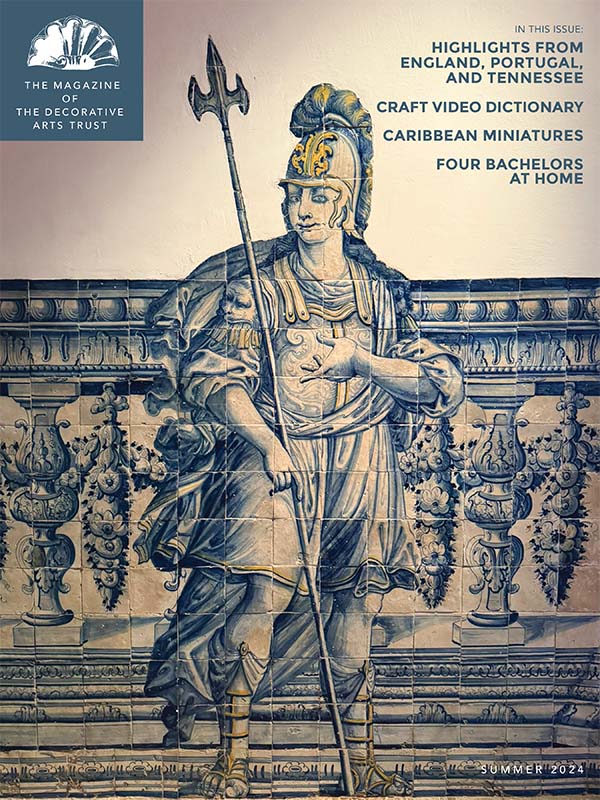 • “A Primer on Portugal” by Matthew A. Thurlow Link»
• “Saltram’s Saloon: Adam, Chippendale, and Reynolds in England’s West Country” by Catherine Carlisle Link»
• “Understanding Craft: A New Digital Tool Debuts” by Emily Zaiden Link»
• “Art and Imagination in Spanish America, 1500–1800: Highlights from LACMA’s Collection” by the Saint Louis Art Museum Link»
• “Painted Walls: New Virtual Museum Offers an Immersive Experience” by by Margaret Gaertner and Kathleen Criscitiello Link»
• “Seafaring Portraits in Bermuda and the Atlantic Basin” by Damiët Schneeweisz Link»
• “Summer Reading Recommendation: Ceramic Art” by Jessie Dean Link»
The printed Magazine of the Decorative Arts Trust is mailed to Trust members twice per year. Memberships start at $50, with $25 memberships for students.
Pictured: The magazine cover features a detail of wall tile from the stair hall of the Palácio Azurara in Lisbon, home of the Fundação Ricardo do Espírito Santo Silva’s decorative arts museum. Bartholomeu Antunes, Tile with the Figure of a Praetorian Guard, 1730–40, Lisbon. Earthenware tile with blue and yellow decoration.
The Burlington Magazine, June 2024
Summer is for falling behind . . . and for catching up . . . The long 18th century in the June issue of The Burlington:
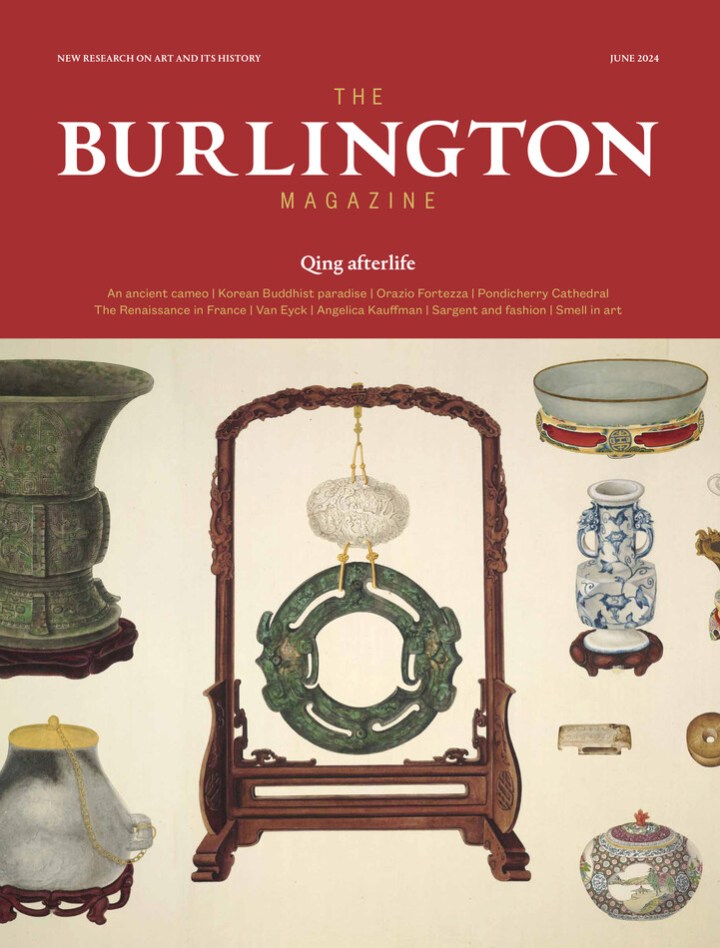
The Burlington Magazine 166 (June 2024)
e d i t o r i a l
 • “La Serenissima,” p, 543.
Henry James famously wrote in his Italian Hours (1909) that there is nothing more to be said about Venice. As so much ink has been spilt over its charms you can see his point. However, James then proceeded to rhapsodise at length about its beauty; and it is imperative that we, similarly, keep talking and writing and championing it, not least because all that it represents seems to be more precious and precarious than ever.
a r t i c l e s
• Ittai Gradel, “Nothing To Do with Menander: A Rediscovered Roman Cameo from the Caylus Collection,” pp. 546–53.
A Roman cameo published in 1752, but since lost, has been rediscovered. It shows actors rehearsing The Pimp by Posidippus, who portrait is included on the cameo. All other identifiable scenes of comedies in Roman art depict plays by Menander, the most popular Greek comic poet on the Roman stage.
• Gauvin Alexander Bailey, “The Cathedral of Notre-Dame-de-la-Conception, Pondicherry,” pp. 580–95.
When the cathedral at Pondicherry, the most ambitious in French India, was begun in 1771, its anonymous designer was obliged to make allowance for separation of the castes, despite a papal edict that they must attend public worship together. The cathedral was completed with the construction of its west facade in 1788–91; its design was based on seventeenth-century Parisian models and is here attributed to the engineer-architect François-Anne-Maire Rapine de Saxy.
• Ricarda Brosch, “The Art of Qing Imperial Afterlife: The Pictures of Ancient Playthings (Guwantu 古玩圖) Revisited,” pp. 596–611.
Two magnificent eighteenth-century handscrolls depict myriad precious objects made of jade, bronze, porcelain, glass, and bamboo. A novel interpretation of their function suggests that the illustrations were originally for wall decorations and remounted as scrolls for the Yongzheng Emperor’s tomb. The paintings’ remediation and repurposing offer a compelling example of the art of Qing imperial afterlife.
r e v i e w s

• Johnny Yarker, Review of the exhibition Angelica Kauffman (London: Royal Academy of Arts, 2024), pp. 620–23.
• William Barcham, Review of Martin Gayford, Venice: City of Pictures (Thames & Hudson, 2023), p. 653.
• Lianming Wang, Review of Henriette Lavaulx-Vrécourt and Niklas Leverenz, Berliner Schlachtenkupfer: 34 Druckplatten der Kaiser von China / Berlin Battle Engravings: 34 Copperplates for the Emperors of China (Deutscher Kunstverlag, 2021), pp. 654–55.
• Amina Wright, Review of Frédéric Ogée, Thomas Lawrence: Le génie du portrait anglais (Cohen & Cohen, 2022), pp. 655–56.
• Barry Bergdoll, Review of Didem Ekici, Patricia Blessing, Basile Baudez, eds., Textile in Architecture: From the Middle Ages to Modernism (Routledge, 2023), pp. 662–63.
Exhibition | Living with Sculpture: Presence and Power
From the press release for the exhibition:
Living with Sculpture: Presence and Power in Europe, 1400–1750
Hood Museum of Art, Dartmouth, Hanover, New Hampshire, 23 March 2024 — 22 March 2025
Curated by Elizabeth Rice Mattison and Ashley Offill

The Hood Museum of Art presents Living with Sculpture: Presence and Power in Europe, 1400–1750, on view from 23 March 2024 until 22 March 2025. Drawing on the wealth of the Hood Museum’s permanent collection, the exhibition contributes to the field’s understanding of the role of sculpture in everyday life, historically and today. Whether given as tokens of affection, cast to memorialize important events, designed to promote faith, or used to write a letter, these sculptures engaged their spectators in dialogues of devotion, authority, and intimacy.
Living with Sculpture is curated by two scholars at the Hood Museum of Art: Elizabeth Rice Mattison, Andrew W. Mellon Curator of Academic Programming and Curator of European Art, and Ashley B. Offill, Curator of Collections. It includes 164 objects in two galleries and is accompanied by a major publication of the same title.
Sculpture enlivened private and public spaces in medieval and Renaissance Europe, contributing to presentations of identity, practices of devotion, and promotions of nationhood. Featuring objects made across the continent, this exhibition examines the significance of sculpture between 1400 and 1750, an era of profound cultural and social change. Amid war, colonization, religious conflict, academic upheaval, and social stratification, these works of art ornamented homes, altars, libraries, and collections.
The role of sculpture as a commemorative and connective tool is newly evident in today’s debates about monuments and cultural patrimony. Sculpture manipulates notions of history, forges bonds between distant places, and promotes future actions, as this exhibition shows. Bringing this often-cerebral area of study down to earth, exhibition curators Elizabeth Rice Mattison and Ashley Offill note, “In examining a group of historic objects, this exhibition highlights the way that the material things with which we surround ourselves are critical to developing our personal identities and our relationships with one another. As curators, we lived with these objects during this project, gaining insight into the works and the people who owned them. The choice of a laurel wreath or a cross on a medal was, in many ways, just as informative back then as a social media bio is today.”
Recent examinations of sculpture suggest its singular presence and power for its makers, patrons, and audiences. The dynamism of sculpture became particularly evident in the 15th and 16th centuries with the explosion of interest in purchasing mass-produced objects such as plaquettes and small-scale bronzes. Technological innovations in making sculpture allowed artists to expand their markets and create new types of artwork.
Organized thematically, this exhibition focuses on small-scale sculptures for everyday spaces. With these works, artists could enhance their status and promote their creativity. Meanwhile, useful sculptures like locks and inkwells communicated their owners’ identities and prestige. In collecting sculptures, patrons activated their social connections. Sculpture also facilitated access to the divine, through objects that focused prayer and encouraged tactile connection with God. Similarly, sculptures forged a sense of history, recording contemporary events and promoting ideas about the past. Together, the sculptures presented here attest to how objects in bronze, wood, or stone gave meaning to people’s lives in early modern Europe.
This exhibition and its corresponding catalogue are organized by the Hood Museum of Art, Dartmouth, and generously supported by the Leon C. 1927, Charles L. 1955, and Andrew J. 1984 Greenebaum Fund, and by grants from the Gladys Krieble Delmas Foundation and the Samuel H. Kress Foundation.
The catalogue is distributed by Penn State UP:
Elizabeth Rice Mattison and Ashley Offill, Living with Sculpture: Presence and Power in Europe, 1400–1750 (Hanover: Hood Museum of Art, Dartmouth, 2024), 340 pages, ISBN: 978-0944722558, $50.
The accompanying publication includes five thematic essays, extended catalogue entries for 99 objects, and an illustrated checklist of 114 additional objects from the important collection of early modern sculpture at the Hood Museum of Art, Dartmouth. The book is published by the Hood Museum of Art, distributed by The Pennsylvania State University Press, and produced by Marquand Books, Seattle.
◊ ◊ ◊ ◊ ◊
Exhibition Colloquium | Living with Sculpture
Hood Museum of Art, Dartmouth, 7 September 2024
In connection with the exhibition, this colloquium brings together scholars and curators from around the Northeast to discuss how audiences, patrons, and makers engaged with sculpture in the Middle Ages and early modern period. Ranging from twelfth-century Spain to seventeenth-century Rome, the discussion topics will offer an in-depth examination of making and living with sculpture. The day will include a tour of the exhibition led by its curators, Elizabeth Rice Mattison and Ashley Offill. Check-in opens at 9.30am, and the program will begin at 10.00. The colloquium itself is free, by registration at Eventbrite. A limited number of hotel rooms are available at the Hanover Inn under the block ‘Living with Sculpture’. Please reserve before August 7.
p r e s e n t a t i o n s
• Elizabeth Lastra (Vassar College), Threads of Power and Identity: Exploring Textile Motifs in Sculpture at the Romanesque Monastery of San Zoilo
• Kelley Helmstutler Di Dio (University of Vermont), Seeing Two Sides of the Same Coin: Leone Leoni’s Circle and their Medals in the Hood Museum
• Lara Yeager-Crasselt (Baltimore Museum of Art), François Duquesnoy’s Funerary Monument to the Painter Jacob de Hase: Untangling Flemish Expatriate Networks in Rome
• Laura Tillery (Hamilton College), The Armed Image of Olav Lorenzo Buonanno, University of Massachusetts, Boston, Living with Imaginary Sculptures
• Miya Tokumitsu (Davison Art Center, Wesleyan), Gothic to Grotesque: Sculptural Ornament in the Prints of Lucas van Leyden
• Nicola Camerlenghi (Dartmouth College), Living Sculptures in the Renaissance Streets of Rome
Exhibition | Looking Allowed?
Now on view at Ambras Castle in Austria:
Looking Allowed? Diversity from the 16th to the 18th Century
Schloss Ambras, Innsbruck, 20 June — 6 October 2024

Johann Gottfried Haid after Johann Nepomuk Steiner, Portrait of Angelo Soliman (Mmadi Make), ca. 1750. Born in West Africa, Soliman was enslaved and shipped to Europe before eventually advancing in Austrian society as a successful Freemason and member of court.
Diversity has always existed. In the Renaissance—as humans increasingly took centre stage—it was not only the ideal that was of interest, but also humans’ inexhaustible diversity. The exhibition Looking Allowed? Human Diversity from the 16th to the 18th Century considers diversity in the past from today’s perspective, taking as its point of reference the Ambras collections of Archduke Ferdinand II. Here the whole world was illustrated, as was common in chambers of art and wonders.
Why did the Portrait of a Disabled Man find its way into the Ambras Chamber of Art and Wonders? Who is behind the ‘hair family’? And why do portraits of ‘court giants’ and ‘court dwarves’ move us? Such paintings run the risk of being dismissed as mere curiosities. This exhibition, by contrast, tells the stories of these people who did not fit period norms, taking as its theme the questions of whether, and if so, how encounters with them took place. It invites visitors to reflect on their own perceptions, confronting us with the question: ‘is it permissible to look?’
Current viewpoints are brought into the exhibition through audio and video contributions. Adapted font sizes and objects placed on different levels are aimed at reducing barriers and making it possible for a variety of visitors to experience the exhibition. Furthermore, the installation of a lift in the upper castle offers easy access for the first time to the special exhibition rooms located on the second floor.
Thomas Kuster, Christian Mürner, and Veronika Sandbichler, eds., Schauen erlaubt: Vielfalt Mensch vom 16. bis 18. Jahrhundert (Cologne: Walther König, 2024), 192 pages, ISBN: 978-3753306506, €19. With contributions by Volker Schönwiese, Katharina Seidl, Susanne Hehenberger, Eva Seemann, Anne Kuhlmann-Smirnov, and Rudi Risatti.
With statements, six essays, and over 70 catalog entries, the volume engages human diversity and the tensions between self-empowerment, acceptance, and discrimination.










 Enfilade
leave a comment