New Book | Time Machines
Just published by MIT Press, with plenty of 18th-century material:
Richard Taws, Time Machines: Telegraphic Images in Nineteenth-Century France (Cambridge: MIT Press, 2025), 400 pages, ISBN: 978-0262049184, $50.
 A riveting exploration of the relationship between art and telegraphy, and its implications for understanding time and history in nineteenth-century France.
In Time Machines Richard Taws examines the relationship between art and telegraphy in the decades following the French Revolution. The optical telegraph was a novel form of visual communication developed in the 1790s that remained in use until the mid-1850s. This pre-electric telegraph, based on a semaphore code, irrevocably changed the media landscape of nineteenth-century France. Although now largely forgotten, in its day it covered vast distances and changed the way people thought about time. It also shaped, and was shaped by, a proliferating world of images. What happens, Taws asks, if we think about art telegraphically?
Placed on prominent buildings across France—for several years there was one on top of the Louvre—the telegraph’s waving limbs were a ubiquitous sight, shifting how public space was experienced and represented. The system was depicted by a wide range of artists, who were variously amused, appalled, irritated, or seduced by the telegraph’s intractable coded messages and the uncanny environmental and perceptual disruption it caused. Clouds, architecture, landscapes, and gestures: all signified differently in the era of telegraphy, and the telegraph became a powerful means to comprehend France’s technological and political past. While Paris’s famous arcades began to crisscross the city at ground level, a more enigmatic network was operating above. Shifting attention from the streets to the skies, this book shows how modern France took shape quite literally under the telegraph’s sign.
Richard Taws is Professor of History of Art and Visual Culture at University College London. He is the author of The Politics of the Provisional as well as coeditor, with Iris Moon, of Time, Media, and Visuality in Post-Revolutionary France and, with Genevieve Warwick, Art and Technology in Early Modern Europe.
New Book | Reading Typographically
From Stanford UP:
Geoffrey Turnovsky, Reading Typographically: Immersed in Print in Early Modern France (Stanford: Stanford University Press, 2024), 328 pages, ISBN: 978-1503637214, $70.
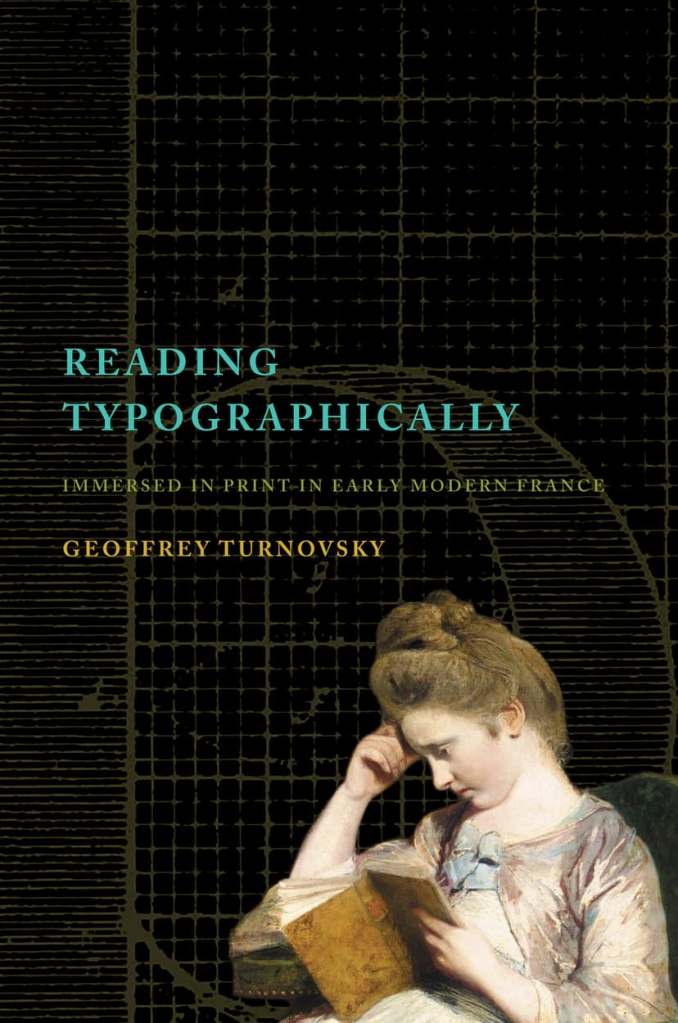 Anxieties about the fate of reading in the digital age reveal how deeply our views of the moral and intellectual benefits of reading are tied to print. These views take root in a conception of reading as an immersive activity, exemplified by the experience of ‘losing oneself in a book’. Against the backdrop of digital distraction and fragmentation, such immersion leads readers to become more focused, collected, and empathetic.
How did we come to see the printed book as especially suited to deliver this experience? Print-based reading practices have historically included a wide range of modes, not least the disjointed scanning we associate today with electronic text. In the context of religious practice, literacy’s benefits were presumed to lie in such random-access retrieval, facilitated by indexical tools like the numbering of Biblical chapters and verses. It was this didactic, hunt-and-peck reading that bound readers to communities.
Exploring key evolutions in print in 17th- and 18th-century France, from typeface, print runs, and format to punctuation and the editorial adaptation of manuscript and oral forms in print, this book argues that typographic developments upholding the transparency of the printed medium were decisive for the ascendancy of immersive reading as a dominant paradigm that shaped modern perspectives on reading and literacy.
Geoffrey Turnovsky is Associate Professor of French at the University of Washington, Seattle. He is the author of The Literary Market: Authorship and Modernity in the Old Regime (2011).
c o n t e n t s
Acknowledgments
Introduction: The Benefits of Reading
1 Typeface: Disappearing Letters from the Romain du Roi to Didot
2 Print Runs: Tender Maps in the Marketplace
3 Format: Appropriations of the Book
4 Editorial Labors: The Typography of Intimate Texts
5 Punctuation Marks: Bringing Speech to Life on the Printed Page
Conclusion: Hybridity and Text Technologies
Notes
Selected Bibliography
Index
New Book | Freedom’s Currency
From Penn Press:
Julia Wallace Bernier, Freedom’s Currency: Slavery, Capitalism, and Self-Purchase in the United States (Philadelphia: University of Pennsylvania Press, 2024), 224 pages, ISBN: 978-1512826470, $50.
 The first comprehensive study of self-purchase in the United States from the American Revolution to the Civil War
Enslaved people lived in a world in which everything had a price. Even freedom. Freedom’s Currency follows enslaved people’s efforts to buy themselves out of slavery across the United States from the American Revolution to the Civil War. In the first comprehensive study of self-purchase in the nation, Julia Wallace Bernier reveals how enslaved people raised money, fostered connections, and made use of slavery’s systems of value and exchange to wrest control of their lives from those who owned them. She chronicles the stories of famous fugitives like Frederick Douglass, who, with the help of friends and supporters, purchased his freedom to protect himself against the continued legal claims of his enslavers and the possibility of recapture. She also shows how enslaved fathers like Lunsford Lane and mothers like Elizabeth Keckley tried to secure lives for their families outside of slavery. Freedom’s Currency argues that freedom played a central role in the social and economic lives of the enslaved and in the ways that these aspects of their lives overlapped. This intimate portrait of community illuminates the complexity of enslaved people’s ideas about their place at the intersection of slavery and American capitalism and their attempts to value freedom above all. Given the stakes—liberation or remaining enslaved—it is an account of both triumph and devastating failure.
Julia Wallace Bernier is Assistant Professor of History at Washington & Jefferson College.
Exhibition | Monstrous Beauty: A Feminist Revision of Chinoiserie
Opening in March at The Met:
Monstrous Beauty: A Feminist Revision of Chinoiserie
The Metropolitan Museum of Art, New York, 25 March — 17 August 2025

Monstrous Beauty: A Feminist Revision of Chinoiserie radically reimagines the story of European porcelain through a feminist lens. When porcelain arrived in early modern Europe from China, it led to the rise of chinoiserie, a decorative style that encompassed Europe’s fantasies of the East and fixations on the exotic, along with new ideas about women, sexuality, and race. This exhibition explores how this fragile material shaped both European women’s identities and racial and cultural stereotypes around Asian women. Shattering the illusion of chinoiserie as a neutral, harmless fantasy, Monstrous Beauty adopts a critical glance at the historical style and its afterlives, recasting negative terms through a lens of female empowerment.
Bringing together nearly 200 historical and contemporary works spanning from 16th-century Europe to contemporary installations by Asian and Asian American women artists, Monstrous Beauty illuminates chinoiserie through a conceptual framework that brings the past into active dialog with the present. In demand during the 1700s as the embodiment of Europe’s fantasy of the East, porcelain accumulated strong associations with female taste over its complex history. Fragile, delicate, and sharp when broken, it became a resonant metaphor for women, who became the protagonists of new narratives around cultural exchange, consumption, and desire.
The catalogue is distributed by Yale University Press:
Iris Moon, ed., Monstrous Beauty: A Feminist Revision of Chinoiserie (New York: The Metroplitan Museum of Art, 2025), 256 pages, ISBN: 978-1588397928, $35. With additional contributions by Marlise Brown, Patty Chang, Anne Anlin Cheng, Elizabeth Cleland, Patricia Ferguson, Eleanor Hyun, Cindy Kang, Ronda Kasl, Joan Kee, Pengliang Lu, Lesley Ma, David Porter, Joseph Scheier-Dolberg, Elizabeth Kowaleski Wallace, Chi-ming Yang, and Yao-Fen You.
Exhibition | Recasting the Past: The Art of Chinese Bronzes, 1100–1900

Incense Burner in the Form of a Goose, Ming dynasty (1368–1644), early 15th century, bronze
(New York: The Metropolitan Museum of Art).
◊ ◊ ◊ ◊ ◊
From the press release (9 January) for the exhibition:
Recasting the Past: The Art of Chinese Bronzes, 1100–1900
The Metropolitan Museum of Art, New York, 28 February — 28 September 2025
Shanghai Museum, 3 November 2025 — 8 March 2026
Curated by Pengliang Lu
In ancient China, bronze vessels were emblems of ritual and power. A millennium later, in the period from 1100 to 1900, such vessels were rediscovered as embodiments of a long-lost golden age that was worthy of study and emulation. This ‘return to the past (fugu) was part of a widespread phenomenon across all the arts to reclaim the virtues of a classical tradition. An important aspect of this phenomenon was the revival of bronze casting as a major art form. Opening at The Metropolitan Museum of Art on 28 February 2025, Recasting the Past: The Art of Chinese Bronzes, 1100–1900 aims to be the most comprehensive study of Chinese bronzes during this period. This exhibition, co-organized by The Met and the Shanghai Museum, where it will open following its display in New York, will present the new aesthetic represented by these creative adaptations of the past, while exploring their cultural and political significance throughout China’s long history.
 “While bronze as an art form has long held a significant role throughout China’s history, this exhibition explores an often-overlooked time period when a resurgence of craftsmanship and artistic achievements revitalized the medium,” said Max Hollein, The Met’s Marina Kellen French Director and Chief Executive Officer. “Bringing together major loans from institutions in China alongside works from The Met collection, this exhibition offers viewers an important opportunity to better understand the lasting aesthetic and cultural impact of bronze objects.”
The exhibition will be divided into five thematic and chronological sections that explicate over 200 works of art—an array of bronze vessels complemented by a selection of paintings, ceramics, jades, and other media. Some 100 pieces from The Met collection will be augmented by nearly 100 loans from major institutions in China, Japan, Korea, Germany, France, the United Kingdom, and the United States to present the most comprehensive narrative of the ongoing importance of bronzes as an art medium throughout China’s long history. Featured in the exhibition are around 60 loans from institutions in China, including major works such as a monumental 12th-century bell with imperial procession from the Liaoning Provincial Museum, documented ritual bronzes for Confucian temples from the Shanghai Museum, and luxury archaistic vessels made in the 18th-century imperial workshop from the Palace Museum, Beijing.
The exhibition begins with the section “Reconstructing Ancient Rites,” which introduces how emperors and scholar-officials commissioned ritual bronzes from the 12th to the 16th century as part of an effort to restore and align themselves with antique ceremonies and rites. The exhibition continues with “Experimenting with Styles,” illustrating how the form, decoration, and function of ancient bronzes were creatively reinterpreted from the 13th to the 15th century. The next section, “Establishing New Standards,” will explore further transformations in both the aesthetic and technical direction of bronze making from the 15th to the 17th century. The fourth section, “Living with Bronzes,” will feature a display in the Ming Furniture Room (Gallery 218) to demonstrate how bronzes were used in literati life from the 16th to the 19th century. The last section, “Harmonizing with Antiquity,” will examine how the deep scholarly appreciation of archaic bronzes during the 18th and 19th centuries led to a final flourishing of bronze production.
Pengliang Lu, Brooke Russell Astor Curator of Chinese Art at The Met, said: “This exhibition attempts a long-overdue reevaluation of later Chinese bronzes by seeking to establish a reliable chronology of this art form across the last millennium of Chinese history. The exhibition will also distinguish outstanding works from lesser examples based on their artistic and cultural merits.”
Later Chinese bronzes have long been stigmatized as poor imitations of ancient bronzes rather than being seen as fundamentally new creations with their own aesthetic and functional character. This exhibition redresses this misunderstanding by showcasing their artistic virtuosity, innovative creativity, and wide cultural impact. Through archaeologically recovered examples and cross-medium comparisons to a wide range of objects, the exhibition demonstrates the ongoing importance and influence of bronzes as well as how they inspired the form and function of works in other media. Recasting the Past: The Art of Chinese Bronzes, 1100–1900 is curated by Pengliang Lu, Brooke Russell Astor Curator of Chinese Art at The Metropolitan Museum of Art.
The catalogue is distributed by Yale University Press:
Pengliang Lu, Recasting the Past: The Art of Chinese Bronzes, 1100–1900 (New York: The Metropolitan Museum of Art, 2025), 320 pages, ISBN: 978-1588397904, $65.
Book Launch | The Dominion of Flowers
From EventBrite:
The Dominion of Flowers: North American Book Launch
Online and in-person, University of Toronto, Thursday, 23 January 2025, 6.30pm
 Between 1760 and 1840, plants were imported into Britain via empire and depicted in periodicals and scientific treatises as specimens alongside objects of natural history. Mark Laird’s provocative new book—part art history, part polemic—weaves fine art, botanical illustration, gender studies, and rare archival material into a political and ethical account of Britain’s horticultural heritage. Drawing on Professor Laird’s genealogical research into his family’s colonial past, The Dominion of Flowers foregrounds Indigenous ideas about ‘plant relations’ in a study that animates trans-oceanic movements of plants and people.
The talk will show how, researched ‘virtually’ in pandemic Toronto, the book’s three-part structure emerged: global, pan-European, and local. His epilogue links New Zealand to Canada, past and present. Following the talk, Therese O’Malley, a historian of landscape and garden design, will facilitate a conversation about Laird’s 40-year career as scholar and practitioner. Prompted by one reviewer who claimed “Laird pioneered plant humanities avant la lettre,” the conversation will turn to botanical studies within the humanities.
Mark Laird is Professor Emeritus at the University of Toronto’s John H. Daniels Faculty of Architecture, Landscape and Design, and a former faculty member of Harvard University. He is the author of The Flowering of the Landscape Garden and A Natural History of English Gardening. The Dominion of Flowers completes his trilogy. In the UK he has been historic planting consultant to Painshill Park Trust, English Heritage, and Strawberry Hill Trust, and in Ontario he has worked on Rideau Hall, Parkwood, and Chiefswood.
Therese O’Malley, FSAH is an historian of landscape and garden design, focusing on the 18th to 20th centuries and the transatlantic exchange of plants and ideas. Former associate dean of CASVA, National Gallery of Art (1984–2021), she continues to lecture and publish internationally. Her many publications include Keywords in American Landscape Design (2010), now expanded as the website, History of Early American Landscape Design (heald.nga.gov). O’Malley has held guest professorships at Penn, Harvard, and Princeton, and serves on boards and advisory committees including those of Dumbarton Oaks, New York Botanical Garden, and the U.S. State Dept. Ambassadors Fund for Cultural Property. She was chair of the Association of Research Institutes in Art History (1994–2000) and president of the Society of Architectural Historians (2000–2006).
Mark Laird, The Dominion of Flowers: Botanical Art and Global Plant Relations (London: Paul Mellon Centre for Studies in British Art, 2024), 277 pages, ISBN: 978-1913107451, £35 / $50.
New Book | Printing Colour, 1700–1830
From Oxford UP:
Margaret Morgan Grasselli and Elizabeth Savage, eds., Printing Colour 1700–1830: Histories, Techniques, Functions, and Receptions (Oxford: Oxford University Press, 2025), 448 pages, $185. Proceedings of the British Academy
 Printing Colour 1700–1830 offers a broad-ranging examination of the rich period of invention, experimentation, and creativity surrounding colour printing in Europe between two critically important developments, four-colour separation printing around 1710, and chromolithography around 1830. Its 28 field-defining contributions by 23 leading experts expand the corpus beyond rare fine art impressions to include many millions of colour-printed images and objects. The chapters unveil the explosive growth in the production and marketing of colour prints at this pivotal moment. They address the numerous scientific and technological advances that fed the burgeoning popularity for such diverse colour-printed consumer goods as clothing, textiles, wallpapers, and ceramics. They recontextualise the rise in colour-printed paper currencies, book endpapers and typography, and ephemera, including lottery tickets and advertisements. This landmark volume launches colour printing of the long 18th century as an interdisciplinary field of study, opening new avenues for research across historical and scientific fields.
Elizabeth Savage is Senior Lecturer in Book History and Communications, School of Advanced Study, and Head of Academic Research Engagement, Senate House Library, University of London. In 2020–22, she was an Honorary Fellow at Centre for the Study of the Book, Bodleian Libraries, Oxford University. In 2022–23, she was a Fellow at Linda Hall Library. Her research into pre-industrial European printing techniques, especially for colour, has won awards including the Schulman and Bullard Article Prize. Her latest book is Early Colour Printing: German Renaissance Woodcuts at the British Museum, and she co-edited Printing Colour 1400–1700. She regularly curates and contributes to exhibitions about print heritage, for example at the British Museum and Musée du Louvre. She teaches at London Rare Books School.
Margaret Morgan Grasselli worked for forty years at the National Gallery of Art in Washington, thirty as Curator of Old Master Drawings. Having retired in 2020, she then served as Visiting Lecturer in the department of History of Art and Architecture of the Faculty of Arts and Sciences at Harvard University (2020–22) and Visiting Senior Scholar for Drawings at the Harvard Art Museums (2020–23). An expert on French drawings, she is also an authority on French color prints of the 18th century. She organised the 2003 exhibition at the National Gallery of Art, Colorful Impressions: The Printing Revolution in Eighteenth-Century France, and was the editor and primary author of the accompanying catalogue.
c o n t e n t s
Introduction — Margaret Morgan Grasselli and Elizabeth Savage
Part 1 | Materials and Techniques Printing Colour in 18th-Century Europe
• Tools, Machines, and Presswork for Printing Colour in 18th-Century Europe — Margaret Morgan Grasselli and Elizabeth Savage
• Colour Printing Inks and Colour Inking in 18th-Century Europe — Elizabeth Savage
Part 2 | Relief Techniques: Letterpress, and Colour Woodcut
• Colour Letterpress in Europe in the Long 18th Century — Ad Stijnman
• Elisha Kirkall and His Proposals for Printing in Chiaroscuro, Natural Colours, and Tints, 1720–40 — Simon Turner
• Printing Chiaroscuro and Colour Woodcuts in Paris, Venice, and London c.1725–70 — Tico Seifert
• Bringing Colour to Books and Objects with Decorated Paper in the Long 18th Century — Sid Berger, Michèle Cloonan
• Colour for Commerce: Letterpress-Printed Ephemera in Britain, 1700–1830 — Rob Banham
Part 3 | Mezzotint and Trichromatic Printing
• The Politics of Process Mezzotint: Jacob Christoff Le Blon’s Reputation, 1700–89 — Elizabeth Savage
• From Colour Theory to Colour Practice: Printmakers in Pursuit of the Ideal Pigments in 18th-Century Europe — Dionysia Christoforou, Manon van der Mullen, and Victor Gonzalez
• Colouring the Body: Printed Colour in Medical Treatises during the Long 18th Century — Julia Nurse
• Colour Printing in Late 18th-Century Italy: Édouard and Louis Dagoty, 1770–1800 — Alice Nicoliello
Part 4 | Chalk, Pastel and Watercolour Manner, and Aquatint
• Printed Paintings and Engraved Drawings: Technical Innovations in Colour Printing in 18th-Century France — Margaret Morgan Grasselli
• Coloured Prints in Imitation of Old Master Drawings in 18th-Century Italy: Anton Maria Zanetti the Elder, Benigno Bossi, Francesco Rosaspina and their Contemporaries — Benedetta Spadaccini
• François-Philippe Charpentier and the Development of Aquatint in France in the 1760s — Rena Hoisington
• A Voyage pittoresque in Norway through Colour Prints, 1789–c.1815 — Chiara Palandri
• The Market for Colour Prints in Paris at the End of the 18th Century — Corinne Le Bitouzé
• Multiple-Plate Colour Prints and the Problems of Variant Impressions, Missing Plates, and Disappearing Inks — Margaret Morgan Grasselli
Part 5 | Stipple and a la Poupée
• English Colour-Printed Stipple Engravings, 1774–1800 — David Alexander
• Between Painting and Graphic Arts: Colour Printmaking in Russia, 1750s–1800s — Zalina Tetermazova
• Anne Allen, Jean Pillement, and the Development of à la poupée Printing in France — Geert-Jan Janse
• The Contribution of à la poupée-inked Colour Printing to Natural History Illustration in France, 1800–1870 — Karen Cook
Part 6 | Consumer Goods and Expanding Markets for Colour Printing
• Anatomy to Embroidery: Intaglio Colour-Printed Illustrations in European Books and Periodicals, 1700–1850 — Ad Stijnman
• Early Dye-Patterned Colour on Calico in Europe, 1600–1840 — Susan Greene
• Printed Wallpaper in England in the Long 18th Century — Phillippa Mapes
• Colour Printing on English Ceramics, 1751–70 — Patricia Ferguson
Part 7 | Technical Experimentation and Industrialisation
• William Blake’s Colour Printing: Methods and Materials — Michael Phillips
• Innovation and Tradition in Early 19th-Century Colour Printing — Michael Twyman
• The Beginnings of Commercial Colour Printing in Europe, 1835–40 — Michael Twyman
Exhibition | Luisa Roldán: Royal Sculptor
Adam Busiakiewicz noted the exhibition at Art History News a few weeks ago:
Luisa Roldán: Escultora Real
Museo Nacional de Escultura, Valladolid, 29 November 2024 — 9 March 2025
Curated by Miguel Ángel Marcos Villán and Pablo Amador Marrero
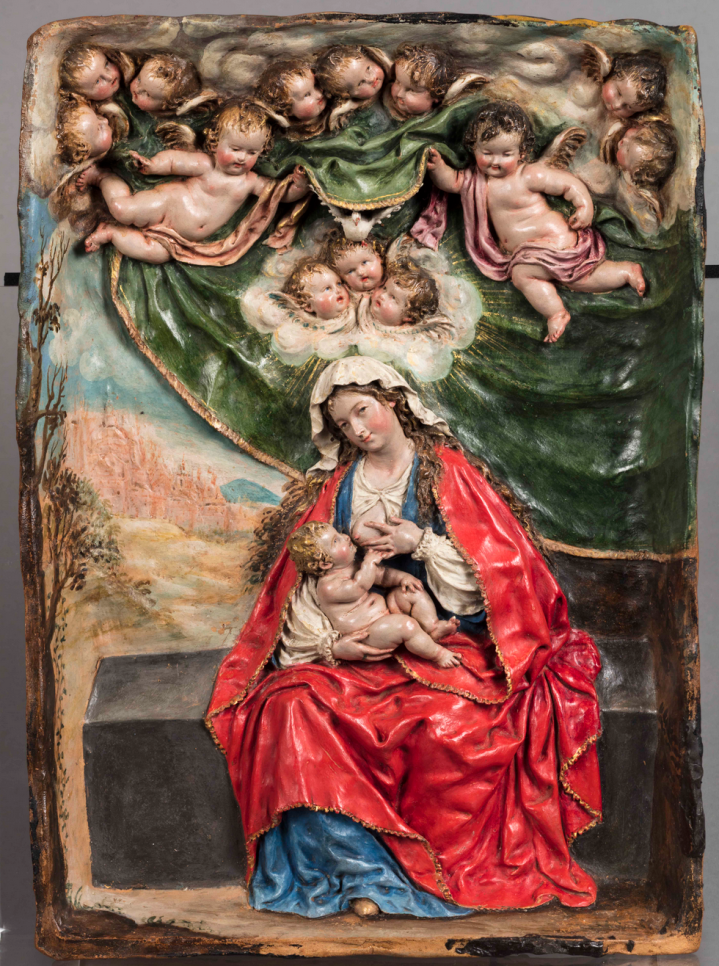
Luisa Roldán, Virgen con el Niño (Sevilla, Convento de San José).
Esta exposición permitirá al visitante adentrarse en una vida apasionante. Luisa Roldán (1652–1706) aunó excelencia, versatilidad y habilidad para romper las barreras de género y llegar a lo más alto como artista: fue nombrada escultora del rey por Carlos II, cargo que mantuvo con Felipe V. Además, fue la primera artista española en ingresar en la Academia de San Lucas en Roma, un hito nunca antes alcanzado por escultores hispanos.
Pero Luisa Roldán: Escultora real también es el producto de una reivindicación y de una necesidad de hacer presente la trayectoria de una de las más destacadas artistas españolas. De hecho, nunca cayó en el olvido y autores como Antonio Palomino (quien la conocería personalmente), Antonio Ponz o Juan Agustín Ceán Bermúdez alabaron su obra. Sin embargo, el hecho de que fuera considerada por muchos como autora de menor calidad que su padre, identificando con él buena parte de su producción, ha pesado en algunos de los estudios que se realizaron sobre su figura. Como también que se le adjudicaran sobre todo obras de devoción, delicadas y de pequeño formato en barro cocido, «más propias de su condición y sexo», según autores como el propio Ceán Bermúdez, dejando en un lugar secundario su rica y extraordinaria producción de obras en madera y de mayor formato.
La dedicación de Luisa Roldán al oficio de la escultura sólo fue posible por su nacimiento en el seno de una familia dedicada a esta disciplina. Su padre, Pedro Roldan fue el gran artista del mercado sevillano y de buena parte del andaluz durante la segunda mitad del siglo XVII. La artista, cuyas dotes para el oficio se desvelaron en época muy temprana, heredó de él la inquietud por el mejor conocimiento del arte. Tras dejar el taller paterno se estableció en Sevilla junto a su marido, Luis Antonio de los Arcos. De allí se trasladaron a Cádiz, metrópoli comercial del momento, y posteriormente el matrimonio y sus hijos fijaron su residencia en Madrid. Allí la escultora pudo entrar al servicio de la Corte, alcanzando el mayor éxito y reconocimiento al que cualquier artista de la época podía aspirar.
Miguel Ángel Marcos Villán and Pablo Amador Marrero, Luisa Roldán: Escultora Real (Valladolid: Museo Nacional de Escultura, 2024), €40.
The Burlington Magazine, December 2024
The long 18th century in the December issue of The Burlington:
The Burlington Magazine 166 (December 2024)
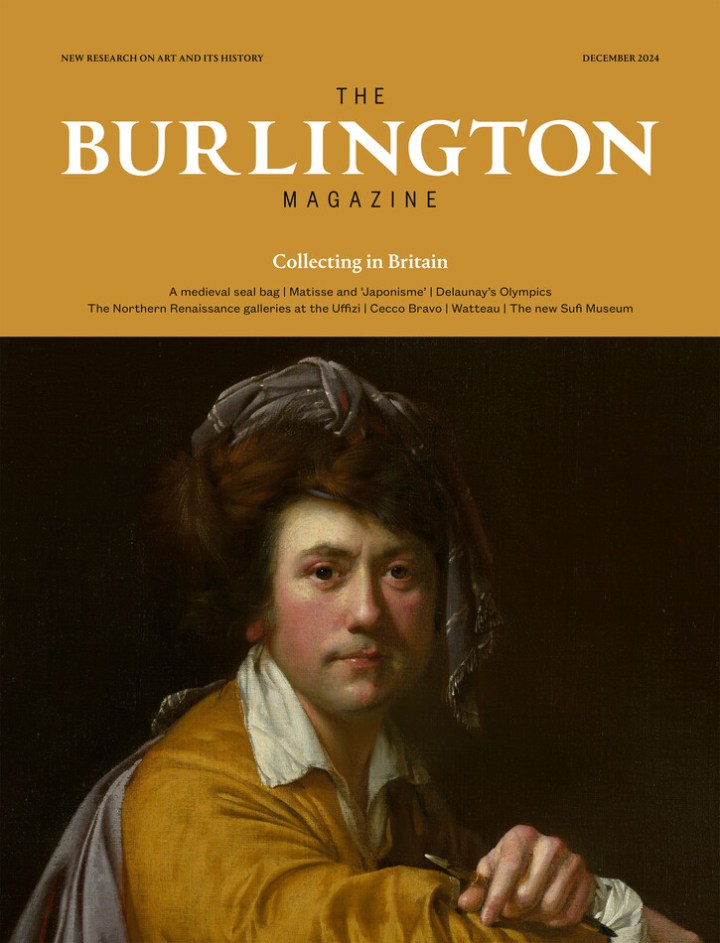 e d i t o r i a l
• “A ‘Grand Life’: Belle da Costa Greene,” pp. 1203–04.
New York’s Morgan Library & Museum was founded as a public institution in 1924 and its centenary this year has been celebrated in style. The most substantial project to form part of the anniversary is the exhibition (25th October–4th May 2025) on Belle da Costa Greene (1879–1950), the museum’s inaugural Director. This is an exercise in fascinating institutional storytelling, but at the same time also considerably more, as Greene was an extraordinary and accomplished figure.
l e t t e r
• Elizabeth Cropper, “Further Notes on boîtes à portrait’,” p. 1205.
A response to Samantha Happé’s article in the October issue of The Burlington: “Portable Diplomacy: Louis XIV’s ‘boîtes à portrait’,” pp. 1036–43.
r e v i e w s
• Richard Rand, Review of the exhibition Revoir Watteau: Un comédien sans réplique. Pierrot, dit le ‘Gilles’ (Louvre, 2024–25), pp. 1238–40.
• Gauvin Alexander Bailey, Review of the exhibition Paris through the Eyes of Saint-Aubin (The Metropolitan Museum of Art, 2024-25), pp. 1249–50.
• Denise Amy Baxter, Review of the exhibition The Legacy of Vesuvius: Bourbon Discoveries on the Bay of Naples (Meadows Musem, 2024), pp. 1251–53.
• Camilla Pietrabissa, Review of the exhibition catalogue L’arte di tradurre l’arte: John Baptist Jackson incisore nella Venezia del Settecento, ed. by Orsola Braides, Giovanni Maria Fara, and Alessia Giachery (Biblioteca Marciana, 2024), pp. 1270–72.
The British printmaker John Baptist Jackson was active in Venice from 1731 to 1745.
• Tom Stammers, Review of Oliver Wunsch, A Delicate Matter: Art, Fragility, and Consumption in Eighteenth-Century France (Pennsylvania State University Press, 2024), pp. 1285–86.
o b i t u a r y
• Simon Jervis, Obituary for Georg Himmelheber (1929–2024), pp. 1287–88.
A pioneering historian of furniture and a curator at Karlsruhe and Munich, Georg Himmelheber was also a founder member of the Furniture History Society; although his expertise encompassed many periods and styles, he was perhaps best known for his work on ‘Biedermeier’ furniture.
s u p p l e m e n t
• “Acquisitions by Public Collections across the UK (2013–23) Made Possible by the Acceptance in Lieu of Tax and Cultural Gifts Schemes,” pp. 1289ff.
Print Quarterly, December 2024
The long eighteenth century in the latest issue of Print Quarterly:
Print Quarterly 41.4 (December 2024)
a r t i c l e s
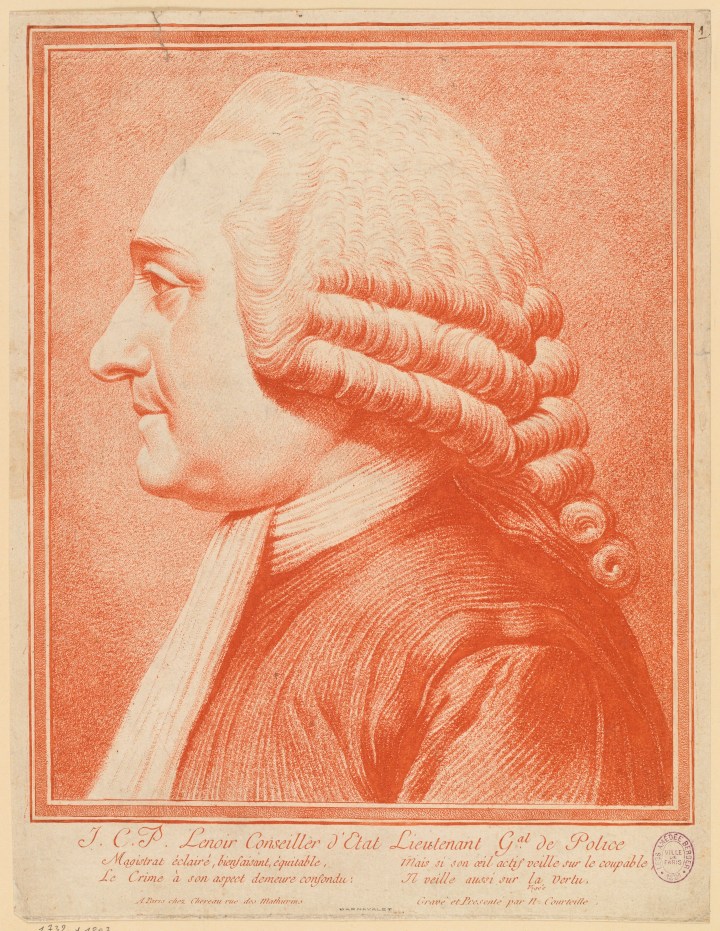
Nicholas de Courteille, presumably after Jean Pierre Bouch, Jean Charles Pierre Lenoir, 1779, soft-ground etching, 308 × 235 mm (Paris, Musée Carnavalet, Histoire de Paris).
• Dorinda Evans, “Jean Pierre Bouch, A Rediscovered Polymath”, pp. 394–407. This article attempts to compile the real identity and life story of the French artist Jean Pierre Bouch (1765–1820), whose diverse career included being a balloonist and pyrotechnician as well as portrait artist.
n o t e s a n d r e v i e w s
• Christian Rümelin, Review of Jean-Gérald Castex, ed., Graver pour le Roi: Collections Historiques de la Chalcographie du Louvre (Louvre éditions and Lienart éditions, 2019), pp. 434–37.
• Evonne Levy, Review of Bettina Wassenhoven, Gravuren nach Skulpturen – Skulpturen nach Gravuren (Konigshausen & Neumann, 2021), pp. 437–38.
• Simon McKeown, Review of Rosa de Marco and Agnès Guiderdoni, eds., Eliciting Wonder: The Emblem on the Stage (Librairie Droz, 2022), pp. 438–41.
• Clarissa von Spee, Review of Anne Farrer and Kevin McLoughlin, eds., The Handbook of the Colour Print in China, 1600–1800 (Brill, 2022), pp. 441–45.
• Nicholas JS Knowles, “The First British Caricature in Aquatint?,” pp. 445–47.
• Bénédicte Maronnie, Reviews of Chiara Casarin and Pierluigi Panza, eds., Giambattista Piranesi: Architetto senza tempo / An Architect out of Time (Silvana Editoriale, 2020); Moritz Wullen and Georg Schelbert, eds., Das Piranesi-Prinzip (E.A. Seeman Verlag, 2020); and Carolyn Yerkes and Heather Hyde Minor, Piranesi Unbound (Princeton University Press, 2020), pp. 469–73.
b o o k s r e c e i v e d
• Jennifer Milam and Nicola Parsons, eds., Making Ideas Visible in the Eighteenth Century (University of Delaware Press, 2021), p. 460.
• Ian Haywood, Queen Caroline and the Power of Caricature in Georgian England (Palgrave Macmillan, 2023), p. 460.










leave a comment