Display | The Declaration of Independence at The Morgan
From the press release for the exhibition:
The Declaration of Independence: Rare Americana from the Collection
The Morgan Library & Museum, New York, 5 May — 13 September 2026
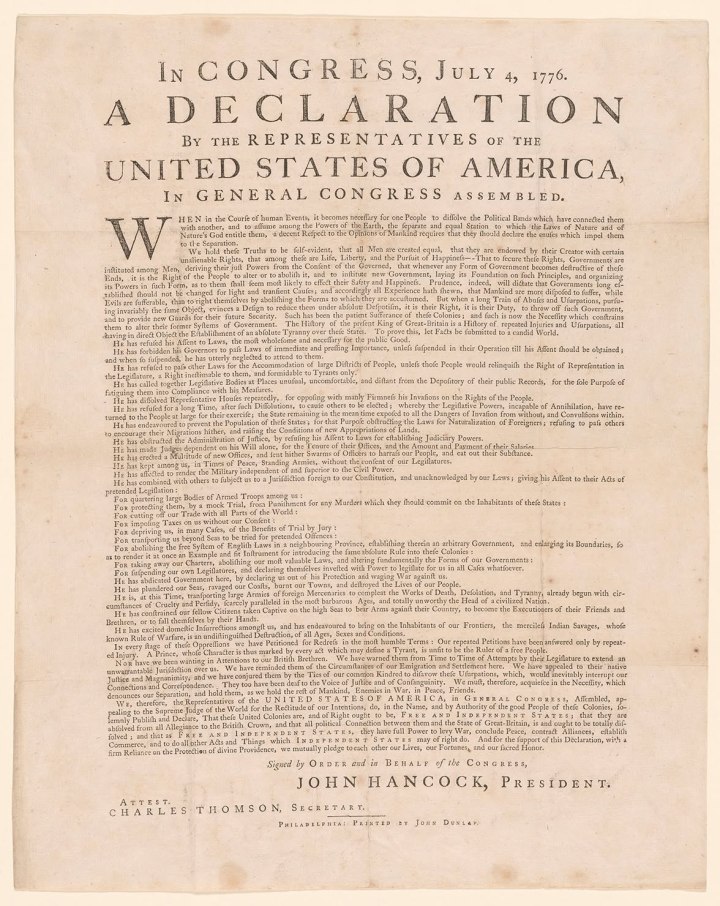
Declaration of Independence (Dunlap Broadside), 1776, printed in Philadelphia by John Dunlap (New York: The Morgan Library & Museum, PML 77518).
In honor of the 250th anniversary of the Declaration of Independence, the Morgan Library & Museum presents a select group of important materials relating to the history of the founding of the nation in the rotunda of the historic library from May 5 until September 13, 2026. Placed in conversation with each other, the six works in this installation provide a snapshot of a robust area of the Morgan’s collection that speaks to the vitality of the country in its nascence.
The centerpiece of the installation is a rare copy of the Declaration of Independence. Known as the “Dunlap Broadside,” this artifact of the nation’s founding was typeset by John Dunlap on the night of July 4, 1776 for distribution to “the several Assemblies, Conventions & Committees or Councils of Safety and to the several Commanding Officers of the Continental troops.” Among the rarest of the rare in this category, it is one of only twenty-six recorded copies surviving today. As a foundational document it is put in context with other important works from the period. Thomas Paine’s radical polemic Common Sense, for example, published earlier that year, gave the nation’s founders a solid rationale for a break from monarchical rule based on the principles of reason.
Also included are correspondences from key figures of the Revolutionary period. A letter dated June 29, 1776, from Patrick Henry, written upon his appointment as Governor of Virginia, reveals the combined sense of humility and anxiety he felt regarding his ability to lead the infant commonwealth through the war effort to combat the “Tyranny of the British King.” Another letter from Martha Washington to her sister Anna Maria ‘Nancy’ Dandridge Bassett, dated August 28, 1776, shows us a window into life on the home front, as she reports on the massive troop movements through Philadelphia toward New York.
In addition, the installation features a life mask of George Washington. In 1785, the French sculptor Jean Antoine Houdon (1741–1828) visited Washington at his Mount Vernon residence. To make a mold of the future first president’s visage, Houdon had Washington lie down and then applied a protective layer of grease followed by a layer of plaster. Once hardened, the mold was removed, and plaster was poured into it to make this positive cast. Houdon brought this ‘life mask’ with him to France and apparently used it while working on the marble statue of Washington for the Virginia State Capitol.
New Book | When the Declaration of Independence Was News
From Oxford UP:
Emily Sneff, When the Declaration of Independence Was News (Oxford: Oxford University Press, 2026), 272 pages, ISBN: 978-0197816691, $30.
 Tracing the moments after its creation, this groundbreaking book follows how news of the Declaration of Independence spread to people throughout the thirteen United States and the Atlantic world.
In 1776 people could hear the Declaration of Independence proclaimed in public squares and could read it in the pages of their local newspapers. Stories of the Declaration typically recount the work that took place inside the Continental Congress, focusing on the men tasked with drafting the text. Although Congress declared independence, the work of spreading the news involved printers, post riders, ship captains, civic leaders, soldiers, clerks, orators, preachers, diplomats, and translators.
When the Declaration of Independence Was News reveals the stories behind how the Declaration was communicated in the United States and around the Atlantic. Tracing the travels of the founding document of the United States from Philadelphia to New York, Boston, Charleston, London, Leiden, Paris, and beyond, Emily Sneff shows how people both celebrated the Declaration and critiqued it. In the weeks after the document was penned, it was printed in the columns of newspapers, translated into German and French, and shared with Native American allies. The document induced some people to make public their privately held beliefs about whether they wanted the United States to be independent or to reconcile with King George III. The Declaration was met with unique circumstances everywhere it went, and people modified the text along the way. The questions of who experienced the news of independence, when, and how reveal an expansive and complex history of a critical moment in the American Revolution.
Published for the 250th anniversary of American independence, When the Declaration of Independence Was News returns to a time before the legacy of these words and the outcome of the war against Great Britain were known to reconsider what the founding of the United States meant to the people who were living through it.
Emily Sneff is a historian of the founding era of the United States and a leading expert on the Declaration of Independence. With a PhD in history from William and Mary, she is a consulting curator for museum exhibitions for the 250th anniversary of the Declaration.
c o n t e n t s
Acknowledgments
1 Introduction: The News of Independence
2 When the Declaration of Independence was News
3 Short of Independence: The May 15 Resolution
4 Postponed: The Continental Congress Debates Independence
5 Publish and Declare: The People Learn the News
6 Melted Majesty: Statues Fall and Tensions Rise in New York
7 The Reigning Subject: Inoculation and Independence in Massachusetts
8 Words and Wampum: Native Americans Acknowledge Independence
9 Embarrassment: Clergymen Close Churches and Change Prayers
10 Intercepted: Broadsides in British Hands
11 Pretended Acts: London Changes the Declaration
12 An Old Storey: Silas Deane Waits for the Declaration
13 Conclusion: A Lasting Testimony
Appendix: Transcription of the Dunlap Broadside of the Declaration of Independence
Notes
Bibliography
Index










leave a comment