New Book | Forbidden Desire in Early Modern Europe
From Oxford UP:
Noel Malcolm, Forbidden Desire in Early Modern Europe: Male-Male Sexual Relations, 1400–1750 (Oxford: Oxford University Press, 2024), 608 pages, ISBN: 978-0198886334, $33.
 A landmark study of the history of male-male sex in early modern Europe, including the European colonies and the Ottoman world.
Until quite recently, the history of male-male sexual relations was a taboo topic. But when historians eventually explored the archives of Florence, Venice, and elsewhere, they brought to light an extraordinary world of early modern sexual activity, extending from city streets and gardens to taverns, monasteries, and Mediterranean galleys. Typically, the sodomites (as they were called) were adult men seeking sex with teenage boys. This was something intriguingly different from modern homosexuality: the boys ceased to be desired when they became fully masculine. And the desire for them was seen as natural; no special sexual orientation was assumed.
The rich evidence from Southern Europe in the Renaissance period was not matched in the Northern lands; historians struggled to apply this new knowledge to countries such as England or its North American colonies. And when good Northern evidence did appear, from after 1700, it presented a very different picture. So the theory was formed—and it has dominated most standard accounts until now—that the ’emergence of modern homosexuality’ happened suddenly, but inexplicably, at the beginning of the eighteenth century.
Noel Malcolm’s masterly study solves this and many other problems, by doing something which no previous scholar has attempted: giving a truly pan-European account of the whole phenomenon of male-male sexual relations in the early modern period. It includes the Ottoman Empire, as well as the European colonies in the Americas and Asia; it describes the religious and legal norms, both Christian and Muslim; it discusses the literary representations in both Western Europe and the Ottoman world; and it presents a mass of individual human stories, from New England to North Africa, from Scandinavia to Peru. Original, critical, lucidly written and deeply researched, this work will change the way we think about the history of homosexuality in early modern Europe.
Sir Noel Malcolm gained his doctorate at Cambridge, where he began his career as a Fellow of Gonville and Caius College, teaching history and English literature; he was later foreign editor of The Spectator. In 1999 he was a lecturer at Harvard; he gave the Carlyle Lectures at Oxford in 2001. Since 2002 he has been a Senior Research Fellow at All Souls College, Oxford. A Fellow of the British Academy, he has published numerous books and articles on early modern intellectual history, and Balkan history and culture. He was knighted in 2014 for services to scholarship, journalism, and European history.
New Book | All the World Beside
From Penguin Random House:
Garrard Conley, All the World Beside: A Novel (New York: Riverhead Books, 2024), 352 pages, ISBN: 978-0525537335, $28.
 From the New York Times bestselling author of Boy Erased, an electrifying, deeply moving novel about the love story between two men in Puritan New England
Cana, Massachusetts: a utopian vision of 18th-century Puritan New England. To the outside world, Reverend Nathaniel Whitfield and his family stand as godly pillars of their small-town community, drawing Christians from across the New World into their fold. One such Christian, physician Arthur Lyman, discovers in the minister’s words a love so captivating it transcends language. As the bond between these two men grows more and more passionate, their families must contend with a tangled web of secrets, lies, and judgments which threaten to destroy them in this world and the next. And when the religious ecstasies of the Great Awakening begin to take hold, igniting a new era of zealotry, Nathaniel and Arthur search for a path out of an impossible situation, imagining a future for themselves which has no name. Their wives and children must do the same, looking beyond the known world for a new kind of wilderness, both physical and spiritual.
Set during the turbulent historical upheavals which shaped America’s destiny and following in the tradition of Nathaniel Hawthorne’s The Scarlet Letter, All the World Beside reveals the very human lives just beneath the surface of dogmatic belief. Bestselling author Garrard Conley has created a page-turning, vividly imagined historical tale that is both a love story and a crucible.
Garrard Conley is the New York Times bestselling author of the memoir Boy Erased, as well as the creator and co-producer of the podcast UnErased: The History of Conversion Therapy in America. His work has been published by The New York Times, Oxford American, Time, and Virginia Quarterly Review, among others. Conley is a graduate of Brooklyn College’s MFA program, where he was a Truman Capote Fellow specializing in fiction. He is an assistant professor of creative writing at Kennesaw State University.
New Book | Unsuitable: A History of Lesbian Fashion
From Hurst, with chapters on cross dressing in 18th-century Britain and Anne Lister. . .
Eleanor Medhurst, Unsuitable: A History of Lesbian Fashion (London: Hurst & Company, 2024), 344 pages, ISBN: 978-1805260967, £25 / $35.
 The way we dress can show or hide who we are; make us fit in, make us stand out, or make our own community. Yet ‘lesbian fashion’ has been strangely overlooked. What secrets can it reveal about the lives and status of queer women through the ages?
The lesbian past is slippery: often deliberately hidden, edited, or left unrecorded. Unsuitable restores to history the dazzlingly varied clothes worn by women who love women, from top hats to violet tiaras. This story spans centuries and countries, from ‘Gentleman Jack’ in nineteenth-century Yorkshire and Queen Christina of seventeenth-century Sweden, to Paris modernism, genderqueer Berlin, butch/femme bar culture and gay rights activists—via drag kings, Vogue editors, and the Harlem Renaissance. This book is a kaleidoscope of the margins and the mainstream, celebrating trans lesbian style, Black lesbian style, and gender nonconformity. You don’t have to be queer or fashionable to be enthralled by this hidden history. Unsuitable lights it up for the world to see, in all its finery.
Eleanor Medhurst is a historian of lesbian fashion and author of the blog Dressing Dykes. She has worked on Brighton Museum’s exhibitions Queer Looks and Queer the Pier and been interviewed by Grazia, Cosmopolitan, Cameron Esposito’s Queery, and Gillian Anderson’s What Do I Know?! This is her first book.
New Book | Love and Marriage in the Age of Jane Austen
From Yale UP:
Rory Muir, Love and Marriage in the Age of Jane Austen (New Haven: Yale University Press, 2024), 432 pages, ISBN: 978-0300269604, $35.
 Marriage is at the centre of Jane Austen’s novels. The pursuit of husbands and wives, advantageous matches, and, of course, love itself, motivate her characters and continue to fascinate readers today. But what were love and marriage like in reality for ladies and gentlemen in Regency England? Rory Muir uncovers the excitements and disappointments of courtship and the pains and pleasures of marriage, drawing on fascinating first-hand accounts as well as novels of the period. From the glamour of the ballroom to the pressures of careers, children, managing money, and difficult in-laws, love and marriage came in many guises: some wed happily, some dared to elope, and other relationships ended with acrimony, adultery, domestic abuse, or divorce. Muir illuminates the position of both men and women in marriage, as well as those spinsters and bachelors who chose not to marry at all. This is a richly textured account of how love and marriage felt for people at the time—revealing their unspoken assumptions, fears, pleasures, and delights.
Rory Muir is a visiting research fellow at the University of Adelaide and a renowned expert on British history. His books include Gentlemen of Uncertain Fortune and his two-part biography of Wellington, which won the SAHR Templer Medal.
The Burlington Magazine, May 2024
From the May issue of The Burlington, which is dedicated to French art — and please note that Yuriko Jackall’s important article is currently available for free, even without a subscription.
Burlington Magazine 166 (May 2024)

Jean-Honoré Fragonard, The Swing, 1767, oil on canvas, 81 × 64 cm (London: Wallace Collection).
a r t i c l e s
• Ludovic Jouvet, “A Medal of the Sun King by Claude I Ballin,” pp. 440–45.
• Yuriko Jackall, “The Swing by Jean-Honoré Fragonard: New Hypotheses,” pp. 446–69.
• Thadeus Dowad, “Dāvūd Gürcü, Ottoman Refugee, and Girodet’s First Mamluk Model,” pp. 479–87.
• Humphrey Wine, “The Paintings Collection of Denis Mariette,” pp. 488–92.
r e v i e w s
• Richard Stemp, Review of Ingenious Women: Women Artists and their Companions (Hamburg: Bucerius Kunst Forum / Basel: Kunstmuseum, 2023–24), pp. 501–04.
• Christoph Martin Vogtherr, Review of Louis XV: Passion d’un roi (Château de Versailles, 2022), pp. 508–10.
• Eric Zafran, Review of The Hub of the World: Art in Eighteenth-Century Rome (Nicholas Hall, 2023), pp. 515–18.
• Saffron East, Review of Black Atlantic: Power, People, Resistance (Cambridge: Fitzwilliam, 2023), 523–25.
• Gauvin Alexander Bailey, Review of Marsely Kehoe, Trade, Globalization, and Dutch Art and Architecture:
Interrogating Dutchness and the Golden Age (Amsterdam UP, 2023), pp. 534–35.
• Helen Clifford, Review of Vanessa Brett, Knick-Knackery: The Deards’ Family and Their Luxury Shops, 1685–1785 (2023) pp. 535–37.
o b i t u a r y
• Michael Hall, Obituary for Jacob Rothschild (1936–2024), pp. 538–40.
One of the leading public figures in the arts in the United Kingdom, Lord Rothschild was a major collector of historic art and a patron of contemporary artists and architects. His principal focus was Waddesdon Manor, his family’s Victorian country house and estate in Buckinghamshire.
◊ ◊ ◊ ◊ ◊
Jean-Honoré Fragonard was one of the supreme exponents of the French Rococo style and his painting The Swing in the Wallace Collection, London, is perhaps his most famous work. Yet despite this elevated status, mystery surrounds its origins. New documentary and technical research presented here by Yuriko Jackall may, however, have finally established for whom it was painted and why the painting was hidden away for the first few years of its existence.
The May issue also includes the publication by Ludovic Jouvet of a previously unknown and spectacular medal of the Sun King, Louis XIV, as well as Humphrey Wine’s study of the intriguing collection of the publisher Denis Mariette (the uncle of the more famous Pierre-Jean Mariette). Other articles feature the work of French Romantic painters: Andrew Watson establishes the early history of Delacroix’s The Death of Sardanapalus in the Musée du Louvre, Paris, and Thadeus Dowad identifies Girodet’s first Mamluk model.
Exhibition reviews include Sarah Whitfield discussing Bonnard’s Worlds (Kimbell Art Museum, Fort Worth, and the Phillips Collection, Washington) and Lisa Stein assessing Saul Leiter (MK Gallery, Milton Keynes). Catalogue reviews feature Christoph Martin Vogtherr on Louis XV, Lunarita Sterpetti on Eleonora of Toledo, and Eric M. Zafran surveying art in eighteenth-century Rome. Meanwhile, an impressive and wide range of new books are examined: these feature Megan McNamee on diagrams in medieval manuscripts, Christine Gardner-Dseagu on photographing Pompeii and Richard Thomson on Henry Lerolle.
◊ ◊ ◊ ◊ ◊
Note (added 31 July 2024) — The posting was updated to include additional content.
New Book | Le Château d’Ormesson
The Château d’Ormesson is about 15 miles southeast of Paris. From Lienart:
Xavier Salmon, Le Château d’Ormesson: Tribulations d’un flacon dans un seau à glace (Paris: Lienart éditions, 2024), 160 pages, ISBN: 978-2359064230, €30.

C’est à une saga que nous invite le château d’Ormesson, celle de ses constructeurs et de la famille qui lui a donné son nom, mais aussi celle de l’évolution du goût.
Dissimulée au bout de son allée de grands arbres, la demeure ne se révèle pas facilement. Il faut l’approcher pour découvrir qu’il s’agit d’une « maison narcisse » qui aime à refléter ses façades sur son miroir d’eau. Il faut la contourner pour comprendre qu’elle fut élevée en deux temps. De brique et pierre, le corps de logis principal et ses deux pavillons posés sur trompe fut peut-être construit à la demande du cardinal René de Birague qui posséda la seigneurie entre 1578 et 1583 et sollicita probablement à cette occasion Baptiste Androuet du Cerceau, le fils du célèbre architecte Jacques Androuet du Cerceau. Avec ses lignes classiques, son toit à la Mansart et son fronton triangulaire, le bâtiment adossé au sud en 1759–1760 pour le premier marquis d’Ormesson, Marie François de Paule, est l’œuvre d’Antoine Matthieu Le Carpentier, l’un des architectes les plus en vogue de son temps. À l’intérieur, l’homme remodela les appartements qui avaient été déjà mis au goût du jour au début du XVIIIe siècle. Tout y est demeuré tel que la famille d’Ormesson, grands serviteurs de l’état, l’avait désiré, entre le caractère enjoué des créations de la Régence et la noble élégance du premier néo-classicisme, mais sans désir d’ostentation afin de répondre parfaitement au caractère des générations qui se sont succédées au sein de la demeure. Denis Diderot voyait en d’Ormesson un « flacon dans un seau à glace ». Il faut aujourd’hui y reconnaître, posé au milieu de son parc à vertugadin et dominant son canal, l’une des plus belles maisons privées préservées aux abords de Paris et qui pour la première fois se livre.
Xavier Salmon est conservateur général du patrimoine. Après avoir été responsable des collections de peintures du XVIIIe siècle et d’arts graphiques au château de Versailles, chef de l’inspection générale des musées de France, directeur du patrimoine et des collections du château de Fontainebleau, il est aujourd’hui chargé du département des Arts graphiques du musée du Louvre.
Exhibition | Horse in Majesty
Opening soon at Versailles:
Horse in Majesty: At the Heart of a Civilisation / Cheval en majesté: Au cœur d’une civilisation
Château de Versailles, 2 July — 3 November 2024
Curated by Laurent Salomé and Hélène Delalex

René-Antoine Houasse, Equestrian Portrait of Louis XIV, ca. 1674, oil on canvas (Château de Versailles, Christophe Fouin).
To coincide with the equestrian events at the Paris 2024 Olympic Games—hosted on the Versailles estate—the Château is holding a major exhibition dedicated to horses and equestrian civilisation in Europe—the first exhibition on this theme to be presented on such a scale. Nearly 300 works will highlight the roles and uses of horses in civil and military society, from the sixteenth to the twentieth century, up to the eve of the First World War, which marked the end of horse-drawn civilisation and the relegation of horses to the realm of leisure. This first exhibition dedicated to horses on such a scale will be divided into thirteen sections, leading visitors on a tour through several emblematic areas of the palace: the Africa Rooms, the King’s State Apartment, the Hall of Mirrors, the War and Peace Rooms, Madame Maintenon’s Apartment, and the Dauphine’s Apartment.
Of Horses and Kings
The first part of the exhibition highlights the links between horses and European sovereigns and emperors. In a gallery of princes’ favourite horses, the exhibition presents Charles XI of Sweden’s collection of horse portraits and more intimate portraits such as those of Queen Victoria’s Arabian horses.
Royal Stables: Palaces for Horses
The beauty and sheer scale of the aristocratic and royal stables built in the seventeenth and eighteenth centuries bear witness to the importance attached to horses in representations of power under the Ancien Régime. The Royal Stables at Versailles are also a place for teaching and passing on knowledge and skills. It was at the Royal Arena in Versailles that the art of traditional French horsemanship reached its pinnacle of perfection.
The Horse, King of War
One of the most important aspects of the companionship between man and horse is their shared adventure in war, and often in death. The exhibition explores the motif of the cavalry clash, based on Leonardo da Vinci’s archetype, with horses and riders merging to form a furious and spectacular mass. The exhibition provides an insight into another great slaughter of modern warfare, that of horses. The many corpses littering the foreground of the paintings enable the artists to highlight the violence of the confrontation and its cost.
Festive Horses: The Equestrian Spectacular
Equestrian festivals played a key role in the life of European courts. The exhibition presents some rare examples of these ephemeral festive arts: ceremonial lances, fancy shields and quivers, studies of caparisons, large gouaches of Swedish carousels, drawings, and illuminated manuscripts.
Horses and Luxury: Treasures from the Stables
Following on from the festive arts, the exhibition reveals a set of prodigiously luxurious horse ornaments, crafted in the form of objets d’art. A complete set of equestrian parade armour takes pride of place in the Hercules Room.
Horses and Science
The exhibition also focuses on the relationship between art and science in anatomical studies of horses. The iconic early drawings by Andrea del Verrochio and Leonardo da Vinci are exhibited together here for the first time, in a collaboration between New York’s Metropolitan Museum and the English Royal Collections.
Horses as Models
Horses have always been a favourite subject and source of inspiration for artists. The exhibition features a number of masterpieces of this genre, and examines the unbridled imaginings elicited by the horse’s body in late-nineteenth-century art.
From One Civilisation to Another
The exhibition closes with an evocation of the end of equestrian civilisation, with the advent of the railway and automobile industries transforming a thousand-year-old way of life in a matter of decades.
Curators
Laurent Salomé, Director of the Musée National des Châteaux de Versailles et de Trianon
Hélène Delalex, Heritage Curator at the Musée National des Châteaux de Versailles et de Trianon
Laurent Salomé and Hélène Delalex, eds., Cheval en majesté: Au cœur d’une civilisation (Paris: Lienart éditions, 2024), 504 pages, ISBN: 978-2359064438, €49.
New Book | Billy Waters is Dancing
From Yale UP:
Mary Shannon, Billy Waters is Dancing: Or, How a Black Sailor Found Fame in Regency Britain (New Haven: Yale University Press, 2024), 384 pages, ISBN: 978-0300267686, $38.
 The story of William Waters, Black street performer in Regency London, and how his huge celebrity took on a life of its own
Every child in Regency London knew Billy Waters, the celebrated ‘King of the Beggars’. Likely born into enslavement in 1770s New York, he became a Royal Navy sailor. After losing his leg in a fall from the rigging, the talented and irrepressible Waters became London’s most famous street performer. His extravagantly costumed image blazed across the stage and in print to an unprecedented degree. For all his contemporary renown, Waters died destitute in 1823—but his legend would live on for decades. Mary L. Shannon’s biography draws together surviving traces of Waters’ life to bring us closer to the historical figure underlying them. Considering Waters’ influence on the London stage and his echoing resonances in visual art, and writing by Douglass, Dickens, and Thackeray, Shannon asks us to reconsider Black presences in nineteenth-century popular culture. This is a vital attempt to recover a life from historical obscurity—and a fascinating account of what it meant to find fame in the Regency metropolis.
Mary L. Shannon is a writer, broadcaster, and senior lecturer in English literature at the University of Roehampton, where her research focuses on nineteenth-century literature and culture. She is author of the award-winning Dickens, Reynolds, and Mayhew on Wellington Street.
Exhibition | The Legacy of Vesuvius
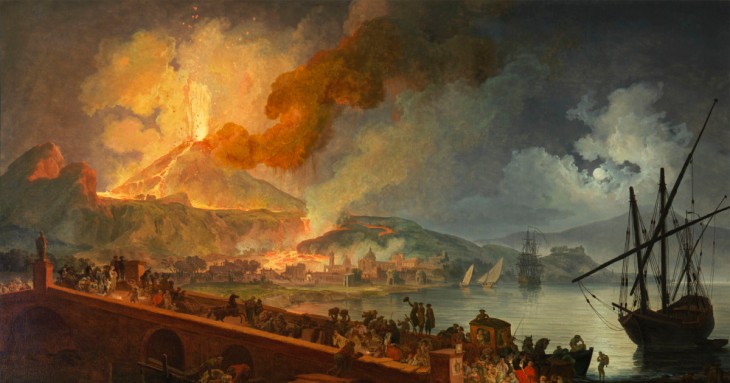
Pierre-Jacques Volaire, Eruption of Mount Vesuvius on the Ponte della Maddalena, 1782, oil on canvas, 129 × 260 cm
(Naples: Museo e Real Bosco di Capodimonte)
◊ ◊ ◊ ◊ ◊
From the press release (8 May) for the exhibition opening this fall:
The Legacy of Vesuvius: Bourbon Discoveries on the Bay of Naples
The Meadows Museum, SMU, Dallas, 15 September 2024 — 5 January 2025
Curated by Michael Thomas, with Heather Bowling and P. Gregory Warden
Set during one of the most dynamic moments in Western history, The Legacy of Vesuvius: Bourbon Discoveries on the Bay of Naples looks at the groundbreaking archaeological excavations sponsored by the Bourbon King Charles VII of Naples—the future king of Spain—and his wife, Maria Amalia, and continued by his son and successor Ferdinand IV, and demonstrates their formative influence on art and thought in the Age of Enlightenment. Comprised of nearly 50 objects, the exhibition’s unique combination of Roman archaeological material from the excavations at Pompeii, Herculaneum, and other sites, mingled with 18th-century paintings, porcelain, and prints—including major loans from Museo e Real Bosco di Capodimonte, Museo Archeologico Nazionale di Napoli, The Metropolitan Museum of Art, and the Wellcome Collection—will provide an exciting introduction to the archaeological treasures of this period and their formative influence on contemporary artistic production. The Meadows Museum, SMU, is the sole venue for the exhibition, which will open on 15 September 2024 and run through 5 January 2025.
“When Mount Vesuvius erupted in 79 CE, in a near instant it preserved the art and material culture of the thriving Roman cities around the Bay of Naples. While these archaeological sites were known in the early modern period, it was thanks to the patronage of the Bourbon monarchs in the 18th century that their systematic excavation was undertaken. The result was nothing short of ‘Roman-mania’ as recently unearthed objects inspired contemporary artistic production, from fashion to furniture, and cemented the Bourbon tastemakers as the force behind Neoclassicism” said Amanda W. Dotseth, the Linda P. and William A. Custard Director of the Meadows Museum. “Upon assuming the throne as Charles III of Spain, the Bourbon monarchs brought their taste, and crucially, their artists with them to Madrid where the archaeological discoveries of Herculaneum and Pompeii inspired new styles and forms in Spanish art, changing it forever. By bringing together ancient artifacts and the 18th-century objects they inspired, this exhibition celebrates the lasting impact of visionary patrons—a fitting subject given the Meadows Museum was itself founded by such a collector with a vision, Algur H. Meadows.”
“We are excited to introduce Dallas to Naples, its connection to Spain, and the profound impact the Bourbon excavations had on the cultural and artistic landscape of 18th- century Europe,” said Michael Thomas, professor and director of the Edith O’Donnell Institute of Art History at The University of Texas at Dallas and the exhibition’s curator. “At its core, this exhibition celebrates the discovery of what is arguably the world’s most famous archaeological site, Pompeii, as well as other ancient sites destroyed by the eruption of Vesuvius in 79 CE. The exhibition captures the innovative vision of Charles and Maria Amalia in the years just before they assumed the Spanish throne. The reigns of Charles and his successor Ferdinand define the ‘Golden Age’ of Naples when the city rose to the forefront of artistic production and cultural influence.”
The Legacy of Vesuvius will unfold across several galleries that define different topics. The exhibition begins with an overview of key historical personalities from the period, emphasizing the royal family’s significant role. Featured prominently in this room are depictions of Charles VII and Maria Amalia, by Francesco Liani, an esteemed Neapolitan artist. A depiction of a youthful Ferdinand by Bourbon court painter Anton Raphael Mengs captures the 8-year old monarch on the occasion of his accession to the throne. Antonio Joli’s landscape painting The Royal Procession of Piedigrotta, seen from the West documents a royal procession that includes Charles and Ferdinand in a gilded carriage set against a panoramic view of the city of Naples, the city at the center of this exhibition.
The next section will showcase finds discovered near the royal palace at Portici which included the ancient city of Herculaneum. These finds include Roman wall paintings, documents cataloging Bourbon finds, as well as 18th-century renditions of ancient artifacts in biscuit porcelain, and 19th-century copies of the famous bronzes from the Villa of the Papyri at Herculaneum. Additionally, a copy of Karl Jakob Weber’s detailed plan of the Villa’s walls, excavation tunnels, and ‘find-spots’, along with excerpts from the Bourbon-commissioned work Le Antichità di Ercolano Esposte (The Antiquities of Herculaneum Exhibited) will be on display.

Flora, from the Villa Arianna, Stabiae, early first century CE, pigment on plaster, 38 × 32 cm (Naples: Museo Archeologico Nazionale de Napoli; photo by Giorgio Albano).
In the next gallery, visitors will see a selection of frescoes that were recovered from both public and private contexts from Pompeii and Stabiae, including a wall painting from a lararium (household shrine) in Pompeii; a fresco and gladiator helmet from the gladiator barracks in Pompeii; and frescoes from the Villa Arianna, Stabiae. Also in this gallery are several objects from Temple of Isis in Pompeii, excavated during the reigns of both Charles and Ferdinand. This temple served as a center for the worship of the Egyptian goddess Isis and documents the influence of Egyptian culture in Roman religious practices. On display will be ancient artifacts unearthed during the Bourbon- led archaeological efforts at the temple, including frescoes depicting sacred landscapes alongside imagery of priests conducting rituals. Among the other notable items will be a bronze sistrum, an instrument used in ceremonies by the priests of Isis.
The next section will highlight the Bourbon court’s fascination with Naples’ picturesque landscapes. Antonio Joli’s pair of evocative paintings depicting King Charles’ departure to Spain provides perspectives from both the maritime and coastal vantage points. Another work by Joli captures Ferdinand’s hunting party in front of the Capodimonte palace with the city of Naples as the backdrop. Jakob Philipp Hackert’s work depicts Ferdinand in his favorite pastime, hunting, while also capturing the natural beauty of the Neapolitan coastline. Élisabeth Vigée Le Brun’s portrait of a young Francis of Bourbon features Mount Vesuvius in the background, further underscoring the connection between the landscape and the Bourbon court. A nighttime scene of the Eruption of Mount Vesuvius on the Ponte della Maddalena (1782) by French artist Pierre-Jacque Volaire emphasizes the sublime beauty and terror of the volcano.
Looming over much of this history were the many eruptions of Mount Vesuvius itself, which will be explored by the prints of Pietro Fabris in the next room. Sir William Hamilton commissioned Fabris to record the scientific properties of Vesuvian eruptions in his publication, Campi Phlegraei: Observations on the Volcanos of the Two Sicilies (1776). Hamilton, a British diplomat, archaeologist, and volcanologist served as the British Ambassador to the Kingdom of Naples from 1764 to 1800. His tenure in Naples provided him the opportunity to indulge in his passion for classical antiquities and led to significant contributions to the fields of archaeology and volcanology.
Lastly, the exhibition demonstrates the influence of these discoveries on the art of the Bourbon court and the enduring impact it had on the artistic production associated with the Grand Tour. This room includes examples of royal furniture and porcelain from the famed factories at Capodimonte. The exhibition concludes with a first look at Royal Power, Exoticism, and Technology, a digital heritage collaboration between the Meadows’s Custard Institute for Spanish Art and Culture and the Edith O’Donnell Institute of Art History that is creating digital models of the two Bourbon porcelain rooms at the royal palaces of Portici and Aranjuez.
The Legacy of Vesuvius: Bourbon Discoveries on the Bay of Naples is a collaboration between the Meadows Museum, SMU, and the Edith O’Donnell Institute of Art History at The University of Texas at Dallas. The exhibition is curated by UTD Professor Michael Thomas, PhD, Director of the O’Donnell Institute, with support from Heather Bowling, Research Coordinator at the O’Donnell Institute, and P. Gregory Warden, PhD, the Mark A. Roglán Director of the Custard Institute for Spanish Art and Culture at the Meadows Museum.
A fully illustrated, hardcover catalogue published by Scala Arts & Heritage Publishers—and sponsored by The Custard Institute for Spanish Art and Culture—will accompany the exhibition, with essays by Michael Thomas, P. Gregory Warden, Robin Thomas, Eric M. Moormann, Carmine Romano, and Agnieszka Anna Ficek. Essay topics include multiple aspects of the Bourbon Court and Vesuvian archaeology. Each object will have a catalogue entry, written by Heather Bowling, Domenico Pino, and Lynley McAlpine.
Michael L. Thomas, ed., The Legacy of Vesuvius: Bourbon Discoveries on the Bay of Naples (London: Scala Arts Publishers, 2024), 192 pages, ISBN: 978-1785515736.
Exhibition | Colonial Memory in the Thyssen-Bornemisza Collections
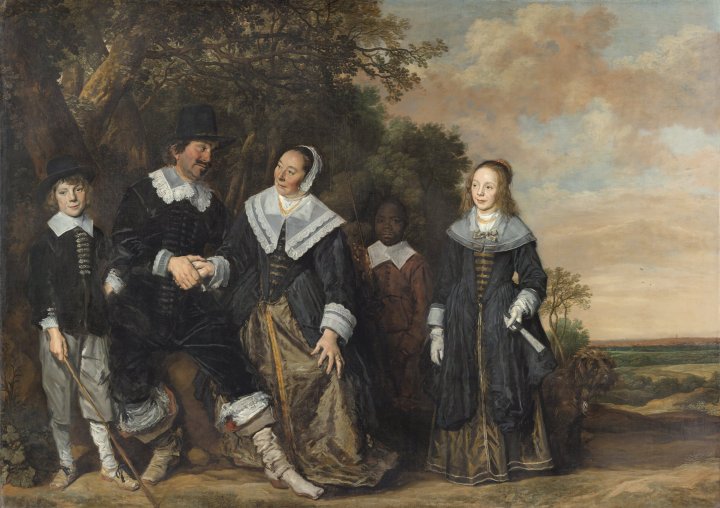
Frans Hals, Family Group in a Landscape, ca.1645–48, oil on canvas, 202 × 285 cm
(Madrid: Museo Nacional Thyssen-Bornemisza)
◊ ◊ ◊ ◊ ◊
Opening this week at the Thyssen:
Colonial Memory in the Thyssen-Bornemisza Collections
Museo Thyssen-Bornemisza, Madrid, 25 June — 20 October 2024
The colonial system lies at the origins of modern western society while its legacy continues to affect human and geopolitical relations around the world. As Europe advanced in the conquest of liberties, it simultaneously imposed a regime of extractivism and physical domination on its territories across the globe.

Circle of Sir Joshua Reynolds (?), Portrait of a Man from the Island of Dominica (?), ca. 1770s, oil on canvas, 76 × 64 cm (Madrid: Museo Nacional Thyssen-Bornemisza).
This exhibition sets out to decipher the elements of colonial power within the iconography of certain works in the Thyssen-Bornemisza collections. A selection of paintings will reveal ‘invisibilised’ stories of racial domination, marronage, and the civil rights struggle, as well as the introduction of the modern mercantile system based on European military control, the use of enslaved African workers, and the appropriation of firstly Latin American and later Asian and African land and raw materials. Visitors will be introduced to fictitious representations of new Arcadias and will witness the western projection of its unsatisfied desires in the form of the ‘Orient’ and the construction of the ‘other’ as barbarian or primitive.
With the aim of rethinking the future through the parameters of cultural diversity, the exhibition benefits from a curatorial team comprising Juan Ángel López (curator at the museum and director of this project), Alba Campo Rosillo (art historian), Andrea Pacheco González (independent curator and artistic director of the space ‘FelipaManuela’), and Yeison F. García López (director of the ‘Espacio Afro’ cultural centre).
La memoria colonial en las colecciones Thyssen-Bornemisza (Madrid: Fundación Thyssen-Bornemisza, 2024), 232 pages, ISBN: 978-8417173906, €42.










 Enfilade
leave a comment