New Book | First Among Men
Published by Johns Hopkins UP, First Among Men was awarded the George Washington Prize last fall:
Maurizio Valsania, First Among Men: George Washington and the Myth of American Masculinity (Baltimore: Johns Hopkins University Press, 2022), 416 pages, ISBN: 978-1421444475, $32.
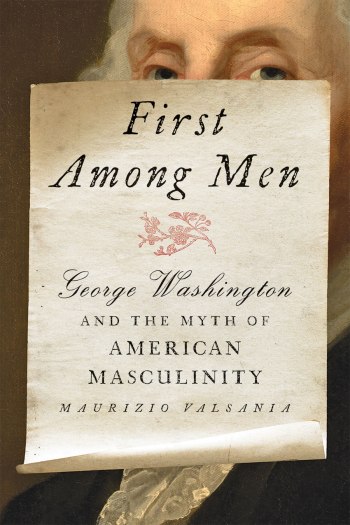 George Washington—hero of the French and Indian War, commander in chief of the Continental Army, and first president of the United States—died on December 14, 1799. The myth-making began immediately thereafter, and the Washington mythos crafted after his death remains largely intact. But what do we really know about Washington as an upper-class man?
Washington is frequently portrayed by his biographers as America at its unflinching best: tall, shrewd, determined, resilient, stalwart, and tremendously effective in action. But this aggressive and muscular version of Washington is largely a creation of the nineteenth century. Eighteenth-century ideals of upper-class masculinity would have preferred a man with refined aesthetic tastes, graceful and elegant movements, and the ability and willingness to clearly articulate his emotions. At the same time, these eighteenth-century men subjected themselves to intense hardship and inflicted incredible amounts of violence on each other, their families, their neighbors, and the people they enslaved. In First Among Men: George Washington and the Myth of American Masculinity, Valsania considers Washington’s complexity and apparent contradictions in three main areas: his physical life (often bloody, cold, injured, muddy, or otherwise unpleasant), his emotional world (sentimental, loving, and affectionate), and his social persona (carefully constructed and maintained). In each, he notes, the reality diverges from the legend quite drastically. Ultimately, Valsania challenges readers to reconsider what they think they know about Washington.
Aided by new research, documents, and objects that have only recently come to light, First Among Men tells the fascinating story of a living and breathing person who loved, suffered, moved, gestured, dressed, ate, drank, and had sex in ways that may be surprising to many Americans. In this accessible, detailed narrative, Valsania presents a full, complete portrait of Washington as readers have rarely seen him before: as a man, a son, a father, and a friend.
Maurizio Valsania is a professor of American history at the University of Turin. He is the author of Jefferson’s Body: A Corporeal Biography.
c o n t e n t s
1 The American Giant
Part I | Physical
2 Testing Himself
3 A Taste for Cruelty and War
4 A Body in Pain
5 Checking the Body
Part II | Emotional
6 The Love Letters
7 The Meaning of Love (and Marriage)
8 A Sentimental Male
9 A Maternal Father
Part III | Social
10 A Person of Fine Manners
11 The Message of His Clothing
12 Astride the Great Stage
13 Consummation
14 Giants Die as Well
New Book | Objects of Liberty
From the University of Delaware Press:
Pamela Buck, Objects of Liberty: British Women Writers and Revolutionary Souvenirs (Newark: University of Delaware Press, 2024), 202 pages, ISBN: 978-16445333338 (hardback), $150 / ISBN: 978-1644533321 (paperback), $43.
 While souvenir collecting was a standard practice of privileged men on the eighteenth-century Grand Tour, women began to partake in this endeavor as political events in France heightened interest in travel to the Continent. Objects of Liberty: British Women Writers and Revolutionary Souvenirs explores the prevalence of souvenirs in British women’s writing during the French Revolution and Napoleonic era. It argues that women writers employed the material and memorial object of the souvenir to circulate revolutionary ideas and engage in the masculine realm of political debate. Looking at travel accounts by Helen Maria Williams, Mary Wollstonecraft, Catherine and Martha Wilmot, Charlotte Eaton, and Mary Shelley, this study reveals how they used souvenirs to affect political thought in Britain and contribute to conversations about individual and national identity. Objects of Liberty is a story about the ways that women established political power and agency through material culture. Easily transported across borders due to their small size, souvenirs allowed women to provide visual representations of the distant conflict in France and encourage sympathy for and remembrance of revolutionary ideals. At a time when gendered beliefs precluded women from full citizenship, they used souvenirs to redefine themselves as legitimate political actors. By establishing networks of sociability, women’s exchange of souvenirs helped Britain develop international alliances and redefine itself as a more powerful and global nation.
Pamela Buck is Associate Professor of English at Sacred Heart University in Fairfield, Connecticut. Her research focuses primarily on women’s writing and material culture in late eighteenth- and early nineteenth-century British literature.
c o n t e n t s
List of Figures
Acknowledgements
Introduction
1 Helen Maria Williams’ Sentimental Objects in Letters from France
2 Mary Wollstonecraft and Political Spectacle in An Historical and Moral View of the French Revolution
3 Imperial Collecting in Catherine and Martha Wilmot’s Travel Journals
4 Charlotte Eaton’s Battlefield Relics in Narrative of a Residence in Belgium
Conclusion: Refiguring the Revolution in Mary Shelley’s Rambles in Germany and Italy
Notes
Bibliography
Index
New Book | Bluestockings
Susannah Gibson will give a lunchtime lecture related to her new book at London’s National Portrait Gallery on 7 March 2024. The volume is scheduled for publication in the United States this summer. From John Murray Press:
Susannah Gibson, Bluestockings: The First Women’s Movement (London: John Murray Press, 2024), 352 pages, ISBN: 978-1529369991, £25 / $30.
 In Britain in the 1750s, women had no power and no rights—all money and property belonged to their fathers or husbands. A brave group risked everything to think and live as they wished, despite the sneers of contemporaries who argued that books frazzled female brains and damaged their wombs.
Meet the Bluestockings:
• Elizabeth Montagu hosted a series of glittering salons in her London drawing room, where a circle of women and men discussed theatre, philosophy and the classics, competing to outdo each other in wit and brilliance. Discover how she took on Voltaire and won.
• Whilst nursing twelve children and helping run her bullying husband’s brewery, Hester Thrale took key writers under her wing—Dr Johnson moved into her house for several years. Her vivid diaries offer a powerful chronicle of what happened when she finally decided to follow her heart.
• Find out how poetess and former milkmaid Ann Yearsley fought back when her snobbish patron refused to hand over her earnings because she was working class and thus irresponsible . . .
• Or how Catherine Macauley’s eight-volume history of England caused such a sensation that she became a leading light in the American Revolution—while her unorthodox love-life scandalised her contemporaries . . .
Susannah Gibson explores the lives and legacies of these and other figures who went on to inspire writers and thinkers from Mary Wollstonecraft to Virginia Woolf and lead the way for feminism.
Susannah Gibson is an Irish writer and historian. She is the author of The Spirit of Inquiry and Animal, Vegetable, Mineral? She holds a PhD from the University of Cambridge in eighteenth-century history and lives in Cambridge, England.
Exhibition | Angelica Kauffman

Angelica Kauffman, Portrait of Emma, Lady Hamilton, as Muse of Comedy, detail, 1791, oil on canvas, 127 × 102 cm
(Private collection)
◊ ◊ ◊ ◊ ◊
A version of the exhibition appeared in 2020 at Düsseldorf’s Kunstpalast and was intended to arrive much sooner at the Royal Academy but was derailed by Covid. The show opens next month (hooray!). . .
Angelica Kauffman
Royal Academy of Arts, London, 1 March — 30 June 2024
Curated by Bettina Baumgärtel and Per Rumberg, with Annette Wickham
Angelica Kauffman RA (1741–1807) was one of the most celebrated artists of the 18th century. In this major exhibition, we trace her trajectory from child prodigy to one of Europe’s most sought-after painters.
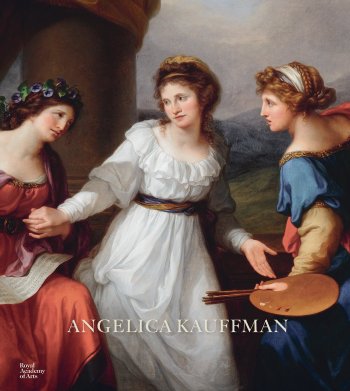 Known for her celebrity portraits and pioneering history paintings, Angelica Kauffman helped to shape the direction of European art. She painted some of the most influential figures of her day—queens, countesses, actors and socialites—and she reinvented the genre of history painting by focusing largely on female protagonists from classical history and mythology. This exhibition covers Kauffman’s life and work: her rise to fame in London, her role as a founding member of the Royal Academy, and her later career in Rome where her studio became a hub for the city’s cultural life. See paintings and preparatory drawings by Kauffman, including some of her finest self-portraits and her celebrated ceiling paintings for the Royal Academy’s first home in Somerset House, as well as history paintings of subjects including Circe and Cleopatra, and discover the remarkable life of the artist whom one of her contemporaries described as “the most cultivated woman in Europe.”
The exhibition is curated by Bettina Baumgärtel, Head of the Department of Painting at the Kunstpalast in Düsseldorf, and Per Rumberg, Curator at the Royal Academy, with Annette Wickham, Curator of Works on Paper at the Royal Academy.
Bettina Baumgärtel and Annette Wickham, Angelica Kauffman (London: Royal Academy of Arts, 2024), 144 pages, ISBN: 978-1915815033, £20 / $30.
◊ ◊ ◊ ◊ ◊
Note (added 15 February 2024) — Wendy Wassyng Roworth’s review of the 2020 exhibition catalogue appeared in The Woman’s Art Journal 42.1 (Spring/Summer 2021): 46–48.
Exhibition | Entangled Pasts, 1768–Now
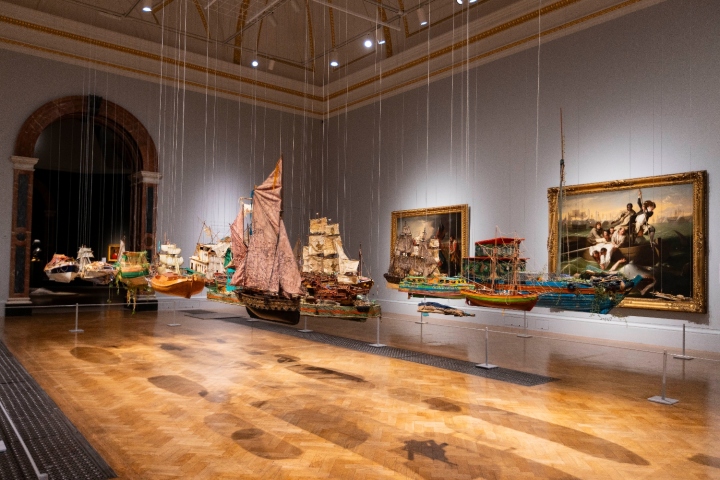
Installation view of Entangled Pasts, 1768–Now: Art, Colonialism, and Change at the Royal Academy of Arts, London, showing Hew Locke’s Armada, 2017–19 (Photo by David Parry for the Royal Academy of Arts, London).
◊ ◊ ◊ ◊ ◊
Now on view at the RA:
Entangled Pasts, 1768–Now: Art, Colonialism, and Change
Royal Academy of Arts, London, 3 February — 28 April 2024
Curated by Dorothy Price with Cora Gilroy-Ware and Esther Chadwick
J.M.W. Turner and Ellen Gallagher. Joshua Reynolds and Yinka Shonibare. John Singleton Copley and Hew Locke. Past and present collide in one powerful exhibition.
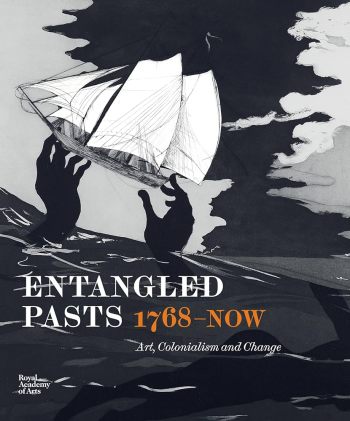 This spring, we bring together over 100 major contemporary and historical works as part of a conversation about art and its role in shaping narratives of empire, enslavement, resistance, abolition, and colonialism—and how it may help set a course for the future. Artworks by leading contemporary British artists of the African, Caribbean, and South Asian diasporas, including Sonia Boyce, Frank Bowling, and Mohini Chandra will be on display alongside works by artists from the past 250 years including Joshua Reynolds, J.M.W.Turner, and John Singleton Copley—creating connections across time which explore questions of power, representation, and history. Experience a powerful exploration of art from 1768 to now. Featuring a room of life-sized cut-out painted figures by Lubaina Himid, an immersive video installation by Isaac Julien, a giant flotilla of model boats by Hew Locke, and a major new sculpture in the Courtyard by Tavares Strachan. Plus, powerful paintings, photographs, sculptures, drawings, and prints by El Anatsui, Barbara Walker, Kerry James Marshall, Kara Walker, Shahzia Sikander, John Akomfrah, and Betye Saar. Informed by our ongoing research of the RA and its colonial past, this exhibition engages around 50 artists connected to the RA to explore themes of migration, exchange, artistic traditions, identity, and belonging.
More information is available here»
Dorothy Price, Alayo Akinkugbe, Esther Chadwick, Cora Gilroy-Ware, Sarah Lea, and Rose Thompson, Entangled Pasts, 1768–Now: Art, Colonialism, and Change (London: Royal Academy of Arts, 2024), 208 pages, 978-1912520992, £25 / $35.
New Books | Shortlist, 2024 Charles Rufus Morey Book Award
The shortlist for the 2024 Charles Rufus Morey Book Award, from the College Art Association, with three of the five books addressing the long 18th c. (and special congratulations to HECAA president, Jennifer Van Horn) –CH
The Charles Rufus Morey Book Award, named in honor of one of the founding members of CAA and first teachers of art history in the United States, was established in 1953. This award honors an especially distinguished book in the history of art, published in the English language. Preference is given to books, including catalogues raisonnés, by a single author, but major publications in the form of articles or group studies may be included. Publication of documents or inventories, unless specifically in the context of an exhibition, are also eligible.
◊ ◊ ◊ ◊ ◊
Delia Cosentino and Adriana Zavala, Resurrecting Tenochtitlan: Imagining the Aztec Capital in Modern Mexico City (Austin: University of Texas Press, 2023), 272 pages, ISBN: 978-1477326992, $60.
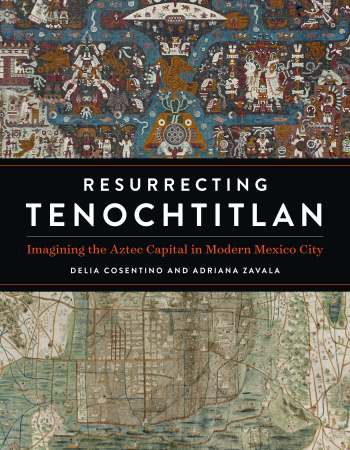 How Mexican artists and intellectuals created a new identity for modern Mexico City through its ties to Aztec Tenochtitlan
After archaeologists rediscovered a corner of the Templo Mayor in 1914, artists, intellectuals, and government officials attempted to revive Tenochtitlan as an instrument for reassessing Mexican national identity in the wake of the Revolution of 1910. What followed was a conceptual excavation of the original Mexica capital in relation to the transforming urban landscape of modern Mexico City. Revolutionary-era scholars took a renewed interest in sixteenth century maps as they recognized an intersection between Tenochtitlan and the foundation of a Spanish colonial settlement directly over it. Meanwhile, Mexico City developed with modern roads and expanded civic areas as agents of nationalism promoted concepts like indigenismo, the embrace of Indigenous cultural expressions. The promotion of artworks and new architectural projects such as Diego Rivera’s Anahuacalli Museum helped to make real the notion of a modern Tenochtitlan. Employing archival materials, newspaper reports, and art criticism from 1914 to 1964, Resurrecting Tenochtitlan connects art history with urban studies to reveal the construction of a complex physical and cultural layout for Mexico’s modern capital.
Delia Cosentino is an associate professor of Latin American art history at DePaul University. She is the author of Las joyas de Zinacantepec: Arte colonial en el Monasterio de San Miguel and was a guest editor for Artl@s Bulletin’s thematic volume Cartographic Styles and Discourse.
Adriana Zavala is an associate professor of the history of art and architecture and race, colonialism, and diaspora studies at Tufts University. She is the author of Becoming Modern, Becoming Tradition: Women, Gender, and Representation in Mexican Art.
◊ ◊ ◊ ◊ ◊
Matthew Francis Rarey, Insignificant Things: Amulets and the Art of Survival in the Early Black Atlantic (Durham: Duke University Press, 2023), 304 pages, ISBN: 978-1478017158 (hardback), $100 / ISBN: 978-1478019855, $27.
 In Insignificant Things Matthew Francis Rarey traces the history of the African-associated amulets that enslaved and other marginalized people carried as tools of survival in the Black Atlantic world from the seventeenth to the nineteenth centuries. Often considered visually benign by white Europeans, these amulet pouches, commonly known as ‘mandingas’, were used across Africa, Brazil, and Portugal and contained myriad objects, from herbs and Islamic prayers to shells and coins. Drawing on Arabic-language narratives from the West African Sahel, the archives of the Portuguese Inquisition, sixteenth- and seventeenth-century European travel and merchant accounts of the West African Coast, and early nineteenth-century Brazilian police records, Rarey shows how mandingas functioned as portable archives of their makers’ experiences of enslavement, displacement, and diaspora. He presents them as examples of the visual culture of enslavement and critical to conceptualizing Black Atlantic art history. Ultimately, Rarey looks to the archives of transatlantic slavery, which were meant to erase Black life, for objects like the mandingas that were created to protect it.
Matthew Francis Rarey is Associate Professor of Art History at Oberlin College.
◊ ◊ ◊ ◊ ◊
Tatiana Reinoza, Reclaiming the Americas: Latinx Art and the Politics of Territory (Austin: University of Texas Press, 2023), 248 pages, ISBN: 978-1477326909, $35.
 How Latinx artists around the US adopted the medium of printmaking to reclaim the lands of the Americas
Printmakers have conspired, historically, to illustrate the maps created by European colonizers that were used to chart and claim their expanding territories. Over the last three decades, Latinx artists and print studios have reclaimed this printed art form for their own spatial discourse. This book examines the limited editions produced at four art studios around the US that span everything from sly critiques of Manifest Destiny to printed portraits of Dreamers in Texas.
Reclaiming the Americas is the visual history of Latinx printmaking in the US. Tatiana Reinoza employs a pan-ethnic comparative model for this interdisciplinary study of graphic art, drawing on art history, Latinx studies, and geography in her discussions. The book contests printmaking’s historical complicity in the logics of colonization and restores the art form and the lands it once illustrated to the Indigenous, migrant, mestiza/o, and Afro-descendant people of the Americas.
Tatiana Reinoza is an assistant professor of art history at the University of Notre Dame.
◊ ◊ ◊ ◊ ◊
Andrew Shanken, The Everyday Life of Memorials (New York: Zone Books, 2022), 432 pages, ISBN: 9781942130727, £30 / $35.
 Memorials are commonly studied as part of the commemorative infrastructure of modern society. Just as often, they are understood as sites of political contestation, where people battle over the meaning of events. But most of the time, they are neither. Instead, they take their rest as ordinary objects, part of the street furniture of urban life. Most memorials are ‘turned on’ only on special days, such as Memorial Day, or at heated moments, as in August 2017, when the Robert E. Lee monument in Charlottesville was overtaken by a political maelstrom. The rest of the time they are turned off. This book is about the everyday life of memorials. It explores their relationship to the pulses of daily life, their meaning within this quotidian context, and their place within the development of modern cities. Through Andrew Shanken’s close historical readings of memorials, both well-known and obscure, two distinct strands of scholarship are thus brought together: the study of the everyday and memory studies. From the introduction of modern memorials in the wake of the French Revolution through the recent destruction of Confederate monuments, memorials have oscillated between the everyday and the ‘not-everyday’. In fact, memorials have been implicated in the very structure of these categories. The Everyday Life of Memorials explores how memorials end up where they are, grow invisible, fight with traffic, get moved, are assembled into memorial zones, and are drawn anew into commemorations and political maelstroms that their original sponsors never could have imagined. Finally, exploring how people behave at memorials and what memorials ask of people reveals just how strange the commemorative infrastructure of modernity is.
Andrew M. Shanken is Professor of Architecture at the University of California, Berkeley. He is the author of 194X: Architecture, Planning, and Consumer Culture on the American Home Front and Into the Void Pacific: Building the 1939 San Francisco World’s Fair.
◊ ◊ ◊ ◊ ◊
Jennifer Van Horn, Portraits of Resistance: Activating Art during Slavery (New Haven: Yale University Press, 2022), 344 pages, ISBN: 978-0300257632, $60.
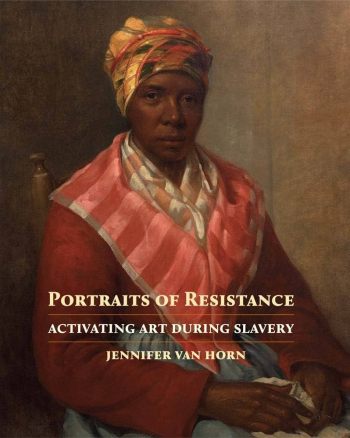 A highly original history of American portraiture that places the experiences of enslaved people at its center
This timely and eloquent book tells a new history of American art: how enslaved people mobilized portraiture for acts of defiance. Revisiting the origins of portrait painting in the United States, Jennifer Van Horn reveals how mythologies of whiteness and of nation building erased the aesthetic production of enslaved Americans of African descent and obscured the portrait’s importance as a site of resistance. Moving from the wharves of colonial Rhode Island to antebellum Louisiana plantations to South Carolina townhouses during the Civil War, the book illuminates how enslaved people’s relationships with portraits also shaped the trajectory of African American art post-emancipation. Van Horn asserts that Black creativity, subjecthood, viewership, and iconoclasm constituted instances of everyday rebellion against systemic oppression. Portraits of Resistance is not only a significant intervention in the fields of American art and history but also an important contribution to the reexamination of racial constructs on which American culture was built.
Jennifer Van Horn is associate professor of art history and history at the University of Delaware.
New Book | Picturing Animals in Early Modern Europe
An early modern story, concluding with late 17th-century France—and entirely relevant to the 18th century. From Brepols:
Sarah Cohen, Picturing Animals in Early Modern Europe: Art and Soul (London: Harvey Miller, 2022), 296 pages, ISBN: 978-1912554324, €150.
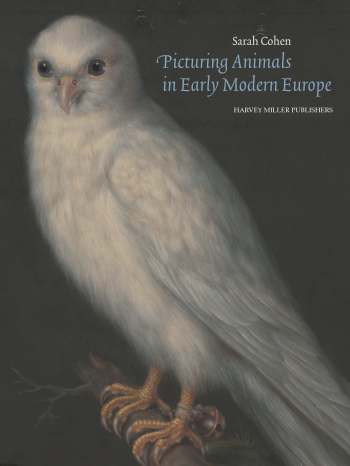 Do animals other than humans have consciousness? Do they knowingly feel and think, rather than simply respond to stimuli? Can they be said to have their own subjectivity? These questions, which are still debated today, arose forcefully in Europe during the sixteenth and seventeenth centuries, when empirical approaches to defining and studying the natural world were coming to the fore. Philosophers, physicians and moralists debated the question of whether the immaterial ‘soul’—which in the early modern era encompassed all forms of thought and subjective experience—belonged to the human mind alone, or whether it could also exist in the material bodies of nonhuman animals.
This book argues that early modern visual art offers uniquely probing and nuanced demonstrations of animal consciousness and agency. The questions that impelled the early modern debates over animal soul are used as a guide to examine a range of works produced in different media by artists in Germany, the Netherlands, northern Italy, and France. Manipulating the matter of their respective mediums, artists emphasized animals’ substantial existence, and a number of them explicitly connected their own role as painters, sculptors, or graphic artists with the life force of animal matter. As nature’s protagonists, the animals in these artworks assume many different kinds of roles, often quite subtle and hard to construe. When studied as a group, they offer striking insight into how early moderns struggled to define and depict the animal ‘soul’.
Sarah R. Cohen is Professor of Art History and Women’s Studies and Chair of the Department of Art and Art History at the University at Albany, SUNY. Her interdisciplinary research explores the body as it has been configured, performed and understood in early modern European culture. Her books include Art, Dance and the Body in French Culture of the Ancien Régime (2000) and Enlightened Animals in Eighteenth-Century Art: Sensation, Matter, and Knowledge (2021).
c o n t e n t s
Acknowledgments
Introduction
Part I: Nature’s Protagonists
Introduction
1 The Sensitive Soul
2 Matter into Life
3 Titian’s Characters
4 Montaigne and the Earthly Paradise
Part II: Animal Drama in the Netherlands
Introduction
5 Exemplary Animal Lives
6 The Debate Over Animal Soul
7 Life and Death
Part III: The Courtly Animal
Introduction
8 Animals in the Salon
9 Animals at Versailles
10 Interspecies Transformations
Conclusion
Notes
Call for Essays | Animal Preservation before 1850
From ArtHist.net, which includes the German version of the CFP:
‘Weder Fisch noch Fleisch’: Animal Preservation before 1850 in Theory and Practice
‘Weder Fisch noch Fleisch’: Tierpräparation vor 1850 in Theorie und Praxis
Volume of essays edited by Dorothee Fischer and Robert Bauernfeind
Proposals due by 31 May 2024, with final essays due by 15 November 2024
The volume ‘Weder Fisch noch Fleisch’ will explore the theory and practice of animal preparation prior to 1850. The book project focuses thus on animal preparations made before the modernization of taxidermy around the middle of the 19th century. While taxidermied objects themselves are irritating in their semantic ambivalence of being both the animal itself and its representation, early modern animal preparation often underwent a further distortion: It was susceptible to deformation due to inadequate conservation methods and created less evidence of the animals’ appearance rather than developing its own momentum as an aesthetic object. Neglect of historical specimens in modern collections contributed to the continuation of this momentum right up to the present day. Damage, deformation, and discolouration can often be observed on the—relatively few—preserved pre-modern specimens. However, both unintentional and deliberate deformations of the specimens contributed to the idea of the ‘nature’ of the respective animals since specimens formed the basis of early modern natural history collections in the 16th century.
In line with these observations, the volume aims to interpret historical specimens not only as objects of the history of both science and collecting, but also in terms of their distinct aesthetics and as sources of insights into (historical) human-animal relationships. In this way, the topic responds to current impulses from various research discourses, promoting interdisciplinary research. While these objects have recently been increasingly addressed from the perspective of collection history, questions about the taxidermied animal as an aesthetic object and trace of the living animal, further bridges the topic to questions of Visual Studies and Human-Animal Studies. From a Human-Animal Studies perspective, deceased yet materially preserved animals still receive less attention than living ones, despite their comparable impact on the relationship between humans and non-human animals. Also, questions about the ‘biographies’ of individual specimens are often a desideratum. Moreover, the exact practices of animal preparation before 1850 have only been marginally examined. The contributions of this volume aim to fill these gaps.
Topics for contributions could encompass, for example, preparation methods, preserved specimens, and their contribution to knowledge production. How do early preparations straddle naturalist interest and artistic craftsmanship? How do these procedures differ from subsequent centuries, and what insights do these objects offer into historical and contemporary human-animal relationships? A workshop held at the University of Trier in the summer of 2022 ignited the dialogue among perspectives from the humanities and natural history museum practice. The volume positions itself as a continuation of this exchange and a deepening of the interdisciplinary examination of early animal preparation. We welcome contributions not only from scholars in cultural studies, art history, and the history of science and knowledge, but also from practitioners of the trade and museum professionals, as well as individuals from other disciplines and perspectives.
Prospective contributors are invited to submit an abstract (maximum of 350 words) and a brief biography via email to the editors, Dorothee Fischer (fischerd@uni-trier.de) and Robert Bauernfeind (robert.bauernfeind@philhist.uni-augsburg.de) by 31 May 2024. Abstracts and contributions may be presented in either English or German. Feedback on our decision will be provided by the end of June 2024. The submission date of the complete contribution (with up to 40,000 characters and 3–4 illustrations) is 15 November 2024. The publication is planned for 2025.
The Magazine of the Decorative Arts Trust, Winter 2023–24
The Decorative Arts Trust has shared select articles from the winter issue of their member magazine as online articles for all to enjoy. The following articles are related to the 18th century:
The Magazine of the Decorative Arts Trust, Winter 2023–24
 • Catherine Carlisle , “Inspiring Thomas Jefferson: Art and Architecture in France” Link»
• Matthew A. Thurlow, “Papered and Painted in Providence” Link»
• Charles Dawson, “The Finest Regency Porcelain Painter: Thomas Baxter in Worcester” Link»
• Philip D. Zimmerman, “Historic Odessa Collections Published” Link»
• Reed Gochberg, “Interwoven: Women’s Lives Written in Thread” Link»
• Kaila Temple, “‘A Place to Cultivate Her Mind in by Musing’: New Exploration of Anne Emlen’s 1757 Shellwork Grotto” Link»
• Laura Ochoa Rincon, “A Million Hidden Stories: Uncovering Materials at the New Orleans Museum of Art” Link»
• Laura C. Jenkins, “French Interiors for an American Gilded Age” Link»
• Alyse Muller, “18th-Century Marine Imagery in the Sèvres Archive” Link»
The printed Magazine of the Decorative Arts Trust is mailed to Trust members twice per year. Memberships start at $50, with $25 memberships for students.
Pictured: The magazine cover features the front parlor of the Rhode Island Historical Society’s John Brown House, which contains a Providence-made nine-shell desk and bookcase (1760–80) flanked by variants of Providence-made Neoclassical side chairs (1785–1800). The wallpaper is a 1975 reproduction by the Birge Co. of Buffalo, NY, based on a 1790s French example.
New Book | The Art of Cooking
Montiño’s cookbook appeared in new editions throughout the 17th and 18th centuries. Carolyn Nadeau’s English translation was just published in November. Her Instagram account is immense fun (and I’m grateful to Ivan Day for noting it on his account). –CH
From the University of Toronto Press:
Carolyn Nadeau, edited and translated, Francisco Martínez Montiño, The Art of Cooking, Pie Making, Pastry Making, and Preserving: Arte de cocina, pastelería, vizcochería y conservería (Toronto: University of Toronto Press, 2023), 760 pages, $150. Bilingual edition.
 In 1611 Francisco Martínez Montiño, chef to Philip II, Philip III, and Philip IV of Spain, published what would become the most recognized Spanish cookbook for centuries: Arte de cocina, pastelería, vizcochería y conservería. This first English translation of The Art of Cooking, Pie Making, Pastry Making, and Preserving will delight and surprise readers with the rich array of ingredients and techniques found in the early modern kitchen. Based on her substantial research and hands-on experimentation, Carolyn Nadeau reveals how early cookbooks were organized and read and presents an in-depth analysis of the ingredients featured in the book. She also introduces Martínez Montiño and his contributions to culinary history, and provides an assessment of taste at court and an explanation of regional, ethnic, and international foodstuffs and recipes. The 506 recipes and treatises reproduced in The Art of Cooking, Pie Making, Pastry Making, and Preserving outline everything from rules for kitchen cleanliness to abstinence foods to seasonal banquet menus, providing insight into why this cookbook, penned by the chef of kings, stayed in production for centuries.
Francisco Martínez Montiño was a Spanish cook and writer of the Golden Age.
Carolyn A. Nadeau is a Byron S. Tucci Professor of Spanish at Illinois Wesleyan University.
c o n t e n t s
List of Figures and Tables
Acknowledgments
Introduction
1 The Cookbook as Cultural Artefact
2 Martínez Montiño’s Biography and the Early Modern Spanish Kitchen
3 Cookbook Organization
4 Ingredients
5 Taste at Court and the Emergence of Spanish Cuisine
6 Curiosities of Martínez Montiño’s Cookbook
7 Martínez Montiño’s Legacy
8 Previous Editions
9 This Edition and Commentary
Arte de cocina, pastelería, vizcochería y conservería
Tasa / Certificate of Price
El Rey (Privilegio) / The King (Privilege)
Prologo al lector / Prologue for the Reader
Advertencia / Notice
Tabla de los banquetes / Table on the Banquets
Chapter 1
Chapter 2
Appendix 1: Kitchen Furnishings and Equipment
Appendix 2: On Measurements
Appendix 3: Images from Recipes Recreated
Glossary
Bibliography
Index










 Enfilade
leave a comment