New Book | Novels, Needleworks, and Empire
Part of the Lewis Walpole Series in Eighteenth-Century Culture and History, from Yale UP:
Chloe Wigston Smith, Novels, Needleworks, and Empire: Material Entanglements in the Eighteenth-Century Atlantic World (New Haven: Yale University Press, 2024), 312 pages, ISBN: 978-0300270785, $65.
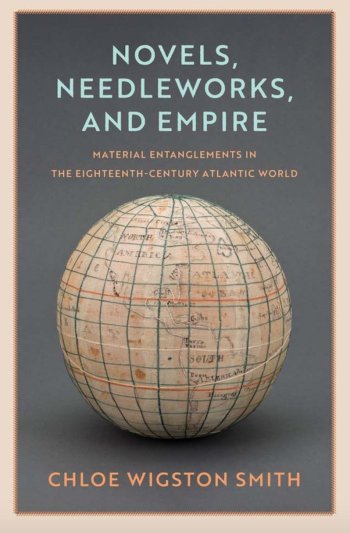 The first sustained study of the vibrant links between domestic craft and British colonialism
In the eighteenth century, women’s contributions to empire took fewer official forms than those collected in state archives. Their traces were recorded in material ways, through the ink they applied to paper or the artifacts they created with muslin, silk threads, feathers, and shells. Handiwork, such as sewing, knitting, embroidery, and other crafts, formed a familiar presence in the lives and learning of girls and women across social classes, and it was deeply connected to colonialism.
Chloe Wigston Smith follows the material and visual images of the Atlantic world that found their way into the hands of women and girls in Britain and early America—in the objects they made, the books they held, the stories they read—and in doing so adjusted and altered the form and content of print and material culture. A range of artifacts made by women, including makers of color, brought the global into conversation with domestic crafts and consequently placed images of empire and colonialism within arm’s reach. Together, fiction and handicrafts offer new evidence of women’s material contributions to the home’s place within the global eighteenth century, revealing the rich and complex connections between the global and the domestic.
Chloe Wigston Smith is professor of eighteenth-century literature at the University of York, where she teaches in the Department of English and the Centre for Eighteenth Century Studies. She is the author of Women, Work, and Clothes in the Eighteenth-Century Novel.
c o n t e n t s
List of Illustrations
Introduction: Entangled Forms
1 Making the Four Corners of the Globe, Oroonoko, and Euphemia
2 Small Marks in Thread: Samplers, Moll Flanders, and Material Expression
3 Global Domestic Objects: Embroidered Maps, Lydia, and The Female American
4 Pins, Needles, and Wampum in Mary Rowlandson and Hobomok
5 Companionship in Black Attendant Needlework, The History of Sir George Ellison, and The Woman of Colour
Coda: Material Entanglements, Then and Now
Notes
Acknowledgments
Index
New Book | François Le Moyne (1688–1737)
From Silvana Editoriale (and on sale until 10 March) . . .
Jean-Luc Bordeaux, François Le Moyne (1688–1737), Opera completa: New Findings and Legacy (Milan: Silvana Editoriale, 2024), 352 pages, ISBN: 978-8836652310, €95.
 First Painter to the king in 1736 for only a few months before his tragic death, François Le Moyne had a career as short as it was prolific. A large number of works by this exceptional representative of French Rococo had been commissioned by the high clergy, the powerful Duke of Antin—official representative of King Louis XV—by members of the high aristocracy like the Prince of Conti or the Duke of Rohan or rich fermiers généraux like François Berger or Abraham Peyrenc de Moras, or even by the elite of great collectors or connoisseurs like Mariette, La Live de July, and Lempereur.
Teacher of Charles-Joseph Natoire and François Boucher and a contemporary of Antoine Watteau and Jean-François de Troy, Le Moyne reached the height of his glory with his Apotheosis of Hercules, painted between 1732 and 1736 on the immense ceiling of the Salon d’Hercule, located between La Chapelle Royale and the royal apartments of the Château de Versailles. After so many years spent in oblivion, Le Moyne is finally recognized today as one of the major artists of the 18th century, exerting a seminal influence on the following generations.
Unfortunately, only few of the works that Le Moyne realized at the beginning of his career, between 1710 and 1715, have been identified. Nonetheless, he left an important corpus of landscapes, religious works, and courtship scenes. He is considered one of the greatest draftsmen of all time and one of the best European artists of illusionistic ceiling painting since the time of Pietro da Cortona and Charles Le Brun. Moreover, Le Moyne contributed with his easel paintings and his technique to the creation of a new, more seductive model for the representation of the female nude in Europe. Lastly, on a technical level, he brightened the palette of French painting and realized sketches with a particularly quick and agile brushstroke.
Nearly forty years after his first monograph devoted to the painter, Professor Jean-Luc Bordeaux proposes a renewed survey of the oeuvre of François Le Moyne (1688–1737). Bordeaux analyses Le Moyne’s contributions to the French rococo as well as lesser-known aspects of his artistic production and career. With almost 140 paintings and 250 drawings, this new catalogue raisonné is an extended edition of the one published in 1984, with significant additions. It also includes an appendix of around twenty pages that describes a considerable amount of works by Le Moyne, now lost but attributed to him by famous collectors of the time and 18th century experts such as Gersaint, Mariette, Paillet, and Remy.
New Book | Colonial Watteau
From De Gruyter:
Charlotte Guichard, Watteau – kolonial: Herrschaft, Handel und Galanterie im Frankreich des Régence / Colonial Watteau: Empire, Commerce, and Galanterie in Regency France (Berlin: Deutscher Kunstverlag, 2022), 128 pages, ISBN: 978-3422990463, €17 / $20. English and German.
 What were the early visions of Empire in Regency France? The book offers a interpretation of Jean-Antoine Watteau’s Pilgrimage to the Isle of Cythera (1717) by framing it in the context of French colonial expansion in the years of the Regency. Born in Louis XIV’s reign, galant aesthetics contributed to frame the colonial encounter in French America. Fantasies of maritime departure, embarkation and/or debarkation, also expressed a longing for colonial travel and exploration. The imperial imagination fueled with codes of galanterie was very developed in the circles of Watteau’s amateurs. From Watteau’s Pilgrimage to the Isle of Cythera (1717) to its visual reenactment in 1763, the book argues that galanterie served as a visual and conceptual model of French commercial and colonial relations.
Wie sahen die frühen imperialen Visionen im Frankreich der Régence aus? Das Buch bietet eine neue und auch provokative Deutung von Jean-Antoine Watteaus Pilgerfahrt zur Insel Cythera (1717), indem es das Werk in den Kontext der französischen kolonialen Expansion in den Jahren der Régence stellt. Die galante Ästhetik, die während der Herrschaft und im Imperium Ludwigs XIV. entstand, trug dazu bei, die koloniale Begegnung in Französisch-Amerika zu gestalten. Die Fantasien vom Aufbruch zur See, vom Einschiffen oder Ausschiffen, allesamt Merkmale des Gemäldes, drückten auch die Sehnsucht nach kolonialen Reisen und Entdeckungen aus. Die imperiale Imagination, die sich aus den Codes der Galanterie speiste, war in den Kreisen von Watteaus amateurs, die ihrerseits den Modernen nahestanden, die neue ästhetische Formen in Kunst und Literatur förderten, sehr ausgeprägt. Von Watteaus Pilgerfahrt zur Insel Cythera (1717) bis zu ihrer visuellen Nachstellung im Jahr 1763 diente die Galanterie als visuelles und konzeptionelles Modell der französischen Handels- und Kolonialbeziehungen.
Charlotte Guichard, Research Professor at the Centre National de la Recherche Scientifique, Paris.
Oxford Art Journal, December 2023
The 18th century in the latest issue of the Oxford Art Journal:
Oxford Art Journal 46.3 (December 2023)
a r t i c l e s
• Aaron Wile, “Absolutism, the Royal Body, and the Origins of Mythologie galante: Charles de La Fosse at the Trianon,” pp. 327–55.

Charles de La Fosse, The Rest of Diana, 1688, oil on canvas, 128 × 160 cm (Versailles, Châteaux de Versailles et de Trianon).
Mythologie galante, a sensual mode of mythological painting that is one the defining developments of eighteenth-century French art, is usually associated with aristocratic resistance to Louis XIV. This article examines three mythological paintings created by Charles de La Fosse for one of the king’s pleasure palaces in 1688, long identified as a major turning point towards mythologie galante, in order to reassess the origins and meaning of the genre. Situating the paintings within the long arc of Louis XIV’s representational politics, I propose that the collapse of the fiction of the king’s two bodies during the second half of his reign and the subsequent redefinition of the king’s public and private spheres allowed La Fosse to develop a new mythological idiom based in touch, intimacy, and sentiment. The resulting works contravened painting’s traditional role under absolutism to form royal subjects, redefining it as a medium of sympathetic encounter. La Fosse’s paintings open up, from this perspective, an alternate account of modern art and subjectivity—one that took shape not in opposition to absolutist culture but from its very heart.
• Robert Jones, “Joshua Reynolds and Deafness: Listening, Hearing, and Not Hearing in Eighteenth-Century Portraiture,” pp. 357–77.
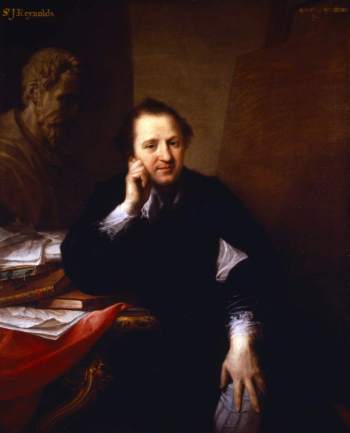
Angelica Kauffman, Portrait of Joshua Reynolds, 1767, oil on canvas, 127 × 102 cm (National Trust, Saltram).
This article examines the significance of deafness in painting and proposes a new trope for the form of picturing undertaken by eighteenth-century art, ‘the listening portrait’. As a first step it recovers and explores the significance of Sir Joshua Reynolds’s own deafness, as represented by his self-portraits as well as images by Nathanial Dance, Angelica Kauffman, and Johan Zoffany. Sound is necessarily absent from painting, audible speech impossible. Having explored these apparent limits (found in eighteenth-century theorizations of art) the essay asks more fundamentally what work is done by the representation of someone striving to listen. By considering this question, it is possible to understand these images as engaging in a more sensitive ethical enquiry concerned with what an aural impairment might mean, and how it is distinct from a refusal or unwillingness to listen. Deafness is consequently shown to be not merely something that paintings show, rather the issue of hearing or not hearing frames their pictorial and moral purpose. Throughout the article recognition of the specificity of Georgian sociability on the one hand, and eighteenth-century artistic theory and practice on the other, seeks to enable the claims of Medical Humanities to recognize previously hidden narratives.
r e v i e w s
• Andrew McClellan, “Purpose, Power, and Possibility: A History of Museums Past and Present,” pp. 493–501.
Review of Krzysztof Pomian, Le musée, une histoire mondiale, 3 volumes (Paris: Gallimard, 2020–22), volume 1: Du trésor au musée, 687 pages, ISBN: 978-2070742370, €35; volume 2: L’ancrage européen, 1789–1850, 546 pages, ISBN: 978-2072924705, €35; volume 3: À la conquête du monde, 1850–2020, 936 pages, ISBN: 978-2072982781, €45.
New Book | Yale and Slavery: A History
From Yale UP:
David Blight, with Yale and Slavery Research Project, foreword by Peter Salovey, Yale and Slavery: A History (New Haven: Yale University Press, 2024), 448 Pages, ISBN: 978-0300273847, $35.
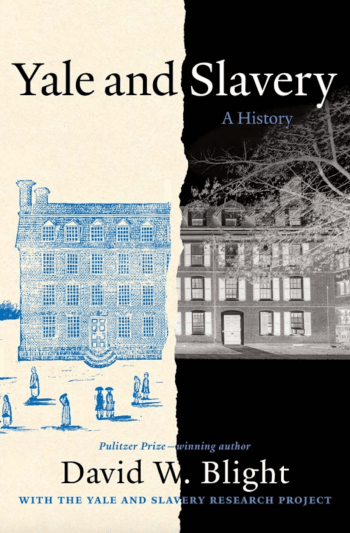 A comprehensive look at how slavery and resistance to it have shaped Yale University
Award-winning historian David W. Blight, with the Yale and Slavery Research Project, answers the call to investigate Yale University’s historical involvement with slavery, the slave trade, and abolition. This narrative history demonstrates the importance of slavery in the making of this renowned American institution of higher learning.
Drawing on wide-ranging archival materials, Yale and Slavery extends from the century before the college’s founding in 1701 to the dedication of its Civil War memorial in 1915, while engaging with the legacies and remembrance of this complex story. The book brings into focus the enslaved and free Black people who have been part of Yale’s history from the beginning—but too often ignored in official accounts. These individuals and their descendants worked at Yale; petitioned and fought for freedom and dignity; built churches, schools, and antislavery organizations; and were among the first Black students to transform the university from the inside.
Always alive to the surprises and ironies of the past, Yale and Slavery presents a richer and more complete history of Yale, the third-oldest college in the country, showing how pillars of American higher education, even in New England, emerged over time intertwined with the national and international history of racial slavery.
David W. Blight is Sterling Professor of History and director of the Gilder Lehrman Center for the Study of Slavery, Resistance, and Abolition at the MacMillan Center at Yale. The Yale and Slavery Research Project was convened in 2020.
TEFAF Maastricht 2024
TEFAF Maastricht opens soon, with lots of interesting 18th-century offerings, including these catalogues from Zebregs & Röell, one of which focuses on a rediscovered portrait of Gustav Badin, a well-known Black African at the court of Maria Louisa of Prussia, Queen of Sweden.
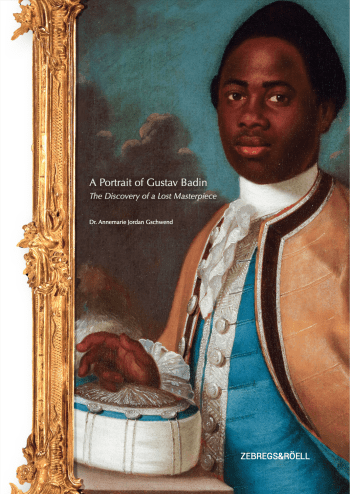
Jakob Björk, after Gustav Lundberg, Portrait of Fredrik Adolf Ludvig Gustav Albert Badin Couschi (ca. 1750–1822), 1776, oil on canvas.
Guus Röell and Dickie Zebregs, Uit verre Streken / From Distant Shores (Maastricht: Zebregs & Röell, 2024), 146 pages. Link»
Annemarie Jordan-Gschwend, A Portrait of Gustav Badin: The Discovery of a Lost Masterpiece (Maastricht: Zebregs & Röell, 2024), 20 pages. Link»
◊ ◊ ◊ ◊ ◊
TEFAF Maastricht
Maastricht, 9–14 March 2024
The European Fine Art Foundation, TEFAF Maastricht, is widely regarded as the world’s premier fair for fine art, antiques, and design, bringing together 7,000 years of art history under one roof. Featuring over 260 prestigious dealers from some 20 countries, TEFAF Maastricht is a showcase for the finest art works currently on the market. Alongside the traditional areas of Old Master paintings, antiques, and classical antiquities that cover approximately half of the fair, you can also find modern and contemporary art, photography, jewelry, 20th century design, and works on paper.
New Book | Disegni di Prospettiva Ideale (1732)
This collection of drawings of Rome by Filippo Juvarra is published as part of the series FONTES: Text- und Bildquellen zur Kunstgeschichte 1350–1750, from arthistoricum.net, where the full PDF is available for free.
Cristina Ruggero, Disegni di Prospettiva Ideale (1732): Un omaggio di Filippo Juvarra ad Augusto il Forte e i rapporti fra le corti di Roma, Torino, Dresda (Heidelberg: arthistoricum.net, 2023), 456 pages, ISBN: 978-3985010851.
 Nella primavera del 1732 Filippo Juvarra spediva da Roma un album con 41 Disegni di Prospettiva Ideale destinato ad Augusto il Forte, principe elettore sassone e re di Polonia. Latore del dono doveva essere Antonio Giuseppe Gabaleone conte di Wackerbarth Salmour—il nobile torinese naturalizzato in Sassonia—che in quel momento era nella città pontificia in missione segreta per suo conto. L’album conservato nel Kupferstich-Kabinett di Dresda celebra l’esemplarità di Roma nei secoli, laddove, attraverso i temi affrontati, le composizioni scenografiche e la tecnica si sviluppa una narrazione di grande forza evocativa, a ulteriore conferma delle poliedriche qualità di Juvarra come grande regista delle arti. I disegni sono pubblicati qui per la prima volta integralmente assieme ad alcune lettere inedite che aiutano a far luce su un episodio artistico che coinvolse le corti di Roma, Torino e Dresda.
Cristina Ruggero è attualmente collaboratrice scientifica del progetto Antiquitatum Thesaurus presso la Berlin-Brandeburgische Akademie der Wissenschaften. Oltre alle sue pubblicazioni su Juvarra, studia da anni la ricezione dell’antico e le reti culturali e artistiche tra le corti europee nel XVIIe XVIII secolo. Ha collaborato con rinomate istituzioni internazionali quali la Bibliotheca Hertziana e l’Università La Sapienza di Roma, il Zentralinstitut für Kunstgeschichte di Monaco e l’Italian Academy at Columbia University di New York.
c o n t e n t s
Page preliminari
Indice
Ringraziamenti
• Introduzione
• Il libro di Disegni di Prospettiva Ideale nel Kupferstich-Kabinett di Dresda
• Catalogo dei disegni
• Filippo Juvarra (1678–1736): l’architetto e i suoi doni di grafica
• Augusto il Forte (1670–1733): un sovrano cultore delle arti
• Giuseppe Antonio Gabaleone conte di Wackerbarth–Salmour (1685–1761) e il suo ruolo di intermediario
• I Disegni di Prospettiva Ideale tra capriccio e seduzione
• Conclusione
• An homage from Filippo Juvarra to August the Strong and the relationships between the courts of Rome, Turin, and Dresden
Abbreviazioni
Bibliografia
Referenze fotografiche
Indice dei nomi
New Book | Specialized Dictionaries and Encyclopedias, 1650–1800
The latest from the Oxford University Studies in the Enlightenment series:
Jeff Loveland and Stéphane Schmitt, eds., Specialized Dictionaries and Encyclopedias, 1650–1800: A Tribute to Frank Kafker (Oxford: Voltaire Foundation with Liverpool University Press, 2024), 488 pages, ISBN: 978-1837641468, $99.
 • One of the first books to focus on specialized dictionaries and encyclopedias
• Complements case studies of specialized dictionaries and encyclopedias with a wide-ranging, analytical overview
• Covers a largely neglected but extremely important aspect of European encyclopedism
• Brings the history of specialized lexicography into touch with the history of science, book history, and the history of culture
During the seventeenth and eighteenth centuries, the number of specialized dictionaries and encyclopedias grew from a trickle to a flood, while the number of disciplines they were devoted to grew from a handful to dozens, representing many varieties of knowledge. Specialized dictionaries—as most were called, whether lexical or encyclopedic—were far more numerous than general encyclopedias. Yet despite their importance—as sources of knowledge, for example, and as definers of disciplines—they have not been much studied. Drawing on Frank Kafker’s methods for studying the period’s general encyclopedias, as pioneered in Notable Encyclopedias of the Seventeenth and Eighteenth Centuries (1981), this volume examines specialized dictionaries as commercial products, collections of content, and cultural artifacts. Specifically, it complements a wide-ranging, analytical introduction sketching out the characteristics of specialized dictionaries in general with a series of individually authored but standardized case studies. The latter deal with dictionaries on a variety of disciplines, from the Bible to mining, and in five European languages. The volume concludes with an essay on Frank Kafker’s influence on historiography.
Jeff Loveland is a visiting assistant professor of history at Utah Tech University. Much of his research concerns the history of encyclopedias, especially eighteenth-century European encyclopedias. His publications include The Early Britannica, 1768–1803, co-edited with Frank A. Kafker (2009) and The European Encyclopedia, from 1650 to the Twenty-First Century (2019).
Stéphane Schmitt is a research director at the Archives Henri Poincaré (French Centre National de la Recherche Scientifique) in Nancy. He works on the history of the life sciences, especially in the eighteenth and the nineteenth centuries. He has published many books and papers on the history of anatomy, embryology, and zoology, and is the main editor of Buffon’s Oeuvres completes (2007–, 17 volumes published to date).
c o n t e n t s
List of illustrations
Introduction
Appendix
• Augustin Calmet’s Dictionnaire historique, critique, chronologique, géographique et littéral de la Bible (1719) — Kathleen Hardesty Doig
• Étienne Chauvin’s Lexicon rationale (1692) and Lexicon philosophicum (1713) — Giuliano Gasparri
• A Medicinal Dictionary (1742–45) by Robert James: An Enlightenment Reference Work — Alexander Wright and R. W. McConchie
• John Barrow’s Dictionarium Polygraphicum (1735) — Craig Hanson
• Noël Chomel’s Dictionnaire oeconomique (1708) — Clorinda Donato
• The Dictionnaire raisonné universel d’histoire naturelle (1764) — Stéphane Schmitt
• The Reales Staats- und Zeitungs-Lexicon (1704) — Jeff Loveland
• The Curieuses Natur- Kunst- Gewerck- und Handlungs-Lexicon (1712) — Ines Prodöhl
• The Dictionnaire universel de commerce (1723–30) — Jeff Loveland
• Nicolas Desroche’s Dictionaire des termes propres de marine (1687): A Linguistic Tool for Seafarers? — Élisabeth Ridel-Granger and Michel Daeffler
• Sven Rinman’s Bergwerks Lexicon (1788–89) and the Emergence of Mining Encyclopedias in Preindustrial Europe — Linn Holmberg
• Frank Kafker and the Social History of Eighteenth-Century Encyclopedism — Gregory S. Brown and Melanie Conroy
Bibliography
New Book | First Among Men
Published by Johns Hopkins UP, First Among Men was awarded the George Washington Prize last fall:
Maurizio Valsania, First Among Men: George Washington and the Myth of American Masculinity (Baltimore: Johns Hopkins University Press, 2022), 416 pages, ISBN: 978-1421444475, $32.
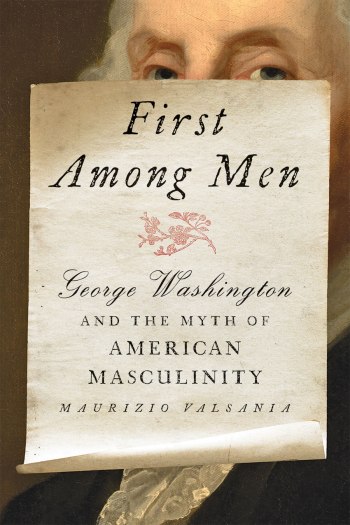 George Washington—hero of the French and Indian War, commander in chief of the Continental Army, and first president of the United States—died on December 14, 1799. The myth-making began immediately thereafter, and the Washington mythos crafted after his death remains largely intact. But what do we really know about Washington as an upper-class man?
Washington is frequently portrayed by his biographers as America at its unflinching best: tall, shrewd, determined, resilient, stalwart, and tremendously effective in action. But this aggressive and muscular version of Washington is largely a creation of the nineteenth century. Eighteenth-century ideals of upper-class masculinity would have preferred a man with refined aesthetic tastes, graceful and elegant movements, and the ability and willingness to clearly articulate his emotions. At the same time, these eighteenth-century men subjected themselves to intense hardship and inflicted incredible amounts of violence on each other, their families, their neighbors, and the people they enslaved. In First Among Men: George Washington and the Myth of American Masculinity, Valsania considers Washington’s complexity and apparent contradictions in three main areas: his physical life (often bloody, cold, injured, muddy, or otherwise unpleasant), his emotional world (sentimental, loving, and affectionate), and his social persona (carefully constructed and maintained). In each, he notes, the reality diverges from the legend quite drastically. Ultimately, Valsania challenges readers to reconsider what they think they know about Washington.
Aided by new research, documents, and objects that have only recently come to light, First Among Men tells the fascinating story of a living and breathing person who loved, suffered, moved, gestured, dressed, ate, drank, and had sex in ways that may be surprising to many Americans. In this accessible, detailed narrative, Valsania presents a full, complete portrait of Washington as readers have rarely seen him before: as a man, a son, a father, and a friend.
Maurizio Valsania is a professor of American history at the University of Turin. He is the author of Jefferson’s Body: A Corporeal Biography.
c o n t e n t s
1 The American Giant
Part I | Physical
2 Testing Himself
3 A Taste for Cruelty and War
4 A Body in Pain
5 Checking the Body
Part II | Emotional
6 The Love Letters
7 The Meaning of Love (and Marriage)
8 A Sentimental Male
9 A Maternal Father
Part III | Social
10 A Person of Fine Manners
11 The Message of His Clothing
12 Astride the Great Stage
13 Consummation
14 Giants Die as Well
New Book | Objects of Liberty
From the University of Delaware Press:
Pamela Buck, Objects of Liberty: British Women Writers and Revolutionary Souvenirs (Newark: University of Delaware Press, 2024), 202 pages, ISBN: 978-16445333338 (hardback), $150 / ISBN: 978-1644533321 (paperback), $43.
 While souvenir collecting was a standard practice of privileged men on the eighteenth-century Grand Tour, women began to partake in this endeavor as political events in France heightened interest in travel to the Continent. Objects of Liberty: British Women Writers and Revolutionary Souvenirs explores the prevalence of souvenirs in British women’s writing during the French Revolution and Napoleonic era. It argues that women writers employed the material and memorial object of the souvenir to circulate revolutionary ideas and engage in the masculine realm of political debate. Looking at travel accounts by Helen Maria Williams, Mary Wollstonecraft, Catherine and Martha Wilmot, Charlotte Eaton, and Mary Shelley, this study reveals how they used souvenirs to affect political thought in Britain and contribute to conversations about individual and national identity. Objects of Liberty is a story about the ways that women established political power and agency through material culture. Easily transported across borders due to their small size, souvenirs allowed women to provide visual representations of the distant conflict in France and encourage sympathy for and remembrance of revolutionary ideals. At a time when gendered beliefs precluded women from full citizenship, they used souvenirs to redefine themselves as legitimate political actors. By establishing networks of sociability, women’s exchange of souvenirs helped Britain develop international alliances and redefine itself as a more powerful and global nation.
Pamela Buck is Associate Professor of English at Sacred Heart University in Fairfield, Connecticut. Her research focuses primarily on women’s writing and material culture in late eighteenth- and early nineteenth-century British literature.
c o n t e n t s
List of Figures
Acknowledgements
Introduction
1 Helen Maria Williams’ Sentimental Objects in Letters from France
2 Mary Wollstonecraft and Political Spectacle in An Historical and Moral View of the French Revolution
3 Imperial Collecting in Catherine and Martha Wilmot’s Travel Journals
4 Charlotte Eaton’s Battlefield Relics in Narrative of a Residence in Belgium
Conclusion: Refiguring the Revolution in Mary Shelley’s Rambles in Germany and Italy
Notes
Bibliography
Index










 Enfilade
leave a comment