New Book | Canova and His World
Coming in the spring from Lund Humphries:
Livio Pestilli, Canova and His World (London: Lund Humphries, 2025), 240 pages, ISBN: 978-1848227354, £60.
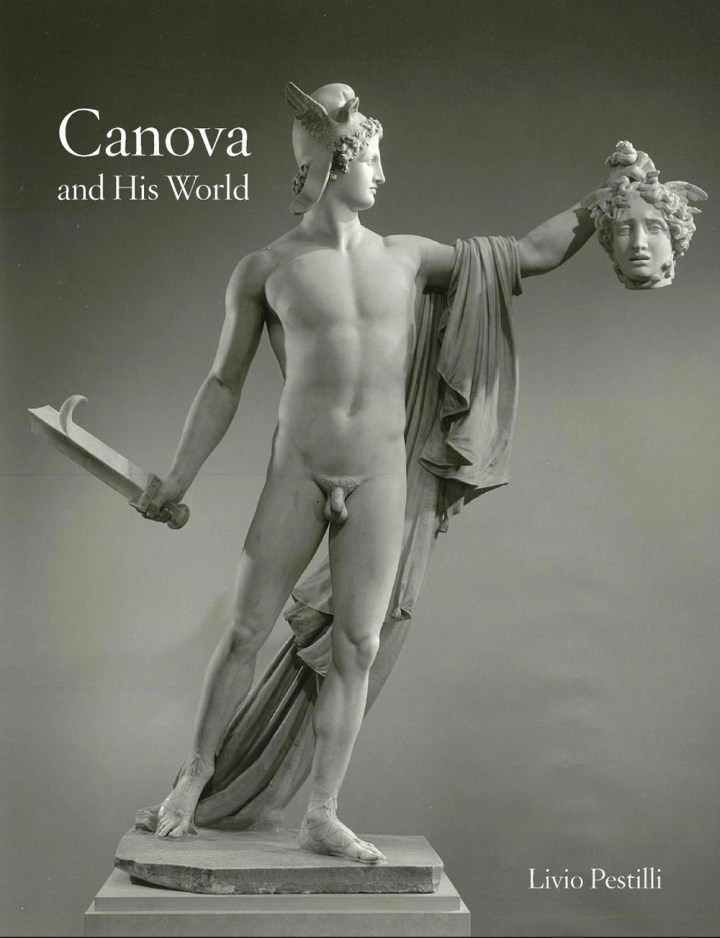 A new examination of Canova’s life and work in comparison with his contemporaries
This kaleidoscopic study of Antonio Canova (1757–1822), one of the most celebrated sculptors of the Neoclassical era, reconsiders his life, work, and artistic legacy in the wake of the two-hundredth anniversary of his death. Pestilli here examines how critics such as Carl Ludwig Fernow and Quatremère de Quincy critically shaped both Canova’s work and its reception and delves into the striking similarities between Canova and his renowned predecessor, Gian Lorenzo Bernini. The narrative breathes new life into the sculptor’s art by placing it within the rich cultural context in which he and his contemporaries worked. Drawing from a wealth of sources—including hundreds of letters and original drawings—Pestilli examines a range of previously unexplored themes that will enhance the understanding of specialists and art enthusiasts alike. This study highlights Canova as a sculptor whose work will continue to resonate for years to come.
Livio Pestilli is the former Director of Trinity College, Rome, where he currently teaches seminars on Michelangelo and Bernini. He is the author of Bernini and His World: Sculpture and Sculptors in Early Modern Rome (Lund Humphries, 2022), Picturing the Lame in Italian Art from Antiquity to the Modern Era (Ashgate/Routledge, 2017), and Paolo de Matteis: Neapolitan Painting and Cultural History in Baroque Europe (Ashgate 2013).
c o n t e n t s
Introduction
Prologue
1 Zoilus
2 The French Connection
3 ‘A [Neo]classical Bernini’
4 Cantilevering
5 The Artist at the Service of the State
Epilogue
New Book | Baroque Architecture in Bohemia
Distributed by The University of Chicago Press:
Petr Macek, Richard Biegel, and Jakub Bachtík, eds., Baroque Architecture in Bohemia, translated by Anna Bryson, Branislava Kuburovic, and Lea Bennis (Prague: Karolinum Press, Charles University, 2026), 767 pages, ISBN: 978-8024655185, $95.
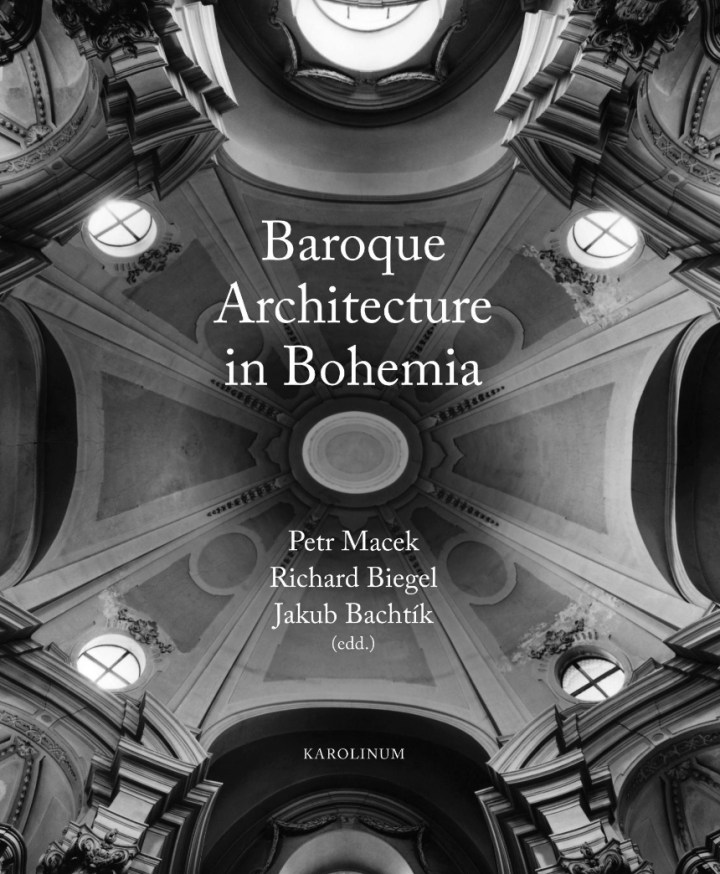 A complete history of Bohemian architecture during the seventeenth and eighteenth centuries.
The art of the seventeenth and eighteenth centuries forms one of the most important chapters in the cultural history of Bohemia. In this period, art attained a remarkably high level, with Bohemia emerging as a rival to the other cultural centers of Europe. This was especially true in terms of architecture, which not only transformed the appearance of towns and villages in Bohemia but also played a part in the creation of the phenomenon known as the Baroque, which to this day remains an essential part of Czech cultural identity.
The monumental Baroque Architecture in Bohemia brings together multiple generations of art historians from Charles University and the Czech Academy of Sciences to offer the single most comprehensive examination and exploration of Bohemian architecture during this extraordinary period. The book begins with the Renaissance roots of Baroque Bohemia: it introduces readers to the influence of the cultured and eccentric Rudolf II, who moved the seat of the Holy Roman Empire back to Prague, inviting foreign artists, architects, and alchemists with him; it shows the importance of Albrecht von Wallenstein, whose military success in the Thirty Years’ War heralded a massive building campaign that helped usher in the Baroque age. When the book moves to the period commonly understood as the Baroque, it discusses leading Czech architects, such as Jan Blažej Santini-Aichel and Kilian Ignaz Dientzenhofer, but also focuses on lesser-known regional architects and the important Italian architects and artists that left their mark on Bohemia. The architectural and artistic developments are all set among the broader cultural and social context of the seventeenth and eighteenth centuries. The book contains extensive pictorial documentation—most impressively Vladimír Uher and Martin Micka’s gorgeous architectural photographs.
c o n t e n t s
Prologue: The Renaissance Roots of the Architecture of the Modern Era in Bohemia
1 The Architecture of the Rudolfine Court
2 Art in the Thirty Years’ War: Lost and Found
3 From Lurago to Mathey: The Crystallization of an Architectural Language in the Later 17th Century
4 The Era of Great Themes and Groundbreaking Innovators
5 Architectural Synthesis in the Work of Kilian Ignaz Dientzenhofer
6 Between the Baroque and the Neoclassical: The Era of Architectural Plurality
7 Art, Life, Culture: Contexts of Baroque Architecture
New Book | Kant: A Revolution in Thinking
From Harvard UP:
Marcus Willaschek, Kant: A Revolution in Thinking, translated by Peter Lewis (Cambridge: Balknap Press, 2025), 416 pages, ISBN: 978-0674296107, $30.
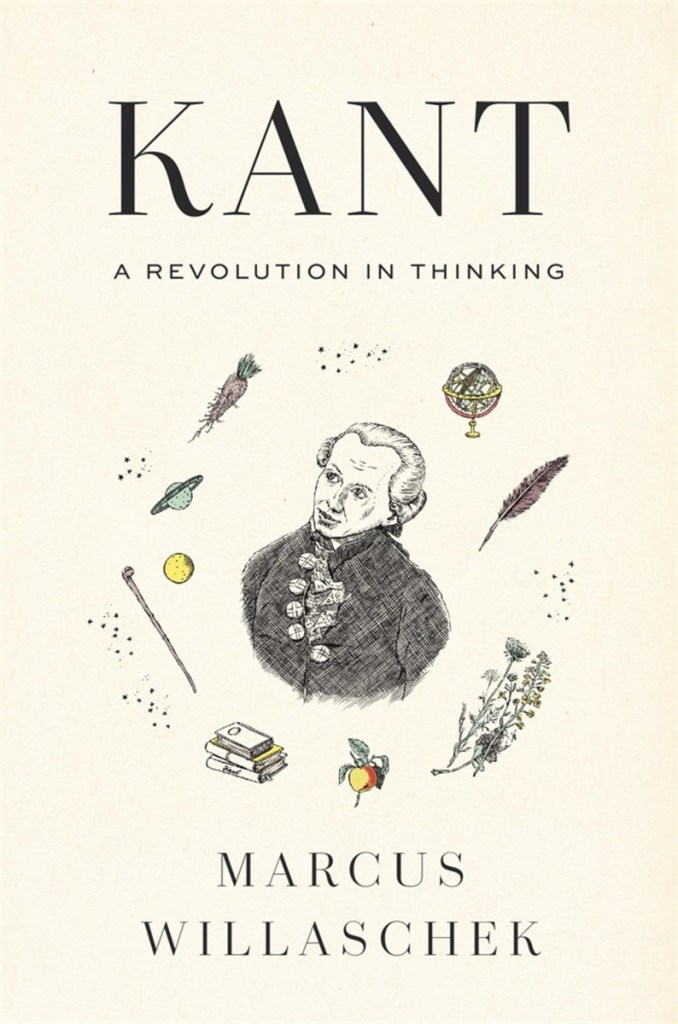 Immanuel Kant is undoubtedly the most important philosopher of the modern era. His Critique of Pure Reason, “categorical imperative,” and conception of perpetual peace in the global order decisively influenced both intellectual history and twentieth-century politics, shaping everything from the German Constitution to the United Nations Charter.
Renowned philosopher Marcus Willaschek explains why, three centuries after Kant’s birth, his reflections on democracy, beauty, nature, morality, and the limits of human knowledge remain so profoundly relevant. Weaving biographical and historical context together with exposition of key ideas, Willaschek emphasizes three central features of Kant’s theory and method. First, Kant combines seemingly incompatible positions to show how their insights can be reconciled. Second, he demonstrates that it is not only human thinking that must adjust to the realities of the world; the world must also be fitted to the structures of our thinking. Finally, he overcomes the traditional opposition between thought and action by putting theory at the service of practice.
In Kant: A Revolution in Thinking, even readers having no prior acquaintance with Kant’s ideas or with philosophy generally will find an adroit introduction to the Prussian polymath’s oeuvre, beginning with his political arguments, expanding to his moral theory, and finally moving to his more abstract considerations of natural science, epistemology, and metaphysics. Along the way, Kant himself emerges from beneath his famed works, revealing a magnetic personality, a clever ironist, and a man deeply engaged with his contemporary world.
Marcus Willaschek is Professor of Philosophy at Goethe University, Frankfurt, and a member of the Berlin-Brandenburg Academy of Science, where he is responsible for the German standard edition of Kant’s works. The author of four books, he is also coeditor of the three-volume Kant-Lexikon.
Exhibition | Stan Douglas: Tales of Empire
From the press release for the exhibition:
Stan Douglas: Tales of Empire
McMichael Canadian Art Collection, Kleinburg, Ontario, 5 December 2025 — 22 March 2026
Curated by Sarah Milroy
This winter, the McMichael Canadian Art Collection presents Stan Douglas: Tales of Empire, a landmark exhibition surveying three decades of work by internationally acclaimed Vancouver-based artist Stan Douglas. The exhibition brings together five major photographic series that explore the histories, legacies, and enduring reverberations of colonialism across continents and centuries. Curated by Frances & Tim Price Executive Director and Chief Curator Sarah Milroy, Tales of Empire investigates the power structures, mythologies, and lived realities shaped by imperialism through Douglas’s technically masterful and conceptually incisive lens.
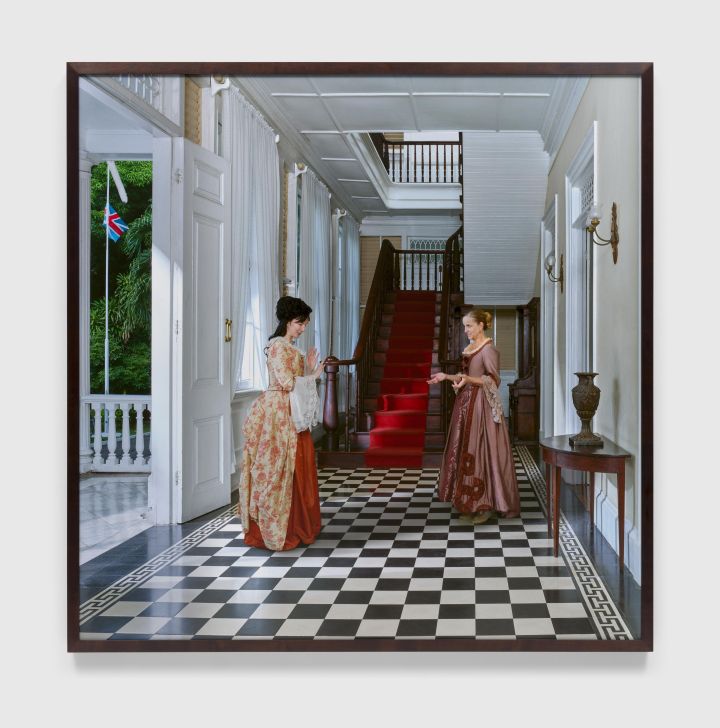
Stan Douglas, Act I, Scene V: In which Polly Peachum is Greeted at the Ducat Estate by Family Friend Diana Trapes, who Will Ultimately Betray Her, 2024, inkjet print on Dibond aluminum, 150 × 150 cm (courtesy of the artist, Victoria Miro, and David Zwirner).
• The Nootka Series (1996) — Created on the northwest coast of Vancouver Island, this series traces the enduring presence of Indigenous communities and moments of early contact with European settlers. At the McMichael, these photographs are being shown in dialogue with historical paintings by A.Y. Jackson, opening a compelling conversation between Douglas’s contemporary vision and the Group of Seven’s early twentieth century perspective.
• The Cuba Series (2005) — Capturing the complex architectural and political landscape of Havana and other Cuban towns, these images illuminate how centuries of Spanish, American, and Soviet influence have shaped the city’s identity and visual fabric.
• The Western Series (2006) — Set in British Columbia’s interior, this series examines landscapes marked by resource extraction, revealing how settler-driven development has altered the environment and reshaped the region.
• The Klatsassin Series (2006) — A cinematic re-imagining of a violent episode of Indigenous resistance in nineteenth-century British Columbia. Douglas invents a cast of characters associated with the event, blurring the boundaries between fact and fiction while probing how stories of colonial conflict are constructed and remembered.
• The Enemy of All Mankind (2024) — Douglas’s most recent project draws inspiration from Polly (1729), the satirical sequel to John Gay’s The Beggar’s Opera. Featuring a costumed ensemble, the series restages scenes of decadence, intrigue, and misadventure in the Caribbean, using Enlightenment-era satire to critique the moral bankruptcy of colonialism for a contemporary audience.
Across these bodies of work, Douglas dissects and dramatizes the machinery of empire—its spectacle, its systems, and its violence—while inviting viewers to reconsider how histories are recorded, contested, and retold.
◊ ◊ ◊ ◊ ◊
 Stan Douglas (b. 1960, Vancouver) is an internationally renowned artist whose multidisciplinary practice spans photography, film, video, installation, and theatre. Since the 1980s, he has created technically ambitious works that explore the complexities of history, collective memory, and the lasting imprint of colonialism. Through innovative uses of both analog and digital media, Douglas restages pivotal historical moments—often at cultural, political, or social tipping points—blurring the boundaries between documentary and fiction, cinema, and visual art.
Douglas has been featured at the Venice Biennale five times, most recently in 2022 with the acclaimed video installation ISDN. His work has been presented in solo exhibitions at major institutions worldwide, including the Centre Pompidou, MoMA, and the National Gallery of Canada and is held in leading museum collections across North America and Europe. Recent projects include a permanent public commission at New York’s Moynihan Train Hall (2021) and the recent survey Stan Douglas: Ghostlight at Bard College’s Hessel Museum of Art in 2025. He is the recipient of numerous awards, including the Audain Prize for Visual Art (2019); the Hasselblad Foundation International Award in Photography (2016); the third annual Scotiabank Photography Award (2013); and the Infinity Award from the International Center of Photography, New York (2012). In 2021, Douglas was knighted as a Chevalier of the Ordre des Arts et des Lettres by the French Minister of Culture, and in 2023 he was awarded an honorary doctorate by Simon Fraser University, Greater Vancouver. Douglas lives and works in Vancouver.
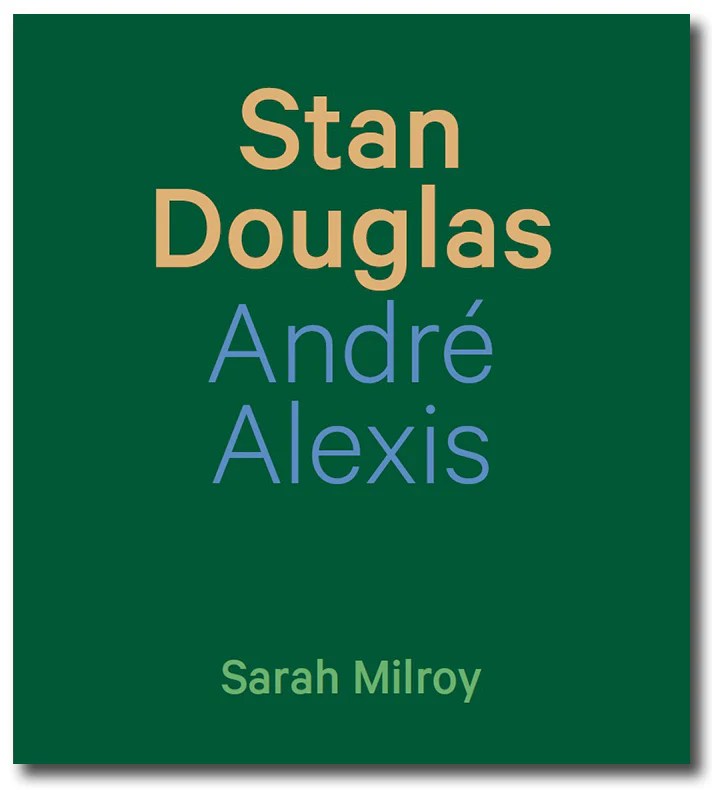
Stan Douglas: Tales of Empire (Kleinburg: McMichael Canadian Art Collection, 2025), 128 pages, $35 CAD. Introduction by Sarah Milroy, an interview with the artist, and an essay by André Alexis.
New Book | Race and the Scottish Enlightenment
From Yale UP:
Linda Andersson Burnett and Bruce Buchan, Race and the Scottish Enlightenment: A Colonial History, 1750–1820 (New Haven: Yale University Press, 2025), 304 pages, ISBN: 978-0300264388, $65. Series: The Lewis Walpole Series in Eighteenth-Century Culture and History.
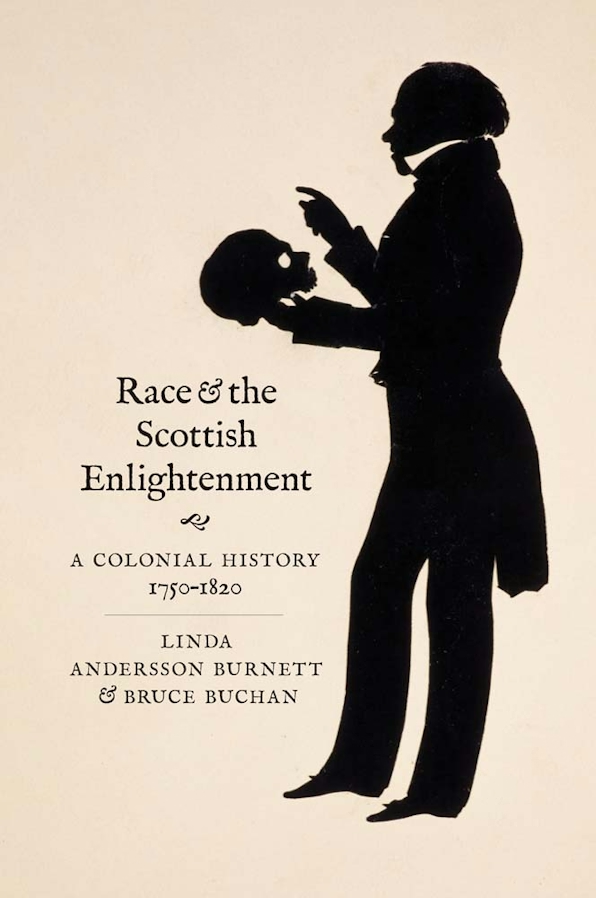 In the decades after 1750, an increasing number of former medical students from the University of Edinburgh construed humanity as a subject of both intellectual curiosity and colonial interest. They drew on a shared educational background, blending medicine with natural history and moral philosophy, in a range of encounters with non-European and Indigenous peoples across the globe whom they began to classify as races. Focusing on a surprising number of these understudied students, this book reveals the gradual predominance of race in Scottish Enlightenment thought.
Teaching provided a toolbox of concepts and theories for students who went on to careers as military and naval surgeons, colonial administrators, and natural historians. While some, such as Mungo Park—who traveled in Africa—are well known, many others such as the long-term residents in the Russian Empire, Matthew Guthrie and his wife, Maria Guthrie, or the Caribbean botanist Alexander Anderson are less remembered. Among this group were those such as the Pacific traveler Archibald Menzies and the circumnavigator of Australia, Robert Brown, who are known primarily as botanists rather than as ethnographers. Together they formed a global network of colonial travelers and natural historians sharing a common educational background and a growing interest in race.
Linda Andersson Burnett is a senior lecturer in the Department of History of Science and Ideas at Uppsala University, Sweden. Bruce Buchan is a professor in the School of Humanities, Languages, and Social Science at Griffith University, Australia.
New Book | Slaves in Paris
From Harvard UP:
Miranda Spieler, Slaves in Paris: Hidden Lives and Fugitive Histories (Cambridge: Harvard University Press, 2025), 256 pages, ISBN: 978-0674986541, $40.
 A pioneering biographical study of enslaved people and their struggle for freedom in prerevolutionary Paris, by an award-winning historian of France and the French Empire.
In the decades leading up to the French Revolution, when Paris was celebrated as an oasis of liberty, slaves fled there, hoping to be freed. They pictured Paris as a refuge from France’s notorious slave-trading ports.
The French were late to the slave trade, but they dominated the global market in enslaved people by the late 1780s. This explosive growth transformed Paris, the cultural capital of the Enlightenment, into a dangerous place for people in bondage. Those seeking freedom in Paris faced manhunts, arrest, and deportation. Some put their faith in lawyers, believing the city’s courts would free them. Examining the lives of those whose dashed hopes and creative persistence capture the spirit of the era, Miranda Spieler brings to light a hidden story of slavery and the struggle for freedom.
Fugitive slaves collided with spying networks, nosy neighbors, and overlapping judicial authorities. Their clandestine lives left a paper trail. In a feat of historical detective work, Spieler retraces their steps and brings to light the new racialized legal culture that permeated every aspect of everyday life. She pieces together vivid, granular portraits of men, women, and children who came from Africa, the Caribbean, and the Indian Ocean. We learn of their strategies and hiding places, their family histories and relationships to well-known Enlightenment figures. Slaves in Paris is a history of hunted people. It is also a tribute to their resilience.
Miranda Spieler is the author of Empire and Underworld: Captivity in French Guiana. She is Professor of History and Politics at the American University of Paris.
New Book | Turner and the Slave Trade
Distributed by Yale UP:
Sam Smiles, Turner and the Slave Trade (London: Paul Mellon Centre for Studies in British Art, 2025), 224 pages, ISBN: 978-1913107512, £30 / $40.
 While J. M. W. Turner’s iconic painting The Slave Ship (1840) is celebrated as a powerful denunciation of the transatlantic trade in enslaved people, his personal and professional ties to slavery tell a more nuanced story. This book provides the first detailed analysis of Turner’s evolving responses to slavery over his lifetime, from his financial investment in a Jamaican property worked by enslaved labourers to his later denunciation of the trade in his art. Drawing on extensive archival research, Turner and the Slave Trade traces the artist’s interactions with patrons tied to the plantation economy and examines the impact of abolitionist discourse on his work. Key chapters investigate The Slave Ship, its inspiration, and its contested interpretations, while situating Turner within broader debates about art, slavery and shifting public sentiment. Offering a nuanced understanding of how art engages with history’s most urgent issues, this important new study presents Turner as an exceptional yet complex figure, whose legacy is intertwined with the institution of slavery and its eventual abolition.
Sam Smiles is honorary professor at the University of Exeter, and the author of The Late Works of J. M. W. Turner: The Artist and his Critics (2020).
Exhibition | Art around 1800
Now on view at the Hamburger Kunsthalle:
Art around 1800: An Exhibition about Exhibitions
Kunst um 1800: Eine Ausstellung über Ausstellungen
Hamburger Kunsthalle, 5 December 2026 — 29 March 2026
Curated by Petra Lange-Berndt and Dietmar Rübel
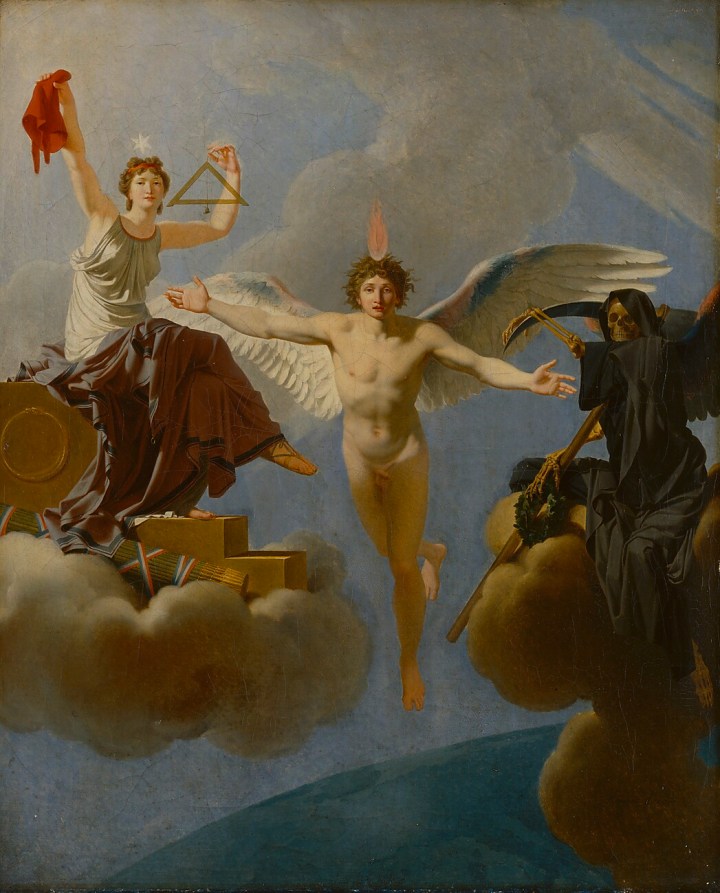
Jean-Baptiste Regnault, Liberty or Death, 1794, oil on canvas, 60 × 49 cm (Hamburger Kunsthalle; photo by Elke Walford).
Art around 1800 revisits the legendary exhibition cycle of that name on view at the Hamburger Kunsthalle some fifty years ago. Presented in nine parts from 1974 to 1981, the series examined the impact of art in the ‘Age of Revolutions’, launching seminal debates on the social relevance of art that continue to resonate today. The effect was to write a new history of European art by focusing on themes and artists that broke with the conventions of their time: Ossian, Caspar David Friedrich, Johann Heinrich Füssli, William Blake, Johan Tobias Sergel, William Turner, Philipp Otto Runge, John Flaxman, and Francisco Goya. The current exhibition will comment on the historical displays created under the aegis of then director Werner Hofmann and update their approach from a contemporary perspective. For this purpose, over 50 paintings, books, and works on paper from the Kunsthalle’s collection from around 1800 will be brought together with selected loans and works by contemporary artists.
Arranged in ten chapters, Art around 1800 examines themes such as dreams, political landscapes, and revolutionary energies from the viewpoint of the present day. Emphasis will also be placed on aspects that were missing from the shows of the 1970s, or which only came to light to some extent, yet are relevant for the period around 1800: feminism, Jewish culture, and people of colour. Like the original series of shows, the current exhibition is presented in the domed hall on the upper floor of the new museum wing inaugurated in 1919. In the 1970s, this area served as a central ‘space for contemplation’ and for curatorial experiments. Sculptor Marten Schech from Berlin has designed the exhibition architecture as a sculptural intervention.
Guest Curators
Petra Lange-Berndt (University of Hamburg)
Dietmar Rübel (Academy of Fine Arts Munich)
Petra Lange-Berndt and Dietmar Rübel, eds., Kunst um 1800, Kuratieren als wissenschaftliche Praxis: Die Hamburger Kunsthalle in den 1970er Jahren (Berlin: Hatje Cantz Verlag, 2024), 440 pages, ISBN: 978-3775756174, €48. With contributions by David Bindman, Johannes Grave, Charlotte Klonk, Petra Lange-Berndt, Jenny Nachtigall, Dietmar Rubel, Richard Taws, Monika Wagner, et al.
New Book | Picturing Landscape in an Age of Extraction
From The University of Chicago Press:
Stephanie O’Rourke, Picturing Landscape in an Age of Extraction: Europe and Its Colonial Networks, 1780–1850 (Chicago: The University of Chicago Press, 2025), 240 pages, ISBN: 978-0226841557, $45.
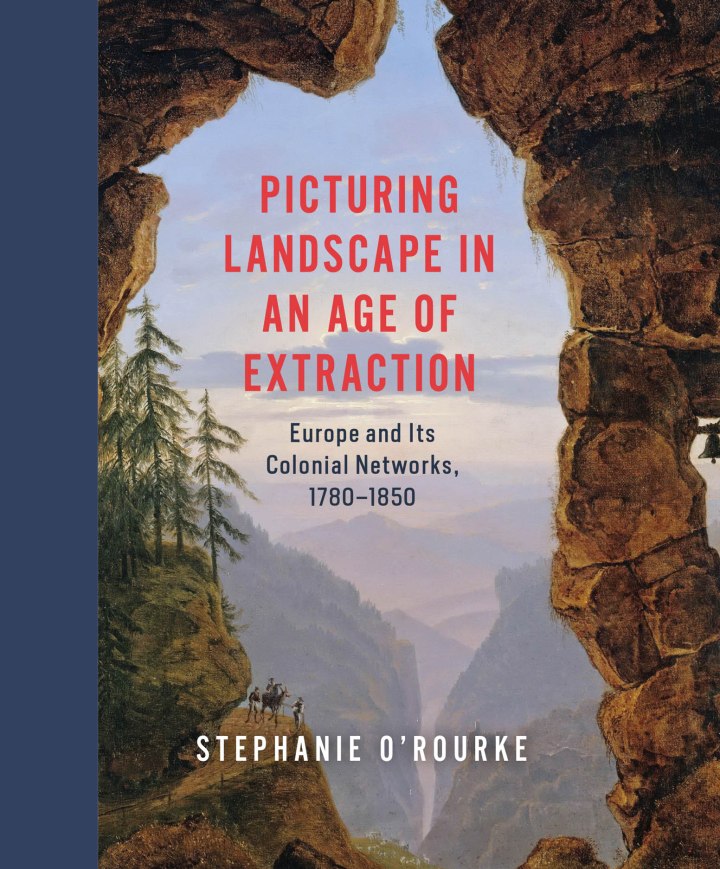 In the late eighteenth and early nineteenth centuries, European artists confronted the emergence of a new way of thinking about and treating the Earth and its resources. Centered on extraction, this new paradigm was characterized by large-scale efforts to transform and monetize the physical environment across the globe. With this book, Stephanie O’Rourke considers such practices, looking at what was at stake in visual representations of the natural world during the first decades of Europe’s industrial revolutions. O’Rourke argues that key developments in the European landscape painting tradition were profoundly shaped by industries including mining and timber harvesting, as well as by interlinked ideas about race, climate, and waste. Focusing on developments in Britain, France, Germany, and across Europe’s colonial networks, she explores how artworks and technical illustrations portrayed landscapes in ways that promoted—or pushed against—the logic of resource extraction.
Stephanie O’Rourke is a senior lecturer in art history at the University of St. Andrews, Scotland. She is the author of Art, Science, and the Body in Early Romanticism.
c o n t e n t s
Introduction
1 The French Landscape and the Colonial Forest
2 Mining Romanticism and the Abyss of Time
3 How to Scale a Volcano
4 Human Resources
Conclusion
Acknowledgments
Notes
Bibliography
Index
Exhibition | Versailles and the Origins of French Diplomacy
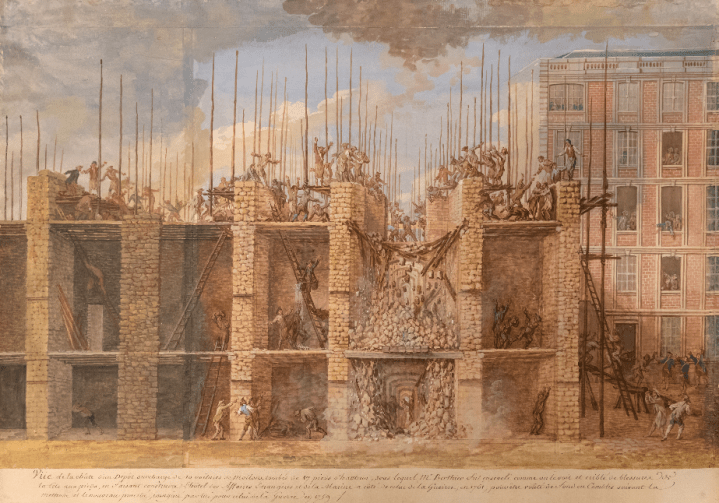
Louis-Nicolas van Blarenberghe, Accident survenu lors de la construction de l’hôtel des Affaires étrangères et de la Marine, à Versailles en 1761, ca. 1761, gouache over black chalk on paper, 38 × 56 cm (Bibliothèque Municipale de Versailles, Inv. 29359).
◊ ◊ ◊ ◊ ◊
Now on view at Versailles:
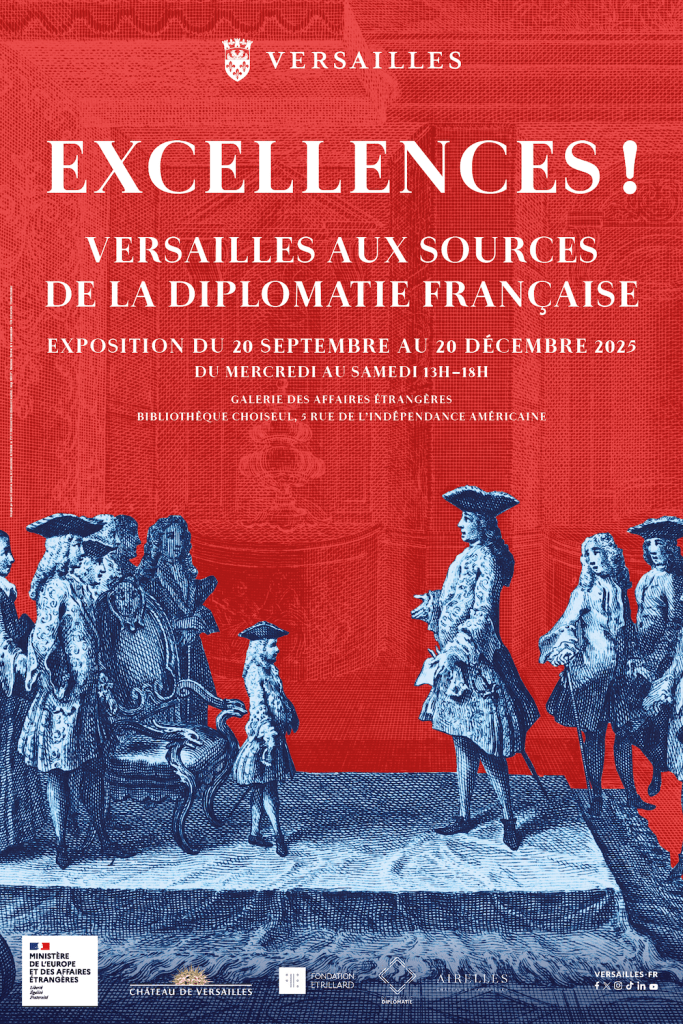
Excellences! Versailles aux Sources de la Diplomatie Française
Bibliothèque Choiseul, Versailles, 20 September — 20 December 2025
Curated by Sophie Astier and Vincent Haegele
La Ville de Versailles en collaboration avec les archives du Ministère de l’Europe et des Affaires étrangères présente l’exposition Excellences ! Versailles aux sources de la diplomatie française, dans un cadre emblématique : la Galerie des Affaires étrangères, lieu de diplomatie française et de la construction d’une administration moderne de la diplomatie. Une sélection exceptionnelle de documents retrace l’histoire de la diplomatie française sous l’Ancien Régime : 157 pièces originales dont près de la moitié, appartenant aux archives des Affaires étrangères, reviendront à Versailles pour la première fois depuis la Révolution française.
 Parmi ces pièces, on peut admirer des documents chargés d’histoire comme le traité de Cambrai dit Paix des Dames (1529), le traité de Westphalie qui termine la guerre de Trente Ans (1648), le traité de Paris (1763), la ratification du contrat de mariage scellant l’union de Louis XVI et Marie-Antoinette (1770), le traité de Versailles concluant la guerre d’Indépendance américaine (1783)…
Du règne de François Ier jusqu’à la guerre d’Indépendance américaine, découvrez l’histoire de la diplomatie française ainsi que la formalisation de ses pratiques et la construction d’une administration moderne. Le propos sera complété par différents portraits et objets d’arts permettant d’illustrer la vie d’ambassade et l’importance des cadeaux diplomatiques.
Une autre thématique abordée sera celle de la diplomatie officieuse, celle des espions, des messages codés et des opérations occultes, en faisant la part belle à ses acteurs les plus mystérieux, comme le chevalier d’Eon, qui sera évoqué par des correspondances, mais aussi par un étonnant portrait mi-homme mi-femme conservé dans les collections de la bibliothèque.
Le parcours de l’exposition est organisé en cinq étapes, qui sont à la fois chronologiques et thématiques. On y trouve une sélection de pièces tirées des collections de la bibliothèque municipale et des Archives diplomatiques, enrichies par quelques prêts exceptionnels venus d’autres institutions, notamment le Musée national des châteaux de Versailles et de Trianon. Dans chaque salle, un ou plusieurs documents constituent un « focus géographique » en lien avec les intitulés historiques des lieux. Le parcours se conclut sur la reconstitution d’un bureau de commis, tel qu’il existait dans la galerie sous Louis XV et Louis XVI.
The exhibition brochure is available here»
Excellences! Versailles aux sources de la diplomatie Française (Dijon: Éditions Faton, 2025), 192 pages, ISBN: 978-2878444056, €27. With contributions by Sophie Astier, Virginie Bergeret-Maës, Guillaume Frantzwa, and Vincent Haegele.










 Enfilade
leave a comment