Exhibition | Indian Skies: The Howard Hodgkin Collection

An Elephant and Keeper, India, Mughal, ca. 1650–60, opaque color and gold on paper
(New York: The Metropolitan Museum of Art, Howard Hodgkin Collection, 2022.187)
◊ ◊ ◊ ◊ ◊
Opening next month at The Met:
Indian Skies: The Howard Hodgkin Collection of Indian Court Painting
The Metropolitan Museum of Art, New York, 6 February — 9 June 2024
Over the course of sixty years, British artist Howard Hodgkin (1932–2017) formed a collection of Indian paintings and drawings that is recognized as one of the finest of its kind. A highly regarded painter and printmaker, Hodgkin collected works from the Mughal, Deccani, Rajput, and Pahari courts dating from the 16th to the 19th centuries that reflect his personal passion for Indian art. This exhibition presents over 120 of these works, many of which The Met recently acquired, alongside loans from The Howard Hodgkin Indian Collection Trust.
The works on view include stunning portraits, beautifully detailed text illustrations, studies of the natural world, and devotional subjects. The exhibition will also display a painting by Hodgkin, Small Indian Sky, which alludes to the subtle relationship between his own work, India, and his collection. This exhibition is accompanied by an issue of The Metropolitan Museum of Art Bulletin.
New Book | The Art of Cloth in Mughal India
From Princeton UP:
Sylvia Houghteling, The Art of Cloth in Mughal India (Princeton: Princeton University Press, 2022), 280 pages, ISBN: 978-0691215785, £58 / $68.
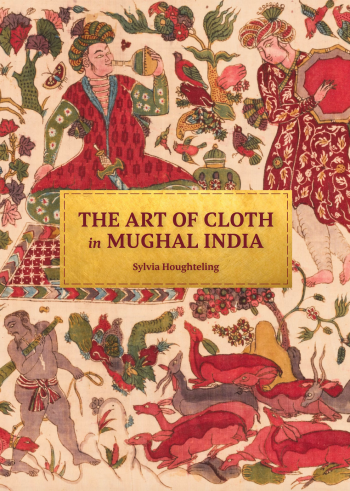 In the sixteenth and seventeenth centuries, a vast array of textiles circulated throughout the Mughal Empire. Made from rare fibers and crafted using virtuosic techniques, these exquisite objects animated early modern experience, from the intimate, sensory pleasure of garments to the monumentality of imperial tents. The Art of Cloth in Mughal India tells the story of textiles crafted and collected across South Asia and beyond, illuminating how cloth participated in political negotiations, social conversations, and the shared seasonal rhythms of the year. Drawing on small-scale paintings, popular poetry, chronicle histories, and royal inventory records, Sylvia Houghteling charts the travels of textiles from the Mughal imperial court to the kingdoms of Rajasthan, the Deccan sultanates, and the British Isles. She shows how the ‘art of cloth’ encompassed both the making of textiles as well as their creative uses. Houghteling asks what cloth made its wearers feel, how it acted in space, and what images and memories it conjured in the mind. She reveals how woven objects began to evoke the natural environment, convey political and personal meaning, and span the distance between faraway people and places. Beautifully illustrated, The Art of Cloth in Mughal India offers an incomparable account of the aesthetics and techniques of cloth and cloth making and the ways that textiles shaped the social, political, religious, and aesthetic life of early modern South Asia.
• Winner of the Charles Rufus Morey Book Award, College Art Association
• Shortlisted for the R.L. Shep Memorial Book Award, Textile Society of America
Sylvia Houghteling is assistant professor of history of art at Bryn Mawr College.
c o n t e n t s
Note on Transliteration
Introduction
1 Landscapes of Cloth in the Mughal Empire
2 The Tell-Tale Textile: Fabric and Emotions in Mughal Hindustan
3 The Moving Walls of the Amber Court
4 The Fame of Machilipatnam Cloth
5 The Flowering of Mughal Textiles in Britain
Conclusion
Acknowledgments
Notes
Bibliography
Index
Image Credits
New Book | Des étoffes pour le vêtement et la décoration
From PUR:
Aziza Gril-Mariotte, Des étoffes pour le vêtement et la décoration: Vivre en indiennes, France, XVIIIe–XIXe siècle (Rennes: Presses Universitaires de Rennes, 2023), 216 pages, ISBN: 978-2753592445, €32.
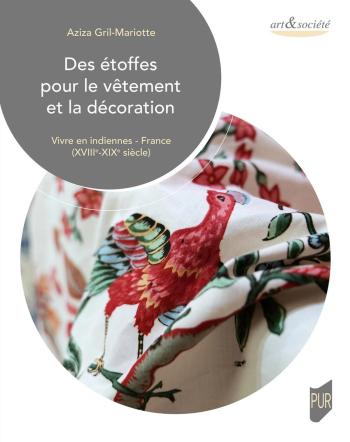 Retracer une histoire du goût en étudiant l’usage des indiennes dans la mode et la décoration intérieure aux XVIIIe et XIXe siècles, tel est l’objectif de ce livre. Il montre comment les manufacturiers ont participé à l’essor d’une société consumériste où la question des modes et des couleurs est indissociable du développement d’une industrie textile. En appréhendant des pratiques vestimentaires et décoratives sur deux siècles, les phénomènes de recyclages, de renouvellement ainsi que de permanence de certains décors sont analysés à la lumière de la fascination que le XVIIIe siècle exerça sur la société du XIXe siècle. Dans la parure vestimentaire, l’usage des indiennes raconte la diffusion dans la société de pratiques longtemps réservées aux élites et la capacité des industriels à se renouveler pour accompagner l’essor de la consommation des étoffes, depuis les marchandes de mode jusqu’aux grands magasins. La question de la place des cotonnades dans la décoration intérieure offre un point de vue renouvelé sur le rôle des étoffes dans l’embellissement du cadre de vie qui perdure et se développe au XIXe siècle en participant au concept des styles historiques.
Avec le soutien de la Fondation Jeanne et Pierre Spiegel et du laboratoire CRESAT de l’université Haute-Alsace.
Aziza Gril-Mariotte est professeur des universités en histoire de l’art moderne à Aix-Marseille université et chercheuse à l’UMR TELEMMe. Elle a présidé le musée de l’Impression sur étoffes entre 2019 et 2022. Actuellement, elle dirige le musée des Tissus et des arts décoratifs de Lyon. Ses travaux portent sur la création et l’innovation dans l’industrie textile aux XVIIIe et XIXe siècles, ainsi que sur les phénomènes de muséification et de patrimonialisation des étoffes depuis le XIXe siècle.
s o m m a i r e
I. Des indiennes aux étoffes, définir l’objet textile
Une nomenclature variée
Une production artistique pour un objet usuel
Des créations pour des usages variés
II. Indiennes et toiles peintes pour la mode
De nouvelles étoffes dans les garde-robes
La fabrique des modes
L’indiennage entre collections annuelles et motifs immuables
III. Les toiles peintes dans les intérieurs
Les étoffes et l’art de vivre à la française
Décorer son intérieur en indienne
Décors et étoffes intemporels
New Book | Turkey Red
From Bloomsbury:
Julie Wertz, Turkey Red (London: Bloomsbury Visual Arts, 2024), 232 pages, ISBN: 978-1350216518 (hardcover), $110 / ISBN: 978-1350216501 (paperback), $37.
 This multi-disciplinary study examines the exceptional Turkey red textile dyeing process and product. Prized for its brilliant colour and durability, yet notoriously difficult to produce, the textile was consumed locally and exported around the world. Considered one of the first instances of industrial espionage, the expansion of the Turkey red industry is closely linked to the Industrial Revolution and the emergence of a new global economy. Significant technological advances in chemistry and dyeing were motivated by the demands of Turkey red dyers and printers, who were located primarily in the west of Scotland, the north of England, and around Mulhouse, Switzerland.
This book explores the arc of the Turkey red industry, the evolution of the process through key producers and technical developments, the complicated printing process, and finishes with an examination of significant Turkey red collections and a selection of object case studies. The chemistry of the process is described in an accessible, contextual manner, highlighting the significance of the distinctive technique that yielded the best red attainable on cotton. Drawing on both historical and contemporary study, Turkey Red presents significant new research on the material characterisation of this fascinating, eye-catching textile, and offers an in-depth historical example of the global effect of textile consumption.
Julie Wertz is Beal Family Postgraduate Fellow in Conservation Science at Harvard Art Museums.
c o n t e n t s
List of Figures
Preface
Acknowledgments
Note on the Text
Introduction
1 The Most Brilliant Color Dyed on Cotton
1.1 Defining Turkey red
1.1.1 A reputable red
1.1.2 A complicated process
1.2 Identifying Turkey red
1.3 Material record
1.4 Conclusion
2 Global Exchanges and Anthraquinone Dyes
2.1 The origin and dissemination of Turkey red
2.1.1 India
2.1.2 Indonesia
2.1.3 The Levant and the Ottoman Empire
2.1.4 The Hapsburg Empire
2.1.5 France
2.1.6 Britain
2.2 Madder
2.2.1 The cultivation of madder
2.2.2 Madder composition and derivatives
2.3 Synthetic alizarin
2.3.1 Understanding alizarin
2.3.2 Alizarin synthesis and patent disputes
2.3.3 Synthetic alizarin products
2.4 Conclusion
3 The Dyeing, Chemistry, and Technological Advances of Turkey Red
3.1 Oiling
3.1.1 Oiling in the old process
3.1.2 The chemistry of oiled cotton
3.1.3 Ruminant dung and tannins
3.1.4 Turkey red oil and the new process
3.1.5 The Steiner process
3.2 Aluminium
3.2.1 Precipitated aluminium soaps
3.3 Dyeing
3.3.1 Color complexes in Turkey red
3.3.2 Blood and albumen
3.4 Clearing
3.5 Conclusions
4 Printed Turkey Red
4.1 Textile printing methods
4.2 Discharge printing
4.2.1 Lead plate press discharging
4.2.2 Acid paste discharging
4.3 A bright palette
4.3.1 Black, blue, yellow, and green
4.3.2 Identifying colorants on Turkey red prints
4.4 Design
4.4.1 Industrial design and production
4.4.2 European design for the export market
4.5 Conclusions
5 Turkey Red in the Industrial Revolution
5.1 Turkey red industry by country
5.1.1 France
5.1.2 England
5.1.3 Scotland
5.1.4 Switzerland
5.1.5 The Netherlands
5.1.6 North America
5.1.7 Other locations
5.2 Working conditions and labor
5.3 Colonialism
5.4 Conclusions
6 Trade, Use, and Object Record
6.1 Documentary evidence of availability
6.2 How Turkey red was used
6.2.1 Bandanas
6.2.2 Domestic textiles, quilts and bedcovers
6.2.3 Accessories, garments, and tools
6.3 Conclusions
Conclusions
Glossary
References
Index
Exhibition | Within Reach of Asia
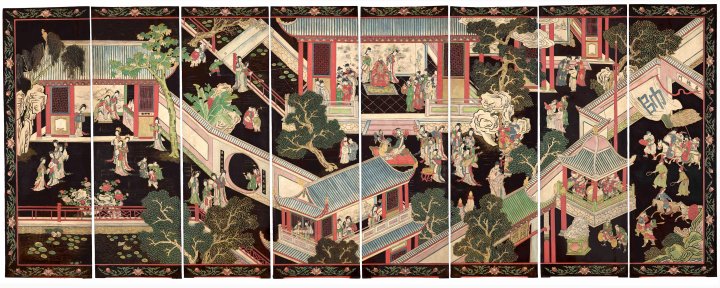
Eight-leaf screen, depicting a Palace Scene with the Arrival of a Delegation and Festivities in Honor of Tang General Guo Ziyi 郭子儀, Qing dynasty, Kangxi (1662–1722) or Qianlong (1736–1795) period, late 17th or 18th century; wood, ‘Coromandel’ lacquer, 135 × 346 cm (Dijon: Musée des beaux-arts). In the 18th century, the screen was part of the collection of Jehannin de Chamblanc (1722–1797).
◊ ◊ ◊ ◊ ◊
A review of the exhibition (in French) by Gilles Kraemer, with excellent installation photographs, is available at Le Curieux des Arts:
Within Reach of Asia: Asian Art Collectors and Dealers in France, 1750–1930
Musée des Beaux-Arts, Dijon, 20 October 2023 — 22 January 2024
Curated by Catherine Tran-Bourdonneau, Pauline d’Abrigeon, and Pauline Guyot
On 20 October 2023, the Musée des Beaux-Arts in Dijon opened its new exhibition À portée d’Asie: Collectors, Collectors and Dealers of Asian Art in France, 1750–1930, labelled of national interest by the Ministry of Culture. In partnership with the Institut National de l’Histoire de l’Art (INHA), the exhibition highlights two centuries of enthusiasm for Asian arts in France, from the royal collections of Louis XV and Marie-Antoinette, to collections gathered for commercial and scientific purposes between 1850 and 1930, along with the vogue for Japonism shared by artists, collectors, and simple amateurs of the bibelotage in the 19th century.
 Extending a research program of INHA, the exhibition brings together national collections and Far Eastern collections of regional museums, which include multiple objects brought from Asia over the ages. With more than 300 works—diverse technically (with lacquers, porcelains, ivories, bronzes, screens, prints and illustrated books, silk paintings, and theater masks), as well as historically and geographically (with objects from China, Japan, Korea, and Cambodia)—the exhibition draws on prestigious loans from important national institutions, including the Musée Guimet, the Louvre, the Palace of Versailles, the Musée des Arts Décoratifs, and the Musée du Quai Branly. Also well represented are the Asian collections of the region (those of Florine Langweil in Colmar and Strasbourg, Jules Adeline in Rouen, and Adhémard Leclère in Alençon) and especially those of Dijon’s Musée des Beaux-Arts. Moreover, through a participatory sponsorship campaign, €10,000 was raised for the museum’s restoration of a Coromandel lacquer screen from the 18th-century collection of Jehannin de Chamblanc.
Organized by the City of Dijon, in partnership with the National Institute of Art History (INHA), the exhibition is recognized as being of national interest by the Ministry of Culture, which provides exceptional financial support. The label ‘Exhibition of National Interest’ (Exposition d’intérêt national) was created by the Ministry of Culture in 1999 to support remarkable exhibitions organized by French museums in different regions. Such exhibitions highlight themes that reflect the richness and diversity of the collections of museums in France. The label rewards an innovative museum discourse, a new thematic approach, a scenography and a mediation device with the aim of reaching various audiences.
Pauline d’Abrigeon, Pauline Guyot, and Catherine Tran-Bourdonneau, eds., À portée d’Asie: Collectionneurs, collecteurs et marchands d’art asiatique en France, 1750–1930 (Paris: Lienart éditions, 2023), 320 pages, ISBN: 978-2359064049, €35.
New Book | Pierrot and His World
From Manchester UP (and currently discounted dramatically at Amazon). . . .
Marika Takanishi Knowles, Pierrot and His World: Art, Theatricality, and the Marketplace in France, 1697–1945 (Manchester: Manchester University Press, 2024), 264 pages, ISBN: 9781526174093, £85 / $130.
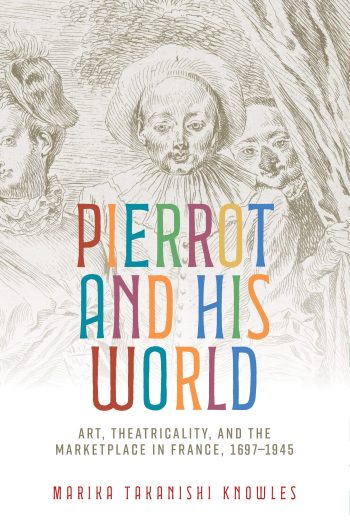 Pierrot, a theatrical stock character known by his distinctive costume of loose white tunic and trousers, is a ubiquitous figure in French art and culture. This richly illustrated book offers an account of Pierrot’s recurrence in painting, printmaking, photography and film, tracing this distinctive type from the art of Antoine Watteau to the cinema of Occupied France. As a visual type, Pierrot thrives at the intersection of theatrical and marketplace practices. From Watteau’s Pierrot (c. 1720) and Édouard Manet’s The Old Musician (1862) to Nadar and Adrien Tournachon’s Pierrot the Photographer (1855) and the landmark film Children of Paradise (1945), Pierrot has given artists a medium through which to explore the marketplace as a form for both social life and creative practice. Simultaneously a human figure and a theatrical mask, Pierrot elicits artistic reflection on the representation of personality in the marketplace.
Marika Takanishi Knowles is a Senior Lecturer in Art History at the University of St Andrews.
c o n t e n t s
Introduction
1 Antoine Watteau and the fête marchande
2 Pierrot-co-co
3 New Paris, Old Pierrot (New Pierrot, Old Paris)
4 Nadar Charlatan
5 Old Clothes and the Dreams of the Artist
Conclusion
Index
New Book | The Art of the Actress
Part of the Elements in Eighteenth-Century Connections series from Cambridge UP (digital downloads are available for free until 25 January!).
Laura Engel, The Art of the Actress: Fashioning Identities (New York: Cambridge University Press, 2024), 75 pages, ISBN: 978-1009486811 (hardcover), $65 / ISBN: 978-1108977906 (paperback), $22. Also available digitally through Cambridge UP.
 The Art of the Actress: Fashioning Identities considers how eighteenth-century visual materials across genres, such as prints, portraits, sculpture, costumes, and accessories, contribute to the understanding of the nuances of female celebrity, fame, notoriety, and scandal. The ‘art’ of the actress refers to the actress represented in visual art, as well as to the actress’s labor and skill in making art ephemerally through performance and tangibly through objects. Moving away from the concept of the ‘actress as muse,’ a relationship that privileges the role of the male artist over the inspirational subject, Laura Engel focuses instead on the varied significance of representations, reproductions, and re-animations of actresses, female artists, and theatrical women across media. Via case studies, this Element explores how the archive charts both a familiar and at times unknown narrative about female performers of the past.
Laura Engel is a Professor in the English Department at Duquesne University, where she specializes in eighteenth-century British literature and theater. She is the author of Women, Performance, and the Material of Memory: The Archival Tourist, 1780–1915 (2019); Austen, Actresses, and Accessories: Much Ado about Muffs (2015); and Fashioning Celebrity: Eighteenth-Century British Actresses and Strategies for Image Making (2011). She also co-edited, with Elaine McGirr, Stage Mothers: Women, Work, and the Theater, 1660–1830 (2014).
c o n t e n t s
Introduction: The Art of the Actress in the Eighteenth Century
1 The Paradox of Pearls
2 The Actress as Artist and the Artist as Actress: Anne Damer and Angelica Kauffman
3 Mary Anne’s Muff: Actresses and Satire
4 Epilogue: Unfinished Business: Elizabeth Inchbald, Lady Cahir, Sir Thomas Lawrence, and the Aftermath of the Art of the Actress
References
The Burlington Magazine, December 2023
The eighteenth century in the December issue of The Burlington, which focuses on Spain:
The Burlington Magazine 165 (December 2023)

Francisco de Goya, Self-Portrait with Dr Arrieta, 1820, oil on canvas, 115 × 77 cm (Minneapolis Institute of Art, 52.14).
a r t i c l e
• Mercedes Cerón Peña, “Goya’s Self-Portrait with Dr Arrieta,” pp. 1300–04.
In 1820 Goya painted a portrait of himself as he had appeared during his serious illness of the year before, attended by his doctor, Eugenio García Arrieta. Newly discovered biographical information about Arrieta suggests that the painting’s red and and green colour scheme may allude to the political views he shared with Goya.
r e v i e w s
• Michael Hall, Review of the new Galería de las Colecciones Reales (Royal Collections Gallery) in Madrid (opened 28 June 2023), pp. 1339–43.
• Stephen Lloyd, Review of the exhibition Return of the Gods (World Museum, Liverpool, (April 2023 — February 2024), pp. 1343–45. “Britain’s largest assemblage of Classical sculpture outside London belongs to National Museums Liverpool . . . In 1959 Liverpool City Council and its museums were gifted the entirety of the Ince Blundell collection—approximately six hundred heavily restored Roman marbles . . . collected by . . . Henry Blundell (1724–1810), a wealthy Catholic landowner, between 1776 and 1809.”
• Humphrey Wine, Review of the catalogue raisonné by Joseph Assémat-Tessandier, Louis Lagrenée, dit l’Aîné (1725–1805) (Arthena, 2022), pp. 1364–65.
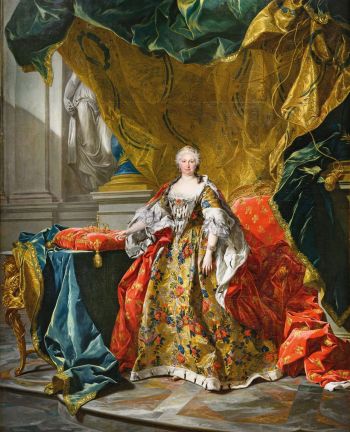
Louis-Michel van Loo, Portrait of Isabel Farnese, 1737, oil on canvas, 341 × 264 cm (Madrid: Galería de las Colecciones Reales).
• Rebeka Hodgkinson, Review of Stephanie Barczewski, How the Country House Became English (Reaktion, 2023), pp. 1370–71.
• Peter Humfrey, Review of Eveline Baseggio, Tiziana Franco, and Luca Molà, eds., La chiesa di Santa Maria dei Servi e la comunità veneziana dei Servi di Maria, secoli XIV–XIX (Viella, 2023), pp. 1374–75. “The demolition of the great fourteenth-century church of the Servi in about 1812–13 represents one of the most grievous of the many losses suffered by Venice’s artistic heritage during the Napoleonic period.”
o b i t u a r y
• Saloni Mathur, Obituary for Kavita Singh (1964–2023), pp. 1379–80.
Professor of art history and Dean of the School of Arts and Aesthetics at Jawaharlal Nehru University, Kavita Singh became internationally known for her publications on the history and politics of museums and the pre-modern art of South Asia. An authority on Indian court paintings, she was an inspiring colleague and teacher who publicly championed both her university and the study of Mughal art in the subcontinent.
New Book | Mariana de Neoburgo
The English description of the book from CEEH:
Gloria Martínez Leiva, with a foreword by Javier Jordán de Urríes, Mariana de Neoburgo, última reina de los Austrias: Vida y legado artístico (Madrid: Centro de Estudios Europa Hispánica, 2022), 432 pages, ISBN: 978-8418760082, €50.
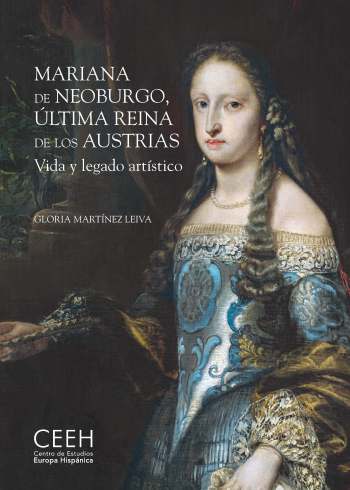 Maria Anna of Neuburg (1667−1740), the second wife of Charles II (Carlos II), was queen consort of Spain for ten years and queen dowager for another forty. However, she is a little-known figure to whom historians have barely paid attention. This study takes a look at her life, her image and her artistic patronage, which was not unaffected by the heightened political tension that characterised European history around 1700 and resulted in a change of dynasty in Spain.
Against this turbulent international backdrop, the survey of the queen’s life explores in depth important aspects of court art such as the decoration of her apartments in the royal palaces and sites in which she lived, drawing on documents held in Spanish and foreign archives. It also examines the residences she occupied as a widow in Toledo and Guadalajara, as well as her homes and palaces in Bayonne during her thirty-two-year exile. The approximately one hundred known portraits of her help both unravel her personality and trace the artistic, stylistic and conceptual evolution of the genre over more than half a century, showing how her image—first as queen consort and subsequently as queen dowager—was shaped and publicly projected.
A comprehensive overview of the works of art she commissioned—especially from Luca Giordano—or owned, the portrait gallery she assembled, the paintings she sent to her brother the elector palatine, her richly stocked library and her exceptional founding of the chapel of Loreto in Chiusa (Italy) sheds new light on the patronage of Maria Anna, who is finally studied in her full dimension as the last Habsburg queen.
Gloria Martínez Leiva, who received a PhD in art history for her thesis on Maria Anna of Neuburg, has focused her research on the Spanish royal collections, on which she has published many articles. She is co-author of Quadros y otras cosas que tiene Su Magestad Felipe IV en este Alcázar de Madrid. Año de 1636 (2007) and El inventario del Alcázar de Madrid de 1666. Felipe IV y su colección artística (2015). She has pursued a career in cultural institutions such as Patrimonio Nacional and the Fundación Universitaria Española. She is director of the platform InvestigArt.
New Book | Praying to Portraits
Largely a 17th-century story, but also entirely relevant to the 18th century with good 18th-century examples—and to my thinking, a really smart, helpful book for thinking about portraits of any sort (and incredibly well-written). –CH
From The Pennsylvania State UP:
Adam Jasienski, Praying to Portraits: Audience, Identity, and the Inquisition in the Early Modern Hispanic World (University Park: Penn State University Press, 2023), 232 pages, ISBN: 978-0271093444, $120.
 In Praying to Portraits, art historian Adam Jasienski examines the history, meaning, and cultural significance of a crucial image type in the early modern Hispanic world: the sacred portrait.
Across early modern Spain and Latin America, people prayed to portraits. They prayed to ‘true’ effigies of saints, to simple portraits that were repainted as devotional objects, and even to images of living sitters depicted as holy figures. Jasienski places these difficult-to-classify image types within their historical context. He shows that rather than being harbingers of secular modernity and autonomous selfhood, portraits were privileged sites for mediating an individual’s relationship to the divine. Using Inquisition records, hagiographies, art-theoretical treatises, poems, and plays, Jasienski convincingly demonstrates that portraiture was at the very center of broader debates about the status of images in Spain and its colonies.
Highly original and persuasive, Praying to Portraits profoundly revises our understanding of early modern portraiture. It will intrigue art historians across geographical boundaries, and it will also find an audience among scholars of architecture, history, and religion in the early modern Hispanic world.
Adam Jasienski is Associate Professor of Art History in the Meadows School of the Arts at Southern Methodist University in Dallas.
c o n t e n t s
List of Illustrations
Acknowledgements
List of Abbreviations
Introduction: Portraits and Sacred Images in Early Modernity
1 Sacrificing the Self
2 True Portraits, Lying Portraits
3 Repainting Portraits
4 Portraits as Sacred Images
Conclusion: The Life Histories of Sacred Portraits and the History of Sacred Portraiture
Notes
Bibliography
Index










leave a comment