New Book | The Ingenious Mr Flitcroft
Coming this fall from Lund Humphries:
Gill Hedley, with an introduction by Charles Saumarez Smith, The Ingenious Mr Flitcroft: Palladian Architect, 1697–1769 (London: Lund Humphries, 2023), 192 pages, ISBN: 978-1848226500, £50.
 Henry Flitcroft was first employed by the leading aristocratic architect of the time, Richard Boyle, Lord Burlington, who helped him to establish his long career. Flitcroft had about 50 clients over 40 years, working for many dynasties, including the royal family, the Bedfords, the Yorke/Hardwickes, and the Malton/Rockinghams. Remarkably, he was employed regularly by the Duke of Montagu and his family from 1725 to 1765, and the Hoare family from 1728 to his death in 1769, and was responsible for some of the great country houses of the period including Wimpole, Woburn Abbey, and Wentworth Woodhouse. This is the first book which details his life and examines his complete body of work. It sets Flitcroft within his social context, providing insights into those for whom he worked as well as his fellow architects. Flitcroft waged fierce battles to maintain his professional positions at Westminster Abbey and St Paul’s, and the documents are revealed here for the first time. The book dissects the dramatic story of Flitcroft’s insane son and the legal cases that ensued that link Flitcroft and G.E. Street, who inherited Flitcroft’s own house in Hampstead. In addition, Flitcroft’s furniture designs are assessed along with his notable churches and London buildings including Chatham House, Benjamin Franklin House, and Pushkin House. Finally, his last great project at Stourhead is re-examined.
Gill Hedley started her career as a curator in museums, organising exhibitions for the British Council and later, as Director of the Contemporary Art Society. She has recently worked as a freelance exhibition curator, museum consultant, and advisor to individual artists. She now writes full time.
c o n t e n t s
Introduction by Sir Charles Saumarez-Smith
1. Hampton Court, Apprencticeship, and Lord Burlington
2 Twickenham, Marriage, and Bower House
3 Amesbury, Montagu House, and St Giles-in-the-Fields
4 St Giles-in-the-Fields
5 Wentworth Woodhouse and Ditchley
6 St Olave’s, Savannah, Stoke Edith, Wimborne, and Frognal
7 Wimpole and Hampstead
8 Shobdon, Windsor, and Woburn
9 Stourhead
10 Stourhead, Redlynch, and Kingston House
11 Henry Flitcroft, Junior
12 Reputation
Online Book Launch | Pevsner’s Oxfordshire
From The Mellon Centre:
Simon Bradley, Nikolaus Pevsner, and Jennifer Sherwood, Oxfordshire: Oxford and the South-East, Pevsner Architectural Guides: Buildings of England (New Haven: Yale University Press, 2024), 800 pages, ISBN: 978-0300209297, $85.
Book Launch with Simon Bradley, Geoffrey Tyack, and James Davies
Online, Paul Mellon Centre for Studies in British Art, London, 2 November 2023, 6pm
 Simon Bradley, series editor of the Pevsner Architectural Guides, will discuss the latest volume in the series with Geoffrey Tyack of Kellogg College, Oxford. The book addresses half a century of change and development since the original edition of 1974 by Nikolaus Pevsner and Jennifer Sherwood, completing the revision of Oxfordshire initiated with Alan Brooks’s North and West volume of 2017. Fresh accounts are provided of the many ambitious new buildings for the university and its colleges, familiar landmarks such as the Bodleian Library and the Radcliffe Camera are reinterpreted and the many renovations and extensions are described and assessed. Oxford’s commercial buildings, suburbs, and houses are explored in depth, including much that is published here for the first time. The accompanying county area extends from the outskirts of Oxford to Henley-on-Thames, following the historic Thames-side boundary of Oxfordshire and taking in the hills of the southern Chilterns. Here the volume includes enhanced accounts of major country houses such as Nuneham Courtenay and Thame Park, new assessments of church restorations, furnishings and stained glass, more inclusive coverage of post-war buildings, and a fuller selection of vernacular and rural architecture across the whole of this attractive and rewarding quarter of rural England. The evening will also include a contribution from James O. Davies, who will talk about the challenges and rewards of taking photographs of the region’s best buildings for the new volume.
Yale University Press is delighted to offer attendees of the virtual launch a special discount price for the new Pevsner guide to Oxfordshire. Attendees will receive a discount code with their Eventbrite confirmation email.
Book online tickets here»
Simon Bradley is series editor of the Pevsner Architectural Guides and co-author of four other Buildings of England volumes: London 1: The City, London 6: Westminster, Cambridgeshire, and Berkshire.
Geoffrey Tyack is Fellow Emeritus of Kellogg College, Oxford, where he has taught urban and architectural history for many years. He is co-author of the Pevsner Architectural Guides’ Berkshire volume and has also published widely on 19th- and 20th-century architectural subjects. His recent books include The Historic Heart of Oxford University (2022).
James Davies has worked as an architectural photographer for thirty years. He has published widely, with books on English prisons, tin mining, post-war buildings, Stonehenge, and many Pevsner volumes, as well as in magazines including Wallpaper, The World of Interiors, Country Life, and Blueprint.
New Book | Dr Andrew Coltée Ducarel
Available for pre-order from Bernard Quaritch Ltd:
Robin Myers, with Andrew Burnett and Renae Satterley, ‘I do not eat the bread of idleness’: Dr Andrew Coltée Ducarel (1713–1785), Huguenot, Advocate, Librarian, Architectural Historian, Numismatist, and Antiquary (Leicester: The Garendon Press, 2023), 264 pages, £45.
 This volume brings together revised versions of four of Robin Myers’s papers on aspects of Andrew Ducarel’s life and work published between 1994 and 2002, and “The Life and Times of the Ducarel Brothers,” her recent introductory essay to Two Huguenot Brothers: Letters of Andrew and James Coltée Ducarel, 1732–1773 (The Garendon Press, 2019), which has been updated with a section by Adam Pollock on the life of the Ducarel children among other Huguenot families in Greenwich. It also contains new essays by Robin Myers on the collaboration and developing friendship between Ducarel and Philip Morant (1700–1770), historian of Essex, and on Doctors’ Commons, an institution whose name most know but few understand. To complement these, Renae Satterley, Librarian of the Middle Temple, contributes an essay on Doctors’ Commons Library, and Andrew Burnett, former Keeper of Coins and Medals at the British Museum, on Ducarel as numismatist. The appendix comprises a family tree from Ducarel to the present day, an annotated list of works of Andrew Ducarel, a timeline of Ducarel’s life, and bibliography. Penelope Bulloch, Christine Ferdinand, and Lorren Boniface helped to edit the work.
Dr Andrew Coltée Ducarel (1713–1785) and his two younger brothers were brought to England in 1722 as infants by their widowed mother fleeing persecution for her faith. Ducarel became a civilian or advocate of Doctors’ Commons, the Inn of Court specialising in Roman and Canon law which dealt with ecclesiastical law, marriage, divorce, and probate, and maritime law in the High Court of Admiralty. Ducarel made a good living as an advocate, which fully occupied him in term time, while his vacations were given to his work as Librarian of Lambeth Palace from 1754. He was an active member of the Society of Antiquaries, pioneered the study of Norman architecture, and was a keen book and coin collector.
‘I do not eat the bread of idleness’ has been designed by Robert Dalrymple. Consisting of 264 pages, measuring 285 x 170 mm, it is profusely illustrated with portraits, coins from Ducarel’s collection, plates from works by Andrew Ducarel, and other contemporary prints sourced by Penelope Bulloch; it has attractive endpapers, sewn binding, rounded and backed and an eye-catching jacket. It is designed as a companion piece to Two Huguenot Brothers and will appeal to those who appreciate excellence in book production.
The Burlington Magazine, September 2023
The eighteenth century in the September issue of The Burlington:
The Burlington Magazine 165 (September 2023)

Bed, by Ince and Mayhew, 1768, mahogany and other woods, with original blue silk ‘flowered tabby’ in the ‘Large Antique Headboard’, tester and cornice, height 356 cm (Stamford: The Burghley House Collection).
a r t i c l e r e v i e w
• Lucy Wood, “The Industry and Ingenuity of William Ince and John Mayhew,” pp. 996–1001.
Fifty years ago, the question was asked what had become of the furniture made by Ince and Mayhew, one of the most successful and long-lasting firms of cabinetmakers in eighteenth-century London? A monograph by Hugh Roberts and Charles Cator, decades in the making, provides the answer in a revelatory picture of the achievements of these rivals of Thomas Chippendale.
r e v i e w s
• Christoph Martin Vogtherr, Review of the exhibition Rosalba Carriera – Perfection in Pastel (Gemäldegalerie Alte Meister, Zwinger, Dresden, 2023), pp. 1007–10.
• Christopher Baker, Review of the Redevelopment of the National Portrait Gallery, London (reopened in June 2023), pp. 1013–17.
• Raha Shahidi, Review of the exhibition catalogue L’Amour en scène! François Boucher, du théâtre à l’opéra, ed. by Hélène Jagot, Jessica Degain, and Guillaume Kzerouni (Éditions Snoeck, 2022), pp. 1029–31.
• Christopher Rowell, Review of Tessa Murdoch, ed., Great Irish Households: Inventories from the Long Eighteenth Century (John Adamson, 2022) and Conor Lucey, ed., House and Home in Georgian Ireland: Spaces and Cultures of Domestic Life (Four Courts Press, 2022), pp. 1038–40.
• Armin Kunz, Review of Mareike Hennig and Neela Struck, eds., Zeichnen im Zeitalter Goethes: Zeichnungen und Aquarelle aus dem Freien Deutschen Hochstift (Hirmer, 2022), pp. 1040–42.

Sewell Bequest, 2008,3008.1). Room 18 of the National Portrait Gallery, London, showing the newly acquired Portrait of Mai (Omai) by Joshua Reynolds (c. 1776) as the centrepiece of a group of eighteenth-century portraits (Photography by Dave Parry).
Print Quarterly, September 2023
The long eighteenth century in the latest issue of Print Quarterly:
Print Quarterly 40.3 (September 2023)
a r t i c l e s
 • Vitalii Tkachuk, “Averkiy Kozachkovskyi and Western Sources of Kyiv Prints, 1720s–40s,” pp. 265–86.
This article features the oeuvre of the Ukrainian engraver Averkiy Kozachkovskyi (active 1721–46), whose illustrated output by the press of the Orthodox monastery Kyiv of the Caves (Kyiv Pechersk Lavra) numbers about forty engravings. He primarily produced book illustrations, but also illustrated printed oaths taken by new members of the local student confraternity. His sources derived largely from seventeenth- and eighteenth-century Catholic imagery from German, Flemish, and French schools, several of which are discussed in detail throughout the article, especially the compositions of Peter Paul Rubens. Such borrowings testify to the willingness of Orthodox recipients to accept imagery—unaltered in iconography or style—stemming from other denominations and cultures. The paper contributes to our knowledge of Ukrainian engraving and to the study of the global transfer of images during the early modern period.
• Nicholas J.S. Knowles, “Thomas Rowlandson’s The Women of Muscovy and Other Russeries after Jean-Baptiste Le Prince,” pp. 287–301.
This article discusses a previously unidentified series of prints by Thomas Rowlandson (1757–1827), after Jean-Baptiste Le Prince (1734–1781), mentioned only as a single lot in the sale of his art collection and studio contents. No definitive set of these “Various Dresses of the Women in Muscovy” has been found, but the author has identified several substantial groups in public and private collections; the largest of these, with twenty-two prints, is in the British Museum. Most of these Rowlandson impressions reside among Le Prince originals and have previously been catalogued as by or after Le Prince. As a series overall, five hundred and forty impressions are claimed to have been produced in the lot description. The article continues with an in-depth discussion of the series and its context. An appendix lists all known impressions of Rowlandson’s Women of Muscovy prints and their location.
n o t e s a n d r e v i e w s
• Mark McDonald, Review of Susan Stewart, The Ruins Lesson: Meaning and Material in Western Culture (The University of Chicago Press, 2020), pp. 322–25. This book explores the significance of ruins in Western art and literature, paying close attention to the evidentiary role of prints and how the printmaking process parallels the ruinous lifecycle of its subject matter. In the review, Piranesi is cited as a fascinating example of creating trompe l’oeil in his prints, while later discussions focus on the discovery and metaphorical associations of Rome’s antique ruins in the eighteenth century.
• David Bindman, Review of the exhibition catalogue, Edina Adam and Julian Brooks, William Blake: Visionary (Getty Publications, 2020), pp. 330–31. This brief review pertains to a previously rescheduled, now forthcoming, exhibition on William Blake at the J. Paul Getty Museum. The author examines the collecting of Blake in America and some of the curatorial choices for this anticipated show.
 • Patricia Mainardi, Review of Pascal Dupuy and Rolf Reichardt, La caricature sous le signe des révolutions. Mutations et permanences, XVIIIe–XIXe siècles (Presses Universitaires de Rouen et du Havre, 2021), pp. 331–34. This book and review introduce the origins and rapid development of caricature during the French Revolutionary period, focusing on how topical imagery and signs manifested into an accessible visual language capable of being understood by ordinary citizens at the time. More importantly, many of these signifying tropes, such as severed heads and raids on government buildings have become universally recognisable up to the present day.
• Mark Bills, Review of Tim Clayton, James Gillray: A Revolution in Satire (Paul Mellon Centre for Studies in British Art, 2022), pp. 353–57. This extensive review of the latest monograph on James Gillray highlights the British artist’s unique achievements in the world of graphic satire. The book bravely tackles some of his previously neglected areas, such as very early and pornographic prints, or previously unpublished ones that can now be contextualised. The same is true of Gillray’s interplay of word and image (his titles, conversations and commentary of the images), which the author believes is Clayton’s most original piece of scholarship in this book.
• Jeannie Kenmotsu, Review of the exhibition catalogue, Hans Bjarne Thomsen, ed., Japanische Holzschnitte: Aus der Sammlung Ernst Grosse / Japanese Woodblock Prints: From the Ernst Grosse Collection (Michael Imhof Verlag, 2018), pp. 357–60. This review recognises the value of this catalogue in bringing Ernst Grosse and his collecting practices to a larger audience, especially since the Museum Natur und Mensch’s collection of Japanese woodblock prints was a historically important case of intersection between European japonisme and ethnological approaches to non-Western cultures. Most of Grosse’s acquisitions were made through the art dealer Hayashi Tadamasa.
Exhibition | Liotard and The Lavergne Family Breakfast

The exhibition opens this fall at The National Gallery (with the press release available here) . . .
Discover Liotard and The Lavergne Family Breakfast
The National Gallery, London, 16 November 2023 — 3 March 2024
In the second of our ‘Discover’ exhibitions, which explore well-known paintings through a contemporary lens, we reunite for the first time in 250 years Swiss painter Jean-Étienne Liotard’s pastel and oil versions of The Lavergne Family Breakfast. With the pastel and oil works side by side, the exhibition presents a rare opportunity to compare the difference in technique and effect between the two.

Jean-Etienne Liotard, The Lavergne Family Breakfast, 1754, pastel on paper stuck down on canvas, 80 × 106 cm (London: National Gallery, accepted in lieu of Inheritance Tax by HM Government from the estate of George Pinto, 2019, NG6685).
Long regarded as Liotard’s masterpiece, The Lavergne Family Breakfast (executed in Lyon in 1754) is the artist’s largest and most ambitious work in pastel. Despite the medium’s notorious delicacy, Liotard skilfully reproduced complex textures: the sheen on the metal coffee pot, the shiny ceramic jug, the silky fabrics and reflections, in the black lacquer tray. Liotard was extremely versatile, producing works in pastel, oil, enamel, chalk, and even on glass. Highly unusually, he returned to The Lavergne Family Breakfast 20 years later to make an exact replica in oil.
Liotard (1702–1789) worked across the length and breadth of 18th-century Europe. Following four years in Constantinople, he grew a long beard, adopted Turkish dress, and nicknamed himself ‘the Turkish painter’. The exhibition showcases the raw materials used to make pastels as well as drawings, paintings, and miniatures that seek to bring this idiosyncratic artist to life.
Francesca Whitlum-Cooper, with contributions by Iris Moon, Discover Liotard & The Lavergne Family Breakfast (New Haven: Yale University Press, 2024), 120 pages, ISBN: 978-1857097023, $20.
New Book | The Future Future
Adam Thirlwell, The Future Future: A Novel (New York: Farrar, Straus and Giroux, 2023), 352 pages, ISBN: 978-0374607616, £19 / $28.
 A wild story of female friendship, language, and power, from France to colonial America to the moon, from 1775 to this very moment: a historical novel like no other.
It’s the eighteenth century, and Celine is in trouble. Her husband is mostly absent. Her parents are elsewhere. And meanwhile men are inventing stories about her—about her affairs, her sexuality, her orgies, and addictions. All these stories are lies, but the public loves them and spreads them like a virus. Celine can only watch as her name becomes a symbol for everything rotten in society. This is a world of decadence and saturation, of lavish parties and private salons, of tulle and satin and sex and violence. It’s also one ruled by men—high on colonial genocide, natural destruction, crimes against women, and, above all, language. To survive, Celine and her friends must band together in search of justice, truth, and beauty. Fantastical, funny, and blindingly bright, Adam Thirlwell’s The Future Future follows one woman on an urgently contemporary quest to clear her name and change the world.
Adam Thirlwell was born in London in 1978. He is the author of four novels, and his work has been translated into thirty languages. His essays appear in The New York Review of Books and the London Review of Books, and he is an advisory editor of The Paris Review. His awards include a Somerset Maugham Award and the E. M. Forster Award from the American Academy of Arts and Letters; in 2018 he was made a Fellow of the Royal Society of Literature. He has twice been selected by Granta as one of its Best of Young British Novelists.
New Book | Goya and the Mystery of Reading
From Vanderbilt University Press:
Luis Martín-Estudillo, Goya and the Mystery of Reading (Nashville: Vanderbilt University Press, 2023), 268 pages, ISBN: 978-0826505330, $120 / ISBN: 978-0826505323 (paperback), $50. Also available as an ebook.
 Spanish artist Francisco de Goya (1746–1828) lived through an era of profound societal change. One of the transformations that he engaged passionately was the unprecedented growth both in the number of readers and in the quantity and diversity of texts available. He documented and questioned this reading revolution in some of his most captivating paintings, prints, and drawings. Goya and the Mystery of Reading explores the critical impact this transition had on the work of an artist who aimed not to copy the world around him, but to see it anew—to read it. Goya’s creations offer a sustained reflection on the implications of reading, which he depicted as an ambiguous, often mysterious activity: one which could lead to knowledge or ecstasy, to self-fulfillment or self-destruction, to piety or perdition. At the same time, he used reading to elicit new possibilities of interpretation. This book reveals for the first time the historical, intellectual, and artistic underpinnings of reading as one of the pillars of his art.
Luis Martín-Estudillo is a professor and Collegiate Scholar at the University of Iowa. His previous books include The Rise of Euroskepticism, winner of an NEH Open Book Award. He is executive editor of the Hispanic Issues series.
c o n t e n t s
Author’s Note
Introduction: Francisco de Goya and the Reading Revolutions
1 Reading and Politics
2 Reading and the Self
3 Reading, Leisure, and Sensuality
4 Reading and the Contours of the Human
Afterword: Words Written at the Edge of Shadows
Notes
Bibliography
Image Credits
Index
Exhibition | Hokusai: Beyond the Great Wave

Katsushika Hokusai, Under the Wave off Kanagawa (The Great Wave), from Thirty-Six Views of Mt Fuji, late 1831, color woodblock print (London: The British Museum, acquired with the assistance of Art Fund and a contribution from the Brooke Sewell Bequest, 2008,3008.1).
◊ ◊ ◊ ◊ ◊
Opening in October at the Bowers Museum:
Beyond the Great Wave: Works by Hokusai from the British Museum
The British Museum, London, 25 May — 13 August 2017
Bowers Museum, Santa Ana, California, 21 October 2023 — 7 January 2024
Katsushika Hokusai (Japanese, 1760–1849) is the renowned artist behind The Great Wave, one of the most iconic prints ever made. Originally part of the series Thirty-Six Views of Mount Fuji, this seminal vision of man in nature is just one of the estimated 30,000 prints that Hokusai designed over his 70-year career. This exhibition includes a beautiful early example of The Great Wave and ventures beyond to feature a broad selection of works that Hokusai produced right up to his death at the age of 90.
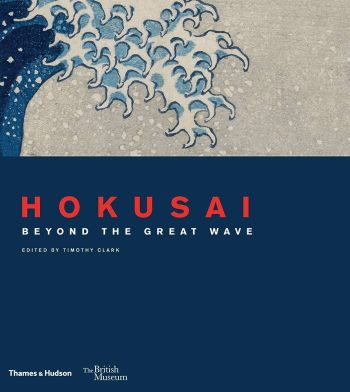 Visitors will be able to examine Hokusai’s personal beliefs through more than 100 paintings, drawings, woodblock prints, and illustrated books that speak to his early career, rise to fame, interest in the natural and supernatural worlds, personal life, and search for immortality. Distinct from the art of his Japanese contemporaries, Hokusai’s work is intensely individual, subjective, energized, and sublime; and the exhibition will provide a powerfully emotional and spiritual experience.
Hokusai never left Japan, but his work traveled around the globe to inspire many European artists and collectors such as Monet and Van Gogh. The exhibition includes biographical portraits of six individuals who helped build the Hokusai collection at the British Museum and shows how these scholars and proponents of Japanese art understood and appreciated Hokusai’s genius, skill, and invention.
The presentation of this exhibition is a collaboration between the British Museum and the Bowers Museum.
Timothy Clark, ed., Hokusai: Beyond the Great Wave (London: Thames & Hudson, 2017), 352 pages, ISBN: 978-0500094068, $65.
New Book | Art and Architecture of Sicily
From Lund Humphries:
Julian Treuherz, Art and Architecture of Sicily (London: Lund Humphries, 2023), 320 pages, ISBN: 978-1848226043, £40 / $80.
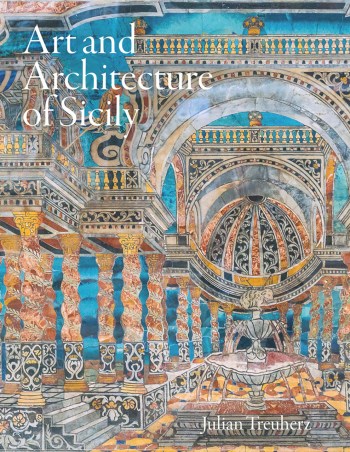 Sicily’ s strategic position in the centre of the Mediterranean led to settlement or conquest by a succession of different peoples—Phoenicians, Greeks, Romans, Byzantines, Muslims, Normans, Germans, French, Spanish—each one leaving its traces on Sicilian culture. This book provides a chronological survey, each section opening with a brief historical overview which is followed with an authoritative and engaging account of the development of the period’ s art and architecture. The leading architects, artists and stylistic currents are all discussed and outstanding individual buildings and works of art are analysed in detail, while archaeology, urban development, patronage and decorative arts are also covered. This is not a story of artistic conquests, but as a successive layering of different cultures: the way each one interacted with its predecessors produced art and architecture quite distinct from anywhere else in Europe.
Julian Treuherz is an art historian who was Keeper of Art Galleries for National Museums Liverpool between 1989 and 2007. He has written many books, articles and exhibition catalogues, and over the last twenty years he has spent part of each year in Sicily studying its art and architecture.
c o n t e n t s
• Introduction
• Prehistoric Sicily
• The Greeks come to Sicily: The Archaic Period
• The Greeks in Sicily: The Classical Period
• Punic Sicily
• The Greeks in Sicily: The late Classical and Hellenistic Periods
• Sicily, Province of Rome
• Early Christian, Byzantine, and Arabic Sicily
• The Normans in Sicily: A New Architectural Style
• The Normans in Sicily: The Royal Workshops, the Pleasure Pavilions, and the Later Cathedrals
• Sicily under the Hohenstaufen Emperors
• Late Medieval Sicily: German, French, and Aragonese Rule
• Sicily under the Spanish Viceroys: The 15th Century
• Sicily under the Spanish Viceroys: The 16th Century
• The Coming of the Baroque to Western Sicily
• The Earthquake of 1693 and the Rebuilding of Eastern Sicily
• Late Baroque Architecture in Western Sicily
• Baroque Painting, Sculpture, and Decorative Arts
• Neoclassicism in Sicily
• The Search for a New Style: Sicily, 1840–1918
• Sicily after 1918










 Enfilade
leave a comment