New Book | The Art of Colour
From Yale UP and Thames & Hudson:
Kelly Grovier, The Art of Colour: The History of Art in 39 Pigments (New Haven: Yale University Press, 2023), 256 pages, ISBN: 978-0300267785, £30 / $38.
 As featured on BBC Worldwide, a captivating new history of art told through the storied biographies of colors and pigments
In this refreshing approach to the history of color, Kelly Grovier takes readers on an exciting search for the intriguing and unusual. In Grovier’s telling, a color’s connotations are never fixed but are endlessly evolving. Knowledge of a pigment and its history can unlock meaning in the works that feature it. Grovier employs the term ‘artymology’ to suggest that color is a linguistic device, where pigments stand in for syllables in art’s language. Color is the site of invigorating conflict—a battleground where past and present, influence and originality, and superstition and science merge into meanings that complicate and intensify our appreciation of a given work. How might it change our understanding of a well-known masterpiece like Vincent van Gogh’s Starry Night to know that the intense yellow moon in that painting was sculpted from clumps of dehydrated urine from cows that were fed nothing but mango leaves? Or that the cobalt blue pigment in Van Gogh’s sky shares a material bloodline with the glaze of Ming Dynasty porcelain? Consisting of ten chapters, each presenting a biography of a family of colors, this volume mines a rich vein of pigmentation from prehistoric cave painting to art of the present day. The book also includes beautifully designed features exploring important milestones in the history of color theory from the Enlightenment to the twentieth century.
Kelly Grovier is an acclaimed poet, columnist, and feature writer for BBC Culture. He is the author of several books, including A New Way of Seeing: The History of Art in 57 Works.
c o n t e n t s
Introduction: Artymology
1 Red
Red Ochre • Carmine • Rose Madder • Vermillion • Red Lead
Colourful Minds: Isaac Newton’s Opticks (1704)
2 Orange
Orpiment • Saffron • Chrome Orange • Cadmium Orange
Colourful Minds: Tobias Mayer’s The Affinity of Colour Commentary (1775)
3 Yellow
Yellow Ochre • Lead-tin Yellow • Naples Yellow • Indian Yellow • Chrome Yellow • Cadmium Yellow • Arylide Yellow
Colourful Minds: Mary Gartside’s Essay on a New Theory of Colour (1808)
4 Green
Verdigris • Malachite • Emerald Green • Veridian
Colourful Minds: Goethe’s Theory of Colours (1810)
5 Blue
Azurite • Ultramarine • Cobalt Blue • Prussian Blue • Artificial Ultramarines
Colourful Minds: Philipp Otto Runge’s Color Sphere (1810)
6 Purple
Tyrian Purple • Cobalt Violet
Colourful Minds: Michel Eugène Chevreul’s The Principles of Harmony and Contrast of Colours (1839)
7 Black
Charcoal • Bone Black
Colourful Minds: Emily Noyes Vanderpoel’s Color Problems (1902)
8 White
Lead White • Calcite • Kaolin
Colourful Minds: Albert Henry Munsell’s Atlas of the Munsell Color System (1915)
9 Brown
Umber • Van Dyke Brown • Mummia • Excrement
Colourful Minds: Johannes Itten’s Utopia 1921
10 Precious Metals
Gold • Silver
Exhibition | Black Founders: The Forten Family of Philadelphia
Now on view at the Museum of The American Revolution:
Black Founders: The Forten Family of Philadelphia
Museum of The American Revolution, Philadelphia, 11 February — 26 November 2023
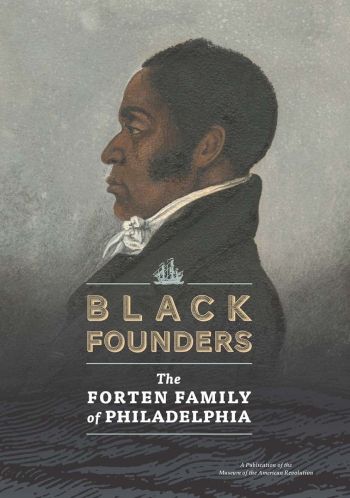 When James Forten (1766–1842) walked the streets of Philadelphia as a young man in the 1770s, he was surrounded by the sights and sounds of transformation. He heard the words of the Declaration of Independence read aloud for the first time in 1776 before setting sail to fight for independence in 1781. Born a free person of African descent, Forten built upon his coming-of-age in a revolutionary city and his wartime experience to forge himself into a changemaker in Philadelphia and the young United States, becoming a successful businessman, philanthropist, and stalwart abolitionist.
In our new special exhibition Black Founders: The Forten Family of Philadelphia, the Museum introduces visitors to Forten and his descendants as they navigated the American Revolution and cross-racial relationships in Philadelphia to become leaders in the abolition movement in the lead-up to the Civil War and the women’s suffrage movement. Using objects, documents, and immersive environments, Black Founders: The Forten Family of Philadelphia explores the Forten family’s roles in the Revolutionary War, business in Philadelphia, and abolition and voting rights from 1776 to 1876.
The exhibition features more than 100 historical artifacts, works of art, and documents from 38 different lenders, including both institutions and private collectors, as well as the Museum’s own collection. Rare historical objects on loan from descendants of the Forten family are on view for the very first time in a public exhibit.
The unique journey and exceptional story of this family of Revolutionaries explores the legacy of the American Revolution, the history of the American experiment of liberty, equality, and self-government, and the ongoing work to improve the nation’s dedication to the principle that “all men are created equal.”
Black Founders: The Forten Family of Philadelphia (Philadelphia: Museum of the American Revolution, 2023), ISBN: 978-1933153445, $38.
New Book | Woodland Imagery in Northern Art, c.1500–1800
From Lund Humphries:
Leopoldine van Hogendorp Prosperetti, Woodland Imagery in Northern Art, c.1500–1800: Poetry and Ecology (London: Lund Humphries, 2022), 160 pages, ISBN: 978-1848224940, £45 / $80.
 Woodland Imagery in Northern Art reconnects us with the woodland scenery that abounds in Western painting, from Albrecht Dürer’s intense studies of verdant trees, to the works of many other Northern European artists who captured ‘the truth of vegetation’ in their work. These incidents of remarkable scenery in the visual arts have received little attention in the history of art, until now. Prosperetti brings together a set of essays which are devoted to the poetics of the woodlands in the work of the great masters, including Claude Lorrain, Jan van Eyck, Jacob van Ruisdael, Peter Paul Rubens, Rembrandt and Leonardo da Vinci, amongst others. Through an examination of aesthetics and eco-poetics, this book draws attention to the idea of lyrical naturalism as a conceptual bridge that unites the power of poetry with the allurement of the natural world. Engagingly written and beautifully illustrated throughout, Woodland Imagery in Northern Art strives to stimulate the return of the woodlands to the places where they belong—in people’s minds and close to home.
Leopoldine Prosperetti is a writer and academic. She is Instructional Professor in the School of Art at the University of Houston, and has written and edited a number of books including Green Worlds in Early Modern Italy: Art and the Verdant Earth (Amsterdam University Press, 2019) and Landscape and Philosophy in the Art of Jan Brueghel (Ashgate, 2009).
C O N T E N T S
Preface
Introduction
Kindle’s Promise
Dürer’s Linden
Jan van Eyck’s Adoration of the Lamb
The Poet’s Catalogue
The Copse
Survivor Sole
Sights of Tivoli
Love in a Ducal Forest
In the Heart of the Forest
Down by the Riverside
Epilogue
Bibliography
Illustrations
Call for Essays | Interpretations of Longinus in the Early Modern Period
From ArtHist.net:
Interpretations of Longinus in the Literature, Painted and Printed Imagery of the Early Modern Period
Edited Volume of Essays To Be Published in 2025
Proposals due by 15 July 2023; final chapters due by 1 July 2024
This volume of the series Trends in Classics (to be published by De Gruyter) seeks to explore aspects of Longinian ideas, addressing in particular the concept of the sublime. It will bring together scholars of art history, history of ideas, literature, and philosophy to reflect upon the reception of these ideas in the literature and the art of Italy, Spain, and the Low Countries from the 15th through the 18th century. Considering that there is probably no direct evidence concerning the Longinian sublime as a productive theory in the early modern times, the primary interest lies in possible interpretations of works in certain artistic media (paintings and prints) as well as re-readings of the Peri hypsus in the literature of the period.
The starting point is the relationship among artists, literati, and patrons; the connections of artworks to various textual sources; the existence of sublime/Longinian literature in libraries of the period; and the tracing of relevant text dissemination. The network of acquaintance with the notion of the sublime may be opened up towards other directions, such as politics, the treatment of the human body, the aesthetics of antiquity, and the Renaissance. The tackling of a complex problem such as the reception of Longinian ideas, makes cross-disciplinary research imperative.
The completed volume will be published in 2025. Drafts from participants will be discussed during an online workshop in February 2024. The presentations will be 20 minutes long. Contributors are invited to submit their proposals in English. There is a two-stage submission procedure.
15 July 2023
Please send a 250-word proposal (in English) and a short cv (500 words) to all the members of the editorial board:
• Ianthi Assimakopoulou, National Kapodistrian University of Athens, ianthiassim@icloud.com
• Nafsika (Nancy) Litsardopoulou, Athens School of Fine Arts, nancylitsardo@hotmail.com
• Evina Sistakou, Aristotle University of Thessaloniki, sistakou@gmail.com
15 September 2023
Selected abstracts will be invited to participate in the online international workshop in February 2024, under the aegis of the National and Kapodistrian University of Athens – Department of History and Archaeology.
February 2024
Online workshop.
1 July 2024
Submission of final versions of the papers (up to 7000 words, excluding bibliography). Following a peer review process, the editorial board will make final decisions on the acceptance of papers.
New Book | Jacopo Alessandro Calvi (1740–1815)
From Silvana Editoriale:
Irene Graziani, with contributions by Francesca Maria Conti, Igino Conti, and Ilaria Negretti, Jacopo Alessandro Calvi, detto Il Sordino (1740–1815): Accademico e Pittore (Milan: Silvana Editoriale, 2022), 512 pages, ISBN: 978-8836652884, €40.
 Nella Bologna della seconda metà del Settecento Jacopo Alessandro Calvi (Bologna, 1740-1815) diviene il principale competitore dei fratelli Ubaldo e Gaetano Gandolfi. Formatosi sotto l’ala di Giampietro Zanotti, segretario dell’Accademia Clementina, fin dagli anni giovanili si sperimenta nelle «dive arti sorelle» della pittura e della poesia, privilegiando un criterio elettivo nel processo di imitazione della natura. Testimoniano il suo successo l’annessione all’Accademia Clementina (1770) e il gran numero di commissioni, soprattutto pale di destinazione ecclesiastica.
Anche nel tempo della «fatal rivoluzione», che comporta una drastica riduzione delle opportunità di lavoro per tutti gli artisti, Calvi regge il colpo, superando le difficoltà del momento, sia attraverso l’intensificarsi dell’attività letteraria — gli si devono fra l’altro la prima monografia critica di Guercino, edita nel 1808, e uno studio su Francesco Francia, pubblicato nel 1812 — sia attraverso lo svolgimento di un ruolo di perito presso l’Accademia Clementina, impegnata nell’ingrato compito di governare il rischio di dispersione dei beni d’arte durante le spoliazioni napoleoniche.
Pur estraneo ai valori giacobini, viene convocato come commissario nel Concorso per la ‘Riconoscenza Nazionale’ (1802), indetto a Milano allo scopo di celebrare il ritorno di Napoleone dopo la parentesi austriaca; e nel 1804 sarà annoverato fra i professori della nuova Accademia di Belle Arti di Bologna. Con il nuovo secolo la sua carriera riesce a trovare ragioni di soddisfazione anche sul fronte della produzione artistica: attraverso un’intelligente lettura critica della maniera del tardo Guercino e del dolce e devoto Francesco Francia, la sua pittura saprà farsi anticipatrice di istanze poi affermatesi nella Bologna tornata papale, appena prima della morte di Calvi, avvenuta a un mese dalla Battaglia di Waterloo.
C O N T E N T S
Catalogo delle opere
Dipinti e bozzetti
Disegni
Stampe su disegno o da dipinti di Jacopo Alessandro Calvi
Opere espunte
Opere segnalate dalle fonti, ma non reperite, non identificate o non ancora rintracciate — Irene Graziani
Disegni di animali di Jacopo Alessandro Calvi: inediti — Francesca Maria Conti
Tavole
Jacopo Alessandro Calvi collezionista: dipinti, disegni e altre opere presenti nello ‘Studio del Sordino’ — Igino Conti
Ferdinando Belvisi, Elogio storico di Jacopo Alessandro Calvi — a cura di Ilaria Negretti
Apparati — a cura di Irene Graziani
Regesto
Appendice documentaria
Indice topografico delle opere
Indice dei nomi
Bibliografia
Exhibition | Giacomo Ceruti: A Compassionate Eye
From The Getty:
Giacomo Ceruti: A Compassionate Eye
Brescia Musei Foundation, 14 February — 11 June 2023
The Getty Center, Los Angeles, 18 July — 29 October 2023
 In a group of remarkably haunting paintings by the Italian 18th-century artist Giacomo Ceruti, beggars, vagrants, and impoverished workers are portrayed in mesmerizing realism, emanating a sense of dignity and emotional depth. Why were these subjects painted? Where and how were these works displayed, and for whom? At a time when severe inequalities continue to mark even the wealthiest societies, Ceruti’s work testifies to the enduring power of art to reflect our shared humanity.
Organized with Fondazione Brescia Musei.
From The Getty Shop:
Davide Gasparotto, ed., with contributions by Roberta D’Adda, Francesco Frangi, Alessandro Morandotti, and Lorenzo Coccoli, Giacomo Ceruti: A Compassionate Eye (Los Angeles: J. Paul Getty Museum, 2023), 128 pages, ISBN: 978-1606068366, $28.
The northern Italian artist Giacomo Ceruti (1698–1767) was born in Milan and active in Brescia and Bergamo. For his distinctive, large-scale paintings of low-income tradespeople and individuals experiencing homelessness, whom he portrayed with dignity and sympathy, Ceruti came to be known as Il Pitocchetto (the little beggar). Accompanying the first US exhibition to focus solely on Ceruti, this publication explores relationships between art, patronage, and economic inequality in early modern Europe, considering why these paintings were commissioned and by whom, where such works were exhibited, and what they signified to contemporary audiences. Essays and a generous plate section contextualize and closely examine Ceruti’s pictures of laborers and the unhoused, whom he presented as protagonists with distinct stories rather than as generic types. Topics include depictions of marginalized subjects in the history of early modern European art, the career of the artist and his significance in the history of European painting, and period discourses around poverty and social support. A detailed exhibition checklist, along with provenance, exhibition history, and a bibliography, provides information critical for the further understanding of Ceruti’s oeuvre.
Davide Gasparotto is senior curator of paintings and chair of curatorial affairs at the J. Paul Getty Museum.
◊ ◊ ◊ ◊ ◊
Note (added 6 August 2023) — The posting was updated to include the Brescia venue, where the exhibition was entitled Miseria & Nobiltà: Giacomo Ceruti nell’Europa del Settecento.
New Book | In the Herbarium
From Yale UP:
Maura Flannery, In the Herbarium: The Hidden World of Collecting and Preserving Plants (New Haven: Yale University Press, 2023), 336 pages, ISBN: 978-0300247916, $35.
 Collections of preserved plant specimens, known as herbaria, have existed for nearly five centuries. These pressed and labeled plants have been essential resources for scientists, allowing them to describe and differentiate species and to document and research plant changes and biodiversity over time—including changes related to climate.
Maura C. Flannery tells the history of herbaria, from the earliest collections belonging to such advocates of the technique as sixteenth-century botanist Luca Ghini, to the collections of poets, politicians, and painters, and to the digitization of these precious specimens today. She charts the growth of herbaria during the Age of Exploration, the development of classification systems to organize the collections, and herbaria’s indispensable role in the tracking of climate change and molecular evolution. Herbaria also have historical, aesthetic, cultural, and ethnobotanical value—these preserved plants can be linked to the Indigenous peoples who used them, the collectors who sought them out, and the scientists who studied them.
This book testifies to the central role of herbaria in the history of plant study and to their continued value, not only to biologists but to entirely new users as well: gardeners, artists, students, and citizen-scientists.
Maura C. Flannery is professor emerita of biology at St. John’s University, New York, and research affiliate in the A. C. Moore Herbarium at the University of South Carolina. She is the author of two previous books and a blog, herbariumworld.wordpress.com. She lives in Aiken, SC.
c o n t e n t s
Acknowledgments
Introduction: Opening Hidden Gardens
1 Rooted in an Herbarium
2 Early Botany
3 The Technology and Art of Herbaria
4 Early Exploration
5 The Value of Collecting
6 Linnaeus and Classification
7 Botanical Exploration
8 Gardens
9 Managing Exploration and Collecting
10 Natural History and Botany
11 Evolution and Botany
12 Changing Botany
13 Useful Plants and Ethnobotany
14 Understanding and Conserving Biodiversity
15 Online Herbaria
16 A Broader Vision: Herbaria and Culture
Epilogue: Herbaria Blooming
Notes
Bibliography
Index
Exhibition | Object Lessons in American Art
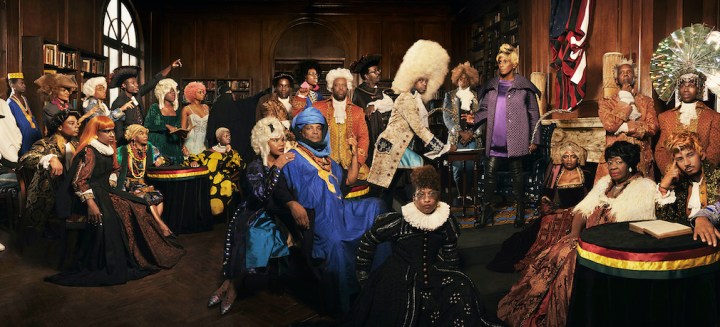
Renee Cox, The Signing, 2018, inkjet print, 122 × 213 cm
(Princeton University Art Museum)
◊ ◊ ◊ ◊ ◊
From Princeton University Art Museum:
Object Lessons in American Art: Selections from the Princeton University Art Museum
Georgia Museum of Art, University of Georgia, Athens, 4 February — 14 May 14 2023
Florence Griswold Museum, Old Lyme, Connecticut, 3 June — 10 September 2023
Speed Art Museum, Louisville, 29 September 2023 — 7 January 2024
Curated by Karl Kusserow

Henry Inman, O-Chee-Na-Shink-Ka a, 1832–33, oil on canvas, 78 × 645 cm (Promised gift from a Private Collection, member of Class of 1982).
Object Lessons in American Art features four centuries of works from the Princeton University Art Museum that collectively explore American history, culture, and society. Inspired by the concept of the object lesson—the study of a material thing to communicate a larger idea—the exhibition brings groups of objects together to ask fundamental questions about artistic significance, materials, and how meaning changes across time and contexts. With a focus on race, gender, and the environment, these pairings demonstrate the value of juxtaposing diverse objects to generate new understanding. Object Lessons presents Euro-American, Native American, and African American art from contemporary perspectives, illustrating how fresh investigations can inform and enrich its meaning, affording new insights into the American past and present. Curated by Karl Kusserow, John Wilmerding Curator of American Art.
Karl Kusserow, ed., with contributions by: Horace Ballard , Kirsten Pai Buick , Ellery Foutch , Karl Kusserow , Jeffrey Richmond-Moll, and Rebecca Zorach, Object Lessons in American Art (Princeton: Princeton University Press, 2023), 200 pages, ISBN: 978-0691978857, £35 / $40.
Object Lessons in American Art explores a diverse gathering of Euro-American, Native American, and African American art from a range of contemporary perspectives, illustrating how innovative analysis of historical art can inform, enhance, and afford new relevance to artifacts of the American past. The book is grounded in the understanding that the meanings of objects change over time, in different contexts, and as a consequence of the ways in which they are considered. Inspired by the concept of the object lesson, the study of a material thing or group of things in juxtaposition to convey embodied and underlying ideas, Object Lessons in American Art examines a broad range of art from Princeton University’s venerable collections as well as contemporary works that imaginatively appropriate and reframe their subjects and style, situating them within current social, cultural, and artistic debates on race, gender, the environment, and more.
C O N T E N T S
Foreword
Preface and Acknowledgments
• Introduction — Lenticular: Subject and Object in American Art — Karl Kusserow
• ‘Race’ as Object Lesson: Objects of Rebellion — Kirsten Pai Buick
• Looking Back and Looking Forward: A Feminist Lens on a Collection of American Art — Ellery E. Foutch
• Oblique Assemblies: Toward Queer Ecologies in American Art — Horace D. Ballard
• Intimations of Ecology: Varieties of Environmental Experience in American Art — Karl Kusserow
• Material Echoes, Traumatic Histories, and Liquid Transformations: The Romance of the Sea in American Art — Rebecca Zorach
• Learning from Object Lessons: Toward a Curatorial Pedagogy of Unfixing and Defamiliarizing the Past — Jeffrey Richmond-Moll
Contributors
Index
Photography Credits
Exhibition | Peter Brathwaite: Rediscovering Black Portraiture
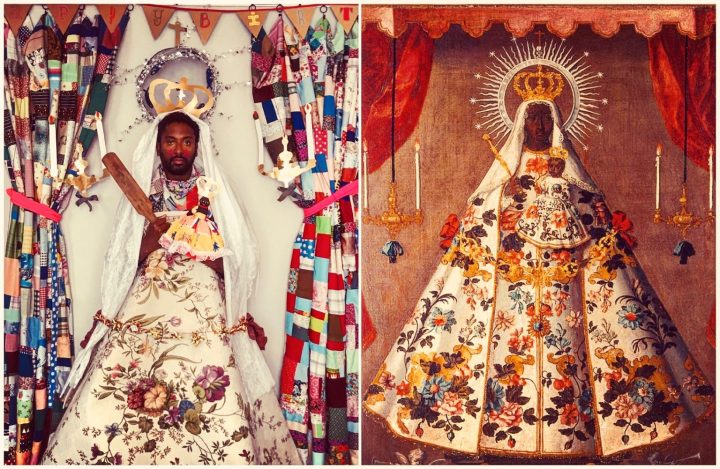
Left: Peter Brathwaite’s restaged version of The Virgin of Guadalupe. Right: Unknown painter, The Virgin of Guadalupe, oil painting, 1745 (London: Wellcome Collection), cropped from original and colour saturated.
◊ ◊ ◊ ◊ ◊
From the Bristol Museum & Art Gallery:
Peter Brathwaite: Rediscovering Black Portraiture
King’s College London, Strand Campus, October 2021 — February 2022
Bristol Museum & Art Gallery, 14 April — 3 September 2023
During the first lockdown in 2020, with all his performances cancelled, baritone, artist, broadcaster, and writer Peter Brathwaite began researching and reimagining more than 100 artworks. These artworks featured portraits of Black sitters, as part of the online #GettyMuseumChallenge to use household objects to restage famous paintings. He called the photographic series Rediscovering Black Portraiture. Alongside this project he also intensified his research into his dual heritage Barbadian roots, uncovering a wealth of detail about his enslaved and enslaver ancestors and their history, including an uprising of enslaved people in 1816 and songs of resistance they sang. Three years on, with a London exhibition behind him and a book out with Getty Publications, Peter Brathwaite brings his whole practice to the history of Georgian House Museum and the collections of Bristol Museum & Art Gallery. New interventions and sound installations reveal the Black presence hidden at the heart of our spaces and objects. The exhibition opened to coincide with the anniversary of the Barbados insurrection, 14 April 1816.
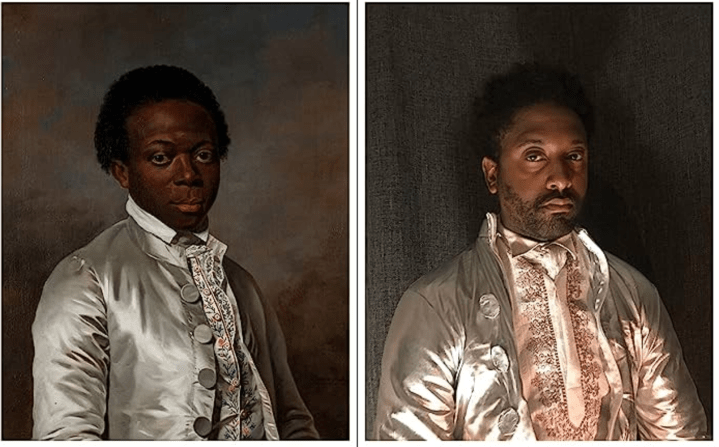
Left: Marie-Victoire Lemoine, Portrait of a Youth in Embroidered Vest, 1785, oil on canvas, 68 × 50 cm (Jacksonville, Florida: Cummer Museum of Art & Gardens). Right: Peter Brathwaite’s restaged version of a Youth in Embroidered Vest.
◊ ◊ ◊ ◊ ◊
From The Getty:
Peter Brathwaite, with contributions by Cheryl Finley, Temi Odumosu, and Mark Sealy, Rediscovering Black Portraiture (Los Angeles, Getty Publications, 2023), 168 pages, ISBN: 978-1606068168, $40.
 Join Peter Brathwaite on an extraordinary journey through representations of Black subjects in Western art, from medieval Europe through the present day. Since the beginning of the COVID-19 pandemic, Peter Brathwaite has thoughtfully researched and reimagined more than one hundred artworks featuring portraits of Black sitters—all posted to social media with the caption “Rediscovering #blackportraiture through #gettymuseumchallenge.”
Rediscovering Black Portraiture collects more than fifty of Brathwaite’s most intriguing re-creations. Introduced by the author and framed by contributions from experts in art history and visual culture, this fascinating book offers a nuanced look at the complexities and challenges of building identity within the African diaspora and how such forces have informed Black portraits over time. Artworks featured include The Adoration of the Magi by Georges Trubert, Portrait of an Unknown Man by Jan Mostaert, Rice n Peas by Sonia Boyce, Barack Obama by Kehinde Wiley, and many more. This volume also invites readers behind the scenes, offering a glimpse of the elegant artifice of Brathwaite’s props, setup, and process. An urgent and compelling exploration of embodiment, representation, and agency, Rediscovering Black Portraiture serves to remind us that Black subjects have been portrayed in art for nearly a millennium and that their stories demand to be told.
Peter Brathwaite is an acclaimed baritone who performs in operas and concerts throughout Europe. He is a presenter on BBC Radio 3 and has been shortlisted for a Royal Philharmonic Society Award. Cheryl Finley is inaugural distinguished visiting director of the Atlanta University Center Art History and Curatorial Studies Collective and the author of Committed to Memory: The Art of the Slave Ship Icon (2018). Temi Odumosu is an art historian, curator, and assistant professor at University of Washington Information School and the author of Africans in English Caricature 1769–1819: Black Jokes, White Humour (2017). Mark Sealy is director of Autograph and professor of photography, race, and human rights at University of the Arts London. His numerous publications include Different (2001), coauthored with Stuart Hall; Decolonising the Camera: Photography in Racial Time (2019); and Photography: Race, Rights, and Representation (2022).
New Book | The Nation That Never Was
From The University of Chicago Press:
Kermit Roosevelt, The Nation That Never Was: Reconstructing America’s Story (Chicago: The University of Chicago Press, 2022), 256 pages, ISBN: 978-0226817613, $25.
 Our idea of the Founders’ America and its values is not true. We are not the heirs of the Founders, but we can be the heirs of Reconstruction and its vision for equality.
There’s a common story we tell about America: that our fundamental values as a country were stated in the Declaration of Independence, fought for in the Revolution, and made law in the Constitution. But, with the country increasingly divided, this story isn’t working for us anymore—what’s more, it’s not even true. As Kermit Roosevelt argues in this eye-opening reinterpretation of the American story, our fundamental values, particularly equality, are not part of the vision of the Founders. Instead, they were stated in Lincoln’s Gettysburg Address and were the hope of Reconstruction, when it was possible to envision the emergence of the nation committed to liberty and equality.
We face a dilemma these days. We want to be honest about our history and the racism and oppression that Americans have both inflicted and endured. But we want to be proud of our country, too. In The Nation That Never Was, Roosevelt shows how we can do both those things by realizing we’re not the country we thought we were. Reconstruction, Roosevelt argues, was not a fulfillment of the ideals of the Founding but rather a repudiation: we modern Americans are not the heirs of the Founders but of the people who overthrew and destroyed that political order. This alternate understanding of American identity opens the door to a new understanding of ourselves and our story, and ultimately to a better America.
America today is not the Founders’ America, but it can be Lincoln’s America. Roosevelt offers a powerful and inspirational rethinking of our country’s history and uncovers a shared past that we can be proud to claim and use as a foundation to work toward a country that fully embodies equality for all.
Kermit Roosevelt III is a professor of constitutional law at the University of Pennsylvania Law School. A former law clerk to Supreme Court Justice David Souter, he is the author of The Myth of Judicial Activism, as well as two novels, Allegiance and In the Shadow of the Law.
C O N T E N T S
Introduction
1 Stories of America
2 Questioning the Standard Story: Dissenters
3 The Exclusive Declaration
4 The Ambiguous Revolution
5 The Geostrategic Constitution
6 The Story of Continuity
7 The March of the Declaration
8 Why We Tell the Standard Story
9 Why We Shouldn’t Tell the Standard Story
10 Magic Tricks and Revolutions
11 Why, How, and Who We Are
12 Redemption Songs: Inclusive Equality and Exclusive Individualism in Modern America
13 The Better Story
Bibliographical Essay
Acknowledgments
Notes










 Enfilade
leave a comment