New Book | Imagining Sculpture: A Short Conjectural History
Published by Hirmer and distributed by The University of Chicago Press:
Stanley Abe, Imagining Sculpture: A Short Conjectural History (Munich: Hirmer Verlag, 2023), 384 pages, ISBN: 978-3777437583, $45.
 A new critical approach to understanding sculpture across cultures.
Imagining Sculpture is the story of the absence of a powerful European idea: Sculpture. In China statues, stele, and other figural objects were made for millennia but were not categorized as Sculpture. Imagining Sculpture explains how they were seen in China as objects beyond the category of Sculpture. The book is a series of short vignettes—historical and fictional. Travellers, scholars, collectors, and antiquarians encounter statues, figures, and effigies in China, Japan, England, Germany, France, Italy, and the United States from the fourteenth to the beginning of the twentieth century. The book is visual, cinematic, and sumptuous—told with rare photographs, paintings, sketches, letters, and ephemera. With little text, images propel the narrative, offering a different way of seeing and knowing.
Stanley Abe is associate professor in the Department of Art, Art History, and Visual Studies at Duke University. He is the author of Ordinary Images and served as editor in chief of Archives of Asian Art from 2011 to 2018.
Exhibition | Johann Gottfried Schadow: Embracing Forms

Johann Gottfried Schadow, Double Portrait Statue of Princesses Luise and Friederike of Prussia, detail, 1795–97, marble
(Staatliche Museen zu Berlin, Nationalgalerie)
◊ ◊ ◊ ◊ ◊
From the Staatliche Museen zu Berlin:
Johann Gottfried Schadow: Embracing Forms / Berührende Formen
Alte Nationalgalerie, Berlin, 21 October 2022 — 19 February 2023
Curated by Yvette Deseyve
The life-size double statue of Princesses Louise and Frederica of Prussia, known as the Princess Group, is the magnum opus of Johann Gottfried Schadow (1764–1850). Seen as the founder of the Berlin School of sculpture, Schadow came to epitomize German neoclassicism, with this work being emblematic of the movement. As the first sculpture depicting two female historical figures, this work wrote art history, and continues to be a highlight for visitors to Berlin from around the world. The first retrospective in some 30 years, this exhibition presents Schadow’s major sculptural, graphic, and art-theoretical works, arranged into 11 thematic sections. Following extensive conservation and restoration work, the original plaster model of the Princess Group (from 1795) is exhibited alongside the original marble rendering (1797) for the first time ever.
 With more than 150 works, the collection of the Nationalgalerie is home to the world’s largest selection of Schadow’s sculptural works, including both originals of the Princess Group. Since the last retrospective almost 30 years ago (which was first exhibited at the Alte Nationalgalerie), a great deal has been uncovered about the artist, his oeuvre, the functioning of his workshop, and his working methods. This knowledge comes in large part from the major research and restoration project focused on the original plaster model of the Princess Group, the findings of which are here presented to the public for the first time. Numerous international loans of sculptures, paintings, and graphic works, as well as art-theoretical writings, offer insights into the genesis and critical reception of the Princess Group. The exhibition also features works by some of Schadow’s contemporaries, including Gainsborough, Tischbein, Weitsch, Chodowiecki, and Begas.
Johann Gottfried Schadow: Embracing Forms is curated by Yvette Deseyve and is accompanied by catalogues in both English and German. The exhibition was made possible by the Freunde der Nationalgalerie, the Ernst von Siemens Kunststiftung, and the Cultural Foundation of the German Federal States. The three-year conservation and restoration project on the original plaster model of the Princess Group was funded by the Hermann Reemstma Stiftung, the Rudolf-August Oetker-Stiftung, and the Cultural Foundation of the German Federal States. The Bern University of Applied Sciences and the Bern Academy of the Arts supported the project as cooperation partners.
Yvette Deseyve, ed., with contributions by Sintje Guericke, Johann Gottfried Schadow: Embracing Forms (Munich: Hirmer Verlag, 2023), 304 pages, ISBN: 978-3777440873, $65.
New Book | Thorvaldsen: Collector of Plaster Casts
From Aarhus UP:
Jan Zahle, Thorvaldsen: Collector of Plaster Casts from Antiquity and the Early Modern Period (Copenhagen: Thorvaldsens Museum and Aarhus University Press, 2020), 3 volumes, 828 pages, ISBN: 978-8771843590, $112.
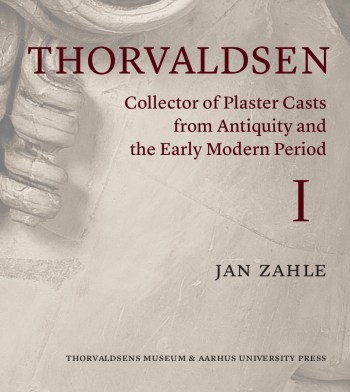 The Danish neoclassical sculptor Bertel Thorvaldsen (1770–1844), who lived most of his life in Rome, was not only one of Europe’s most sought-after artists; he was also a collector. In addition to his own works and drawings, he built extensive collections of paintings, prints, drawings, and books—and of ancient artefacts from Egyptian, Greek, and Roman antiquity: coins, lockets, containers, vases, lamps, fragments of sculpture, and more. He also acquired a large collection of plaster casts, primarily after ancient sculptures and reliefs, but also of works dating from the Renaissance and up until his own lifetime. Thanks to Thorvaldsen’s bequest to the city of Copenhagen, his birthplace, all of these collections are still largely intact and well preserved at his museum.
Home to a total of 657 plaster casts, the Thorvaldsen Museum’s cast collection is unique for several reasons: The collection offers us insight into the sculptor’s working methods and the development of his work because it served a clear function as an image bank of forms, motifs and subjects for Thorvaldsen’s own endeavours. Furthermore, the dual fact that the collection is so well preserved and was established over a relatively brief period of time makes it a valuable example illuminating the trade and distribution of plaster casts during the first half of the nineteenth century.
These areas of study form the central focal point of Volume I of this publication. Volume II contains a catalogue of the individual objects in the cast collection, while Volume III collects the overviews, inventories, concordances, and primary sources referred to in the first two volumes. Arising out of many years of study of Thorvaldsen’s cast collection conducted by their author, the classical archaeologist Jan Zahle, these books contain comprehensive source material from the period, much of it previously unknown.
The table of contents is available as a PDF file here»
New Book | Ten Kings’ Clothes: Royal Danish Dress, 1596–1863
Distributed by Yale UP:
Katia Johansen, Ten Kings’ Clothes: Royal Danish Dress, 1596–1863 (Denmark: Aarhus University Press, 2022), 496 pages, ISBN: 978-0300266764, $80.
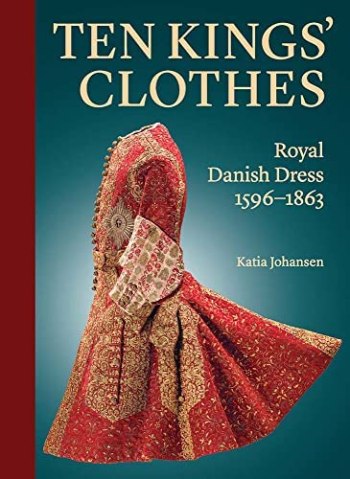 A richly illustrated glimpse into the magnificent collection of seventeenth-century men’s dress from the Danish kings’ wardrobes
Ten Kings’ Clothes: Royal Danish Dress, 1596–1863 presents the unparalleled collection of male dress belonging to the Danish kings from Christian IV to Frederik VII. The incomparable research showcases the collection of each monarch, put into context against the backdrop of pivotal moments in Danish history, the networks of supply, and the production and circulation of luxury goods. Richly illustrated with portraits, prints, and the stunning garments, extended entries and hand-drafted patterns allow a detailed and technical appreciation of each item. The historical garments tell the story not only of the kings’ coronations and weddings but also of everyday life at court, including the contributions of tailors, embroiderers, valets, portrait artists, castle stewards, and laundresses. The book includes a foreword written by Her Majesty Queen Margrethe II of Denmark.
Katia Johansen is a renowned author, lecturer, and teacher of textile conservation, exhibition techniques, and costume history. She is the former textile conservator and costume curator at The Royal Danish Collections at Rosenborg Castle, Denmark, where she worked for over 35 years.
The Art Bulletin, December 2022
The eighteenth century in the latest issue of The Art Bulletin 104 (December 2022), along with the methodological ‘perspective’ conversation from Fricke and Flood:
A R T I C L E S
 • Beate Fricke and Finbarr Barry Flood, “Premodern Globalism in Art History: A Conversation,” pp. 6–19.
A conversation took place in 2021 between two art historians whose research focuses on different regions of the premodern world and who have recently collaborated on a project dealing with early histories of globalism. The discussion considers the potential archival value of ‘flotsam’—that is, extant artifacts and images lacking extensive textual metadata—for (re)constructing transcultural and transregional histories of circulation and reception. It addresses divergences in the nature of the available archival materials and the ethical and methodological challenges this poses. The discussants consider the need to move beyond earlier, largely celebratory narratives of the global to engage the ways in which transregional and transcultural networks intersected with more rooted or regional traditions of art making and material culture.
• Paris A. Spies-Gans, “Why Do We Think There Have Been No Great Women Artists? Revisiting Linda Nochlin and the Archive,” pp. 70–94.
In 1971 Linda Nochlin published her quickly canonical “Why Have There Been No Great Women Artists?” (ARTnews 69, no. 9). She offered a powerful narrative, claiming that Western institutional structures and a lack of access to vital educational opportunities had historically prevented women from becoming ‘great’ artists—indeed from even having the potential to achieve greatness. I suggest new visual and textual lenses through which we can update Nochlin’s narrative and reconsider women artists on their own societies’ terms, arguing that by returning to the archive, we can identify greatness and professionalism where they have eluded us before.
R E V I E W S
• Amy Knight Powell, Review of Aaron Hyman, Rubens in Repeat: The Logic of the Copy in Colonial Latin America (Getty Publications, 2021), pp. 120–23.
• Amanda Lahikainen, Review of Joseph Monteyne, Media Critique in the Age of Gillray: Scratches, Scraps, and Spectres (University of Toronto Press, 2022), pp. 123–26.
New Book | Media Critique in the Age of Gillray
From Toronto UP:
Joseph Monteyne, Media Critique in the Age of Gillray: Scratches, Scraps, and Spectres (Toronto: University of Toronto Press, 2022), 316 pages, ISBN: 978-1487527747, $75.
 In the late 1790s, British Prime Minister William Pitt created a crisis of representation when he pressured the British Parliament to relieve the Bank of England from its obligations to convert paper notes into coin. Paper quickly became associated with a form of limitless reproduction that threatened to dematerialize solid bodies and replace them with insubstantial shadows. Media Critique in the Age of Gillray centres on printed images and graphic satires which view paper as the foundation for the contemporary world. Through a focus on printed, visual imagery from practitioners such as James Gillray, William Blake, John Thomas Smith, and Henry Fuseli, the book addresses challenges posed by reproductive technologies to traditional concepts of subjective agency.
Joseph Monteyne shows that the late eighteenth-century paper age’s baseless fabric set the stage for contemporary digital media’s weightless production. Engagingly written and abundantly illustrated, Media Critique in the Age of Gillray highlights the fact that graphic culture has been overlooked as an important sphere for the production of critical and self-reflective discourses around media transformations and the visual turn in British culture.
Joseph Monteyne is an associate professor in the Department of Art History, Visual Art, and Theory at the University of British Columbia.
C O N T E N T S
List of Illustrations
Acknowledgments
Introduction: Making and Unmaking the Paper World
1 Dark Media and the Materiality of Nothing
Dark Media and Graphic Materiality
Smoked Images and Night Pieces: Touching Nothing
Form and Formlessness in Blake’s Embedded Media
2 Haunted Media
Conjuring Dead Painters
The Baseless Fabric of Print
Dematerializing Media
3 Good Copies, Bad Copies
Counterfeit Masks
Repetition with Difference
Pairs of Portraits
4 Social Detritus, Paper Detritus
Blind Beggars and Printed Images
Cobbling, Patching, Translating
The Gatherer of Scraps
Notes
Bibliography
Index
Exhibition | Fortune and Folly in 1720

Installation view of Fortune and Folly in 1720
The New York Public Library, 2022
◊ ◊ ◊ ◊ ◊
At the NYPL (and on view during this year’s CAA conference) . . .
Fortune and Folly in 1720
New York Public Library, 23 September 2022 — 19 February 2023
Curated by Nina Dubin, Meredith Martin, and Madeleine Viljoen
In 1720, everyday citizens converged on the banking streets of Paris, London, and Amsterdam, speculating in New World trading companies and other maritime ventures. By the close of that year, an unprecedented bull market would culminate in the world’s first international financial crash. Orchestrated by the insolvent governments of France and England, and fueled by illusions of colonial wealth, these investment bonanzas—henceforth known as the Mississippi and South Sea Bubbles—have remained synonymous with the temptations of get-rich-quick schemes and the dangers of herd behavior. Three centuries and many booms and busts later, their imprint is indelible. Not only did the bubbles accelerate the growth of a financial system overflowing with stock shares, newly created banknotes, and other mysterious paper devices imbued with financial alchemy—they also illustrated the power of trust and dread, faith and fear, as drivers of market volatility.
The works on display draw from the collections of The New York Public Library and include a trove of caricatures from a Dutch volume known as The Great Mirror of Folly (Het groote tafereel der dwaasheid). Published as the crisis was unfolding, these prints portray the bewildering forces of modern economic life. Loaded with jokes, often of a scatological nature, The Great Mirror of Folly lifts the curtain on a farcical political theater whose stars include bankers and statesmen—and that’s just for starters. Offering tragicomic depictions of malevolent traders, hoodwinked investors, and villainous seductresses, the prints hold up a mirror to our own age, with its ever more complex monetary instruments and periodic meltdowns. They also reflect on the intersections between art and finance, reminding us that both are products of human imaginings.
Madeleine Viljoen, Nina Dubin and Meredith Martin, Meltdown! Picturing the World’s First Bubble Economy (Turnhout: Harvey Miller, 2020), 157 pages, ISBN: 978-1912554515, $65 / €50.
New Book | The Great New York Fire of 1776
From Yale UP:
Benjamin Carp, The Great New York Fire of 1776: A Lost Story of the American Revolution (New Haven: Yale University Press, 2023), 360 pages, ISBN: 978-0300246957, $30.
 Who set the mysterious fire that burned down much of New York City shortly after the British took the city during the Revolutionary War?
New York City, the strategic center of the Revolutionary War, was the most important place in North America in 1776. That summer, an unruly rebel army under George Washington repeatedly threatened to burn the city rather than let the British take it. Shortly after the Crown’s forces took New York City, much of it mysteriously burned to the ground. This is the first book to fully explore the Great Fire of 1776 and why its origins remained a mystery even after the British investigated it in 1776 and 1783. Uncovering stories of espionage, terror, and radicalism, Benjamin L. Carp paints a vivid picture of the chaos, passions, and unresolved tragedies that define a historical moment we usually associate with “life, liberty, and the pursuit of happiness.”
Benjamin L. Carp is professor of history at Brooklyn College and the CUNY Graduate Center. He is the author of Defiance of the Patriots: The Boston Tea Party and the Making of America and Rebels Rising: Cities and the American Revolution. He lives in New York City.
New Book | Décoration intérieure et plaisir des sens, 1700–1850
From Editoriale Artemide and GRHAM:
Noémi Duperron, Barbara Jouves-Hann, Maxime Georges Métraux, Marc-André Paulin, and Bérangère Poulain, eds., Décoration intérieure et plaisir des sens, 1700–1850 (Rome: Artemide edizioni, 2022), 168 pages, ISBN: 978-8875754204, €30. With contributions by Muriel Barbier, Élisabeth Caude, Christina Contandriopoulos, Aurélien Davrius, Joséphine Grimm, Johanna Ilmakunnas, Olivier Jandot, Desmond-Bryan Kraege, Ulrich Leben, Frédéric Leblanc, and Erika Wicky.
 Dès le début du XVIIIe siècle, l’idée de plaisir—comme recherche de sensations agréables—devient une composante essentielle et constante de la société. Selon l’historien Paul Hazard, la sensation permet alors à l’individu de prendre conscience de l’existence du monde qui l’entoure, et devient une préoccupation centrale pour les hommes de lettres et les artistes. Dans les espaces intérieurs, ce nouveau rapport de proximité entre l’homme sensible et les murs, le mobilier ou les objets du décor se ressent au travers des interrogations sur la place du plaisir sensoriel dans la distribution, l’ameublement et l’ornementation.
Ce paradigme est au cœur des articles présentés dans cet ouvrage. Focalisés sur la production européenne entre 1700 et 1850, leurs auteurs examinent les sensations sous l’angle de la culture matérielle, des normes sociales ou de l’usage des différentes pièces du logement, que celui-ci ait été édifié, théorisé ou simplement imaginé. En s’appuyant sur des méthodologies variées, les différentes études montrent le rôle central joué par le plaisir, le confort, la commodité ou encore l’agrément dans la conception des intérieurs à cette période. Affectant toutes les échelles de l’habitat, de la construction du bâtiment à la décoration de ses recoins les plus intimes, les sens du toucher, de l’odorat, de la vue ou de l’ouïe sont autant d’éléments auxquels les architectes, les artistes et les artisans devaient prêter attention pour satisfaire les exigences de leurs utilisateurs aux perceptions aiguisées.
Noémi Duperron est assistante diplômée à l’Université de Genève où elle enseigne l’histoire de l’art de la période moderne. Elle conduit une thèse de doctorat sur les représentations et les interprétations de l’Iliade d’Homère dans les arts français et britanniques au XVIIIe siècle sous la direction des Professeurs Jan Blanc et Christian Michel. Elle a conduit ses recherches portant essentiellement sur les échanges franco-britanniques, la peinture d’histoire et la réception de l’Antiquité grecque dans différentes institutions comme la Wallace Collection, la Biblioteca Herziana – Max Planck Institut für Kunstgeschichte ou encore le Warburg Institute.
Barbara Jouves-Hann est ingénieure de recherche, chargée du projet « Recherche et Restauration » pour le DIM PAMIR, Région Île-de-France. Elle est également responsable des études et de la recherche chez Madelénat Architecture et enseigne à l’Université Paris 1 Panthéon- Sorbonne ainsi qu’à l’Institut national du patrimoine. Sa thèse de doctorat, exécutée sous la direction du Professeur Thierry Lalot, a été soutenue à l’Université Paris 1 Panthéon-Sorbonne en 2019 sous le titre La conservation et la restauration des tableaux des collections privées à Paris entre 1789 et 1870 (à paraître aux Éditions de la Sorbonne).
Maxime Georges Métraux est historien de l’art, membre de l’équipe de la galerie Hubert Duchemin et chargé d’enseignement à l’Université Paris 1 Panthéon Sorbonne. Il a été commissaire scientifique de l’exposition Chic Emprise : Cultures, usages et sociabilités du tabac à l’époque moderne (2019, La Rochelle, musée du Nouveau Monde). Il a dernièrement publié dans le catalogue de l’exposition Les Animaux du Roi (2021, Versailles, château de Versailles) et Renoir, Monet, Gauguin. Images of a Floating World – The Kojiro Matsukata and Karl Ernst Osthaus collections (2022, Essen, Museum Folkwang).
Marc-André Paulin est restaurateur du patrimoine en ébénisterie et responsable de l’atelier de restauration mobilier au Centre de recherche et de restauration des Musées de France. Il prépare actuellement une thèse de doctorat à l’université de Lille sur l’ébéniste Jean-Henri Riesener.
Bérangère Poulain est maître-assistante en histoire de l’art de la période moderne à l’Université de Genève. Sa thèse de doctorat, exécutée sous la direction du Professeur Jan Blanc et la codirection du Professeur Christian Michel, a été soutenue à l’Université de Genève en 2020 sous le titre «Nouvelles couleurs, nouvelles jouissances». La polychromie des boiseries françaises au siècle des Lumières.
S O M M A I R E
Avant-Propos — Noémi Duperron, Barbara Jouves-Hann, Maxime Georges Métraux, Marc-André Paulin et Bérangère Poulain
I. En quête de sens : théorie et imaginaire
• Blondel et l’architecture dans le ‘goût moderne’ : la machine à habiter au service du plaisir des sens au XVIIIe siècle — Aurélien Davrius
• Fraicheur, senteurs et procédés rédactionnels : Le génie de l’architecture de Le Camus de Mézières à la lumière de la théorie des jardins — Desmond-Bryan Kraege
• La rhétorique des sens : la visite de Madame de Maisonneuve au Dôme des Invalides — Christina Contandriopoulos
II. Plaisir des sens : de l’objet à l’espace
• Formes, matérialité et usages du mobilier en France au XVIIIe siècle — Ulrich Leben
• Le cabinet particulier du roi Louis XIV à Versailles : secrets autour des transformations d’un bureau — Élisabeth Caude et Frédéric Leblanc
• « Une tente sous laquelle on dort » : l’alcôve et le lit d’alcôve dans la chambre au XVIIIe siècle — Muriel Barbier
• Construire le boudoir idéal : état de l’influence réciproque de la littérature sur les traités d’architecture au XVIIIe siècle — Joséphine Grimm
III. Les sens en éveil : pratiques et usages
• L’odeur des vernis ou la toxicité du confort au XVIIIe siècle — Erika Wicky
• Le confort thermique, l’ordre spatial et les objets dans les demeures suédoises au XVIIIe siècle — Johanna Ilmakunnas
• Le feu caché. Introduction du confort thermique et métamorphoses de l’économie des sens (France, 1700–1850) — Olivier Jandot
Résumés
Index
New Book | Schloss Hubertusburg

Johann Christoph von Naumann, Hubertusburg, begun in 1721 under Augustus the Strong, Elector of Saxony and King of Poland; it then served as the residence of his son Augustus III. The palace was site of the signing of the 1763 Treaty of Hubertusburg that ended the Seven Years’ War (Wikipedia entry; photo from Wikimedia Commons, May 2013).
◊ ◊ ◊ ◊ ◊
From Sax-Verlag and Sachsen.de:
Landesamt für Denkmalpflege Sachsen, ed., Schloss Hubertusburg / Band I: Essays / Band II: Katalog der Architekturzeichnungen, Reihe Arbeitshefte des Landesamtes für Denkmalpflege Sachsen, Band-Nr. 30 (Markkleeberg: Sax-Verlag, 2022), 1240 pages, ISBN 978-3867292825, €40.
Schloss und Garten von Hubertusburg in Wermsdorf gelten als größte barocke Residenzanlage in Sachsen und gehören zu den spektakulären Bau- und Kunstdenkmälern von internationaler Bekanntheit.
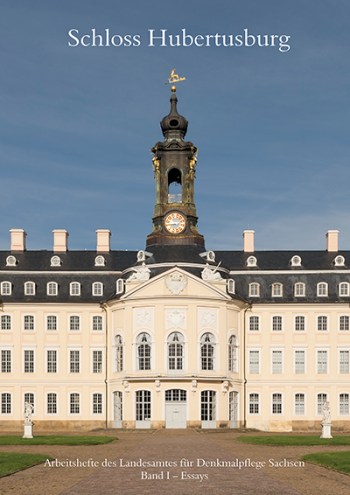 Trotz des kontinuierlichen Bauunterhalts durch den Freistaat, vier großer Ausstellungen der Staatlichen Kunstsammlungen Dresden in den letzten Jahren, dem Wirken eines lokalen engagierten Fördervereins sowie zahlreicher Veranstaltungen fristet Schloß Hubertusburg sowohl in der Öffentlichkeit als auch im wissenschaftlichen Kontext immer noch ein randständiges Dasein.
Mit dem Arbeitsheft 30 liegen in dem ausführlichen Katalogband erstmals sämtliche, zum heutigen Zeitpunkt verfügbare Bau- und Gartenpläne aus dem 17. Jahrhundert bis zum Jahr 1945 zu Hubertusburg vor, aus bedeutenden sächsischen und europäischen Sammlungen, wissenschaftlich erschlossen und aufbereitet. Neben einer fotografischen Bestandsaufnahme werden neue Erkenntnisse zur Bau- und Gartengeschichte, zur ursprünglichen Raumausstattung wie der Königlichen Gemäldegalerie, Hof-Konditorei und Hofkellerei vorgestellt, gartenarchäologische Methoden sowie kunsthistorische Betrachtungen zur Schlosskapelle, aber auch restauratorische und denkmalpflegerische Fragen thematisiert. Die beiden zusammengehörigen Bände werden in einem Schutzschuber geliefert.
I N H A L T
Band I
Geleit- und Vorworte
• Louise Walleneit — Wände, die ausatmen
• Ingo Fischer — Zwei Schlösser in Einem
• Tim Tepper — Wandel und Spuren. Zur Geschichte von Hubertusburg und denkmalpflegerische Schlussfolgerungen für eine zukünftige Nutzung
• Hartmut Ritschel — Die Kapelle von Schloss Hubertusburg
• Michael Lange — Giovanni Battista Grone – das Deckenbild in der Kapelle von Schloss Hubertusburg
• Ralf Witthaus / Text: Barbara Rübartsch — Der Garten in mir – Ein Aktionskunstwerk im Sommer 2019
• Henrike Schwarz — Prachtgarten, Pachtland, Patientengarten und was bringt die Zukunft? Eine Würdigung des Schlossgartens Hubertusburg
• Hartmut Olbrich — Der Schlossgarten zu Hubertusburg. Archäologie zum Verständnis einer komplexen Anlage
• Eduard Wätjen — Das Kupferstichwerk zu Schloss Hubertusburg von Johann Christoph Naumann
• Thomas Liebsch — Die Gemäldegalerie König Augusts III. von Polen in der Jagdresidenz Hubertusburg
• Tobias Knobelsdorf — Die Plünderung von Schloss Hubertusburg im Frühjahr 1761 in zeitgenössischen Berichten
• Maureen Cassidy-Geiger — K. H. C. H.: The Königliche Hof-Conditorei Hubertusburg
• Johannes Wolff und Martin Kornek — Die Hofkellerei in Schloss Hubertusburg
Gernot Klatte, Die Büchsenkammer des Kurprinzen Friedrich August auf Schloss Hubertusburg
• Mike Huth — Quellenverzeichnis Schloss Hubertusburg
Bibliografie
Verwendete Dokumentationen
Abkürzungen
Abbildungsnachweis
Autoren
Band II
Vorwort
1 Altes Schloss Wermsdorf mit Fasanengarten
2 Weitere Gebäude in Wermsdorf
3 Jagdanlagen im Wermsdorfer Forst
4 Schloss Hubertusburg, 1. Bauphase 1721–1733: Vermessungspläne
5 Das Hubertusburger Jagdrevier 1723–1942
6 Schloss Hubertusburg, 1. Bauphase 1721–1733: Vorentwürfe zum Hauptpalais
7 Schloss Hubertusburg, 1. Bauphase 1721–1733: Grundrisse Hauptpalais
8 Schloss Hubertusburg, 1. Bauphase 1721–1733: Außenbau Hauptpalais
9 Schloss Hubertusburg, 1. Bauphase 1721–1733: Innenräume
10 Schloss Hubertusburg, 1. Bauphase 1721–1733: Nebengebäude
11 Schloss Hubertusburg, 1. Bauphase 1721–1733: Wachthäuser und Kasernen
12 Schloss Hubertusburg, 1. Bauphase 1721–1733: Lust- und Küchengarten
13 Schloss Hubertusburg, 1. Bauphase 1721–1733: Ziegelscheune
14 Schloss Hubertusburg, 2. Bauphase 1733–1763: Gesamtpläne
15 Schloss Hubertusburg, 2. Bauphase 1733–1763: Vorhof
16 Schloss Hubertusburg, 2. Bauphase 1733–1763: Kopfbauten im Vorhof
17 Schloss Hubertusburg, 2. Bauphase 1733–1763: Rundflügel
18 Schloss Hubertusburg, 2. Bauphase 1733–1763: Projekt zum Umbau des Stallhofs 1756
19 Schloss Hubertusburg, 2. Bauphase 1733–1763: Küchenhof
20 Schloss Hubertusburg, 2. Bauphase 1733–1763: Hundeställe und weitere Nebengebäude
21 Schloss Hubertusburg, 2. Bauphase 1733–1763: Gartenpläne
22 Schloss Hubertusburg, 2. Bauphase 1733–1763: Opernhaus 1741
23 Schloss Hubertusburg, 2. Bauphase 1733–1763: Wasserleitungen
24 Schloss Hubertusburg, 2. Bauphase 1733–1763: Vorentwürfe zum Umbau des Hauptpalais
25 Schloss Hubertusburg, 2. Bauphase 1733–1763: Grundrisse des Hauptpalais
26 Schloss Hubertusburg, 2. Bauphase 1733–1763: Ansichten des Hauptpalais
27 Schloss Hubertusburg, 2. Bauphase 1733–1763: Innenräume
28 Schloss Hubertusburg nach 1763: Hauptpalais
29 Schloss Hubertusburg nach 1763: Nebengebäude
30 Schloss Hubertusburg nach 1763: Lagepläne des 19. Jahrhunderts
31 Schloss Hubertusburg nach 1763: Lagepläne des 20. Jahrhunderts
32 Schloss Hubertusburg nach 1763: Vermessungskampagne Friedrich Carl Preßler 1830/31
33 Schloss Hubertusburg nach 1763: Umbauprojekt H. L. Otto 1835
34 Der Planschrank im Archiv des Fachkrankenhauses Hubertusburg
Anhang
Planmaterial zu Schloss und Garten Hubertusburg in historischen Planverzeichnissen
Gebäudebestandsplan und Gebäudenutzung in der Hubertusburger
Schloss- und Gartenanlage seit 1721
Abkürzungen
Abbildungsnachweis










 Enfilade
leave a comment