New Book | Francisco de Goya and the Art of Critique
Published by Zone Books and distributed by Princeton UP:
Anthony Cascardi, Francisco de Goya and the Art of Critique (New York: Zone Books), 376 pages, ISBN: 978-1942130697, $40 / £30.
 Francisco de Goya and the Art of Critique probes the relationship between the enormous, extraordinary, and sometimes baffling body of Goya’s work and the interconnected issues of modernity, Enlightenment, and critique. Taking exception to conventional views that rely mainly on Goya’s darkest images to establish his relevance for modernity, Cascardi argues that the entirety of Goya’s work is engaged in a thoroughgoing critique of the modern social and historical worlds, of which it nonetheless remains an integral part. The book reckons with the apparent gulf assumed to divide the Disasters of War and the so-called Black Paintings from Goya’s scenes of bourgeois life or from the well-mannered portraits of aristocrats, military men, and intellectuals. It shows how these apparent contradictions offer us a gateway into Goya’s critical practice vis-à-vis a European modernity typically associated with the Enlightenment values dominant in France, England, and Germany. In demonstrating Goya’s commitment to the project of critique, Cascardi provides an alternative to established readings of Goya’s work, which generally acknowledge the explicit social criticism evident in works such as the Caprichos but which have little to say about those works that do not openly take up social or political themes. In Francisco de Goya and the Art of Critique, Cascardi shows how Goya was consistently engaged in a critical response to—and not just a representation of—the many different factors that are often invoked to explain his work, including history, politics, popular culture, religion, and the history of art itself.
Anthony J. Cascardi is the Sidney and Margaret Ancker Distinguished Professor at the University of California, Berkeley. He is the author of numerous books, including The Consequences of Enlightenment; Cervantes, Literature, and the Discourse of Politics; The Subject of Modernity; and The Cambridge Introduction to Literature and Philosophy.
C O N T E N T S
Introduction
1 Secularization and the Aesthetics of Belief
2 A Promise of Happiness?
3 Goya, Modernity, Aesthetic Critique
4 The Limits of Representation
5 Conflicts of the Faculties: Goya and Kant
6 Extremities
7 Freedom and the Face of Darkness
8 Beauty and Sympathy
Acknowledgments
Notes
Index
Image Credits
The Burlington Magazine, November 2022
The eighteenth century in the November issue of The Burlington . . .
The Burlington Magazine 164 (November 2022) — Sculpture

Massimiliano Soldani Benzi, Lamentation over the Dead Christ, 1690–92(?), gilded bronze, 57 × 40 cm (Córdoba Cathedral).
E D I T O R I A L
• The Parthenon Sculptures, p. 1063.
A R T I C L E S
• Fernando Loffredo, “Soldani’s Lamentation in Córdoba,” pp. 1118–22.
R E V I E W S
• Colin Bailey, Review of the exhibition catalogue, Renoir: Rococo Revival (Städel Museum, Frankfurt am Main, 2022), pp. 1150–53.
• Joseph Connors, Review of Livio Pestilli, Bernini and His World: Sculpture and Sculptors in Early Modern Rome (Lund Humphries, 2022), pp. 1160–62. [Pestilli “mines the correspondence of the directors of the Académie de France and sorts through student drawings in the Accademia de San Luca to find that well into the eighteenth century Bernini was copied more than any other artist” (1162).]
• Jamie Mulherron, Review of Alexandre Maral and Valérie Carpentier-Vanhaberbeke, Antoine Coysevox (1640–1720): Le sculpteur du Grand Siècle (Arthena, 2020), pp. 1165–66.
• Hugo Chapman, Review of Carel van Tuyll van Serooskerken, The Italian Drawings of the Seventeenth and Eighteenth Centuries in the Teyler Museum (Primavera Pers, 2021), pp. 1166–67.
• Christopher Martin Vogtherr, Review of Sarah Salomon, Die Kunst der Außenseiter: Ausstellungen und Künstlerkarrieren im absolutistischen Paris jenseits der Akademie (Wallstein Verlag, 2021), pp. 1167–68. [Salomon’s book focuses on four institutions: the Académie de Saint-Luc, the Colisée, the Salon de la Correspondence, and the Exposition de la Jeunesse.]
• Stephen Lloyd, Review of Magnus Olausson, Miniature Painting in the Nationalmuseum: A World-Class Collection (Nationalmuseum Stockholm, 2021), pp. 1168–70.
O B I T U A R I E S
• Michael Hall, Obituary for Mark Girouard (1931–2022), pp. 1171–72.
New Book | The Moving Statues of Seventeenth-Century Amsterdam
From Penn State UP:
Angela Vanhaelen, The Moving Statues of Seventeenth-Century Amsterdam: Automata, Waxworks, Fountains, Labyrinths (University Park: Penn State University Press, 2022), 236 pages, ISBN: 978-0271091402 (hardcover), $115. Also available as an ebook, with a paperback edition scheduled for release in March 2023.
 This book opens a window onto a fascinating and understudied aspect of the visual, material, intellectual, and cultural history of seventeenth-century Amsterdam: the role played by its inns and taverns, specifically the doolhoven.
Doolhoven were a type of labyrinth unique to early modern Amsterdam. Offering guest lodgings, these licensed public houses also housed remarkable displays of artwork in their gardens and galleries. The main attractions were inventive displays of moving mechanical figures (automata) and a famed set of waxwork portraits of the rulers of Protestant Europe. Publicized as the most innovative artworks on display in Amsterdam, the doolhoven exhibits presented the mercantile city as a global center of artistic and technological advancement. This evocative tour through the doolhoven pub gardens—where drinking, entertainment, and the acquisition of knowledge mingled in encounters with lively displays of animated artifacts—shows that the exhibits had a forceful and transformative impact on visitors, one that moved them toward Protestant reform.
Deeply researched and decidedly original, The Moving Statues of Seventeenth-Century Amsterdam uncovers a wealth of information about these nearly forgotten public pleasure parks, situating them within popular culture, religious controversies, global trade relations, and intellectual debates of the seventeenth century.
Angela Vanhaelen is Professor of Art History at McGill University. She is the author of the award-winning book The Wake of Iconoclasm: Painting the Church in the Dutch Republic, also published by Penn State University Press.
C O N T E N T S
List of Illustrations
Acknowledgements
Introduction
1 The Closed Door: Walking In
Ritual Routes
2 The Courtyard Fountain: Bacchic Rites
3 Into the Labyrinth: Containing the Human Monster
The Moving Statue Strikes
4 Automata: Activating Human Behavior
5 Strange Things for Strangers: Transcultural Automata
Protestant Paganism
6 Wax Portraits: Body Politics
7 Time Machines in the Golden Age: The Kairos of Clockwork
Epilogue: Obsolescence
Notes
Bibliography
Index
New Book | Alexandre-Évariste Fragonard (1780–1850)
From Arthena:
Rébecca Duffeix, with a preface by Barthélémy Jobert, Alexandre-Évariste Fragonard (1780–1850) (Paris: Arthena, 2022), 520 pages, ISBN: 978-2903239688, €135.
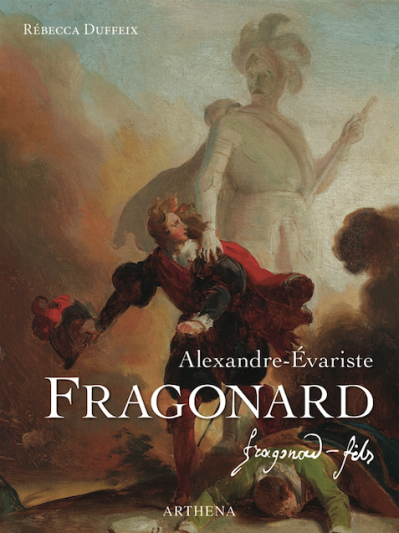 Reconnu jusqu’aux années 1830 comme un artiste majeur, Alexandre-Évariste Fragonard (1780–1850) a été injustement éclipsé au profit de son père, le célèbre Jean-Honoré.
Peintre d’Histoire en vogue, artiste ‘troubadour’, Alexandre-Évariste est un créateur au talent éclectique. Précoce—il présente son premier dessin au Salon à treize ans—il n’aura de cesse d’explorer avec succès tous les domaines : peinture, dessin, gravure et sculpture. Si ses scènes d’Histoire nationale—François Ier armé chevalier par Bayard, Jeanne d’Arc sur le bûcher ou La Bataille de Marignan—sont entrées dans notre imaginaire, Fragonard a également fourni de nombreux dessins pour des recueils de gravures, des modèles de formes et de décors pour la manufacture de Sèvres ou pour des costumes de l’Opéra. Fidèle aux leçons de son maître David, ‘Fragonard fils’, nous montre aussi ses dons de coloriste, aux effets de lumière audacieux et maîtrisés, hérités de son père, et ses évocations de Bradamante ou de la statue du commandeur de Dom Juan peuvent être qualifiées de romantiques.
Diplômée en Lettres modernes et docteur en Histoire de l’art à l’université Lumière Lyon 2, où elle a enseigné, Rebecca Duffeix a soutenu sa thèse en 2000 sur la vie et l’oeuvre d’Alexandre-Evariste Fragonard. Spécialiste de cet artiste, elle a notamment été commissaire de deux expositions qui lui ont été consacrées (Grasse en 2017 et Angoulême en 2020–21). Elle est actuellement en charge du centre de documentation et de la bibliothèque des musées Gadagne à Lyon.
New Book | James Gillray: A Revolution in Satire
From Yale UP:
Tim Clayton, James Gillray: A Revolution in Satire (London: Paul Mellon Centre for Studies in British Art, 2022), 408 pages, ISBN: 978-1913107321, £50 / $65.
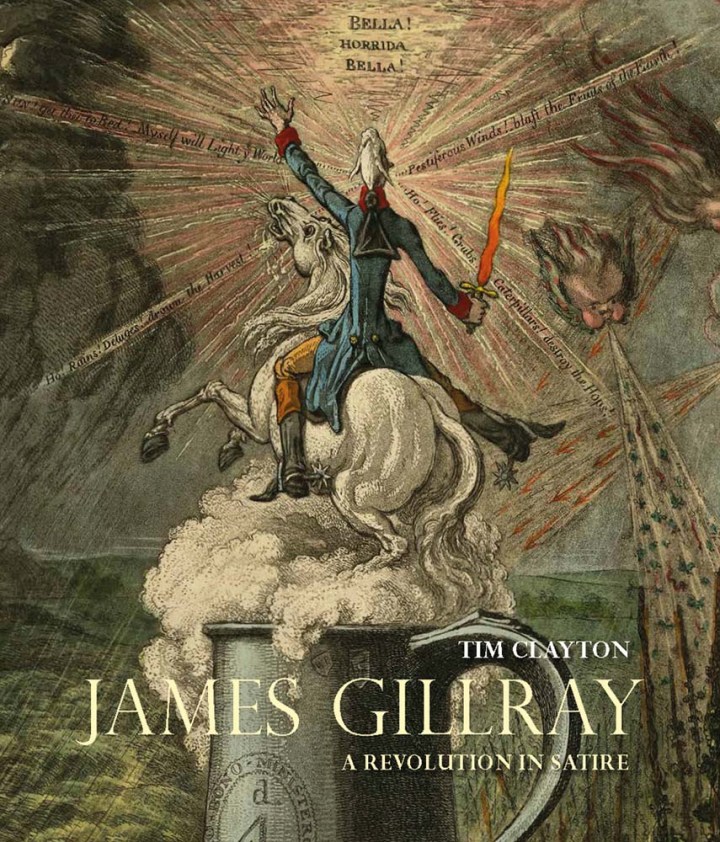 A lavishly illustrated biography of James Gillray, inventor of the art of political caricature
James Gillray (1756–1815) was late Georgian Britain’s funniest, most inventive and most celebrated graphic satirist and continues to influence cartoonists today. His exceptional drawing, matched by his flair for clever dialogue and amusing titles, won him unprecedented fame; his sophisticated designs often parodied artists such as William Hogarth, Joshua Reynolds, and Henry Fuseli, while he borrowed and wittily redeployed celebrated passages from William Shakespeare and John Milton to send up politicians in an age—as now—where society was fast changing, anxieties abounded, truth was sometimes scarce, and public opinion mattered.
Tim Clayton’s definitive biography explores Gillray’s life and work through his friends, publishers—the most important being women—and collaborators, aiming to identify those involved in inventing satirical prints and the people who bought them. Clayton thoughtfully explores the tensions between artistic independence, financial necessity, and the conflicting demands of patrons and self-appointed censors in a time of political and social turmoil.
Tim Clayton is a historian and writer. He is a specialist in eighteenth and early nineteenth-century history and culture and a leading authority on the printed images of that period.
New Book | Louis Lagrenée (1725–1805)
From Arthena:
Joseph Assémat-Tessandier, with a preface by Jan Blanc, Louis Lagrenée (1725–1805) (Paris: Arthena, 2022), 472 pages, ISBN: 978-2903239701, €99,
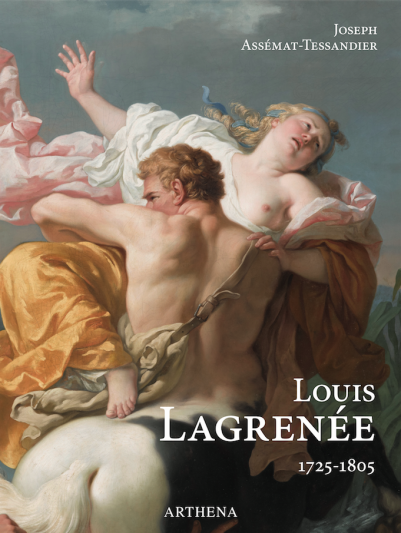 Peintre d’Histoire, à la belle carrière officielle, Louis Lagrenée (1725–1805) présente plus de 150 tableaux au Salon du Louvre de 1755 à 1789. Soulevant à plusieurs reprises l’enthousiasme de Diderot, sa peinture est appréciée des milieux financiers et aristocratiques, jusqu’à la Cour de Russie. Son succès au Salon de 1763 lui donne accès aux commandes pour les demeures royales. Il participe ensuite au programme d’encouragement de la peinture d’Histoire, organisé par le comte d’Angiviller de 1777 à 1789 (La Mort de la femme de Darius ou Les Deux Veuves d’un officier indien). De ses petits tableaux de cabinet (Vierge à l’Enfant, allégories ou scènes mythologiques) aux grands sujets inspirés de l’histoire ancienne (Annibal ayant trouvé le corps de Marcellus), son style épuré et raffiné au coloris délicat lui vaut le surnom d’ ‘Albane français’.
Les découvertes de ces dernières années (carnets de croquis, dessins préparatoires et réapparition d’oeuvres perdues), qui ont permis de doubler le corpus connu de Lagrenee l’aîné, ainsi différencié de son frère Jean-Jacques (1739–1821), apportent un nouvel éclairage sur son art, jalon précieux dans l’évolution de la peinture française vers le néoclassicisme naissant.
Joseph Assémat-Tessandier a soutenu en avril 2020 à l’université de Genève, sa thèse en histoire de l’art sur le peintre Louis Lagrenée. Diplômé de Sciences Po Paris et de l’Insead, il a travaillé auparavant dans des institutions financières américaine et française. Ses recherches se poursuivent à l’heure actuelle sur le peintre Jean-Jacques Lagrenée.
Exhibition | Promenades on Paper: 18th-C. French Drawings
From The Clark:
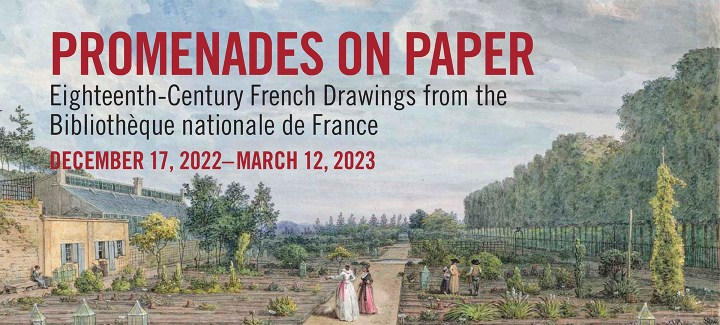
Promenades on Paper: 18th-Century French Drawings from the Bibliothèque Nationale de France
Promenades de papier: Les collections de dessins du 18e siècle de la BnF
The Clark Art Institute, Williamstown, MA, 17 December 2022 — 12 March 2023
Musée des Beaux-Arts de Tours, 13 May — 28 August 2023
Curated by Esther Bell, Sarah Grandin, Anne Leonard, Corinne Le Bitouzé, Pauline Chougnet, and Chloé Perrot
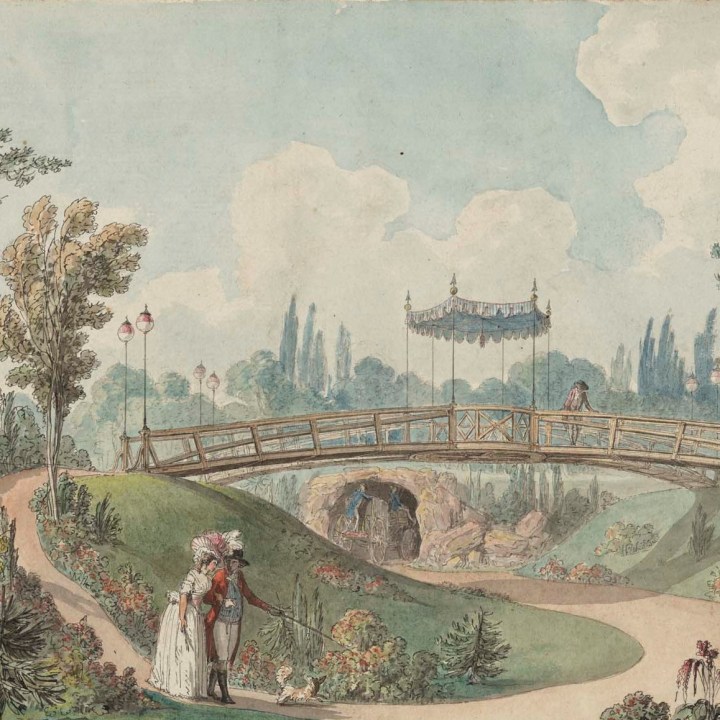
François-Joseph Bélanger, The Garden of Beaumarchais, 1788, watercolor and pen and ink (Bibliothèque nationale de France).
In partnership with the Bibliothèque nationale de France (BnF), the Clark is organizing the first exhibition of the library’s eighteenth-century French drawings. The selection of eighty-six enchanting studies, architectural plans, albums, sketchbooks, prints, and optical devices expands our understanding of drawing as a tool of documentation and creation in the age of Enlightenment, spanning the domains of natural history, current events, theater design, landscape, and portraiture. Displayed together, these objects immerse audiences in the world of eighteenth-century France—a world shaped by invention, erudition, and spectacle. Works by celebrated artists of the period such as François Boucher (1703–1770) and Gabriel de Saint-Aubin (1724–1780) are featured alongside exquisite drawings by lesser-known practitioners, including talented women, royal children, and visionary architects.
Promenades on Paper: Eighteenth-Century French Drawings from the Bibliothèque nationale de France is co-organized by the Clark Art Institute, Williamstown, Massachusetts, and the Bibliothèque nationale de France, Paris. It is curated by Esther Bell, Deputy Director and Robert and Martha Berman Lipp Chief Curator; Sarah Grandin, Clark-Getty Curatorial Fellow; and Anne Leonard, Manton Curator of Prints, Drawings, and Photographs from the Clark, and by Corinne Le Bitouze, Conservateur général; Pauline Chougnet, Conservateur en charge des dessins; and Chloé Perrot, Conservateur des bibliothèques from the Bibliothèque nationale.
This exhibition is made possible by Jessie and Charles Price. Major funding is provided by Elizabeth M. and Jean-Marie Eveillard, the Getty Foundation through its Paper Project initiative, and the Samuel H. Kress Foundation. The exhibition catalogue is made possible by Denise Littlefield Sobel.
Esther Bell, Pauline Chougnet, Sarah Grandin, Charlotte Guichard, Corinne Le Bitouzé, Anne Leonard, and Meredith Martin, Promenades on Paper: Eighteenth-Century French Drawings from the Bibliotheque nationale de France (Williamstown: Clark Art Institute, 2023), 272 pages, ISBN: 978-0300266931, $50.
◊ ◊ ◊ ◊ ◊
Note (added 12 June 2023) — The posting was updated to include the Tours venue.
New Book | La légèreté et le grave
From Passés Composés:
Cécile Berly, La légèreté et le grave: Une histoire du XVIIIe siècle en tableaux (Paris: Passés Composés, 2021), 150 pages, ISBN: 978-2379334009, €24.
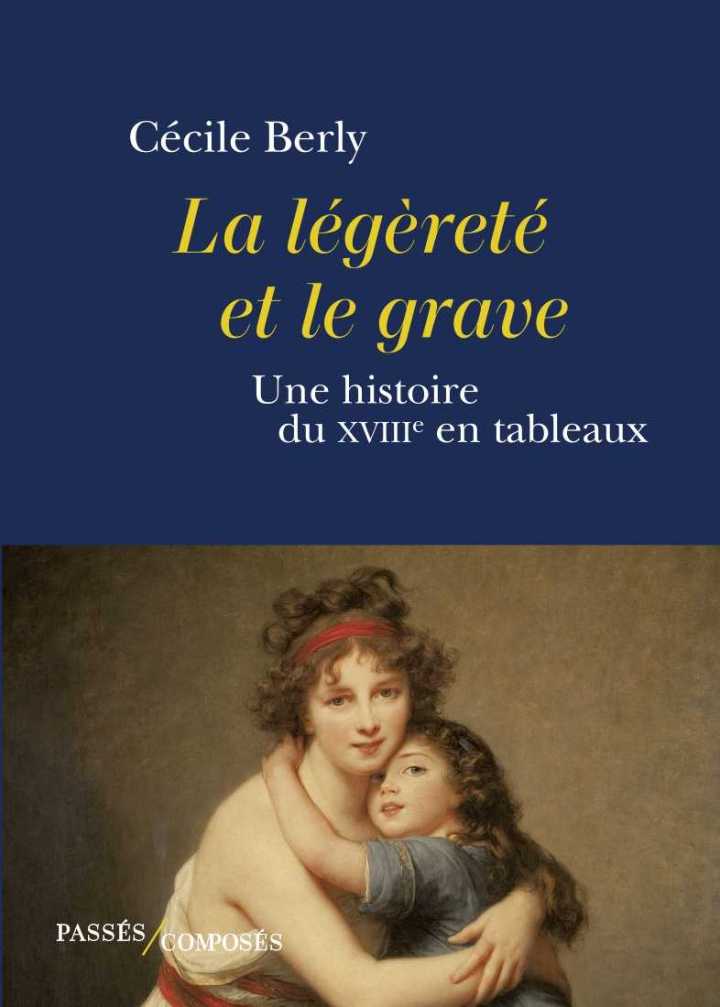 Le XVIIIe siècle s’ouvre avec Le Pèlerinage à l’île de Cythère d’Antoine Watteau et s’achève avec La Mort de Marat de Jacques-Louis David : la naissance de la fête galante versus l’agonie d’un tribun révolutionnaire. Deux chefs-d’œuvre qui illustrent la légèreté et la gravité d’un siècle, deux facettes antagonistes mais complémentaires d’une même époque.
Les dix œuvres ici racontées sont ainsi autant de jalons pour saisir ce siècle passionnant dans ses innombrables contradictions : elles correspondent toutes à un moment du XVIIIe et disent son histoire artistique, culturelle, philosophique, sociale, économique et, bien évidemment, politique. Autant de chefs-d’œuvre qui ont forgé une société nouvelle, éprise de liberté, d’indépendance et de transgressions, au fil d’un siècle qui, sous la plume sensible de Cecile Berly, oscille sans cesse entre une légèreté savamment entretenue et une gravité qui confine au drame.
Historienne, spécialiste du XVIIIe siècle, Cécile Berly a publié plusieurs ouvrages sur Marie-Antoinette. Elle a également présenté et annoté la correspondance de Madame de Pompadour, et est l’auteure des Femmes de Louis XV et de Trois femmes: Madame du Deffand, Madame Roland, Madame Vigée Le Brun.
New Book | L’autre famille royale: Bâtards et maitresses
From Passés Composés:
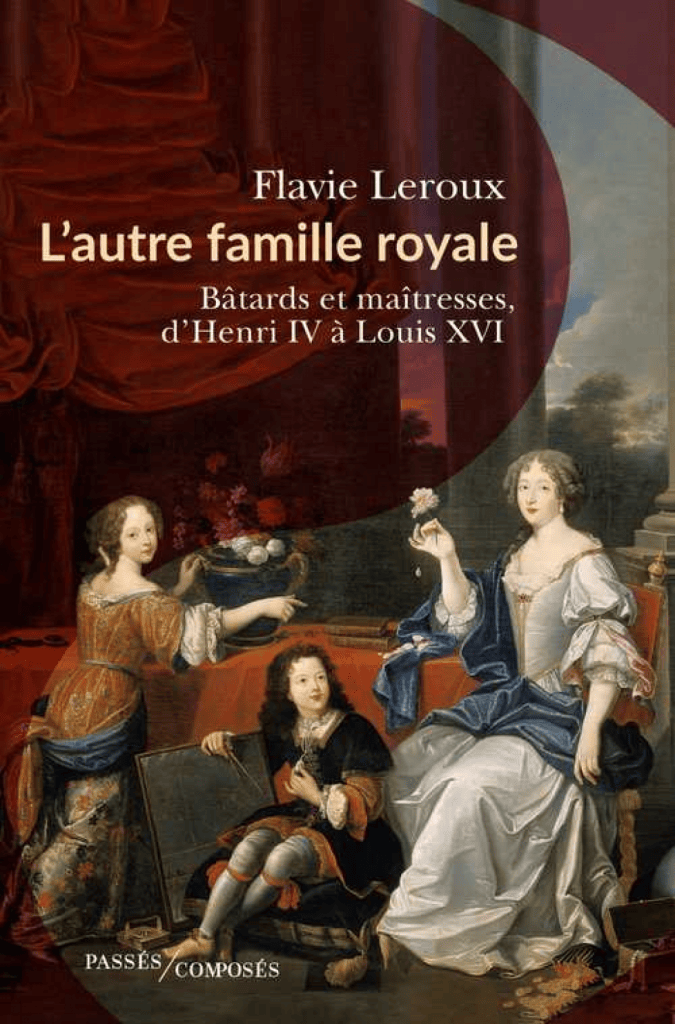
Flavie Leroux, L’autre famille royale: Bâtards et maitresses d’henri IV à Louis XVI (Paris: Passés Composés, 2022), 272 pages, ISBN: 978-2379334801, €22.
 La faillite de l’absolutisme
Maîtresses et bâtards sont au cœur de l’histoire monarchique et tiennent, à l’avènement de ce qu’on appelle « l’absolutisme », un rôle de premier plan. Mais quel est-il ? Et surtout comment la famille royale peut-elle s’en accommoder alors que sur elle reposent la légitimité et la continuité du pouvoir ? C’est à cette question que Flavie Leroux répond en relisant les règnes des Bourbon, d’Henri IV à Louis XVI. Elle redonne leur place aux maîtresses successives et à leurs enfants, aussi bien dans l’idéologie monarchique que dans la réalité du pouvoir et de la vie de cour. D’abord famille de substitution sous Henri IV, avec Gabrielle d’Estrées et les Vendôme, ils s’imposent ensuite, avec Henriette d’Entragues, Louise de La Vallière ou Mme de Montespan, comme une famille parallèle que le roi garde auprès de lui et impose aux côtés de sa lignée légitime. Cette « contre famille » va concurrencer la « véritable » famille à un point tel que, sous Louis XV puis Louis XVI, c’est la crédibilité du pouvoir des Bourbon qui est mise en péril par cette nouvelle organisation. Entre famille, pouvoir et société, un livre inédit, brillant et décisif sur l’inexorable déclin de la monarchie française avant la Révolution française.
Docteur de l’École des Hautes Études en Sciences Sociales, chargée de recherche au Centre de recherche du château de Versailles, membre associée au Centre de recherches historiques, Flavie Leroux est spécialiste d’histoire de la cour et des femmes en France à l’époque moderne, en particulier des maîtresses royales, auxquelles elle a consacré sa thèse et un ouvrage, Les maîtresses du roi, de Henri IV à Louis XIV (2020).
New Book | Indigenous Continent: The Epic Contest for North America
From Norton:
Pekka Hämäläinen, Indigenous Continent: The Epic Contest for North America (New York: Liveright, 2022), 592 pages, ISBN: 978-163149698, $40.
 A prize-winning scholar rewrites 400 years of American history from Indigenous perspectives, overturning the dominant origin story of the United States.
There is an old, deeply rooted story about America that goes like this: Columbus ‘discovers’ a strange continent and brings back tales of untold riches. The European empires rush over, eager to stake out as much of this astonishing ‘New World’ as possible. Though Indigenous peoples fight back, they cannot stop the onslaught. White imperialists are destined to rule the continent, and history is an irreversible march toward Indigenous destruction.
Yet as with other long-accepted origin stories, this one, too, turns out to be based in myth and distortion. In Indigenous Continent, acclaimed historian Pekka Hämäläinen presents a sweeping counternarrative that shatters the most basic assumptions about American history. Shifting our perspective away from Jamestown, Plymouth Rock, the Revolution, and other well-trodden episodes on the conventional timeline, he depicts a sovereign world of Native nations whose members, far from helpless victims of colonial violence, dominated the continent for centuries after the first European arrivals. From the Iroquois in the Northeast to the Comanches on the Plains, and from the Pueblos in the Southwest to the Cherokees in the Southeast, Native nations frequently decimated white newcomers in battle. Even as the white population exploded and colonists’ land greed grew more extravagant, Indigenous peoples flourished due to sophisticated diplomacy and leadership structures.
By 1776, various colonial powers claimed nearly all of the continent, but Indigenous peoples still controlled it—as Hamalainen points out, the maps in modern textbooks that paint much of North America in neat, color-coded blocks confuse outlandish imperial boasts for actual holdings. In fact, Native power peaked in the late nineteenth century, with the Lakota victory in 1876 at Little Big Horn, which was not an American blunder, but an all-too-expected outcome.
Hämäläinen ultimately contends that the very notion of ‘colonial America’ is misleading, and that we should speak instead of an ‘Indigenous America’ that was only slowly and unevenly becoming colonial. The evidence of Indigenous defiance is apparent today in the hundreds of Native nations that still dot the United States and Canada. Necessary reading for anyone who cares about America’s past, present, and future, Indigenous Continent restores Native peoples to their rightful place at the very fulcrum of American history.
Pekka Hämäläinen is Rhodes Professor of American History at Oxford University and the author of The Comanche Empire, winner of the Bancroft Prize, and Lakota America: A New History of Indigenous Power. He lives in Oxford, England.










leave a comment