Call for Papers | Medieval Manuscripts in the Eighteenth Century
Collections, remaniements, expositions: Les vies du manuscrit médiéval
aux périodes moderne et contemporaine
Institut national d’histoire de l’art, Paris, 18 November 2013
Proposals due by 19 May 2013
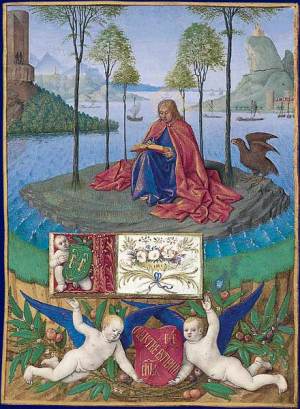
Saint Jean à Pathmos. Heures d’Étienne Chevalier, enluminées par Jean Fouquet (Chantilly: Musée Condé) Photo from Wikimedia Commons
Dismantled codices, where pages have been extracted from their original contexts, have provided museums with important examples of medieval and Renaissance illumination. Although artists of the late medieval period began to create single-leaf illuminations, many of the pages donated and purchased by museums resulted from the cutting and reshaping of complete manuscripts during the eighteenth century, a phenomenon which was spurred by changing collecting practices that favoured the presentation of single objects as a works of art.
Despite their importance to the history of the book, these objects are rarely displayed, little studied, and generally unknown. In the fall of 2013, a series of three exhibitions will be presented in collaboration with the INHA (the French National Institute for Art History): the first at the Musée des Beaux-Arts in Angers, followed by the Palais des Beaux-Arts in Lille, and then the Musée des Augustins in Toulouse. These exhibitions, which will help to inform audiences about this fragile heritage, will bring together objects from the collections of museums and learned societies in regions such as the Centre and Pays de la Loire, Nord-Pas-de-Calais, Picardy and
Champagne-Ardenne, Midi-Pyrénées and Languedoc-Roussillon.
To mark this occasion, the INHA will organize a one day conference on the 18th of November, 2013. This Journée d’études will consider the history of modern and contemporary manuscript collections, paying special attention to the practice of cutting, pasting, and revising medieval works during the eighteenth century. Issues relating to the conservation, restoration, and exhibition of these objects in museums will also be taken into account.
The famous manuscripts known as the Hours of Etienne Chevalier by Jean Fouquet is an example of this phenomenon. Dismembered during the eighteenth century, its miniatures were pasted on panels to create independent images satisfying the desires of collectors. For both economic and aesthetic reasons, the history of medieval books is full of similar examples of assembly from several manuscripts, collections of initials, and detached single leaves. Such practices reveal the tastes and the aspirations of collectors, some of whom were famous for their approach to illuminated manuscripts (J. Granger and J. Bagford during the eighteenth century, or Luigi Celotti during the nineteenth century). Collectors and learned societies played an important role in the constitution of certain collections, facilitating the preservation of many illuminated works. Papers may thus address the following questions:
• Practices of collectors concerning illuminated manuscripts from the beginning of the modern era to the contemporary period (cutting, reshaping, destruction, creation of false/fakes/false leaves, etc.)
• The development of manuscripts collections in museums
• The conservation, restoration and presentation of manuscripts in museums or private collections and learned societies from the nineteenth century to the present day
Communications in English, French or Italian. Please send an abstract of 250 words with a CV (maximum two pages) to Tania Lévy (tlevy@info-histoire.com) and Judith Soria (judith.soria@yahoo.fr) before the May 19th, 2013. The program will be announced in July 2013.
For the call for papers in French, click here»
Call for Papers | Materializing the Spirit: Cultures of Women Religious
From the H-WRBI:
Materializing the Spirit: Spaces, Objects, and Art in the Cultures of Women Religious
Institute of Historical Research, Senate House, London, 5-7 September 2013
Proposals due by 1 February 2013
The History of Women Religious of Britain and Ireland Annual Conference will be hosted by the Institute of Historical Research, University of London, on 5-7 September 2013.
Paper proposals are now invited. Presentations should be 20 minutes in duration, and should address some element of the conference theme, with reference to British and/or Irish contexts. The devotional and vocational activities of women religious sculpted the physical space of religious houses in unique ways. Patterns of use were etched into the fabric of buildings, guiding structural design and interior decoration. But buildings also shaped practice: whether the formal monastic sites of early or revived enclosed orders or the reused secular buildings of active congregations, women both adapted and adapted to their material surroundings.
A growing body of literature has addressed itself to convent art, exploring nuns as patrons, consumers and manufacturers of material and visual culture. These practices span the history of women’s religious life – from the early Middle Ages to the present day – and suggest a hidden but dynamic tradition of artistic enterprise. This conference explores the creative output of women religious including but not limited to textiles and the decorative arts, illuminated manuscripts and printed books, women’s patronage of painting and architecture, the commercial production of ecclesiastical textiles in the nineteenth-century, production of liturgical and devotional art in recent periods, and the development of unique convent and institutional spaces by and for women religious.
Key aims of the conference will be to highlight the scholarly value of these under-researched and little known spaces and collections and also to raise awareness and discuss the threats that they face as communities decline, buildings close, artefacts and archives are dispersed.
This conference will take a broad and diverse view on what constitutes ‘material culture’, emphasizing the conception, production, and meanings of the many material outputs of convents and monasteries. Papers are welcomed from a diverse range of disciplines: scholars from social and religious history, art and architecture, theology, anthropology, psychology and beyond are invited to offer fresh and innovative perspectives in order to illuminate ways in which women religious in Britain and Ireland created and were formed by material histories for over a thousand years.
Please send 200-word proposals for 20-minute papers to conference conveners Kate Jordan (kate.jordan.09@ucl.ac.uk) and Ayla Lepine (ayla.lepine@gmail.com) by no later than 1 February 2013.
Call for Papers | Encounters, Affinities, Legacies
Encounters, Affinities, Legacies: The Eighteenth Century in the Present Day
University of York, 28-29 June 2013
Proposals due by 19 April 2013 (extended from previous due date of 1 March 2013)
As the field of eighteenth-century studies continues to boom within the academy, the eighteenth century – invoked around names like Rousseau, Voltaire, and Adam Smith – is becoming an increasingly frequent interlocutor in contemporary debates in the international media about society, democracy, human rights, and the economy. Whilst social and political commentators are reading our present in dialogue with our eighteenth-century past, cultural appetites for the eighteenth century on page, stage, and screen continue to grow: powerful suggestions that intertwined discourses like (E)nlightenment and modernity, central to so much eighteenth- and twentieth-century thought, remain vital to the social, political and cultural construction of our contemporary moment. This interdisciplinary conference seeks to explore the complex webs of interconnection between the long eighteenth century and the ‘long’ twentieth century, from 1900 to the present.
Keynote speakers: Donna Landry (University of Kent) and Markman Ellis (Queen Mary, University of London)
The conference will take place at the heart of a festival of public engagement events including public lectures, fashion, music, performance, and photography. Any proposals for involvement in the festival would also be received with interest, and should be emailed to Adam Perchard at agkp500@york.ac.uk by the end of January 2013.
The conference organisers welcome submissions for presentations in the following formats:
• Pre-formed panels, approximately one hour in length. Panels can contain two, three or exceptionally four speakers, and should identify an appropriate panel chair. We particularly encourage interdisciplinary panels.
• Individual papers, approximately 20 minutes in length.
We welcome presentations in original and innovative formats, such as interactive demonstrations, Q&A/debating sessions, or exhibitions. These should be no longer than 30 minutes per contributor. Topics may include, but are not limited to, the following:
• intertexts/intersects: engagements between eighteenth- and twentieth-century texts, images, and performances
• the eighteenth century on the twentieth-century stage, page and screen
• nostalgia and rejection: twentieth-century historiographies of the eighteenth century
• global centuries: (post-)empire, race, and cosmopolitanisms
• legacies and disconnects: constructing and reforming society
• print culture and satire: resistance, radicalism, and freedom of speech
• ‘the rise of the novel’: literary grand narratives
• place and space: architecture between centuries
• Romantic Modernisms/Modern Romanticisms
Panel submissions: Please send a 250-300 word abstract for each paper in the panel, along with a panel overview of 300 words, explaining how the individual papers relate to one another. Include the name and contact details for your chair, as well as each of the contributors.
Individual paper submissions: Please send a 250-300 word abstract outlining your paper. Include your name and contact details.
Alternative format submissions: Please send a 300-350 word outline of your presentation, outlining the content and format. Where presentations are made by more than one contributor, longer proposals will be considered. Include the names and contact details of all contributors.
Please send abstracts to encounters.2013@gmail.com no later than 1 March 2013.
Call for Papers | Traces of Early America
Traces of Early America: An Interdisciplinary Graduate Student Conference
The McNeil Center for Early American Studies, University of Pennsylvania, 26-28 September 2013
Proposals due by 15 March 2013
Scholars encounter early America through its traces, the vestiges and fragments left behind. And in reconstructing the fleeting and ephemeral, scholars also attempt to trace early American encounters. This conference will bring together graduate students from a wide variety of disciplines to explore the various meanings of traces—as material objects, cultural representations, and academic practices. Papers might consider how people deliberately and unwittingly left traces as they moved through space and time; what traces or remnants of the past get privileged while others are marginalized or occluded; how written, visual, and other texts are both material objects and traces of lives and experiences; and where we look for the traces of different communities and conflicts in early America. More generally, papers might address tracing as a method of historical inquiry, one that both uncovers and constitutes objects and archives, as well as the methodological traces that have reconfigured early American studies, such as Atlantic history, diaspora studies, hemispheric studies, and circum-Caribbean and Latin American studies.
We welcome applicants from a wide variety of disciplines—among them history, literature, gender studies, ethnic studies, anthropology, archeology, geography, art history, material culture, religious studies, and political science—whose work deals with the histories and cultures of North American and the Atlantic world before 1850. Applicants should email their proposals to mceas.traces.2013@gmail.com by March 15, 2013. Proposals should include an abstract of no more than 250 words along with a one-page c.v. Paper presentations should be no more than 20 minutes. Limited financial support is available for participants’ travel expenses. Decisions will be announced by May 15, 2013.
Any conference-related questions can be directed to: mceas.traces.2013@gmail.com.
Call for Papers | London and the Emergence of a European Art Market
London and the Emergence of a European Art Market, c. 1780-1820
The National Gallery, London, 21-22 June 2013
Proposals due by 15 February 2013
The French Revolution and the ensuing Napoleonic Wars with occupations of Italy, Spain and the Low Countries, instigated a sweeping redistribution of art. At the same time, the Papacy’s loss of temporal power undermined the enforcement of export laws in the Papal States. This convergence of events ensured that large volumes of paintings—often entire collections, from European monasteries, churches, and private palaces—were widely dispersed via auction and private treaty sales in a true diaspora of art. Current scholarship posits that amidst these large-scale market transformations London emerged as the new hub of the international art trade, replacing Paris. The well-known example of the move of the Orléans collection to London, where it was sold through various private treaty transactions and a series of auctions between 1798 and 1802, is often considered a pars pro toto for the British assumption of power on the international art market.
While some studies have begun to address the velocity and scale of this redistribution, little has been done to analyze the dynamic networks of agents who provided the infrastructure for the circulation of art works and sales information throughout Europe. Economist Neil de Marchi recently pointed out that the financial market linking crucial centers such as Amsterdam, London, and Paris has been studied in depth, but comparable research into the “mechanism of the painting trade and the extent to which it was integrated across those centers has barely begun.” This conference aspires to tackle this issue by convening scholars and experts from a range of disciplines to discuss broad research questions such as: Did the long-term effects of the political turmoil in France alter the existing personal and professional networks of dealers and connoisseurs? What would have been the motivations to ship art works to foreign market places? How integrated was the European art market around 1800, or were there still relatively independent local markets? Was there an implied hierarchy of metropolitan markets or were conditions too volatile and fluid for fixed patterns to emerge?
Given the vast amount of historical evidence now available to scholars, we have the capacity to address these micro and macro developments in innovative ways. Over the last two years the National Gallery, London, and the Getty Research Institute, Los Angeles, have collaborated on a project to research, transcribe, and index auction catalogues published in Great Britain between 1780 and 1800. By January 2013, almost 100,000 new sales records from c. 1,200 catalogues will be published online, via the Getty Provenance Index® databases. This will add significantly and strategically to the already extant data-pool of approximately half a million records from British, French, German, Dutch, Belgian, and Scandinavian Sales, spanning the period of c. 1780 to 1820.
One of the main objectives of this international conference is to work towards a methodological synergy of art historical case studies and data-driven socioeconomic analysis in order to understand better the mechanisms of the international art trade at this pivotal period as well as the long-term implications for the history of collecting, the establishment of museums, and the formation of the discipline of art history.
Topics for consideration include, but are not limited to:
• A R T W O R K S Cross-border traffic of objects (cultural transfers, customs regulations, arbitrage, etc.) and its effect on the formation of private and public collections.
• A G E N T S Market integration throughout Europe (national/transnational dealer networks, centre and periphery, impact of revolution and war, etc.)
• I N F O R M A T I O N Auction catalogues as economic tool and literary genre (classification systems, lot sequence, transparency, connoisseurship, etc.)
• V A L U E S Idea of art as an investment (different national canons and currencies, growth of investment-minded collectors, ascendancy of the banker as a key player, price manipulation, etc.)
Please send proposals for papers (to last 30 minutes) of no more than 250 words by 15 February 2013 to either/both:
Susanna Avery-Quash
Research Curator in the History of Collecting and Display
The National Gallery, London
susanna.avery-quash@ng-london.org.uk
Christian Huemer
Managing Editor, Project for the Study of Collecting and Provenance
The Getty Research Institute, Los Angeles
chuemer@getty.edu
Call for Articles | The Discourses of Anger
Brill’s series seems to define the early modern period as ca. 1450/1500 to ca. 1700. Still, for those of you working at the turn of the seventeenth and eighteenth centuries, this might be relevant. . .
◊ ◊ ◊ ◊ ◊
The Discourses of Anger in the Early Modern Period
Edited by Karl A.E. Enenkel and Anita Traninger
Proposals due by 1 March 2013
 Intersections is a peer-reviewed series on interdisciplinary topics in Early Modern Studies published by Brill (Leiden/Boston). Contributions may come from any of the disciplines within the humanities, such as history, art history, literary history, book history, church history, social history, cultural history, and history of ideas. Each volume focuses on a single theme and consists of essays that explore new perspectives on the subject of study. The series aims to open up new areas of research on early modern culture and to address issues of interest to a wide range of disciplines.
We are inviting proposals for contributions to a volume on discourses of anger in the Early Modern Period to be published in the series Intersections. The volume will be edited by Karl A.E. Enenkel (Münster University) and Anita Traninger (Freie Universität Berlin).
Emotion, the perceived counterpoint to reason, has received intense attention in the humanities and the social sciences in recent decades. Anger, however, has traditionally been conceived as pertaining to both reason and passion, since it involves complex mechanisms of rational judgment of social situations but is at the same time characterized by untamed/violent emotional repercussions. Aristotle held that anger was the morally justified seeking of revenge following the incurrence of a slight. Being thus conceived of as a social emotion, anger has since been construed as being composed of sadness and hope, as involving social and moral categories, and as mediating between the past and the future.
Even though anger is characterized as a just reaction to social misdemeanor, it has not been acknowledged universally as a socially beneficial reaction. The Stoics insisted that it was necessary to suppress it at the first showing of angry symptoms in order to achieve freedom from the disturbance of emotions which forms the basis of the good life; Christianity, where Stoic views were adopted very early on, found it difficult to reconcile the idea of anger as the just reaction of a virtuous man with its ideals of passivity.
In the Early Modern period, this already ambiguous conception was complicated by a changing intellectual framework. The Early Modern period sees long-term shifts between traditional systems of thought: a mounting criticism of Aristotelianism, a forceful contestation of Scholasticism, the factioning of religious belief and the emergence of contesting theologies along with moral canons, the rediscovery and transformative appropriation of Stoic and Sceptic doctrines, to name but a few. We are interested in how the notion of anger is informed by these developments.
Despite the recent surge in research on the history of emotions, there is no comprehensive, interdisciplinary account of notions of anger in the early modern period. There is a host of studies on ‘ancient anger’, and the Middle Ages have also received due attention, but the early modern period has been neglected in this regard, despite a wealth of sources and despite the fact that wide-spread speculation about the emotions in general emerged in Early Modern times.
Thus in our volume, we ask contributors to discuss the fate of anger with a view to the tensions between these developments. Contributors to the volume are invited to trace the framing of anger in various discourses in the Early Modern period, including theology, philosophy, literature, medicine, law, political theory, and the arts, as well as
to account for changes in the discourses of anger in this era. We would like to see discussions of anger as a contested field, one that is goverened and defined in various ways by various discourses which may nevertheless converge in literary and non-literary texts, images, religious practice, scholarly debates, etc. (more…)
Call for Papers | Financial Crisis of 1720 and John Law’s Legacy
From Le Blog de l’ApAhAu:
Le Système de Law: Représentations, discours et fantasmes du XVIIIe siècle à nos jours
Université de Montpellier 3, IRCL, 4-5 October 2012
Proposals due by 15 July 2013
Dans les périodes de bulles et de crises financières, John Law et son système sont volontiers évoqués dans le discours médiatique en tant que paradigme et exemple historique de l’une des premières crises financières d’origine spéculative. Les références ou allusions qui y sont faites n’examinent cependant pas les spécificités d’une bulle qui ne fut pas uniquement française mais concerna également l’Angleterre et la Hollande, les pays d’Europe les plus engagés dans l’émergence d’un capitalisme financier au XVIIIe siècle.
A partir des pistes ouvertes par Paul Harsin qui donne une édition des oeuvres complètes de John Law en 1934 (ainsi qu’une première édition des écrits de Dutot, proche collaborateur de Law) et de l’ouvrage d’Edgar Faure (La Banqueroute de Law, 17 juillet 1720, Paris, Gallimard, 1977), historiens et historiens de l’économie ont délimité les différentes étapes et analysé l’enchaînement des faits qui conduisirent à une banqueroute de la première banque royale et à l’instauration d’une durable méfiance à l’égard de la finance et de la forme fiduciaire de l’argent. Si ces recherches ont permis d’établir une chronologie et de faire la lumière sur de nombreux aspects du Système (comme l’ont fait par exemple les recherches récentes de l’historien Antoin Murphy sur des écrits inédits de Nicolas Dutot), peu d’analyses ont pris en compte l’événement dans sa transversalité et sa globalité. Les spécialistes de littérature ont également bien identifié les allusions aux événements de 1720, de manière ponctuelle sous la forme de représentations plus ou moins allégorisées (comme dans les Lettres Persanes de Montesquieu) ou de manière plus diffuse en tant qu’effets sur la représentation de l’argent et des transactions par exemple (voir Martial Poirson, Spectacle et économie à l’âge classique, Garnier, 2011). En 2006, deux articles portant sur les représentations de la banqueroute de Law ont été publiés par des spécialistes de littérature qui s’emploient chacun à élaborer une lecture croisée des événements de l’histoire économique et des fictions qui leur sont contemporaines : Yves Citton procède à une relecture d’un texte de Jean-François Melon, un proche collaborateur de John Law, Mamhoud le Gasnévide, qui raconte sous une forme allégorique les événements financiers survenus sous la Régence (« Les comptes merveilleux de la finance : confiance et fiction chez Jean-François Melon », Fééries n°2, 2005-2006) ; Erik Leborgne s’attache à dégager les fantasmes sous-tendant les représentations de l’argent et de la spéculation dans des textes contemporains des événements (« Le Régent et le système de Law vus par Melon, Montesquieu, Prévost et Lesage »,Féeries n°3, 2006). Se situant dans le prolongement de ces travaux, le présent projet entend renforcer l’interdisciplinarité des approches du phénomène et faire le point sur ce qui peut être considéré comme un événement traumatique et structurant de la France moderne, en suggérant trois orientations non limitatives : (more…)
Call for Articles | The Digital Turn
The Digital Turn
Special Issue of the Journal for Early Modern Cultural Studies (JEMCS)
Proposals due by 15 January 2013
It is well understood that ‘the digital turn’ has transformed the contemporary cultural, political and economic environment. Less appreciated perhaps is its crucial importance and transformative potential for those of us who study the past. Whether through newly—and differently—accessible data and methods (e.g. ‘distant reading’), new questions being asked of that new data, or recognizing how digital reading changes our access to the materiality of the past, the digital humanities engenders a particularized set of questions and concerns for those of us who study the early modern, broadly defined (mid-15th to mid-19th centuries).
For this special issue of JEMCS, we seek essays that describe the challenges and debates arising from issues in the early modern digital, as well as work that shows through its methods, questions, and conclusions the kinds of scholarship that ought best be done—or perhaps can only be done— in its wake. We look for contributions that go beyond describing the advantages and shortcomings of (or problems of inequity of access to) EEBO, ECCO, and the ESTC to contemplate how new forms of information produce new ways of thinking. We invite contributors to consider the broader implications and uses of existing and emerging early modern digital projects, including data mining, data visualization, corpus linguistics, GIS, and/or potential obsolescence, especially in comparison to insights possible through traditional archival research methods. Essays of 3000-8000 words are sought in .doc, .rtf, or.pdf format by January 15, 2013 to <jemcsfsu@gmail.com>. All manuscripts must include a 100-200 word abstract. JEMCS adheres to MLA format, and submissions should be prepared accordingly.
In addition, we would welcome brief reports (500-1500 words) that describe digital projects in progress in early modern studies (defined here as spanning from the mid-fifteenth to the mid-nineteenth centuries), whether or not these projects have yet reached completion. These reports, too, should be submitted in .doc, .rtf, or.pdf format, using MLA style, by 15 January 2013.
Please don’t hesitate to write me if you have any questions about this special issue. We look forward to reading your work in this area.
Devoney Looser
Co-Editor, Journal for Early Modern Cultural Studies
looserd@missouri.edu
Call for Papers | A Window on Antiquity: The Topham Collection
A Window on Antiquity: The Topham Collection at Eton College Library
The Paul Mellon Centre for Studies in British Art, London, 17 May 2013
Proposals due by 10 February 2013
 To accompany the exhibition Paper Palaces: The Topham Drawings as a Source for British Neo-Classicism at Eton College Library, 9 May – 1 November 2013
Consisting of 37 volumes and more than 3,000 items, the collection amassed by Richard Topham (1671-1730) is one of the most significant resources for the history of antiquarianism and for the culture and industry of the Grand Tour in Europe. This collection of drawings, watercolours and prints after antique sculptures and paintings in Rome and Italy is the largest of its kind assembled in England, surpassing in both scale and breadth those collected by other celebrated antiquarians such as John Talman, Dr Richard Mead or Thomas Coke, 1st Earl of Leicester.
Since its arrival at Eton in 1736 the Topham Collection has fascinated and served archaeologists, researchers investigating collections of antiquities and scholars of the history and reception of the classical tradition. The drawings have also attracted the attention of art historians, as Topham managed to assemble an extraordinary range of works by some of the best Italian draughtsmen of the first half of the eighteenth century, such as Pompeo Batoni, Giovanni Domenico Campiglia and Francesco Bartoli, or by artists who later excelled in other fields, including the architect William Kent. More recently it has also emerged that Francesco Bartoli’s drawings of ancient ceilings and wall elevations in the collection were extensively copied and re-adapted by neo-classical architects such as Robert Adam, James Wyatt and Charles Cameron, becoming one of the most important sources for a decorative language that would spread over Europe.
However, despite the growing body of scholarship on the Topham Collection produced in recent decades, notably the work of the late Louisa M. Connor Bulman, a comprehensive study of the whole collection and of its role in eighteenth-century antiquarian culture is still wanting.
We invite proposals for papers on any aspect of the Topham Collection. Special consideration will be given to papers examining the Topham Collection in relation to British and European antiquarian and artistic culture. Cross-disciplinary and comparative studies are particularly welcome.
The conference, jointly hosted by Eton College, The Paul Mellon Centre for Studies in British Art and The University of Buckingham, will be held in London at The Paul Mellon Centre on 17 May, 2013. Selected papers may be published in an edited volume.
For further information please contact Dr Adriano Aymonino (University of Buckingham) or Lucy Gwynn (Eton College Library). Please email abstracts of no more than 300 words by 10 February, 2013 to:
adriano.aymonino@buckingham.ac.uk
l.gwynn@etoncollege.org.uk
Call for Papers | Travel, Topography, and the Book Trade
Print Networks Conference: Travel, Topography, and the Book Trade
University of Chichester, 23-25 July 2013
Proposals due by 31 January 2013
Guest Speakers: Bill Bell (Cardiff University) and Anthony Payne (Anthony Payne Rare Books & Manuscripts)
The thirty-first Print Networks Conference on the History of the British book trade will take place at the University of Chichester on 23rd-25th July 2013. Due to the proximity of the conference venue to the south coast, ‘Travel, Topography and the Book Trade’ has been chosen as the theme for the conference. The theme is broadly defined, and any papers relating to the production, distribution and reception of texts and images about travel, imagined and real, from the Middle Ages to the modern era will be considered. Papers on travelling and migrating practitioners of the book trade, the physical movement of texts and travelling printing technology are also welcome. The geographical scope for the conference is Britain and the Anglophone world. Papers should be of 30 minutes’ duration. An abstract of the offered paper should be submitted (preferably via email) by 31st January 2013 to: Catherine Armstrong: C.M.Armstrong@mmu.ac.uk
The Print Networks Conference also offers an annual fellowship to a postgraduate scholar whose research falls within the parameters of the conference brief, and who wishes to present a paper at the conference. The fellowship covers the cost of attending the conference and some assistance towards costs of travel. A summary of the research being undertaken accompanied by a letter of recommendation from a tutor or supervisor should be sent to the above address by 31st January 2013.
The papers presented will be considered for publication; details to follow at the conference. It is understood that papers offered to the conference will be original work and not delivered to any similar body before presentation at this conference.
En-suite accommodation will be provided on the Bishop Otter campus of the University of Chichester. In addition to a full programme of papers, there will be a conference dinner and a visit to the special collections of the University of Chichester library.










leave a comment