Call for Papers | Sugar and Beyond
From the conference website:
Sugar and Beyond
The John Carter Brown Library, Providence, RI, 25-26 October 2013
Proposals due by 15 December 2012
◊ ◊ ◊ ◊ ◊
Organizers: Christopher P. Iannini (Rutgers), Julie Chun Kim (Fordham), and K. Dian Kriz (Brown)
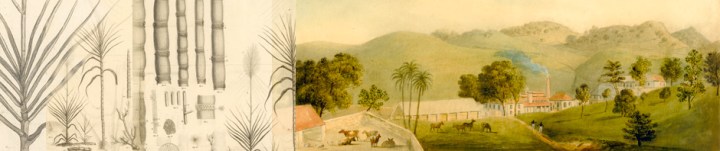
The John Carter Brown Library seeks proposals for a conference entitled Sugar and Beyond, to be held on October 25-26, 2013, and in conjunction with the Library’s Fall 2013 exhibition on sugar in the early modern period, especially its bibliographical and visual legacies. The centrality of sugar to the development of the Atlantic world is now well known. Sugar was the ‘green gold’ that planters across the Americas staked their fortunes on, and it was the commodity that became linked in bittersweet fashion to the rise of the Atlantic slave trade. Producing unprecedented quantities of sugar through their enforced labor, Africans on plantations helped transform life not only in the colonies but also in Europe, where consumers incorporated the luxury commodity into their everyday rituals and routines.
Sugar and Beyond seeks to evaluate the current state of scholarship on sugar, as well as to move beyond it by considering related or alternative consumer cultures and economies. Given its importance, sugar as a topic still pervades scholarship on the Americas and has been treated in many recent works about the Caribbean, Brazil, and other regions. This conference thus aims to serve as an occasion where new directions in the study of sugar can be assessed. At the same time, the connection of sugar to such broader topics as the plantation system, slavery and abolition, consumption and production, food, commodity exchange, natural history, and ecology has pointed the way to related but distinct areas of inquiry.
Although sugar was one of the most profitable crops of the tropical Americas, it was not the only plant being cultivated. Furthermore, although the plantation system dominated the lives of African and other enslaved peoples, they focused much of their efforts at resistance around the search for ways to mitigate or escape the regime of sugar planting. We thus welcome scholars from all disciplines and national traditions interested in exploring both the power and limits of sugar in the early Atlantic world. Topics that papers might consider include but are not limited to the following:
• The development of sugar in comparative context
• The rise of sugar and new conceptions of aesthetics, taste, and cultural refinement
• Atlantic cultures of consumption
• Coffee, cacao, and other non-sugar crops and commodities
• Natural history and related genres of colonial description and promotion
• Imperial botany and scientific programs of agricultural expansion and experimentation
• Alternative ecologies to the sugar plantation
• Plant transfer and cultivation by indigenous and African agents
• Provision grounds and informal marketing
• Economies of subsistence, survival, and resistance
• Reimagining the Caribbean archive beyond sugar: new texts and methodological approaches
In order to be considered for the program, please send a paper proposal of 500 words and CV to jcbsugarandbeyond@gmail.com. The deadline for submitting proposals is December 15, 2012.
Presenters will likely have some travel and accommodation subvention available to them. For more information, consult the conference website or email Margot Nishimura, Deputy Director and Librarian (margot_nishimura@brown.edu).
Call for Papers | Connected Histories of Empire
Connected Histories of Empire
University of Bristol, Centre for the Study of Colonial & Postcolonial Societies, 15-16 July 2013
Proposals due by 14 January 2013
Over the last two decades, scholars have begun to characterise the British Empire as a complex patchwork of interacting and dynamic agencies, rather than as a homogenous monolith. As a result, the traditional spatial framework based on a stable division between the metropole and the periphery seems increasingly outmoded. Instead, historians, literary critics, scholars of globalisation, and philosophers have been writing about the webs, networks, and circuits in which people, objects, and ideas moved. This conference will interrogate the idea of an empire of connections, considering the possibilities opened up by thinking in terms of global interaction, as well as the challenges of incorporating the myriad interconnections of empire into coherent historical narratives.
The conference is the culmination of a year of events at the University of Bristol which have focused particularly on the memorialisation and commemoration of the British Empire. As scholars have begun to uncover the intricately woven interconnections of empire, a central concern of the conference will be to consider how this might influence how empire has been, and is, remembered and memorialised in Britain and elsewhere.We would like to invite proposals for papers and panels that speak to the following broad themes:
· Commemoration and memorialisation of different imperial sites, events and phenomena
· Links between imperial port-cities/global cities
· Flows of people, goods (physical and cultural), and cash
· The movement, preservation and display of imperial artefacts and archives
· Imperial networks and imperial careering
· Imperial audiences and public spheres
· Links between global history and imperial history
We would like to encourage broad discussion of connections and comparisons between different modern empires: proposals need not be restricted to the history of the British empire. We would also welcome papers from a range of academic disciplines. To apply, please send a 250-word abstract to the organisers at connectedhistoriesofempire@yahoo.co.uk by 14 January 2013.
Conference Organisers
History: Emily Baughan, Robert Bickers, Peter Coates, Tim Cole, Simon Potter, Jonathan Saha, and Rob Skinner
Hispanic, Portuguese and Latin American Studies: Matthew Brown and Joanna Crow
English: John Lee
Archaeology and Anthropology: Mark Horton
Call for Papers | American Association for Italian Studies Conference
The complete Call for Papers is available at the conference website:
American Association for Italian Studies
University of Oregon, Eugene, 11-14 April 2013
Proposals due by 15 November 2012
We are pleased to invite you to join the forthcoming 2013 AAIS Conference that will be hosted by the Department of Romance Languages at the University of Oregon in Eugene, OR on April 11–14, 2013. The AAIS (American Association of Italian Studies) gathers scholars and intellectuals who conduct research in Italian literature and more broadly contribute to the study of the different aspects of Italian society and artistic production, including its influence on other cultures.
We envision next year’s conference as an opportunity for a stimulating and fruitful exchange of ideas and expertise that will span not only the different periods of Italian literature, but also related areas of scholarship such as art, art history, history, philosophy, music, photography, etc. We look forward to seeing you next April. For more information on the American Association for Italian Studies, please visit the AAIS website.
Call for Papers | The Paris Fine Art Salon, 1791-1881
From the University of Exeter:
The Paris Fine Art Salon, 1791-1881
University of Exeter, 4-6 September 2013
Proposals due by 25 January 2013
Keynote speakers: Susan Siegfried (University of Michigan), Pierre Vaisse (University of Geneva), and Richard Wrigley (University of Nottingham)
The Paris Fine Art Salon dominated French artistic life throughout the nineteenth century. Organised by the State, and usually lasting between two and three months, the Salon was an annual or biennial showcase for the contemporary visual arts and a conspicuous manifestation of French artistic hegemony. It provided artists with the most important opportunity available to present their work to the public, attract a clientele, launch and sustain a career, and compete for state honours and prizes, and public and private buyers and commissions. For the public it was a huge social and cultural event, attracting hundreds of thousands of visitors from across Europe and beyond.
The conference will coincide with the completion of a three-year, AHRC–funded project, entitled Painting for the Salon? The French State, Artists and Academy, 1830-1852. The participants in the project, Professor James Kearns (Principal Investigator), Dr Alister Mill (Research Fellow) and Harriet Griffiths (doctoral candidate) will each present elements of their research at the beginning of the second day, which will be devoted to the period 1830-1852. The first day will be devoted to the period 1791-1830, the third to 1852-1881.
We invite proposals for papers which explore issues and ideas centred around the Paris Salon as an artistic and cultural event in the period 1791-1881. Areas that may be considered include the Salon’s importance for the careers of the exhibiting artists, its relationship to other exhibition spaces in Paris and the provinces, its management by the State, the shifting role of the Académie des Beaux-arts and/or the Salon jury, viewing conditions in the Salon, the impact of changes in Salon management on such issues as participation rates and stylistic innovation, and the exhibition’s significance as a social as well as artistic event. Please email James Kearns at J.Kearns@exeter.ac.uk with a title and 150-word abstract of your proposed 20/25-minute paper by 25 January 2013.
Conference papers to be delivered in either English or French.
Call for Papers | Exotic Goods in France and the U.S., 1700-2000
In the spring at NYU’s Center for International Research in the Humanities and Social Sciences:
Objects From Abroad: The Life of Exotic Goods in France and the United States
New York University, 25 April 2013
Proposals due by 31 December 2012
The development of material studies and consumption studies, of anthropology of the material world and the material culture of art history shows growing interest for the material dimension of pictures and goods. This perspective calls attention to the physical and social life of things. In this sense, our conference looks to analyse the production of goods and their transformation, in connection with their various uses and contexts. A historiography focusing on the construction of international spaces and exchanges through the movements of things, goods, merchandises and artworks is currently on its way.
This conference would like to concentrate on the goods imported in France and the United States between the 18th and the 20th century, and their existence within their new environment: business or tourist trips, where the exotic objects were collected and gathered in private spaces; scientific expeditions, where “anthropological” artefacts were collected for Western museums. What kind of things and goods were brought back to New York City, Paris, and the other American and French cities – and through cities of many countries – between the 18th and the 20th century? How were they exhibited, put on display, but also converted and updated? We wish to interrogate the life and “career” of goods, their collection and their circulation, as well as the way in which goods acted upon reception societies. What was the impact of these objects on ways to consume, to live, to dress, to create? What about the processes of translation and interpretation that accompanies such uses and appropriation?
Exchanges between Europe and United States were heavy and significant but they are seldom analysed. Therefore they needs to be carefully examined. At the same time, paying attention to these goods is also a way to repopulate these worlds with different actors. Collectors, but also ethnographers, dealers, painters, soldiers: they were all inventing, marketing and consuming these singular things. From this angle, these goods become boundary objects that mobilized and gathered different communities – scientific, commercial, artistic, etc. Around the actors lie various spaces: we would like to observe the large scale movements but also micro-movements and circulations, and also how these goods were set up and displayed in museums as well as in houses. In this sense, this conference tries to link social practices and representations, visual and material cultures, private and public spaces.
Four directions, all connected, could be explored during this conference:
1. Uses and re-uses
Processes of decontextualisation and recontextualisation (collection, re-use, reparation) will focus our attention. How are the objects sold, exposed, reterritorialized? When bought, how are they used? And, when necessary, how are they repaired or redesigned? Rebuilt and recomposed? Through a series of case studies, it may be useful to follow certain objects from the merchant’s shop to the individual interiors, or from the private space to the museum, looking carefully at the hands and
gestures that welcome and transform the goods.
2. Witnesses and souvenirs
Some objects, such as travel souvenirs, have a special memorial function. What kind of memory do they keep? What are they witnessing? How do they tell us an emotion, a narrative, a story or a part of history? This reflection can also be extended to the issue of fake and authenticity, or of hyper-reality, by studying life-casts, prints, or, in some cases, photography.
3. Actors and markets
Objects are taken as part of a chain involving various actors and consumers that need to be identified. Who are the people involved in these exchanges and what are their roles in the invention of these objects? In their updating and marketing? What are the specific issues, circuits and contours of these markets? How do the different actors and consumers use these objects to develop various identities?
4. Fictions and identities
The fourth axis will focus on fiction, disguise, game, and more generally on fictional use. Joanna Sofaer has already shown how the use and representation of some exotic accessories build identities. How do dresses, dishes or accessories related to tobacco, for instance, work on the identity of their owner? How are these objects mobilized and used in the artworld, in private or public spaces, theater plays or paintings?
Paper abstracts (maximum 300 words) and a short bio (maximum 100 words) should be submitted to Noemie Etienne (noemie.etienne@unige.ch) and Manuel Charpy (manuel.charpy@wanadoo.fr) by December 31, 2012.
Call for Papers | Risk, Crisis, Speculation, 1500-1800
The upcoming Santa Barbara conference on Risk, Crisis, and Speculation is supported — at least for Santa Barbara graduate students — with an course on the subject from the English Department:
ENGL 231: Early Modern Risk (Fall 2012) (Graduate)
Inspired by the ‘Speculative Risk’ programming of last year, this course will pursue the topic of risk in early modern England. In most contemporary discussions of the topic, risk is correlated with modernity. In this course we will address the emergence of some modern conceptions of risk in early modern economic practice and political theory. We will also explore premodern cognates to the notion of risk in concepts like chance and hazard, contingency and calculation, uncertainty and exposure to loss. In our inquiry into early modern risk, we will read More’s Utopia, Bacon’s New Atlantis, book two of Spenser’s Faerie Queene, Marlowe’s Doctor Faustus, and Shakespeare’s Merchant of Venice and The Winter’s Tale. In the course of our conversation we will also touch on the thought of Aristotle, Augustine, Luther, Hobbes, Blumenberg, Derrida, and Butler as we discuss topics ranging from utopian desire and societal engineering to the rise of speculative capitalism and insurance, from the dangers of maritime trade and metaphors of shipwreck to moral philosophy and the technologies of the self, from the hazards of transformative reading and religious conversion to hospitality, affective calculation, and the madness of decision.
While the topic is framed with a grounding in the sixteenth and seventeenth centuries, the conference extends the theme into the eighteenth century, too.
◊ ◊ ◊ ◊ ◊
Risk, Crisis, Speculation, 1500-1800
Early Modern Center at the University of California, Santa Barbara, 9 February 2013
Proposals due by 2 December 2012
The Early Modern Center at the University of California, Santa Barbara is pleased to announce our twelfth annual conference, Risk, Crisis, Speculation, 1500-1800, which will take place in the McCune Conference Room, HSSB 6020, on Saturday, February 9, 2013. Our keynote speaker for this year’s conference is Professor Joseph Roach (Yale University). This year’s conference is being hosted in conjunction with a one-day UC multi-campus research group “(w/Shakespeare)” symposium on “Shakespeare & Risk,” which will take place on UCSB’s campus on Friday, February 8th, and feature keynote speaker Professor Richard Halpern (New York University). Conference attendees and presenters are cordially invited to attend both Friday’s and Saturday’s events.
Contemporary discussions of ‘risk’ or ‘speculation’ often identify these concepts as distinguishing features of modern or postmodern societies. In this conference, we seek to explore and investigate early modern English cognates, forebears, and analogues of ‘risk’ (including, but not limited to, ‘hazard’ and ‘venture’). We hope for a range of presentations investigating religious, economic, political, or environmental aspects of risk in early modern literature and history.
Possible topics include, but are not limited to: maritime trade and the rise of insurance; mathematics and the early history of probability; civic and political crises and governmental intervention; environmental and social crises (plague, famine, etc.) and their ‘management’; gambling, play, and games of chance; erotic and romantic exposure; religious reform and upheaval; conversion and the specter of apostasy; hermeneutics and reading; the stigma of print and publication; violence and the vulnerability of the body.
Please send abstracts, 250-500 words in length, to EMCconference@gmail.com by December 2, 2012. Feel free to contact Christopher Foley at EMCfellow@gmail.com with specific questions.
Call for Essays | The Modern French Interior and Mass Media
Plans for this edited volume grow out of a session from this year’s meeting of the Society for French Historical Studies (March 2012 in Los Angeles). As noted at the Society of Architectural Historians:
Edited Volume: The Modern French Interior and Mass Media
Co-editors: Anca I. Lasc, Georgina Downey, and Mark Taylor
Proposals due by 19 November 2012
We invite papers that focus on the relationship between mass media (broadly defined) and the modern French interior. Since the mid-18th century, a new interest in the modern and comfortable interior, removed from the world of power, staged a gradual dislocation of life away from the court at Versailles and into the city. New patrons and new living spaces inaugurated an unprecedented interest in new building techniques, fashionable tendencies in interior decorating, and new modes of social interaction. With the 19th century, techniques of representing the modern interior witnessed an extraordinary development, enhanced by advances in photography, techniques of color reproduction, and photo-mechanical printing processes. Architectural drawings were complemented by visual representations of the modern interior in prints, books, illustrated journals, private collections, department store catalogs, photographs, guidebooks, and even film. The variety of media employed in representing the modern interior blurred the boundaries between spectacle and privacy, collecting and decorating, the fine and the decorative arts, the domestic and the commercial spheres. Possible topics include, but are not limited to:
– The invention, display, and commercialization of the modern French interior
– The modern interior and technologies of reproduction
– Privacy and publicity in the modern interior
– Mass media – advice and consumption for the home
– Visual and textual narratives of the spectacular or the tasteful interior
– The gendering and politicization of private space as mediated through representational techniques
– Advertising and selling Empire, Art Nouveau, or Art Deco interiors
– The exhibition as a new mass medium for displaying the private interior
– New representational strategies for staging the modern French interior in fine and/or commercial art
– The modern French interior, the studio, and the performed self: artists, ateliers and apartments
– The modern French interior and sexuality: dandies and divas
Please submit a 500-600 words abstract and a short C.V. to Anca I. Lasc (alasc@ship.edu), Georgina Downey (georgina01@adam.com.au) and Mark Taylor (Mark.Taylor@newcastle.edu.au).
Call for Papers | The Substance of Sacred Place
From the Kunsthistorisches Institut in Florenz:
The Substance of Sacred Place: An Interdisciplinary Workshop on Locative Materiality
Kunsthistorisches Institut in Florenz – Max-Planck-Institut, Florence, 20-21 June 2013
Proposals due by 30 November 2012
Organised by Laura Veneskey and Annette Hoffmann
The study of holy places has long been a central concern of not only the humanities, but also the social sciences. Much of this body of scholarship has focused on pilgrimage and sacred centers, either as theoretical constructions or as concrete places, such as Jerusalem, Mecca or Benares. These subjects have been explored, on the one hand, through the study of ritual and liturgy, and on the other, through various modes of representation, be they architectural, cartographic, iconic, or textual. Complementary to these lines of inquiry, we invite papers that explore the material and tactile dimensions of locative sacrality across religious traditions. How is a sense of place communicable through physical means? What can a consideration of matter tell us about the often fraught relationship between the tangible world and its representation?
We seek analyses of all materials evocative of a particular sacred milieu, not only earth, dust, stone, but also wood, metal, pigments, oil, or water. Presentations exploring either the substances and places themselves or textual and iconic depictions thereof are equally welcome. We invite papers from all disciplines on any locale conceived of as sacred, whether scriptural, pilgrim, monastic, ascetic, or cultic, between antiquity and the early modern period. The workshop is aimed at young researchers, and is intended to bring together graduate students, postdoctoral scholars, and those in the early stages of their teaching or professional careers. Possible topics include, but are not limited to:
– Sacred landscapes (deserts, mountains, caves, etc.)
– The material dimensions of topographic representation (iconic or textual)
– Earthen, geographic, and locative relics
– Transportable versus site-specific sanctity
– The physicality of built environments and places of worship
Interested applicants should send a current c.v. and an abstract of no more than 250 words (for presentations of twenty minutes) to hoffmann@khi.fi.it and lv2308@columbia.edu). Proposals must be received by date 30th November 2012.
Call for Papers | Mapping Discursive Geographies
Graduate Student Conference: Mapping Discursive Geographies
University of Arizona, Tucson, 1 February 2013
Proposals due by 20 November 2012
The Art History Graduate Student Association at the University of Arizona is pleased to announce its twenty-third annual symposium, Mapping Discursive Geographies, which will take place February 1, 2013 at the University of Arizona Student Union, Santa Rita Room. The keynote speaker for this year’s symposium is Dr. Stella Nair from the University of California, Los Angeles.
The goal of this symposium is to explore the relationship between geography and art, art history, and curatorial practices, within the context of recent scholarship on natural and artificial landscapes, landscape aesthetics, earth works, land preservation and degradation, hybridities of art and science, disputed and fraught boundaries, the distribution of resources, and immigration. This symposium hopes to provide a forum to address how geography is a cultural process which can be instrumental in the formation of identity.
Some ideas to consider are: how do national and social identities become inscribed in the terrain? How do visual representations of terrestrial and corporeal spatiality construct meaning? How have shifts in geographies changed the production, exhibition, and/or consumption of artistic, curatorial practices and art historical discourse? Paper topics may include, but are not limited to:
1. Site specificity, locality, and intervention
2. Construction of mythology and symbolism in the landscape
3. National/corporeal identities
4. Physical or intangible borders between nations/individuals and issues of ownership and sovereignty
5. Commercialization, consumerism, and tourism
6. Historic and contemporary cartographic or locational practices
Graduate students in art history and relating disciplines are invited to submit a 300-word abstract and curriculum vita to AHGSA.org@gmail.com by November 20, 2012. Applicants will receive notification via email of the committee’s decisions by December 12, 2012. To learn more about the Art History Graduate Student Association at the University of Arizona, please visit www.cfa.arizona.edu/ahgsa/.
Call for Papers | Material Culture Studies in Three Dimensions
From The Center for Material Culture Studies at the University of Delaware:
Embodied Objects: Material Culture Studies in Three Dimensions
Winterthur Museum, Garden & Library, 20 April 2013
Proposals due by 30 November 2012
 The Center for Material Culture Studies at the University of Delaware invites submissions for papers to be given at the Eleventh Annual Material Culture Symposium for Emerging Scholars.
The objects we create, manipulate, and consume mediate our experience with the world. We seek a broad range of papers that highlight the intersection between objects and humans, things and people. We’re interested in how three-dimensional objects act as extensions of ourselves, provide repositories for memory, help stabilize identity, interrupt our sense of scale and space, give permanence to relationships, and mirror human forms. Papers may also address how objects mediate human sensory experience and create aesthetic meaning. We encourage papers that reflect upon and promote an interdisciplinary discussion on the state of material culture studies today.
Disciplines represented at past symposia include American studies, anthropology, archaeology, consumer studies, English, gender studies, history, museum studies, and the histories of art, architecture, design, and technology. We welcome proposals from graduate students, postdoctoral scholars, and those just beginning their teaching or professional careers.
Format
The symposium will consist of nine presentations divided into three panels. Each presentation is strictly limited to eighteen minutes, and each panel is followed by comments from established scholars in the field. There will be two morning sessions and one afternoon session, with breaks for discussion following each session and during lunch. Participants will also have the opportunity to tour Winterthur’s unparalleled collection of early American decorative arts and to engage in a roundtable discussion on Friday, April 19. Travel grants of up to $300 will be available for presenters.
Submissions
The proposal should be no more than 300 words and should clearly indicate the focus of your object-based research, the critical approach you take toward that research, and the significance of your research beyond the academy. While the audience for the symposium consists mainly of university and college faculty and graduate students, we encourage broader participation. In evaluating proposals, we will give preference to those papers that keep a more diverse audience in mind.
Send your proposal, with a current c.v. of no more than two pages, to emerging.scholars@gmail.com. Proposals must be received by 5 p.m. on November 30, 2012. Speakers will be notified of the vetting committee’s decision in January 2013. Confirmed speakers will be asked to provide symposium organizers with digital images for use in publicity and are required to submit a final draft of their papers by March 11, 2013.
Conference Co-Chairs: Liz Jones and Amy Torbert










leave a comment