Call for Papers: Cleveland Symposium
Cleveland Graduate Student Symposium — Things Fall Apart: Fragmentation in Visual Culture
Cleveland Museum of Art, 23 March 2012
Proposals due 15 December 2011
 The 2012 Cleveland Symposium invites graduate submissions exploring the theme of fragmentation in the visual arts. This trope has manifested itself in a variety of ways in response to political, social, ideological, or aesthetic trends of a particular epoch. Students are encouraged to interpret this theme broadly, through avenues such as iconoclasm, revolution, political upheaval, physical fragmentation of materials, or particular aesthetic movements.
We welcome submissions from graduate students in all stages of their studies and from all fields and geographic regions, ranging from ancient through contemporary art. We will also consider papers from a wide range of methodologies and approaches. A monetary prize will be awarded to the speaker who presents the most innovative research in the most successfully delivered paper.
Please send an abstract of no more than 300 words for papers of no longer than 20 minutes, along with a curriculum vitae or résumé, to clevelandsymposium@gmail.com by December 15, 2011. Please include “Cleveland Symposium Submission” in the subject line of your email. Selected presenters will be notified by January 1, 2012.
Call for Papers: London-Irish
The London-Irish in the Long Eighteenth Century, 1680-1830
University of Warwick, 13-14 April 2012
Proposals due by 31 January 2012
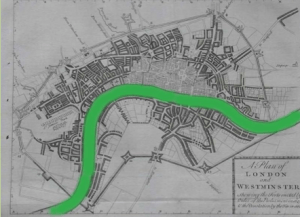 The Irish became an intrinsic part of the London population through the course of the eighteenth century. Whether Catholic and Protestant, professional or plebeian, London provided opportunities for waves of Irish migrants. Irish migrants can of course be found throughout Britain (and Europe) at this time but London offered a burgeoning world capital that embraced all tiers of Irish society. The Irish, from both sides of the religious divide, could be found almost anywhere in London: in its kitchens, drawing rooms, legal chambers, banking houses, theatres, newspaper offices, and courts. Nevertheless robust systematic historical data on these migrants is scarce – such accounts that exist of the Irish diaspora in pre-1815 London (Denvir, Akenson, and Jackson) are useful but fragmentary and Irish historiography on the diaspora has generally tended to concentrate on the famine years.
There is work on Irish Catholics in Europe but only recently have more focused accounts of Irish networks operating in London in the eighteenth century begun to emerge. Yet despite the sparse accounts of their activities, there was certainly a strong Irish – Catholic as well as Protestant – presence in London throughout this period. Archbishop King warned that Irish visitors in London ‘converse only in a very sneaking private way with one another’ and this observation suggests a metropolitan space within which the Irish diaspora could form themselves into tight social and professional networks. The study of such networks would provide a fresh perspective on London in the long eighteenth century. How did such networks form? How did they evolve? To what degree were they inclusive/ exclusive? How did they represent ‘Irishness’ and/or Ireland to London? And how were they received?
This interdisciplinary conference is being organized by David O’Shaughnessy and will be hosted by the Department of English & Comparative Literature, University of Warwick. Plenary lectures will be given by Professor Toby Barnard (History, University of Oxford); Professor Claire Connolly (Literature, University of Cardiff; and Professor Mary Hickman (Sociology, London Metropolitan University). Papers will be welcomed in all disciplines and from scholars at all stages of their careers. The deadline for 300-word abstracts is 31 January 2011 (email: londonirish@warwick.ac.uk). Suggested topics might include but are not limited to:
- Quantifying the Irish diaspora (population, migration patterns/routes, births, deaths, baptisms, funerals)
- Defining an Irish community/network
- Catholic and Protestant communities/networks
- Professional Irish (lawyers, bankers, merchants, tutors, physicians, booksellers)
- Literary and artistic Irish (theatre, newspapers, literary clubs, artists, Society of Antiquaries, Royal Academy, bookshops)
- Labouring Irish (military, servants, sailors, shipwrights, builders)
- Religious Irish (places of worship, priests)
- Political Irish (clubs, societies, parliament, lobbyists, spies, petitioners, the Irish at court)
- Anti-Irish sentiment
- Irish language
- Riots
- Sport
- Irish societies and charitable organizations
- The Irish on trial (lawyers and criminals)
- The rise of the Irish pub (taverns/coffee houses patronised by the Irish)
- The Irish ‘ghetto’ (geography of the Irish in London)
- Irish elites and their circles (Burke, Goldsmith, Sheridan)
Call for Papers: Napoleonic Wars
From The Courtauld:
Contested Views: Visual Culture and the Revolutionary and Napoleonic Wars
Courtauld Institute of Art Research Forum at Tate Britain, London, 19-20 July 2012
Proposals due by 16 December 2011
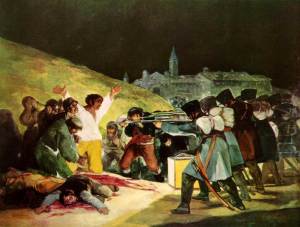
Goya, "The Third of May 1808," 1814 (Madrid: Prado)
In July 2012, in advance of commemoration of the bicentenary of the Battle of Waterloo, Tate Britain is to host a two-day conference exploring the impact of the Revolutionary and Napoleonic Wars on world-wide visual culture, from the outbreak of the pan-European conflict with France in 1792 to the present day. Centered on themed panels, plenary lectures and workshops, this cross-disciplinary conference will promote knowledge and understanding of the range of ways in which the ‘First Total War’ has been mediated in visual cultures, not only in Britain and continental Europe but throughout the world.
The organizers are keen to receive proposals for papers that present new research and/or methodological approaches. In particular they would like to encourage proposals from scholars from different disciplines who wish to work in collaboration with each other. Please send proposals of no more than 250 words to Phil Shaw ps14@le.ac.uk.
Organised by Martin Myrone (Tate Britain), Satish Padiyar (The Courtauld Institute of Art), Phil Shaw (University of Leicester), and Philippa Simpson (National Maritime Museum)
Call for Papers: The History of Jewish Art
Ars Judaica Conference: Traditions and Perspectives in History of Jewish Art
Bar-Ilan University, Israel, 10-13 September 2012
Proposals due by 6 November 2011
The conference will bring together historians of art and material culture and researchers in history, religions, semiotics, psychology, sociology, and folklore to explore the fields of interest of Ars Judaica: The Bar-Ilan Journal of Jewish Art that include, but are not limited to:
– The Jewish contribution to the visual arts and culture from antiquity to the present
– Art and architecture of Jewish sacred spaces
– Biblical texts as a source in Christian and Muslim visual arts
– Jerusalem and the Holy Land as an object and model in visual arts
– Images of Jews in visual arts
– Hebrew script in visual arts
– Patrons, collectors and museums of Jewish art
– Jews, arts and politics
Abstracts (limited to 200 words) of twenty-minute presentations with a short CV should be submitted (as attached MSWord documents) by January 6, 2012 to gr.ajudaica@biu.ac.il. The applicants will be notified of the decision regarding their proposals by February 6, 2012.
Call for Papers: Material Matters for Emerging Scholars
From the University of Delaware:
Tenth Annual Material Culture Symposium for Emerging Scholars: Material Matters
Winterthur Museum, Garden & Library, Delaware, 14 April 2012
Proposals due by 16 November 2011
Focus: Object-based research has the potential to expand and even reinvent our understanding of culture and history. In honor of the tenth anniversary of the MCSES, we seek a broad range of papers from emerging material culture scholars. Whether exploring the latest theories, viewing existing material through a new lens, or reinterpreting standing historical conversations with an object-based focus, proposed papers should exemplify the possibilities in material culture research. In exploring these material matters, we hope to promote an interdisciplinary discussion on the state of material culture studies today. Disciplines represented at past symposia include American studies, anthropology, archaeology, consumer studies, English, gender studies, history, museum studies and the histories of art, architecture, design and technology. We welcome proposals from graduate students, postdoctoral scholars, and those just beginning their teaching or professional careers.
Format: The symposium will consist of nine presentations divided into three panels. Each presentation is limited to twenty minutes, and each panel is followed by comments from established scholars in the field. There will be two morning sessions and one afternoon session, with breaks for discussion following each session and during lunch. Participants will also have the opportunity to tour Winterthur’s unparalleled collection of early American decorative arts and to engage in a roundtable discussion on Friday, April 13. Travel grants of up to $300 will be available for presenters.
Submissions: The proposal should be no more than 300 words and should clearly indicate the focus of your object-based research, the critical approach you take toward that research, and the significance of your research beyond the academy. While the audience for the symposium consists mainly of university and college faculty and graduate students, we encourage broader participation. In evaluating proposals, we will give preference to those papers that keep a more diverse audience in mind. Send your proposal, with a current c.v. of no more than two pages, to emerging.scholars@gmail.com.
Deadline: Proposals must be received by 5 p.m. on Wednesday, November 16, 2011. Speakers will be notified of the vetting committee’s decision in January 2012. Confirmed speakers will be asked to provide symposium organizers with digital images for use in publicity and are required to submit a final draft of their papers by March 5, 2012.
Call for Articles: Special Issue of ‘World History Connected’
Special Issue of World History Connected: Art in World History
Submissions due 1 December 2011
The February 2012 issue of the online journal World History Connected will focus on “Art in World History.” It seeks to offer case studies and effective methodological and/or pedagogical approaches highlighting this important aspect of both research and teaching in the field of world history. The editor of the journal, Marc Jason Gilbert, and the guest editor of this forum, Ralph Croizier, seek five sorts of contributions: (more…)
Call for Papers: Women Artists in Italy, 1500-1750
Women Artists in Early Modern Italy
The Medici Archive Project, Florence, 3 March 2012
Proposals due 1 December 2011
 The Jane Fortune Research Program on Women Artists in the Age of the Medici at The Medici Archive Project is organizing a one-day conference (Florence, March 3, 2012) to highlight new documentary findings on the creative production of women in the visual arts (broadly defined) in the period 1500-1750.
Researchers have been exploiting historical archives to answer such questions as, What were the lives of women artists like in early modern Italy? Did their creative production take its cues from the social, cultural and professional circumstances that characterized their careers? Did they operate workshops similarly to male artists? Did their techniques for attracting patronage and setting prices follow the example of male artists? Where else besides the professional artist’s studio did women engage in the visual arts? Are there works of art by women artists that can be identified, dated or otherwise clarified by means of archival evidence? This conference offers an opportunity for comparing findings on early modern women artists and for examining a range of useful archival strategies and historiographic methodologies.
Although Italian women artists are of primary concern at this conference, papers on women artists of other countries are welcome particularly if they can be linked with the Medici or if their works were collected by any of the Medici (as in the case of Rachel Ruysch for instance). We are also particularly keen to include papers dealing with the collecting and display of works by women artists in the years 1500-1750, as well as papers that characterize the patronage enjoyed by women artists of this period.
To apply, please submit by December 1, 2012, a paper title, a one-page abstract either in English or Italian, and a curriculum vitae. Submissions should be sent via email to Dr. Sheila Barker: barker@medici.org
Call for Papers: Historical Jewish Districts
Jews and Jewish Districts in Europe, 18th to 21th Centuries
11th International Conference on Urban History
Charles University, Prague, 29 August — 1 September 2012
Proposals due by 15 November 2011
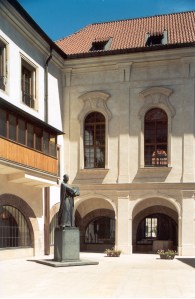
Charles University, Prague
Panel organizers invite paper proposals for the session Jews and Jewish Districts in Europe, 18th to 21th Centuries in conjunction with the 11th International Conference on Urban History, sponsored by The European Association for Urban History. Focusing on ‘Cities & Societies in Comparative Perspective’, the conference will be held in Prague from 29 August to 1 September 2012. More information is available at the conference website. For online submission visit www.eauh2012.com/sessions/call-for-paper-proposals/.
◊ ◊ ◊ ◊ ◊
The European Association for Urban History was established in 1989 with the support of the European Union. Conferences are organised every two years. These biannual conferences provide a multidisciplinary forum for historians, sociologists, geographers, anthropologists, art and architectural historians, economists, planners and all others working on different aspects of urban history. Membership in the Association is free of charge, and is demonstrated
by repeated active participation at the conferences.
The Association supports participation of young scholars by stipends, which cover registration fees, and since 2010 it even offers mobility stipends in a limited number of justified cases. Up to now 10 conferences have been organised. The first one took place in Amsterdam in 1992; twenty years after this first conference, we will meet in Prague. You are sincerely welcome to join us.
Call for Papers: Graduate Student Symposium at Boston
Boston University Graduate Student Symposium on the History of Art & Architecture
Boston University, 2-3 March 2012
Proposals due 28 November 2011
The 28th Annual Boston University Graduate Student Symposium on the History of Art & Architecture invites submissions exploring the role of doubles, multiples, and copies in artistic production from antiquity to the present.
Possible topics include, but are not limited to, the following: molds, casts, and replicas; afterimages, mirror images, twinning/tripling, and “mise en abyme”; serial formats and presentations; Janus or Gemini figures, uncanny doubles, doppelgangers, and evil twins; the replication or reappearance of architectural elements and structures; mimicry and mimesis; issues of reproduction in photography, print culture, media, and mass production; copying and emulation in practice and pedagogy; work that problematizes, resists, or elides duplication or multiplication; appropriation, plagiarism, and copyright issues; the re-presentation of works or performances; relationships between facsimiles and originals; and dialogues between final products and sketches or models.
We welcome submissions from graduate students at all stages of their studies, working in any area or discipline. Please email a 500-word abstract and CV as attachments to Leslie K. Brown, Symposium Coordinator, at lkbrown@bu.edu by November 28, 2011. Papers should be 20 minutes in length and selected speakers will be notified before January 1st. The Symposium will be held March 2-3, 2012, with a keynote lecture (TBD) at the Boston University Art Gallery at the Stone Gallery on Friday evening and paper presentations on Saturday in the Riley Seminar Room of the Museum of Fine Arts, Boston.
This event is generously sponsored by The Boston University Center for the Humanities; the Boston University Department of History of Art & Architecture; the Museum of Fine Arts, Boston; the Boston University Graduate Student History of Art & Architecture Association; and the Boston University Art Gallery at the Stone Gallery.
Call for Papers: Luxury Trade Conference
Call for Papers as noted at British Art Research:
The Trade in Luxury & Luxury in Trade: Production, Display, and Circulation
Musée Gadagne, Lyon, 22-23 November 2012
Proposals due by 1 January 2012
This Call for papers is for an international interdisciplinary conference, The Trade in Luxury & Luxury in Trade: The Production, Display, and Circulation of Precious Objects from the Middle Ages to the Present Day, organized by the Laboratoire de Recherche Historique Rhône-Alpes (UMR 5190) to take place at the musée Gadagne in Lyon, on Thursday 22 and Friday 23 November 2012.
How were luxury objects produced, displayed, disseminated and consumed? The aim of this conference is to return to the question of progressive specialization in a trade devoted to precious objects. The chronological, spatial and disciplinary boundaries are flexible, open in order to encourage the participation of specialists from different backgrounds – history, art and design history, economics, literature, sociology, etc. The conference’s objective is to reveal the richness and diversity of what the term ‘luxury’ embraced (and embraces) and to consider how specialist markets were gradually created and defined. Two specific approaches will be developed. On one hand, the focus will be on people and goods; on the other, it will be on points of sale and the material and symbolic power deriving from this particular sector of the economy.
The methods of production, display, circulation, and consumption of luxury goods will be the subject of this conference. The aim is to raise questions about growing specialization in a trade devoted to precious objects which are designed to make people and their surroundings more attractive. Specialists from different backgrounds will deal with these questions from many chronological, spatial and disciplinary perspectives. Diverse acadenic fields will thus be represented, among them history, art and design history, economics, literature, sociology, etc.
This interdisciplinary approach to the luxury market across a long period of time, from the Middle-Ages to the present day, will make it possible to contrast different experiences and underline continuities as well as changes. Luxury has often been discussed merely with reference to fine arts production. Here, in contrast, the objective is to reveal the richness and diversity of a phenomenon referred to as ‘luxury’, and the progressive emergence of specialized markets. Two specific approaches will thus be developed in the conference: on the one hand, a focus on people and goods, and on the other hand, a focus on points of sale and the material and symbolic power deriving from this particular sector of the economy. Indeed, luxury does not only derive from the methods and forms of the material economy; it is also a controversial value, a symbolically charged trade, a political argument, a religious controversy. These facets of luxury are either linked with or remote from the circuits of consumption, leading or following consumption practices. The papers, which may refer to French or foreign examples, should contribute to the following topics and perspectives: (more…)










leave a comment