Call for Papers: Centre and Periphery in the Enlightenment
From the society’s website:
Centre and Periphery in the Enlightenment: The Annual Conference of the Werkgroep 18e Eeuw
Groningen, The Netherlands, 20-21 January 2012
Proposals due by 30 June 2011
In recent years, Enlightenment studies have moved away from a traditional national, most often Francocentric or Anglocentric focus toward a new view of the Enlightenment as an international process. New conceptual categories have emerged, including that of an international, transnational or Atlantic Enlightenment, while older categories such as the Republic of Letters have been revived. Yet these categories do not fully do justice to the power relations also underlying much Enlightenment debate, in the Low Countries and beyond. As attractive as the notion of a transnational Enlightenment may be, it obscures the unequal access to power of different participants in Enlightenment debate, not only in terms of geography but also related social, institutional, and gender identifications.
This conference would therefore like to ask whether the older concept of centre and periphery might be useful in addressing power discrepancies between participants in Enlightenment debates. In doing so, it takes up the provocative question formulated by one of the conference’s key-note speakers, Jorge Cañizares-Esguerra: whose Enlightenment was it anyway? Who defined what the Enlightenment’s central discourse and players were, and who defined its periphery? Can centre-periphery relations be perceived not only horizontally, i.e. across national borders, but also vertically, i.e. within them? What was the relation between various forms of regionalist consciousness and Enlightenment discourse? Topics that may be considered include, but are not restricted to:
• colonial discourse on / and the Enlightenment
• regionalism and Enlightenment
• the participation of ‘small’ or peripheral countries and regions to Enlightenment debate
• gatekeepers controlling access to Enlightenment discourse
• key institutions / mediators within larger configurations of power structures
• authors’ positioning as insiders / outsiders
Prospective speakers are invited to submit a 300-word paper proposal, together with a short bio-bibliographical statement, by 3oth June 2011 to the conference organizers: M.M.Lok@uva.nl and A.C.Montoya@rug.nl. Accepted proposals will be printed as abstracts in the conference booklet, together with high-resolution illustrations where relevant. Speakers will be asked to limit their papers to 20 minutes. The conference language will be English.
◊ ◊ ◊ ◊ ◊
From the society’s website:
The Werkgroep 18e Eeuw / The Dutch-Belgian Society for Eighteenth-Century Studies
The ‘Werkgroep 18e Eeuw’ endorses research into all aspects of eighteenth-century history in the Low Countries (Belgium and the Netherlands). The society is open to anybody who is interested in eighteenth-century history; both interested laymen and professional researchers alike. The Werkgroep intermediates between members and is a meeting place for all those interested in eighteenth century history. The Werkgroep approaches its objectives primarily through the organisation of annual conferences and the publication of the periodical De Achttiende Eeuw. By means of an electronic news letter, the Werkgroep keeps its members informed about conferences, calls for papers, guest lectures by foreign experts, and other current developments. Each year, the Werkgroep awards a the author of the most outstanding MA thesis on a topic concerning eighteenth-century history. (more…)
Call for Papers: François Cointeraux and Earthen Architecture
François Cointeraux (1740-1830), Pioneer of Modern Earthen Architecture:
Theory, Teaching and Dissemination of a Vernacular Technique
Lyons, 10-12 May 2012
Proposals due by 31 July 2011
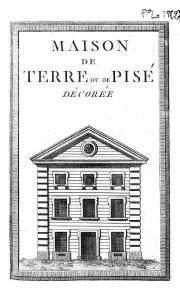 From 1785 onwards, the builder and master mason François Cointeraux actively promoted a construction technique of vernacular origin, known as pisé de terre (or ‘rammed earth’), which was at that time confined to southeast France. His cahiers or fascicules from the Ecole d’architecture rurale (School of Rural Architecture), published in Paris in 1790-91, were rapidly translated into seven languages (German, Russian, Danish, English, Finnish, Italian and Portuguese). They attracted the attention of major architects such as Henry Holland (1745-1806) in England, Thomas Jefferson (1743-1826) in America, David Gilly (1748-1808) in Germany and Nicolaï L’vov (1751-1803) in Russia, founder of a flourishing school of earthen architecture in Tiukhili near Moscow, based on Cointeraux’s school of the Colisée in Paris. Through his publications, Cointeraux generated an almost universal interest for this material, as cheap as it was abundant, and encouraged its adaptation to rural or residential architecture.
This success can largely be explained by a desire to revive rural architecture, which was in perfect harmony with both the physiocrats’ line of thought and the actions of agricultural societies. However, Cointeraux never managed to popularise its use widely and lastingly in France. His numerous publications did not achieve their expected uptake with the institutions concerned. He is nonetheless representative of a culture of invention and innovation, highly characteristic of the first industrial revolution and the birth of modern architecture. The aim of the conference is to present a synthesis of the extensive research carried out on François Cointeraux over the course of the last twenty years and to re-situate his work in the wider context of the evolution of ideas and techniques.
T H E M E S O F T H E C O N F E R E N C E (more…)
Call for Papers: 200 Years of Sense and Sensibility
I realize this is more literary than art historical, but how nice it would be to hear a strong visually-oriented talk on sensibility in Austen’s context. From the conference website:
200 Years of Sense and Sensibility
University of St Andrews, 9-10 September 2011
Proposals due by 30 June 2011
Keynote speakers: Kathryn Sutherland (St Anne’s College, Oxford) and Paula Byrne (author of the new Harper Collins Jane Austen biography).
“I am never too busy to think of S&S,” Jane Austen wrote to her sister, Cassandra in April 1811. The year saw the publication of her first novel and to mark the anniversary, we are hosting a conference that reflects upon two hundred years of readership and opens up new interpretations of the novel. We invite proposals for 20-minute papers and round table panels on any aspect of the novel. Possible topics may include but are not limited to:
• Social and historical context
• Reception
• Tradition of Sensibility/contemporary aesthetic theory
• Literary influences
• Sibling relationships
• Feminist readings
• Adaptations and appropriations
• Re-writings and sequels
• The novel’s place in the canon
Please send abstracts of no more than 250 words to the conference organisers, Marina Cano López and Rose Pimentel, at 200sensibilities@gmail.com. Please also email us with any questions. The deadline for proposals is 30 June 2011.
Call for Papers: ‘Art Against the Wall’ at the Courtauld
Art Against the Wall
The Courtauld Institute of Art, London, 19 November 2011
Organized by Thomas Balfe and Jocelyn Anderson

Anon. Fireplace with sculpture of birds, Claydon House, Buckinghamshire, 19th century. Source: Conway Library, The Courtauld Institute of Art
Art against the Wall, the third symposium of The Courtauld’s Early Modern department, will provide an occasion for established and emerging scholars to present and discuss their research together. This one-day symposium will explore the relationship between walls and art in early modern visual culture. During the period 1550-1850 the interplay between work and wall became increasingly complex as art objects began to pull away from the walls which had previously defined them. The enduring association between artistic skill and craft production meant that many art works were often still regarded as elements in overarching decorative schemes; paintings installed in eighteenth-century English domestic interiors, for example, continue to be described as part of the ornamentation, even as the furniture, of a room. Conversely, walls now had the power to redefine art works, giving them a new meaning through a new context; thus, in late sixteenth-century debates on the status of the religious image, walls – which map the division between sacred and secular space – take on crucial importance. Yet the wall could also become art, as the numerous examples of trompe l’oeil wall illustration to be found in seventeenth-century architecture and garden design suggest. Taking as its point of departure Derrida’s insight that there can be no clear separation of ergon (work) from parergon (not-the-work, ‘wall’), the symposium will attempt to investigate the rich questions raised by the phenomenon of art against the wall. We welcome contributions relating to paintings, sculptures, decorative schemes, architecture and works on paper. Topics for discussion may include, but are not limited to: (more…)
Call for Papers: Eighteenth-Century Scottish Studies Society
Conference of the Eighteenth-Century Scottish Studies Society: Media and Mediation
University of South Carolina, Columbia, 12-15 April 2012
Proposals due 1 December 2011
 ECSSS will celebrate its 25th annual conference in Columbia, South Carolina, in April 2012. The conference will explore the varieties of media through which eighteenth-century Scots articulated or created both individual voices and communal understandings. Papers and sessions may focus on any aspects of cultural mediation or forms of oral and written media in the broadest sense, including manuscript culture journals, letters, notebooks, and marginalia), aural culture (sermons, songs, conversation, and academic lectures), and print culture (from stately folios and elegant octavos, to pamphlets, newspapers, broadsides, and chapbooks). Papers focused on the mediators rather than the media-authors, diarists, scholars, orators, readers and listeners, singers and composers, editors, critics, and members of the book trades-are equally welcome, as are Conference sessions will be held in the new Hollings Special Collections Library, home of the G. Ross Roy Collection of Robert Burns & Scottish Literature, and other Scottish collections. Plenary sessions will include the 2012 W. Ormiston Roy Memorial Lecture by Professor Nigel Leask, Regius Professor of English, University of Glasgow, speaking on the cultural functions of commonplace books. (more…)
Call for Papers: Transnational History of Museums
As noted at Le Blog de L’ApAhAu and at OSK — Onderzoekschool Kunstgeschiedenis (Dutch Postgraduate School for Art History) . . .
Transnational History of Museums
Technische Universität Berlin, 17-18 February 2012
Proposals due by 15 June 2011
 Temple of muses, custodian of cultural heritage, site of memory, space for the mediation of taste and knowledge: The functions of the museum are manifold and are given different emphases, depending on the type of museum and the disciplinary outlook. However, the argument that the institution is a major venue for the construction of national identity has recurred again and again since the first royal collections were opened to the public around the middle of the eighteenth century. Indeed, the number of museum foundations was particularly high in Europe during the nineteenth century, when the modern nation-state was being established. Yet the tight linkage between nation-building and the birth of public collections has increasingly been called into question by recent scholarly work on the history of museums. Instead, local traditions have been stressed or international comparisons have been drawn upon in order to explain policies of collecting, the display of exhibits or the architectural design of individual galleries.
The aim of the planned conference is to go beyond the national framework in analyzing the institution of the museum. It offers an invitation to reflect from a transnational perspective upon the purposes and concepts of museums, museum practices, and the perception of museum culture. Which models from abroad were imported by museum representatives in order to give their own collections a certain profile? To what extent were “foreign” principles of order and hanging appropriated? Can the international networks on which museum experts relied be reconstructed? How can we describe the activities of commissions that were assigned to explore the organisation of museums beyond their geographic borders? Did an internationally inspired taste have any influence on the planning, the architectural settings or the compositions of collections? Do documents such as letters, travelogues or diaries written by museum visitors give concrete indications of a comparative, transnational perception?
Central to the conference is the discussion of the museum as a space of, even product of, cross-border processes of exchange and transfer. Seen from this angle, an examination of the museum of art, in particular, is to be carried out, also taking into account archaeological and historico-cultural collections, arts and crafts museums and the so-called universal museums inside and outside of Europe. Chronologically, the conference sets in around 1750, at that point in history when there was a gathering momentum of the crucial characteristics of the modern museum of art still familiar today: public access, an independent exhibition space or building, the application of scientific principles of order, or didactic aspirations. A second chronological benchmark ? before the caesura of World War II? is the conference that took place in Madrid in 1934. For the first time, museum experts from all over the world came together and thus made the museum, as such, very literally the pivotal subject of intense international discussion.
The conference will be held on Friday, February 17, and Saturday, February 18, 2012 at the Technische Universität Berlin. Please submit proposals of about 1.000 characters for papers not exceeding 30 minutes by June 15, 2011 to Prof. Dr. Bénédicte Savoy (benedicte.savoy@tu-berlin.de) or Dr. Andrea Meyer (andrea.meyer@tu-berlin.de). Languages of the conference are German, English and French.
Call for Papers: MWASECS November 2011
Midwestern American Society for Eighteenth-Century Studies Conference
Indiana State University, Terre Haute, 4-6 November 2011
Proposals due by 19 August 2011
We are pleased to announce that the annual conference of the Midwestern American Society for Eighteenth-Century Studies will be held jointly with the Midwest Conference on British Studies at Indiana State University in Terre Haute, Indiana, November 4-6, 2011. Our plenary speaker will be Paula Backscheider, Phillpott-Stephens Eminent Scholar of English Literature at Auburn University, and author of Eighteenth Century Women Poets and Their Poetry.
MWASECS invites contributions on all aspects of the eighteenth century. We welcome traditional 20-minute paper presentations as well as more innovative formats such as round table discussions, performances, etc. Please send individual abstracts and/or proposals for complete sessions to mwasecs2011@gmail.com by August 19, 2011. For an early response, please submit your abstract/proposal by July 30.
Free Access to the ‘Electronic Enlightenment’ til the End of June
Various announcements from Robert McNamee, Director of the Electronic Enlightenment Project:
 Try Electronic Enlightenment Free Till the End of June
Electronic Enlightenment is being offered on a free trial till the end of June. Access this growing correspondence network, with over 7,100 distinct correspondents and nearly 60,000 letters. Simply go to www.e-enlightenment.com and login with:
Username: ee2011
Password: enlightenment
◊ ◊ ◊ ◊ ◊
EE Colloquium — Epistolary Quarrels: Matter and Manner
Oxford, 19 November 2011
Proposals due by 9 September 2011
I will not deprecate you with regard to our Quarrel, for if any thing escaped me (as you pretend) that seemed strong, that is, that hurt you a little, I am not conscious of any such meaning, & you would not have me apologize for mere words, or an ill-contrived expreſsion.
— Thomas Gray to Edward Bedingfield (10 August 1757)
The colloquium is intended to provide a forum for both academics and graduate students exploring correspondence in the early modern period. The papers given by academics will be 40 minutes; those given by graduate students will be 20 minutes. Conference papers can be in English or French. A selection of papers will be published electronically in the Electronic Enlightenment Project’s Letterbook. Please send us your proposals (max 250 words) by Friday 9 September 2011: eecolloquium@e-enlightenment.info
◊ ◊ ◊ ◊ ◊
Write a Lesson Plan and Win a Book from Oxford University Press
Submit a lesson plan to onlinemarketing@oup.com on a subject of your choosing, and if chosen you will win £40 worth of books from OUP’s catalogue of outstanding print publications. To see our current selection of lesson plans, go to www.e-enlightenment.com/classroom/
◊ ◊ ◊ ◊ ◊
The latest review of EE in The Charleston Advisor:
Jennifer Dekker, The Charleston Advisor 12.4 (April 2011): 28-31.
Electronic Enlightenment is a new-generation digital collection offered by the Bodleian Library at Oxford University. It not only functions as a repository and access point for valuable correspondence and related documentation on the eighteenth century, but it is also an interactive community project continually building new resources into its database and encouraging external users to participate in its evolution. For example, readers are invited to correct information in the EE resource base and are even welcome to add letters that have not yet been included. This level of interaction is not often seen in commercial tools, but because EE is facilitated, hosted, and marketed by a major research library in collaboration with an established group of eighteenth century scholars, this database is more innovative and flexible than a typical commercial product. 4.750/5 stars.
Johan Zoffany, More to Come — Exhibition, Catalogue, and Conference
From The Yale Center for British Art:
Johan Zoffany RA: Society Observed
Yale Center for British Art, New Haven, 27 October 2011 — 12 February 2012
The Royal Academy of Arts, London, 10 March — 10 June 2012
Curated by Martin Postle with Gillian Forrester and MaryAnne Stevens

Johan Zoffany, “The Drummond Family” (detail), ca. 1769 (New Haven: Yale Center for British Art)
Of all the major artists working in eighteenth-century England, none explored more inventively the complexities of Georgian society and British imperial rule than Johan Zoffany (1733–1810). Born near Frankfurt, Zoffany trained as an artist in Germany and Italy. In 1760 he moved to London, where he adapted brilliantly to the indigenous art culture and patterns of patronage, creating virtuoso portraits and subject pictures that proved to be highly desirable to a wide range of patrons. Zoffany’s work provides an invaluable and distinctive appraisal of key British institutions and edifices: the art academy, the Court, the theatre, the families of the aristocracy and bourgeoisie, and the burgeoning empire. Despite achieving considerable success in England, Zoffany remained in many ways an outsider, scrutinizing British society and its customs and mores. Restless and drawn to a peripatetic existence, he traveled for extended periods in his native Germany, Austria, Italy, and India. After his death there was no move to situate Zoffany as one of the key figures in the burgeoning British school of art; this exhibition aims to correct that oversight and will demonstrate his central importance to the artistic culture of eighteenth-century Britain and Europe. (more…)
Call for Papers: BSECS Conference, January 2012
From the BSECS website:
British Society for Eighteenth-Century Studies Annual Conference
St Hugh’s College, Oxford, 4-6 January 2012
Proposals due 30 September 2011
The annual meeting of the British Society for Eighteenth-Century Studies is Europe’s largest and most prestigious annual conference dealing with all aspects of the history, literature, and culture of the long eighteenth century. We invite proposals for papers and sessions dealing with any aspect of the long eighteenth century, not only in Britain, but also throughout Europe, North America, and the wider world. Proposals are invited for fully comprised panels of three or four papers, for roundtable sessions of up to five speakers, for individual papers, and for ‘alternative format’ sessions of your devising.
While proposals on all and any eighteenth-century topics are very welcome, this year the conference theme will be Landscapes & Environments. We would thus particularly welcome proposals for panels and papers that address eighteenth-century uses of, and attitudes to, landscapes and environments of all kinds, throughout the long eighteenth century and in any part of the world. These might include, but will not be confined to: changes in the landscape (including urban landscapes) and environment; climate and weather (for example ‘the great storm’ of 1703); ‘greening’ the eighteenth century; landscape gardening; enclosure; pastoral; the picturesque; sacred landscapes; ruins and archaeology; representations of the landscape; and meanings and significance given to landscapes and environments, in all fields from history to the arts, literature, and philosophy.
All enquiries regarding the academic programme of the conference should be addressed to the academic programme co-ordinator, Dr Corinna Wagner (academic@bsecs.org.uk). Proposals are due by Friday 30 September. Registration will be available in September and you will be notified whether your paper has been accepted or not by Friday 21 October. For more information please see the BSECS website.










leave a comment