Call for Papers | Objects in Early Modern Latin America
From ArtHist.net:
Objects and Everyday Life in Early Modern Latin America: Art, Crafts, and Material Culture in Light of the Encounter with European Travellers
Centre de recherche et de restauration des musées de France, Paris, 12 February 2024
Organized by Maddalena Bellavitis, Corinne Mencé-Caster, and José Manuel Santos Pérez
Proposals due by 15 November 2024
Colonial studies in recent years are increasingly bringing attention to topics that go beyond purely historical, geographical, or ethical issues. There is also a desire to focus on aspects of everyday life, on the elements that constituted moments of family routine, the rituals of cult activities, the spheres of work, like handicrafts, agriculture, and commerce, or personal affairs. In this field, research from a variety of disciplines is mixed, collaborating with each other to search for sources from which information can be drawn, and to analyse their contents in order to reconstruct contexts and narratives that can give us glimpses of the reality of that time.
This workshop intends to explore precisely this reality, and investigate the objects that were part of the private and everyday—but also public and religious—moments in the lives of the peoples of Latin America between the 16th and 18th centuries. Consideration will be given not only to items produced, constructed, and preserved in situ, but also to those that travelled to Europe with the ships that returned there, collected by travellers as curiosities or trophies. Particular attention will then be paid to objects that were derived from the encounter with European culture, through technical, practical, or aesthetic inspiration. Therefore, all proposals that deal with the world of objects, both craft and artistic, and material culture related to colonial Latin America and its encounter with Europe are welcome.
Please submit a one-page PDF with abstract for an unpublished contribution and short bio by 15 November 2024 to the following address: maddalena.bellavitis@gmail.com. Presentations will be in English, French, Spanish, or Portuguese and will last a maximum of 20 minutes. The organizers, Maddalena Bellavitis, Corinne Mencé-Caster, and José Manuel Santos Pérez, will notify the selected proposals by the end of November 2024.
Call for Papers | Sex and Art
From ArtHist.net:
What Is Sex? Special Issue of Frame[less] Magazin
Proposals due by 8 December 2024
In der Kunstgeschichte ist Sexualität seit jeher ein facettenreiches und kontroverses Thema, das sich sowohl in subtilen Andeutungen als auch in expliziten Darstellungen widerspiegelt und eine breite Spannweite an Imagination und Interpretation bietet.
Klassische Darstellungen wie Tizians Zeus und Danae oder Berninis Apoll und Daphne zeigen, wie sexuelle Themen in mythologischen Kontexten verarbeitet wurden und bieten, wie die Erzählung der unbefleckten Empfängnis, die ikonografisch besonders in religiösen Darstellungen verankert ist, reiches Material für eine kritische Auseinandersetzung.
Auch Stillleben beinhalten oft subtile Anspielungen auf Erotik und Sexualität, erzählen von verborgenen Begehren und reflektieren das Verhältnis von künstlerischer Darstellung und gesellschaftlichen Normen, das sich weniger offensichtlich auch in den Werken Fragonards widerspiegelt.
Wie haben sich diese Erzählungen über die Jahrhunderte verändert und welche Bedeutung haben sie noch heute?
Die Enttabuisierung sexueller Themen in der Kunst, insbesondere seit den 1960er Jahren, bietet Ansatzpunkte für die Betrachtung, wie Künstler*innen den Diskurs über Sexualität und Feminismus revolutioniert haben und welche Tabus heute noch herausgefordert werden.
Gender, Diversität und LGBTQ+-Themen sind von zentraler Bedeutung, wenn es um die Frage geht, wie Kunst die Komplexität sexueller Identitäten und Vielfalt sichtbar macht und reflektiert.
Künstlerinnen wie Sarah Lucas und Nan Goldin setzen sich in ihren Arbeiten explizit mit der Darstellung von Geschlechtsteilen und sexuellen Handlungen auseinander. Auch im Performativen findet sich diese Auseinandersetzung mit Sexualität—wie zuletzt in Florentina Holzingers Opernperformance Sancta, die weltweit Schlagzeilen machte. Direkte Konfrontation—erotische Fotografie—künstlerisch inspirierte Form der Pornografie: Welche Grenzen werden zwischen Kunst und Konsum gezogen und wie fungiert der Körper dabei als Medium?
Im digitalen Zeitalter erweitert sich dieser Diskurs um neue Dimensionen: Cybererotik und die Erforschung von Körperlichkeit im Virtuellen schaffen innovative Formen der Sexualität, die physische Grenzen verschwimmen lassen und den erotischen Ausdruck in bisher unerforschte digitale Räume verlagern. So entstehen neuartige Verbindungen zwischen Körper, Sexualität und Technologie, die den Umgang mit Intimität auf radikal neue Weise gestalten.
Nach Foucault ist Sex Macht und das Bild Verhandlungsebene zwischen Gesagtem und Gesehenen. Doch welche Rolle spielt Kunst in der Auseinandersetzung mit problematischen Machtverhältnissen, mit Missbrauch und Übergriffen? Kann Kunst wirklich aufklären und ist Sex in all seinen Facetten und sozialen Implikationen überhaupt darstellbar?
frame[less]—das digitale Magazin für Kunst in Theorie und Praxis ist auf der Suche nach euren Beiträgen. Für das Issue #8 schreiben wir den Open Call zum Thema SEX aus. Die Form wird den Beitragenden freigestellt. Wir freuen uns über vielfältige Formate wie theoretische, kritische und wissenschaftliche Annäherungen an das Thema, genauso wie praktische, projektbezogene Beiträge. Ebenso heißen wir interdisziplinäre und hybride Formen willkommen. Es gibt keine formalen und personenbezogenen Kriterien für die Auswahl der Beiträge. Einzig die Qualität der Abstracts und Proposals entscheidet.
Wir ermöglichen einen interdisziplinären Diskurs im Bereich Kunst, wobei wir einen offenen Kunstbegriff propagieren, der unter anderem Disziplinen wie Architektur und Design mit einbezieht. Besonders Menschen, die sich als FLINTA definieren und beziehungsweise oder BIPoC möchten wir ermutigen, sich zu bewerben.
Sende uns dein Abstract oder Projektvorhaben (maximal eine Seite) zu, in dem du kurz deine Idee beschreibst. Bis zum 08.12.2024 hast du Zeit, dich unter redaktion@framelessmagazin.de zu bewerben. Wir geben dir dann schnellstmöglich eine Rückmeldung (ca. eine Woche) und informieren dich über alle weiteren Vorgänge.
frame[less] ist ein digitales Magazin für Kunst in Theorie und Praxis. frame[less] ist ein unabhängiges und nicht kommerzielles Online- Magazin, das Studierenden, Wissenschaftler:innen sowie Künstler:innen eine Plattform bietet, wissenschaftliche Beiträge, Essays, Kritiken, Kommentare, künstlerische Arbeiten und weitere Formen zu veröffentlichen.
Call for Papers | Religion, Ancestry, and Identity
From ArtHist.net:
Religion, Ancestry, and Identity: On the Relationship between Theology, Genealogy, and Heraldry in the Early Modern Period
Warburg-Haus, Hamburg, 3–4 April 2025
Proposals due by 13 December 2024
In early modernity, genealogy was a topic of major religious and theological relevance. During the Reformation, genealogical thinking helped to shape new confessional identities, significantly influencing perceptions of family and kinship. References to ancestry served to illustrate religious continuities and the transmission of the ‘true’ faith across generations. Thus, genealogy not only contributed to establishing religious authority, but also shaped confessional identities and served as a tool for resolving theological issues. This interdisciplinary conference proposes to discuss the various interconnections between questions of origin or ancestry and confessional contexts.
The conference takes as its starting point the seemingly surprising observation that numerous theologians were simultaneously active in the fields of genealogy or heraldry. On the Protestant side, Cyriacus Spangenberg (1528–1604), Philipp Jakob Spener (1635–1705), and Johann Ulrich Pregitzer IV (1673–1730) can serve as examples. On the Catholic side, the pronounced engagement of Jesuits in genealogy and heraldry is particularly striking, with Philibert Monet (1566–1643) and Claude-Francois Menestrier (1631–1705) being prominent examples in France.
This phenomenon can be explained through the numerous intersections between the fields of genealogy, heraldry, and theology. Genealogical and heraldic practices served theologians as tools for addressing theological issues, such as resolving the conflicting genealogies of Jesus in the Gospels of Matthew and Luke. Additionally, the merging of secular and sacred fields of knowledge generated iconographic innovations for illustrating and conveying these topics, for instance in the form of printed family trees, which differed from earlier representations. In heraldic literature, there was cross-confessional discussion up until the seventeenth century about the extent to which the origins of coats of arms could be traced back to the 12 tribes of Israel or even to Adam. Christian symbols, such as depictions of saints, were widely used in early modern city coats of arms—a tradition whose traces can still be seen today. At the same time, Jesuits were particularly active in princely genealogy and heraldry. Their studies were initially connected to the education of young nobles in these subjects at their colleges, but they also resulted in extensive heraldic and genealogical compendia.
At least on the Protestant side, theologians engaged in genealogical and heraldic activities often faced pressure to justify their work. Contemporary criticism of genealogical and heraldic studies as vanity or a waste of time must be understood within the context of a broader moral-theological debate about the Christian valuation of family, ancestry, and birth. A central reference point in this debate was Paul’s (seemingly) critical view of the genealogies of ancient Judaism (1 Timothy 1:4 and especially Titus 3:9), around which an antiquarian-theological dispute unfolded in the sixteenth and seventeenth centuries. The influence of this criticism can be traced from Spangenberg to Spener.
While there has been some initial research into the complex and sometimes tense relationship between genealogy, heraldry, and theology during the early modern period, the majority of the field remains largely unexplored. This is especially true regarding Christian discourses on genealogy and heraldry, the use of theological arguments in both fields, and changing perspectives on the family as a result of the Reformation, as well as possible confessional differences regarding these topics. The aim of the conference is to illuminate and discuss the early modern relationship between religion and ancestry in an interdisciplinary way.
Possible topics include:
1 What confessional differences can be identified in the use and discussion of genealogical concepts? How did genealogical concepts help to support or clarify biblical/confessional narratives? To what extent do genealogy and heraldry, as secular fields of knowledge, offer a ‘common ground’ for understanding between different confessions?
2 What media and narrative forms of expressing ancestry can be identified in religious contexts? What temporal and confessional developments can be observed?
3 In what ways and contexts were theological concepts and arguments applied and incorporated in genealogy and heraldry? To what extent did these applications vary according to region or confession within Christianity? What specific theological challenges could be addressed through genealogical and heraldic approaches?
4 How did the contemporary moral pressure to justify their work affect theologians who engaged with genealogy and heraldry? Can confessional differences in these debates be identified? To what extent did societal expectations and norms influence theologians’ approaches to genealogical and heraldic studies? Are there specific examples of conflicts between the outcomes of their research and the doctrinal mandates of the church? What strategies did theologians develop to deal with this pressure and present their research as morally justifiable?
5 How do genealogy and heraldry integrate into the biographies of theological scholars? What motivated theologians to engage in these studies? Was it a matter of personal interest, an exploration of their own family history, a didactic endeavour (for instance, as tutors to princes), or a serious alternative career option?
Contributions from cultural and literary studies, history, art history, and theology are warmly invited. If interested, please send a (working) title and a brief abstract by 13 December 2024, to Kai.Hendrik.Schwahn@uni-hamburg.de.
Call for Papers | Irish Heritage Studies, Volume 2
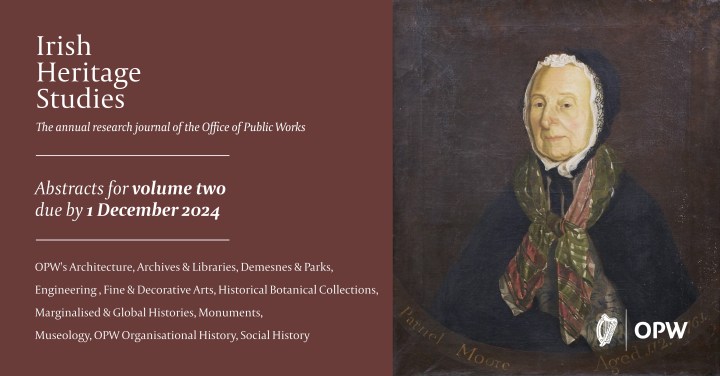
From Ireland’s Office of Public Works:
Irish Heritage Studies, Volume 2
Proposals due by 1 December 2024
Irish Heritage Studies is the new annual research journal of the Office of Public Works in Ireland, published in association with Gandon Editions. Volume one will be published next spring, and we’re currently inviting abstracts for volume two. The deadline is 1 December 2024.
The journal showcases original critical research rooted in the substantial portfolio of material culture in the care of or managed by the OPW: built heritage; historic, artistic, literary, and scientific collections; the national and international histories associated with these places and objects; and its own long organisational history. Papers contribute to a deeper understanding of this important collection of national heritage, and investigate new perspectives on aspects of its history. The journal is designed for a broad public, specialist, and professional readership. Full details on the journal are available here; and enquires are welcome at IHSjournal@opw.ie.
Image: Mrs. Parnel Moore. Aged 112. 1761, by unknown artist, oil on canvas. The sitter was housekeeper at Castletown House, co. Kildare.
Call for Papers | Global Material Culture and the Body, BSECS 2025 Panel
From HECAA:
Panel | Global Material Culture and the Body
British Society for Eighteenth-Century Studies Conference, Pembroke College, Oxford, 8–10 January 2025
Panel organized by Chloe Wigston Smith
Proposals for this session due by 18 October 2024
 Jointly supported by the Historians of Eighteenth-Century Art and Architecture and the University of York’s Center for Eighteenth Century Studies, this panel aims to foster interdisciplinary conversations about the relations between global material culture and the body, in keeping with the theme of the 54th annual BSECS conference, Bodies and Embodiment. Papers might focus on the body’s physical proximity to examples of global material culture, whether in the form of clothes, accessories, cosmetics, and domestic furnishings (and more); the body’s haptic experience of global objects, through making, production, handling, and consumption; and / or the representation of the body and bodies on specific objects. Papers might focus on a wide range of print, visual, and material sources, including ceramics, drawings, watercolours, handiwork, woodwork, etc, and / or the broad range of materials in the period, such as cotton, indigo, or silver. Submissions from early career scholars are especially encouraged. Please submit abstracts of no more than 350 words along with a short (1 page) CV to Chloe Wigston Smith at chloe.wigstonsmith@york.ac.uk.
Please note that selected presenters will need to become members of BSECS to register for the conference. Or BSECS honors ASECS memberships, so if you are an ASECS member you will not need to join BSECS.
Call for Papers | Conservation through the Centuries
From the Call for Papers:
Matters of Knowledge: Paradigms and Practices of Conservation through the Centuries
Les matières du savoir: Paradigmes et pratiques de la conservation à travers les siècles
Université de Neuchâtel, June 5–6 June 2025
Proposals due by 31 October 2024
Preservation and conservation, along with collecting and valuation, are pillars of any institution that holds a collection of cultural heritage. However, conservation is rarely the subject of analytical and reflexive discourse, researched in a historical perspective. Studies in museology, the history of collections, and even the history of science and technology, have offered their perspectives on why and how all kinds of material collections are preserved in institutions dedicated to conservation. Further, the professionals of these institutions are faced with their own questions about the state of their collections and the origins of the practices they execute in their daily work.
Increasingly, questions relating to collecting, the status of objects, how to show them, as well as exhibition devices have been investigated within academia and museums. Over the past two decades, this self-reflection of institutions has become the subject of exhibitions, which incorporate the multiple identities and status of certain objects or collections (and their possible reassignment) in relation to the institution’s history, its constitution, its values and the formulation of its practices. What is the impact of this renewed look on conservation and the professions related to it?
Research into the ways in which collections are built has highlighted both the voluntary and unintentional nature of their constitution. How have ideas and practices of conservation been articulated and perpetuated since the building of institutions and the formalization of occupations related to collecting, whether within disciplinary or thematic museums, cabinets, libraries or even botanical gardens?
As part of the SNSF project Libraries and Museums in Switzerland (https://www.biblios-musees.ch/), a two-day conference will be held on June 5th and 6th, 2025, focusing on all these dimensions of the conservation of important collections since their founding. This event will bring together academic, scientific and professional circles, while providing an opportunity for theoretical reflection and case studies. It will take a global approach to the phenomenon, focusing primarily on the period between the 17th and the end of the 19th century. However, papers focusing on the 20th century will be welcome, if they engage with the past.
The following themes will be explored:
• Object trajectories and typologies: redefinitions and taxonomy; functionality and instruments; hybrid objects
• Genius loci and the diversity of collections: cabinets, museums, libraries, archives, botanical gardens, etc.; the vagaries of material history: moving, finding, relisting, etc.
• Conservation devices and the ‘spectacle of order’: containers, display cases, storage methods
• Nomenclature(s)
• Inventories, catalogues, ‘paper technologies’: When and why are inventories and catalogues drawn up? What classification criteria were applied? How did such systems contribute to conservation?
• Dematerialization of material history: digital measures and databases
• Theorizing conservation: historiography; methods, sources and models; traditions and innovation
• Individuals and institutions: curators (a profession that did not have a name); disciplines, professionalization; weight of politics; organization and evolution of public service
• Loss, sorting, destruction: criteria and challenges of ‘conscious’ conservation
Proposals—in French, German, Italian, or English—should not exceed 300 words. In addition to your abstract, please submit a short CV (1–2 pages). Please email your proposal by 31 October 2024 to Valérie Kobi (valerie.kobi@unine.ch) and Chonja Lee (chonja.lee@unine.ch). Notifications will be sent in November 2024.
Call for Papers | Recipes and Flavors on the Move
From ArtHist.net:
Recipes and Flavors on the Move: The Circulation of Traditions and Ingredients between the Mediterranean and the American Colonies
Institut national d’histoire de l’art (INHA), Paris, 22 January 2025
Organized by Maddalena Bellavitisl, Corinne Mencé-Caster, and José Manuel Santos Pérez
Proposals due by 21 October 2024
Scholars in recent years have intensified their interest in cultural aspects of the colonial world, going beyond purely historical and social analysis. They have also been looking at the whole context constituted by the expressions and habits related to the daily, intellectual, and artistic life of the local populations and of those who found themselves traveling—in one direction or another—between Europe and the distant lands of ancient or recent discovery. The question thus raised relates to the cultural heritage of the territories concerned, both tangible and intangible heritage, and therefore also a whole series of details belonging to the sphere of the senses and habits most closely linked to local traditions. Among these, of course, the most fundamentally intertwined with popular life and culture is that of food. Therefore, a research direction that looked precisely in this direction was needed, questioning food habits, raw materials, recipes, and flavors.
This workshop therefore proposes a dialogue on colonial culture and food, choosing to set the discussion according to a perspective of exchange and mutual enrichment, with a view to reconstructing paths and narratives that have seen the intertwining of knowledge and traditions. Thus, the first part will be devoted to the interchanges, reception, and perception of Mediterranean food culture in Latin America and vice versa, with a consideration of ingredients, recipes, and tastes, while the second part will focus on material and iconographic culture, considering visual representations that depict this diffusion of flavors and the objects involved in the process.
The organizers, Maddalena Bellavitisl, Corinne Mencé-Caster, and José Manuel Santos Pérez, welcome proposals for 20-minute contributions—in English, French, Spanish, or Portuguese—on interdisciplinary topics addressing the subjects to which the workshop is dedicated. Those who are interested can send a one-page PDF file with an abstract and short bio to maddalena.bellavitis@gmail.com by 21 October 2024. Selections will be made at the beginning of November 2024.
Call for Papers | Scottish Society for Art History: Art and Text
From ArtHist.net:
Scottish Society for Art History: Art and Text
National Library of Scotland, Edinburgh, 6–7 February 2025
Proposals due by 25 October 2024
The Scottish Society for Art History (SSAH), in partnership with the National Library of Scotland, will host a two-day in-person event exploring the relationship between art and the written word in Scotland.
Scottish art has long been inspired by literature, while Scottish artists and publishers have made fundamental contributions in the fields of book and magazine illustration, advertising posters, comics, graphic novels, and artists’ books. In turn, there has been a significant body of writings on Scottish art in both fiction and non-fiction, and many outstanding collaborations between artists and writers. This conference will share current research and critical debate into the myriad relationships between art and text and we hope to engage with artists, writers, curators, archivists, art historians, literary and linguistic scholars, and interdisciplinary researchers. Topics include, but are not limited to:
• Art inspired by literature
• Critical writing on art
• Fiction and poetry inspired by art
• Artists’ books
• Concrete poetry
• Posters and advertising
• Banners and protest art
• Illuminated manuscripts
• Comics, magazines, and book illustration
• The relationship between art and text in theatre, performance art, video, and multimedia art
• Collaborations between artists and writers
• Artists’ archives
• Crossovers between art history, literary history, and Scottish studies
• Art and art history relating to Scots, Gaelic, and Doric
We welcome proposals for 20-minute papers or 10-minute case studies to be presented in person at the event. Proposals should be in the form of 300- to 500-word abstracts, accompanied by brief biographical details and a supporting image. The deadline for proposals is 5pm on Friday, 25 October 2024. If you would like to discuss the CFP in greater detail or submit an abstract, please contact Matthew Jarron at m.h.jarron@dundee.ac.uk.
The organisers are unable to provide speakers’ fees, but all speakers will receive free entry to the event, promotion via social media as part of the event, and publication opportunities. A selection of papers from the conference will be published in the Journal of the Scottish Society for Art History.
Call for Papers | Le vrai, le faux: Festival de l’histoire de l’art
From ArtHist.net:
Le vrai, le faux: Festival de l’histoire de l’art / The True, the False: Festival of Art History
Fontainebleau, 6–8 June 2025
Proposals due by 3 November 2024
En 2024, la région autrichienne du Salzkammergut porte le titre de Capitale européenne de la culture. Si nous le mentionnons, c’est d’une part pour montrer qu’au-delà de Vienne, Linz ou Salzbourg, l’Autriche recèle des lieux culturels qui en font le pays invité de cette 14e édition du festival de l’histoire de l’art mais c’est aussi parce que cette région abrite le village d’Hallstatt. Ce charmant bourg de près de 800 âmes est inscrit sur la liste du patrimoine mondial de l’UNESCO, un classement qui ne l’a pas empêché d’être reconstruit à l’identique (lac inclus !) dans la province de Guangdong dans le sud-ouest de la Chine. Parler simplement d’Hallstatt a-t-il encore un sens ? Ne vaut-il mieux pas préciser « Hallstatt en Autriche » et « Hallstatt en Chine » ? Ou bien faut-il dire « Hallstatt l’originale » ? Y a-t-il alors une « vraie Hallstatt » et une « fausse Hallstatt » ? Le village construit en Chine n’est-il pas aussi réel que celui construit en Autriche ? Et si l’on répond à cette question par la négative, quels arguments convoquer ? L’origine géographique ? L’antériorité temporelle ? L’authenticité ?
En novembre 2017 a eu lieu, au palais de justice de Paris, dans les salons de la Cour de cassation, un colloque réunissant trois cent cinquante magistrats, juristes, conservateurs, historiens de l’art et experts. Au cœur de leurs discussions, l’évolution nécessaire de la loi du 9 février 1895 dite « loi Bardoux », seule loi dans l’arsenal juridique français à réprimer les « fraudes en matière artistique »[1] et établissant une distinction entre le faux et la contrefaçon[2].
Que faire de ces objets pris dans le champ du vrai et du faux ? Les exposer ? Les cacher dans les réserves ? Que faire des restaurations des édifices advenues au fil des siècles ? Faut-il montrer les strates historiques d’un édifice ou bien s’en tenir à la dernière version en date ? Autant d’interrogations qui touchent au cœur même de l’histoire de l’art et de ses métiers. Interroger le vrai et le faux dans l’histoire de l’art, ses discours et ses pratiques, exige de prendre en compte les glissements qui peuvent s’opérer entre ces deux notions et au sujet desquelles la réflexion se forme et se transforme au fil du temps et de bien garder à l’esprit que les partages entre vrai et faux se font selon des critères très différents en fonction des contextes culturels et historiques.
Rien n’a été plus normal, tout au long de l’histoire de l’art et ce, jusqu’à une époque relativement récente, que la répétition des formes et des œuvres sans altération de la valeur des premières créées. Bien que certains sculpteurs grecs ou romains, certains orfèvres ou architectes médiévaux aient l’habitude de signer leurs œuvres, la notion d’originalité de la création artistique comme fondement de la valeur d’une œuvre n’existait pas au sens où nous l’entendons aujourd’hui. Les premières anecdotes artistiques posant le problème du vrai et du faux en art occidental datent de la Renaissance. Le cupidon de Michel-Ange offert comme un antique au cardinal de San Giorgio, la copie sur cuivre par Marc-Antoine Raimondi des gravures sur bois d’Albrecht Dürer et l’utilisation par le premier du monogramme du second sont des topoï de la littérature artistique. La culture européenne de la première modernité n’ignorait pas le lien entre valeur artistique et authenticité de l’œuvre mais il ne s’agissait pas de penser les œuvres comme vraies ou fausses. Du XVIe au XIXe siècle, les copies, les pastiches, les interprétations sur d’autres médiums étaient nombreuses et leur utilité — pédagogique, politique, mémorielle — et leur valeur résidaient plus dans leurs qualités techniques que dans leur degré d’authenticité.
Le XIXe siècle marque un tournant dans l’importance conférée à cette notion. En 1885, le petit-fils de Jacques-Louis David publiait un texte intitulé Quelques observations sur les 19 toiles attribuées à Louis David à l’exposition des portraits du siècle (1783–1883). Ecole Nationale des Beaux-Arts (V. Havard, Paris, 1883). Sur ces dix-neuf toiles, il en reconnaît quatre, en accepte six autres et en exclue huit[3]. Jacques-Louis-Jules David fait donc œuvre d’expert et son jugement vaut pour homologation de l’œuvre de son aïeul. La figure de l’expert, qu’il ou elle soit artiste, historien de l’art ou critique, prend ainsi une importance nouvelle, capable de réduire à peau de chagrin le catalogue d’un artiste comme de le faire grossir plus que de mesure. À partir de la seconde moitié du XXe siècle, le faux et son créateur, le faussaire, deviennent les antagonistes majeurs des historiens de l’art, des experts, des musées et institutions culturelles. Ce n’est qu’avec ce qu’on appelle la « post-modernité » que le double, la copie et parfois le faux redeviennent des opérations artistiques et esthétiques à part entière[4]. Mais le faux peut aussi, pour certains artistes, être un objet politique. Lorsque le collectif d’artistes et d’auteurs italiens Wu Ming tentait de faire advenir dans les journaux d’informations nationaux ce que l’on appelle aujourd’hui des fake news, ce n’était pas dans le but de tromper mais bien de faire comprendre les mécanismes de la tromperie en rendant ensuite le stratagème public[5]. À l’ère de la post-vérité, nous pourrons poser la question de la réussite et des risques d’une telle utilisation du vrai et du faux. Aujourd’hui, les images générées par l’intelligence artificielle, elle-même nourrie d’images existantes, sortent du paradigme de la copie ou de la citation et obligent à repenser les notions d’auctorialté et d’authenticité[6].
Le thème choisi pour cette 14e édition du festival de l’histoire de l’art embrasse tous les champs de notre discipline, c’est pourquoi il est utile de dégager quelques pistes de travail qui ne sont, bien sûr, pas exhaustives :
• Entre « vrai » et « faux » : « Vrai » et « faux » sont les deux pôles d’une réflexion qui porte en premier lieu sur l’unique et le multiple. Les propositions pourront s’attacher ainsi au statut des différents types de production artistique qui viennent redoubler l’œuvre originale : il en va ainsi de l’interprétation (retranscription de l’originale dans une technique différente), du pastiche (travail réalisé à partir d’une œuvre par un autre artiste pour souligner la manière du premier), de la copie (reproduction fidèle d’une œuvre qui s’annonce comme telle) et bien évidemment du faux, dont les modalités varient entre la contrefaçon intentionnelle (la copie que l’artiste ou le vendeur n’annonce PAS comme telle mais comme original), la falsification de l’authenticité ou encore la reproduction non autorisée d’œuvres protégées par des droits d’auteur.
• Des histoires de « faux » : L’histoire de l’art est remplie d’œuvres et d’objets qui ont été à un moment considéré comme authentiques et dont on a par la suite démontré qu’il s’agissait de « faux », soit exécutés volontairement pour tromper, soit mal identifiés par celles et ceux qui les ont acquis, exposés et commentés. Les propositions pourront porter sur telle ou telle « affaire » plus ou moins célèbre, sur la manière dont le caractère faux ou inauthentique des œuvres ou d’un ou plusieurs éléments de celles-ci a été découverte, sur les modifications des discours qui ont pu en surgir. La parole des restauratrices et restaurateurs sera ici particulièrement précieuse.
• Techniques et reproductibilité technique: les questionnements autour du vrai et du faux, de l’unique et du multiple, doivent tenir compte des conditions de production. L’une des problématiques principales de cette édition est l’œuvre d’art aux époques de sa reproductibilité technique, de l’estampe à la photographie aux images numériques actuelles. Ces techniques reproductives successives soulèvent la problématique de l’œuvre originale et de ce que Walter Benjamin appelle son « aura », un concept qui se trouve aujourd’hui détaché des œuvres originales précisément à cause des techniques modernes de reproduction[7]. La dimension technique, celle qui permet à un artiste qui copie ou à un faussaire qui falsifie de s’approcher au plus près du style d’un artiste doit nous retenir et nous amener à nous demander où commence le faux. La création du faux requiert un véritable art de la contrefaçon et si un faussaire repenti souhaite venir partager ses secrets techniques avec le public du festival, qu’il ou elle s’en sente bienvenu.
• Plaisir de tromper et d’être trompé: dans l’Antiquité puis à partir de la Renaissance, le concept de mimesis possède une importance capitale dans les théories de l’art. Pourra ainsi être interrogée la notion de trompe l’œil qui, quel que soit le medium utilisé, cherche à donner par une exacte représentation l’illusion de la présence de l’objet figuré. Les grandes figures — réelles ou légendaires — de ce genre (Zeuxis et Parrhasios, Bramante, Le Bernin, Cornelis Gijsbrechts ou Louis-Léopold Boilly) pourront être convoquées mais il faudra également convier à nos débats les philosophes qui ont interrogé ce genre et qui et qui contestent la parfaite adéquation du trompe l’œil à la réalité et parlent plutôt du plaisir donné par une illusion connue [8].
• Restauration et authenticité : la notion de restauration ou de restitution authentique ou « à l’identique » varie fortement suivant les contextes historiques et culturels.
• L’histoire de l’art face au faux: quelle(s) position(s) pour l’historien/historienne de l’art face à cette question du vrai et du faux ? Dans une optique historiographique, nous invitons les participantes et participants à se pencher sur la fascination mais aussi la difficulté que certains grands noms de notre discipline ont éprouvé face à ces sujets. Toute aussi importante est la réflexion sur l’appréciation relative qui est attachée à la valeur d’authenticité. Ce qui est considéré comme non-authentique dans une culture, ne l’est pas forcément dans l’autre. Nous sommes particulièrement intéressés à élargir les exemples au-delà de l’art européen. Et puis, il serait intéressant de voir comment l’histoire de l’art peut s’emparer, si ce n’est du faux tout du moins de la fiction, sur un plan méthodologique. Certains de nos collègues historiens et historiennes travaillent depuis plusieurs années selon la méthode de l’histoire contrefactuelle[9]. Et si ? Et s’il existait une histoire de l’art contrefactuelle ? La méthode contrefactuelle, voici un futur encore trop peu advenu dans le champ de l’histoire de l’art qu’il serait pertinent d’interroger.
• De l’utilité du faux: aujourd’hui, la valeur de la copie ou de la reproduction ne se conçoit plus en fonction de la virtuosité qu’elles affichent mais de leur utilité. Les fac-similés permettent de montrer des œuvres et des lieux majeurs de l’histoire de l’art trop fragiles pour être visibles, voire de replacer dans son contexte original une œuvre déplacée. Cette problématique engage de nombreuses questions techniques, notamment celle de l’échelle de ces fac-similés (l’échelle 1 des moulages du musée des monuments français et les dimensions inférieures de la « réplique » de la grotte Cosquer à Marseille ne peuvent être mis sur le même plan), des matériaux utilisés pour les produire (voir le travail par exemple de l’atelier Factum Arte à Madrid dont l’imprimante assure des impressions reproduisant la couleur et le relief) et de la dimension éthique de leur utilisation (objectif uniquement financier, accessibilité du public et protection de l’œuvre, défi technique).
• Connoisseurship versus analyses scientifiques: traditionnellement, les arguments d’authenticité étaient fondés sur les analyses stylistiques qui permettaient d’attribuer une œuvre à un artiste. Aujourd’hui, et ce déjà depuis quelques décennies les méthodes et les outils scientifiques, parfois de laboratoires travaillant de concert avec les institutions culturelles (le C2RMF du Louvre ou le Labart à Louvain-la-Neuve), opposent au discours des experts celui des sciences dites dures. Si parfois les deux discours peuvent en effet s’affronter, comme pour les termes « vrai » et « faux », une opposition aussi binaire et manichéenne n’a pas lieu d’être. Le festival sera heureux de faire dialoguer ces deux méthodes tant « l’intervention du laboratoire dans les questions de critique d’art [est] l’une des principales révolutions [contemporaines][10]. »
• Le droit et la valeur de l’original : en lien avec ces discours d’authentification, le thème « Vrai-Faux » demande à la fois d’interroger celles et ceux qui élaborent le discours juridique nécessaire pour faire face aux dérives, mais aussi celles et ceux qui attribuent une valeur aux objets. Nous souhaitons accueillir des propositions abordant le marché de l’art d’hier et d’aujourd’hui, analysant la manière dont le vrai, le faux et toutes les nuances entre ces deux termes modifient, font ou défont la valeur d’une œuvre[11]. Cette problématique engage notamment le domaine de la restauration des monuments historiques et des œuvres. Si, sans le savoir-faire des restaurateurs, soucieux de préserver ou de reconstituer les œuvres dont l’état de conservation est fragile, nombre d’entre elles seraient menacées de disparition, quand est-ce qu’une restauration devient une « hyper-restauration », voire un faux[12]? Où se termine la restauration et où commence la création ?
Je propose une communication :
https://www.festivaldelhistoiredelart.fr/appel-a-contribution-le-vrai-et-le-faux/
[1] Loi du 9 février 1895, sur les fraudes en matières artistiques, JORF du 12 février 1895, page 805, modifiée par l’ordonnance n°2000-916 du 19 septembre 2000, art. 3.
[2] Cette loi définit le faux « à l’apposition d’une fausse signature » et ne s’applique qu’aux œuvres non tombées dans le domaine public. La loi définit la contrefaçon comme une violation des droits d’auteurs, cette dernière dépendant d’autres dispositions du code de la propriété intellectuelle (Articles L. 111-3, L. 332-1, L. 332-3, L. 335-2 et L. 335-3 du code de la propriété intellectuelle).
[3] François CHAMOUX et al, « Copies, répliques et faux », Revue de l’art, 21, 1973, p. 5–31.
[4] Thierry LENAIN, « Le faux en art et ses valeurs. Repères pour une archéologie », Boris LIBOIS et Alain STROWEL (éd.), Profils de la création, Bruxelles, Presses universitaires Saint-Louis, 1997, p. 177–187.
[5] Stefania CALIANDRO, « Fake Art, entre le contrefait et le contrefactuel », Interfaces numériques, 11 (2), 2022.
[6] Gregory CHATONSKY et Antonio SOMAINI, « Sortir du paradigme de la copie », A.O.C., mercredi 24 janvier 2024.
[7] Bruno Latour et Adam Lowe, « La migration de l’aura ou comment explorer un original par le biais de ses fac-similés », Intermédialités / Intermediality (17), 2011, p. 173–91.
[8] Jean BAUDRILLARD, « Le trompe-l’œil ou la simulation enchantée », De la séduction, Paris, Denoël-Gonthier, coll. « Bibliothèque Médiations », 1981 ; Oscar CALABRESE, L’Art du trompe-l’œil, Follet J.-P. (trad. de l’italien), Paris, Citadelles & Mazenod, coll. « Phares », 2010.
[9] Quentin DELUERMOZ, Pierre SINGARAVELOU, « Explorer le champ des possibles. Approches contrefactuelles et futurs non advenus en histoire », Revue d’histoire moderne & contemporaine, 2012/3 (n° 59-3), p. 70–95.
[10] Thierry LENAIN, « Le faux en art et ses valeurs … », art. cit.
[11] « [L]’esthétique a cédé la place à l’authentique qui, loin des critères de beauté, fait ou défait la valeur d’une œuvre, tant au regard de l’histoire de l’art, que du marché ». Jean-Claude Marin, procureur général près la Cour de cassation, Allocution prononcée lors du colloque du vendredi 17 novembre 2017, « Le faux en art » : https://www.courdecassation.fr/toutes-les-actualites/2017/11/17/le-faux-en-art
[12] Hélène VEROUGSTRAETE, « Vers des frontières plus claires entre restauration et hyper-restauration », CeROArt, 3 | 2009, [En ligne], URL : http://ceroart.revues.org/index1121.html ; voir également Hélène VEROUGSTRAETE, Roger VAN SCHOUTE et Till-Holger BORCHERT, T.-H.(éd.), Restaurateurs ou faussaires des Primitifs flamands. [Fake or not fake. Het verhaal van de restauratie van de vlaamse Primitieven]. Catalogue d’exposition, Bruges Groeningemuseum 26 novembre 2004-28 février 2005, Gand (Ludion) 2004.
______________________________________
Modalités des interventions
Les interventions du festival de l’histoire de l’art adoptent des formats variés, avec une priorité donnée à des interventions traduisant la recherche en histoire de l’art sous une forme vivante et destinée à un large public.
• Conférence : 1 participant, entre 20 ou 30 minutes maximum,
• Dialogue : 2 participants, entre 40 et 50 minutes maximum,
• Table ronde : jusqu’à 3 participants plus 1 modérateur, durée 1h à 1h10 minutes maximum durée 1h30 maximum incluant le temps d’échange avec le public.
N.B. : Chaque intervention est suivie d’un échange de 10 à 15 minutes avec le public
Dépôt et sélection des propositions
Sont encouragées à candidater conservatrices et conservateurs, restauratrices et restaurateurs, professionnelles et professionnels du monde de l’art, étudiantes et étudiants en master et doctorat, chercheuses et chercheurs, enseignantes et enseignants.
Les candidatures peuvent être envoyées jusqu’au 3 novembre 2024 inclus (avant minuit) via le formulaire dédié : https://www.festivaldelhistoiredelart.fr/appel-a-contribution-le-vrai-et-le-faux/
Un lien n’est pas attendu entre le thème du FHA et le pays invité (l’Autriche), ce dernier ne faisant pas l’objet d’un appel à communication.
Les propositions de communication doivent impérativement être rédigées en français et se présenter sous la forme suivante :
• Titre du projet (80 signes maximum, espaces compris)
• Un résumé (600 signes maximum, espaces compris)
• Une présentation plus longue (3500 signes maximum, espaces compris)
• Un CV + une courte biographie professionnelle
N.B. : Dans le cas des dialogues et des tables rondes, le porteur ou la porteuse du projet doit se désigner clairement dans la proposition d’intervention. Les propositions incomplètes ne seront pas examinées.
L’examen des propositions sera réalisé par l’équipe du festival de l’histoire de l’art accompagné d’un jury issu du comité scientifique du festival de l’histoire de l’art présidé par Madame Laurence Bertrand Dorléac.
Call for Papers | ASECS 2025, Online
From the Call for Papers for round 3 (abstracts due by Friday) . . . and please be sure to consult the full list of panel offerings:
2025 American Society for Eighteenth-Century Studies Conference
Online, 55th Annual Meeting, 28–29 March and 4–5 April 2025
Proposals due by 20 September 2024
The American Society for Eighteenth-Century Studies (ASECS) is pleased to announce our Call for Papers for the 55th Annual Meeting, to be held virtually over two weekends in 2025: March 28–29 and April 4–5. The Society, established in 1969, is the foremost learned society in the United States for the study of all aspects of the period from the later seventeenth through the early nineteenth century. Round 3 (Submissions to Sessions) is open for submissions to panels, roundtables, and special sessions.
More information is available here»
◊ ◊ ◊ ◊ ◊
Africans and Africa in Italy (Italian Studies Caucus)
Chair: Wendy Wassyng Roworth (University of Rhode Island), wroworth@gmail.com [ID 51 / March 28–29]
Given the interest generated by the “Africans and Africa in Italy” panel at the 2024 ASECS meeting, the Italian caucus proposes another panel on the same topic for the 2025 online meeting. This session is dedicated to the realities and representations of African peoples and their homelands in the various Italian States, be they economic, political, religious, artistic, social, educational, etc. Papers may examine the lived experiences of Africans in rural and city environments, among nobility and other classes, and in relation to a variety of public entities. Portrayals of Africa and Africans may come from literary, theatrical, figurative, ceremonial, academic, etc. sources. Examples include but are not limited to: Africans featured in portrait and other figurative arts genres, treatment of/reference to Africans in historical, scientific, medical, ethnographic, encyclopedic and travel narratives; Africa as protagonist and/or setting in fictional, scientific, poetic, or dramatic literature. Papers may also interpret “Africans in Italy” in an indirect sense, i.e., to include the heated debates taking place in Italy (in person and in print) on the experiences of Africans outside of Italy. Chief among those discussion topics would be Africans’ experience of the transatlantic slave trade and subsequent enslavement in the Americas.
◊ ◊ ◊ ◊ ◊
Anne Schroder New Scholars Session (Historians of Eighteenth-Century Art and Architecture)
Chair: Laurel Peterson (Yale Center for British Art), laurel.peterson@yale.edu [ID 53 / April 4-5]
The Anne Schroder New Scholars Panel, sponsored by HECAA, seeks to promote scholarship that represents the future of eighteenth-century art and architectural studies. We invite proposals from advanced graduate students and early-career scholars working in the academy or museums. We welcome submissions that explore topics across the cultures, spaces, and materials that are related to art and architectural history globally over the long eighteenth century. We seek papers that reflect new approaches to both long-standing and under-studied issues and methods in eighteenth-century studies broadly, including but not limited to: critical race art history; Disability studies; ecocriticism and environmental studies; empire, colonization, and decolonial theory; gender and queer theory; global diasporic histories; Indigeneity; and material culture studies. Papers can be based on dissertations, book or article manuscripts in progress, Digital Humanities collaborations, or curatorial projects. We encourage scholars from underrepresented communities, contingent or independent scholars, and those working outside of North America to apply.
◊ ◊ ◊ ◊ ◊
‘Bad’ Art of the Long Eighteenth Century
Chair: Katherine Iselin (Emporia State University), kiselin@emporia.edu [ID 109 / April 4–5]
What constitutes ‘bad’ art? In art history, we often focus on surviving works that are unique or masterful in some way; works that epitomize the major interests of the period or works that exemplify the skill of the maker. But many other examples of art survive that do not qualify for any of these descriptions, or are perhaps even as far from them as possible. This panel looks to highlight these oft-forgotten pieces that occasionally sit in museum storage or private collections, hidden away from public eyes because they are considered unworthy of display. Yet we can learn much from such works: they can tell us a great deal of the levels of artistic production and appreciation, the accessibility of art to the non-elite, or artistic tastes outside the well-renowned. This panel seeks papers that examine works of art that might be construed as ‘bad’ in some way, exploring their place within the history of art in the long eighteenth century. Papers might also consider the role of accessibility for the artist, patron, or owner, as well as how works may have been displayed or viewed during their initial creation and by later collectors or owners.
◊ ◊ ◊ ◊ ◊
Bodies of Thought: Re-conceptualizations of the Body in Eighteenth-Century Art and Culture
Chair: Dorothy Johnson (University of Iowa), dorothy-johnson@uiowa.edu [ID 130 / April 4–5]
The Enlightenment in Europe witnessed radical shifts in the representation of the human figure in art and visual culture from the Rococo period to Neoclassicism and Romanticism. Transformations in the typology of the body in art can be best understood in the context of changing aesthetic, social, cultural, and political ideas and ideals that inflected the eighteenth century. The rise in prominence and prestige of the natural sciences during this period, which interrogated human origins and evolution, corporeal structures, biological, physiological, social and cultural identity and behavior, were ineluctably intertwined with artistic transformations in style and meaning. This panel invites papers that investigate the new meanings that accrued to the body as sign and signifier of cultural evolutions and revolutions.
◊ ◊ ◊ ◊ ◊
Eighteenth-Century Cats! (ASECS Graduate and Early Career Caucus)
Chair: Taylin Nelson (Rice University), tpn2@rice.edu [ID 68 / March 28–29]
What is an internet-based conference without addressing the internet’s favorite topic: cats!? This panel seeks papers interested in exploring eighteenth-century cats in their many facets and figurations. Cats abound during this period: from big cats in the natural histories, moralizing cats in fables and children’s stories, mysterious and symbolic cats in the art of Fragonard or Chardin, to real-life cats in the lives of Samuel Johnson or Horace Walpole.
Cats posed a challenge to Enlightenment thinking and represented diverse modes of existence during the period. It was Rousseau who claimed “the cat, enemy of all constraint, [a]s useful for characterising liberty.” From cultural perspectives, cats could represent a variety of topics, such as: domesticated pets, objects of torture, experimentation, and amusement, materially useful mousers, symbolic free agents, as street food, muses of philosophy and poetry, or dangerous predators from the ‘New World’.
This open-ended panel challenges panelists to tackle topics such as, but not limited to:
• Cats and Gender (associations with women and children, old maid tropes, sexuality and fertility, female subjectivity/objectivity)
• Cats and revolution (liberty, slavery, obedience, domestication, freedom versus torture)
• Cats and labor (skills, jobs, use-value, luxury versus labor, class)
• Cats and Science (vivisection and other experiments such as Lunardi’s balloon flight)
• Cats and the Atlantic World (predators, mousers on ships, posing threats/aids to colonists)
• Cats as vermin (massacres or street clearings)
• Thomas Gray’s “On the Death of a Favourite Cat” and any other artistic iterations of the poem
• Cats in fables (morality, education, kindness, pain, religion, transmutation)
• Author cats (Walpole, Johnson, Christopher Smart, and so on)
◊ ◊ ◊ ◊ ◊
Gifts from Flowers: Pollen, Fruit, Honey, Vegetables, Bouquets, Ceremonies, and More (South-Central Society for Eighteenth-Century Studies)
Chair: Kevin Cope (Louisiana State University), encope@lsu.edu [ID 83 / April 4–5]
Floral elements abound in long eighteenth-century culture. Still life paintings include or feature flowers; speculators plunge into the tulip market; posies and bouquets ornament every ceremony. Scientific concern for flowers reached a high pitch, whether in Thomas Jefferson’s pea-breeding program or among the growing ranks of botanical illustrators. Poets from John Philips to William Cowper celebrated all the members of the blooming tribe; travelers, fiction writers, and even musicians encounter or deploy the denizens of the vase. This panel is open to papers on all aspects of flower culture and activity, whether flowers themselves in art, literature, science, or philosophy or whether flowers as producers or sources of other cherished materials, whether the fruits and vegetables that swell from the bloom or the sweetening honey that competed with new-world sugar or even the icons that adorn heraldic devices. Papers from all disciplines, whether art history or botany or literature, are welcome.
◊ ◊ ◊ ◊ ◊
Hygge: The Visual and Material Culture of Coziness and Comfort
Chair: Kaitlin Grimes (Flagler College), KGrimes@flagler.edu [ID 150 / April 4–5]
Hygge, a Dano-Norwegian word, evokes the notions of comfortability and coziness that comes from the creation of a relaxing environment with specific creature comforts. Think of thick socks, a warm and fluffy blanket, a soft fire, a lovely cup filled with tea, and a good book all of which illustrate the simple and quiet pleasures of life away from the outside world. As we conference remotely, let us think about how those in the eighteenth century brought themselves comfort, both in childhood and adulthood. How did they create a cozy environment at home after a long day? What material objects did they turn to during the cold winters or the hot summers? And how was this idea depicted in eighteenth-century visual culture? Potential topics for this panel could include: blankets/textiles, fireplaces, tea and or coffee sets/services, beds/furniture, books (as a physical object), clothing, foodstuffs, children’s toy, interior decoration, family traditions, etc. This panel invites papers from all disciplines and as well as papers outside the potential topics listed above.
◊ ◊ ◊ ◊ ◊
‘Local’ Culture and Resistance
Chair: Harvey Shepherd (The Courtauld Institute of Art), hshepherd@courtauld.ac.uk [ID 123 / April 4–5]
This panel invites proposals from scholars studying ‘local’ culture as both a site and a tool of active resistance to conquest and cultural assimilation during the long-eighteenth century. The period of 1660 to 1830 is characterised by the emergence of national identities both in Europe and beyond, and the increase of colonial activity around the globe. These macrohistorical trends resulted in part from many understudied instances of interaction and erasure occurring at a regional level, often in border territories, coastlines, and newly-conquered areas. This discussion aims to complicate the distinction between the ‘micro’ and ‘macro’ histories of the eighteenth century by considering ‘the local’ as a sphere of resistance to the emergent globalisation of the early modern period. Panellists will consider the ways in which markers of ‘local’ cultural distinction—present in material and visual cultures, linguistics, writing, religious beliefs, or other expressions of identity—were mobilised as active tools of resistance to colonisation or the formation of modern nation states. In addition to considering the stakes involved in utilising ‘local’ identity as a form of resistance, the question of what constitutes our understanding of the term ‘local’ in the eighteenth century is itself a subject which presenters may choose to focus on. The panel welcomes submissions from scholars working in all areas of the humanities, and aims to stimulate conversation across disciplinary distinctions. Similarly, the discussion is not limited to any one geographical space, and papers are invited which examine any aspect of ‘local’ cultural resistance occurring across the eighteenth-century world.
◊ ◊ ◊ ◊ ◊
Sending a Woman to Do What an Army Could Not: Women in Asia
Chair: Samara Cahill (University of North Texas), samara.cahill@unt.edu [ID 46 / March 28–29]
Inspired by the multi-layered relationships among women portrayed in Hiroyuki Sanada et al’s 2024 adaptation of Shogun, James Clavell’s 1975 novel of early modern Japan, this panel invites papers on any aspect of women’s representation, experience, and relationships in long eighteenth-century Asia. Gender is both a mechanism of power and a method of symbolizing power dynamics that greatly influences the production of social institutions, privileges, and expectations. The issue of gender attained unprecedented prominence in early modern Asia, as the regulation and depreciation of women, which had long been shared and practiced, was fundamentally shaken by substantial social, political, and cultural transformations of the period. This panel asks literary scholars, historians, and art historians to investigate how social perceptions of gender were shaped and reshaped in diverse Asian cultures during the long eighteenth century.
◊ ◊ ◊ ◊ ◊
The Aesthetics of Chance, Risk, and Contingency
Chairs: Joseph Litts (Princeton University), jlitts@princeton.edu; and Erin Hein (University of Delaware), erinhein@udel.edu [ID 119 / March 28–29]
Being an artist is—and has been—risky business. Increased attention to and anxiety about uncertainty coincides with a period of increased transit, globalization, and industrialization from around 1650 to 1850. Fires and shipwrecks upended workshops and destroyed finished artworks, while open art markets led to financial instability. New and old media behaved unpredictably: marble cracked, oil paints did not cure, printmaking inks and acids went rogue, early photography capriciously captured and lost images. How did artists negotiate the unexpected? Amidst growing global trade, makers struggled to understand and manipulate new materials and subject matter. Printing errors paradoxically increased the value of impressions in Paris art markets. British and Dutch painters depicted maritime disasters for merchants whose treacherous voyages put lives and their own profits at stake. Artists from Giovanni Battista Piranesi to Alexander Cozens encouraged looking to random blots, tangled lines, and stains for inspiration. How did artists, collectors, and artworks convert chance, failures, mistakes, and risk into profits of all kinds?
Modern insurance, the stock market, and art itself converted loss into reward. For example, even the catastrophic financial losses of the South Sea Bubble became profitable for satirical artists who capitalized on the sudden inversion of fortune. Building on recent scholarship by Nina Dubin, Meredith Martin, and Madeleine Viljoen, as well as Charlotte Guichard and Matthew Hunter, how were artists visualizing and participating in systems of uncertainty? And how were art objects entangled in these networks? Attention to chance, risk, loss, and profit unsettles the fixedness of eighteenth century history and aesthetics. While this panel takes the Atlantic as its point of departure, we encourage contributions on a broad geographic range of materials and makers. We welcome submissions from scholars at all stages.
◊ ◊ ◊ ◊ ◊
The Art of Balance: Concepts of Equality and Democracy in Art and Visual Culture (Deutsche Gesellschaft für die Erforschung des 18. Jahrhunderts)
Chairs: Iris Brahms (Universität Tübingen), iris.brahms@fu-berlin.de; and Elisabeth Fritz (Freie Universität Berlin), elisabeth.fritz@fu-berlin.de [ID 78 / March 28–29]
In Western politics and philosophy of the eighteenth century, concepts of balance, equality, and democracy experienced a groundbreaking contouring that continues to have an impact until today (see McMahon 2023). These issues were negotiated not least in the arts. Our thesis is that the parallelism and simultaneity of opposing views and ideologies led to a striving for equilibrium and harmony, and was articulated, for example, within the ideas of social justice and political equality, or the goal of levelling extreme economic and financial differences, an idealistic balance that ultimately paved the way for new concepts of societal order, respectively democracy.
There is no glossing over the fact that a certain degree of difference and hierarchy to guarantee the aesthetically ‘harmonic’ order and balance was a persistent and prevailing ideal of the eighteenth century. Just as much, while aspiring for a newly balanced order within society, the dynamics of the socio-cultural developments of this period kept contributing to ongoing social injustices such as slavery or gender inequality. We decisively want include and discuss problematic strategies of appropriation and hegemonic agency and their paradoxical agenda in the names of equalization, modulation, normality, or assimilation, as well as non-Western concepts of equilibrium and collectivity. Our goal is to enter a fruitful debate and to develop a critical methodological approach, when we ask in which ways and to which ends the visual arts and their discourses helped to shape and spread the understanding of balance, equality, and democracy in the long eighteenth century.
◊ ◊ ◊ ◊ ◊
The Art of the Table: Dining and Desire in the Early Modern Period
Chair: Esther Gabel (Washington University in Saint Louis), esther.gabel@wustl.edu [ID 138 / March 28–29]
The early modern period saw a substantial shift in the preparation and presentation of food. Focus shifted from spice to ingredient, from captured to cultivated. New culinary techniques required new implements, and new methods of serving led to innovative porcelain and silver designs. Dining became more intimate, yet more elegant. Colonial drinks were the height of fashion. This panel seeks to bring together interdisciplinary perspectives to examine the complexities of ‘setting the table’ in the early modern period. Potential topics include (but are not limited to): print, cooks and cookbooks; porcelain and the art of presentation; the garnish; gardening; indulgence and intimacy in the dining room; food in art, or food as art; butter and sugar; and food or fiction (or melons made of sausage).
◊ ◊ ◊ ◊ ◊
The Historical Geographies of the Churrigueresque in the Iberian World
Chairs: Luis Gordo Peláez (California State University, Fresno), luisgordopelaez@csufresno.edu; and Cody Barteet (UWO), cbarteet@uwo.ca [ID 145 / April 4–5]
Spanish art historiography of the late 1700s (Llaguno and Ceán Bermúdez), favored Juan de Herrera’s sixteenth-century classical architecture and Bourbon-era architects Ventura Rodríguez and Juan de Villanueva. The latter architects were credited with restoring canonical models and shaping a national artistic identity by some historical and modern writers. This narrative castigates other ornamental architectural styles that developed after the mid-1600s, that were described as decorative fantasies and their designers, like Hurtado, Churriguera, and Ribera, labeled as ‘heretics’. In juxtaposition, the early 1900s American architects viewed Spanish architecture linearly, recognizing that Herrera’s work was in response to existing ornamental styles (like the Plateresque), and his ‘pure Classicism’ gave way to Churriguera’s ornamental creations. While vilified in Spain, Churriguera was celebrated in America, and Herrera criticized for adopting an ‘unrooted’ style deemed ‘out of key with the Spanish character’, unlike the ornamental styles that preceded or post-dated including the Churrigueresque. Few modern scholars have reconsidered this historiography by analyzing the exuberant aesthetic dominating Hispanic architecture in the late 17th and 18th centuries. The Churrigueresque and its transoceanic interpretations remain understudied in English scholarship. This panel aims to further examine the Churrigueresque through textual analyses and studies of its relationship to the Hispanic world’s built environment, including architectural, sculptural, and ephemeral elements. Proposals may address various aspects:
• Churrigueresque historiography and taxonomy, including the influence of other ‘decorative fantasies’ or styles
• Influence of other cultures and their technologies
• Intersection of race and built environment, sensorial studies, and digital humanities
• Center and Periphery Methodologies concerning the Churrigueresque in the broader Iberian world
◊ ◊ ◊ ◊ ◊
Women Artists: Emulation, Collaboration, Innovation
Chair: Christina Lindeman (University of South Alabama), clindeman@southalabama.edu [ID 99 / April 4–5]
In recent years, scholars have focused increased attention on women artists in the long eighteenth century. From watershed exhibitions including Making Her Mark in North America and Geniale Frauen in Europe, to publications on women artists by Spies-Gans (2022), Strobel (2023), and Quinn (2024). Taking advantage of this new research and artworks emerging on the market opens more opportunities to study women artists in various geographical areas and working in multifarious mediums. This panel seeks papers proposing new perspectives on women artists engaged in emulation, collaboration, and innovation from diverse regions and cultural settings.
Emulation was understood as a virtuous practice that led to innovation. However, as Laura Auricchio noted in her research on Adélaïde Labille-Guiard, that emulation was “necessary for female artists’ careers but dangerous for their reputations.” Emulating artworks deemed inappropriate could potentially damage a woman’s social standing even being judged unnatural. Moreover, a woman could be deemed a ‘copyist’ and lacking the intellectual breadth for history painting. How did women artists engage with artworks from the historical past or their contemporaries?
Taking collaboration as a focus, this panel invites new pathways to analyze the dynamic and gendered relationships in the studio. Papers that address how women collaborated with other artists, whether family members or contemporaries, are welcomed. How did women assert themselves in collaborative professional relationships? In what instances did collaborative working relationships run counter to established gender roles? How was the division of labor and responsibilities divided?
Finally, where can we see women innovating? Which women artists invented new methods of making art? How did they engage the materiality of their art by, for example, creating new formulas in pigments, brushes, pastels, or paper? How did women artists engage with natural philosophy and/or laboratory practices in the studio?
◊ ◊ ◊ ◊ ◊
Roundtable | Material Methods
Chair: Sal Nicolazzo (UC Davis), snicolazzo@ucdavis.edu [ID 118 / March 28–29]
We have long known that the eighteenth century was profoundly shaped by both materials and theories of materiality itself. From metallurgy to textiles, from ceramics to foods, scholars of eighteenth-century literature, the arts, history, economy, and governance have contributed to a rich and multifaceted understanding of how specific materials both acquired profound socio-cultural meaning and shaped human and ecological relations through their material properties.
This roundtable seeks to convene an interdisciplinary discussion of material methods for understanding the eighteenth century in the present. What kind of knowledge-production is entailed in cooking, fermenting, sewing, sculpting, binding, printing, growing, harvesting, or amalgamating the materials either represented or elided in the primary sources more traditionally employed in our disciplines for historical inquiry? How might we engage methodologically with contemporary artists like Candice Lin, Kara Walker, and Joscelyn Gardner, who devise artistic methods for reanimating eighteenth-century materials and histories? How might material methods transform, rather than simply re-enact, the material histories that shaped the eighteenth century, or push us to find terms other than ‘the eighteenth century’ for understanding the temporalities of our research or teaching? What material methods are necessary for engaging transformatively with the planetary material “duress” (Ann Stoler) of eighteenth-century capitalism and empire in which we all live? A wide array of formats, genres, and creative interpretations of the topic are welcomed, as is creative engagement with the unique affordances of the virtual format.
◊ ◊ ◊ ◊ ◊
Roundtable | The Legacies of Morris Eaves
Chairs: Wayne Ripley (Winona State University), wripley@winona.edu; and Tom Hothem (University of California, Merced), thothem@ucmerced.edu [ID 116 / March 28–29]
This panel invites participants to reflect on the life and work of the William Blake and Romanticism scholar Morris Eaves, who passed away in the spring of 2024. Eaves was the co-editor of Blake: An Illustrated Quarterly and a co-founder of the William Blake Archive as well as the author of books and articles on Blake, art history, technologies of visual reproduction, digital humanities, and editorial theory.
Eaves opened new interdisciplinary vistas of scholarly inquiry that were attuned to the relationship of print production, visual culture, and changing modes of technology. His book The Counter-Arts Conspiracy: Art and Industry in the Age of Blake (1992) positioned Blake in a variety of interrelated contexts—aesthetic, chalcographic, technological, religious, economic, and political—to show that Blake was engaged with debates that were both central to the eighteenth century and, as it happens, newly pertinent to the late twentieth and early twenty-first centuries. Eaves similarly understood how changes in technology demanded, in his phrase, a new “editorial settlement.” By helping to create and maintain the Blake Archive, which celebrates its 30th anniversary in 2025, Eaves posited a new model of the scholarly edition for the digital age and helped to advance the idea of the digital humanities.
Contributors to this panel are welcome to explore any aspect of Eaves’s thought in relation to the eighteenth century, and/or to offer personal reflections. We appeal especially to Eaves’s students, colleagues, and readers in asking participants to examine our field’s current interdisciplinary trajectory in relief of given work(s) from the Age of Blake. Participants should engage cultural production as rigorously and specifically as possible, certainly in the spirit with which Eaves approached such work.










leave a comment