Call for Papers | Discovering Dalmatia X
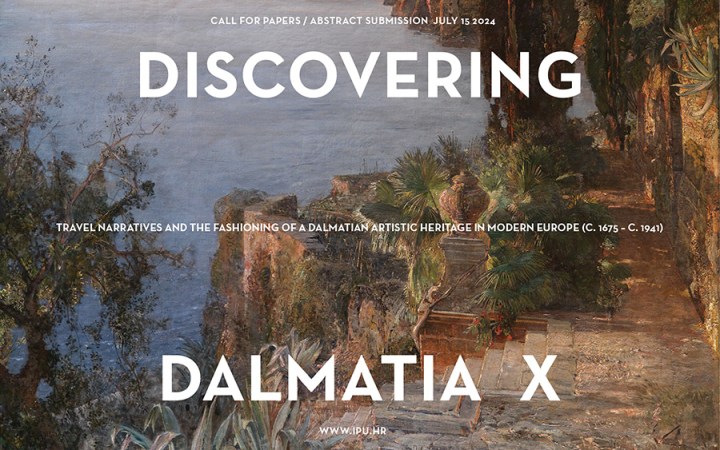
From the Institute of Art History – The Cvito Fisković Centre in Split:
Discovering Dalmatia X: Travel Narratives and the Fashioning of a Dalmatian Artistic Heritage in Modern Europe, c. 1675–1941
Online and in-person, Split City Museum – Old City Hall, 12–14 December 2024
Proposals due by 15 July 2024
Travel narratives encompass travel experiences presented in books, illustrated books, magazines, personal or official reports, diaries, letters, drawings, paintings, prints, and photographs. These are among the most frequently used sources in history, literature, art history, anthropology, and a range of other disciplines. But, due to their diversity and complexity as texts, travel narratives have tended to elude definition or easy categorisation across the spectrum of disciplines that draw on travel as valuable primary source materials.
Travelogues about Dalmatia, both visual and textual, have played a considerable role in the construction of its European identity, grounded in a curiosity about the region’s unique artistic heritage. The reasons for this lie with Dalmatia’s geographical position on the border between East and West, between the Christian and Islamic cultural worlds—the long history of which is richly recorded in the art and cultural expression of the region. The dichotomy of ‘East’ and ‘West’ in Dalmatia has meant a hybridisation of cultural, artistic, and geographical borders, all of which have made Dalmatia a particularly attractive destination for study trips from the early modern period.
The key period for the diffusion of travelogues about Dalmatia in Europe began in the late seventeenth century, and lasted until the mid-twentieth century. This era saw extraordinary popularisation and internationalisation of the travel genre in Europe, prior to the rise of organised tourism. This was likewise a crucial period for modern art history, during which processes of disciplinary transition and modernisation took place, both in Dalmatia and throughout the continent of Europe as a whole. Dalmatia was ‘exotic’ and yet simultaneously accessible to the classically-oriented Western European cultural imaginary.
With this conference, we aim to bring together historical and theoretical research on the travel genre as experiences transformed into textual and visual forms (irrespective of the geographical area), with a re-evaluation of the role of travel narratives in shaping the cultural identity of Dalmatia.
We, therefore, pose, two key questions:
• What does ‘travel narrative’ encompass?
• How did travelogues influence perceptions of Dalmatia’s artistic heritage in modern Europe?
Historians and theorists of art, architecture, urbanism, literature, anthropology, ethnology, and those engaged with travel narratives, are warmly invited to participate in scholarly presentations and discussion at the conference. We hope to contribute, on the one hand, to fostering an understanding of travel as an autonomous multidisciplinary and multimedia practice, and, on the other, to understanding the formation of perceptions of Dalmatia in the European imaginary. We are looking forward to considering a wide range of travel narratives for the conference—varying in genre characteristics, recording media, authors’ origins, and travel motives.
We welcome proposals for 20-minute papers. Proposals consisting of a 250-word abstract and a short CV in Croatian or English should be sent via email as a PDF attachment to discoveringdalmatia@gmail.com by 15 July 2024.
We plan to enable participation at the conference both in person in Split and via online platforms to facilitate international involvement. Registration will take place on the evening of the 11th of December, the closing address will take place on the 14th of December, and the hosts will organise coffee and refreshments for the conference participants during breaks. No participation fee will be charged for this conference. The organisers do not cover travel and accommodation costs. The organisers can help participants to find reasonably-priced accommodation in the historical city centre. Papers and discussion will be conducted in English. The duration of a spoken contribution should not exceed 20 minutes. Presentations will be followed by discussions. We propose to publish a collection of selected papers from the conference.
The conference is organized as part of the Croatian Science Foundation project Travelogues Dalmatia IP-2022-10-8676.
Scientific Committee
Basile Baudez (Princeton University, Department of Art and Archaeology)
Joško Belamarić (Institute of Art History – Cvito Fisković Centre Split)
Mateo Bratanić (University of Zadar, Department of History)
Iain Gordon Brown (Honorary Fellow, National Library of Scotland)
Hrvoje Gržina (Croatian State Archives)
Katrina O’Loughlin (Brunel University London)
Cvijeta Pavlović (University of Zagreb, Department of Comparative Literature)
Frances Sands (Sir John Soane’s Museum)
Marko Špikić (University of Zagreb, Department of Art History)
Ana Šverko (Institute of Art History – Cvito Fisković Centre Split)
Elke Katharina Wittich (Leibniz Universität Hannover)
Organizing Committee
Joško Belamarić (Institute of Art History – Cvito Fisković Centre Split)
Tomislav Bosnić (Institute of Art History – Cvito Fisković Centre Split)
Mateo Bratanić (University of Zadar, Department of History)
Ana Ćurić (Institute of Art History)
Matko Matija Marušić (Institute of Art History)
Katrina O’Loughlin (Brunel University London)
Cvijeta Pavlović (University of Zagreb, Department of Comparative Literature)
Ana Šverko (Institute of Art History – Cvito Fisković Centre Split)
Call for Papers | The Expert’s Eye
From the Call for Papers, which includes the Spanish version:
El ojo experto: Método, límites y la disciplina de la Historia del Arte
The Expert’s Eye: Method, Limitations, and the Practice of Art History
Museo Arqueológico Nacional, Madrid, 24–25 October 2024
Organized by Pilar Diez del Corral Corredoira and David Ojeda Nogales
Proposals due by 15 June 2024
 The work of the art historian revolves around the art object, and the need to tailor one’s methodology to that object gives the discipline its variety and richness. Yet paradoxically, to stress that art works are the centre of art history feels almost transgressive at a time when basic questions of identification and dating are increasingly deemphasized in training new generations of scholars and curators. Perhaps as a result, recent years have seen a proliferation of news about masterpieces that have gone unnoticed until some expert (typically from the art market rather than the university or the museum) has recognized the hand of a leading artist. Among Old Master paintings, it is common knowledge that Caravaggio final canvas, an Ecce Homo, almost left Spain after having been confused with a lesser work. The numerous Rembrandts that have emerged in recent years, as well as the complex case of Leonardo’s Salvator Mundi or the dubious Goyas that regularly appear, seem to confirm a decline in traditional expertise.
The new art history, by contrast, has shown itself perfectly capable of conducting research without having to study or even look at the art object. Without discrediting the results, which are sometimes more characteristic of departments of history or anthropology, the ease with which art-historical fact is blurred can be surprising. Over the last fifty years, the notable decrease in studies that examine the most fundamental problems of dating and authorship has raised questions about the usefulness of prevailing methodologies, leading to extreme cases in which a trained or expert eye is considered unnecessary, or at least insufficient, to deal with objects lacking documentary or other external proof of origin, creator, or date. By contrast, having an educated eye implies knowing the difference between a Roman bust from the first century AD and a modern copy, between discovering the hand of Leonardo and detecting an excellent falsification. Not all reattributed works will be first rate, but by returning anonymous or misidentified objects held in the depths of the world’s museums and collections to their rightful place, the astute art historian helps reconstruct the story of their creators.
In light of these trends, this conference aims to interrogate and challenge the abandonment of visual, material, and historical expertise among art historians. Key questions include:
• When, where, and why have works of art lost their place the centre of art history? Has this been uniform across the discipline, or does it vary by field?
• How have conservators, collectors, and academics fostered or resisted a repudiation of material knowledge of the art work?
• What forms does the ‘expert eye’ take across media and art forms, including drawing, sculpture, painting, ceramics, metalwork, etc.?
• Is an emphasis on attribution essential or dispensable? What are its limits and limitations, and how does it apply to different times, places, and artistic media?
• Can older notions of ‘connoisseurship’ be reconciled with developments in technical art history? How do ever-expanding methods of scientific testing challenge or enhance the ‘expert eye’?
• How can art history ensure that it is not limited to the study of objects that have a documentary trail?
• (How) can we aspire to a holistic history of art that links questions of dating, authorship, condition, and authenticity to the broader contextual and interpretive issues that have dominated recent scholarship?
Our intention in this conference is to gather experts from different areas of art history to wrestle with these questions. We welcome historical and methodological reflections as well as object-based case studies that engage the issues outlines above. We invite you to send your proposal with a short CV (no more than 10–15 lines) before 15 June 2024. If you have any questions or suggestions, please don’t hesitate to contact us. We will be delighted to help. The conference will take place in Madrid, in-person, at the Museo Arqueológico Nacional. It is our intention to publish a selection of papers, in an anthology, by a publisher with peer-review.
Technical coordination
• Marta I. Sánchez Vasco, misanchezvasco@gmail.com
Scientific coordination
• Pilar Diez del Corral Corredoira, diezdelcorral@geo.uned.es
• David Ojeda Nogales, dojeda@geo.uned.es
Scientific committee
• Amaya Alzaga Ruiz (UNED)
• Jeffrey L. Collins (Bard Graduate Center, Nueva York)
• Ana Diéguez Rodríguez (Instituto Moll)
• Pilar Diez del Corral Corredoira (UNED)
• David Ojeda Nogales (UNED)
• Markus Trunk (Universität Trier)
Call for Papers | Watercolour & Weather, 1750–1850

Louis Ducros, View of the Grand Port of Valette, detail, ca. 1800–01, black ink (pen), watercolor, heightened with gouache and oil on paper, 78 × 127 cm (Lausanne: MCBA).
◊ ◊ ◊ ◊ ◊
From the conference website:
Watercolour & Weather, 1750–1850 / Aquarelle & phénomènes météorologiques, 1750–1850
Musée cantonal des Beaux-Arts, Lausanne, 5–6 June 2025
Organized by Bérangère Poulain and Desmond Kraege
Proposals due by 15 June 2024
Simultaneously with a resurgence of landscape painting, the period 1750–1850 in European art witnessed an increased interest in the weather, not only as concerns its momentary states (clouded skies, lightning), but also the broader study of meteorological phenomena and of their unfolding over time. Besides the more radical events—such as storms—that were frequently represented, this period thus developed a keen observation of subtle moments of changing weather, allowing artists to combine varied effects of light. This is true not only of the most famous British painters (Joseph Mallord William Turner, John Constable, Alexander and John Robert Cozens) but also of figures from further afield, such as Giovanni Battista Lusieri, Caspar David Friedrich, and Abraham Louis Rodolphe Ducros.
In close connection to this artistic evolution, the period under scrutiny also witnessed the development of meteorology and climatology as scientific disciplines. This led both to Luke Howard’s classification of clouds (1804) that remains in use to this day, and to the theorisation of the greenhouse effect by Joseph Fourier in 1824. A new consciousness of the atmosphere and of its complexities, leading directly to present concerns regarding climate change, can thus be traced back to this cultural environment.
Luke Howard’s study of clouds rested partly upon watercolour sketches representing nebulous formations, revealing that the multiplication of weather-related images extended beyond the professional field of landscape painting to encompass works by scientists. Likewise, architects were not to be excluded: Pierre François Léonard Fontaine, chiefly known for his role in Napoleon I’s ambitious construction projects, chose to cover his design for a monumental cemetery on Montmartre with a stormy sky (Paris, ENSBA, PC 82161); whereas in Joseph Gandy’s cutaway view of Sir John Soane’s Bank of England (London, Sir John Soane’s Museum, P267), rays of sunlight part the clouds to illuminate the sprawling structure. These works confirm that watercolour, together with closely related techniques such as wash drawing, gouache, and hand-coloured etching, constituted the chief medium for the pictorial exploration of weather conditions by figures hailing from varied disciplinary horizons. As a water-based technique, comparatively rapid in uptake and highly adapted to outdoor use, it was particularly suitable for capturing fleeting atmospheric variations on the spot. Professional painters’ preparatory watercolor sketches for oil paintings also ensured that a strong connexion was maintained with this more highly specialised technique. More generally, parallels emerge between representations of the weather in watercolour and in other media such as oil and pastel, each technique furthermore being used to produce both studies and finished works.
While considerable attention has been paid to representations of meteorological conditions by the most famous British landscape painters, the broader development of this phenomenon remains to be studied, both in British, Continental, and non-Western art: how can Swiss painter Abraham Louis Rodolphe Ducros’s sudden interest in increasingly dramatic skies around 1790 be explained, and what impact did his work exert on his younger contemporaries? Likewise, what interactions emerge between the works of Indian artist Sita Ram and the evolving British watercolour? What role was performed by the exchange of ideas and artworks in connection with the Grand Tour or other travels?
This conference will attempt to elucidate some of these questions, along axes of enquiry that might include—but are not limited to—the following:
• The evolving concern for the representation of weather conditions in watercolour painting (or wash drawing, gouache, or hand-coloured etching) between 1750 and 1850
• Convergences or divergences between the practice of watercolour painting and the development of meteorology as a science
• Watercolour representations of weather conditions outside the field of professional landscape painting; for instance in works by amateurs, architects, scientists, or their draughtsmen
• Individual painters’ evolving engagement with the weather, including their affinity or familiarity with specific meteorological phenomena
• Interactions between representations of the weather in watercolour and in other pictorial techniques (including oil painting, oil studies, and pastel), and between open-air and workshop-based practice
• Weather conditions and (traces of) human presence in a landscape
• Reflections in watercolour painting of broader cultural (including literary) pairings between weather and emotion
• Continuities and/or distinctions between topographical representation (including the veduta tradition) and the integration of weather conditions in the image, particularly as regards historical perceptions of the ‘objectivity’ or ‘subjectivity’ of these representations
• Women artists’ contributions to the pictorial exploration of meteorological phenomena
• The possible impact on watercolour painting of maritime knowledge and of seafarers’ preoccupations regarding weather conditions
This conference forms part of a broader research and teaching project at the Universities of Lausanne and Geneva concerning Swiss watercolour artist Abraham Louis Rodolphe Ducros, whose personal collection forms the original nucleus of the Lausanne MCBA Museum. The conference will include a viewing of a selection of his works.
The conference will be held on 5 and 6 June 2025 at the Lausanne MCBA Museum. We look forward to receiving proposals (max. 400 words) for 20-minute papers until 15 June 2024 at the following addresses: berangere.poulain@unige.ch and desmond-bryan.kraege@unil.ch. Accommodation in Lausanne will be provided, as well as reimbursement of travel expenses within Europe. The primary conference language is English, though proposals in French will also be accepted. A collective publication is planned.
Organisers
Bérangère Poulain (University of Geneva)
Desmond Kraege (University of Lausanne)
Scientific Committee
Basile Baudez (Princeton University)
Jan Blanc (University of Geneva)
Werner Busch (Freie Universität Berlin)
Ketty Gottardo (The Courtauld Gallery, London)
Catherine Lepdor (Lausanne MCBA Museum)
Camille Lévêque-Claudet (Lausanne MCBA Museum)
Constance McPhee (The Metropolitan Museum of Art, New York)
Christian Michel (University of Lausanne)
Perrin Stein (The Metropolitan Museum of Art, New York)
Call for Papers | Hand-Colouring of Natural History Illustrations

◊ ◊ ◊ ◊ ◊
From ArtHist.net:
The Hand-Colouring of Natural History Illustrations in Europe, 1600–1850
In-person and online, University of Konstanz, 26–27 February 2025
Organized by Joyce Dixon and Giulia Simonini
Proposals due by 21 June 2024
From the first instances of coloured engravings depicting botanical and zoological subjects, the usefulness and effectiveness of the printed image was transformed. In the seventeenth century the practice of hand-painting prints in watercolour was pioneered in luxurious and costly works such as Basilius Besler’s Hortus Eytettensis (1613). A century later this technique allowed for the publication of Maria Sibylla Merian’s exquisite Metamorphosis Insectorum Surinamensium (1705), and the first British collection of hand-coloured zoological engravings, A Natural History of English Insects (1714–1720) by Eleazar Albin. Color, pictorially represented, had become crucial to the project of natural knowledge-making: as Mark Catesby commented in 1731, “a clearer Idea may be conceiv’d from the Figures of Animals and Plants in their proper Colours, than from the most exact Description without them.”
The proliferation of hand-coloured impressions continued into the nineteenth century and yielded a highly-productive cottage industry. Even with the advent of colour printing, chromatic details of biological subjects were usually finished by hand (Friedman, 1978). Yet despite their vital role in the formation and dissemination of natural knowledge, the activities of hand-colourers—known also as ‘colourists’, ‘afzetters’ (in Dutch), and ‘illuminist’ (in German)—remain poorly understood (Jackson, 2011; Oltrogge 2000). This workshop aims to shed light on this vital aspect of European image-making and hopes to attract researchers investigating diverse areas of natural history.
The workshop will take place at the University of Konstanz on Thursday–Friday, 26–27 February 2025, with Dr. Alexandra Loske delivering a keynote address. We are accepting proposals for 20-minute papers in English. We welcome contributions on the following themes and topics:
• Materiality: paints and pigments, colouring techniques, equipment
• Semantics: methods of image replication, proofing processes, modes of pictorial translation
• Economy: working conditions and wages, guilds, case studies of individual enterprises
• Afterlife: consumption and circulation, amateur colourers, reception and significance
Please send your title, a 200-word abstract, and a short biography (150 words) to Joyce Dixon, joyce.dixon@ed.ac.uk, and Giulia Simonini, giulia.simonini@tu-berlin.de, by Friday, 21 June 2024. Papers can be given in person or virtually; please indicate your preferred method of delivery when submitting your abstract.
Call for Articles | Casting Art
From ArtHist.net:
Casting Art
Volume published by De Gruyter and edited by Yaëlle Biro and Noémie Etienne
Proposals due by 1 September 2024, with full articles due by February 2025
Plaster casts molded from artworks are ubiquitous in museum and university collections. In the art history department at the university of Vienna, for instance, a small vitrine surrounded by plants displays old plaster casts of medieval ivories. The installation functions simultaneously as an educational tool from the past, an archive of the department history, and a decorative ensemble. The German anthropologist Leo Frobenius had multiple plaster casts made of several terracottas he excavated in 1910 in Ife, Nigeria, marked them with his name and donated them to European ethnographic museums. He thus transformed masterpieces of an ancient West African civilization into his own vanity pieces-carte de visite and subjects of scientific research.
As can be seen in many museum storage and gypsotheques, over centuries, plaster casts have been molded on art works, architectural elements, and even human beings. The Italian Renaissance and the 19th century are two contexts often discussed in the framing of the importance of casting as part of broader creative processes but their presence and impact goes beyond. Since the 1990s and the work by Georges Didi-Huberman (e.g. L’empreinte, 1997), plaster casts have stimulated art historical research and have expanded thinking about heritage.
In this edited volume from De Gruyter (new series Traces), we propose to redefine collectively what plaster casts are across different geographies and time periods, focusing mainly on the reproduction of objects. As the use of 3D printing of works of art is becoming common practice as a tool to the current debate on restitution of cultural patrimony, we would like to interrogate how this replication practice differs conceptually from the earlier one. We will explore what plaster casts were upon production and what they have become, what they enable, and how they impact original productions as well as discourses surrounding them.
Topics of interest can include
1. Past: Plaster copies were highly circulated between institutions and continents. How were they traded, commercialized, and commodified? How did plaster cast enable the forging of specific disciplines, in which context and for whose profit? How were plaster casts used in teaching and study collections? How were they produced, circulated, and exhibited?
2. Present: We believe that plaster casts, and casts in general, need to be better defined in a global theoretical framework. Despite the numerous single studies focusing on specific contexts, in both art history and anthropology, the topic per se lacks broader conceptualization. How should this type of object be defined? What do they convey? How do they transform the casted original, be it an artwork (or even sometimes a human being)? Topics can also include the connection between artistic and anthropological castings, as well as the use of casts in contemporary art.
3. Future: Plaster is a very sensitive material prone to degradation. What are the specific challenges of exhibiting and preserving plaster cast today? Should they be preserved at all as parts of the museums’ collections? Does today’s proliferation of 3D printing of works of art, and their possible use in the context of restitution practices, present similar challenges and should these processes be submitted to better control?
Guest editors: Yaëlle Biro and Noémie Etienne
Publisher: De Gruyter
In the New Series: Traces. Public History and Cultural Heritage Studies
Publication date: 2026
Abstracts expected (c. 300 words): September 1st 2024
Please send your abstracts to: yaellebiro@gmail.com and noemie.etienne@univie.ac.at
Full articles (if abstracts are accepted): February 2025
A peer-reviewed evaluation will take place
Final versions of the articles are expected for April 2025
Call for Papers | Securities of Art: The History of Authentication
From the ArtHist.net announcement, which includes the German:
Securities of Art: On the History of Authentication between Work, Text, and Context
Carl von Ossietzky Universität Oldenburg, 5–7 December 2024
Organized by Tobias Vogt and Lukas Töpfer
Proposals due by 15 June 2024
Workshop as part of the DFG project Wertpapiere der Kunst. Authentifizierung als künstlerisches Konzept in Zeiten von Finanzkrisen, 1720–2020 (Securities of art. Authentication as an artistic concept in times of financial crises, 1720–2020), Prof. Dr. Tobias Vogt and Lukas Töpfer M.A., Institute for Art and Visual Culture, Carl von Ossietzky University Oldenburg.
The workshop Securities of Art: On the History of Authentication between Work, Text, and Context (Wertpapiere der Kunst: Zur Geschichte künstlerischer Authentifizierung zwischen Werk, Text und Kontext) will examine artistically conceived authentications that have become constitutive for the status and value of artworks since the early 18th century. The guiding assumption is that artists in particular interrogate specific methods of authentication—such as signatures and titles, but also certificates, contracts, and other securities in the broadest sense—and integrate them into the structure of their works. Examples range from specially designed subscription tickets for the purchase of prints in the early 18th century to images of real and fake paper money dating from the French Revolution, from designs and caricatures of bonds since 1900 to certificates and contracts in works of contemporary art that comment on or criticize the changing financial system.
The focus is on exploring an art history of authentication in overarching social, economic, and legal-historical contexts on the one hand, and on the other, delineating the theoretical contours of the relationship between the authenticating and the authenticated, between work and parergon, and between text, paratext, and context. We will engage in a historical and theoretical analysis of the shift from the authentication of art to authentication as art and how this led to a corresponding blurring or reorganization of the relationships between ergon and parergon. Another important question is the extent to which authentications are particularly likely to emerge as artistically conceived in the face of radical changes to a prevailing value structure: in times of financial crises.
The presentations should last approximately 25 minutes in English or German and preferably focus on individual case studies of artistically designed authentications. We are particularly (but not exclusively) interested in the following questions:
• What are the pictorial and textual characteristics of a specific artistically conceived authentication?
• What procedures and constellations (of works and parerga) is it integrated into?
• How does authentication generate value not only as an element of economic practice, but also and especially within its own syntax and semantics, materiality, and mediality as determined by visual artistic practice?
• How does it respond in terms of form and function to the contemporary financial world? How does it perhaps even operate inside it?
• How does it specifically place the authenticating and the authenticated in relation to each other?
• What qualifies as an authentic work of art? How is it created—parergonally? How do artists themselves address this question, whether directly or indirectly?
• How does the question of the work relate to the creation, formation and preservation of value in general, where the intersection between art and finance is particularly relevant?
Please send an abstract of approximately 200 words, together with a short biographical note, to tobias.vogt@uni-oldenburg.de and lukas.mathis.toepfer@uni-oldenburg.de by 15 June 2024. Travel and accommodation costs will be covered within reason.
Call for Papers | Beauty and Aesthetic Canons within Hispanic Painting
From Le Blog de l’ApAhAu:
A Beautiful Painting? Aesthetic Canons and Pictorial Production within Spanish Crown Territories, 16th–19th Centuries
Lo bello en la pintura? Cánones estéticos y producción pictórica en los territorios de la Corona española, siglos XVI–XIX
Une belle peinture? Canon(s) esthétique(s) et production picturale dans les territoires de la Couronne d’Espagne, XVIe–XIXe siècle
Paris, 9–11 December 2024
Proposals due by 30 April 2024
The beautiful in the field of Hispanic painting (in the sense of painting produced in the territories of the Spanish Crown) is a notion that is not precisely defined and debated regarding its fundamental character in art history in general, and this in favor of an approach that focuses mainly on the realistic canon of this painting. The Spanish Golden Age, religious painting, still life and its great names (Velázquez, Zurbarán, Ribera, etc.) are all linked to a form of realism or naturalism presented as the most characteristic feature of Spanish painting.
However, some recent publications on the Golden Age itself show a renewed interest and a new approach to the subject, which are also evidenced by the new directions of young researchers in the field of Hispanic painting of the 15th–19th centuries. Moreover, exciting works have already been devoted to the painting produced within colonial America, which highlight the importance of adopting a periodization in which 1700 is not a breaking point for American territories, research on painting in the colonial Philippines is hardly sketched out, and for the other territories of the Crown also it seems obvious that periodization cannot be a fixed given. Finally, a renewed interest in a historiographical approach to Spanish art history has emerged in the last decade. The history of Hispanic art is therefore undergoing a period of change.
This symposium is devoted to the question of the beautiful in painting produced within the territories of the Spanish Crown (Spain, but also Sicily, Naples, Milan, South Netherlands, Artois, Franche-Comté, as well as the American and Filipino territories) from the 16th century to the early 19th century. It aims to question both the way in which an ideal has been forged in the painting produced in these territories, often associated in historiography with a «realistic» or «naturalist» canon, with all the problems that these terms imply, and the way in which this canon was perceived and received, or even adapted, transformed to the different periods. What was considered beautiful in the paintings produced in the territories under Spanish rule during modern times? What was the aesthetic ideal of the painter and the viewer? Was beauty really the painters’ first objective? What about the 18th century, particularly after the dynastic change, and the arrival at the Court of artists from France and Italy? What about the 16th century?
From the historiographic point of view, have the paradigms of Beauty been so modified that they have made Spanish painting lose its signs of recognition (realism, predominance of the religious), and have made it forget? What place should be given in this context to the greatest names in painting (Morales, Ribera, Zurbarán, Velázquez, Goya, etc.)? Can we think of the history of Spanish art by giving them less space in the aesthetic canons associated with it?
This event is dedicated to young researchers, and more specifically to doctoral and postdoctoral students working on one of the aspects described above. These French researchers will be able to enter into dialogue with foreign doctoral students, in particular Spanish ones, who are of course also expected: their presence will make it possible to assess whether there are gaps in their approaches, particularly because of the historiographic traditions on which they are based.
Contribution proposals in the form of an abstract of a maximum of 200 words and a brief biographical profile must be sent before the 30th April 2024 to clemence.raccah@inha.fr, iris.romagne@louvre.fr, and cecile.vincent-cassy@cyu.fr. Travel and living expenses (3 nights) will be covered by the organization of the meeting.
Places
Maison du Patrimoine et de la Photographie, Charenton (9th December), Institut national d’histoire de l’art, Paris, Vasari room (10th December), Centre Dominique-Vivant Denon, Paris (11th December)
Organization Committee
• Clémence Raccah (INHA)
• Iris Romagné (CY Université and Musée du Louvre)
• Cécile Vincent-Cassy (CY Cergy Paris Université)
Scientific Committee
• Luisa Elena Alcalá (Universidad Autónoma de Madrid)
• Charlotte Chastel-Rousseau (Musée du Louvre)
• Elsa Espin (CY Cergy Paris Université)
• Pablo González Tornel (Museo de Bellas Artes de Valencia)
• Álvaro Molina Martín (UNED)
• Felipe Pereda (Harvard University)
• Cécile Vincent-Cassy (CY Cergy Paris Université)
Call for Papers | Historically Free African Americans in Representation
From ArtHist.net:
Historically Free African Americans in Visual and Spatial Representation
Ludwig-Maximilians-Universität, Munich, 2–3 September 2024
Proposals due by 20 April 2024
Organized by Andrea Frohne
Art historians have overwhelmingly focused on representations of enslavement. In her 2015 book Picture Freedom: Remaking Black Visuality in the Early Nineteenth Century, Jasmine Nichole Cobb calls for a “disentangling [of] Blackness from slavery within the shared space of the nation” (6). This workshop focuses on free African American people through art, visual culture, and studies of space. It investigates circumstances of freedom and the disconnection from slavery prior to the Civil War, representations of free people of colour and descendants in visual culture and studies of space into the 21st century, and 17th- and 18th-century White European immigration into Black America.
For pre-Civil War processes and circumstances of legalising freedom, presentations may address free Black life from birth, manumission, or the Underground Railroad. Freedom at birth occurred when children born of free mothers were immediately free at birth regardless of racial categorisation. Second, manumission processes included documents or wills written by enslavers and enslaved people purchasing their and their family members’ own freedom. Third, freedom seekers escaped on the Underground Railroad into lands where slavery was illegal. Once liberated or free at birth, descendants of all of the above remained free through the centuries.
Presentations may focus on artworks made by free people of colour, such as sculptor Edmonia Lewis, portrait photographer J.P. Ball, landscape artist Robert S. Duncanson, and painters Henry Ossawa Turner and Edward Mitchell Bannister. How did their status as free play a role in their artistic careers or impact the content of their artworks? Papers may also focus on mobility and migration into free Black settlements across the United States and Canada. Topics include visual and spatial analyses of Black churches and schools, ownership of property shown in land surveys, rural roads named after free families of colour, or cemeteries in areas such as Black Philadelphia, Seneca Village in Manhattan, the Ohio River Valley (Lett Settlement, Tablertown, Berlin Crossroads, Cutler, Blackfork, Barnett Ridge), Beech Settlement in Indiana, Nicodemus in Kansas, Mecosta County in Michigan, Chestnut Ridge in West Virginia, Amherstburg in Ontario, Buxton in Ontario, etc.
Finally, with our location in Germany for the workshop, we seek to explore European migration into enslaving territories. What are the through lines of White families who become Black in the new world? They may have become enslavers who bore liberated children of colour. Or they may be indentured servants who bore free children of colour. Some free people of colour in the United States descended from German, British, Irish, and Scottish forebears. What are the global ramifications of such disrupted, disconnected genealogies? Overall, the workshop seeks to contribute new scholarship to the underrecognised subject of free African Americans and descendant populations in visual and spatial representation.
Please note that the language of the workshop is in English. Abstracts (fewer than 250 words) with short bio-notes (fewer than 150 words) for 25-minute presentations are invited for this in-person event at the Käte Hamburger Research Centre global dis:connect at Ludwig-Maximilians-Universität München. Accommodations in Munich and meals during the workshop will be provided, and some support for travel may be available.
Andrea Frohne, Fellow Alumna of the Käte Hamburger Centre and Professor at Ohio University, is the workshop convener. To apply, please email Dr Frohne at frohne@ohio.edu by 20 April 2024. Decisions will be conveyed by 1 May.
Call for Papers | The Global History of Knowledge, 1450–1750
From ArtHist.net and Scientiae:
Scientiae Fall Conference: The Global History of Knowledge, 1450–1750
Brown University, Providence, 25–26 October 2024
Proposals due by 15 May 2024

Samuel de Champlain, Brief discours des choses plus remarquables que Samuel Champlain de Brouage á reconneues aux Indes occidentales, 1602, 35r (igre. Loupcervier Leopard). Providence: John Carter Brown Library, Codex Fr 1.
Scientiae is very pleased to announce its first fall conference. This event will take place at, and with support of Brown University, Providence, Rhode Island, on Friday 25 and Saturday 26 October 2024. For this conference we have chosen the theme The Global History of Knowledge with a specific, but not exclusive, focus on the Americas and the Atlantic in the period 1450–1750. Historians of science, philosophers, literary scholars, art historians, and many other seemingly distant experts are encouraged to reflect together on the complexities of the early modern period. We are proud to announce a keynote address by Pablo F. Gómez (University of Wisconsin-Madison).
The organizing committee consists of Matthijs Jonker (Scientiae/Utrecht University), Tara Nummedal (Brown University), and Hal Cook (Brown University). Inquiries can be addressed to m.j.jonker@uu.nl.
We envision three ways to join:
• Individual, 20-minute papers: please submit a descriptive title, 200-word abstract, and one-page CV.
• Complete panels: same as above for each paper, plus 200-word rationale for the panel (maximum four presenters, including chair and/or respondent).
• Workshops or seminars: one-page CV for each session leader, plus 200-word plan explaining the topic’s suitability and its techniques or resources.
Please submit your proposal online before midnight, 15 May 2024, at scientiae.uk@gmail.com.
Providence has a good airport and is well-connected to New York City and Boston by train. The conference organizers look forward to welcoming you to Providence in October!
Call for Papers | The Face in 18th- and 19th-C Public Sculpture
Excerpted from the Call for Papers at ArtHist.net, which includes the French:
The Intimate and the Public: The Face in 18th- and 19th-Century Public Sculpture in France and the German Sphere
L’intime face au public : le visage dans la sculpture publique des XVIIIe et XIXe siècles en France et dans la sphère germanique
Institut National d’histoire de l’Art, Paris, 25–26 November 2024
Proposal due by 15 May 2024
This study day devoted to sculpture will focus on one element in particular: the face. As an essential part of the sculpted figure, the face has the dual role of enabling identification and expression. This dual role became more apparent in the 18th and 19th centuries, with the rise of portraiture, as well as the interest in the inner self and more broadly, the intimate. The aim of this exhibition is to draw a parallel between two contradictory concepts: the intimate and the public. As sculpture is the art par excellence of the public space, the aim is to confront the face, which is intimate, with the imperatives of public sculpture. The subject is all the more relevant given that statues in public spaces were subject to constantly changing decorum throughout the 19th century. The portrait was and remains the preferred type of statuary, whether full-length or in bust form. As a means of honouring a person, a propaganda tool, and an official image, the sculptural face had many functions, which began to take shape in the 18th century and became clearer in the 19th, as sculpture shifted from a religious and royal function to a civic one. Oscillating between idealisation and resemblance, the figuration of the face in the sculptural medium is a questionable concept in the Franco-German 18th and 19th centuries. In addition to the similarities in their artistic and textual origins, these two geographical areas will enable us to examine the artistic circulations that took place, and above all to analyse how political developments, which affected both France and the Germanic sphere, led to a national affirmation that was embodied in public sculpture. The aim of this study day is to examine the representation of the face in Franco-German public sculpture in the 18th and 19th centuries, analysing its theories, practices, techniques, possible typologies and the way it is perceived by the viewer. . . .
The aim of this study day is to return to a motif that is already well known and studied, the face, but this time by analysing it as an element at the junction of two spheres—the intimate and the public—through a body of sculpture. In addition to the obvious lack of studies devoted to this art form, the choice of focusing on sculpture is justified above all by its coherence with the areas of research: sculpture is mainly used to represent figures, and therefore faces, and it is the art form par excellence used in the public space.
Written submission must address one of these 8 major themes:
• The role of the face in the sculpture of public spaces
• Theories and practices of facial representation
• The relationship between the intimate and the public
• Individualisation and typology of faces
• The relationship between the face of a sculpture and the urban space
• Technique and materiality of sculpture
• Destruction or alteration of the face of a contested statue
• The gaze of the sculpture and/or the viewer / the sculpted figures in relation to each other
This call is open to all researchers, whatever their discipline or status, and we particularly encourage young researchers. Proposals for papers in English or French (maximum 300 words, accompanied by a brief bio-bibliographical presentation) should be sent before 15 May 2024 to the following address: sculptureparis24@gmail.com. The selection committee will respond to proposals by 20 June 2024.
Organizers
• Justine Cardoletti, doctoral student in art history at the University of Paris 1 Panthéon-Sorbonne, justine.cardoletti@gmail.com
• Emilie Ginestet, doctoral student in art history at the University of Toulouse Jean Jaurès, emilie.ginestet8@gmail.com
• Sarah Touboul-Oppenheimer, doctoral student in art history at the University of Paris 1 Panthéon-Sorbonne, sarahtoub.st@gmail.com










 Enfilade
leave a comment