Call for Papers | Human and Nature Interactions
From the Call for Papers:
Human and Nature Interactions in History: The Impact of Climate, Environment, and Natural Phenomena on Human Life
Istanbul University, Faculty of Letters, Kurul Odası, 28–29 May 2024 (with opportunities for virtual presentations)
Proposals due by 26 March 2024
Over the course of history, the fact that humans have been faced with the impact of the environment in which they live and that the relationship between humans and nature directly or indirectly has governed cultural, economic, and social structures and artistic currents has been a common problematic that concerns various disciplines. The fact that humans were subjected to compulsory guidance by nature, of which they were inclined to take control in the making of civilizations and cities, has been one of the main issues determining the historical and current agendas in varying degrees and forms.
This symposium will discuss the ways in which the natural environment shapes new habitations, the impact of the natural structure on the essential elements of the city such as architecture and settlement patterns, and how the diversity of fauna and flora affects social, cultural, emotional, and economic development or deprivation. In addition, it aims to examine the drawbacks such as water shortages, droughts, floods, fires, earthquakes, epidemics, storms, and forced migrations. In this context, it is expected to receive papers that can evaluate the manifold reflections of these phenomena that might positively or negatively affect, change, or give direction to the historical course.
Organized by the History Research Center, this free symposium aims to bring together experts from diverse fields, including environmental science, geography, historical geography, literature, economics, cultural heritage, history, and art history. If you would like to participate in the meeting with a paper, please send a short CV and an abstract of 200–300 words to tam@istanbul.edu.tr. The event will be held in a hybrid format, with both physical and online opportunities to present.
Call for Papers | Eating or Not Eating Animals: Sociability and Ethics

A glutonous man thinking about the food and drink he will consume at Christmas! From The Comic Almanack for 1839: An Ephemeris in Jest and Earnest, Containing ‘All Things Fitting for Such a Work’ by Rigdum Funnidos, Gent, with illustrations by George Cruikshank (London: Charles Tilt, 1838).
◊ ◊ ◊ ◊ ◊
From the Call for Papers (the PDF of which includes the French), via GIS Sociabilités:
Eating or Not Eating Animals: Sociability and Ethics around the Table
Manger ou ne pas manger la chair: Sociabilité et éthique autour de la table
Université Rennes 2, 6 June 2024
Organized by Florence Magnot-Ogilvy and Sophie Mesplède
Proposals due by 15 March 2024
Since the non-human turn of the early 21st century, numerous critical works have examined the animal question in the 18th century, a time when humanity’s place in the world, the relationship between human beings and non-human animals, the latter’s sensibility, and debates on the sensory soul were at the heart of the reflections of philosophers, physicians, naturalists, and educationalists.[1]
Few studies, however, have explored the question of meat- and non-meat-eating patterns specifically from the point of view of sociability.[2] Yet the issue formed one of the dividing lines in sociability, between men and women, young and old, people from different backgrounds, but also, in a new way, between humans and non-humans, in a century in which pets were playing an increasingly important role in human sociability.[3] As more and more human beings developed unique emotional relationships with cats, dogs, monkeys, and birds—to name but a few companion species—the question arose as to whether or not the bodies of animals credited with sensibility should be consumed. Some naturalists and writers, such as the Englishman Lord Monboddo and the hunter-philosopher Charles Georges Leroy, author of Lettres sur les animaux, recognized the ability of these animals to aggregate into communities that they felt were close to human societies. The tradition of the metempsychosis narrative, revived by the vogue for Orientalism, was then articulated in an unprecedented way with reflections on point of view, sensibility, and individuality.
In the 18th century, the abstinence from meat practiced for religious reasons[4] along with that driven by medical concerns (in George Cheyne’s writings, for example, where the question of diet was also linked to an imagination of power) was joined by that born of ethical considerations regarding the duties of humans towards other animals. The latter would profoundly question the dividing line between humanity and animality in European cultures won over by the imperatives of sensibility. The philosophical writings of Voltaire, Diderot, Condillac, and Rousseau on the nature of this boundary and the consequences to be drawn from it in terms of food were to be read throughout Europe. Meanwhile, their fictions were supported by a food imaginary weighed down by moral and political values, from Zadig’s supper to the gendered eating habits of Clarens as set out by Saint-Preux in one of the letters of La Nouvelle Héloïse. Across the Channel, it was often men of faith who spoke out against the cruelty inflicted on other species, and called for reflection on the modalities of their killing as much as on its finality. If the barbaric treatment of certain animals jeopardized the moral fiber of human beings, as William Hogarth’s series of engravings entitled The Four Stages of Cruelty (1751) helped to bring to light for a large English audience, what about the consumption of their flesh? “Vegetarianism,” term that did not appear until the middle of the 19th century, seemed to an increasing number of men and women to be a virtuous option that, although not always practiced, provided a subject for reflection and discussion in the context of enlightened sociability.
This study day, devoted to the debates surrounding the consumption of animals during the Enlightenment and the reconfiguration of positions that took place at the time, invites us to examine the question of a meat-eating habits insofar as these intersected with the emergence of new forms of sociability in Europe. It will look at how discussions about the ontological status of non-human animals helped redefine European sociability, where flesh-eating was a regular practice encouraged by the commercial adventures of the long 18th century.
Current debates around vegetarianism, veganism, anthropocentrism, and the gendered nature of food invite us to go back to the origins of modernity and to re-interrogate the Enlightenment on the place and role of non-human animals in what constitutes society. With this in mind, we will look at the many representations, both textual and pictorial, evoking the consumption of animal bodies in various social and literary contexts:
• In the visual arts — iconographic representations of animals killed or fattened for human consumption (hunting pictures, portraits of livestock, still-life paintings), animal carcasses, culinary preparations that visibly include them, market stalls and kitchen tables, the presence of animals in banqueting scenes, scenes of animals being fed, visual associations between femininity and animal flesh, caricatures and satirical representations, illustrations for fables, educational texts or scientific publications, etc.
• In literature — the representation of discussions about food and drink (table discussions, the material conditions of debates on the issue, the modalities of conversations, arguments and debates), hygiene-related considerations about children’s diets, the influence of flesh consumption on human morals, the link between what people ate and who they were, whether and how this type of discourse was influenced by the different literary genres, etc.
• In the periodical press, essays, political writings, and pamphlets — how and when the issue was used to support a particular argument.
• In scientific writings (naturalist, veterinary, and medical writings) — the extent to which they took the ongoing changes in morals and attitudes towards animals into account
Papers may be presented in French or English. Proposals (with a provisional title, a 250-word summary, and a brief biography of the author) should be sent before 15 March 2024 to:
Florence Magnot-Ogilvy, florence.magnot-ogilvy@univ-rennes2.fr
Sophie Mesplède, sophie.mesplede@univ-rennes2.fr
This event is supported by the GIS Sociabilités.
i n d i c a t i v e b i b l i o g r a p h y
Arena, Francesca, Yasmina Foehr-Janssens, Irini Papaikonomou et Francesca Prescendi (eds.), Allaitement entre humains et animaux : représentations et pratiques de l’Antiquité à aujourd’hui, Anthropozoologica 52/1, 2017.
Berchtold, Jacques, “Julie et l’âme des poissons du Léman dans La Nouvelle Héloïse de Rousseau”, De l’animal-machine à l’âme des machines : querelles biomécaniques de l’âme XVIe–XXIe siècles, Paris, éditions de la Sorbonne, 2010.
Berchtold Jacques et Jean-Luc Guichet (ed.), « L’animal des Lumières », Dix-huitième siècle 42, 2010.
Blackwell, Mark, The Secret Life of Things: Animals, Objects, and It-Narratives in Eighteenth-Century England (Bucknell University Press, 2007).
Burgat, Florence, L’humanité carnivore (Seuil, 2017).
Gregory, James, “Vegetable Fictions in the Kingdom of Roast Beef: Representing the Vegetarian in Victorian Literature”, in Tamara S. Wagner and Narin Hassan (dir.), Consuming Culture in the Long Nineteenth Century: Narratives of Consumption, 1700–1900 (Lexington Books, 2007): 17–34.
Guerrini, Anita, “A Diet for a Sensitive Soul: Vegetarianism in Eighteenth-Century Britain.” Eighteenth-Century Life 23.2, May 1999: 34–42.
Guichet, Jean-Luc, Rousseau, l’animal et l’homme. L’animalité dans l’horizon anthropologique des Lumières (Cerf, 2006).
Guichet, Jean-Luc (ed.), De l’animal-machine à l’âme des machines : querelles biomécaniques de l’âme XVIe–XXIe siècles, Paris, éditions de la Sorbonne, 2010.
Larue, Renan, Le Végétarisme des Lumières. L’abstinence de viande dans la France du XVIIIème siècle (Garnier, 2019).
Magnot-Ogilvy, Florence, « Instabilité énonciative et hiérarchie des valeurs dans l’Histoire véritable : l’effet-personnage et la projection sensorielle chez Montesquieu », Montesquieu et la fiction : autour des Lettres persanes, Aurélia Gaillard (dir.), Lumières, 2022: 145–159.
Morton, Timothy, “Joseph Ritson, Percy Shelley, and the Making of Romantic Vegetarianism”, Romanticism 12.1, 2006: 52–61.
Page-Jones, Kimberley, “From Buffon to Coleridge: Sociability and Humanity in Eighteenth- and Nineteenth-Century Comparative Anatomy”, Literature & History 32(2), 2023: 110–128.
Puskar-Pasewicz, Margaret, Cultural Encyclopedia of Vegetarianism (Greenwood, 2010).
Richardot, Anne (dir.), Bestiaire des Lumières, Revue des sciences humaines 296, 2009.
Serna, Pierre, L’Animal en République (Anarchasis, 2016).
Serna, Pierre, Comme des bêtes (Fayard, 2017).
Spencer, Colin, The Heretic’s Feast: A History of Vegetarianism (UPNE, 1996).
Strivay, Lucienne, « Manger juste. Les droits de l’animal dans les encyclopédies de 1750 à 1800. De l’éthique au politique », in Bodson, Liliane, Le Statut éthique de l’animal : conceptions anciennes et nouvelles (Université de Liège, 1995): 61–99.
Stockhorst, Stefanie, Jürgen Overhoff and Penelope J. Corfield, Human-Animal Interactions in the Eighteenth Century: From Pests and Predators to Pets, Poems, and Philosophy (Brill, 2021).
Wolloch, Nathaniel, Subjugated Animals: Animals and Anthropocentrism in Early Modern European Culture (Humanity Books, 2006).
Scientific Committee
• Jacques Berchtold (Sorbonne Université/ Fondation Bodmer)
• Valérie Capdeville (Rennes 2)
• Émilie Dardenne (Rennes 2/ IUF)
• Jean-Luc Guichet (Université de Picardie)
• David Mc Callam (University of Sheffield)
• Florence Magnot-Ogilvy (Rennes 2)
• Sophie Mesplède (Rennes 2)
• Kimberley Page-Jones (UBO)
• Sophie Vasset (Université Paul Valéry)
• Phil Withington (University of Sheffield)
n o t e s
1. See in particular L’animal des Lumières, Jacques Berchtold and Jean-Luc Guichet (eds.), DHS n°42, 2010; Bestiaire des Lumières, Anne Richardot (ed.), Revue des sciences humaines 296, 2009; Figures animales, Annie Duprat (ed.), Sociétés et représentations 27, 2009; Jean-Luc Guichet, Rousseau, l’animal et l’homme, l’animalité dans l’horizon anthropologique des Lumières (Cerf, 2006) ; as well as the works of Pierre Serna, L’Animal en République (Anarchasis, 2016) and Comme des bêtes (Fayard, 2017).
2. With the notable exception of Le Végétarisme des Lumières. L’abstinence de viande dans la France du XVIIIème siècle by Renan Larue (Garnier, 2019), which sets out to explore the roots of vegan and vegetarian thought in the writings of the Enlightenment. Renan Larue founded a vegan studies programme at the University of California where he teaches, broadening the perspective to current debates on vegetarianism and eating patterns as political stances.
3. See the PhD thesis recently defended in 2023 by Tomohiro Kaibara under the supervision of Antoine Lilti: “Le Grand sacre des chats: l’invention d’un animal de compagnie en France (1670–1830).”
4. The case of Thomas Tryon springs to mind, as do the dietary prohibitions of all religions, which attracted the attention of philosophers such as Voltaire in France.
Call for Papers | Textiles and Masculinities
From ArtHist.net and the Design History Society:
Textiles and Masculinities
Online, Design History Society, 15 June 2024
Proposals due by 11 April 2024
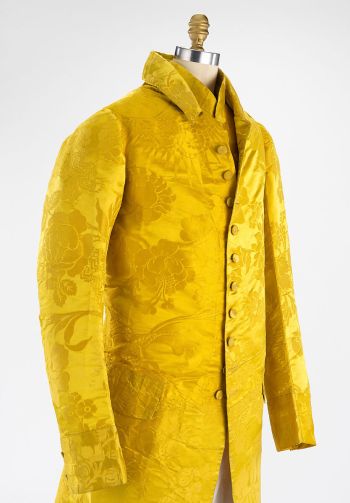
Banyan, British, ca. 1780, silk (New York: The Metropolitan Museum of Art, 1978.135.1).
The complex and evolving relationships between masculinities and textiles have been underrepresented in histories of design to date. This picture contrasts with the cultural and social importance textiles have in maintaining, contesting, and performing masculinities. This online symposium will share international research on historical and contemporary textiles in global contexts. We invite researchers at any level who investigate some aspect of masculinities and textiles to submit an abstract.
Themes include but are not limited to:
• Fashion textiles and masculinities
• Maintaining, performing, or contesting masculinities through textiles
• Queer, non-binary, and fluid gender identities and textiles
• Masculinities, textiles, and interior design
• Decolonising textiles and masculinities
• Textiles for menswear in fashion for all
• Design, production, and consumption of textiles and masculinities
Due to the language limits of the organisers, the symposium will take place in English. We acknowledge that information/knowledge can be disseminated in different ways, and so we are open to different presentation styles and formats. To be considered for a 15-minute presentation, please submit a 300-word abstract and a 50- to 100-word biography to the DHS Senior Administrator Jenna Allsopp at designhistorysociety@gmail.com by 11 April 2024. Applicants will be notified of the outcome of the submission within two weeks of the closing deadline. Please contact Dr Fiona Anderson (Glasgow School of Art) at f.anderson@gsa.ac.uk with any questions.
Call for Papers | New Perspectives on Life Drawing
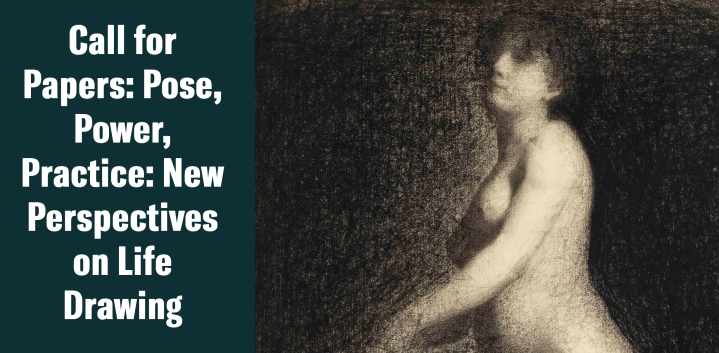
Georges Seurat, Female Nude, detail, ca. 1879–81, black conté crayon over preliminary drawing with stumped graphite
(London: The Courtauld, D.1948.SC.151)
◊ ◊ ◊ ◊ ◊
From the Call for Papers and The Courtauld:
Pose, Power, Practice: New Perspectives on Life Drawing
The Courtauld Institute of Art, Vernon Square, London, 20 June 2024
Proposals due by 22 March 2024
From the sixteenth century to the present, drawing the human body from life has remained a mainstay of Western institutional art practice. Despite significant shifts in the aesthetics, media, and purpose of art over the last five hundred years, life drawing endures in both the studio and the classroom. Pose, Power, Practice is a one-day symposium that seeks to reassess the state of the field on life drawing and apply new critical frameworks to this sustained practice. It aims to better understand life drawing in all its complexity, from its presumed advantages to its consequences. This is a practice deeply intertwined with concerns central to the discipline of art history, including but not limited to: the power dynamics of the gaze; the politics of representation; recognition of multiple forms of artistic labor; formulations of race, dis/ability, gender, and sexuality; and critiques of institutions. How has life drawing changed across time and place? How and why has it endured as a pedagogical practice, despite repeated dismissals of its ‘academicism’? What uses does it hold today, for artists and art historians alike?

Charles Joseph Natoire, The Life Class at the French Royal Academy of Painting and Sculpture, 1746, pen, black and brown ink, grey wash and watercolour, graphite over black chalk (Courtauld, D.1952.RW.3973).
We invite studies that unearth the specificities of life drawing to interrogate larger questions of ethics, labor, power, and potential in the life studio. Papers might attend to any and all aspects of this practice, from the models who pose, to the materials used, to the dynamics of the environments—formal and informal—in which life drawing takes place. We welcome papers that consider artistic engagements with drawing the human figure from life across all regions and periods, historical and contemporary.
This symposium aims to bridge connections and bolster dialogue across specialist scholarly communities by centring this shared subject of concern, while also inspiring broader understandings of what constitutes expertise in this field. We therefore encourage applications from all scholars and practitioners of life drawing, including students, artists, and models, in the UK and abroad. In addition to 20-minute conference papers, we welcome creative or collaborative submissions.
Pose, Power, Practice will take place at the Courtauld’s Vernon Square campus in person on Thursday, 20 June 2024. The programme will be recorded and subsequently shared on the Courtauld’s YouTube channel. Speakers will be further invited to participate in a workshop in The Courtauld’s Prints and Drawings Study Room on 21 June 2024. Partial reimbursement for travel and accommodation may be available. In addition, we are planning a remote component of the symposium earlier in the week in collaboration with The Drawing Foundation, so if you are unable to travel to Vernon Square please do submit an application and indicate this preference.
Applications are due via this Google form on 22 March and speakers will be notified by 5 April. If you have any questions, please contact Zoë Dostal (azd2103@columbia.edu) or Isabel Bird (isabelbird@g.harvard.edu).
7th Annual Ricciardi Prize from Master Drawings
Ian Hicks was the winner of the 2024 Ricciardi Prize for his ground-breaking reconsideration of a group of drawings by Giambattista Tiepolo, research that was begun during his term as the Moore Curatorial Fellow at the Morgan (2020–22). From Master Drawings:
Seventh Annual Ricciardi Prize from Master Drawings
Submissions due by 15 November 2024

Johann Schenau, The Crowning of the Rosiere, pen and brown ink and wash over graphite, on wove paper (New York: The Morgan Library & Museum, 2009.287).
Master Drawings is now accepting submissions for the 7th Annual Ricciardi Prize of $5,000. The award is given for the best new and unpublished article on a drawing topic (of any period) by a scholar under the age of 40. The winning submission will be published in a 2025 issue of Master Drawings. Information about essay requirements and how to apply can be found here. Information about past winners and finalists is available here.
The average length is between 2,500 and 3,750 words, with five to twenty illustrations. Submissions should be no longer than 10,000 words and have no more than 100 footnotes. All submissions must be in article form, following the format of the journal. Please refer to our Submission Guidelines for additional information. We will not consider submissions of seminar papers, dissertation chapters, or other written material that has not been adapted into the format of a journal article. Written material that has been previously published, or is scheduled for future publication, will not be eligible. Articles may be submitted in any language. Please be sure to include a 100 word abstract outlining the scope of your article with your submission.
Call for Papers | The Bottle, 17th- and 18th-C. Representations of Alcohol
From the Call for Papers, which includes the original French Appel à communication, information on the organizing committee, and a select bibliography:
The Culture of the Bottle: Uses and Visual Representations of Alcoholic Drinks in the 17th and 18th Centuries
La culture du flacon: Usages et représentations visuelles des boissons alcoolisées aux XVIIe et XVIIIe siècles
Institut national d’histoire de l’art, Paris, 13–14 June 2024
Proposals due by 31 March 2024

Jean-François de Troy, The Oyster Luncheon / Le Déjeuner d’huîtres, 1735, oil on canvas, 180 × 126 cm (Chantilly, Musée Condé).
The subject of alcoholic beverages (wine, beer, liqueurs, etc.) in the modern era has been embraced by the museum world, which has found it a pleasing and intriguing subject to attract audiences. Over the last twenty years, modernist historians have also have also examined the subject, publishing major works on drunkenness (Lecoutre, 2007, 2011 & 2017) and wine (Figeac-Monthus & Lachaud-Martin, 2021).
However, alcoholic beverages such as Armagnac for France, schnapps for the German Empire, gin for Great Britain, or rum and sake for more distant regions, remain under-studied as compared to wine—and, to a lesser extent, beer—which have been the subject of scientific publications. The history of art has often multiplied studies concerning bacchanals, Dutch or Roman bambochades, and the works of the Le Nain brothers but has neglected other types of representations as well as objects associated with this consumption. Above all, places of alcoholic consumption such as farmlands, wine cellars, breweries, taverns, inns, and banquets are largely absent from this historiography. Case studies drawing on cultural history, art history, and material history are needed to fill these gaps and sketch out a comprehensive overview of the production, consumption, and representation of alcoholic beverages in the 17th and 18th centuries.
By fostering a dialogue among researchers engaged in the exploration of this interdisciplinary theme, GRHAM’s annual symposium [at INHA] aims to scrutinize the concept of ‘alcoholic beverage’ in France, Europe, and worldwide to better comprehend the methods and stakes related to its representation. A comprehensive approach to global exchanges and consumption patterns could shed light on a perspective often overly focused on Europe. Moreover, various disruptions, such as armed conflicts, droughts, and floods, intermittently disrupted the habits of European consumers.
A lexicographical approach allows us to identify a typology of beverages and consumers and to move away from a rhetoric that can be simplifying and tinged with moralizing connotations. In the 18th century, the Encyclopédie defined “drink” as “liquid food intended to repair our strength,” before distinguishing cold water (recommended as the healthiest) from “beer, wine, & other strong liquors [which should be reserved] for occasions when where it is a matter of warming up, giving movement, irritating, attenuating.” A drinker is “a man who drinks wine, & who drinks a lot of it.” A drunken person is said to have a “brain clouded by the fumes & vapors of wine, or some other beverage.” A “drunkard” is a man “who has the habit of getting drunk or drinking to excess” (Dictionnaire de l’Académie française). In the 1718 edition, the ivrognesse is already mentioned: a woman who is “inclined to get drunk & drink to excess.” Those drunkards are then contrasted with the “sober” individual who is “Temperant in drinking & eating, who drinks & eats little” (Dictionnaire de l’Académie française, 1762). What might these definitions be in other languages? And in other cultures? What types of beverages, more or less strong, were drunk in the 17th and 18th centuries?
A marker of everyday practices, often tied to a particular geographical area, alcohol also played a part in the dynamics of social distinction and conspicuous consumption. The cohabitation of busy servants and cheerful masters around the Déjeuner d’huîtres is an instructive illustration. Unlike effervescent champagne, beer was a “very common drink” made from wheat, barley, or hops in 18th-century France (Dictionnaire de l’Académie française, 1762). However, the Encyclopédie does not devote a single entry to this beverage. Wine, on the other hand, gives rise to a fascinating history of taste, highlighting the characteristics of this beverage as well as the most important wine-growing regions of the time. How do discourses and images apprehend drinks and consumers (drunk or sober) in the society of modern times period? What are the moments, functions (festive, medical, religious, etc.), spaces, and objects (typology of drinking and serving containers) associated with this practice?
The first axis of this symposium is dedicated to the analysis of artistic practices and sociability related to alcohol. Taverns are an essential meeting place for both local and foreign artists. What role do these spaces play in artistic sociability (professional, friendly and emotional encounters; workplaces; recreational and commercial activities…)? To what extent do gatherings over a glass of beer boost or hinder artistic activity? It’s worth noting, for instance, new members of the Bentvueghels in Rome underwent an initiation rite involving the baptism of wine. Painters such as Valentin de Boulogne, Alexis Grimou, and Gabriel de Saint-Aubin were known for their excessive drinking. But what about lesser-known architects, sculptors, and engravers? It is not uncommon for an inventory after an artist’s death to reveal a well-stocked cellar. Was alcohol a source of inspiration or failure? Was it a factor of sociability or social exclusion?
The second axis focuses on the iconography of alcoholic beverages and drinkers. How have artists represented the alcoholic liquid and its container in their works? Is the moralism in literature just as strong in visual representations? The representation of liquids is a recurrent motif in still life paintings, Nordic and Caravaggesque genre scenes and Italian bambochades. These themes spread throughout the 18th century, particularly in engravings. Alcohol nourished a varied iconography that contributes to festive, religious, and political themes, often with moral or provocative dimensions that should be put into perspective.
Drunkenness, festivity, fertility, and sexuality are intimately linked to the representation of alcohol when it comes to bacchanals, carnival parades, banquets, Dionysian scenes, and trysts. In this respect, the representation of drunkenness can be understood as a way of contravening the norms imposed by civility. Alcohol is also an important symbol in religious and political iconography. Wine has a strong spiritual and liturgical dimension in Christian Europe and the representation of opponents (political, religious, etc.) as drinkers could be used to discredit them, as in counter-revolutionary prints. On the other hand, a true scenography of alcohol can mark certain political celebrations. For instance, the construction of wine fountains regularly accompanies military successes and royal entrances. More detailed studies could reveal other meanings linked to the representation of alcohol. For example, the allegory of joy is often associated with a glass of wine, as are oaths of loyalty or, on the contrary, of revenge. More broadly, we will inquire into how representations of alcohol were employed to convey social and political commentary. Were they the target of regulatory limitations or repressive measures in response to moral license and deviant alcohol consumption? Finally, we aim to examine the various alcohol containers (engraved glasses, bottles, services, etc.) and the drinkers’ accessories which serve as supports for all these iconographies. How did craftsmen and artist-decorators interpret and reproduce motifs widely disseminated through engraving?
The third and final axis aims to focus on the representation of the work of the brewer, the winemaker, and the intermediaries who transport the alcohol to the consumer’s table. How can these images shed light on the production, marketing, and service of alcoholic beverages? We would like to analyze the illustrations of vineyards and their topography, the instruments used to make the beverages, the architecture of the production sites, the stores built in Paris by suppliers to the French Court, and the merchants’ advertising tools (signs, posters, labels, etc.).
Participants are encouraged to review existing work, identify gaps in current research, discuss methodological approaches, and propose new ones (quantitative methods, digital humanities…). We welcome critical analyses, reflections on research methods, as well as innovative proposals for understanding the presence and significance of alcohol in the art (and history) of the 17th and 18th centuries. Proposals must be submitted by 31 March 2024 to asso.grham@gmail.com.
Call for Essays | Animal Preservation before 1850
From ArtHist.net, which includes the German version of the CFP:
‘Weder Fisch noch Fleisch’: Animal Preservation before 1850 in Theory and Practice
‘Weder Fisch noch Fleisch’: Tierpräparation vor 1850 in Theorie und Praxis
Volume of essays edited by Dorothee Fischer and Robert Bauernfeind
Proposals due by 31 May 2024, with final essays due by 15 November 2024
The volume ‘Weder Fisch noch Fleisch’ will explore the theory and practice of animal preparation prior to 1850. The book project focuses thus on animal preparations made before the modernization of taxidermy around the middle of the 19th century. While taxidermied objects themselves are irritating in their semantic ambivalence of being both the animal itself and its representation, early modern animal preparation often underwent a further distortion: It was susceptible to deformation due to inadequate conservation methods and created less evidence of the animals’ appearance rather than developing its own momentum as an aesthetic object. Neglect of historical specimens in modern collections contributed to the continuation of this momentum right up to the present day. Damage, deformation, and discolouration can often be observed on the—relatively few—preserved pre-modern specimens. However, both unintentional and deliberate deformations of the specimens contributed to the idea of the ‘nature’ of the respective animals since specimens formed the basis of early modern natural history collections in the 16th century.
In line with these observations, the volume aims to interpret historical specimens not only as objects of the history of both science and collecting, but also in terms of their distinct aesthetics and as sources of insights into (historical) human-animal relationships. In this way, the topic responds to current impulses from various research discourses, promoting interdisciplinary research. While these objects have recently been increasingly addressed from the perspective of collection history, questions about the taxidermied animal as an aesthetic object and trace of the living animal, further bridges the topic to questions of Visual Studies and Human-Animal Studies. From a Human-Animal Studies perspective, deceased yet materially preserved animals still receive less attention than living ones, despite their comparable impact on the relationship between humans and non-human animals. Also, questions about the ‘biographies’ of individual specimens are often a desideratum. Moreover, the exact practices of animal preparation before 1850 have only been marginally examined. The contributions of this volume aim to fill these gaps.
Topics for contributions could encompass, for example, preparation methods, preserved specimens, and their contribution to knowledge production. How do early preparations straddle naturalist interest and artistic craftsmanship? How do these procedures differ from subsequent centuries, and what insights do these objects offer into historical and contemporary human-animal relationships? A workshop held at the University of Trier in the summer of 2022 ignited the dialogue among perspectives from the humanities and natural history museum practice. The volume positions itself as a continuation of this exchange and a deepening of the interdisciplinary examination of early animal preparation. We welcome contributions not only from scholars in cultural studies, art history, and the history of science and knowledge, but also from practitioners of the trade and museum professionals, as well as individuals from other disciplines and perspectives.
Prospective contributors are invited to submit an abstract (maximum of 350 words) and a brief biography via email to the editors, Dorothee Fischer (fischerd@uni-trier.de) and Robert Bauernfeind (robert.bauernfeind@philhist.uni-augsburg.de) by 31 May 2024. Abstracts and contributions may be presented in either English or German. Feedback on our decision will be provided by the end of June 2024. The submission date of the complete contribution (with up to 40,000 characters and 3–4 illustrations) is 15 November 2024. The publication is planned for 2025.
Call for Papers | Improvisation and Citation in the Arts of 18th-C. France
For next year’s MLA conference, which takes ‘Visibility’ as its presidential theme:
Improvisation and Citation: Experimentation and Creativity in the Arts
18th-Century French Forum at the Modern Language Association Convention, New Orleans, 9–12 January 2025
Proposals due by 18 March 2024
This panel, covering topics of or related to eighteenth-century French or Francophone culture, invites submissions that explore the role of improvisation and citation as techniques in aesthetic creation, focusing on their adaptation from music to other art forms such as literature, theatre, and visual arts. We are particularly interested in interdisciplinary topics, including but not limited to: portrayals of musical performances in literary and theatrical works, and the use of improvisational and citational methods in literary forms. Additionally, we seek analyses of art criticism that employ the improvisational vocabulary of music. Another area of interest is also the representation of improvisation in various arts: we aim to examine which type of artists are portrayed as possessing the innate ability to improvise, and how literary works reinterpret and repurpose the motifs associated with the improvisational prowess of artists. Please send abstract submissions to scott.m.sanders@dartmouth.edu by Monday, 18 March 2024.
Call for Papers | Cultural History of the Hunt
From ArtHist.net, which includes the German version:
7th Workshop of the Cultural History of the Hunt Research Network
Online (via Zoom), 3 May 2024
Proposals due by 28 February 2024
The Cultural History of the Hunt research network (Netzwerk Jagdgeschichten) was founded in the summer of 2021 to promote academic exchange on the history of hunting. By viewing the topic of hunting from a transdisciplinary perspective, we aim to critically examine the role of hunting in the constitution, transformation, and perpetuation of the culture/nature-divide and related binary hierarchies. This international network brings together researchers at different career stages and consciously understands itself as open to a variety of research approaches regardless of their methodological, regional, and temporal framework, as well as their points of view concerning animal ethics.
The 7th meeting is thematically open. The workshop is intended to encourage an exchange regarding all questions from the field of cultural-historical research on hunting. Please send your proposals for a 20- to 30-minute contribution (maximum 200 words) and a short CV to Laura Beck (laura.beck@germanistik.uni-hannover.de) and Maurice Saß (maurice.sass@alanus.edu) before 28 February 2024.
Call for Papers | Commerce and Circulation of Decorative Arts, 1792–1914
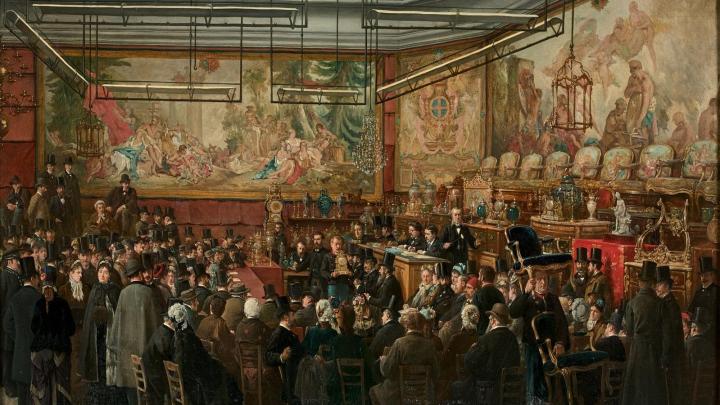
Benjamin Eugène Fichel, À l’hôtel Drouot, 1876 , exhibited at the Salon in 1877, oil on canvas, 61 × 90 cm. [The painting sold for €80,000 at a sale held in Paris by Beaussant Lefèvre on 22 June 2017, as reported by the Antiques Trade Gazette. –CH]
◊ ◊ ◊ ◊ ◊
From the Call for Papers, which includes the French Appel à communications:
The Commerce and Circulation of Decorative Arts, 1792–1914:
Auctions, Dealers, Collectors, and Museums
Le commerce et la circulation des objets d’art, 1792–1914:
Ventes aux enchères, marchands/es, collectionneurs/ses et musées
Lyon, 25–27 September 2024
Proposals due by 17 March 2024
This international three-day colloquium, to be held in Lyon, France, from 25 to 27 September 2024, will investigate the role played by auctions, dealers, collectors, and museums in the circulation of the decorative arts from 1792 until 1914. Beginning with the ‘ventes des biens des émigrés’ in Revolutionary France and ending with the onset of World War I, these were years of seismic political and socio-economic change that revolutionised the art market.
It was during the nineteenth century that the decorative arts, originally described as ‘curiosities’ and then ‘antiques’, became the subject of intellectual curiosity. The period under review saw the emergence of a more scholarly approach and publications, the development of the antiques trade and of museum collections devoted to the decorative arts, facilitated by the expansion of global trading networks, extended by colonisation and encouraged by international travel and world fairs. London and Paris led the growth of this market, but economic downturn in Britain and France resulted in the mass export of art to the Americas from the 1880s. At the same time, a new cosmopolitan elite stimulated purchase across Europe, competing with museums for prize objects.
These developments were first charted by Gerald Reitlinger in The Economics of Taste: The Rise and Fall of the Objets d’art Market since 1750 (1963) and then by Clive Wainwright in The Romantic Interior (1989). Art market historiography has increased exponentially over recent years with scholarship on dealers (Lynn Catterson, Paola Cordera, Charlotte Vignon, Mark Westgarth), collectors and museums (Julius Bryant, Ting Chang, Suzanne Higgott, Sophie Le-Tarnec, Pauline Prévost-Marcilhacy), collecting culture (Elizabeth Emery, Tom Stammers, Adriana Turpin), and markets and networks of trade (Anne Helmreich, Léa Saint-Raymond), among others as well as a dedicated Journal for Art Market Studies. This has been augmented by the Getty Provenance Index, Bloomsbury Art Market, the Archives Directory for the History of Collecting in America, the creation of specific publishers’ series (from Brill and Bloomsbury), the digitisation of auction catalogues, and two programmes initiated by INHA (one on Connoisseurs, Collectors and Dealers of Asian Art in France, 1700–1939, and the other on Sales of Antiquities in Nineteenth-Century France).
To date, however, scholarship has largely centred on the fine arts. This conference will focus on the commerce and global circulation of the decorative arts in order to open new perspectives and approaches that will provide a more comprehensive understanding of the art market. ‘Decorative arts’ are taken to include: furniture, metalwork, clocks, silverware, ceramics and glass, enamels, small sculpture, hardstones, ivories, jewellery, textiles, tapestries, and boiseries, from Ming dynasty porcelain, Mamluk glass, and Augsburg Kunstkammer objects to Boulle furniture, and Thomire bronzes, not to mention the contemporary Arts and Crafts and Art Nouveau movements.
We hope to encourage interdisciplinary dialogue among participants specialising in art history, material culture and economic history. We welcome presentations using new methodologies or technologies for interpreting dealer/ collector/museum records and auction results as well as well as more traditional case studies. Topics for consideration will investigate the inter-relationships between the decorative arts market, connoisseurship, taste, and collecting practice. They may include, but are not limited to the following:
• The repercussions of political and socio-economic change on the circulation of objects
• Auctions and their impact on networks of local and international exchange
• Collectors’ preferences and methods of acquisition (auctions, dealers, agents, and advisors)
• The role of dealers, agents, curators and advisors, their influence on taste and collecting practice
• Networks of trade between Europe, the Americas, Asia, the Middle East, and further afield
• Collaboration and competition within and between networks across borders
• The influence of the circulation of antiques on workshop practice and craftsmanship in the decorative arts
• The involvement of museums in the art market, their role at auctions, and the relations between dealers and curators, trade expertise, and scholarly research
• The impact of public exhibitions on the art market and the trade in decorative arts
• Connoisseurship and expertise across borders: the interrelationship between the discourse of decorative art history and the market (including the use of photography, sale catalogues, museum catalogues, and scholarly publications and journals)
• Cultural transfers through collecting practice
• The visualisation and staging of the collecting space/ interior
• The use of digital tools to analyse the circulation of the decorative arts
We encourage submissions from both early career researchers (PhD candidates) and established scholars, involved in the study of trade, art markets, collections, as well as museums and provenance research. This will be an ‘in-person’ event. It is hoped to cover accommodation for speakers for the duration of the conference. The symposium will be bi-lingual (English is preferred). Please submit abstracts for 20-minute papers (of no more than 350 words), together with a brief biography as an email attachment to camille.mestdagh@univ-lyon2.fr and diana_davis@hotmail.co.uk no later than 17 March 2024. Applicants selected by the scientific committee will be notified by 22 April 2024. Further updates will be posted on the event webpage. We hope to publish a volume of essays stemming from revised conference papers.
Organising Committee
Natacha Coquery (Professeure, Université Lumière Lyon 2, LARHRA), Camille Mestdagh (Post-doctoral researcher, Université Lumière Lyon 2, LARHRA), Igor Moullier (Maître de conférences, ENS Lyon, LARHRA), Rossella Froissart (Directrice d’études, Ecole Pratique des Hautes Études-PSL, SAPRAT), Diana Davis (Independent researcher, PhD, University of Buckingham, UK)
Scientific Committee
Arnaud Bertinet (Maître de Conférences, Paris 1 Panthéon Sorbonne), Jérémie Cerman (Professeur, Université d’Artois, Arras), Paola Cordera (Associate Professor, Politecnico di Milano), Elizabeth Emery (Professor, Montclair State University, New Jersey), Sandra van Ginhoven (Head, Getty Provenance Index, Getty Research Institute, Los Angeles), Anne Helmreich (Director, Archives of American Art, Smithsonian Institution, Washington), Caroline McCaffrey-Howarth (Lecturer, University of Edinburgh), Johannes Nathan (co-founder of the Centre of Art Market Studies, Technische Universität, Berlin), Anne Perrin-Khelissa (Maître de conferences HDR, Université Toulouse-Jean Jaurès), Florencia Rodríguez Giavarini (Doctoral fellow, UNSAM-CONICET, Buenos Aires), Adriana Turpin (Head of Research, IESA, Paris)
This colloquium forms part of a wider project on the market for decorative arts: OBJECTive – ANR/ Lyon 2 Université / LARHRA : OBJECTive – ANR Objects through the Art Market: A Global Perspective – LARHRA.










 Enfilade
leave a comment