Call for Papers | Improvisation and Citation in the Arts of 18th-C. France
For next year’s MLA conference, which takes ‘Visibility’ as its presidential theme:
Improvisation and Citation: Experimentation and Creativity in the Arts
18th-Century French Forum at the Modern Language Association Convention, New Orleans, 9–12 January 2025
Proposals due by 18 March 2024
This panel, covering topics of or related to eighteenth-century French or Francophone culture, invites submissions that explore the role of improvisation and citation as techniques in aesthetic creation, focusing on their adaptation from music to other art forms such as literature, theatre, and visual arts. We are particularly interested in interdisciplinary topics, including but not limited to: portrayals of musical performances in literary and theatrical works, and the use of improvisational and citational methods in literary forms. Additionally, we seek analyses of art criticism that employ the improvisational vocabulary of music. Another area of interest is also the representation of improvisation in various arts: we aim to examine which type of artists are portrayed as possessing the innate ability to improvise, and how literary works reinterpret and repurpose the motifs associated with the improvisational prowess of artists. Please send abstract submissions to scott.m.sanders@dartmouth.edu by Monday, 18 March 2024.
Call for Papers | Cultural History of the Hunt
From ArtHist.net, which includes the German version:
7th Workshop of the Cultural History of the Hunt Research Network
Online (via Zoom), 3 May 2024
Proposals due by 28 February 2024
The Cultural History of the Hunt research network (Netzwerk Jagdgeschichten) was founded in the summer of 2021 to promote academic exchange on the history of hunting. By viewing the topic of hunting from a transdisciplinary perspective, we aim to critically examine the role of hunting in the constitution, transformation, and perpetuation of the culture/nature-divide and related binary hierarchies. This international network brings together researchers at different career stages and consciously understands itself as open to a variety of research approaches regardless of their methodological, regional, and temporal framework, as well as their points of view concerning animal ethics.
The 7th meeting is thematically open. The workshop is intended to encourage an exchange regarding all questions from the field of cultural-historical research on hunting. Please send your proposals for a 20- to 30-minute contribution (maximum 200 words) and a short CV to Laura Beck (laura.beck@germanistik.uni-hannover.de) and Maurice Saß (maurice.sass@alanus.edu) before 28 February 2024.
Call for Papers | Commerce and Circulation of Decorative Arts, 1792–1914
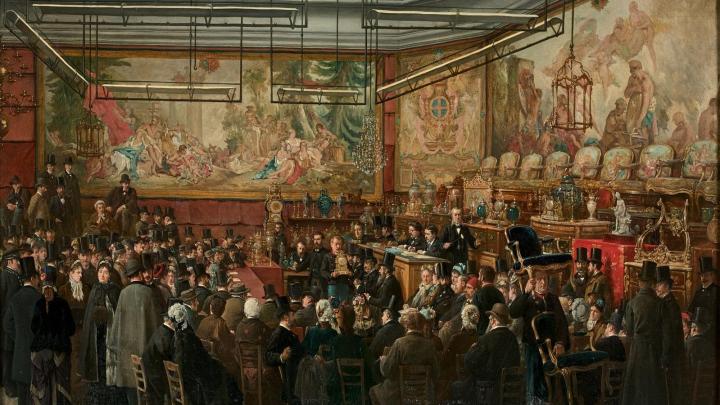
Benjamin Eugène Fichel, À l’hôtel Drouot, 1876 , exhibited at the Salon in 1877, oil on canvas, 61 × 90 cm. [The painting sold for €80,000 at a sale held in Paris by Beaussant Lefèvre on 22 June 2017, as reported by the Antiques Trade Gazette. –CH]
◊ ◊ ◊ ◊ ◊
From the Call for Papers, which includes the French Appel à communications:
The Commerce and Circulation of Decorative Arts, 1792–1914:
Auctions, Dealers, Collectors, and Museums
Le commerce et la circulation des objets d’art, 1792–1914:
Ventes aux enchères, marchands/es, collectionneurs/ses et musées
Lyon, 25–27 September 2024
Proposals due by 17 March 2024
This international three-day colloquium, to be held in Lyon, France, from 25 to 27 September 2024, will investigate the role played by auctions, dealers, collectors, and museums in the circulation of the decorative arts from 1792 until 1914. Beginning with the ‘ventes des biens des émigrés’ in Revolutionary France and ending with the onset of World War I, these were years of seismic political and socio-economic change that revolutionised the art market.
It was during the nineteenth century that the decorative arts, originally described as ‘curiosities’ and then ‘antiques’, became the subject of intellectual curiosity. The period under review saw the emergence of a more scholarly approach and publications, the development of the antiques trade and of museum collections devoted to the decorative arts, facilitated by the expansion of global trading networks, extended by colonisation and encouraged by international travel and world fairs. London and Paris led the growth of this market, but economic downturn in Britain and France resulted in the mass export of art to the Americas from the 1880s. At the same time, a new cosmopolitan elite stimulated purchase across Europe, competing with museums for prize objects.
These developments were first charted by Gerald Reitlinger in The Economics of Taste: The Rise and Fall of the Objets d’art Market since 1750 (1963) and then by Clive Wainwright in The Romantic Interior (1989). Art market historiography has increased exponentially over recent years with scholarship on dealers (Lynn Catterson, Paola Cordera, Charlotte Vignon, Mark Westgarth), collectors and museums (Julius Bryant, Ting Chang, Suzanne Higgott, Sophie Le-Tarnec, Pauline Prévost-Marcilhacy), collecting culture (Elizabeth Emery, Tom Stammers, Adriana Turpin), and markets and networks of trade (Anne Helmreich, Léa Saint-Raymond), among others as well as a dedicated Journal for Art Market Studies. This has been augmented by the Getty Provenance Index, Bloomsbury Art Market, the Archives Directory for the History of Collecting in America, the creation of specific publishers’ series (from Brill and Bloomsbury), the digitisation of auction catalogues, and two programmes initiated by INHA (one on Connoisseurs, Collectors and Dealers of Asian Art in France, 1700–1939, and the other on Sales of Antiquities in Nineteenth-Century France).
To date, however, scholarship has largely centred on the fine arts. This conference will focus on the commerce and global circulation of the decorative arts in order to open new perspectives and approaches that will provide a more comprehensive understanding of the art market. ‘Decorative arts’ are taken to include: furniture, metalwork, clocks, silverware, ceramics and glass, enamels, small sculpture, hardstones, ivories, jewellery, textiles, tapestries, and boiseries, from Ming dynasty porcelain, Mamluk glass, and Augsburg Kunstkammer objects to Boulle furniture, and Thomire bronzes, not to mention the contemporary Arts and Crafts and Art Nouveau movements.
We hope to encourage interdisciplinary dialogue among participants specialising in art history, material culture and economic history. We welcome presentations using new methodologies or technologies for interpreting dealer/ collector/museum records and auction results as well as well as more traditional case studies. Topics for consideration will investigate the inter-relationships between the decorative arts market, connoisseurship, taste, and collecting practice. They may include, but are not limited to the following:
• The repercussions of political and socio-economic change on the circulation of objects
• Auctions and their impact on networks of local and international exchange
• Collectors’ preferences and methods of acquisition (auctions, dealers, agents, and advisors)
• The role of dealers, agents, curators and advisors, their influence on taste and collecting practice
• Networks of trade between Europe, the Americas, Asia, the Middle East, and further afield
• Collaboration and competition within and between networks across borders
• The influence of the circulation of antiques on workshop practice and craftsmanship in the decorative arts
• The involvement of museums in the art market, their role at auctions, and the relations between dealers and curators, trade expertise, and scholarly research
• The impact of public exhibitions on the art market and the trade in decorative arts
• Connoisseurship and expertise across borders: the interrelationship between the discourse of decorative art history and the market (including the use of photography, sale catalogues, museum catalogues, and scholarly publications and journals)
• Cultural transfers through collecting practice
• The visualisation and staging of the collecting space/ interior
• The use of digital tools to analyse the circulation of the decorative arts
We encourage submissions from both early career researchers (PhD candidates) and established scholars, involved in the study of trade, art markets, collections, as well as museums and provenance research. This will be an ‘in-person’ event. It is hoped to cover accommodation for speakers for the duration of the conference. The symposium will be bi-lingual (English is preferred). Please submit abstracts for 20-minute papers (of no more than 350 words), together with a brief biography as an email attachment to camille.mestdagh@univ-lyon2.fr and diana_davis@hotmail.co.uk no later than 17 March 2024. Applicants selected by the scientific committee will be notified by 22 April 2024. Further updates will be posted on the event webpage. We hope to publish a volume of essays stemming from revised conference papers.
Organising Committee
Natacha Coquery (Professeure, Université Lumière Lyon 2, LARHRA), Camille Mestdagh (Post-doctoral researcher, Université Lumière Lyon 2, LARHRA), Igor Moullier (Maître de conférences, ENS Lyon, LARHRA), Rossella Froissart (Directrice d’études, Ecole Pratique des Hautes Études-PSL, SAPRAT), Diana Davis (Independent researcher, PhD, University of Buckingham, UK)
Scientific Committee
Arnaud Bertinet (Maître de Conférences, Paris 1 Panthéon Sorbonne), Jérémie Cerman (Professeur, Université d’Artois, Arras), Paola Cordera (Associate Professor, Politecnico di Milano), Elizabeth Emery (Professor, Montclair State University, New Jersey), Sandra van Ginhoven (Head, Getty Provenance Index, Getty Research Institute, Los Angeles), Anne Helmreich (Director, Archives of American Art, Smithsonian Institution, Washington), Caroline McCaffrey-Howarth (Lecturer, University of Edinburgh), Johannes Nathan (co-founder of the Centre of Art Market Studies, Technische Universität, Berlin), Anne Perrin-Khelissa (Maître de conferences HDR, Université Toulouse-Jean Jaurès), Florencia Rodríguez Giavarini (Doctoral fellow, UNSAM-CONICET, Buenos Aires), Adriana Turpin (Head of Research, IESA, Paris)
This colloquium forms part of a wider project on the market for decorative arts: OBJECTive – ANR/ Lyon 2 Université / LARHRA : OBJECTive – ANR Objects through the Art Market: A Global Perspective – LARHRA.
Call for Papers | Dress and Painting: Clothing and Textiles in Art
From the Call for Papers:
Dress and Painting: Clothing and Textiles in Art
The Association of Dress Historians International Conference
National Portrait Gallery, London, 7–8 October 2024
Proposals due by 28 April 2024
The Association of Dress Historians are delighted to introduce our two-day autumn conference for 2024 on the theme of Dress and Painting: Clothing and Textiles in Art. The conference aims to bring together scholars, professionals, and practitioners to explore and examine the wide range of interconnections between dress, textiles, and painting across any culture or region of the world, from before classical antiquity to the present day.
Confirmed Keynote Speakers
– Aileen Ribeiro, Professor Emeritus of the Courtauld Institute of Art
– Timothy McCall, Associate Professor of Art History at Villanova University
– Anna Reynolds, Deputy Surveyor of The King’s Pictures at Royal Collection Trust
Papers are invited that investigate, but are not limited to, any of the following prompts:
• The value (and limitations) of painted sources for historians of dress including portraits, genre scenes, illuminated manuscripts, frescoes, and miniatures
• The reality (or otherwise) of clothing portrayed in paintings through comparison with extant garments, documentary sources, etc
• The practices of dressing up (e.g. fancy dress, professional robes) or dressing down (e.g. déshabillé) for portraits
• The symbolism of dress in paintings
• The role of clothing in interpretations of meaning or narrative
• Individual artists and their different approaches to depicting dress
• Artists’ involvement in decisions about what sitters should wear for portraits
• Artists’ personal attitudes to fashion and the selection of clothing worn in self-portraits
• Techniques used by artists to represent textiles and three-dimensional garments in paint
• The draped figure in painting, depictions of the clothed and unclothed body
• The role of the specialist drapery painter in artists’ studios
• Overlapping spheres of production in the raw materials for paintings and textiles e.g. pigments and dyes, linen canvas, animal hair
• Paintings as fashion illustration, and their role in the fashion design process
• Textile designs inspired by paintings
• Painters who were also fashion/textile designers
• Museum practices of exhibiting paintings alongside items of dress
We welcome submissions for 15- to 20-minute research presentations. To submit a proposal, please send an abstract of no more than 200 words alongside a biography of no more than 50 words and an optional illustrative image* with caption to be included in an online programme to dressandpainting@dresshistorians.org by 00:00 BST on 28 April 2024. The conference is guest chaired by Anna Reynolds (Royal Collection Trust) and co-convened by Kirsten Burrall (Deputy Chair of ADH).
* Please send images as separate tiff or jpeg attachments and include the relevant caption beneath your abstract. Image captions are not included in abstract word count.
Call for Papers | ‘The Hearts of the Leuchtenberg’
From the Call for Papers (see the DFK’s website for the German and French versions) . . .
‘The Hearts of the Leuchtenberg’: Cultures of Remembrance of a 19th-C. European Noble Family
‘Die Herzen der Leuchtenberg’: Erinnerungskultur(en) einer europäischen Adelsfamilie im 19. Jahrhundert
Munich, Bayerisches Nationalmuseum, 24–26 October 2024
Proposals due by 15 April 2024
On the occasion of the two-hundredth anniversary of the death of the founding father of the Leuchtenberg dynasty—Eugène de Beauharnais, who died on 21 February 1824 in Munich—the German Center for Art History Paris (DFK Paris) is co-organizing, with the Musée national des châteaux de Malmaison et Bois-Préau and the Bayerisches Nationalmuseum, an international colloquium on the cultures of remembrance within the Leuchtenberg family. The Leuchtenbergs’ French-Napoleonic origins, as well as the loss of former greatness that accompanied the family’s exile in Bavaria and change of name, had a lasting impact on their position in the Kingdom of Bavaria, where, following Eugène’s appointment as the Duke of Leuchtenberg and Prince of Eichstätt by Maximilian I Joseph on 15 November 1817, they were the highest-ranking nobles outside the royal family.
The development of the various memorial practices and/or memorial concepts of this important noble family is to be examined against the backdrop of the specific cultures of remembrance that characterized the first half of the nineteenth century, which were shaped equally by the new emotional culture of the era of sentimentality as by the Restoration period with its anti-French tendencies. Their rich material legacy—which includes souvenir albums, commemorative pieces of jewellery, hand-crafted objects and furnishings, which today remain preserved in public and private collections—partakes of the epochal phenomenon of the “unübersehbare[n] Konjunktur des dinglichen Andenkens in der materiellen Kultur des 19. Jahrhunderts” (unmistakable boom in souvenirs within the material culture of the nineteenth century) [Holm/Oesterle 2005]. In addition to objects, the Leuchtenbergs left behind abundant correspondence and diaries. Along with collections, libraries, and archives; moreover, they bequeathed a aristocratic culture of remembrance and a material culture that consisted not only of monuments—such as the heart urns, former in the chapel of the Palais Leuchtenberg in Munich and today in the Wittelsbachergruft in St Michael—but also charitable foundations and portraits. As “means of remembrance,” these are eloquent expressions of the intimate relationships among the individual family members, which intensified with the early death of the father and with the conditions of spatial separation that resulted from the family’s successful marriage politics. Aside from its main historical residences in France, Italy, and Bavaria, the family is traceable through the marriages of Joséphine von Leuchtenberg (1807–1876) in Sweden, of Amélie (1812–1873) in Brazil, of Auguste (1810–1835) in Portugal, and of Eugénie (1808–1847) and Théodelinde (1814–1857) in southern Germany (principalities of Hohenzollern-Hechingen and Württemberg). The Russian phase of the family’s history began on 14 July 1839 with the marriage of the youngest son and heir, Maximilian, 3rd Duke of Leuchtenberg (1817–1852), to Maria Nikolaevna, the daughter of Tsar Nicholas I.
The aim of the colloquium is to document, for the first time, the “artifacts and media” scattered around the world from the Leuchtenberg estate and to jointly reassess them through the lens of the culture of remembrance, including questions of materiality and mediality, investigation of haptic properties and performativity, and the presentation of exact provenances. The ways in which objects were gifted, dedicated, passed down, and perhaps exchanged among the Leuchtenbergs are crucial for understanding their precise location in the memorial practices of the family. In addition to the sentimental-emotional orientation—e.g. commemorative objects “die der bedürftigen Seele zur Anlehnung dienen” (that offer support for the needy soul) [Praz], or the “Interieur als Fluchtorte in die Erinnerung” (interior as a place of escape into memory)—the question of commemorative motivation also arises in the case of the newly princely Leuchtenbergs. The exploration of “sozialer Sinn- und Zeithorizonte” (social horizons of meaning and time), for instance by examining the referentiality to the past and a still-to-be-defined orientation of the family’s culture(s) of remembrance, is intended to contribute to a better understanding of the Leuchtenberg family, which had to reinvent and assert itself as a dynasty in its time—as a Gedächtnisgemeinschaft, or community of memory [Jan Assmann; Pierre Nora].
The colloquium marks the conclusion of a long-term research project, wherein, after France and Italy, Bavaria is the current focus of research as the last of the three stages of Prince Eugène’s life. The period under investigation includes the lifetime of his wife Augusta Amalia of Bavaria (d. 1851), who as a supervisory entity decisively steered and shaped the mementos of Prince Eugène (Honneur et fidelité), as well as his direct descendants. Comparative examples from other families or national contexts that address questions around the aristocratic culture of remembrance in the nineteenth century are just as welcome as transdisciplinary and transcultural research approaches. Possible topics are: objects and object biographies (e.g. souvenirs, memorial jewellery, hand-crafted items); the culture of gifting; commemorative albums, including questions about performativity; communication culture (e.g. letters, diaries); memory in literature (e.g. biographies, editions of letters); monuments (e.g. commemorative plaques, grave monuments); collections (e.g. archives between Funktionsgedächtnis and Speichergedächtnis, libraries, art collections); places; domestic culture and materiality; festivals; travel; image culture (e.g. portraits); and the cults of family and friendship.
The colloquium will take place 24–26 October 2024 in the Mars-Venussaal of the Bayerisches Nationalmuseum in Munich. Junior scholars are welcome to submit their proposals. Presentations are limited to 20 minutes, followed by a 15-minute discussion. Proposals are requested in German, French, or English by 15 April 2024 and should not exceed approximately 3,000 characters (including spaces), a short biography and contact details (email address, address, and institution). Submit proposals to the following address: leuchtenberg@dfk-paris.org. A notification of the acceptance of submissions will be made by the beginning of May 2024.
Organizing Committee
• Elisabeth Caude, Director of the Service à Compétence Nationale des musées nationaux des châteaux
de Malmaison et Bois-Préau, de l’île d’Aix et de la Maison Bonaparte à Ajaccio
• Dr Jörg Ebeling, Research Director, German Center for Art History Paris
• Dr Sybe Wartena, head of department, Furniture, games, musical instruments and models, Bavarian
National Museum, Munich
Scientific Committee
• Dr Birgit Jooss, Head of Art and Tradition, Wittelsbacher Ausgleichsfonds
• Dr Sylvia Krauss-Meyl, Former Archive Director, Bayerischen Hauptstaatsarchiv München
• Lars Ljungström, Head of the Department of Collections and Documentation, Swedish Royal Collections
• Prof. Dr Hans Ottomeyer, Former President, Stiftung Deutsches Historisches Museum, Berlin
• Marina Rosa, Chair, Centro documentazione Residenze Reali Lombarde
A select bibliography for the Leuchtenberg Family is available with the full Call for Papers.
Call for Papers | Visualizing Antiquity: Collectors, Artists, Scholars
From the Call for Papers and ArtHist.net (which includes the Call for Papers in German). . .
Visualizing Antiquity: On the Episteme of Early Modern Drawings and Prints —
Part III: Collectors, Artists, Scholars: Knowledge and Will in Collection Catalogs
Bildwerdung der Antike: Zur Episteme von Zeichnungen und Druckgrafiken der Frühen Neuzeit — III: Sammler, Künstler, Gelehrte: Wissen und Wollen in Sammlungskatalogen
Berlin-Brandenburgische Akademie der Wissenschaften, 21 June 2024
Organized by Ulrich Pfisterer, Cristina Ruggero, and Timo Strauch
Proposals due by 17 March 2024
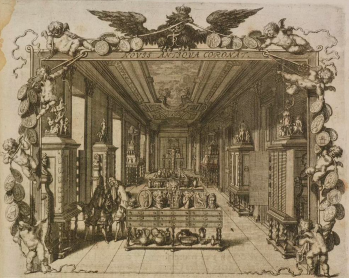
Lorenz Beger, Numismatum Modernorum Cimeliarchii Regio-Electoralis Brandenburgici Sectio Prima … (Coloniæ Brandenburgicæ 1704), p. 1 (Photo: UB Heidelberg).
The academy project Antiquitatum Thesaurus: Antiquities in European Visual Sources from the Seventeenth and Eighteenth Centuries, hosted at the Berlin-Brandenburg Academy of Sciences and Humanities (thesaurus.bbaw.de/en), and the Zentralinstitut für Kunstgeschichte Munich (zikg.eu) are organizing a series of colloquia in 2023–2025 on the topic Visualizing Antiquity: On the Episteme of Drawings and Prints in the Early Modern Period. The significance of drawings and prints for ideas, research, and the circulation of knowledge about ancient artifacts, architecture, and images in Europe and neighboring areas from the late Middle Ages to the advent of photography in the mid-19th century will be examined. The two previous colloquia were dedicated to the topics of the ‘unrepresentable’ properties of the depicted objects and the documentation of different states and contexts of ancient artifacts. This third conference will explore the questions of form, purpose and meaning of images and illustrations in collection catalogs and the role of the people involved.
Collecting is one of the oldest human activities. The interest in gathering objects of varying artistic, scientific, historical, religious, idealistic and emotional value or antiquitates, realia, naturalia, and curiositates was initially documented primarily by written sources such as inventories, but since the 16th century there has been an increase in illustrated (drawn or printed) evidence of the passion for collecting. Our colloquium questions possibilities and strategies to visualize a collection. Descriptions of private or public collections, Thesauri, Monumenta, Specimens, Recueils, Specula, Theatra mundi, Segmenta nobilium, Admiranda antiquitatum, Corpora, and Commentaria are the most common titles of publications dedicated to the various types of collections of (antique) objects. The need to record their holdings in pictures, to give them a classificatory order, to supplement or interpret them descriptively with commentaries, grew particularly with the development of printmaking, while the drawn collection was usually the privilege of a few, mostly wealthy or educated personalities.
We would like to examine the illustrated collection catalogs and analyze the role of the collectors, artists, and scholars involved in relation to the knowledge and intentions expressed in the collection catalogs. Furthermore, we are interested in different uses of these important visual sources and strive to gain new insights into the functions and impact of these catalogs on the art world. Possible contributions can address the following aspects, but further suggestions are also welcome:
• First genre-specific or heterogeneous collection catalogs in Europe
• The role of collectors in the art world and their influence on the construction of collection catalogs
• The relationship between artists and collectors in relation to the presentation of artworks in catalogs
• The importance of scholars and experts in the creation of collection catalogs and their involvement in the creative process
• The range of visualization of collections as a whole and of the individual collection object; formats, techniques, plate vs. text illustration, etc.
• The possibilities of comparative representation, displaying different sizes, quantities, formal characteristics, thematic focuses, material values, etc.
Solicited for the third colloquium are papers in English, French, German, or Italian, 20 minutes in length, ideally combining case study and larger perspective. Proposals (maximum of 400 words), together with a short CV (maximum of 150 words), can be submitted until 17 March 2024 to thesaurus@bbaw.de, keyword ‘Episteme III’. Publication in extended form is planned. Travel and hotel expenses (economy-class flight or train; 2 nights’ accommodation) will be reimbursed according to the Federal Law on Travel Expenses (BRKG).
The fourth and final study day in the series—expected to take place in January 2025 on the occasion of a planned exhibition at the Zentralinstitut für Kunstgeschichte—will be entitled Fake-News? Fantasy Antiquities and will address the problem of the authenticity of the antiquities depicted.
Call for Articles | Valuing Luxury
From ArtHist.net:
Valuing Luxury: Controversial Collections, Divisive Displays, and Ethical Exhibits
Collection of essays edited by Elisabetta Maistri and Robert Hanson
Proposals due by 15 March 2024; complete essays due by 1 November 2024
In an era concerned with social and historical injustices, of wealth inequality and exploitation, and increasing awareness of the anthropogenic ecological impact, the vast collections of luxury goods that fill museums seem at odds with the current political mood. Whilst luxuries have driven much of human development, our attitude towards justice compels us to ask the question: how should museums present their collections in a manner that celebrates humanity’s triumphs without erasing the injustices that fuelled them? This interdisciplinary anthology focuses on the dark side of luxuries from early modern empires, exploring the questions of how we should acknowledge, respond to, and represent their problematic legacies in the contemporary era in public and private collections. The book investigates the role and responsibilities of museums, our relationship with luxuries, and our duties to historical legacies, both good and bad.
We invite scholars to contribute case-study driven chapters which will see authors discuss the history, concept, and normativity of luxury status through the following thematic lenses:
1 Conceptualising Luxury
2 Decolonisation and Social Justice
3 Environment and Sustainability
4 Negative Heritage
5 Inequality and Excess
6 Appropriation and Repatriation
7 Luxury and Desperation
Abstracts should be no more than 500 words and should be submitted to rwhem19@gmail.com by 15th March 2024. Authors should state which theme their paper should be associated with. Please name the file as follow: Surname_THEME NUMBER_TOPIC
Successful abstracts will be called to submit the complete paper to the same email address by 1 November 2024, and will be subject to double-blind peer review prior to the submission of the anthology to the publishing house. Priority given to submissions on objects created prior to the 20th century and to objects associated with the global south. We are also particularly keen to promote the work from underrepresented demographics in the scholarship, particularly women and scholars from the global south.
More information is available here»
Call for Papers | Panel on Ships at ASPHS 2024 in Lisbon
The Association for Spanish and Portuguese Historical Studies annual conference will be held in Lisbon, 8–12 July 2024.
Ships and Their Contents: Shipbuilding, Shipwrecks, and Global Circulation in the Iberian World, 1600–1800
Chaired by Sabina de Cavi and Luis Gordo Peláez
Proposals due by 21 January 2024
In a recent talk organized by the Getty Research Institute, Mirko Sardelić (Senior Research Associate of the Croatian Academy of Sciences and Arts / The University of Western Australia) theorized about Renaissance ships as mobile cross-cultural systems. In response to the increasing academic interest in maritime history, ars navigandi, and maritime archaeology, this panel aims at discussing the materiality of ships and their role as cultural and artistic media in a transoceanic context. It focuses on the global trade in the Iberian World that was dominated by the two main urban centers and port cities of Seville and Lisbon and often interacted and clashed with English and Dutch interests. We welcome contributions on topics such as: the materiality and daily life on the early modern ship; economic partnerships for shipbuilding; shipwrecks, their representation and remains; the iconography of transatlantic cargo ships and the global trade (cartography); cargoes of art and precious goods; smuggling, docks and customs across the globe; marines and the maritime society in the broadest sense (gente di mare). Please submit a 300-word proposal, 5 keywords and a one-page CV before 21 January 2024 to Sabina de Cavi (scavi@fcsh.unl.pt) and Luis Gordo Peláez (luisgordopelaez@csufresno.edu).
Call for Papers | HECAA Emerging Scholars Showcase
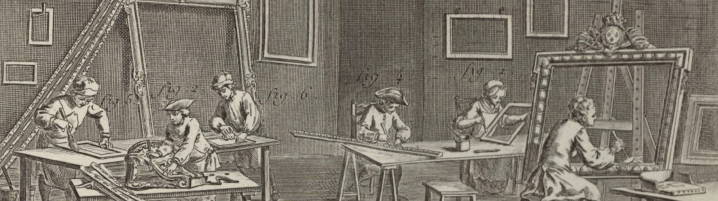
Workshop for Gilding on Wood (Doreur sur bois), detail, Encyclopédie ou Dictionnaire raisonné des sciences, des arts et des métiers, edited by Denis Diderot and Jean le Rond d’Alembert, volume 20, plate IV (Paris, 1765 / ARTFL Encyclopédie Project, University of Chicago).
◊ ◊ ◊ ◊ ◊
HECAA Emerging Scholars Showcase
Online, 5 March 2024
Proposals due by 26 January 2024
We at HECAA are thrilled to invite emerging scholars studying the art, architecture, and visual culture of the long eighteenth century around the globe to participate in our 2024 virtual showcase. A beloved HECAA tradition, the showcase is intended as a platform for emerging scholars to connect with the wider HECAA community and get feedback on their research.
Scholars will each be given 3–5 minutes to present their work, followed by an open question and answer session. This year’s Emerging Scholars Showcase will be held on Tuesday, March 5 (time TBD based on participants’ time zones). As in previous years, an additional showcase may be added if there is sufficient interest; so, we encourage you to apply even if you are unable to present on Tuesday, March 5.
To apply, please fill out this form by Friday, January 26 at midnight (EST). Emerging scholars may be current graduate students (MAs or PhDs) and early career researchers who have received their PhDs in the past five years. We ask that presenters apply no more than once every three years to allow for as many individuals as possible to participate. Also note that you do not have to be a member of HECAA to apply to participate in the Emerging Scholars Showcase, so feel free to circulate widely in your networks. Please, direct all questions, suggestions (and love) to hecaa.emergingscholarsrep@gmail.com.
Warmly,
Demetra Vogiatzaki
HECAA Board Member At-Large, Emerging Scholars Representative
Call for Articles | Spring 2025 Issue of J18: Africa, Beyond Borders
From the Call for Papers:
Journal18, Issue #19 (Spring 2025) — Africa: Beyond Borders
Issue edited by Prita Meier, Hermann von Hesse, and Finbarr Barry Flood
Proposals due by 1 April 2024; finished articles will be due by 1 September 2024
Since the dawn of decolonization in 1950s and 1960s Africa, Africanist scholars have emphasized Africa’s connections to the rest of the world before the period of European colonialism. While such views have gained widespread currency among Africanists and some Africanist-adjacent scholars and journals, Africa, apart from the continent’s Mediterranean coast, is hardly discussed beyond these circles. Even when medieval and early modern (art)history and material culture studies claim to be global, Africa often remains on the periphery of the discussion of long-distance trade, artistic innovations, and material cultural exchange.
This special issue of Journal18 invites contributions that examine the confluence of the global, interregional, and local in shaping African arts, material culture, and sartorial practices. It seeks to shift standard accounts of globalization by decentering European empire-building and the colonial archive. The long eighteenth century saw the expansion of African polities and local networks of exchange flourished. Internal trade and migration were just as important as oceanic movements. Traders, merchants, and migrants constantly moved between different societies, actively facilitating the intermingling of diverse cultural forms across great distances. Artisans, both free and enslaved, were also highly mobile during this period. Archipelagic Africa, especially its port cities and mercantile polities, played a significant role in shaping the commodity networks of the entire world.
Among the questions that this issue seeks to address are: Can the discussions of African trade objects help us historicize intra-and inter-continental trade and cultural exchanges? How did African royals, travelers, enslaved, and free individuals engage with the foreign and the faraway? What can African artifacts tell us about religious, aesthetic, and cultural transformations in Africa and its internal or transregional diasporas before the colonial period? What can historic African art collecting tell us about African identities and transcultural negotiations? How did Africa inspire global artistic imaginations during this dynamic period?
We welcome proposals for contributions on related topics, including African architectural forms and notions of space; the visualization of race in pre-colonial Africa; cultures of making and their regional and transregional connections; the reception and reimagining associated with transregional or transcultural reception; African writing and graphic systems; the material cultures of enslaved/free Africans and their experiences of migration and diaspora; and the politics of eighteenth-century heritage conservation.
To submit a proposal, send an abstract (250 words) and brief biography to the following addresses: editor@journal18.org and spm9@nyu.edu, vonhesse@illinois.edu, fbf1@nyu.edu. Articles should not exceed 6000 words (including footnotes) and will be due by 1 September 2024. For further details on submission and Journal18 house style, see Information for Authors.
Issue Editors
Prita Meier, New York University
Hermann von Hesse, University of Illinois Urbana-Champaign
Finbarr Barry Flood, New York University










leave a comment