Call for Articles | 2028 Issue of NKJ: The Artist’s Biography
From the Call for Papers:
The Artist’s Biography, 1400–Present
The Netherlands Yearbook for History of Art / Nederlands Kunsthistorisch Jaarboek (NKJ)
Volume 78 (2028)
Proposals due by 20 January 2026
In Rembrandt en de regels van de kunst (1961), Jan Emmens explored how, shortly after Rembrandt’s death, critics portrayed him as a Pictor vulgaris who preferred low-life company, fallen women, and ‘rough’ brushwork rather than classicism and fine painting. Such early criticism had a lasting impact on the Romantic idea of the artist as a misunderstood genius, influencing how Rembrandt and his artworks are perceived to this very day. Art historians also indulge in biographical manipulation, as Machiel Bosman shows in Rembrandts plan: De ware geschiedenis van zijn faillissement (2019). He scrutinizes archival material to expose the fragility of biographical claims built on incomplete or interpreted evidence while inviting reflection on how artist’s biographies are constructed, revised and contested. At the same time, new research on the artist, such as into Rembrandt’s relationship to the African community in Amsterdam (Ponte, 2020), has expanded our understanding of the artist as well as provided an entry into further understanding the Black experience in the Dutch Republic.
Biography, the containment and shaping of the unruly details of a human life into writing by another, has been central to art history since the appearance Vasari’s Lives of 1550. Authors of lives of Netherlandish artists, Karel van Mander, Joachim von Sandrart, Cornelis de Bie, Arnold Houbraken, Gerard de Lairesse, Filippo Baldinucci, Bainbrigg Buckeridge, Adriaan van der Willigen and Gerarda Hermina Marius, among others, all used biography to shape their accounts of art and included commentary on artists’ life choices alongside evaluations and descriptions of their art. Netherlandish art history from the start has thus been enmeshed with the personal identity of the artists who contributed to it, and biography, however problematic or challenging, has always been implicated in art theory and the analysis of art objects. As Nanette Salomon showed in “The Art Historical Canon: Sins of Omission” (1991), the selection of which artists’ lives to include and how they were written effectively shaped the canon of art history.
Of late, however, analysis of biographies has also served as an instrument to expand and critique the canon with particular significance for the study of Netherlandish art. Aspects neglected in biographies like artists’ gender, sexual orientation, ethnicity, and social class serve as a lens to ask new questions of familiar artworks or bring to the fore previously unknown or ignored artworks. Artists who did not appear in the standard biographies, especially women, are being rediscovered and given new ‘lives’. Additionally, biographical studies can also move into the direction of cancel culture. Comedian Hannah Gadsby, in her Netflix show Nanette (2017) and her exhibition, It’s Pablomatic (2023) at the Brooklyn Museum castigated Picasso’s misogyny. That same year, essayist Claire Dederer published Monsters: A Fan’s Dilemma (2023), exploring the consequences of such feelings as described by Gadsby. What do we do with great art by bad people? How do we define what’s bad and how does this relate to the art?
NKJ 78 invites contributions exploring examples of entanglement between artwork and artist biography that will advance our understanding of the significance and theoretical implications of biographies of artists from the Low Countries (present-day Luxembourg, Belgium, and the Netherlands), 1400-present. We are also interested in papers that consider the definition of artists’ biographies and the potential value to art historical study for expanding it.
The call is open for studies on a range of matters related to artists’ biographies, including but not limited to:
• Historical attempts at separating artists from their art
• Identity as a driving artistic force
• Appropriation of an artist’s biography to political ends
• Biography in the quest for greater representation in scholarship and museum collections
• Biography in relation to notions of genius or greatness
• Relationship of artists’ biographies and the identity and status within culture
• Transgression/transgressive behavior as inherent artistic quality
• The relation between biography and cancel culture
• The power of time to change appreciation of artists’ conduct
• The relationship between individual artist’s identities and their broader societal contexts
• Differences in the form and function of artist biographies in northern and southern Europe
• Differences in the writing and perception of biographies between male and female artists
• How art theory shapes biography and vice versa
• Relating the life of the artist to the life of objects
• Portraits as a form of biography
• Artistic autobiography, including self portraits
• Expansion of the notion of biography
• Biography as a frame of cultural encounter, involving the locations, mobility and geographical affiliations of artists
• Biography and the development of art connoisseurship, including insights from technical and digital art history
• The literary tools of artists’ biographical writing: ekphrasis, anecdote, the moral exemplum
The NKJ is dedicated to a particular theme each year and promotes innovative scholarship and articles that employ a diversity of approaches to the study of Netherlandish art in its wider context. More information is available here. Contributions to the NKJ are limited to a maximum of 7500 words, excluding notes and bibliography. Following a peer review process and receipt of the complete text, the editorial board will make a final decision on the acceptance of a paper.
Please send a 500-word proposal and a short CV to all volume editors by 20 January 2026:
Lieke Wijnia, l.wijnia@rug.nl
Natasha Seaman, nseaman@ric.edu
Ingrid Vermeulen, i.r.vermeulen@vu.nl
Schedule
20 January 2026: Deadline for submission of abstracts
February 2026: Notifications about abstracts
1 November 2026: Submission of full articles for peer review
Early 2027: Decision on acceptance based on peer reviews
1 July 2027: Deadline revised articles
1 September 2027: Final articles, including illustrations & copyrights
Early 2028: Publication
Call for Papers | The Lessons of Rome
From ArtHist.net:
Les Leçons de Rome / The Lessons of Rome, 9th Edition
Lyon Museum of Fine Arts, 13 March 2026
Proposals due by 15 February 2026
This study day aims to provide a space of reflection for anyone who grasps Italy as an architectural, urban, and landscape research laboratory. Defining Italy as a laboratory involves analyzing contexts of urban policies as well as design experiences, theories, practices, legacies, mutations, and prospects. It means building knowledge and culture, learning and developing tools to conceive the present and to enrich contemporary practices. The Lessons of Rome will provide an opportunity to engage current and upcoming research, to share existing and generate new knowledge and dialogues with Italy. Professionals, students, PhD candidates, researchers, and people from various academic disciplines, schools, and nationalities are welcome. Th study day is organized in partnership by the Ecole nationale supérieur d’architecture de Lyon, the LAURE, the Institut Culturel Italien of Lyon, and the Lyon Museum of Fine Arts.
Researchers wishing to contribute are invited to send a proposal with a title, an abstract (about 200 words), and a short biography to rome@lyon.archi.fr before 15 February 2026. The official language of the day is French, but proposals and papers may also be submitted in English.
Scientific Committee
Nicolas Capillon, Ecole nationale supérieure d’architecture de Lyon
Julie Cattant, Ecole nationale supérieure d’architecture de Lyon
Benjamin Chavardès, Ecole nationale supérieure d’architecture de Lyon
Lorenzo Ciccarelli, Università degli studi di Firenze
Philippe Dufieux, Ecole nationale supérieure d’architecture de Lyon
Federico Ferrari, Ecole nationale supérieure d’architecture de Paris-Malaquais
Audrey Jeanroy, Université de Tours
Manuel Lopez Segura, Graduate School of Design, Harvard University
Alessandro Panzeri, Ecole nationale supérieure d’architecture de Lyon
Davide Spina, The University of Hong Kong
Call for Papers | Rethinking Early Modern Prints, 15th–18th Centuries
From ArtHist.net:
Rethinking Early Modern Prints Today: New Questions and New Approaches
Actualités et perspectives de la recherche sur l’estampe à l’époque moderne
Université de Poitiers, CRIHAM, 24 September 2026
Proposals due by 16 February 2026
This symposium aims to bring together established researchers, early career scholars, PhD candidates, and students—in art history or related disciplines—to present and discuss current research and perspectives on prints in the early modern period (15th–18th centuries). It seeks to provide a forum for exchange devoted to recent approaches and ongoing projects, whether they focus on the practices and techniques of printmaking, on its networks of production, circulation, and exchange, or on the place of the printed image within visual and material culture. Presentations, lasting around twenty minutes, may address, without geographical restriction, any aspect of the production, circulation, or reception of prints, from historical, artistic, material or theoretical perspectives.
As part of the Creation, Corpus, Heritage (Création, corpus, patrimoine) program of the Centre de Recherches Interdisciplinaires en Histoire, Histoire de l’Art et Musicologie (CRIHAM), the symposium will take place at the University of Poitiers and will also be available via videoconference. Please submit an abstract with a title (in French or English) of no more than 2500 characters (including spaces) and a short biographical note (institutional affiliation, contact details, and research topics) by 16 February 2026 to je.rechercheestampe@gmail.com.
Organizers
• Teoman Akgönül, University of Poitiers (CRIHAM) and INHA
• Amélie Folliot, Rennes 2 University (HCA)
• Estelle Leutrat, University of Poitiers (CRIHAM)
• Louise Quentel, University of Poitiers (CRIHAM)
Call for Papers | Framing the Drawing / Drawing the Frame
From the Call for Papers as noted at ArtHist.net:
Framing the Drawing / Drawing the Frame
Bibliotheca Hertziana—Max Planck Institute for Art History, Rome, 13–15 May 2026
Organized by Tatjana Bartsch, Ariella Minden, and Johannes Röll
Proposals due by 16 January 2026
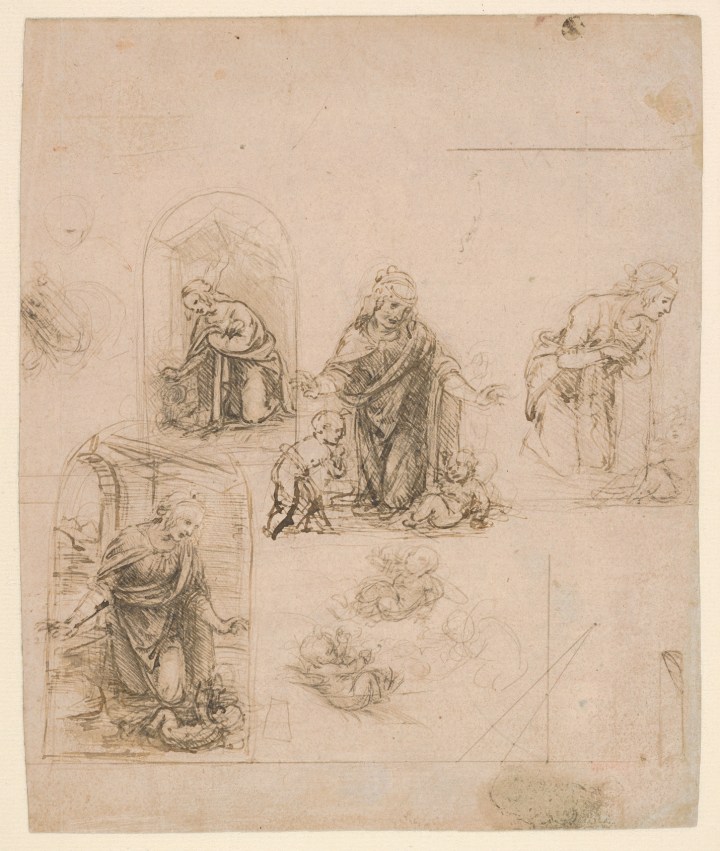
Leonardo da Vinci, Compositional Sketches for the Virgin Adoring the Christ Child, with and without the Infant St. John the Baptist, silverpoint, pen and brown ink, ca. 1480–85 (New York: The Metropolitan Museum of Art, 17.142.1). As Carmen Bambach notes in her entry for the drawing, “The geometric constructions at the lower right represent his attempts to work out the perspective within the composition, with respect to the spectator’s vantage point.”
The 2026 Gernsheim Study Days seek to explore the relationship between early modern drawings, frames, and framing.
In the early modern period, the frame as a physical object was something that could and, not infrequently, did cost more than the artwork it was framing. Together with the understanding of its economic value, the frame performed a monumentalizing role. The microarchitectural structure was used to signal the importance of an image through the imposition of new hierarchies of space. The symbolic dimension of the frame was both mobilized by artists as an integral part of compositional ensembles and retroactively applied to underscore the importance of certain images.
In the medium of drawing, with the physicality of the wrought object removed, the symbolic connotations associated with acts of framing came to be transposed to a two-dimensional plane, emphasizing the practice as a cultural technique. The form of elevation accomplished by the frame was transformed into a personal referencing system for the artist, part of a creative practice, where the addition of the drawn frame could transform a sheet of paper from an open field, a space for ideas to emerge, to a closed one, creating new hierarchies of space in the mise-en-page. Similarly, a drawn frame around a single motif on a sheet of paper with several motifs serves to illustrate the artist’s selection process and offers an opportunity for reflection on the connection between artist, viewer, and message to be conveyed. It is the goal of this conference to examine these semiotic potentials in and related to drawing in their multiplicity.
In addition to the generative role that forms of framing played in early modern drawings, we are interested in the framing of drawings themselves as it pertains to histories of collecting, reception, and museums. From Vasari’s Libro dei disegni to the modern passepartout, we seek to address how acts of framing shape or change our perception of drawings.
Finally, given the practical, economic, and symbolic significance of the frame, drawings for actual frames comprise an important line of inquiry in interrogating the relationship between drawing, frames, and framing. Alongside the use of the word cornice in Italian to refer to the frame in the early modern period, decorative surrounds were also identified in contemporary sources as ornamenti, a term that could refer both to the celebratory quality of frames as well as the nature of the frame as a liminal space or threshold where artists were able to reflect on the inventiveness of art making. In this context, papers might address the relationship between frame design and drawing and what impact—if any—the expanded drawing practices of the early modern period had on practices of framing.
We invite papers that treat frames and framing, broadly conceived, as they relate to drawing. Possible topics and questions that we hope to address include:
• Frame design and drawing for the decorative arts
• The role of frames and framing in the making or changing of meaning
• Inscriptions on drawings or, later, passepartouts, as a form of framing
• Marginalia as paratextual frames
• How the frame in drawing complicates our understanding of the frame
• The frame as mediator of drawings
• The frame as a metapictorial device
To submit a proposal, please upload a title, a 250-word abstract, and brief CV (no more than 2 pages) as a PDF document at https://recruitment.biblhertz.it/position/19759108 by 16 January 2026.
Conference languages are English, German, and Italian. The Bibliotheca Hertziana will organize and pay for accommodation and reimburse travel costs (economy class) in accordance with the provisions of the German Travel Expenses Act (Bundesreisekostengesetz).
Call for Papers | Undergraduate History Symposium, Istanbul
From the Call for Papers:
3rd Undergraduate Student Symposium
Department of History, Istanbul University, 5–6 May 2026
Proposals due by 29 March 2026
 The 3rd Undergraduate Student Symposium organized by the Department of History at the Faculty of Letters, Istanbul University, will be held May 5–6, 2026 in the Kurul Odası. The symposium aims to support academic development at the undergraduate level by providing a platform for students from various universities to present their research on different periods and themes in history. Students wishing to present a paper should submit an abstract of 250–400 words via the online submission form by March 29. Presentations will be limited to 15 minutes. Accepted proposals will be announced on April 12. For inquiries, please contact edebiyat.kariyertarih@istanbul.edu.tr.
Call for Papers | Material Ecologies: Boston U. Graduate Symposium
From the Call for Papers:
Material Ecologies: Connecting Care, Nature, and Identity
The 42nd Annual Mary L. Cornille Boston University Graduate Symposium on the History of Art & Architecture
Boston University and MFA Boston, 10–11 April 2026
Coordinated by Allegra Davis and Jailei Maas
Proposals due by 1 February 2026 (extended from 15 January)
The graduate students of the Boston University History of Art & Architecture Department invite proposals for papers that explore themes of art and the environment, engaging questions of materiality, craft, and alternative ecologies, for the 42nd anniversary of the Mary L. Cornille (GRS ‘87) Boston University Graduate Symposium on the History of Art & Architecture.
In recent decades, as critical approaches to the environmental humanities have experienced rapid expansion, ecocritical art histories have examined aesthetic engagements with the natural world in light of extraction, pollution, and climate change, often reconsidering hierarchies imposed on the environment and artists’ relationships with natural subjects and materials. Ecofeminism, meanwhile, as both a social movement and a theoretical framework, has specifically linked human domination of nature with patriarchal structures, calling for the deconstruction of both gender and species-based divisions and oppressions. Taking cues from these movements, Material Ecologies will center materiality and feminist critique as lenses for environmental inquiry in art history, investigating how artists depict, consider, and collaborate with more-than-human beings to refigure humanity’s own relationships with the world around us. In this symposium, we aim to break down boundaries and hierarchies not only between humanity and nature, but also among academic and artistic disciplines, geopolitical borders, and material categories. How have artists used both traditional and innovative materials and methods to address themes of the environment, climate, and identity? Where do ecological, scientific, cultural, and artistic practices overlap and intersect, and what insights are produced as a result? What new ways of creating and being can we access by resisting the urge to insulate and taxonomize?
Possible subjects include but are by no means limited to: artistic collaborations with nature; the expanded field of sculpture; ecofeminism and decolonialism; queer and feminist craft practices; salvaged and repurposed materials; Black Feminist, Indigenous, and queer ecologies; and kinships between art and science.
Submissions should align with the goal of this symposium to center BIPOC, LGBTQIA2S+, feminist, and counter-colonial voices, fostering a space for these perspectives to resonate within the academy and beyond. We encourage interdisciplinary approaches, bringing together art history, architectural history, environmental humanities, cultural studies, literature, and more. We welcome submissions from graduate students at all stages and from any area of study in the global history of art and architecture. Papers must be original and unpublished. Please email as a single Word document: title, abstract (250 words or less), and CV to artsymp@bu.edu. The deadline for submissions is 15 January 2026. Selected speakers will be notified in early February. Presentations will be 15 minutes in length, followed by a question-and-answer session. The symposium will be held at the Boston University campus and the Museum of Fine Arts, Boston on April 10 and 11, 2026.
This event is generously sponsored by Mary L. Cornille (GRS ’87). For more information, please visit our website or email artsymp@bu.edu.
◊ ◊ ◊ ◊ ◊
Note (added 18 January) — The posting was updated with the new, extended due date.
Call for Papers | The Global Neoclassicism Project
From the Call for Papers:
Neoclassicism in the Extended Field: A Global Project
Online, 28–30 May 2026
Organized by Faraz Olfat and Rebecca Yuste
Proposals due by 1 February 2026
Neoclassicism—rooted in the aesthetic, philosophical, and political traditions of Greece and Rome—stands as a defining current of the long nineteenth century, especially the period from 1750 to 1860. Often linked to state-building, emerging national identities, and the rise of secular modernity, the movement was shaped significantly by figures such as Robert Adam, Jacques-Louis David, Angelica Kauffman, Thomas Jefferson, Antonio Canova, and Abbé Laugier. Their ideas circulated broadly, aided by expanding imperial networks, print culture, and the development of photography. As a result, Neoclassical forms and ideals appeared far beyond Europe, taking shape in the colonial Americas, the Middle East, South Asia, and across the African continent. Art academies and new modes of image dissemination further amplified access to classical models once limited to travelers and on-site observers.
This conference asks what happens when Neoclassicism moves beyond its traditionally understood geographic center in Western Europe. How was the movement introduced, promoted, adapted, and transformed in non-Western contexts? How did Greco-Roman traditions intersect with existing local architectural, artistic, and archaeological legacies? And in what ways did Neoclassicism participate in, or respond to, global imperial structures?
We invite papers that expand, complicate, or challenge established narratives of Neoclassicism across media from the rediscovery of Pompeii and Herculaneum through the first decade of the twentieth century. Topics may include, but are not limited to:
• Transmission of Neoclassical design through colonial networks
• Photography, pattern books, architectural treatises, and academic training (including the École des Beaux-Arts)
• Governmental architecture, libraries, financial institutions, religious monuments, private residences, or unrealized projects
• Theoretical or historiographic studies that question conventional boundaries of the movement
We welcome contributions that offer new perspectives, illuminate understudied regions, or reconsider the global dynamics that shaped Neoclassical expression. As this will be an online symposium, we are especially eager to hear from scholars working in Asian, African, and Latin American geographies. Please submit an abstract of no more than 250 words along with a CV to faraz.olfat@yale.edu by the 1st of February 2026. We will communicate decisions by the beginning of March. For any questions or concerns contact Rebecca Yuste at rmy2107@columbia.edu.
Keynote Speaker
Meredith Martin — Professor of Art History, New York University
Chairs
Faraz Olfat — PhD candidate, Department of the History of Art, Yale University
Rebecca Yuste — PhD candidate, Department of Art History & Archaeology, Columbia University, and Junior Fellow, Garden and Landscape Studies, Dumbarton Oaks
Call for Articles | Images of Architecture at the Turn of the Enlightenment
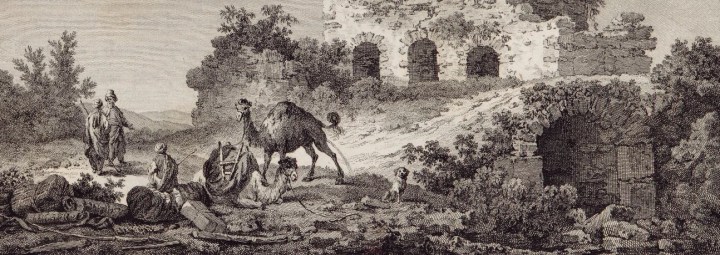
Ruines d’un Gymnase à Pergame, detail, from the second volume of Choiseul-Gouffier, Voyage pittoresque de la Grèce (1809).
◊ ◊ ◊ ◊ ◊
Utpictura 18 is now accepting proposals for a special issue, scheduled for publication in January 2027:
Utpictura18 | Images d’architecture au tournant des Lumières
Edited by Séverine Guillet and Fabrice Moulin
Proposals due by 30 January 2026; final articles will be due by 10 July 2026
Entreprises éditoriales, aux contours génériques mouvants, les “Voyages pittoresques” se développent de façon très importante à partir du dernier tiers du XVIIIe siècle et dans la période romantique. Ils sont les héritiers de traditions littéraires savantes occidentales, qui ont participé, par la découverte et l’observation, à l’ouverture et à l’élargissement du monde et du savoir: lointainement, le récit viatique humaniste, et plus directement les voyages antiquaires des XVIIe et XVIIIe siècles, ou encore les recueils d’antiquités ainsi que les voyages à visée scientifique et encyclopédique des Lumières.
Ancré, au départ, dans un double territoire, méditerranéo-oriental d’une part (le Voyage pittoresque ou description des royaumes de Naples et de Sicile de Saint-Non en 1781; le Voyage pittoresque de la Grèce de Choiseul-Gouffier en 1782), et national d’autre part (le Voyage pittoresque de la France, initié par Laborde dès 1780), le voyage pittoresque, dont les horizons s’élargissent parfois jusqu’aux Indes ou au Nouveau Monde, est aussi bien une affaire d’histoire (avec en vue l’antique, ou le passé médiéval) que de géographie (paysages lointains ou proches, urbains, ruraux, alpins…). Parmi les nombreuses publications françaises qui s’affichent sous ce titre, on compte, sur cette période, au moins une quarantaine d’ouvrages illustrés. En dépit des disparités qui traversent ce corpus, a fortiori sur une période de quarante ans, les voyages pittoresques illustrés ont en commun, bien souvent, une forte ambition éditoriale: ce sont le plus souvent de luxueux ouvrages, de grand format, financés non sans difficultés par des souscriptions, voire des subventions. Ils sont richement illustrés de gravures (plus tard de lithographies) extrêmement soignées. Ils partagent surtout le projet, inscrit aussi dans leur titre (qui joint parfois le «voyage» au «tableau», et le «pittoresque» au «sentimental», puis au «romantique»), de faire voir, de rendre visible l’expérience singulière et sensible du voyage. Par l’image comme par le texte, le pittoresque traduit d’abord une nouvelle sensibilité au paysage, qui, à travers le vécu du voyage, cherche avant tout à produire de l’effet sur le spectateur-lecteur. Depuis Choiseul, qui place, dans son prospectus, le Voyage pittoresque de la Grèce sous le signe du désir de «communiquer […] une partie des sensations qu’[il] ven[ait] d’éprouver» jusqu’à Nodier, qui dit écrire, avec le Voyage pittoresque de l’ancienne France, un «voyage d’impressions», le voyage pittoresque configure la communication d’une expérience.
Des expériences d’architecture en images?
Qu’ils participent tantôt de la culture de l’observation scientifique des Lumières (en articulant, à loisir, savoirs archéologiques et topographiques, histoire naturelle, études de mœurs…) ou de l’affirmation d’une nouvelle sensibilité romantique (notamment à l’histoire et au passé national), ces voyages pittoresques placent l’architecture, délibérément ou non, au cœur de leurs enquêtes. Dans un article, adossé à une thèse restée inédite mais importante pour l’étude de ce corpus, Caroline Jeanjean-Becker constate que si «la forme et le fond de ces récits évoluent au cours de la période […] l’intérêt des voyageurs pour les monuments et la manière dont ils sont érigés demeure une constante. [Ces voyages] constituent donc autant d’histoires de l’architecture et d’expression d’une sensibilité à l’architecture» (Jeanjean-Becker 1999). L’intérêt des historiens de l’architecture pour ces voyages n’a fait que confirmer cette intuition (Szambien 1988; Armstrong 2013, par exemple). D’une certaine manière, c’est même autour du savoir et de l’imaginaire architectural que l’entreprise du voyage pittoresque s’invente (avec les Ruines des plus beaux monuments de la Grèce de Leroy, précurseur du genre) et qu’elle aurait pu trouver son apogée (avec le projet initial, mais abandonné car trop ambitieux, du baron Taylor de donner une «histoire de l’architecture chez tous les peuples», qui se resserra finalement sur les Voyages pittoresques de l’ancienne France).
Inabouti, ce rêve éditorial d’une histoire universelle de l’architecture dans les premières années du XIXe siècle, nous invite néanmoins – c’est tout le sens de ce projet de numéro – à lire la production des voyages pittoresques illustrés comme autant, sinon d’histoires, du moins de récits imagés, d’expériences figurées d’architecture. Avec des accents culturels différents selon les périodes, les intentions éditoriales, les auteurs et les artistes, qu’ils soient portés par l’esprit de découverte encyclopédique des Lumières, ou la nouvelle sensibilité au paysage, par la passion archéologique de l’antique ou le goût pour les vestiges médiévaux, par l’attirance exotique ou la constitution d’un patrimoine national, tous ces ouvrages ont en commun de produire et diffuser, avec les moyens mécaniques de l’imprimé, un nombre colossal d’images qui font basculer l’essentiel du savoir et du plaisir promis au lecteur du voyage, du régime du discours vers celui du visible. Comment ces voyages pittoresques, en permettant la circulation et la comparaison massive d’images d’architectures – tantôt lointaines, inconnues ou redécouvertes, tantôt ancrées dans la France et ses provinces – participent-ils d’une nouvelle forme d’histoire de l’architecture par les images? et, plus généralement, d’une culture visuelle du bâti? Comment cette galerie, ce museum imaginaire et livresque (le musée s’invente d’ailleurs à cette époque) dialogue-t-il avec d’autres traditions visuelles de l’architecture, d’autres corpus d’images (comme ceux de Fischer von Erlach ou de Piranèse, par exemple); mais aussi avec les recueils d’antiquités ou encore les traités d’architecture et leurs illustrations, voire des illustrations de fictions? Comment ces illustrations donnent-elles à voir l’inscription complexe du savoir architectural (que l’iconographie humaniste avait surtout centré sur la question des proportions et des ordres), dans l’expérience multiple et dynamique du voyage? Comment se traduisent, dans les vues des voyages pittoresques, la série de nouveaux rapports dont se nourrit l’imaginaire architectural du tournant des Lumières? Rapport à la nature et au paysage (quelle part du bâti dans les esthétiques pittoresque et sublime?); rapport aux passés (quelles reconfigurations historiques, entre retour à l’antique et conscience d’une histoire nationale?); rapport à la subjectivité (la poétique ou la mélancolie des ruines, par exemple); rapport aux mœurs et aux sociétés (quand le bâti participe de l’enquête ethnographique naissante).
Cet appel se veut une invitation à circuler dans ces corpus gravés, dessinés, lithographiés, en croisant les approches plurielles de l’histoire de l’art, de l’architecture et du livre, de l’histoire littéraire, mais aussi de la sémiologie, ou des études visuelles. Les quelques grands circuits suivants pourront guider les recherches et les enquêtes, sans exclusive:
L’architecture et l’expérience du voyage
On pourra interroger les différentes modalités selon lesquelles les perceptions, les savoirs, les découvertes d’architecture s’intègrent dans l’expérience globale et mouvante, intellectuelle et sensible, du voyage. Quelle place pour l’architecture au sein du système des savoirs construit par le voyage et son illustration? Comment l’information d’architecture s’articule-t-elle aux autres types de savoirs véhiculés par l’image (savoir géologique, géographique, historique, ethnographique, épigraphique, numismatique…)? De même, quelle place occupe la thématique de l’architecture et son iconographie au sein du projet éditorial? Dans quelle mesure l’enquête architecturale reste-t-elle, comme le suggérait Caroline Jeanjean-Becker «le souci principal» du voyageur? Parfois, cet intérêt est délibérément formulé et mis en avant (comme dans le Voyage pittoresque de la Syrie, de la Phénicie, de la Palestine et de la Basse-Egypte de Louis-François Cassas ou le Voyage pittoresque des isles de Sicile… de Jean-Pierre-Louis Houël), posant la question de la nature de cet intérêt. Dans cette perspective, l’étude des discours préfaciels et préliminaires, des péritextes promotionnels, voire des traces de métadiscours sur le projet iconographique pourrait permettre de dégager une sorte de poétique de l’image d’architecture, qui interroge les fonctions différentes qu’on lui assigne et les publics auxquels on la destine: restitution scientifique pour le savant et l’amateur? sauvegarde patrimoniale ou mémorielle? recherche de l’«effet» pour le lecteur? À l’inverse, on pourra se pencher sur les cas où le bâti s’invite sans qu’on l’y attende, jusqu’à occuper, dans le texte et dans l’image, une place importante, parfois à réévaluer, dans des voyages a priori tournés vers l’évocation de la nature ou l’observation des mœurs. Au-delà des approches qui ont volontiers privilégié le champ antiquaire ou l’histoire monumentale, on pourra se demander comment l’expérience du voyage, comme laboratoire d’une ethnographie naissante et au gré des mutations du pittoresque, a contribué à élargir les représentations de l’architecture, en portant une attention nouvelle à des formes du bâti encore relativement négligées par la littérature d’architecture: habitat modeste, rural ou typique, architectures vernaculaires ou industrielles (moulins, manufactures…), constructions édilitaires (pont, aqueduc, fontaine…) mais aussi logements fragiles, provisoires ou nomades (on pense, par exemple, aux frêles tentes des habitants d’Anatolie, que Choiseul-Gouffier fait représenter au milieu des vestiges de temples antiques). Quelle nouvelle visibilité pour ces bâtiments et constructions? Pour quelles nouvelles formes d’inscription du bâti dans les représentations de la société et des pratiques humaines? Enfin, entre exotisme (dans les expéditions de Grèce, du Levant ou d’Egypte…) et imaginaire national (depuis les Antiquités de France de Clérisseau, conçues comme parallèlement au Voyage pittoresque de la Grece de Choiseul-Gouffier, jusqu’à l’ancienne France de Taylor et Nodier), on pourra interroger les rôles fluctuants des motifs d’architecture dans les constructions politiques, idéologiques et poétiques des identités culturelles.
L’architecture mise en scène
«On a peint ce qu’on a vu, et on l’a peint avec amour » déclare le comte de Choiseul-Gouffier dans le prospectus du Voyage pittoresque de la Grèce. Cela pose la question, abordée dans le premier axe, de ce que les voyageurs voient effectivement, mais aussi celle de la manière dont ils le restituent «avec amour». Un questionnement autour de la mise en scène de l’architecture dans les voyages pittoresques permettra ainsi de s’emparer de corpus graphiques plus ou moins connus et de créer des ponts avec d’autres ensembles issus des livres d’architecture, d’histoire naturelle (où le bâti est parfois présent en tant que décor ou élément de contexte, comme dans les Tabulae sceleti… (1747) d’Albinus et Wandelaar), de fiction (tel le Voyage du jeune Anacharsis de l’abbé Barthélémy), ou avec l’œuvre de dessinateurs, architectes et graveurs (Piranèse, Clérisseau, Pâris, Wailly…).
On pourra plus précisément mettre en avant des filiations à travers la circulation de modes de représentation de l’architecture entre ces différentes sources: jeux d’échelles, cadrage, point de vue, mise en page, etc., dans la lignée de ce qu’a fait, par exemple, Susan M. Dixon pour Piranèse et Houël (Dixon 2003). Un questionnement autour de la circulation de motifs et même de gravures (par exemple entre le Voyage pittoresque de la Grèce et le Voyage du jeune Anacharsis), sera également bienvenu.
Le même Choiseul-Gouffier affirme que les «planches utiles» de son ouvrage, à savoir les cartes, les relevés d’édifices et d’éléments architecturaux, supposent un «goût vif pour l’architecture et des connaissances en géographie». Mais ce type de gravures côtoie aussi des scènes d’intérieur, des vues d’ensemble et paysagères, des reconstitutions parfois: autant de représentations jugées moins utiles mais susceptibles, en parlant à l’imagination, de plaire à un plus large lectorat. Cette tension ou complémentarité entre deux registres figurés caractérise un grand nombre d’ouvrages de la période étudiée. Il s’agira ainsi d’envisager les choix de représentation opérés dans les voyages pittoresques comme autant d’éléments d’une culture livresque plus vaste: comment s’articulent ces différents modes de représentation de l’architecture, entre recherche de rigueur, d’exactitude et d’effet voire d’émotion? À quels régimes de connaissance se raccrochent-ils? Au cœur de cette thématique se trouvent les vues animées de figures. S’agit-il de figures de convention, contemporaines ou historiques, ou bien de protagonistes du récit et/ou d’acteurs du projet éditorial (le comte de Choiseul-Gouffier abordé par un moine sur l’île de Patmos, ou Voltaire dessiné au premier plan d’une vue de Ferney dans les Tableaux de la Suisse de Laborde)? Qu’ajoutent-elles à l’intelligence des lieux représentés et quelle médiation apportent-elles au lecteur (guide, dessinateur, voyageur…)? Habitent-elles ces lieux ou sont-elles simplement disposées autour? La question de l’absence de ces figures, le cas échéant, pourra aussi être posée. Enfin, on s’intéressera au rapport de l’architecture à la nature, afin de mieux cerner les contours problématiques d’un pittoresque et d’un sublime qui seraient proprement architecturaux. Au-delà du motif de la ruine ou du tombeau, qu’on pourra suivre dans leurs glissements de l’antique vers le médiéval, le ressort principal des gravures, moins souvent étudié, réside aussi dans l’inscription du bâti (quel qu’il soit) dans l’écrin du site naturel (de la cabane rustique au village, en passant par le pont), voire la fusion métaphorique de leurs frontières: dans le texte comme dans l’image, la nature s’appréhende parfois comme artefact (terrasses, ponts, forteresses, colosses…) et l’artefact comme production naturelle (les visions piranésiennes de l’océan de débris, des murailles qui deviennent roches…). Autant de variations sur la confrontation entre l’homme et la nature, qu’on pourra étudier, en écho avec les grandes rêveries philosophiques des Lumières (celles d’un Diderot du Salon de 1767, d’un Bernardin de Saint-Pierre dans les Études de la Nature) ou les méditations romantiques (comme celles d’un Chateaubriand).
La fabrique du livre illustré: une architecture entre estampe et texte
Les voyages pittoresques sont souvent le résultat de véritables entreprises éditoriales qui ont pu durer de longues années. Peut-on d’ailleurs parler d’un résultat unique? Parutions par livraisons, puis en volumes, puis rééditions: ce que l’on désigne comme un voyage pittoresque recouvre parfois plusieurs réalités matérielles. Dans la lignée de ce qui a déjà été proposé pour certaines de ces entreprises (celles de Choiseul-Gouffier, de Laborde et de Saint-Non, par exemple), il conviendra alors d’éclairer la fabrique de ces livres. Que sait-on des premières démarches de leur(s) concepteur(s)? Quel était l’objectif de départ et à quoi cela a-t-il abouti? Derrière un ou deux noms, de multiples acteurs ont généralement contribué à ces entreprises. Dessinateurs, peintres, architectes, graveurs, écrivains, érudits, entrepreneurs, souscripteurs, imprimeurs, éditeurs…: on pourra, dans la mesure du possible, retracer certaines collaborations, certains parcours d’artistes (voir par exemple les rares études sur les architectes Fauvel ou Foucherot (Zambon et Pinon 2007)). Cela permettra d’éclairer et d’interroger les choix opérés, d’une technique de gravure à un mode de financement, ainsi que les chaînes de production, de l’artiste à l’éditeur et du dessin à la gravure, par exemple. La question de la publicité et de la réception pourra également être abordée.
Enfin, l’un des enjeux majeurs du voyage pittoresque – dans sa fabrication comme sa réception – c’est l’articulation complexe entre l’illustration et le texte. La représentation de l’architecture s’élabore dans le rapport entre ces deux régimes, iconique et textuel. Selon quelles tensions? Quelles complémentarités? Quels décrochages, quelles circulations pour le lecteur? Quels dialogues, quels passages entre les logiques narratives ou descriptives du voyage d’une part et l’organisation de la collection d’images (parfois en recueil et livraisons) qui fixent l’édifice ou cherchent à l’animer, d’autre part?
Si la promotion de l’illustration, tout au long de la période, tend à faire primer l’image, «partie principale», sur le texte «accessoire» (Choiseul), dans quelle mesure le discours (explicatif, descriptif, narratif) ne détient-il pas malgré tout certaines clefs de la lisibilité de l’image d’architecture ? Comment le texte du voyageur, traversé lui-même par d’autres textes, nourri de références livresques (Choiseul voyage «un Homère à la main») en vient-il à habiter et animer les lieux et les sites représentés? À les creuser par le récit, le mythe, ou l’expérience vécue? Comment, à l’inverse, l’illustration s’affranchit-elle du texte, selon quels décalages, pour quelle autonomie?
La période retenue pour les enquêtes s’ouvre naturellement avec les trois premiers voyages pittoresques illustrés édités par Saint-Non, Choiseul et Laborde, pour se refermer dans les années 1820, avec, notamment le premier volume des Voyages pittoresques de l’Ancienne France de Taylor et Nodier. En effet, à partir des années 1825, une double révolution scientifique (avec l’invention de l’archéologie moderne) et technique (le succès définitif du procédé lithographique), inaugure une nouvelle ère pour le livre illustré, le tourisme moderne et l’approche scientifique du monument historique. Cette périodisation a aussi l’avantage de placer l’imaginaire des voyages pittoresques en perspective avec ce moment, à la fois cohérent et tourmenté, du tournant des Lumières, dont bien des mutations culturelles se cristallisent, justement, dans les représentations du paysage. On laissera néanmoins ouverte la possibilité d’explorations comparatives en amont (en convoquant, par exemple, l’influence de la tradition savante des voyages d’antiquaires ou, dans un autre registre, les premiers voyages pittoresques au format de guides pratiques pour la découverte des beaux-arts à Paris ou ailleurs) et les prolongements en aval vers les mutations du genre après 1830, ou la réception et l’exploitation postérieure des gravures. D’une manière générale, nous serons ouverts à l’examen de propositions de contributions dédiées à des périodes plus tardives du XIXe siècle, pourvu qu’elles présentent, d’une façon ou d’une autre, un ancrage dans les enjeux et la période du tournant des Lumières.
De même, si le volume envisage de centrer les contributions sur les publications en France, on pourra nourrir la réflexion en montrant comment ces images d’architectures s’inscrivent dans un contexte européen, marqué notamment par la double influence anglaise, antiquaire (les premières grandes expéditions en Grèce de Richard Pococke, Stuart et Revett ou encore Wood et Dawkins) et esthétique (avec les élaborations théoriques autour du pittoresque chez Gilpin notamment).
A selected bibliography of primary and secondary sources is available here»
Calendrier et consignes
Les propositions d’articles (250-300 mots) devront être envoyées, accompagnées d’une courte bio-bibliographie, avant le 30 janvier 2026 à Séverine Guillet, guillets@parisnanterre.fr, et à Fabrice Moulin, moulinfabrice@yahoo.fr. Le comité donnera sa réponse à la mi-mars 2026.
Les articles dont les propositions auront été retenues devront nous parvenir avant le 10 juillet 2026. Longueur maximale des articles: 35000 signes, espaces compris. Se conformer aux consignes de mise en page (à lire avant de commencer à rédiger). Chaque article pourra être illustré de 15 images maximum. Les consignes sur la préparation des dossiers iconographiques seront données aux auteurs en mars 2026. Publication prévue en janvier 2027.
Numéro coordonné par
Séverine Guillet, université Paris Nanterre (HAR)
Fabrice Moulin, université Paris Nanterre (CSLF)
Comité scientifique:
Odile Parsis-Barubé, Université de Lille, IRHIS
Gilles Bertrand, Université Grenoble Alpes, LUHCIE
Elise Pavy, Université Bordeaux-Montaigne, PLURIELLES
Jean-Marie Roulin, Université Jean-Monnet Saint Etienne, IHRIM
Christopher Drew Armstrong, University of Pittsburg, Dpt of History of Art and Architecture
Éditeur de la revue Rubriques:
Université d’Aix-Marseille, CIELAM
Maison de la recherche
29, avenue Robert-Schuman-Schuman
13621 Aix-en-Provence cedex 01
Directeur de la publication: Stéphane Lojkine
Call for Contributions | Towards a Blue Art History
From ArtHist.net:
Online Platform: Towards a Blue Art History
Hosted on Arcade by the Stanford Humanities Center
Curated by Juliette Bessette and Margaret Cohen
Proposals for contributions accepted on an ongoing basis
The visual arts hold a privileged position in exploring human connections to the ocean. Across history, they have expressed ocean emotions and ocean knowledge. In the modern and contemporary periods, they have been associated with its scientific, popular, poetic, mythical, and political approaches. Increasingly, visual studies scholars are surfacing the connections among human practice, the imagination, and the environment to reveal the power of the image, in all its forms, to probe and expand the human relationship with the seas.
The importance and critical role of visual studies within the field of blue humanities, or ocean humanities originated from the interdisciplinary symposium A Blue Art History (Marseille, France, 2024, organized by Juliette Bessette, with Margaret Cohen as keynote speaker). Bringing together insights from ocean sciences and the humanities, as well as from art historians, artists, and museum professionals, it highlights key issues through which art has shaped conceptions of the ocean across different periods and contexts, as well as specific oceanic modes of understanding the world. These issues include the porous boundaries between artistic and scientific representations of the sea, the emotions and ethics of fishing, and the cultural significance of the marine environment and its biodiversity, whether shown in conventional art venues or visited in underwater installations.
Towards a Blue Art History is a scholarly platform bringing together contributions from current research on art and visual culture related to the ocean. Its aim is to foster the development of a Blue Art History: a historical approach to the arts grounded in the blue humanities and attentive to how artworks, across periods, articulate and shape human relationships with the sea. The platform is curated by Juliette Bessette (Université de Lausanne) and Margaret Cohen (Stanford University) and is hosted by the Stanford Humanities Center on Arcade. A more detailed introductory text is available on the platform here.
Proposals are welcome from all disciplines, provided they engage in sustained and critical attention to artworks or visual objects and make them central to the argument; hence art historians are especially encouraged to contribute. All historical periods and a wide range of visual media are encouraged. There is no submission deadline. Contribution formats are open and can be defined in dialogue with the editors, ranging from written essays to short video capsules, interviews, or other alternative formats discussed collaboratively. Contributions should help expand and structure the emerging field of Blue Art History. To submit a contribution idea (no more than 500 words) outlining the topic, corpus, and approach, please write to juliette.bessette@unil.ch.
Call for Papers | The Jews, the Arts, and the Mediterranean, 1450–1750
From ArtHist.net and the Call for Papers:
The Jews, the Arts, and the Mediterranean, 1450–1750
Les Juifs, Les Arts, et la Méditerranée, 1450–1750
Palazzo Alberti, Florence, 12 June 2026
Organized by Piergabriele Mancuso and Jorge Morales
Proposals due by 1 March 2026
Supported by The Medici Archive Project (Florence), Université de Versailles Saint-Quentin-en-Yvelines (Université Paris-Saclay), and Fondazione Ugo e Olga Levi (Venice)
A period of major sociopolitical transformations and profound cultural and spiritual ruptures—from the discovery of the New World to the rise of religious dissent—the early modern era marked for Jews the beginning of a long phase of arbitrary legal impositions, among which were the creation of ghettos, first in Italy and then in the rest of Europe. Despite these legal, economic, and social discriminations, small groups of Jewish intellectuals, artists, musicians, and artisans managed to weave fruitful relationships with the cultural and political elites of Italian and Southern European courts. Starting from this premise, some strands of historiography have often failed to recognize the interpenetrating interactions that took place beyond, and the connections that were triggered between different social groups thanks to the porous nature of the barriers of separation.
 Clear evidence of this phenomenon can be found in the world of craftsmanship and the arts, both visual and musical. A systematic review of historical sources shows that in these areas the legal restrictions imposed upon Jews were repeatedly disregarded—by Jews and Christians alike. Such ‘exceptions’ often extended far beyond the specific spheres of the disciplines involved, giving rise to more complex exchanges.
This conference aims to identify, contextualize, and historically define the significance of these phenomena; to analyze the education, working conditions, and material production of Jewish musicians, artists, and artisans in the early modern Mediterranean. All forms of artistic production (music, visual arts, performing arts) and craftsmanship were essential activities for the functioning of daily life, and in particular for the artistic life (theater, concerts, performances, visual arts) of a court, a city, or a given place.
The organizers—Piergabriele Mancuso (The Medici Archive Project) and Jorge Morales (Université de Versailles–Saint-Quentin)—invite proposals for 20-minute unpublished papers in English, Italian, and French that address topics including, but not limited to:
• Collecting and Patronage Patterns (Visual Arts, Literature, Music and Theater)
• Decorative Arts
• Jews as Artistic Brokers
• The Ottoman Empire and the West
• The Jewish Maghreb
• Port Cities and Cultural Exchange
• Women and the Arts
• Book and Print Culture
• Artistic Dialogue between Sephardic, Italian, and Ashkenazi Cultures
• The Architecture of Sacred Spaces
• Northern European Jews in the Mediterranean
• Artistic Theory and Practice
To apply, please send a PDF with an abstract (max 250 words) and a short bio (max 100 words) by 1 March 2026 to education@medici.org. Successful applicants will be notified on 1 April 2026. We plan to include selected papers in an edited volume published by the Medici Archive Project Series with Brepols/Harvey Miller.










 Enfilade
leave a comment