Call for Papers | Upcoming Issue of Perspective, On Inhabiting
From the Call for Papers (with the French version available here) . . .
Special Issue on Inhabiting / Habiter
Perspective: actualité en histoire de l’art (2021–22)
Proposals due by 10 January 2021; final articles due by 15 June 2021
For its coming issue, the journal Perspective asks the question of what it means to inhabit: to inhabit a space, a territory, one’s home or one’s body, whether we are dealing with far away frontiers, or the outlines of intimacy; to inhabit one’s life, one’s society/ies, one’s epoch, in what inhabiting means in terms of being present in one’s world, for and with one another, to face circumstances as they stand. In a time when, across the globe, entire populations are confined to their homes, Perspective issues an invitation to revisit the visual and imaginary plasticity of inhabiting: “to occupy a place of settled residence or habitat,” so states the dictionary, suggesting habit, repetition, regularity; but also occupying persons, inhabiting them, animating them, moving them.
Inhabiting is not only a question of space. When we speak of ‘the spirit of a place’, it opens the poetic question of being inhabited: to haunt, to be haunted, to possess a place or a being, to be possessed, as one may possess an idea, values or beliefs which, in turn, inhabit us. Thus, both time and intangibility find their way into the material world: inhabiting refers to what is built (masonry, roofs, buildings, frontiers), but it also refers to what we inherit, immaterial presences, intimate representations and mental spaces—finally, it refers to what holds us up, holds us back, or holds us together. In fine, inhabiting articulates the individual and the collective, what is shared and what is separated, what is movement and what is closure, places and non-places, and brings forth the question of the Commons: in our world, what do we share? This inevitably brings us to the question of ecology, in its original meaning; the science of the habitat (oikos, the ‘home’), to how our multiple forms of existence and coexistence interweave.
In this manner, Perspective endeavours to dedicate its coming issue to the ways in which artists, art historians, and their colleagues from various neighbouring disciplines, take on these interrogations and bring forth the multiple ways in which one can inhabit or be inhabited. This subject calls for a wide variety of approaches, both in terms of thematic and fields of study. All proposals will be studied as long as submissions remain in line with the journal’s editorial policy. Investigations into the fields of history of architecture, urbanism, landscaping, visual arts, but also museology, ethnology, anthropology, visual studies, and digital humanities, as well as decorative arts, design, fashion, performing arts and cinema shall all be welcome.
Published by the Institut national d’histoire de l’art (INHA) since 2006, Perspective is a biannual journal which aims to expose the diverse topicality of research in art history, while remaining constantly in movement, and explicitly aware of itself and of its own historicity and articulations. It bears witness to the historiographical debates within the field, while remaining in continuous relation with images and works of art themselves, updating their interpretations, and thus fostering global, intra- and interdisciplinary reflexions. The journal publishes scientific texts which offer novel perspectives on a given theme. These may be situated within a wide range, yet without ever losing site of the object of their focus ; to reach over and above any given case study, and interrogate the discipline, its methods, its history and limitations, while aligning these interrogations with topical issues from art history and neighbouring disciplines, which speak to each and every one of us as citizens.
Perspective invites contributors to update their historiographical material and the theoretical questionings from which they draw their work, to think from and around the starting point of a precise question, an assessment that will be considered an epistemological tool rather than a goal in itself. Thus, each article shall be written with a new approach, by creating links with the great societal and intellectual debates of our time.
Perspective is conceived as a disciplinary crossroad and aims to encourage dialogue between art history and other fields of research, human sciences in particular, and put into action the ‘law of the good neighbor’ developed by Aby Warburg. All geographical areas, periods, and mediums are welcome.
Please send your submissions (an abstract of 2,000 to 3,000 characters, a provisional title, a short bibliography on the subject, and a biography of a few lines) to the editorial office (revue-perspective@inha. fr) before 10 January 2021.
As Perspective will manage translations, projects will be examined by the issue’s editorial board regardless of language. The authors of selected proposals will be informed of the committee’s decision in February 2021, and articles must be submitted by 15 June 2021. Submitted articles, with a final length of 25,000 or 45,000 characters depending on the project, will be definitively accepted after the anonymous peer- review process.
Call for Papers | The Afterlife of the Mausoleum of Halicarnassus
From ArtHist.net:
Re-Conceiving an Ancient Wonder: The Afterlife of the Mausoleum of Halicarnassus, 1500–1850
RWTH Aachen University, 24–26 June 2021
Proposals due by 31 January 2021
The importance of the Mausoleum of Halicarnassus for European culture is revealed by its very name, which—in many languages—has become a noun signifying any sufficiently monumental tomb. However, the Mausoleum was destroyed during the Middle-Ages, and many aspects of its appearance remain uncertain, even since the excavation of its foundations in the 1850s. During the Early Modern Period, the main sources of information on this building were thus ancient texts, which were the only references concerning the Mausoleum’s dimensions and appearance. Accurately reconstructing architecture according to brief written descriptions, however, is an impossible task. Yet, despite this difficulty or perhaps due to the liberty it offered the imagination, numerous artists, architects and antiquaries took a keen interest in the monument during the timeframe 1500–1856, mainly using Pliny’s description to suggest reconstructions, devise pictorial representations and seek inspiration for new funerary projects or monumental public architecture.
This workshop aims to examine the afterlife of the Mausoleum during this period. Being an invisible reference, the monument left far more leeway to the imagination than other, existing ancient buildings that also attracted scholarly and artistic attention, such as the Pantheon. The Mausoleum’s invisibility entails that it is not the monument itself that will be investigated here, but rather the ensemble of texts, images and architectural projects referring to this central but unknowable model. Drawing upon recent developments in the methodologies of intermediality and temporality, the project aims to add a new dimension to this discussion by focusing on a precise case study examining the evolution of several key themes over a long period.
The following questions offer a common intellectual framework for the workshop. Further research themes suggested by participants, however, will naturally be welcomed.
• How did reconstructions engage with the Mausoleum’s invisibility and the intermedial relations that it entailed between architecture, text and image?
• What differences emerge between various groups (e.g. antiquarians, architects, painters) in their interpretations of the Mausoleum and in the motivation of their interest for this structure?
• How did the Mausoleum inspire actual buildings and serious architectural projects?
• Or, inversely, imaginary pictorial vistas and stage sets?
• How did the Early Modern reception of the Mausoleum engage with the different means of architectural quotation (shape, dimensions, ornaments)?
• Why did the Mausoleum generate particular interest within specific cultural contexts?
• How, when and to what extent was the funerary function of the Mausoleum emphasised?
• What did the Early Modern Period make of the Mausoleum’s insertion into an urban context and of its relation to the surrounding landscape?
• How is the Mausoleum discussed in general histories of architecture written during the period under consideration?
While we are interested in all proposals concerning the period 1500–1850, topics from the seventeenth and nineteenth century will be especially welcome, since they remain underrepresented amongst the several key speakers already selected.
We invite scholars to submit proposals (max. 1 page) for 20-minute talks that can later be developed into full-length book chapters. Abstracts should be sent to halicarnassus@ages.rwth-aachen.de until 31 January 2021.
The workshop will be held at RWTH Aachen University on 24–26 June 2021. Funding will be available for a partial reimbursement of participants’ expenses, thanks to a grant from the German Research Foundation (DFG).
The workshop will result in a collective publication—a coherent book, rather than a loose set of articles—retracing key issues regarding the afterlife of the Mausoleum throughout the timeframe under consideration. For this purpose, we strive for an open workshop format that fosters debate and concrete ideas for a collective publishing project. We sincerely hope that we will be able to meet in person, however, if the pandemic lasts until summer 2021 we will prepare an appropriate digital format for the workshop.
Organisational Committee
Prof. Dr. Anke Naujokat (RWTH Aachen University)
Dr. Desmond Bryan Kraege (AHO Oslo School of Architecture and Design)
Felix Martin M.Sc. (RWTH Aachen University)
Call for Papers | Food—Media—Senses
From ArtHist.net:
Food — Media — Senses
Philipps-Universität Marburg, 1–2 July 2021
Proposals due by 21 December 2020
The notion that eating is linked to sensuality is a commonplace. But once we take into consideration that during a meal all five senses can be involved, the relationship between eating and the senses becomes much more interesting. By eating we understand a cultural practice which includes the consumption of food as much as its preparation and presentation. Not only in the culinary art and fine dining of the last decades—for example, molecular cuisine—but also in the industrial processing of convenience food, trends of putting all five senses into relation to each other can be observed.
But this very aspect of sensuality is often ignored in the debates of the humanities or cultural science about eating and food, although aesthetics in the sense of aisthesis is one of its core subjects. Strangely enough, up until now there has been only little research on how eating relies on the interplay of the senses. This might generally be due to the fact that sensual experience has been held in high cultural regard only when initiating the creation of sense. The incorporation of the object of perception in no way seemed to be in a position to transcend the bodily, in the manner of the distanced sensory perceptions of seeing and hearing (Zechner 2013). We find here an implicit hierarchization which might be the reason for a lack of differentiated linguistic tools and of useful distinctions when it comes to tasting and smelling, the senses central to eating. While tools for capturing the visual and auditory already have been developed by scholars of musicology, art history, media studies or theater studies. A cultural science which is adequate to the cultural technique of designing food—as haute cuisine or as convenience food—is still lacking. Even the most recently booming food studies are only peripherally are concerned with the sensorially experienced aisthesis of dishes and, when concentrating on the socio-cultural functions of eating, fall back onto a wider perspective of cultural studies.
In order to acknowledge the material and media-related aspects of eating as a cultural praxis, the conference proposes to understand the various aspects of eating as a purposefully designed sensory experience. Thereby it aims to introduce, produce and discuss research tools commensurate with the sensuality of eating. First, we intend to develop ways of describing how the individual senses are addressed by food and to conceptualize their modes of interaction. As they design sensual experience the dishes prepared are to be considered as media themselves. They offer perceptive opportunities which are strongly formed by culture and in special ways address the sensory as much as sense. In addition, haute cuisine even works with textures, smells and taste nuances in an attempt to create meaning. Focusing the senses in combination with the concept of media and its heuristics is meant to permit a new perspective on dishes and eating.
The involvement of media in eating can be further differentiated. By an open concept of media—which could for instance be obtained from the ethnographic orientation of the actor-network theory—the constitutive roles of menu, cutlery, tableware and dining room can be taken into account without relegating them to the secondary role of ‘context’. In this sense, we have to describe the preparation and combination of food together with the specific choice of tableware, table decoration, furniture, interior design, music and, last but not least, the service to the table and additional media components. Also, the fine arts always have reflected on food, for example in the genre of the still life or, since Modernity, in interactive settings which take eating as a starting point for creating a Gesamtkunstwerk and reflect on the aesthetic and socio-cultural dimensions of food.
Finally, media come into play when representing and communicating eating in advance or afterwards. Under this aspect we may ask by which forms of linguistic expression, structure and imagery for example a cooking recipe is characterized, how film and television evoke the sensual experience of eating or how the oeuvre of a certain chef is represented in photo books. Complementary it has to be asked in which ways a whole media ensemble is grouped around food and its preparation, how such a media ensemble organizes perception and consequently directly feeds back onto the senses. The intrinsic logic of particular media and how it affects the presentation of food has to be taken into consideration, too.
The conference is conceived as an interdisciplinary exploration in which experts from media studies, art history, literature, sociology, ethnology, cultural studies and design studies come together for productive exchanges and share their special approaches such as gastrosophy, culinary studies and food studies. The following three thematic blocks can be defined:
1 Food as Medium
The first section focusses on the media-related qualities of eating, which is understood as a designed sensual experience. Food as a multisensory and multimodal object of perception as well as all related practices of preparation, presentation and consumption come into view. In contrast to the traditional approaches in the study of meals, we suggest an understanding of the preparation, presentation and consumption of food not as a cultural framing, but as a communicative practice which includes the meal’s design and its whole field of experience: which role is played by sensual experience when buying and preparing food? Which options are there to control the parameters of sensory experience during cooking? How is a meal arranged to let the eater have a certain experience? How is food semantically charged? Of course, specific associations are induced in food; but can we imagine other strategies as well? The analysis of happenings in the fine arts which perform and simultaneously reflect on the preparation of food as much as on its communal consumption can yield great insights. Art works not only use food and its staging as a vehicle for messages but can also convey its sociocultural implications and even reveal how the construction of culture works.
2 Food in Media
The representation of eating and the sensual experience connected to it has a long history: the interest in food’s colors and tactile surfaces is one of the major causes for the emancipation of the still life as a genre of its own. Cookbooks seek to demonstrate the preparation of meals as much as the expected pleasures by a variety of linguistic devices, specific layouts and images. Food photography in advertising and in cookbooks claims to visualize sensual experience. On product packaging, food photography can work like a serving suggestion inasmuch as it can trigger, in combination with color design etc., sensual associations. In addition, attention must be paid to the parameters of media-specific presentation and how they feed back on the cultural practice of eating. Photogenics and, recently, instagrammability highlight colorful and structured dishes. In what ways does a photogenic appearance indirectly impact on sensual experience? Visual communication as an applied science, at the service of the food industry, which deals with the relationship between packaging design and buying decisions, has to be taken into consideration.
3 Sociology and Culturality of Food
We want to explore how the sensuality of eating is treated in specific cultural contexts. It is not only about preferences—for example, for the bitter or the sour—but also about the involvement of the different senses in eating: in which cultural contexts is the sense of sight particularly emphasized? In which cultural contexts is the sense of touch addressed through texture? In addition to the findings of Claude Lévi-Strauss, not only the relation between the raw and cooked but also between the liquid, soft and solid plays a role. At this point, we would like to reflect on the sensuality of cultural and national identities. Following the discussion on a sociology of taste, as has been prominently guided by Pierre Bourdieu, we aim to identify how the relationship between sensual experience and social biography contributes to the formation of social identity. Sensual experience becomes understandable as basically socially formed; concurrently, the socio-cultural formation is recognized as a naturalized one when, for example, preferences of taste are regarded as being gender-based.
The conference is to be held July 1–2 at the Philipps-Universität Marburg in person or as a hybrid event. In view of the COVID pandemic, it is not yet possible to make definitive statements about the form of the event that can ultimately be realized. Accommodation will be financed by the organizers. Travel expenses will be covered or subsidized, depending on the cost. There are no conference fees. Proposals (of approx. 400 words) for a 25-minute presentation accompanied by a brief CV should be sent by 21 December 2020 to foodmediasenses@uni-marburg.de.
Organising committee: Christina Bartz (Paderborn), Jens Ruchatz (Marburg), Eva Wattolik (Erlangen)
Call for Papers | ECRS Series, 2021
From ECRS:
The Eighteenth-Century Research Seminar Series
(Online) Fortnightly on Wednesdays, from 27 January to 7 April 2021
Proposals due by 15 December 2020
The Eighteenth-Century Research Seminar (ECRS) series invites proposals for twenty-minute papers from postgraduate and early career researchers addressing any aspect of eighteenth-century history, culture, literature, art, music, geography, religion, science, and philosophy. The seminar series seeks to provide a regular interdisciplinary forum for postgraduate and early career researchers working on the eighteenth century to meet and discuss their research.
ECRS will be hosted online by the University of Edinburgh. Seminars will take place on Wednesdays between 4:30 and 6:00pm on a fortnightly basis from 27 January to 7 April 2021. Each seminar will consist of two papers.
Abstracts of up to 300 words along with a brief biography and institutional affiliation should be submitted in a Word document to: edinburgh18thcentury@gmail.com. In your email, please also indicate any scheduling restrictions you may have. The closing date for submissions is Tuesday, 15 December 2020.
The Eighteenth-Century Research Seminar is kindly sponsored by the University of Edinburgh’s Eighteenth-Century and Enlightenment Studies Network.
Call for Papers | The [After]Lives of Objects
From ArtHist.net:
The [After]Lives of Objects: Transposition in the Material World
(Online) University of Virginia Art & Architectural History Graduate Symposium, 18–19 March 2021
Proposals due by 15 December 2020
Transposition involves the movement of people, objects, and ideas from one context to another. The reverberating impacts of such regional and transregional exchanges have shaped artistic expressions, systems of knowledge, and relationships among polities. Recently, scholarship has turned to the object as a material manifestation of cross-cultural, transregional, and imperial encounters. [After]Lives is an interdisciplinary symposium that explores how transposition has materialized throughout history. How are objects changed when they are activated as mediums of encounter? In what ways do makers and users negotiate their positionality between and within societies through objects? How have artists and other creators problematized binary ideas of encounter and exchange in their works? When should adaptations be considered cultural appropriation instead of cross-cultural connectors? Can they be both? What is at stake when materials, artistic techniques, and/or technologies originating from one region are duplicated outside of that region?
Possible topics include, but are not limited to:
• Mediation of transcultural encounters through visual and material objects
• Processes of adaptation and assimilation in visual and material culture
• History of looting, collecting, and the art market
• Role of institutions in the (re)contextualization of objects
• Studies that problematize notions of influence, exchange, and reception across social, cultural, and artistic hierarchies
• Imperial and colonial networks of collection, trade, and exchange
We welcome submissions from graduate students at all stages and areas of study. Papers should be 20 minutes in length and will be followed by a Q&A plenary session. Papers must be original and previously unpublished. Graduate students are invited to submit a CV and an abstract (250 words) in a single PDF file by 15 December 2020 to the symposium committee at uvaartandarch@gmail.com. Applicants will be notified of decisions by 15 January 2021. Limited funds will be available to cover expenses associated with presenting at the symposium.
Keynote Speaker: Kristel Smentek, Associate Professor of Art History, Department of Architecture, MIT | Author of Mariette and the Science of the Connoisseur in Eighteenth-Century Europe (2014) and Objects of Encounter: China in Eighteenth-Century France (forthcoming).
Call for Papers | New Directions in 18th- and 19th-Century Art, Season 3
From NDENCA:
New Directions in Eighteenth- and Nineteenth-Century, Art Season 3
Digital Seminar Series
Abstracts due by 30 November 2020
This digital seminar series seeks to showcase new and innovative research being undertaken on eighteenth- and nineteenth-century art and its histories. We invite contributions for papers investigating any aspect of the artistic, visual, and material cultures of this period, and produced across the globe. Sessions will be hosted via video conferencing software and will take the form of a 40-minute seminar, with time following for questions.
We welcome proposals from PhD researchers, early career academics and museum professionals, particularly those from underrepresented groups. Please send your abstracts to ndencaseminar@gmail.com.
Call for Essays | Academic Research and the Contemporary Museum
From the Call for Articles:
Academic Research and the Contemporary Museum (working title)
Collection of essays edited by Dr Nicola Pickering, to be published by Routledge
Proposals due by 30 November 2020
This publication intends to re-establish the importance of focused and supported academic object-based research in museum practice and encourage a more robust debate within the museums sector surrounding the requirement and benefits of this work. It aims to reveal how new and creative academic research can be of value to audience-focused outcomes and public engagement work in museums, something that has not received the attention it should have up to now.
In this publication ‘academic research’ will be considered as activity of a scholarly nature, involving in- depth study of museum objects, drawing heavily on the examination of primary and secondary sources, and undertaken by subject-specialists using methodologies drawn from academic disciplines. This book will offer a unique opportunity for readers to see how new academic research can successfully inform visitor-centred practices in museums, and public outcomes for non-specialists, rather than remain the preserve of elitist curators and be produced for limited and privileged audiences.
This book will contain case studies that highlight the value of skilfully and appropriately transferring and translating academic research into public-facing projects and outcomes in the museums sector. Sympathetically integrated into public interpretation and education projects, and astutely linked to contemporary issues, new object-focused and audience-focused academic research can assist in widening access and participation and contribute to museum work in areas such as wellbeing, accessibility, social justice and sustainable funding. Thus, it can complement and bolster visitor-centred approaches, rather than work in opposition to them. It is hoped that the case studies collected in this volume will show that primary research and object-based scholarship in curatorial practice, which focuses on the needs of audiences, as well as collaborations with academics and academic organisations, can enhance the public impact and wider appeal of museums.
Case studies that feature examples of object-focussed research drawing on alternative theories (for example post-colonial, feminist, critical race, post-human and environmental theories) will highlight how museums can reinterpret objects from multiple and new perspectives. This might then show how new, or a wider range of, audiences may then be engaged in the work of the museum through the curatorial, learning, engagement and community projects that draw on this fresh research. Such activity can assist in widening access and participation and contribute to museum work in areas such as wellbeing, accessibility, social justice and sustainable funding.
Case Studies Sought
Case studies—each approximately 5,000-6,000 words—of successful and innovative methodologies, practices and projects in which new and creative academic object-based research has been employed to enhance public-facing outcomes are sought for this publication.
This book aims to discuss the controversies and extend the current debate regarding curatorial approaches. Thus, case studies should discuss new ways of thinking about the role of content specialists or expertise and academic research in museums, and highlight new and creative uses of academic research in collections-based projects. Case studies might be examples of innovative and imaginative undertakings, methodologies and practices, those highlighting the value of transferring and translating academic research into public-facing projects and outcomes in the museums and heritage sector. The case studies will come together to show why this is so important, how to approach such activities, and the benefits of pursuing such projects.
The case studies should help to show how new, or a wider range of, audiences may then be engaged in the work of the museum through the curatorial, learning, engagement and community projects that draw on this fresh research. If possible, the benefits of primary research and content-focussed scholarship to successful measurable outcomes (increased visitor numbers, greater visitor engagement, raised income through commercial activities, sponsorship or grant awards, changes in diversity of audiences) should be highlighted in the case studies.
Case studies that contribute to the current debate surrounding curatorial practice, museum management and public engagement will be positively received.
The necessity of strong partnerships and interdisciplinary working might be highlighted: successful case studies in which academic staff have worked alongside museum staff to achieve innovative outcomes are sought. In doing so it is hoped this publication will assist in showing how scholarly research can be made accessible to the general public in an effective way, and help museum professionals, academics and students to see how this might be done well. Potential ways that external partnerships and internal expertise within museum and heritage organisations might be developed and maintained could be discussed in the case studies.
We are seeking case studies from any country, from a variety of types of museum (national, trust/charity, independent, local authority, university), and it is hoped they will feature a range of collection objects, subject matters, spaces, locations and budgets. Examples from museums outside of the UK and those that have an international dimension or show engagement with source communities from around the world are actively sought.
Your case study must fall into one of the following five categories:
o University museums and academic partnerships with museums.
o Public–privatepartnerships.
o Untold stories (e.g. gender and sexuality / under-represented, disenfranchised and marginalised groups / post-colonial interpretation).
o Retold stores and contemporary issues (e.g. community stories, lost and forgotten stories, audience interest reinvigorated).
o Difficult spaces and projects undertaken on small and restricted budgets (e.g. at local authority museums, independent museums).
The case study chapters will be presented thematically, examining specific research themes as outlined above. The case studies will combine to show the variety of primary, object-focused and academic research that is being undertaken in museums in projects that have visitor-focused outcomes.
Required
• Summary of your proposed contribution (no more than one side of A4).
• A list of any suggested illustrations, tables etc.
• Author CV (and list of previous published material if applicable).
MuseumResearchContributions@gmail.com
Deadline
Midday on Monday, 30th November 2020.
More information is available here.
.
Call for Articles | Reframing Eighteenth-Century European Ceramics
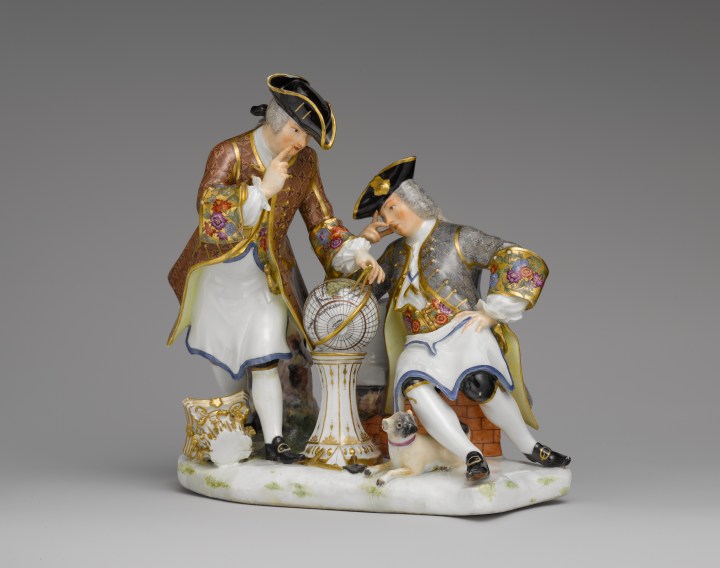
Two Freemasons, modelled by Johann Joachim Kändler, Meissen, ca. 1744; hard-paste porcelain, enamels, and gold; 23 × 24 × 15 cm
(New York: The Metropolitan Museum of Art, Gift of Irwin Untermeyer, 1964. 64.101.112)
◊ ◊ ◊ ◊ ◊
From the Call for Papers:
Reframing Eighteenth-Century European Ceramics
The French Porcelain Society Journal 9 (2022)
Proposals due by 1 February 2021; completed articles due by 1 September 2021
The French Porcelain Society Journal is the leading academic, peer-reviewed English-language publication on European ceramics and their histories, illustrated in full colour. Over recent years we have broadened our mandate to encompass all European ceramics from 1450 to 1950. Our next issue, volume IX, to be published in 2022, will concentrate on the eighteenth-century, which saw the discovery of ‘white gold’ (porcelain manufactured in Europe), embraced a widespread interest in the Age of Enlightenment, coupled with rising political upheavals and a consumer revolution for the luxury goods market. Yet what role did ceramics play within this? Can we rethink the traditional roles of the patron, the consumer, and the collector? What impact did the social construction of gender, race, and class have on ceramic production, design, markets, and use? Beyond their technological developments, how did ceramics reflect and respond to the significant artistic, cultural, social, economic, spiritual, and political matters of their time? This forthcoming issue of FPS Journal will challenge us to rethink accepted definitions by presenting works that demonstrate the tremendous variety of subjects and purposes of European ceramics. We are seeking articles that reframe our traditional perceptions, paying attention to materials and environments that re-evaluate conventional approaches to ceramic history, and welcome proposals that introduce historically under-represented objects or subjects. Articles are not restricted to French porcelain but may also include Spanish, Italian, Portuguese, Dutch, English, Scandinavian, German, and Austrian porcelain and earthenware.
Topics for consideration may include but are not limited to the following:
• Displaying ceramics in eighteenth-century and later interiors, exhibiting practices and architectural spaces
• Ceramics in eighteenth-century literature
• Socio-economic factors influencing eighteenth-century ceramic design or production
• Intersections between ceramics and the history of dining and food culture
• Recycling and repurposing eighteenth-century ceramics
• Collaboration and competition between factories
• Ceramics, politics and nationalism
• Patronage
• Ceramics, science and enlightenment
• Originality and invention in manufacture and design
• Eighteenth-century ceramics and visual culture
• Ceramic encounters between cultures through colonization, migration, trade, and war
• Eighteenth-century ceramics and the museum, acquisition, and display
• Ceramics and the art market
• Collecting ceramics in the eighteenth century
• Collecting eighteenth-century ceramics after 1800
Submissions in the first instance should be a summary of no more than 500 words, with a brief description of the argument, a historiography and a note of the research tools and sources used. Articles must be original; we do not accept modified versions of articles published elsewhere electronically or in print. Please include a brief biography. The journal accepts articles in French as well as in English. The volume will comprise about 15 articles that will be peer reviewed by the editorial board and the FPS council of academic and museum specialists which includes: Dame Rosalind Savill, DBE, FBA, FSA (Curator Emeritus, The Wallace Collection, London); Oliver Fairclough, FSA; John Whitehead, FSA; Errol Manners, FSA; Patricia Ferguson; Dr. Diana Davis; and Dr. Caroline McCaffrey-Howarth (Visiting Research Fellow University of Leeds and Curator, Victoria & Albert Museum). Articles should be between 4,000 and 8,000 words in length excluding endnotes. Up to 15 high-resolution images per article will be accepted.
Please send abstracts as an e-mail attachment to Patricia Ferguson, patricia.f.ferguson@gmail.com; Caroline McCaffrey-Howarth c.mccaffrey-howarth@leeds.ac.uk; and Diana Davis diana_davis@hotmail.co.uk by 1 February 2021. If your abstract is accepted, articles and images will be due by 1 September 2021. Publication is provisional on satisfactory peer review. For further details, please see the FPS website.
Call for Papers | On Portraiture
From ArtHist.net:
On Portraiture: Theory, Practice, and Fiction — From Francisco de Holanda to Susan Sontag
University of Lisbon, 26–28 April 2021
Proposals due by 30 November 2020
Centro de investigação e de estudos em belas-artes (CIEBA) – Artistic Studies Research Centre, Faculty of Fine Arts, University of Lisbon
This colloquium intends to discuss the theory and practice of artistic, historical, anthropological, social, and political experience on the topic of portraiture, as well as the fictional dimension contained within it. Located at the intersection of several disciplinary fields, the discussion(s) and papers will address the portrait as a concept, theme, process, object (monument and document), and device, in its multiple developments and in its successive conceptual, technological, and contextual updates. More than defining a temporal framework, the subtitle—From Francisco de Holanda to Susan Sontag —underscores the dynamic porosity on the researched topic in the fields of art and literature, as well as, in its mutual reversibility.
Francisco de Holanda, humanist and 16th-century Portuguese artist, is the author of Do Tirar pelo Natural [On Portraiture], the first treatise dedicated to portraiture in early modern Europe, which he concluded in 1549, in the decade following his return from a trip to Italy undertaken in 1538 to 1540, as member of the embassy of Ambassador D. Pedro de Mascarenhas. One objective for Holanda was to meet Michelangelo Buonarroti, in addition to observing and drawing fortresses and the most outstanding works of art across Italy. Upon his return, Holanda undertook writing Da Pintura Antiga [On Ancient Painting], concluded on October 13 (St. Lucas Day) 1548, as it is written at the end of Book II, followed by his second treatise, Do Tirar polo Natural [On Portraiture]. These two works were prepared for publication and were even translated into Spanish in 1563, by his friend, the Portuguese painter Manuel Denis. These treatises, written almost simultaneously, would only see publication, in Portuguese and Spanish, only in the 19th century. At the end of the Do Tirar polo Natural, Holanda states that the text was completed on January 3rd, 1549, only a few months after the completion of the two Books of Da Pintura Antiga. In fulfilment of John B. Bury’s ground-breaking research, a bilingual edition of this portrait treatise, published by Paul Holberton Publishing in London, will be presented during this Congress.
Indeed, the two great pillars of Francisco de Holanda’s theory of art—the imitation of himself, nature, and antiquity on one hand, and idea, on the other—have, precisely, as a point of departure, the artist’s creative process which Holanda discusses in his first two treatises. The importance of Do Tirar polo Natural for the theory of art, which Holanda explains and abundantly illustrates in his two books in On Ancient Painting, as well as in his drawings and illuminated albums, especially in As Antigualhas [On the Antique], makes Holanda’s need to write a portrait treatise fully justified. As an autonomous work, Do Tirar polo Natural complements Da Pintura Antiga. This treatise’s structure, in the form of dialogues, follows the model used in Book II of Diálogos em Roma [Dialogues in Rome], but here, instead of many interlocutors, is reduced to conversations between two protagonists, Brás Pereira and Feramando, the disciple and master, as well as the alter ego of Holanda. The themes and issues defined in Do Tirar polo Natural extend, deepen, and, above all, specify in detail questions regarding portraiture, themes related to the representation of the human figure which Holanda took up in Chapters 38 to 41 in Book I of Da Pintura Antiga. These chapters lack the decisive contributions, which throughout the eleven, small dialogues of Do Tirar polo Natural, Holanda describes as precepts for a painter to ‘portray’ or ‘paint from life’ the ‘persona’ of a sitter. In Do Tirar, Holanda distinguishes the portrait as distinctive from other representations of the human figure.
In The Volcano Lover, Susan Sontag begins with documentation related to three historical figures from the 18th century, expanding them into a fictional extension where they appear as characters or doubles; emerging as figures stabilized in the credibility of portraits, thus questioning their presence throughout the history of art and the history of images. These figures are the diplomat, collector, and volcanologist William Hamilton; his wife Emma Hamilton, lover of Admiral Nelson and the muse of the painter George Romney; and Admiral Nelson. The portraits directly refer to those of William Hamilton, made by Joshua Reynolds, and those of Emma Hamilton, made by George Romney and Élisabeth Vigée-Lebrun. The questions asked regard the genesis of the sensitive body, in the example of the statue of Condillac, and the metamorphosis of the statue in the myth of Pygmalion; the metamorphosis of beings in the morphological accidents of the earth and in natural objects that retain their name and history; the ideal portrait; the impossibility of describing the beauty of a face or a body, delegated to the rhetorical artifice of metaphor; the portrait as a theme and as a model; the genre of statues: action and stillness, narcissism and modesty; effigies: symbolic death; cameos: miniaturization of the portrait, living picture: representation staged inside a box or in a place surrounded by the frames of the paintings; the body in pose: support and object of the representation of a representation; the body as the embodiment of the work; the ephemerality of the body and the perpetuity of the portrait; the figure, the portrait and the recognition that erases or illuminates the name. And the ruin of it all, because ruin is the inevitable destiny of human bodies and their representations, some and others relegated to the future of our time.
In conjunction with these topics the main thematic lines of the colloquium are defined as:
• The portrait as a place and the place of the portrait in the visual culture of all periods
• Time and trans-temporality in and of the portrait
• The portrait as theory and the theories of the portrait
• The portrait as fiction
In the transversality of these lines, the following sub-themes are proposed:
The body and the portrait; Portrait: presence and representation; Portrait, self-portrait and self-representation; The expanded portrait: media, intermediary and mediation; Portrait: iconism, symbolism and similarity; Metonymic portrait; Portrait galleries; The portrait as a connotative place; The double and the portrait; The portrait and the mask; Portrait and genre: the collector and the collection; Portrait and gender: the artist and the model; Portrait: celebration and power; Portrait: celebration of anonymity; Portrait: show and monstrosity; The statistical portrait; Avatar: copy without original; The Impossible Portrait; The composite portrait; Portrait: the desecration of the body.
Keynote speakers will be selected according to the sessions formed from the submitted proposals and the thematic lines of this congress. The official languages are Portuguese, English, French, Italian, and Spanish.
All those interested in participating must send an abstract of up to 400 words, including title, name, affiliation, and text, along with a brief curriculum summary of 50 words maximum by 30 November 2020. Proposals should be submitted in doc. file from Office Word, according to the template available HERE and sent to onportraiture.congress@belasartes.ulisboa.pt. The email’s subject and the attached file should be designated as follows: NAME_SURNAME_TITLE OF PAPER. Results will be released by 31 December 2020.
Authors from selected papers are invited to participate in an optional pitch session (5 min/5 slides), which will take place on 15 January 2021 between 14.00 and 19.00 (in Lisbon).
Call for Papers | AAH 2021, Online (addendum)
Last week, a Call for Papers for AAH 2021 appeared here at Enfilade. I’m sorry that I failed to include the following session on Race and Representation in the French Colonial Empire; the posting has been updated, though I’m glad also to draw readers’ attention to the panel here. –CH
Association for Art History (AAH) Conference
Online (University of Birmingham), 4–17 April 2021
Proposals due by 2 November 2020
Race and Representation in the French Colonial Empire
Susannah Blair (Columbia University), seb2210@columbia.edu
Stephanie O’Rourke (University of St Andrews), so38@st-andrews.ac.uk
This session will consolidate new research on the visual culture of race in France and its colonies during the 18th century and into the 19th century. It will be oriented around two key terms, ‘representation’ and ‘possession’, and their many resonances—artistic, political, legal and relational. Papers will be invited to explore how art objects articulated, contested and disseminated changing notions of racial identity and citizenship in France and its global networks.
Over the past several years, scholars have examined the role of pictorial representation in shaping ideas of race, identity, indigeneity and slavery in the context of the British Empire. Bringing together new scholarship that builds upon these precedents, we aim to address a deliberately expansive geographical notion of French visual culture, one that includes the Caribbean, New France, North Africa, Canada and the Indian Ocean in addition to sites within the ‘metropole’ such as Paris and Nantes. Fostering a dialogue between art history, indigenous studies and critical race theory, our panel will provide a crucial scholarly platform for research that can inform pedagogy, curatorial practice and future scholarship.










leave a comment