Call for Papers | Valuing Sculpture
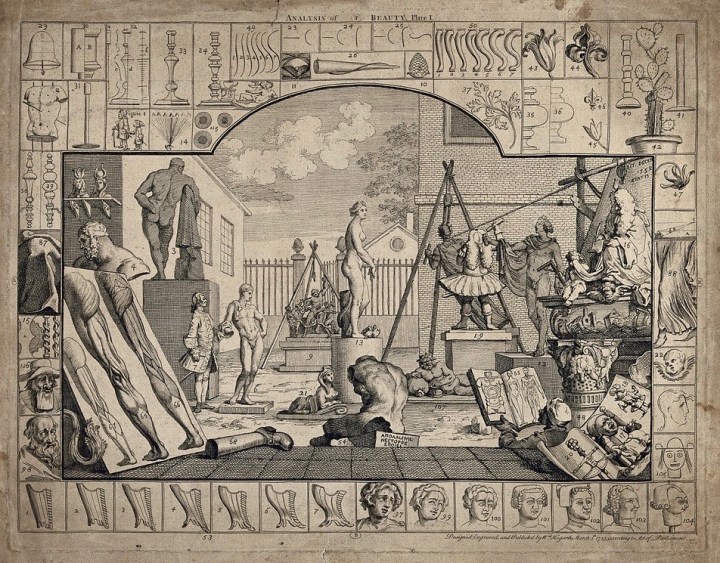
William Hogarth, A sculpture yard filled with copies of Greek and Roman sculptures, together with contemporary people and objects, 1753, engraving (London: Wellcome Collection).
◊ ◊ ◊ ◊ ◊
From the Henry Moore Foundation:
Valuing Sculpture: Contemporary Perspectives on Art, Craft, and Industry, 1660–1860
Online, Henry Moore Institute, Leeds, 27–28 July 2021
Proposals due by 7 May 2021
Keynote Speakers
Dr Greg Sullivan (University of York/ St. Paul’s Cathedral)
Dr Rebecca Wade (Independent)
The indeterminate position of sculpture within the arts is a malleable concept which continues to challenge researchers. Categorisations such as art, craft, or industry contrive barriers, separating works from one another and disavowing the cross-fertilisations between sculptors, makers, and artisans involved in the formal practices and aesthetics of art production. The conference Valuing Sculpture: Contemporary Perspectives on Art, Craft and Industry, 1660–1860, held as part of the Henry Moore Institute’s 2021 Fabrication Research Season, will refocus attention on how links have been consistently made between media and making processes to categorise and subsequently value sculpture.
How and why has sculpture been continually explored and defined as part of art, craft, and industry? Are these classifications still useful for discussing a medium that reaches across so many medial and dimensional boundaries, and what might be excluded or lost through such categorisations? How might we more fully address the processes of collaboration and exchange between sculptors and makers involved in sculptural production?
We invite proposals to foster an interdisciplinary dialogue between researchers and sculpture practitioners, considering how value judgements of sculpture were formed in the period 1660–1860 and their impact on the development of modern sculptural practices. We are viewing sculpture in its widest definition and across a broad geography and history. As such, we particularly welcome proposals about less widely studied media, such as bone, textile, and plasterwork.
Possible topics could include but are not limited to:
• Individual vs collaborative making processes
• Relationships between sculptors, artisans, manufacturers, and fabricators
• Commercialisation of manufacture
• Perceived vs actual value of materials
• Hierarchies of subject matter in sculpture
• Value of sculpture as determined by context
• Aesthetic vs commercial value of functional objects
• Definitions of decorative vs fine arts
The conference is organised by Sammi Scott and Charlotte Davis (University of York), Caitlin Scott (University of Sheffield), and Hannah Kaspar (University of Leeds) in collaboration with the Henry Moore Institute. Sessions will be held online over two consecutive afternoons.
The conference is open to researchers and sculpture practitioners from all backgrounds and will be a supportive environment for postgraduate students and early career researchers. Abstracts should be no more than 300 words and need to be accompanied by a brief biographical note. If you have prior recordings of other papers that you have presented online, then please also include links in your email. Please send your abstract and biography in an email with the subject heading ‘Valuing Sculpture’ to research@henry-moore.org by Friday, 7 May 2021.
Call for Papers | Painted Ceilings in Europe
From ArtHist.net (where the French version is available). . .
Painted Ceilings in Europe, 14th–21st Centuries: Forms, Functions, Fictions
Plafonds Peints en Europe, XIVe–XXIe Siècles: Formes, Fonctions, Fictions
Deutsches Forum für Kunstgeschichte (DFK), Paris, 2–3 December 2021
Proposals due by 31 May 2021
Organisé par le Centre allemand d’histoire de l’art-DFK (Paris), la Ludwig Maximilian Universität (Munich) et l’université de Bourgogne (LIR3S, CNRS, UMR 7366)
Emerging in the Middle Ages and then becoming in the Early Modern period one of the most important spaces for the development of painting, interior decoration, and representations of power, painted ceilings have represented prestigious artworks to this day, implementing its own poetics and symbolism.
From the beams of medieval castles to the ceilings of town halls, through the vaults of Baroque galleries and the domes of churches and theaters, ceiling painting constitutes a parallel history to that of the easel painting. Although the period from the 16th to the 19th century represents a privileged moment of the painted ceiling, its origins in medieval times (Bourrin Bernardi, 2009 ; Fern, 2016) and its more recent developments (Bianchi, 2016) deserve to be also considered, due to various identical problematics.
This critical object of art history has experienced a recent resurgence of interest from researchers in both the medieval and modern and contemporary periods, as evidenced by the creation of an international association for research on medieval framework structures and painted ceilings (RCPPM), investigations outreach to sites outside Europe (Raggi, 2017 ; Bailey, 2018), and the ceiling commission from Cy Twombly for the Louvre in 2010. While the research field has been consequently broadened geographically and chronologically, it has also included new problematics, beyond the representation of power (Milovanovic, 2005). The current survey takes more into consideration the site’s specificity through the eye of a mobile spectator (Alpers, Baxandall, 1994); illusionism beyond classical and baroque, as an effective rhetoric (Scott, 1991); and the issue of propaganda and artistic identity (Oy-Marra, 2016). Recent research has favored monographic approaches in the different countries of Europe (see selective bibliography): it is now relevant to situate these studies within a European horizon.
This conference will examine both case studies and general reflections, taking advantage of recent research contributions from a cross-history perspective. Four lines of thought (which may be intertwined in the papers) are envisioned:
1. Challenges of the painted ceiling: what to expect from a painted ceiling?
2. Powers of the image: how does a large decor work?
3. Decoration temporalities: appropriations, retrospective views, re-uses and misappropriations, historiographies.
4. Digital and research: contributions of new visualization and reconstruction techniques
To submit a paper (which will be limited to 20 minutes), please send an abstract no more than 500-word long in English, French, German, or Italian, along with a short 100-word biography, before May 31, 2021, to plafondspeintsfff@gmail.com. The conference will be held in Paris, with the presence of the participants, or as a virtual event, pending future sanitary measures. It is planned to allow much time to discussions and to organize sites’ visits.
Organizing Committee: Olivier Bonfait (Université de Bourgogne, Dijon, LIR3S), Matteo Burioni (Corpus « Deckenmalerei », Ludwig Maximilian Universität, Munich), Bénédicte Gady (musée des Arts décoratifs, Paris), Thomas Kirchner (Deutsches Forum für Kunstgeschichte-Centre allemand d’histoire de l’art, Paris), Matthieu Lett (Université de Bourgogne, Dijon, LIR3S)
Call for Papers | Work, Rest, and Power
From the Call for Papers:
Work, Rest, and Power: Architecture, Space, and Political Life, 1500–1815
Online Workshop Hosted by the Humanities Research Centre at the University of York, 27 May 2021
Proposals due by 12 April 2021
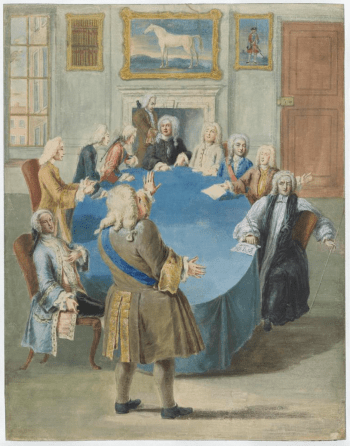
Joseph Goupy, Sir Robert Walpole Addressing the Cabinet, 1723–42, drawing, 36 × 29 cm (London: The British Museum, 1920,0214.4).
This workshop explores the role of the home in politics and political life, taking a broad view to explore the lived space of political figures, materiality, and the role of women and the household. The workshop will commence with a keynote paper from Dr Manolo Guerci, University of Kent, before leading into a series of panel discussions and optional thematic breakout sessions for those who wish to continue the discussion.
Interested scholars are invited to submit abstracts of no more than 250 words by 12 April 2021. We are seeking abstracts that relate to the home as a political space, broadly conceived, in any place or time period within the early modern era. We welcome submissions from all scholars, but particularly encourage postgraduate and early career researchers.
Topics may include, but are by no means limited to:
• Definitions: what makes a home political?
• Homes of political figures or homes located in political institutions
• Political sociability
• Materiality, art, architecture, and archaeology
• The household: wives, family, and servants
• Uses of space: orientation, gendered space, public and private
• Town and country houses
• Social history of the home: class, economics, and ritual
Please submit abstracts and any questions via email to the organisers Kirsty Wright (kmw532@york.ac.uk) or Murray Tremellen (mat550@york.ac.uk). For further information, please see our website.
Call for Papers | Buying Art and Antiquities in Eighteenth-Century Italy
From the Call for Papers, which also includes the Spanish version:
Buying Art and Antiquities in Eighteenth-Century Italy
La compra de arte y antigüedades en la Italia del siglo XVIII
Online and/or Universidad Nacional de Educación a Distancia (UNED), Madrid, 4–5 November 2021
Proposals due by 31 May 2021

Jean-François Sablet, In the Antiquities Shop, Rome, 1788 (Private Collection)
The third meeting of the international conference series Transnational Relations and the Arts will address the issue of art and antiquities markets in eighteenth century. With the Grand Tour at its peak, men from all over Europe and beyond flooded into the cities of Italy, mainly Rome but also Naples, Venice, and Florence. These grand tourists fed an already flourishing art market and were also active agents of the spread of ancient marbles and vases, Old Master paintings, ancient coins, and medals back to their homelands, not to mention the diffusion of an international ‘buon gusto’ among the middling and upper classes.
We are interested in proposals that address any aspect related to this phenomenon. Especially welcome are cross-disciplinary contributions, proposals that deal with different cases studies in a comparative way, or studies focused in a city/country, as well as discussions around a particular period acquired at that period.
Topics may include, but are not limited to:
• Commercial hubs
• Agents: merchants, clients, antiquarians, dealers, etc.
• Logistics of buying art in the eighteenth century
• Forgeries and fakes of antiquities
• Copies of Old Masters for profit
• Classical art collections in the eighteenth-century (from the individual object to the whole collection)
Scientific coordination
Pilar Diez del Corral Corredoira (Eighteenth Century), diezdelcorral@geo.uned.es
David Ojeda Nogales (Classical Antiquity), dojeda@geo.uned.es
Please submit your proposal and an abbreviated CV to both organizers by 31 May 2021. And do not hesitate to write with any questions you have related to your proposal; we will be happy to discuss the details with you. Depending upon health conditions, the conference may take place online, but we will try our best to host it in Madrid. In the event that the conference will proceed online, we will assist with any technical support you may need in order to give the paper as easily as possible. There are plans for publishing the outcomes as a volume of selected papers in a prestigious print and the contributions will go through a peer-review system.
Call for Papers | The Sources of Colour: The Gobelins Dyeing Workshop
From ArtHist.net:
The Sources of Colour: The Gobelins Dyeing Workshop
Institut national d’histoire de l’art (INHA), Paris, 7–8 Octotber 2021
Proposal due by 12 March 2021
The National Institute of Art History (Institut National d’Histoire d’Art, INHA), in conjunction with the Archives Nationales and the Mobilier National, will be holding two study days specifically devoted to the Gobelins dyeing workshop.
Jehan Gobelin, a dyer from Reims, set up a workshop in the mid-fifteenth century not far from the Bièvre River, whose water was particularly suitable for dyeing purposes. His descendants, who were experts in the dyeing of wool in Venice scarlet, soon acquired vast stretches of land that ran alongside the Bièvre and constructed large workshops. Henri IV rented them and had tapestry workshops installed on the sites. In 1662, Colbert acquired the property for the Crown, and he brought together and placed the various workshops under the direction of Charles Le Brun. To reorganise the dyeing workshop, Le Brun solicited the help of a Dutch master dyer, Josse Kerchove. Since this time, the Gobelins dyeing workshop, which is the oldest European workshop of its kind that has been operating continuously since its foundation, has remained in the same place inside the Gobelins enclosure, to the north of the chapel.
This rich diachronic and multidisciplinary history is the topic of these study days, the first ever devoted to the Gobelins dyeing workshop, in its long history. Based on unprecedented sources or sources seen from a fresh perspective, these study days aims to focus on the latest knowledge concerning the dyeing workshop. Using new research findings and sources compiled since 2015 by the teams working at the Mobilier National and made available to researchers, various themes will be addressed during these study days:
• The role of the dyeing workshop in the evolution of regulatory texts relating to the métier of dyer, from Colbert’s reorganisation to the beginning of the twentieth century
• The contributions made by the successive directors of the dyeing workshop; generally speaking, all prosopographical research into the staff working in the dyeing workshop is welcome
• The contributions made by industrial chemistry to all of the fabric preparatory and dyeing processes
• The school of dyeing founded at the beginning of the nineteenth century by the Gobelins and the courses held by Chevreul, which were replaced by instruction in dyeing in Paris, throughout the nineteenth century (similar training was provided by Payen and Persoz at the Centre National des Arts et Métiers (CNAM), and in the 1830s in Lyon, Mulhouse, and Rouen)
• The status of national laboratory of expertise acquired by the dyeing workshop in the nineteenth century, initially during the First Empire in relation to the manufacture of Lyon silks, and subsequently in the context of the development of the dyeing industries in the colonies (madder and cochineal in Algeria; indigo in Senegal), and more generally in the Western world
For each of these themes, information about other dyeing workshops or other international experiences involving the transmission of knowledge and dyeing techniques is very welcome, from a comparative viewpoint. Likewise, the participation of researchers conducting studies into the history of the sciences, history, literature, textile design, and colour, or in the conservation sciences is particularly welcome.
The conference will be held both online and face-to-face, requiring particular care with regard to the way in which the discussions are conducted. We will ask participants to focus on their statements very precisely for fifteen minutes to optimise the discussion times. Participants may communicate in French or in English. Contributions (2,000 characters), accompanied by a short biography/bibliography, must be sent before 12 March 2021 to marie-anne.sarda@inha.fr and alexia.raimondo@culture.gouv.fr.
Sources on the Gobelins dyeing workshop
(More detailed information about the collection may be obtained from the members of the scientific and study day organisation committee)
• The Archives Nationales, the Pierrefitte-sur-Seine site:
Sub-series AF/IV (the Secretariat of State)
Sub-series F/12 (commerce and industry), here and here
Sub-series F/21 (fine arts)
Sub-series O/2, O/3, O/4, and O/5 (the Maison de l’Empereur or Maison du Roi)
• The Mobilier National, Paris (online search tools)
• Several digital sources are currently being published online
• The Bibliothèque Centrale du Muséum National d’Histoire Naturelle, Paris (online Calames union catalogue)
An inventory of the Eugène Chevreul collection is currently being compiled, so any requests for information or requests to view the archives must be sent to patrimoinedbd@mnhn.fr.
• The Manuscript Department of the Bibliothèque Nationale de France (online catalogue)
Scientific and organisational committee
Muriel Barbier (the Mobilier National)
Anne-Laure Carré (the Conservatoire National des Arts et Métiers, CNAM)
Hélène Cavalié (the Mobilier National)
Claude Coupry (the Centre National de la Recherche Scientifique, CNRS)
Joëlle Garcia (the Muséum National d’Histoire Naturelle)
Clémence Lescuyer (the Archives Nationales)
Alexia Raimondo (the Archives Nationales)
Charlotte Ribeyrol (Paris-Sorbonne University)
Marie-Anne Sarda (Institut National d’Histoire d’Art, INHA)
Call for Papers | Figures of Widows

Jean-Baptiste Greuze, The Widow Receiving Her Priest Surrounded by Her Children , 1784, oil on canvas, 50 × 63 inches
(Saint Petersburg: Hermitage Museum)
◊ ◊ ◊ ◊ ◊
The Call for Papers for this GRHAM Study Day, via ArtHist.net, where the French version is also available:
Widows in the 17th and 18th Centuries: Images of Social Status—Accepted, Hidden, Claimed?
Figures de veuves à l’époque moderne (XVIIe et XVIIIe siècles): Images d’un statut social accepté, caché, revendiqué?
INHA (Institut National d’Histoire de l’Art), Galerie Colbert, Paris, 15 June 2021
Proposals due by 15 March 2021
Woman and widow under the Ancien Régime? The images defining a woman abound, should they describe a seductive woman, an influential or a common one. However, the images that could characterize the widow remain vague. As a matter of fact, the widow is defined essentially in negative terms; a widow is ‘the one who has lost her husband’ [1]. The social status imposed by widowhood is considered less favorable than that of a married woman, the Dictionnaire de Trévoux specifying that ‘a widow mourns her husband, not so much for her loss, but mostly because she is deprived of the rank she held and the consideration she benefited from’ [2]. This could lead her to condemnable behaviors: ‘The widow often subtracts and conceals her husband’s most beautiful furniture’ [3]. Opposite to this unattractive vision, however, widowhood seems then to offer to women a freedom that neither daughters nor wives experienced [4].
Several images arise from this contrasting portrait. The first one to appear is the widow seen through a state policy point of view such as Marie de Medici as Regent by Frans Pourbus (1613), Anne of Austria in Mourning Clothes with her Children by Philippe de Champaigne (1643) or Marie-Antoinette in the Conciergerie Prison by Alexandre Kucharski (1793). These portraits evoke in turn the woman in position of power, the patron, the arts and letters’ amateur, but also the grieving, lonely, old and fallen woman.
The widow can be portrayed in many other ways. Like Madame Godefroid, Keeper of the King’s Paintings by Jean Valade (1755), she could hold a position by succession to her late husband. She could also be the spokesperson for various passions highlighted by bourgeois drama: the sadness of Greuze’s Inconsolable Widow (1762), the melancholy of Reynolds’s Countess of Lincoln (1781), or the moral probity of Greuze’s Widow Receiving her Priest Surrounded by her Children (1782). These different aspects of widowhood revealed by the artists enable to question all the statutory references that define the widow: her mourning clothes, her attributes such as the faithful dog and her psychological characteristics which give great importance to sentimentality. The absence of some of these visual codes allows to question other widow figures for the young widow rarely remains inconsolable, as La Fontaine’s fable reminds us [5]. Under Choderlos de Laclos’ pen, the Marquise de Merteuil became even a manipulative libertine, taking full advantage of the financial autonomy and independence of mind that the widowhood offered her.
This brief panorama would be incomplete without mentioning the widow in religious paintings such as The Raising of the Son of the Widow of Naim, The Raising of Lazarus, or Agrippina Landing at Brindisi with the Ashes of Germanicus. The image of the widow is also endowed with a strong allegorical power that makes her one of the first figures in war memorials, such as the Monument for the Heart of Victor Thérèse Charpentier, Count of Ennery (1777–81).
This study day aims to question the identity of these widows—famous or unknown—in order to better understand their intellectual, political, and social influence, by finding out whether their widowhood proved to be an asset or a weakness. How did the image of the widowed woman develop during the 17th and 18th centuries? And how did it deal with the particular 18th-century rising value shaped by Rousseau’s representation of a woman as a mother dedicated to both her home and the education of her children?
This study day proposes several topics in order to better define and understand the image of the widow in the arts, not only in France but also in Europe:
• The image of the widow through her various portraits, emphasizing her political, economic, intellectual, and moral power. Were such portraits reserved only for influential women or for those who had famous husbands? Or, could they also depict women belonging to different social classes?
• The representation of the widow in history and genre painting: is she the main figure in these paintings or secondary one? In these paintings, which psychological characteristics are most often solicited? Do these descriptions reflect a widow’s specific identity?
• The destination of the image of the widow in the arts of the Ancien Régime. Are these representations kept within family confines or are they disseminated in a wider environment? If so, which are the reasons behind?
• Beyond the specific matter of representation, particular attention will be paid to widows who are also artists as well as artists’ widows. What is their place in society? What role do they play in the preservation of their husband’s artistic heritage?
• Finally, considering also the material culture, do external signs of mourning worn by widows—clothes and accessories—act as a testimony of constant imposed codes or, conversely, bear witness of an evolution, not only in fashion, but also in the way in which widows are represented?
We welcome proposals in French or English, of about 500 words, for papers addressing either broader analyses or specific case studies. Candidates are invited to attach a curriculum vitae. Submission and contact: asso.grham@gmail.com.
This study day is organized by GRHAM with the support of the Doctoral School of Art History of the University Paris 1 Panthéon-Sorbonne (ED 441) and the HiCSA (EA 4100).
[1] Antoine FURETIÈRE, Dictionnaire universel contenant généralement tous les mots françois tant vieux que modernes, & les Termes des Sciences & des Arts (La Haye, Rotterdam, Arnoud & Reinier Leers, 1701), III, See «Veuf, Veuve».
[2] Dictionnaire universel François et latin, vulgairement appelé Dictionnaire de Trévoux (Paris, Delaune, 1743), VI, See «Veuf, Veuve».
[3] FURETIÈRE, Dictionnaire, op. cit., See ‘Soustraire’.
[4] Françoise FORTUNET, «Veuves de guerre à l’époque révolutionnaire», PELLEGRIN, Nicole, WINN, Colette H. (dir.), Veufs, veuves et veuvage dans la France d’Ancien Régime (Paris, Champion, 2004), 138–39: ‘It has long been noted that widowhood was the most favorable status that a woman could have had in our old society, for it gave her a freedom ignored by daughters and wives. In theory it was known, but living examples are stronger proof’ (translated from French).
[5] Jean de LA FONTAINE, Fables choisies mises en vers (Lyon, Sarrazin, 1696, 1668), 140, CXXIV: «La perte d’un époux ne va point sans soupirs//On fait beaucoup de bruit, et puis on se console».
Call for Paper by GRHAM (Research Group in Modern art History) / Appel diffusé par les membres du bureau du GRHAM (Groupe de Recherche en Histoire de l’Art Moderne):
• Florence Fesneau (Université Paris 1 Panthéon-Sorbonne)
• Barbara Jouves-Hann (Université Paris 1 Panthéon-Sorbonne/ENS Paris-Saclay)
• Maxime Georges Métraux (Université Paris-Sorbonne)
• Alice Ottazzi (Université Franche-Comté)
• Marine Roberton (Université Paris 1 Panthéon-Sorbonne)
• Maël Tauziède-Espariat (Université de Bourgogne)
• Marianne Volle (Université Paris 1 Panthéon-Sorbonne et York University)
Call for Papers | The Helvetic Republic and France
The 2022 meeting of the Swiss Society for the Study of the Eighteenth Century addresses relations between the Helvetic Republic and France. From the Call for Papers, via ISECS:
Le Corps helvétique et la France, 1660–1792: Transferts, asymétries, et interdépendances entre des partenaires inégaux
Colloque de la Société Suisse pour l’Étude du XVIIIe Siècle (SSEDS)
Château de Waldegg, Feldbrunnen-St. Niklaus (canton de Soleure), Switzerland, 28–30 April 2022
Proposals due by 31 March 2021
Organized by Simona Boscani-Leoni, Claire Gantet, André Holenstein, Timothée Léchot, Bérangère Poulain
Si le Corps helvétique et le royaume de France n’acquirent que dans la seconde moitié du XVIIe siècle une longue frontière commune, les relations politiques, diplomatiques et économiques entre les deux pays inégaux étaient déjà très étroites depuis le début du XVIe siècle. La Paix perpétuelle (1516) et l’alliance régulièrement renouvelée de 1521 à 1777 entre les cantons et le roi de France constituèrent l’épine dorsale des relations extérieures du Corps helvétique jusqu’en 1792. Rien ne manifeste mieux l’éminent intérêt du Roi très chrétien à des relations étroites avec le Corps helvétique que la présence d’un ambassadeur permanent de la France à Soleure (à partir de 1530). L’affirmation de la France en tant que grande puissance continentale sous Louis XIV attisa une discussion de plus en plus controversée sur les relations asymétriques entre ces partenaires inégaux. Tandis que les clients de la France saluaient Louis XIV comme un protecteur bénéfique de la liberté et de l’unité confédérées, le parti antifrançais dans les Cantons helvétiques percevait dans la politique offensive d’expansion (conquête de la Franche Comté en 1668/1674 et de Strasbourg en 1681) et dans la persécution des huguenots un danger imminent pour la Confédération. Contre les intérêts des entrepreneurs de guerre, des pensionnaires et des négociants tournés vers la France, il voulait contrebalancer la forte dépendance envers la France du Corps helvétique en le rapprochant de l’Empire, de l’espace néerlandais et de l’Angleterre. Ces tensions atteignirent un apogée en 1715 lorsque le roi — à l’encontre d’une politique qui traditionnellement visait l’accord entre les partis confessionnels — ne renouvela son alliance qu’avec les cantons catholiques. En 1777 seulement, la diplomatie française parvint à inciter l’ensemble des cantons divisés à renouveler leur alliance avec le roi, en tant que leur « plus vieil ami et allié » — une alliance qui fut unilatéralement résiliée par la France républicaine révolutionnaire en 1792.
Proximité et distance, dépendance et retrait : ces traits ne caractérisèrent pas seulement les relations politiques et diplomatiques du Corps helvétique et de la France. Ils caractérisèrent aussi les arts, la littérature, l’architecture et les pratiques culturelles, jusqu’à la mode et la consommation. D’un côté, la France exerça une grande influence sur le Corps helvétique en tant que grande puissance politique mais aussi modèle culturel, comme en témoignent la langue, la littérature, les modes de vie, l’architecture et les intérieurs des élites sociales. De l’autre, la puissance politique et culturelle du voisin provoqua des réactions de défense jusque dans ces domaines. Elles se manifestèrent dans la critique de l’artificialité, de la superficialité et de la frivolité «des Français», et dans l’éloge du «bon sens» anglais (Beat Ludwig von Muralt), dans la stylisation de la simplicité et du naturel républicains en tant que contre-modèles culturels à l’affectation de la société de cour, dans le déploiement d’une littérature suisse francophone distincte qui s’émancipait de la poésie classique française, ou dans une critique de ton de plus en plus national développée par des partisans des Lumières réformatrices à l’encontre du mode de vie aulique cosmopolite des patriciens confédérés, laquelle s’exprima notamment dans le rejet des voyages à l’étranger des jeunes patriciens et dans la revendication d’institutions éducatives en Suisse.
Le colloque veut éclairer les relations franco-suisses au XVIIIe siècle compte tenu de ces tensions entre proximité et distance, admiration et rejet, dépendance et émancipation. En élargissant les notions avancées dans la recherche récente de transferts culturels (Michel Espagne, Michael Werner) et de tropisme (Wolfgang Adam, Jean Mondot) — qui analysent les relations franco-allemandes dans une perspective avant tout littéraire et culturelle —, le colloque, conformément à la vocation interdisciplinaire de la Société Suisse pour l’étude du XVIIIe siècle, envisage tant pour sa conception que pour sa thématique le spectre entier des relations franco-suisses dans le siècle et demi qui s’écoula jusqu’à la Révolution française. Il sonde les dynamiques, conjonctures et crises des relations et perceptions réciproques des deux voisins. Cette interrogation ouvre la voie à quantité de thèmes : l’entreprise de guerre et les services étrangers ; les relations diplomatiques ; les relations commerciales et la contrebande ; les mouvements migratoires ; les appropriations, transferts et les critiques des modèles culturels dans les domaines de l’art, de l’architecture, de la littérature, de la consommation et de la mode ; les contacts et relations entre les lettrés ; le vécu et les perceptions des voyageurs ; la formation et les perceptions de la frontière commune ; la constructions d’images de soi et de l’autre notamment.
Les communications individuelles seront limitées à 25 minutes, les communications collectives à 40 minutes. Les projets de communications rédigés en français ou en allemand, ou en anglais (avec un maximum de 300 mots) peuvent être adressés jusqu’au 31 mars 2021 à Claire Gantet (claire.gantet@unifr.ch) ou André Holenstein (andre.holenstein@hist.unibe.ch). Le comité scientifique du colloque se prononcera jusqu’au 30 juin 2021.
Call for Papers | Reproductive Prints in the 18th and 19th Centuries
From the Call for Papers:
La Storie dell’Arte Illustrata e la Stampa di Traduzione, 18 e 19 Secolo
(Online, via MS Teams) Università di Chieti Gabriele d’Annunzio, Chieti, 10–11 June 2021
Proposals due by 25 January 2021 (for papers in Italian or English)
“E per le Arti poi l’incisione è quel che la stampa è per le scienze”
–Francesco Milizia, Dizionario di Belle Arti del Disegno (Bassano: Giuseppe Remondini, 1797)
La Cattedra di Storia della Critica d’arte del Dipartimento di Lettere Arti e Scienze Sociali, Università degli Studi “G. d’Annunzio” di Chieti – Pescara terrà una giornata di studi dedicata alla stampa di traduzione e storia dell’arte. Se gli studi sugli artisti incisori e lo sviluppo di un mercato di stampe europeo vivace e ben delineato hanno visto un crescente interesse negli ultimi anni per i secoli XVII– XVIII e XIX, l’indagine rimane ancora aperta per la stampa di traduzione utilizzata a corredo della storiografia artistica di quei secoli.
 Partendo dall’affermazione dell’incisione di traduzione a contorno semplice nel Dizionario di Belle Arti del Disegno di Francesco Milizia (1797), la giornata di studi si propone di presentare nuove ricerche sull’utilizzo delle incisioni e delle stampe per lo studio della storia dell’arte, esplorando le tematiche seguenti pur non limitandosi solo ad esse, anzi auspicandone un ampliamento sia in termini geografici che cronologici:
• singoli contributi su artisti, disegnatori e incisori
• singoli contributi su album o raccolte di stampe ed incisioni
• il mercato delle stampe di traduzione e dei libri d’arte illustrati: stamperie, librai, mercanti e collezionisti
• stampa di traduzione e studio dell’arte: trattati, cataloghi, recueils, quotidiani a stampa, riviste d’arte, descrizioni, letteratura periegetica illustrata
• illustrare per promuovere: i cataloghi di vendita delle collezioni
• nascita e sviluppo delle monografie d’artista illustrate
• stampa di traduzione per la storia della letteratura
Le proposte di partecipazione alla giornata di studi dovranno pervenire all’indirizzo valentina.fraticelli@unich.it in forma di abstract (350–500 parole, con titolo e parole chiave), ed essere accompagnate da CV e affiliazione accademica o breve profilo biografico (300 parole) entro il 25/01/2021. Le giornate di studio si svolgeranno sulla piattaforma Microsoft Teams; gli interventi selezionati, di cui è prevista la pubblicazione, avranno una durata di circa 20-30 minuti e verranno presentati online. Lingue: italiano, inglese. Per ulteriori informazioni contattare la dott.ssa Valentina Fraticelli all’indirizzo email valentina.fraticelli@unich.it.
Comitato scientifico: Ilaria Miarelli Mariani, Valentina Fraticelli, Tiziano Casola, Vanda Lisanti
Segreteria organizzativa: Laura Palombaro
Call for Papers | BU Graduate Symposium, Crowd Control
From Boston University:
Crowd Control
The 37th Annual Boston University Graduate Symposium in the History of Art & Architecture
(Online) 23–24 April 2021
Proposals due by 15 December 2020
Crowd control—as both an idea and an act—raises questions about agency, authority, and influence. From ancient Rome to Boston City Hall, state-sponsored architecture has policed the body and shaped the ideal of a citizen.Yet subtler forces such as painting, prints, and photographs also exert powerful influence. The events of this past year have heightened our awareness of both the power of the people and the contours of the systems which surround them. We have seen the wide array of structures that seek to order, pacify, neutralize, inspire, repress, or control the collective. The 37th Annual Boston University Graduate Symposium in the History of Art & Architecture invites submissions examining images, objects, and structures that engage with the regulation and redirection of peoples and their social behaviors.
Possible subjects include, but are not limited to, the following: architecture, urbanism, and the organization of private and public spaces; monuments, memory, and civic structures; masquerade, carnival, and festivals; ceremonies and processions; exhibitions and viewing conditions; pilgrimage and religious institutions; protest, policing, the carceral system, and surveillance; population control, eugenics, urban growth and decline; collective and mass culture; conquest, colonialism, coloniality, xenophobia; caste, race, and social hierarchies.
We welcome submissions from graduate students at all stages of study, from any area of study. Papers must be original and previously unpublished. Please send an abstract (300 words or fewer), a paper title, and a CV to bugraduatesymposiumhaa@gmail.com. The deadline for submissions is December 15, 2020. Selected speakers will be notified by early February. Papers should be 15 minutes in length and will be followed by a question and answer session. The symposium will be held virtually on Friday, 23 April, and Saturday, 24 April 2021, with a keynote lecture by Dr. Paul Farber, Director of Monument Lab and Senior Research Scholar at the Center for Public Art & Space at the University of Pennsylvania Weitzman School of Design.
This event is generously sponsored by the Boston University Center for the Humanities; the Boston University Department of History of Art & Architecture; and the Boston University Graduate Student History of Art & Architecture Association.
Call for Papers | Art and Nature
From ArtHist.net:
Art and Nature: 6th Conference for Doctoral and Post-Doctoral Students in Humanities and Social Sciences
Online / Center for Iconographic Studes, Rijeka, 8 October 2021
Proposals due by 15 May 2021
This conference will address how the natural world has been presented, reflected or interacted by visual artists through centuries. Papers from PhD students and recent PhD graduates will debate on various topics from the pragmatic view of the natural world, existed simply to serve society, through the idea of natural phenomena, animals, plants etc. as allegories and symbols utilized to draw morality tales or aesthetic principles, which were viewed with as much importance as scientific information, to nature as a source of inspiration for new ideas and movements reflected in the fields of arts. Specific focus is put on the modern technologies and media, as well as the artists’ addressing social and political issues relating to the natural environment.
Topics of the conference include, but are not limited to:
• Art as mirror of nature: interpretation of nature in various historical periods, artistic contexts and individual artistic opuses
• Art and nature: allegoric and symbolic representations, illustrations in the books of nature (botanical and zoological studies), flora and fauna in emblems, design and applied arts;
• Art and natural context: landscape painting, Animalists, Wanderers Art Movement, Land Art, Earth Art, Environmental Art
• Art and new technologies: biotechnological arts (BioArt), Genetic art, Evolutionary art, ethical problems considering using modern technologies and bio materials in art etc.
• Art and contemporary aspects and dilemmas: climate changes, environmental problems, ecological awareness represented through visual arts (EcoArt, Crop art, Sustainable art)
Proposals should be sent to phd.conference2020.lj@gmail.com by 15 May 2021 and should include an abstract of maximum 400 words and a short CV. More information is available here.










leave a comment