Call for Papers | Décoration intérieure et plaisir des sens
From the Call for Papers:
Décoration intérieure et plaisir des sens, 1700–1850
University of Geneva, 28–29 May 2020
Proposals due by 13 January 2020
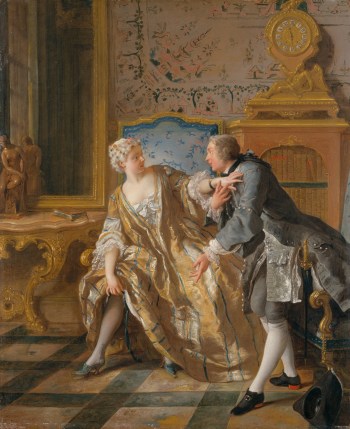
Jean-François de Troy, La jarretière détachée (The Garter), 1724, oil on canvas, 65 × 54 cm (New York: The Metropolitan Museum of Art, Jayne Wrightsman Collection).
Dans la lignée des travaux de Goubert (Du Luxe au confort, 1988), de Crowley (The Invention of Comfort, 2001) et de DeJean (The Age of Comfort, 2009), ce colloque souhaite revenir sur la part que tenait le plaisir sensoriel dans l’organisation des espaces intérieurs en Europe entre 1700 et 1850. Plusieurs traités d’architecture du XVIIIe siècle tels que celui de Boffrand (1745) ou plus tard de Le Camus de Mézières (1780) mettent l’accent sur l’importance des sens dans la disposition et la décoration des pièces. Ces textes soulignent que certains arrangements, pour reprendre le terme de l’époque, doivent créer une impression de plaisir et de bien-être sur ses usagers. Cette idée d’un décor qui éveille les différents organes de perception du corps humain dans le but de produire un effet sur le spectateur s’inscrit dans une approche sensualiste de l’architecture. Cette préoccupation est alors désignée par de nombreux auteurs sous les termes d’« agrément » et de « commodité » qui permettent d’exprimer, avant qu’il n’apparaisse au début du XIXe siècle, le concept de confort [1].
[1] Joan DeJean, The Age of Comfort: When Paris Discovered Casual and the Modern Home Began (New York, Bloomsbury, 2009).
Nous proposons de privilégier trois grands axes de réflexion, qui n’épuisent évidemment pas le champ des possibles:
I. DE LA THÉORIE A LA PRATIQUE
Le premier axe est consacré à la place de l’agrément et du confort dans les ouvrages théoriques et à l’impact de ceux-ci dans la production de décors. Il s’agira ainsi de déterminer la part accordée aux sens et au corps non seulement dans les traités d’architecture, mais aussi les textes destinés aux artistes décorateurs, comme le livre d’André Jacob Roubo (L’Art du menuisier en meubles, 4 vols, 1769–75), et, plus incidemment, dans les recueils de modèles (Jean-Charles Delafosse (Nouvelle Iconologie historique, 1768). L’intérêt porté aux sensations dans ces ouvrages peut être pensé (/envisagé) en regard de la philosophie sensualiste (Condillac, Traité des sensations, 1754) mais aussi de la littérature libertine du siècle des Lumières (La Petite Maison de Bastide, 1763).
Nous interrogerons les fondements idéologiques de cette préoccupation nouvelle pour le corps, mais aussi le reflet de cet intérêt dans le développement d’un langage spécifique et dans l’apparition de nouveaux termes désignant des biens mobiliers. L’éventuel impact de cette nouvelle exigence sur la créativité des artisans, sur les innovations techniques et formelles, sera également questionné.
II. NORMES ET USAGES
Le deuxième axe de réflexion propose d’interroger la notion d’agrément à l’aune des normes sociales et de l’usage des différentes pièces de l’habitat. Dans l’historiographie plus ou moins récente, l’idée de confort est régulièrement associée aux lieux dits de l’« intime » qui apparaissent simultanément à l’art de la distribution (petits appartements, boudoirs, salles des bains, etc.). Il sera intéressant de se demander si l’opposition entre les espaces d’apparat et ceux plus privés, dédiés au confort et au bien-être des individus, est pertinente pour appréhender les meubles et objets composant les décors produits entre l’Ancien Régime et la Monarchie de juillet. Quels mécanismes sociaux, économiques ou culturels ont pu favoriser un nouvel idéal consistant à rechercher des sensations agréables dans les intérieurs ? Dans quelles mesures (et quand ?) le confort du quotidien devient-il un marqueur social permettant d’affirmer son rang ? Comment penser les rapports entre le confort et le luxe ? Et enfin peut-on observer des changements dans l’étiquette de cour en lien avec la notion de confort ?
III. MATÉRIALITÉ ET RESTAURATION
Le troisième axe est orienté sur des questions matérielles. Il conviendra alors d’étudier l’importance du confort dans l’évolution des formes données au mobilier. Nous prendrons aussi en compte les questions économiques relatives aux matériaux utilisés. Les essences de bois et de tissus exotiques importés des nouvelles colonies, comme l’ébène, le coton ou la soie, attisent les curiosités et jouissent d’un grand intérêt en raison de leurs caractéristiques agréables.
Une grande importance sera également donnée aux questions de transformation et de réemploi des objets. Il s’agira notamment de considérer la place du confort dans l’histoire de l’adaptation et la mise au goût du jour d’intérieurs existants. Ceux-ci connaissent, au cours de leur existence, de nombreuses restaurations et modifications visant à leur conserver une certaine modernité et utilité. Quelle place tient le confort dans l’adaptation de formes anciennes aux évolutions de la mode ?
Des questions relatives aux restaurations du XXe siècle pourront également être abordées. Le constat montre qu’en dépit des principes déontologiques de la conservation restauration des biens culturels prônant les valeurs de lisibilité de l’œuvre, de visibilité et de réversibilité de traitement, la restauration du mobilier a toujours eu cette particularité de présenter une dualité entre exigences déontologiques et remise en état de présentation et d’utilisation. Dans quelle mesure, la restauration n’est-elle pas un acte de création, lorsqu’il s’agit d’une intervention fondamentale ? Lorsque l’objet a été modifié postérieurement à sa création, faut-il revenir à son état originel ?
Modalités pratiques
Le colloque durera une journée et demie et sera conclu par une visite guidée. Les communications, d’une durée de 30 minutes, pourront être prononcées en français ou en anglais. Elles seront suivies de minutes d’échanges avec le public. Elles devront s’efforcer, dans la mesure du possible, de soulever des questions afin de susciter la discussion.
Les propositions sont attendues pour le 13 janvier 2020 au plus tard. Elles devront être composées d’un titre, d’un résumé ne dépassant pas 300 mots à l’adresse email decoration.et.plaisir@gmail.com. Elles devront être accompagnées d’un CV, ainsi que, pour les doctorants, de l’intitulé de la thèse et des noms du ou des directeur(s) de recherche. Une réponse sera adressée aux participants au plus tard le 15 février 2020.
Colloque organisé par
• Noémi Duperron, Université de Genève
• Maxime Georges Métraux, Université Paris-Sorbonne et Galerie Hubert Duchemin
• Barbara Jouves, Université Paris 1 Panthéon-Sorbonne
• Marc-André Paulin, Université Lille 3 et Centre de Recherche et de Restauration des Musées de France
• Bérangère Poulain, Université de Genève
Call for Papers | Le parfumeur
From ArtHist.net, with the extended CFP available here:
Le parfumeur: The Evolution of a Figure since the Renaissance
Palace of Versailles Research Centre, 28–29 January 2021
Organized by Alice Camus and Érika Wicky
Proposals due by 15 June 2020
This conference will explore the history of the professional perfumer, analyzing how the image of the perfumer emerged during the Renaissance in Italy, how it was further constructed during the seventeenth century in France and England, and how it continued to evolve to the present day. Under the Ancien Régime, when trade in most European countries was regulated by corporations and states, the assertion of the perfumer’s identity was often undermined by a legal struggle to become the sole holder of the right to manufacture and sell perfume products. Since its recognition, this profession has undergone metamorphoses evident in the way they affected each of three operations that have defined the perfumer throughout history: creating, manufacturing and selling perfumes (Gobet and Le Gall, 2011). Indeed, perfumers have had to adapt to changing trends in fragrance use and to distinguish themselves from their competitors at different times in their history by manufacturing and marketing not only scented waters, but also other perfumed products such as gloves, the creation of which was their first vocation, then sachets, cosmetics, hair powders, soaps, and even more recently, scented candles. The evolution of the use of perfumes, sometimes prophylactic, hygienic or hedonistic, also affected perfumers, who in turn allied themselves with other areas of activity, collaborating with apothecaries, hairdressers and chemists, followed by artists and fashion designers.
The conference will offer a multidisciplinary approach to the history of perfumers, their profession, their social status and their representations, through the presentations of specialists from diverse backgrounds: historians, art historians, literary scholars, philosophers, perfumers and professional in the contemporary world of perfumery. The multidisciplinary approach will provide a detailed and nuanced vision of the figure of the perfumer at different moments in his historical evolution by drawing on a wide range of historical, literary and artistic sources (professional documents, legal documents, inventories, etc.). This conference also seeks to highlight the links between the exercise of the profession of perfumer and the socio-cultural environment of his or her time.
Proposals for papers, in French or in English, of about 3000 characters, should be sent to Alice Camus (acamus@guerlain.fr) and Érika Wicky (erika.wicky@univ-lyon2.fr), before June 15, 2020. They must be accompanied by a short bio-bibliography. A more detailed CFP, a french version of it, and more information can be found here.
Scientific comitee: Eugénie Briot (Givaudan), Natacha Coquery (Université Lumière Lyon 2 / LARHRA), Chantal Jaquet (Université Paris 1 Panthéon-Sorbonne), Cheryl Krueger (University of Virginia), Catherine Lanoë (Université d’Orléans), Rosine Lheureux (Archives départementales du Val-de-Marne), Jean-Alexandre Perras (Voltaire Foundation).
Call for Essays | Studi Neoclassici
From ArtHist.net:
Studi Neoclassici: Rivista internazionale 8 (2020)
Submissions due by 31 March 2020
 The journal Studi Neoclassici, created with the aim of publishing the results of the activity promoted by the ‘Istituto di ricerca per gli studi su Canova e il Neoclassicismo’ (‘Research Institute for Studies on Canova and Neoclassicism’) of Bassano del Grappa, has been a tool for disseminating research of the Edizione Naionale delle Opere di Antonio Canova (National edition of the works of Antonio Canova), that converge in the critical editions of the enormous Canova’s epistolary, with the historical, biographical, stylistic insights that matter requires. The major scholars of Neoclassicism constitute the scientific and editorial council of the journal.
The magazine proposes itself to the attention of scholars in various fields of research, from history to literature, from archeology to art history, from the history of culture to art criticism to the history of collecting, from the history of music to that of dance and costume.
Journal articles follow the same methodological approach that characterized the “Canovian Weeks”, i.e. the formula of connecting different artistic and cultural experiences, from literature to art history, to history and to other arts included in the historical period between second half of the eighteenth and the first decades of the twentieth century, with the intention of proposing a complete and not only specialized picture of the theme.
Studi Neoclassici publishes monographic numbers and free topic numbers relating to the historical period of the journal, the texts of which, selected through a ‘Call for papers’ procedure, are all—except for rare and justified exceptions—subject to peer review by a ‘double blind’ peer review procedure. In the case of exceptions it is the management, in its collegiality, that after careful examination assumes the responsibility of accepting the texts.
The number 8, 2020 will host free articles and one or two reviews of volumes relating to the period covered by the magazine. The editorial rules are available here. Texts can be presented in Italian, German, French, English, or Spanish; must not exceed 35,000 characters (spaces and notes included); and must be sent by 31 March 2020 to giuliana.ericani@gmail.com or gianpavese@gmail.com.
Call for Papers | Interpreting Italians Abroad
From ArtHist.net:
Interpreting Italians Abroad: The Migration of Ticinese Architects in the Early Modern Era
Erlangen, 24–25 April 2020
Proposals due by 10 January 2020
From at least the thirteenth to the nineteenth centuries, architects—including painter and sculptor-architects—from Ticino and northern Lombardy migrated and worked in great numbers across Europe. Their movements extended from the Iberian Peninsula to Russia, and they were also active throughout Italy itself. These architects moved in extended family networks, often bringing whole teams of masons and other artists on their journeys abroad, and many returned to their home valleys each winter. Despite the prevalence of these migrations throughout Europe and the high number of artists and architects involved, there has not yet been a comprehensive study of their movements, their effect on the regions in which they worked, or the influence of these different environments on the Ticinese themselves. The absence of such a study is particularly acute for the sixteenth and seventeenth centuries as it has long been assumed that the Ticinese and Lombards were key agents in the development of Renaissance architecture in other regions of Europe.
The earliest attempts to quantify this migration consisted mainly of lists of architects and where they worked and were often colored by a nationalistic interpretation of their role in European art history (most notably their inclusion in the series from the 1930s, L’opera del genio italiano all’estro). Later studies (such as those by Crivelli, 1966–1971) turned away from such overtly politically motivated interpretations, but still failed to address key questions why such migration was desirable from the point of view of either the artists or their patrons, what exactly was their effect on the regions in which they worked, and how they related to local architects and craftsmen.
Contemporary studies have consisted mainly of focused case studies of individual architects or families working in a specific region but have tended to isolate these figures from their local environments. Although Ticinese architects worked in great numbers throughout Italy itself, specific studies of their activities have been comparatively limited, with a focus mainly on Genoa. Other studies address outstanding figures such as Carlo Maderno, Francesco Borromini, and Domenico and Carlo Fontana, whose fame has seemingly allowed them to transcend their Ticinese origins.
This workshop proposes to address the totality of the phenomena of Ticinese artistic migration across Europe in light of recent developments in migration studies, network studies, center-and-periphery studies, and studies of cultural and stylistic transfer. Both finished papers and works-in-progress are welcome.
Some themes that might be addressed include:
• What affect did Ticinese architects have on their environments? How were they changed by their new surroundings?
• What relationship did the migratory architects have to local colleagues and professional bodies such as guilds?
• Why were the Ticinese desirable as architects and workers?
• How were their professional networks structured and how did they function? Can professional connections beyond extended family networks be identified?
• What facilitated their movement in some regions (Central Europe, Spain and Portugal, Italy) more than others (France, England, the Netherlands)?
• What role did the Ticinese architects play in the development of Renaissance forms in architecture across Europe? Can this influence be evaluated against other sources of knowledge such as prints and books or travel to Italy itself by patrons and foreign architects?
• How does ‘influence’ or ‘stylistic transfer’ actually work in a given environment? What individuals or cultural factors are at play in this process?
• How can the idea of the Ticinese as agents of the Italian Renaissance be reconciled with the fact of their stylistically plural work (for example their work in Gothic or Netherlandish styles)?
The workshop will take place at the Institute of Art History in Erlangen, Germany on 24–25 April 2020. Please send an abstract in either English or Italian (max. 300 words) and a short CV to Sarah W. Lynch (sarah.lynch@fau.de) by 10 January 2020.
Call for Papers | Queer Crossings, Unruly Locales, 1500–1800
From the Call for Papers:
Queer Crossings, Unruly Locales, 1500–1800
University of California, Santa Barbara, 28–29 February 2020
Proposals due by 5 December 2019
The Early Modern Center at the University of California, Santa Barbara invites proposals for our annual conference Queer Crossings, Unruly Locales, 1500–1800, to be held on February 28 and 29, 2020. We are happy to announce our two keynote speakers: Melissa E. Sanchez (University of Pennsylvania) and Rajani Sudan (Southern Methodist University).
Queer Crossings, Unruly Locales, 1500–1800 will explore the intersection between queer studies and the study of mobilities, crossings, and networks, both local and global, in early modern England and around the world. We invite conversations that address and interrogate the concept of ‘queer crossings’ and ‘unruly locales’ broadly construed. We seek to answer questions such as: What constitutes a crossing? What does it mean to read locales as unruly? What power dynamics reveal themselves in weighing queer crossings and unruly locales? How do travel narratives reveal and abound with queerness in terms of identity, time, relations, and other perspectives? Who or what has the privilege of crossing, queerness, or unruly-ness?
Possible topics include, but are not limited to:
• The global early modern
• Borderlands
• Gender, sexuality, trans, and queer studies in the global early modern
• Queer philology
• Migration and migratory studies
• Crossings of genre
• Critical race studies
• Global mobility and crossings
• Travel narratives/narratives of exploration
• Critical food studies; ‘fusion’ as crossing/queer
• Translation and mediation
• Currency, capital, and trade across early modern periods/borders
• Connected histories
• Queering the archive
We invite abstracts of 150 to 200 words and a one-page CV to be sent to emcfellow@gmail.com by November 20, 2019. We envision and invite both twenty-minute panel presentations and ten-minute roundtable presentations; we will also consider complete panel or roundtable proposals. If you have further questions, please feel free to contact the conference organizer, Giorgina Paiella, at emcfellow@gmail.com.
Call for Papers | Boston University Graduate Symposium — Environment
From Boston University:
Environment: Awareness, Exchange, and Impact
36th Annual Boston University Graduate Symposium in the History of Art & Architecture
Museum of Fine Arts, Boston, 28 March 2020
Coordinated by Bailey Benson and Rebecca Arnheim
Proposals due by 6 December 2019
Conversations about the environment are a prominent and contentious aspect of life in the 21st century, but the environment has always been an omnipresent force. Serving both as a stage for human performance and as an active agent in shaping human actions, the environment permeates the consciousness and creative output of artists and architects, as well as influencing interactions with their works. The topic of ‘the Environment’ serves as a nexus for discussions surrounding the natural, the man-made, the built, and the social, among others.
The 36th Annual Boston University Graduate Symposium in the History of Art & Architecture invites submissions that consider the theme of ‘the Environment’. How have interactions with, and interpretations of, natural and man-made environments informed artistic and architectural work? How do various locations, identities, and political climates impact the production of art and architecture?
Possible subjects include, but are not limited to, the following: landscape painting; architectural responses to the environment; garden design and landscaping; responses to climate change and sustainability; expressions of real or imagined spaces; ceremonial and spiritual engagement; land use and reclamation as it relates to artistic practice; environmental activism and justice; political interventions and implications; the gendering of environment; and climate disasters, displacement, and the anthropocene. We welcome submissions from graduate students at all stages of study, and from any area of study.
Papers must be original and previously unpublished. Please send an abstract (300 words or fewer), a paper title, and a CV to bugraduatesymposiumhaa@gmail.com. The deadline for submissions is Friday, December 6, 2019. Selected speakers will be notified by December 20, 2019, and are expected to accept or decline the offer within a week of notification. Papers should be 20 minutes in length and will be followed by a question and answer session. The Symposium will be held Saturday, March 28, 2020, with a keynote lecture Dr. Christopher Heuer, and graduate presentations in the Trustees Room of the Museum of Fine Arts, Boston.
This event is generously sponsored by the Boston University Center for the Humanities; the Boston University Department of History of Art & Architecture; the Museum of Fine Arts, Boston; and the Boston University Graduate Student History of Art & Architecture Association. Additional information is available here.
Call for Papers | Unleashing the Senses in the Art of the Americas
From ArtHist.net:
Touch, Taste, Turn: Unleashing the Senses in the Art of the Americas
Fifth Annual Symposium of Latin American Art
Institute of Fine Arts, New York University, 2–4 April 2020
Proposals due by 13 January 2020
The Institute of Fine Arts at New York University, The Graduate Center at the City University of New York, Columbia University in the City of New York, and the Institute for Studies on Latin American Art (ISLAA) are pleased to announce the Fifth Annual Symposium of Latin American Art. Touch, Taste, Turn: Unleashing the Senses in the Art of the Americas will be held in New York on April 2, 3 and 4, 2020. The symposium will include keynote lectures by María Magdalena Campos-Pons and Claire Tancons, and a methodological workshop for the panelists led by Constance Classen.
Cultural and artistic practices that engage with multiple senses (e.g. sight, smell, hearing, taste, touch, and beyond) have a long history in the Americas. Indigenous civilizations and Afro-diasporic communities have developed artifacts and practices that promote forms of knowledge grounded in presence, materiality, and sensorial perception. Examples include Andean quipus or knotted cords used to communicate information, Haitian Vodun visual and ritualistic practices summoning sensorial and spiritual energies, and seventeenth-century Tupinambá ceremonial feather capes. These legacies continue to inspire artists today, such as Cecilia Vicuña, who produces environments that evoke quipus; María Magdalena Campos-Pons, whose mixed-media works incorporate bodily interventions and soundscapes; and Guadalupe Maravilla, whose performances explore movement and the experience of migration.
With these precedents in mind, this year’s iteration of the symposium will bring together interdisciplinary and cross-temporal scholarship focusing on objects and practices by makers and artists in the Americas that engage in multisensorial experiences. By placing an emphasis on multiple senses and their interrelation, the event will draw upon and expand on the ‘sensory turn’, an approach more commonly associated with disciplines such as anthropology, history, and cultural studies since the late 1980s. Unleashing the senses poses important challenges to art history, a discipline founded on the privileging of sight, by underscoring the role of multiple senses in the creation of meaning.
Our event will recall previous undertakings by art historians and critics in the Americas who have embraced the sensorial to analyze or theorize Latin American, Caribbean, and Latinx art. Examples range from Brazilian poet Ferreira Gullar’s 1959 Manifesto Neo-Concreto to Nuyorican artist Raphael Montañez Ortiz’s multimedia pedagogical projects in the 1970s, as well as the 1981 “Primer Coloquio Latinoamericano de Arte No Objetual y de Arte Urbano” in Medellín. Anticipating the ‘sensory turn’, these efforts brought attention to practices previously undervalued in art history such as vernacular music and culture, self-taught arts and crafts, and performance.
Inspired by the rich and diverse artistic and historiographical production of the Americas, this event revolves around questions such as: What does a multisensorial approach bring to the understanding of Latin American, Caribbean, and Latinx art? Conversely, what does the production of those regions bring to the understanding of multisensorialism? What strategies can artists and scholars adopt to complicate the sense of sight? How are sensorial experiences conditioned by social, cultural, and historical variables, and how can they help us understand those variables? How does a multisensorial model put pressure on art history? How can museums and cultural institutions promote experiences that go beyond visuality? Possible themes include but are not limited to:
• Immersive, participatory, and multisensorial installations (including soundscapes, haptic media, and techniques, olfactory and edible artworks, etc.)
• Artistic engagements with kinesthesia and synesthesia
• Motion, performance, and physicality
• The relation between multisensoriality and intermedial practices
• Landscape, the built environment, and the senses
• Artistic and cultural deployment of psychotropics
• Technology’s potential for sensorial expansion
• Challenges to the hierarchization of the senses
• The politics of sensorial repression or negation
• Archival practices that transcend visual documentation
• Spiritual knowledges, magical thinking, and ritualistic practices
• Art engaging bodily pleasure and desire
• Accessibility issues in curatorial and pedagogical strategies
• The ‘sensory turn’, interdisciplinary methodologies, and art history
Current graduate students, recent graduates, and emerging scholars are invited to apply, especially those based in Latin America and the Caribbean. Topics from all historical periods of Latin American / Latinx / Chicanx / and Caribbean art (e.g. pre-Columbian, Colonial, Modern, Contemporary), as well as fields outside the realm of art history, but grounded in visual material (e.g. Cinema and Media Studies, Latin American and Latinx studies, Visual Culture) are highly encouraged. Abstracts will be accepted in English, Spanish, and Portuguese.
To apply, please submit an abstract of up to 300 words to symposium@islaa.org by Monday, January 13, 2020. Applicants will be notified of their acceptance by Monday, February 3, 2020. Presentations will be limited to 20 minutes, with additional time for discussion. In your application, please indicate your current institutional affiliation and from where you will be traveling, as well as the languages you speak. Limited funding may be available to assist with travel expenses.
This symposium is generously funded by the Institute for Studies on Latin American Art (ISLAA), the Rewald Endowment of the Graduate Center’s Ph.D. Program in Art History, and the Department of Latin American and Iberian Cultures and the Institute for Latin American Studies at Columbia University. It is coordinated by Professors Edward J. Sullivan, Helen Gould Sheppard Professor in the History of Art at the Institute of Fine Arts; Anna Indych-López, Professor of 20th-Century Latin American and Latinx Art at the Graduate Center; Katherine Manthorne, Professor of Art of the United States, Latin America, and their Cross-Currents, 1750–1950 at the Graduate Center; Lisa Trever, Lisa and Bernard Selz Associate Professor in Pre-Columbian Art History and Archaeology; Alexander Alberro,Virginia Bloedel Wright ’51 Professor of Art History, Barnard; and Kellie E. Jones, Professor. The symposium is organized by current PhD candidates Horacio Ramos and Francesca Ferrari and PhD students Juan Gabriel Ramírez Bolivar, Gwen Unger, Julián Sánchez González, and Tie Jojima.
For further information or with any questions, please contact symposium@islaa.org.
Call for Papers | Veiling the Body
From ArtHist.net:
Veiling the Body: Cloth, Skin, Membrane, Paper
The John Rylands Research Institute, University of Manchester, 11–12 June 2020
Proposals due by 20 January 2020
The word ‘veil’ most commonly connotes a piece of cloth worn on the body not primarily for warmth or protection, but as a symbol, usually of modesty or withdrawing from a public realm. In many cultures, veils have held a contradictory status of concealing the (most often female) body and of heightening the significance of exposure. In Europe, the word ‘veil’ and its cognates have also variously connoted: human skin and bodily membranes; draperies and curtains in religious and secular spaces; relics; and the separations between material and spiritual realms. In all contexts, the word points to secrecy and hiddenness, inflected with the potential for exposure and display.
Veiling the Body will bring together these themes in a cross-disciplinary workshop to explore the themes of secrecy and exposure, as well as the interrelations between the skin and membranes of our bodies, the cloths that cover them, and the materials with which we represent both. We welcome proposals on themes including, but not limited to:
• Religious veils and relics
• Anatomical and medical images of unveiling
• Spiritual or ethereal veils
• The resonances between skin and cloth
• Clothing, veiling and exposure of the body
• Images that veil, or work in unique ways to represent veils
• The material culture of veils, skin and membranes
With this workshop, we aim to make connections across disciplines, time periods and locations. We invite proposals for 20-minute papers from scholars across the arts and humanities, museum staff, and artists working on the themes of veils and bodies from any place and time. Proposals of no more than 250 words, along with a short bio, should be sent to veilingthebody2020@gmail.com by 20th January 2020. Travel and accommodation will be provided for speakers, and conference fee waivers will be available for attendees who do not have research budgets.
In addition to conference-style paper sessions, the workshop will include collections encounters with historic and contemporary material. The workshop will be held in the Historic Reading Room of the John Rylands Library in Manchester.
Call for Papers | Color Charts
From ArtHist.net:
Color Charts as Trading Zones between Science and Art, 1500–1800
9th International Conference of the European Society for the History of Science
Bologna, 31 August — 3 September 2020
Proposals due by 5 December 2019
This is a call for abstracts for a symposium proposal to be submitted to the 9th International Conference of the European Society for the History of Science (ESHS) that will be held in 2020 in Bologna.
The seminal role played by color in the progress of science, technology, industry, and commerce during the early modern period and enlightenment has never been thoroughly analyzed from a broad perspective. Today we tend to compartmentalize the historical investigation of color science, artisanal technology, and commercial endeavors as separate fields. However, historically, coloring substances represent a clear-cut intersection between these three worlds. The opening of communication channels between artisanal and academic worlds has been defined by Pamela O. Long as a “trading zone” (Long 2011). From the early modern period, the growing interest of natural philosophers in the processes of manufacturing pigments and dyestuffs and the ability to control their use with systematic and scientific approaches were fundamental factors in the technological and commercial advancements that are usually associated with the period. The tacit color knowledge of artisans was gradually traded to the sciences and popularized in dictionaries, encyclopedias, and academic journals.
Besides the publication of color recipes and mixing instructions as handbooks, this specific trading zone allowed the production of (colored) visual tools, like color charts, painting palettes, sample cards and pattern books, relating to color technology, color teaching, and color selling. These visual tools have been generally regarded as painters’ instruments and teaching aids for amateur painters, and only in few recent studies linked to the sciences (Lowengard 2006; Kuehni and Schwarz 2008; Bushart and Steinle 2015; Karliczek and Schwarz 2016). We propose a symposium which will focus on intersectional aspects of trading color-related information and knowledge, from chemistry through commerce to art, with a specific focus on color charts.
We invite historians of science and from other disciplines to submit cross-disciplinary papers discussing topics like:
• Color charts and raw materials relating to botany, zoology, mineralogy, pharmacy
• Color charts and experimenting and developing colors for dyeing, porcelain, enamel, watercolors, oil painting, glass manufacturing
• Color charts and scientific illustrations (cartography, petrography, zoology, botany, mineralogy)
• Color charts and color selling (color samplers, color cakes, color cases, color price and relating fraud)
• Color charts and teaching (paintings, printing, dyeing)
Please send your abstracts (300 words) with a cv (150 words) to Giulia Simonini (giulia.simonini@tu-berlin.de) by December 5, 2019.
Cited Literature
• Pamela O. Long, Artisan/Practitioners and the Rise of the New Sciences, 1400–1600 (Corvallis, 2011).
• Sarah Lowengard, The Creation of Color in Eighteenth-Century Europe (Gutenberg-e, 2006).
• Rolf G. Kuehni and Andreas Schwarz, Color Ordered: A Survey of Color Order Systems from Antiquity to the Present (New York, 2008).
• Magdalena Bushart and Friedrich Steinle, eds., Colour Histories: Science, Art, and Technology in the 17th and 18th Centuries (De Gruyter, 2015).
Call for Papers | Paintings, Peepshows, and Porcupines
From the Call for Papers:
Paintings, Peepshows, and Porcupines: Exhibitions in London, 1775–1851
The Huntington Library, Art Museum, and Botanical Gardens, San Marino, California, 17–18 September 2021
Organized by Jordan Bear and Catherine Roach
Proposals due by 1 April 2020
In 1820, the Romantic painter Théodore Géricault sent his now-famous image of a shipwreck, The Raft of the Medusa, by boat to London. There, it was shown at Bullock’s Egyptian Hall, a display space that also featured attractions as varied as live reindeer and Napoleon’s carriage, captured at Waterloo. This well-known episode was not an aberration or a Romantic eccentricity; it was, quite simply, business as usual. In many nineteenth-century cities, exhibiting outside of official art venues was not uncommon, nor was it necessarily an act of rebellion. Recent scholarship has challenged preconceptions about audience and cultural hierarchy in relation to Géricault’s Raft, but we are only beginning to understand the role of artworks within a broader culture of display.
This conference will assemble an international group of distinguished scholars to rethink some of our fundamental assumptions about exhibitions in the eighteenth and nineteenth centuries. It will focus on London as the center of an exhibitionary culture and as a hub of empire. It will consider a vibrant period of this culture, roughly from the opening in 1775 of the Leverian Museum, or Holophusikon, brimming with artifacts from Captain Cook’s voyages, to the staging in 1851 of the Great Exhibition, which inaugurated a new age of international shows.
The protagonist of many of the most influential art historical studies of recent decades has been the figure of the spectator, who has brought with her a revitalized engagement with the surprisingly varied modes of the reception of works of art. And while the foregrounding of the experience of the spectator, or ‘beholder’, or ‘observer’, has broadened the compass of the discipline considerably, we still hold a relatively orthodox view of the kinds of venues, events, and display practices that are deemed worthy of inquiry. Even as art historians have valorized the expressive possibilities of alternative exhibition spaces so central to avant-garde identity, the appearance of paintings in the precincts of commercial entertainment has, for many years, been consigned to a position of marginal curiosity in the history of art. Exhibition-makers are often characterized as either renegades or hucksters—as if aesthetically daring artists were not part of the market, or as if commercial displays could not contain works of aesthetic or cultural merit. Both the sheen of avant-garde rebellion and the tarnish of lucre continue to color approaches to eighteenth- and nineteenth-century displays.
Even the most adventurous of recent studies have not fully accounted for the most singular feature of the display of these works of art in the first decades of the century: their embeddedness in an exhibitionary landscape consisting of the richest imaginable array of artifacts, environments, and living creatures. Imperialist expansion and the need to justify it brought an increasingly wide range of objects to European urban centers. Moreover, these diverse displays were consumed in concert. They were part of a round of seasonal entertainments that might include viewing oil paintings in the morning and taxidermy in the afternoon—or viewing examples of both at a single venue. To recapture this context, talks given at this event will consider relationships among venues or trace the circulation of objects and visitors among multiple sites of display.
Speakers will include
• Ann Bermingham (University of California, Santa Barbara)
• Rosie Dias (University of Warwick)
• Meredith Gamer (Columbia University)
• Mark Hallett (Paul Mellon Centre for Studies in British Art)
• John Plunkett (University of Exeter)
We are now seeking additional speakers to join this roster. Early career scholars and scholars from underrepresented groups are especially encouraged to apply. We anticipate that papers will be 35–40 minutes in length, and will be presented to the Huntington’s larger scholarly community. The generous support of the Huntington’s Research Department will cover economy airfare, hotel accommodation, and incidental transport expenses for speakers. To apply, please send an abstract of 250 words and a CV to huntingtonconference2021@gmail.com by 1 April 2020.










leave a comment