Call for Papers | Veiling the Body
From ArtHist.net:
Veiling the Body: Cloth, Skin, Membrane, Paper
The John Rylands Research Institute, University of Manchester, 11–12 June 2020
Proposals due by 20 January 2020
The word ‘veil’ most commonly connotes a piece of cloth worn on the body not primarily for warmth or protection, but as a symbol, usually of modesty or withdrawing from a public realm. In many cultures, veils have held a contradictory status of concealing the (most often female) body and of heightening the significance of exposure. In Europe, the word ‘veil’ and its cognates have also variously connoted: human skin and bodily membranes; draperies and curtains in religious and secular spaces; relics; and the separations between material and spiritual realms. In all contexts, the word points to secrecy and hiddenness, inflected with the potential for exposure and display.
Veiling the Body will bring together these themes in a cross-disciplinary workshop to explore the themes of secrecy and exposure, as well as the interrelations between the skin and membranes of our bodies, the cloths that cover them, and the materials with which we represent both. We welcome proposals on themes including, but not limited to:
• Religious veils and relics
• Anatomical and medical images of unveiling
• Spiritual or ethereal veils
• The resonances between skin and cloth
• Clothing, veiling and exposure of the body
• Images that veil, or work in unique ways to represent veils
• The material culture of veils, skin and membranes
With this workshop, we aim to make connections across disciplines, time periods and locations. We invite proposals for 20-minute papers from scholars across the arts and humanities, museum staff, and artists working on the themes of veils and bodies from any place and time. Proposals of no more than 250 words, along with a short bio, should be sent to veilingthebody2020@gmail.com by 20th January 2020. Travel and accommodation will be provided for speakers, and conference fee waivers will be available for attendees who do not have research budgets.
In addition to conference-style paper sessions, the workshop will include collections encounters with historic and contemporary material. The workshop will be held in the Historic Reading Room of the John Rylands Library in Manchester.
Call for Papers | Color Charts
From ArtHist.net:
Color Charts as Trading Zones between Science and Art, 1500–1800
9th International Conference of the European Society for the History of Science
Bologna, 31 August — 3 September 2020
Proposals due by 5 December 2019
This is a call for abstracts for a symposium proposal to be submitted to the 9th International Conference of the European Society for the History of Science (ESHS) that will be held in 2020 in Bologna.
The seminal role played by color in the progress of science, technology, industry, and commerce during the early modern period and enlightenment has never been thoroughly analyzed from a broad perspective. Today we tend to compartmentalize the historical investigation of color science, artisanal technology, and commercial endeavors as separate fields. However, historically, coloring substances represent a clear-cut intersection between these three worlds. The opening of communication channels between artisanal and academic worlds has been defined by Pamela O. Long as a “trading zone” (Long 2011). From the early modern period, the growing interest of natural philosophers in the processes of manufacturing pigments and dyestuffs and the ability to control their use with systematic and scientific approaches were fundamental factors in the technological and commercial advancements that are usually associated with the period. The tacit color knowledge of artisans was gradually traded to the sciences and popularized in dictionaries, encyclopedias, and academic journals.
Besides the publication of color recipes and mixing instructions as handbooks, this specific trading zone allowed the production of (colored) visual tools, like color charts, painting palettes, sample cards and pattern books, relating to color technology, color teaching, and color selling. These visual tools have been generally regarded as painters’ instruments and teaching aids for amateur painters, and only in few recent studies linked to the sciences (Lowengard 2006; Kuehni and Schwarz 2008; Bushart and Steinle 2015; Karliczek and Schwarz 2016). We propose a symposium which will focus on intersectional aspects of trading color-related information and knowledge, from chemistry through commerce to art, with a specific focus on color charts.
We invite historians of science and from other disciplines to submit cross-disciplinary papers discussing topics like:
• Color charts and raw materials relating to botany, zoology, mineralogy, pharmacy
• Color charts and experimenting and developing colors for dyeing, porcelain, enamel, watercolors, oil painting, glass manufacturing
• Color charts and scientific illustrations (cartography, petrography, zoology, botany, mineralogy)
• Color charts and color selling (color samplers, color cakes, color cases, color price and relating fraud)
• Color charts and teaching (paintings, printing, dyeing)
Please send your abstracts (300 words) with a cv (150 words) to Giulia Simonini (giulia.simonini@tu-berlin.de) by December 5, 2019.
Cited Literature
• Pamela O. Long, Artisan/Practitioners and the Rise of the New Sciences, 1400–1600 (Corvallis, 2011).
• Sarah Lowengard, The Creation of Color in Eighteenth-Century Europe (Gutenberg-e, 2006).
• Rolf G. Kuehni and Andreas Schwarz, Color Ordered: A Survey of Color Order Systems from Antiquity to the Present (New York, 2008).
• Magdalena Bushart and Friedrich Steinle, eds., Colour Histories: Science, Art, and Technology in the 17th and 18th Centuries (De Gruyter, 2015).
Call for Papers | Paintings, Peepshows, and Porcupines
From the Call for Papers:
Paintings, Peepshows, and Porcupines: Exhibitions in London, 1775–1851
The Huntington Library, Art Museum, and Botanical Gardens, San Marino, California, 17–18 September 2021
Organized by Jordan Bear and Catherine Roach
Proposals due by 1 April 2020
In 1820, the Romantic painter Théodore Géricault sent his now-famous image of a shipwreck, The Raft of the Medusa, by boat to London. There, it was shown at Bullock’s Egyptian Hall, a display space that also featured attractions as varied as live reindeer and Napoleon’s carriage, captured at Waterloo. This well-known episode was not an aberration or a Romantic eccentricity; it was, quite simply, business as usual. In many nineteenth-century cities, exhibiting outside of official art venues was not uncommon, nor was it necessarily an act of rebellion. Recent scholarship has challenged preconceptions about audience and cultural hierarchy in relation to Géricault’s Raft, but we are only beginning to understand the role of artworks within a broader culture of display.
This conference will assemble an international group of distinguished scholars to rethink some of our fundamental assumptions about exhibitions in the eighteenth and nineteenth centuries. It will focus on London as the center of an exhibitionary culture and as a hub of empire. It will consider a vibrant period of this culture, roughly from the opening in 1775 of the Leverian Museum, or Holophusikon, brimming with artifacts from Captain Cook’s voyages, to the staging in 1851 of the Great Exhibition, which inaugurated a new age of international shows.
The protagonist of many of the most influential art historical studies of recent decades has been the figure of the spectator, who has brought with her a revitalized engagement with the surprisingly varied modes of the reception of works of art. And while the foregrounding of the experience of the spectator, or ‘beholder’, or ‘observer’, has broadened the compass of the discipline considerably, we still hold a relatively orthodox view of the kinds of venues, events, and display practices that are deemed worthy of inquiry. Even as art historians have valorized the expressive possibilities of alternative exhibition spaces so central to avant-garde identity, the appearance of paintings in the precincts of commercial entertainment has, for many years, been consigned to a position of marginal curiosity in the history of art. Exhibition-makers are often characterized as either renegades or hucksters—as if aesthetically daring artists were not part of the market, or as if commercial displays could not contain works of aesthetic or cultural merit. Both the sheen of avant-garde rebellion and the tarnish of lucre continue to color approaches to eighteenth- and nineteenth-century displays.
Even the most adventurous of recent studies have not fully accounted for the most singular feature of the display of these works of art in the first decades of the century: their embeddedness in an exhibitionary landscape consisting of the richest imaginable array of artifacts, environments, and living creatures. Imperialist expansion and the need to justify it brought an increasingly wide range of objects to European urban centers. Moreover, these diverse displays were consumed in concert. They were part of a round of seasonal entertainments that might include viewing oil paintings in the morning and taxidermy in the afternoon—or viewing examples of both at a single venue. To recapture this context, talks given at this event will consider relationships among venues or trace the circulation of objects and visitors among multiple sites of display.
Speakers will include
• Ann Bermingham (University of California, Santa Barbara)
• Rosie Dias (University of Warwick)
• Meredith Gamer (Columbia University)
• Mark Hallett (Paul Mellon Centre for Studies in British Art)
• John Plunkett (University of Exeter)
We are now seeking additional speakers to join this roster. Early career scholars and scholars from underrepresented groups are especially encouraged to apply. We anticipate that papers will be 35–40 minutes in length, and will be presented to the Huntington’s larger scholarly community. The generous support of the Huntington’s Research Department will cover economy airfare, hotel accommodation, and incidental transport expenses for speakers. To apply, please send an abstract of 250 words and a CV to huntingtonconference2021@gmail.com by 1 April 2020.
Call for Papers | Ordering Colours
From ArtHist.net:
Ordering Colours in 18th- and Early 19th-Century Europe
Technische Universität Berlin, Chair for the History of Science, 13–14 March 2020
Proposals due by 30 November 2019
The question of how to order colours reaches far back, but in the 18th century, particularly in its second half, we see a steeply increasing number of studies that indicates a broad and urgent interest in classifying colour. Quite diverse contributions from the sciences, arts, crafts, and trade created a diverse field of colour order research in the 18th century. The workshop will explore, examine, and discuss those efforts and hereby contribute to the history of color in 18th- and early 19th-century Europe. Proposals from other epochs are welcome when focussing on or crossing substantially the 18th or early 19th centuries; for instance the revival of antique knowledge/ ideas. While focussing on Europe, the workshop also welcomes studies of other cultural regions. The workshop will be opened by a keynote talk by Jose Luis Caivano (Buenos Aires).
According to the multidisciplinary historical approaches, we invite contributions from the history of arts, artisanry, economy, technology, science as well as scholars from restoration, cultural, and material studies. Work in progress contributions are as welcome as finalized results. There might be detailed case studies, but also comparative, long-term and cross-sectional studies on the history of materials, objects, practices, theories, or ideas. Through all the bewildering variety of colour research of that period, the focus of the workshop will be on the attempts of ordering or even systematizing colours.
Topics might include, among others
• Colour samples, colour ordered objects, colour selections, colour collections, and colour atlases
• Colour diagrams: illustrations, papertools
• Colour codes, colour nomenclatures, colour references, and colour systems
• Colour experiments
• Early colour print and the trichromatic idea
• Discussion about colour primaries
• Natural history and colour
• Mining, chemistry, and colour knowledge
• Colour materials: porcelain, dyes, Indian / inks
• Commercial and theoretical interest in colour orders: developers, producers, traders
• Exchange of colour knowledge and objects in Europe: networks, connectors, translators, hotspots, and peripheries.
Please send your proposal in English (up to 350 words) before 30th November 2019 to tanja.kleinwaechter@tu-berlin.de. Notification of acceptance will be given by 22nd December.
Call for Essays | Thomas Aquinas and His Images
Thomas Aquinas and His Images
Edited by Claire Rousseau and Émilie Roffidal
Proposals due by 15 June 2020

Michel Serre (1658–1733), Thomas Aquinas Trampling Heresy, Basilica of Mary Magdalene, Saint-Maximin-la-Sainte-Baume, Var.
On the occasion of the double centennial of Thomas Aquinas (1225–1274)—with 2023 marking the 7th centennial of his canonization and 2025 the 8th centennial of his birth—and in parallel with events pertaining to the philosophical and theological approach of the ‘angelic doctor’, this publication aims at questioning pictorial representations of the saint. Thomas Aquinas’s innovative work is a link in the transmission of ancient philosophy and early theology’s heritage and has marked European intellectual thought throughout the centuries (with the Summa Theologiae and Summa contra Gentiles, to name just the most famous of his works). The numerous depictions of this extraordinary Dominican answer various purposes: glorification of the Order founded by Saint Dominic through one of its most remarkable figures, hagiographic processes, bringing the devotion of the Blessed Sacrament to the fore via the composer of the Roman office of Corpus Christi, particular devotions, etc.
The proposed publication addresses three themes:
• the doctor: the figure of the intellectual, of the theologian
• the depiction of his virtues
• his canonization
We expect papers offering cross-cutting approaches as well as case studies (paintings, sculptures, or engravings) highlighting the specific features of the iconography proper to Thomas Aquinas, or on the contrary its inscription in traditional schemes of representation (inspired writer, ecstatic saint, etc.). The envisioned chronology covers the long period stretching from the 15th to the 20th century, as well as areas as diverse as Europe or South America (and more).
Schedule
• 15th of June 2020 at the latest: proposals due with title, summary, and bio-bibliographical presentation of the author.
• November 2021: final essays due (35,000 characters at most, 3/4 free of rights photos). The text can be written in French, English, or Italian.
Proposals are to be sent to: Claire Rousseau ParisIV-Sorbonne (maison.seilhan@gmail.com) and Émilie Roffidal CNRS-UT2J (emilie.roffidal@univ-tlse2.fr)
Publisher: Angelicum University Press Roma
Call for Papers | Prints in Their Place
From The Courtauld:
Prints in Their Place: New Research on Printed Images in Their Places of Production, Sale, and Use
Research Forum, Courtauld Institute of Art, Vernon Square, Kings Cross, London, 19–20 June 2020
Proposals due by 15 January 2020
Organized by Sheila McTighe, Paris Spies-Gans, and Anita Viola Sganzerla
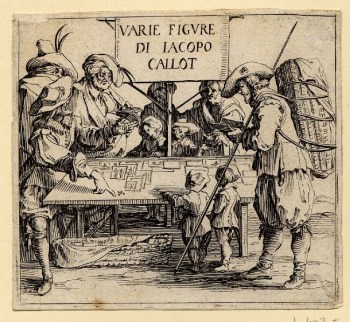
Jacques Callot, Title page to Varie figure, etching, ca. 1621/22 (Washington, DC: National Gallery of Art).
We solicit papers that address printed images in relation to their early modern and modern contexts in the broadest sense. We hope to include papers that cover the full span of the history of prints, and the range of disciplines in which print is now studied, from art history, the history of the book and print culture studies, to the history of science and ideas.
We open up the terms ‘place’ or ‘context’ to include a variety of approaches to the study of prints and of print. To look at prints in their place might concern the relation between prints and their place of production—how did the spaces and formats of artists’ workshops shape their creative process and affect the prints produced? How did the entrepreneurship of print producers in workshops and publishing houses affect the print materials that were bought by their customers? How were the places in which cheap prints were sold—on the street, in the piazza, the book fair, the market table—reflected in their format, imagery, and functions? Equally rich contexts include the places in which printed materials were collected, stored, and used: how did the formats and conventions for looking at prints, pamphlets and books, in libraries, kunstkammer, galleries, chapels, schools, kitchens, laboratories, bedrooms, coffee shops and salons, affect the way prints were made as well as what they portrayed? More broadly, when print shops and book shops were clustered into certain streets or districts in the city, and/or when a locality became associated with the print trade, what effects did the character of this site have on the culture of print in that place? We also encourage topics that consider gender as well as women artists—Were these places gendered? Did women cultivate their own spaces of print production? When and where did women actors navigate the spaces above? What was the place of print, literally or figuratively, for aspiring or established women artists or publishers? The places for prints might also be considered as metaphoric or imagined spaces, such as the international arena for news and political debate. Finally, we invite studies of such real or imagined places for prints that extend beyond western Europe.
If you are interested in presenting a paper at this conference, please send a proposal with your name and institutional affiliation (if you have one), your paper’s title, an abstract of no more than 200 words, and a brief cv, to sheila.mctighe@courtauld.ac.uk. Deadline for submissions is 15 January 2020.
Organizers: Dr. Sheila McTighe (Senior Lecturer, Courtauld Institute), Dr. Paris Spies-Gans (Harvard University Society of Fellows), Dr. Anita Viola Sganzerla (Independent scholar)
Call for Essays | The Enlightened Nightscape, 1700–1830
From the Call for Proposals:
The Enlightened Nightscape, 1700–1830
Edited by Pamela Phillips
Proposals due by 20 December 2019; completed essays due by 30 June 2020
Traditional timelines divide the past into the ‘Dark Ages’ and the ‘Enlightenment’, with their corresponding associations with ignorance, the irrational, and superstition in opposition to light, clarity, and reason. In recent years numerous academic disciplines have challenged this black and white view, converging in and on the night to study the many dimensions of the other half of our daily twenty-four-hour cycle. The emerging field of Night Studies has examined the evolution of the meaning of night since the Middle Ages, its representation in different national literatures and art, and the impact of street illumination in the creation of nightlife, especially in urban centers, among other topics. This line of research is particularly relevant to eighteenth-century studies, as the Enlightenment’s embrace of light and reasoned knowledge makes it easy to overlook that night and darkness held both physical and metaphorical importance. The invention of lighting technology and economic growth, along with the rise of social infrastructures like cafés and the fascination with graveyards and other dark spaces, brought life and light to the eighteenth-century nightscape. The night became a source of inspiration for many writers and artists, and philosophers explored its hidden meanings.
The objective of this edited collection is to present a cross-disciplinary discussion on the thinking about the concept of night through examples from the global and long eighteenth century. The Enlightened Nightscape 1700–1830 seeks to bring together case studies that address how the night became visible in the eighteenth century through different mediums and in different geographical contexts. The proposed study of the representation, treatment, and meaning of the night in the long and global eighteenth century also contributes to an on-going exercise that questions the accepted definitions of the Enlightenment. By bringing Eighteenth-Century Studies into dialogue with Night Studies, The Enlightened Nightscape 1700–1830 enriches the critical conversation on both lines of research.
Contributions may consider, but are not limited to, the following topics:
• Night, dusk, and dawn as periods and spaces of the daily cycle
• Darkness and the (in)visible world
• Nocturnal landscapes and architecture (cemeteries, forests, etc.)
• The unknown, uncertainty, and obscurity
• Urban and rural night culture
• Blindness and sight
• Public spaces and sociability
• Gender and mobility
• Astrology and astronomy
• Shadows in art and life
• Chiaroscuro and nocturne painting
• Sleep and dreams
• Nighttime animals (wolves, bats, etc.)
• Evening customs (witchcraft, storytelling, crime, etc.)
• Literary and artistic representations
In its embrace of the global turn in eighteenth-century studies, The Enlightened Nightscape 1700–1830 welcomes multidisciplinary topics, analysis of literary, visual, aural, and material texts, and considerations of nightscapes that extend beyond the traditional European canon.
Please submit a 300-word abstract and an abbreviated CV to Pamela Phillips (phillips.pamela@gmail.com) by December 20, 2019. Authors will be notified by January 31, 2020. Complete, original, and not previously published essays of 6,000–8,000 words will be due by June 30, 2020.
The editors of the Routledge Studies in Eighteenth-Century Cultures and Societies series have expressed an initial interest in the collection and a full proposal will be submitted to the publisher once the abstracts have been selected. Please send all proposals and inquiries to Pamela Phillips: phillips.pamela@gmail.com.
Pamela Phillips, PhD
Department of Hispanic Studies
University of Puerto Rico, Río Piedras
Call for Papers | Making a Case for Cases
From ArtHist.net:
Making a Case for Cases: The Furniture of Display
The Bowes Museum, County Durham, 10–11 January 2020
Proposals due by 22 November 2019
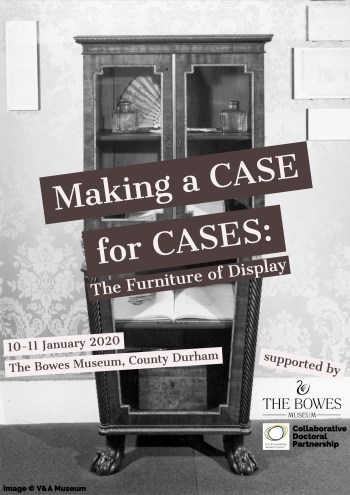 This conference aims to explore the furniture used by collectors, museums and institutions for displaying artefacts. Spanning diverse functions and definitions, objects known as display cases, showcases, china cabinets, vitrines, specimen tables, or even trophy cabinets, are ubiquitous in the home and museum. However, there remains a lack of scholarly engagement with cases in the writing on and about museums, demoting them as merely utilitarian or secondary to the objects they contain. This conference aims to shift the focus from the contained to the container.
From the earliest wunderkammer, treasure houses, and royal palaces, collectors and institutions have purchased, or commissioned craftsmen to make furniture to hold possessions or artefacts. With the rise and development of public art museums and large-scale international exhibitions in the nineteenth century, display cases became increasingly central to the aesthetics and practicalities of exhibiting art. As more people jostled to see or touch objects, cabinets were redesigned to fit with new techniques of preservation and display. We might consider the boom in the luxury furniture trade that offered private collectors from a range of social backgrounds the opportunity to decorate their homes and show off their prize pieces. How did public and private display cases mould forms of class and gender identity? How did they balance the need for access with the claims of distinction?
The display case was an invitation to close-looking and even scientific investigation. Types of visual scrutiny were inherently bound up with technological advances and this was mediated through shifts in case design. What were the power dynamics at work when something was placed inside a case, particularly in the imperial context of the nineteenth century, as foreign cultures were subject to study and objects were displaced from their original locations. Which histories do display cases speak to? This event will open a discussion around the topic between historians of any discipline who examine display cases and their role in presenting art and material culture.
The organisers invite abstracts for 20-minute papers and also shorter, in-focus presentations of around 5–8 minutes in length. We welcome papers on topics engaging with, but certainly not limited to:
• Cases in domestic or historic interiors, c.1750–1950
• The different taxonomy of cases: for porcelain, jewellery, taxidermy, documents, coins and medals, natural history and botanical specimens.
• Uniformity and difference in display cases
• Case design and architecture
• The impact of curators, collectors, artists or dealers on display case design.
• The criteria of cases; for study, classification or aesthetics?
• Display cases and preservation/conservation
• Display cases and Empire
• Display cases in commercial spaces.
Please direct all submissions to casesconference2020@gmail.com by noon on Friday 22 November 2019. The organisers will be in touch with the outcome of applications the following week.
The conference will take place in The Bowes Museum on Friday, 10 January and the morning of Saturday 11 January, allowing time for speakers and delegates to arrive via Darlington train station on Friday morning and to leave on Saturday after lunch. With its important collection of furniture used for display purposes, The Bowes Museum offers the ideal venue for this conference. We warmly invite all participants to join us on the afternoon of Saturday, 11 January at the museum for extra discussion and activities. Information on arrangements for accommodation will be available in due course.
This conference is generously supported by the Collaborative Doctoral Partnership Consortium and The Bowes Museum.
We look forward to receiving your abstracts. With thanks from the organisers:
Charlotte Johnson (The University of Birmingham and Kedleston Hall, National Trust),
Lindsay Macnaughton (Durham University and The Bowes Museum),
Simon Spier (The University of Leeds and The Bowes Museum)
Call for Papers | Animaterialities
From ArtHist.net:
Animaterialities: The Material Culture of Animals (including Humans)
Sixteenth Material Culture Symposium for Emerging Scholars
University of Delaware, 24–25 April 2010
Proposals due by 5 December 2019
The Center for Material Culture Studies at the University of Delaware invites submissions for graduate student papers that examine the relationship between material culture and animal studies for its biennial Emerging Scholars Symposium (April 24–25, 2020). This symposium merges the interdisciplinary study of animals—and the related critical conversations surrounding animality, species, agency, objectivity, and subjectivity—with material culture studies.
Five years after the Audubon Society’s startling Birds and Climate Change Report, we continue to hear about the prices non-human animals pay for human choices: extinction, loss of habitat, and poisoned food sources. The present moment begs, more than ever, critical questions about the intersections between the material world and the (fellow) animals with whom we share it. We thus propose the theme ‘animaterialities’, a term which acknowledges the constant presence of other-than-human animals as physical bodies entangled in various anthropocentric systems, whether political, economic or cultural. Animaterialities encourages participants to consider animals not as passive forms of matter for human use, but as active beings capable of resilience in the face of humans’ material domination and exploitation. Finally, it recognizes the necessary turn material culture studies must take when applied to other-than-human animals, as opposed to artificial, vegetal, or mineral subjects/materials.
Generative questions might include:
• How do material objects define or challenge the boundaries between humans, animals, and objects?
• How are animals transformed into material forms?
• How are animals made visible or invisible in the built environment, text, image, material goods, the archive, and the museum?
• How do animal materialities cut across, complicate, and generate global, hemispheric, and imperial worlds?
• How can we re-conceptualize materialities and animalities as active agents in their worlds, rather than passive participants?
Contributions to this theme may take, but are not limited to, the following forms:
• The production and conservation of animal materials
• Materials that imitate animals
• Animals as objects, the “thingness” of animals, and defying objective treatment
• The materialities of animal labor
• Experimentation with animals and animal materials
• Animal classification, collecting, and display
• Material culture of living history farms, zoos and zoological gardens, and preserves
• Visual culture and representation of animal materials
• The social life of animals
• The material aspects of animal abuse
Submissions: Proposals by current graduate students and recent graduates (May 2019 or later) should be no more than 250 words. Up to two relevant images are welcome. Send your proposal and a current c.v. (two pages or fewer) to emergingscholars2020@udel.edu.
Deadline: Proposals must be received by December 5th, 2019. Speakers will be notified of the committee’s decision by the end of January 2020. Confirmed speakers will be asked to provide digital images for use in publicity and are required to submit their final papers and presentations/slide decks ahead of the conference. Travel grants will be available for participants.
Call for Papers | ‘Dark Enlightenments’

From the conference website:
‘Dark Enlightenments’: David Nichol Smith Seminar in Eighteenth-Century Studies XVII
Adelaide, Australia, 2–4 December 2020
Early proposals due by 1 November 2019; regular proposals due by 1 March 2020
The Australian and New Zealand Society for Eighteenth-Century Studies (ANZSECS), Flinders University, and the University of Adelaide invite you to the 17th David Nichol Smith (DNS) Seminar for Eighteenth-Century Studies. Inaugurated in 1966 by the National Library of Australia, the DNS is the leading forum for eighteenth-century studies in Australasia. It brings together scholars from across the region and internationally who work on the long eighteenth century in a range of disciplines, including history, literature, art and architectural history, philosophy, theology, the history of science, musicology, anthropology, archaeology, and studies of material culture.
The theme for this conference is ‘Dark Enlightenments.’ We ask delegates to consider the dark, shadowy aspects of enlightenment processes of the eighteenth century. When broadly conceived, the theme is open to numerous up-to-the-minute, interdisciplinary possibilities, including (for example):
• the dark side of the public sphere, such as expressed in satire and polemic
• Empire and enlightenment
• critiques of empathy and humanitarianism
• negative emotions
• crime, conflict and violence
• the use and abuse of the past
• progress and ethics (political, social, scientific)
• war
• romanticising death
• the Gothic
• the numinous eighteenth century
• the transformation of night-time
• developments in notions of privacy, secrecy and the hidden self
• the ‘shady’ moralities of libertinism
• the aesthetics of darkness and light
This, we believe, is a particularly timely theme, partly owing to the nationalist turn in global politics, and the recent controversy stirred in Australia by the proposed Ramsay Centre for Western Civilisation. It offers both sides of the political spectrum the opportunity to interrogate and fully understand the costs, benefits, and legacies of eighteenth-century ‘progress’. It is also a theme designed to emphasise the Enlightenment in its moral complexity and richness, and the wide range of domains (from the everyday to philosophical thought) that contributed to its production.
We also welcome papers for subjects that fall outside the main conference theme. Proposals for 20-minute papers should consist of a title, 250-word abstract, and short bio sent via email as a pdf attachment to DNS2020@flinders.edu.au. We also accept proposal for panels of three papers, which should include all the above for each presenter, a panel title, and if possible, the name and short bio of the panel chair.
Deadlines for submissions
For early deliberation: 1 November 2019. A first round of acceptances will be made shortly after this date to facilitate international attendance.
Final deadline: 1 March 2020
Keynotes
Associate Professor Kate Fullager (Macquarie)
Professor Sasha Handley (Manchester)
Associate Professor Eugenia Zuroski (McMaster)
◊ ◊ ◊ ◊ ◊
Attention Early Career Researchers!
Aspiring to deliver a keynote lecture at a major international conference? Here’s your chance! We’d like to invite early career researchers to propose a keynote lecture addressing the conference theme. This scheme is open to all topics and areas of expertise in literary/humanities studies broadly defined, and to researchers who are in regular university employment as well as those who are not. Applicants must:
• have an outstanding research track record relative to opportunity;
• be within 5 years after award of the PhD (extended to 7 if not in stable university employment or with a significant career interruption).
To apply, please submit a proposed title, 300–400 word abstract, a bio, and a CV (3 pages max) to DNS2020@flinders.edu.au.
In making a selection diversity and the presence of under-represented groups will be recognised, as well as the spectrum of existing keynotes at the conference. We also reserve the right to seek third-party testimony as to the researcher’s capacity to speak and deliver scholarly presentations. The winner will deliver the proposed keynote lecture, with flights, accommodation, and registration covered. The deadline for early career researcher keynote proposals is 1 November 2019.










leave a comment