Call for Articles | Metropolitan Museum Journal
Manuscript Guidelines for the Metropolitan Museum Journal:
Metropolitan Museum Journal
Submissions for Volume 54 are due by 15 October 2018
The Editorial Board of the peer-reviewed Metropolitan Museum Journal invites submissions of original research on works of art in the Museum’s collection. There are two sections: Articles and Research Notes. Articles contribute extensive and thoroughly argued scholarship. Research Notes typically present a concise, neatly bounded aspect of ongoing investigation, such as a new acquisition or attribution, or a specific, resonant finding from technical analysis. All texts must take works of art in the collection as the point of departure.
Articles and Research Notes in the Journal appear both in print and online, and are accessible via MetPublications and the Journal’s home page on the University of Chicago Press website.
Manuscripts are reviewed by the Journal Editorial Board, composed of members of the curatorial, conservation, and research science departments. To be considered for the following year’s volume, an article must be submitted, complete including illustrations, by October 15. Once an article is accepted for publication, the author will have the opportunity to review it after it has been edited and again after it has been laid out in pages. The honorarium for publication is $300, and each author receives a copy of the Journal volume in which his or her article appears.
Additional information is available here»
Call for Papers | Hidden in Plain Sight
From the conference flyer:
Hidden in Plain Sight: Meanings and Messages in Ceramics, 1650–1950
Rienzi Biennial Symposium, Museum of Fine Arts, Houston, 21–22 September 2018
Proposals due by 15 July 2018

Chinese, Masonic Punch Bowl, ca. 1750–70, hard-paste porcelain (The Museum of Fine Arts, Houston, the Rienzi Collection, 74.216).
Rienzi, the house museum for European decorative arts of the Museum of Fine Arts, Houston, begins the celebrations for its 20th anniversary as a public collection with a symposium featuring international emerging scholars, Hidden in Plain Sight: Meanings and Messages in Ceramics, 1650–1950. Scholars are asked to discuss objects made for rare or unlikely uses, display, or celebration. We ask participants to examine the use of ceramics as vehicles for concealed language regarding humor, courtship, diplomacy, learning, class, and contemporary culture.
Rienzi houses a significant collection of European paintings, sculpture, furniture, porcelain, and silver from the mid-17th through mid-19th centuries. Built in 1953 as a residence and opened to the public as a house museum in 1999, Rienzi evokes fine European houses of the 18th century with architecture reminiscent of the Italian Palladian style, surrounded by period European decorative arts and paintings. Rienzi is particularly rich in 18th-century European porcelains, thanks to the collecting interests of Harris and Carroll Masterson, its founding collectors. This scholarly exploration of ceramics honors their legacy and philanthropic spirit.
Master’s and doctoral students as well as entry level and mid-career professionals are invited to submit a 400-word abstract outlining a 20-minute presentation, along with a CV, to sniemeyer@mfah.org by 15 July 2018. Selected participants will be notified by 1 August 2018 and will be offered a $600 stipend for travel and lodging. All presentations are given Saturday, 22 September 2018, at the Museum of Fine Arts, Houston. The keynote lecture is held Friday evening, followed by a reception at the Museum of Fine Arts, Houston.
Possible themes of investigation may include, but are not limited to
• Display
• Dining
• Privacy
• Social pastimes
• Etiquette
• Gender
• Travel
• Economics
• Politics
• Beauty
• Print culture
• Secret societies
Graduate Student Workshop | Asian Aesthetics and American Art
From the University of Delaware:
International Graduate Student Workshop
Global Impact of Asian Aesthetics on American Art and Material Culture
The University of Delaware and Winterthur Museum, Garden, and Library 11–12 October 2018
Proposals due by 8 June 2018
With the generous support of the Terra Foundation for American Art, the University of Delaware’s Department of Art History and the Winterthur Program of American Material Culture will host a two-day International Graduate Student workshop on October 11 and 12, 2018. This workshop is part of a series of events in October 2018 to launch the project In Search of Global Impact of Asian Aesthetics on American Art and Material Culture.
We invite graduate students from a variety of fields, from all regions of the world, to submit a short abstract of a dissertation in progress or a project that: 1) redefines the canon of art history, with a focus on the multidirectional impact of Asian aesthetics on American art and material culture, and/or 2) proposes new interpretations of the transcultural and transhistorical flow of aesthetics that not only redefine the geocultural boundaries of Asia and North America, but also rethink methodological formations of aesthetic emergence.
We strongly encourage proposals that consider the flow of global aesthetics beyond the circulation of objects, as well as those that examine ‘Asia’ and ‘North America’ as discursive structures or cultural constructs in connection with other world regions such as Africa, Europe, South America, among others. In sum: How do design ideas, patterns, and aesthetics travel across the globe, even when objects do not?
To apply, send a short abstract written in English (300–500 words) and a 2-page CV to global-aesthetics@udel.edu by 8 June 2018. Applicants will be notified of decisions by 8 July 2018. Successful applicants will be invited to submit a dissertation chapter or excerpt, or paper, (9000–10000 words), to be pre-circulated and read before the workshop.
Official respondents are: Partha Mitter (Sussex, emeritus), Dorothy Ko (Barnard/Columbia), Lee Glazer (Freer/Sackler Galleries), Marco Musillo (Kunsthistorisches Institut in Florenz), with the Terra Foundation’s guest critics: Zhang Gan and Chen Anying (Academy of Arts and Design, Tsinghua, Beijing), in addition to the faculty workshop advisors from the Department of Art History and the Winterthur Program of the University of Delaware.
Lodging and meals are provided for invited participants throughout the workshop. Applicants seeking travel support should include in the application a letter demonstrating the need and a budget plan.
In addition to the Terra Foundation, we thank the following organizations for their support: The University of Delaware’s Office of Graduate and Professional Education and the Center for Material Culture Studies, with grants from the Unidel Foundation, and National Endowment for the Humanities.
Call for Contributions | Printing Colour 1700–1830
This collection of essays will build and expand upon the research recently presented at the conference of the same name (Institute of English Studies, London, April 2018) to offer the first handbook of color printing techniques in the long eighteenth century.
Printing Colour 1700–1830: Histories, Techniques, Functions and Receptions
Edited by Elizabeth Savage and Margaret Morgan Grasselli
Proposals due by 8 June 2018; finished essays due by 15 February 2019
Following from the award-winning volume Printing Colour 1400–1700, Printing Colour 1700–1830 will be the first handbook of early modern colour printmaking in the long eighteenth century. It will contribute to a new, interdisciplinary paradigm for the history of printed material in the west. It aims to understand how new (and old) forms of colour printing changed communication during the late handpress period, from the invention of trichromatic printing until the Industrial Revolution and the introduction of chromolithography allowed the mass production of diverse colour-printed materials.
The discussion will encompass all media, techniques, and functions, from text to image, fashion to fine art, wallpaper to scientific communication. For this reason, submissions are sought from academics, curators, special collections librarians, printers, printmakers, cataloguers, conservators, art historians, book historians, digital humanities practitioners, scientists, and others who care for colour-printed material, seek to understand how it was produced and used, or engage with it in research.
Please submit 300-word abstracts online by 8 June 2018. Chapters of 4,000–6,000 words (including notes and captions) with up to 10 illustrations will be due 15 February 2019 for publication in mid-2020. The book will be peer-reviewed and published in full colour. Contributors will be responsible for sourcing images and copyright for their contributions, but they will qualify for fee waivers from many heritage collections because the publisher is a charitable academic press. This book is an output of the Printing Colour Project. For enquiries, please contact Gemma Cornetti at printingcolourproject@gmail.com.
Call for Session Proposals | ASECS 2019, Denver
Panel proposals for ASECS are due soon:
2019 American Society for Eighteenth-Century Studies Conference
Denver, 21–23 March 2019
Session Proposals due by 15 May 2018
The 50th Annual Meeting of the American Society for Eighteenth Century Studies is less than a year away! ASECS will hold its anniversary meeting in Denver, Colorado, 21–23 March 2019. We hope to see you there.
Proposals for panels, roundtables, and other sessions at the 2019 Meeting are now invited. The deadline for submission is 15 May 2018. The online form for proposing sessions may be accessed here: ASECS 2019 Call for Proposals. In addition to welcoming session proposals on all aspects of eighteenth-century studies, the Executive Board encourages members to propose panels connected to the 50th Anniversary of the Society—for example, reflecting on the history of the organization, debating its future, or examining the state of eighteenth-century studies within academia or in specific disciplines.
If you have any questions, please contact the ASECS Business Office at asecsoffice@gmail.com.
Call for Papers | Excess! at UAAC
Along with the HECAA session at this year’s UAAC Conference, readers may be interested in this panel organized by Ersy Contogouris and Marie-Ève Marchand. Details and a full list of panels (68 in all) are available here»
Excess! | Universities Art Association of Canada
Department of Fine Arts, University of Waterloo, Ontario, 25–27 October 2018
Proposals due by 1 May 2018
 As a transgression of a norm that is culturally contingent, excess has tended to be condemned in the West as a moral failing. Yet, it can also be a strategy for empowerment, agency, and creativity (Skelly, 2017, 2014; Potvin & Myzelev 2009). And though it often manifests itself as overabundance, its counterpart—including vacuum, censorship, or prohibition—can also be a form of excess. This panel seeks to investigate different manifestations of excess in visual art and material culture. At what point does ‘a lot’ becomes ‘too much’? Are there degrees of excess (a moderate vs. an excessive excess)? Who decides? What are the emotional, visual, environmental, conceptual, or other modalities, effects, and responses to excess? What are the gendered, sexualized, racialized, geographical, cultural, class-specific, or other valences of excess? And how can some mediums or materials in themselves be markers of excess? We welcome explorations into these and other displays of excess in art and design from historians, curators, and practitioners. Submissions for presentations in French or English should include an abstract (of up to 300 words) and a short biobibliography (of up to 150 words) and should be sent to Ersy Contogouris (ersy.contogouris@umontreal.ca) and Marie-Ève Marchand (marie- eve.marchan@mail.concordia.ca) using the form available as a PDF file here. For more information, please contact the session organizers.
Call for Papers | Artisans of the Surface in Early Modern Europe
From H-ArtHist:
Artisans of the Surface in Early Modern Europe, 1450–1750
King’s College London, 20–21 September 2018
Proposals due by 8 June 2018
This workshop focuses on the practices of a range of artisans (tailors, barbers, cooks, cheesemakers, gardeners, and agronomists) and their relationships with the fields of meteorology, botany, natural history, medicine, earth sciences, and veterinary medicine. These artisans and their practices shared a set of skills related to the observation and manipulation of human and non-human surfaces. We will explore how, and if, practical knowledge about the surface of things and bodies (and their storage and preservation in relation to specific environmental conditions) led to the concept of nature and matter as composed of layers, and how such a framework contributed to the demise of traditional Galenic and Aristotelian views on nature.
This workshop also aims at getting past the dichotomies between quantitative and qualitative knowledge and between natural philosophy and the arts, and so we intend to broaden the focus to include a set of artisans who have traditionally remained invisible from accounts of this ‘age of the new’. We will explore the many different ways in which ‘modern science’ emerged, the relationships between social and cognitive practices, and the contribution that non-mathematical sciences gave to the mental habits of observing, collecting, experimenting with, and manipulating natural matter.
We welcome proposals, in particular, that address the relationships between gardening, natural history, and medicine; cooking and knowledge; work on animal skin; leatherwork; or veterinary medicine. Proposals (up to 250 words) for 20-minute papers should be sent to Paolo Savoia at renaissanceskin@kcl.ac.uk by 8 June 2018.
Call for Papers | Marginal Drawing Techniques
From H-ArtHist:
Marginal Drawing Techniques as an Aesthetic Strategy, 1600–1800
Zentralinstitut für Kunstgeschichte München, Munich, 5 October 2018
Proposals due by 20 April 2018
Cennino Cennini’s metaphorical description of drawing as the “entrance and gateway to painting” provides an important indication of the purpose of drawing around 1400. Beyond its role in the execution of panel paintings, to the present day, drawing serves in the enhancement of motifs as a repository of alternatives and as ‘finger exercise’ for the development of routine manual dexterity—the prerequisite for a “free hand” (Albrecht Dürer).
Beyond the specific appreciation of “freehand drawing,” which reached a particular zenith in the eighteenth century, artists of all periods used different techniques for organising the drawing process, both materially and economically. They traced and pounced, made counter-proofs and impressions, and produced natural imprints and cliché verres. However, it would appear that the characteristics of such processes cannot be adequately explained in terms of the mere simplification of the process of creating a drawing. Instead, the aforementioned techniques or processes also served in the stimulation of the imagination, which was inspired, for example, by more or less random blots and smudges; similarly, cutting and pasting techniques contributed to the flexible arrangement of variations.
In view of the fact that such techniques generally assume a less prominent role in the study of drawing, as they also raise questions of quality for the art trade and collection history, it is intended to explicitly explore the functional and aesthetic importance of these marginal processes in case studies beyond the Alps during the period from around 1600 to around 1800. The aim here is to understand technical skill and versatility as a condition of creative and artistic-intellectual performance and to increase awareness of the correlation between theory and practice with a view, not least, to making the case for a greater focus on artistic-technical processes.
Possible key questions and issues in relation to the proposed sections include:
• Tracing–Verso: Which tracing techniques exist and what functions did they fulfil? What is the role of the reverse side of the drawing here? To what extent does the tracing process become visible in the drawing process? Is it covered during the further execution of the work or visually highlighted in other cases? Where does the upgrading of the tracing process become evident?
• Counter-Proofs–Inversion: The question regarding the different techniques and functions of counter-proofs also arises here. How do the reproductive printing techniques relate to this? Which sensoria and semantizations were developed for the side-inverted image? How can these be embedded in terms of cultural history, also on the basis of documentary sources (workshop treatises, art criticism, literature)?
• Klecksography–Random Processes: As is generally known, Leonardo saw blots and cloud formations as a huge stimulus for the imagination. Artists resorted to processes that were only controlled to a limited extent to incorporate a certain principle of chance into the drawing process. However, these processes often only prove to be random on a superficial level: they were executed with extreme bodily motor skill and were intended to evoke a certain studied facility (sprezzatura).
• Cut and Paste: The value of a treasury of motifs is particularly evident in the repeated use of models and patterns. Individual parts of a drawing could be cut out, stuck on and removed again for editing and checking a new draft. What are the artistic implications of such a procedure? And how can the cut & paste process be related to other techniques?
• Repetition–Palimpsest: Finally, it is planned to examine practices involving the repetition of drawings and the cultural-historical dimensioning of drawings as a palimpsest.
Please send an abstract (max. 500 words) and a short CV for a 20-minute presentation in German or English by 20 April 2018 to marginalia@zikg.eu. Travel costs (economy class) and accommodation in accordance with the provisions of the German Travel Expenses Act will be covered.
Scientific Conception: Iris Brahms (Zentralinstitut für Kunstgeschichte Munich, Wallraf-Richartz-Museum Cologne), Thomas Ketelsen (Wallraf-Richartz-Museum Cologne), Ulrich Pfisterer (Institut für Kunstgeschichte der LMU, Zentralinstitut für Kunstgeschichte Munich)
Call for Panels | CAA in New York, 2019
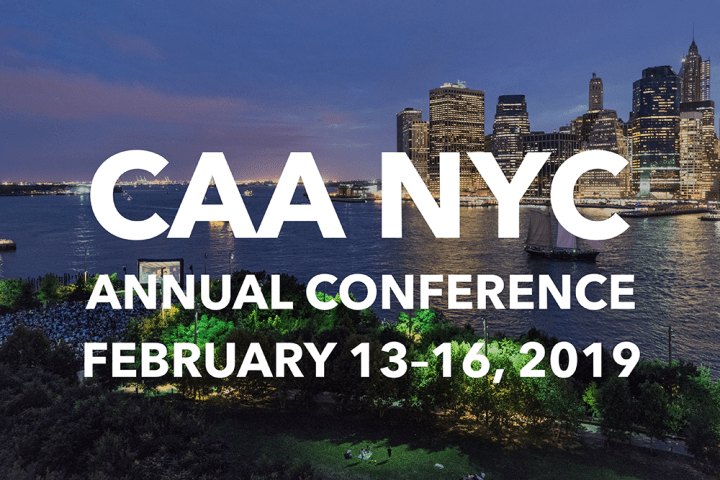
From CAA:
107th Annual Conference of the College Art Association
New York Hilton Midtown, 13–16 February 2019
Most Panel Proposals due by 27 April 2018
The CAA Annual Conference is the largest professional convening of art historians, artists, designers, curators, and others in the visual arts. Each year we offer sessions submitted by our members, committees, and affiliated societies offering a wide range of program content. The Annual Conference Committee members review over 800 submissions each year. They take into account subject areas and themes that arise from accepted proposals to present as a broad and diverse a program as possible. The Committee selects approximately 250 sessions for each conference, and it must, at times, make difficult decisions on submissions of high merit. This means that on occasion, quality submissions may not be selected.
General Proposal Submission Information
• Session and paper/project abstracts should be no more than 250 words in length.
• Please follow The Chicago Manual of Style for your submission.
• The accuracy of information in the submission is important as, if selected, it will be transferred to the conference program, abstracts booklet, website, etc., exactly as written.
P R O P O S A L S U B M I S S I O N T Y P E S
Complete Session
Proposals due by 27 April 2018
The organizer has complete information about the session including names and affiliations of all session participants, presentation titles, abstract texts, etc.
Session Soliciting Contributors
Proposals due by 27 April 2018
The organizer proposes a session title and abstract that will require a call for participation. Session organizers review and select papers and projects based on their own requirements. The 2019 Call for Participation (CFP) for accepted Sessions Soliciting Contributors will be posted on the CAA Annual Conference website on May 14, 2018. Submissions will be accepted for review through June 21, 2018. Submissions should be sent directly to the session chair(s)—if there is more than one session chair, send materials to both chairs. Proposals should include a proposal form (found at the end of the CFP), an abstract of your presentation, a cover letter to chair(s), a shortened CV, and work documentation (if necessary).
Individual Paper/Project
Proposals due by 27 April 2018
An individual CAA member may submit an abstract (with title), which, if accepted, will be included in the 2019 conference as part of a composed session with others accepted in this category based on subject area or compatible content.
Professional Development Workshops
Proposals due between 15 May and 15 August 2018
CAA welcomes current CAA members to share their expertise with colleagues in Professional Development Workshops. Workshops are ninety minutes in length and content ranges from business strategies and negotiation, finding grants and fellowships, marketing, audience engagement, education on new technologies, and more.
Exhibitor Session
Proposals due between 15 May and 14 September 2018
Registered exhibitors at the 2019 conference are welcome to propose full sessions or workshops (ninety minutes in length) for inclusion in the full-conference program. These sessions should convey practical information, professional expertise, or historical/scholarly content and may not be used for direct marketing, sales or promotion of products, publications, or services or programs.
Call for Papers | Collecting Dutch and Flemish Art in Germany
From H-ArtHist:
Collecting Dutch and Flemish Art in Germany, 1500–1900
Conference ANKK and RKD, Den Haag, 18–20 October 2018
Proposals due by 15 April 2018
Much of Dutch and Flemish Art was acquired by German collectors, so that today there are more of these artefacts in German collections than in those of other countries. The 2018 conference of the ANKK seeks to analyse the ways in which Netherlandish art was and is collected in the German speaking countries and how this influenced not only scholarship but also the art market.
The German organisation for the Study of Netherlandish Art and Culture [Arbeitskreis Niederländische Kunst- und Kulturgeschichte e.V.] will hold its decennial as an international conference in Den Haag in cooperation with the RKD from 18 to 20 October 2018. The RKD is currently investigating the cultural exchange between the Netherlands and Germany between 1500 and 1900 in its three-year project Gerson Digital: Germany. The basis of the project is the pioneering publication by Horst Gerson (1907–1978), Ausbreitung und Nachwirkung der holländischen Malerei des 17. Jahrhunderts (Amsterdam 1983, ed. princ. Haarlem 1942), in which the circulation and imitation of Dutch paintings in Europe are processed by country.
Proposals for 20-minute papers could address—but are by no means limited to—the following topics:
• spaces of the art market for Netherlandish Art and the main art centres for the German speaking countries, public and private collections, and clerical institution
• prize formation mechanisms for Dutch and Flemish Art
• networks of artists, dealers and collectors (both private and institutional), as well as writers on art and other audiences
• new scientific methods and methodologies of research and their influence on scholarship or collecting
• ‘art agents’ and their changing roles
• the nature of collections (municipal or princely), their buildings, and shared knowledge spaces
• interdependences of primary and secondary art markets for Netherlandish art
We also aim to have one open session of lightning talks in which any future, present or past project or exhibition, unrelated to the above-mentioned panels, can be presented in exactly eight minutes. Please indicate in your abstract whether your proposal is meant for the lightning talks or the more traditional panel format. No matter which format you prefer, we also encourage junior researchers to send us their proposals. Please send an abstract of the proposed paper (maximum of 500 words) in German or English and a short curriculum vitae to both the RKD (leeuwen@rkd.nl) and the ANKK (bmuench@uni-bonn.de) by 15 April 2018.










leave a comment