Call for Papers | New Scholarship in British Art History
From the conference website:
New Scholarship in British Art History: Discoveries at the NCMA
North Carolina Museum of Art, Raleigh, 27–28 January 2017
Proposals due by 15 September 2016

Attributed to John Hoppner, The Honorable Sherson (Raleigh: NCMA, G.28.2.43).
A two-day symposium, in collaboration with the University of North Carolina at Chapel Hill, hosted alongside the upcoming exhibition History and Mystery: Discoveries in the NCMA British Collection.
The question of what makes the British Isles ‘British’ is particularly relevant given recent political events, such as the United Kingdom’s exit from the European Union. Using the North Carolina Museum of Art’s British collections as inspiration, this New Scholars Conference explores the ways in which we can examine ‘English’ and ‘British’ works of art. Particularly, this topic raises questions about the ways Britain can be viewed, either as inward looking and/or in dialogue with the wider world.
We encourage topics ranging from traditional categories of British art, such as portraiture, to new investigations into the mobility of artists and styles, as well as issues of race, class, and gender. The aim of this conference is to explore how innovative scholarship and new narratives can help expand the larger discipline of British studies. This conference is intended for graduate students, recent doctoral graduates, and post-doctoral scholars. We strongly suggest that speakers consider their papers in relation to the British collections at the NCMA, whose works of art range from 1580 to 1850.
We invite 20-minute papers on topics including (but not limited to) the following:
• English Portraiture
• Britain’s Relationship to the World
• Post-Reformation Effects on the Arts
• Influence of Sir Joshua Reynolds
• British Notions of Territory
• Architecture in the English Context
• Race, Gender, and Class in Art
• Formation of the British Academy
• The Immigrant Artist
• The British Family in Art
• Foreign Influences in British Art
• Imagery of Travel and Exchange
Please send an abstract (250 words) and a CV to Miranda Elston (mlelston@email.unc.edu) by 15 September 2016 with the email heading ‘NCMA New Scholarship in British Art History’ and your Name, Affiliated Institution, and Paper Title in the email. Speakers will be informed via email by October 1, 2016.
Call for Papers | Art and the Environment in Britain, 1700–Today

From the conference website:
Art and the Environment in Britain, 1700–Today
Université Rennes 2 Haute Bretagne, 2–3 March 2017
Proposals due by 3 September 2016
The concern of artists for the fate of their environment—understood as the natural world in which they breathe, live, and create—is often thought to be a relatively recent phenomenon. The term ‘environmental art’ was indeed coined in the 1960s, while more recently eco-art has been used to refer to the rise of ecological awareness and pressing concerns for sustainability, with a more specifically political and activist take on environmental art. Recent exhibitions in Britain, such as Radical Nature: Art and Architecture for a Changing Planet, 1969–2009 at the Barbican and Earth: Art of a Changing World at the Royal Academy, both held in 2009, or Art and Climate Change presented in 2006 and 2007 in London and Liverpool, along with the Art & Environment conference held at Tate Britain in 2010, testify to this recent interest in environmentally-conscious practices. Contemporary artistic practices directly engage with the environment, thus displaying multi-faceted relationships between British visual arts and the surrounding world of trees, plants, animals, and even sounds.
However, the contemporary focus on preservation and political activism should not obfuscate the fact that the interaction between Britons and their environment has a much older history. Visual artists from earlier periods also had something to say, both in pictures and in related writings, about their place as humans cohabiting with non-humans, both animate and inanimate, in a physical world whose boundaries were relentlessly pushed back and transformed. As explorers and scientists uncovered new areas—from the far reaches of the earth to that of human ancestry—these artists reacted to an expanding environment that elicited all kinds of emotions, from excitement and wonder to, all too quickly, anxiety and a sense of loss. The British countryside, largely mediated by the visual representations of eighteenth-century landscape painters, has now become artistic heritage, part of a national identity defined by an osmotic relationship with exceptionally hospitable surroundings. The way eighteenth- and nineteenth-century artists represented—and, in the case of landscape gardeners, actively refashioned—a natural world on which cities impinged at a quickening pace in fact often bore the mark of an awareness that what they contemplated and plundered for ideas and ideals was in constant flux. The advent of the Industrial Revolution was to be one of the most decisive illustrations of the transformative power of man over a land so far presented as a timeless Eden. Brought up with the Enlightenment notion that emotional engagement was mandatory for any self-regarding man of feeling, British artists were the prime observers of and witnesses to the alterations that humankind imposed on the natural substrate that ensured its maintenance. Just as their productions betrayed the preoccupations of their times, their personal takes on the relationship between humans and their environment, disseminated through visual representations, contributed to shaping contemporary debates.
The word environment as in ‘nature, or conditions in which a person or thing live’ did not appear until 1827, at which time it was used by the reformer Thomas Carlyle to translate the German Umgebung. The much older verb ‘to environ’, in use in the English language since the late fourteenth century, had come from the French environner and conjured up the image of a circle with a centre around which other elements turned, or veered. For centuries, the centre of this circle was firmly believed to be humankind. Yet, as Keith Thomas has made it quite clear in Man and the Natural World: Changing Attitudes in England 1500–1800 (1983), man’s theologically grounded belief in his total dominion over nature was gradually, over the course of the three centuries spanned by the British historian’s study, dented by “new arguments,” “new conditions,” and “new sensibilities.” As what Thomas called the “dethronement of man” had started a century earlier at the very least, Charles Darwin’s 1859 Origin of Species was to provide the final nail with which to close the coffin of a certain human uniqueness tightly shut. Closer to us, the momentous post-human turn in the humanities—an umbrella term that encompasses an amazing variety of paradigm shifts—currently contributes to reinforcing the idea that humans live in a symbiotic environment characterised by a porous line with non-human animals and machines, and where New Materialist theories such as Jane Bennett’s go as far as claiming agency for ‘things’ such as food, commodities, electricity, and minerals. Part of our scientific committee, T. J. Demos advocates the definition of a post-anthropocentric political ecology. His very latest book, Decolonizing Nature, Contemporary Art and the Politics of Ecology, published in 2016, posits that creativity, and more specifically contemporary art, are instrumental in developing this less possessive relationship to nature.
Whether one thinks of environment as context, setting, climate change, green spaces or sounds, today’s epistemology invites us to rethink man’s relation to the external world to the extent that the ‘inside’ and ‘outside’ coalesce, nature and culture merge, man and animal are reconfigured. How have British artists responded to these shifting perceptions of the world around them, of this great swirling circle of life and non life in which they found—or imagined—themselves diversely positioned, for a long time at the centre, then in a more undefined place—at the margin even? How has art itself positioned itself in this newly defined environment? A precursor to such interrogations, environmental art was early on intended as a decidedly extensive term, which, due to the American influence of Robert Smithson, came to encompass both sites and non-sites, both the pastoral and the urban. With the introduction of Environmental art departments in British art schools in the 1980s, the environment has been understood by artists as all the different contexts available to them outside of the gallery. We see this conference as an ideal opportunity to highlight these tensions between different definitions and to look into terminologies, as well as historical variations; to explore the links between representation and preservation; the way British artists have represented animals, natural elements, and the climate, and their preoccupation with environmental aesthetics and the altered positioning of humankind in the world, in a British context. Abstracts of about 400 words should be uploaded, along with a short biographical note, to the conference webpage.
Organizers
Laurent Châtel (csti-HDEA EA 4086, Paris Sorbonne), Charlotte Gould (Prismes, Sorbonne Nouvelle), and Sophie Mesplède (ACE EA 1796, Université Rennes 2)
Scientific Committee
Laurent Châtel, Sophie Mesplède, and Charlotte Gould
T. J. Demos, Professor of History of Art and Visual Culture, and Director of the Centre for Creative Ecologies, UC Santa Cruz
Anne Helmreich, Dean of the TCU College of Fine Arts, Fort Worth, Texas
Marie-Madeleine Martinet, Emeritus Professor of British Visual Culture, Sorbonne, Paris
Corinne Silva, Artist and Associate Lecturer at London College of Communication, UCL
Anne Goarzin, Professor of Irish Literature and Visual Culture, Rennes II University
Call for Papers | Private Collecting and Public Display
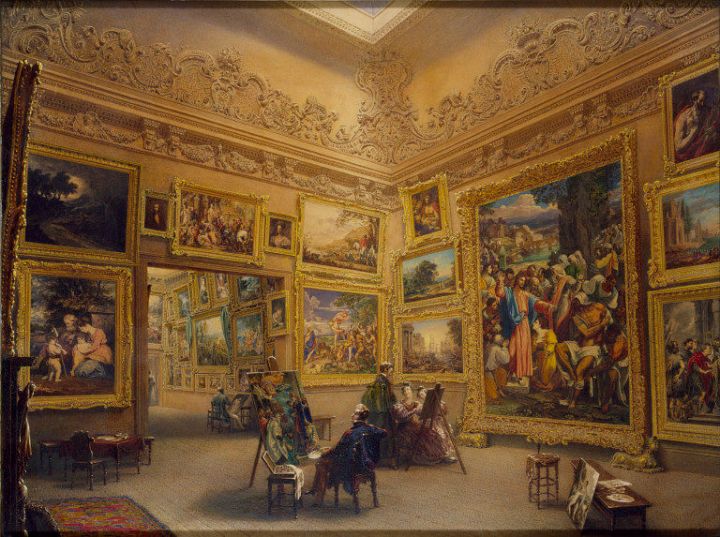
Frederick MacKenzie, The National Gallery When at Mr J. J. Angerstein’s House, Pall Mall, 1824–34, watercolour
(London: V&A, 40-1887)
◊ ◊ ◊ ◊ ◊
Private Collecting and Public Display: Art Markets and Museums
University of Leeds, 30–31 March 2017
Proposals due by 1 November 2016
Keynote Speaker: Susanna Avery-Quash
This two-day conference investigates the relationships between ‘private’ collections of art (fine art, decorative art, and antiquities) and the changing dynamics of their display in ‘public’ exhibitions and museums. This shift from ‘private’ to ‘public’ involves a complex dialectic of socio-cultural forces, together with an increasing engagement with the art market. The conference aims to explore the relationship between the ‘private’ and ‘public’ spheres of the home and the museum and to situate this within the scholarship of the histories of the art market and collecting.
Art collections occupy a cultural space which can represent the individual identity of a collector—often as a manifestation of self-expression and social class. Many museums today arose from ‘private’ collections including The Wallace Collection, Musée Nissim de Camondo, The Frick Collection, and the Isabella Stewart Gardner Museum. Whilst they now exist as ‘public’ spaces, many still signify the residues of the ‘private’ home of a collector. What processes do collections undergo when they move from a ‘private’ sphere to a ‘public’ exhibition space? In what ways are collections viewed differently in these environments?
How and when do ‘private’ collections move into the ‘public’ domain, and what does this tell us about the increasingly porous nature of these boundaries? Whilst the relationship between ‘private’ and ‘public’ art collecting takes on particular forms from the early modern period onwards, it emerged particularly in the latter half of the nineteenth century, with the creation of temporary exhibitions and permanent displays in museums that relied on donations from collectors. Many national museums are indebted to loans made by private individuals. The Waddesdon Bequest at The British Museum, the Wrightsman Galleries at The Metropolitan Museum, and the John Jones Collection at the Victoria and Albert Museum are key examples of the continuity of the private in the public. What are the ‘private’ to ‘public’ dynamics of these exchanges? How have museums negotiated the restrictions proposed by the collector for the display, containment, expansion or reinterpretation of their collection? What is the implication for the status and value of an object when ‘public’ works are sold and re-enter the art market? What meanings are attached to ‘public’ art objects when they begin, once again, to circulate in the art market?
The PGR subcommittee of the Centre for the Study of the Art and Antiques Market welcomes proposals for 20-minute papers which explore these themes or which address any other aspect of the private collecting and public display of collections, from the Early Modern period until the 21st century. We are delighted to confirm Dr. Susanna Avery-Quash, Senior Research Curator (History of Collecting) at the National Gallery, London as our keynote speaker.
Topics can include but are not limited to
• The relationships between ‘private’ and ‘public’ spheres
• The role and impact of the art market in the ‘public’ and ‘private’ realms
• The history and role of temporary loan exhibitions
• The role played by gender in collecting practices and bequests
• Collecting and loaning objects by minority groups
• Legacies of the collector
• Philanthropy vs self-promotion
• Deaccessioning- public museums selling art back into art market/into private collections
• The dynamic of contemporary art collecting and public art galleries
To propose a paper, please send a Word document with your contact information, paper title, an abstract of 300-500 words, and a short biographical note. Full session proposals for a panel of three papers are also welcomed. Some travel bursaries will be available for accepted speakers. Proposals should be sent to csaa@leeds.ac.uk by 1st November 2016.
Call for Essays | Garden Narratives in Literature, Art, and Film
From H-ArtHist:
Enchanted, Stereotyped, Civilized: Garden Narratives in Literature, Art, and Film
Proposals due by 15 October 2016
Gardens have been a crucial part of mythology and literature. Throughout English literature for example, the idea of a garden is a recurrent image; these images largely stem from the story of the Garden of Eden as found in Genesis. If gardens reveal the relationship between culture and nature—the garden can be seen as civilized and ‘shaped’ and therefore domesticated nature—in the vast library of garden literature few books focus on what the garden means—on the ecology of garden as idea, place, and action. Our volume will discuss the topic of the garden in different theoretical contexts such as ecological, botanical, literary, filmic, art historical, and cultural ones. We want to investigate the representations of and the interconnections between gardens and the above named fields over a wide timescale, with consideration of how gardens are represented and used as symbols and of how literature or visuality took form in, or influenced, gardens.
Suggested topics include, but are by no means limited to the following:
• The Biblical/Theological Garden
• The Mythological Garden
• The Renaissance Garden
• The Romantic Garden
• The Revolutionary Garden
• The Colonial/Postcolonial Garden
• Gardens in Film
• Gardens in Art History
• The Garden as… a location in general and as a place of romanticism specifically, or a crime scene, or a labyrinth and therefore as a mirror of psychological conditions
• Ecological Aspects on Garden Culture
The timetable for the volume is as follows
• Deadline for abstracts: 15 October 2016
• Feedback: 31 October 2016
• Submission for articles (completed): 30 April 2017
• Double peer review process and feedback due to: 30 May 2017
• Articles sent back to editors: mid of June 2017
• A publication is planned during autumn/winter 2017.
Chapters may explore different media (literature, movies, art, visual arts, television, etc.) and address topics on gardens. If you are interested in proposing a chapter, please email an abstract of 500 words and a short CV to both Dr. Feryal Cubukcu (cubukcu.feryal@gmail.com) and Dr. Sabine Planka (planka@phil.uni-siegen.de). Your abstract should outline your hypothesis and briefly sketch the theoretical framework within which your chapter will be situated. All submissions will be acknowledged. If you do not receive a confirmation of receipt within 48 hours, you may assume that your email was lost in the depths of cyberspace. In that case, please re-submit. Please note that we will not include previously published essays in the collection.
Call for Papers | CAA in New York, 2017
105th Annual Conference of the College Art Association
New York, 15–18 February 2017
Proposals due by 30 August 2016
The 2017 Call for Participation for the 105th Annual Conference, taking place February 15–18 in New York, describes many of next year’s sessions. CAA and the session chairs invite your participation: please follow the instructions in the booklet to submit a proposal for a paper or presentation. This publication also includes a call for Poster Session proposals. Also, bear in mind that with the changes to next year’s schedule, some sessions have already been fully formed at the time of acceptance; a schedule of those will appear in the coming weeks.
◊ ◊ ◊ ◊ ◊
Charting a New Course: Reorienting the Discourse of Early African American Art History
Mia L. Bagneris (Tulane University) and Anna Arabindan-Kesson (Princeton University), mbagneri@tulane.edu and akesson@princeton.edu
Since the 1943 publication of James Porter’s Modern Negro Art formally inaugurated the field, the study of twentieth- and twenty-first-century artists has dominated African American art historical scholarship. However, Porter’s seminal text began with three important chapters chronicling a history of African American artists and artisans before 1900; likewise, the pioneering scholars of early African American art largely engaged in a heroic sort of recovery project, rescuing the names, biographies, and works of forgotten artists from obscurity, and, to some extent, situating them within the larger context of American art history. With the publication of Lisa Farrington’s new survey text earlier this year and with much—though, importantly, not all—of this rescue mission completed, what new concerns, perspectives, paradigms, and methodologies will inform the direction of early African American art history? This panel seeks to take account of the shifting terrain of the field by beginning to articulate such new approaches and their implications for expanding the study of eighteenth- and nineteenth-century African American art. Possible themes include (but are not limited to) concepts like ‘movement’ or ‘exchange’ as useful lenses of critical analysis, a consideration of African American artists within their very local contexts or the greater diaspora, and how reappraising the place of enslaved artisans and artists reorients the larger field. We invite papers that directly re-imagine the field itself from a theoretical point of view, as well as those that are engaged in unearthing material that can lead to new directions in early African American art historical scholarship.
◊ ◊ ◊ ◊ ◊
Early Modern Objects and the Boundaries of Materialities
Lauren R. Cannady (Clark Art Institute) and Valérie Kobi (Universität Bielefeld), lcannady@clarkart.edu and valerie.kobi@uni-bielefeld.de
This session will explore objects situated at the boundaries of materialities, such as plaster painted to resemble terracotta, wax portraits or specimens reproducing the properties of flesh, glass and porcelain flowers, tapestries framed as paintings, and gardens designed as grottoes. These are just a few examples of the ambivalent materiality of certain early modern artifacts. One might say that these are equivocal art objects—things that resist precise classification. Questions we are interested in pursuing include: what might it mean to substitute one material for another, to translate an object or concept into a different medium? How do we reconcile the mutability and instability of things? How were such objects theorized then and how are they now? How does an object’s materiality—and the questions of likeness, illusion, allusion, metonymy, and metaphor potentially associated with it—substantiate and/or complicate the interdisciplinary claims of art historians and material culture specialists? In addition to addressing the creation, reception, and categorization of such objects, this panel will be an opportunity to question the intersections between the arts and other fields including but not limited to the sciences or landscape and garden studies. We invite contributions that introduce new historical and methodological approaches. Proposals that seek to go beyond the case study are especially encouraged.
◊ ◊ ◊ ◊ ◊
Historians of Netherlandish Art (HNA)
The Netherlands and the Global Baroque, 1580–1750
Caroline Fowler (Yale University), covertonfowler@gmail.com
For the Kochi-Muziris Biennale (in Kochi, Kerala, India) in 2012, seventeenth-century Dutch warehouses built by the Dutch East India Company (Vereenigde Oost-Indische Compagnie, or VOC) became sites for contemporary art installations. Many of these works engaged with the history of the VOC in the region of the Indian Ocean and its continuing in uence in economics, trade and urbanism. Following in the footsteps of the Kochi-Muziris Biennale and the more recent exhibition Asia in Amsterdam (Amsterdam and Salem, MA), this panel seeks to explore the architectural, artistic and urban imprint of the Dutch in the regions of their global trade centers, as well as the in uence of the Indian and Atlantic regions and their cultures on Dutch artistic practice and theory. This panel will examine the economic, environmental and visual impact of both the VOC and the WIC (De Geoctroyeerde West-Indische Compagnie, or West India Company) in early Dutch colonial enterprises. Papers will explore a visual archaeology of how ideas and objects from Dutch trade and territorial enterprises in uenced concepts of art, material culture, and religion in the Netherlands, as well as the impression of the Dutch on the landscapes of trade partners such as Brazil, India, Indonesia, South Africa, Sri Lanka, Suriname, and the United States in architecture, material culture, and urbanism in the seventeenth and eighteenth centuries.
◊ ◊ ◊ ◊ ◊
Graphic Growth: Discovering, Drawing, and Understanding Nature in the Early Modern World
Catherine Girard (Williams College) and Jaya Remond (Max Planck Institute for the History of Science), catherine.girard@yahoo.com and jremond@mpiwg-berlin.mpg.de
This panel explores how drawing and related graphic media were used to gain insight into nature during the early modern period. Naturalists and artists faced a natural world in expansion, which they sought to describe in detail as new realms of natural history emerged, facilitated by a conjunction of events ranging from geographic explorations to the invention of the microscope. As rich scholarship in the history of science and of art has shown, images could function as powerful instruments of knowledge and as repositories of newly gained information about plants, animals, and minerals. Addressing the epistemological encounter between artists, scientists, and the natural world, this panel zooms in on how this moment of intersection called for innovative strategies of visualization and shaped new graphic conventions in the production of images. It interrogates how techniques of up-close observation, connected to technological progress, informed innovative modes of depiction and vice-versa, as exemplified by figures as diverse as Robert Hooke, Claude Aubriet, and Maria Sybilla Merian. When exposed to lush tropical botany or seemingly hybrid organisms (such as polyps and corals), how did naturalists and artists use drawing to stabilize nature? What were the operations that transformed observation into a graphic act? How did experienced observers respond to this abundance of information and translate into lines the sensorial overload triggered by unfamiliar morphologies? Papers using interdisciplinary approaches and with a focus on France and Northern Europe in a global context are particularly welcome.
◊ ◊ ◊ ◊ ◊
Methods for the Study of Colonial Visual and Material Culture
John F. López (Skidmore College), jlopez1@skidmore.edu
With the turn towards visual and material culture, art and architectural historians have put to task the periphery-metropole binary, questioning the applicability and validity of art historical categories such as ‘artist’, ‘art’, and ‘genius’ in colonial artworks. Inherent in this binary was the belief that hermetically sealed ‘superior’ civilizations bestowed culture upon socially backward and morally corrupt societies in far away places. The discipline has already acknowledged that this unidirectional movement of culture is more myth than fact and that the periphery was not just a passive receptor of metropolitan models, but rather, a mutually constitutive body in a global network of artistic ideas, material exchanges, and aesthetic concerns. Attuned to the asymmetrical and incongruent relationship between colonial artworks and canonical art historical categories, scholars have offered a myriad of models, such as ‘mestizaje’, ‘prime object’, or ‘mutual entanglement’ to name but three, as methodological inroads for locating and scrutinizing the production of art and architecture in a colonial context.
Open to any geographic location and time period, this panel aims to engage in a trans-regional discussion about the interpretative frames employed in the study of colonial African, Asian, and Latin American art and architecture. In doing so, the session chair welcomes papers that examine historical and historiographical themes, concepts, or problems from a methodological standpoint that aid understanding strategies for considering colonial visual and material culture.
◊ ◊ ◊ ◊ ◊
Biographies of Early Modern Works of Art
Anita Moskowitz (Stony Brook University) and Virginia Brilliant (Ringling Museum of Art), anita.moskowitz@stonybrook.edu and virginia.brilliant@ringling.org
Museum-goers looking at art within gallery spaces view, frequently unbeknownst to themselves, not the pristine state of new-born objects, but rather their mature state– that moment akin to the cosmeticized appearance of a successful adult’s public body. While the didactic information generally shared with visitors on wall displays tends to be more transparent now than in the past, the complex vicissitudes of an object’s life history remain difficult to fully perceive. Most scholars know, however, that a huge percentage of Old Master museum objects have undergone restoration and conservation treatments throughout the centuries and particularly during the golden age of collecting and the art market during the decades before and after 1900. This panel seeks papers that o er case studies of painting, sculpture and decorative art demonstrating the additions, subtractions, and alterations made, for purposes of religious efficacy, aesthetic pleasure, conservation and, not least, successful marketing, during the course of an object’s life history. In addition, papers are welcome that confront the legitimacy, social context, and theoretical framework of such interventions, as well as proposals for viewing and display strategies that promote a more informed encounter between the museum object and the visitor. Is it possible to view a work in a gallery space with a dual vision: the object’s present material state as well as—based on visual clues within or didactic information auxiliary to the object—its life history, in order to appreciate both the authentic, i.e., original and the less than authentic elements before one’s eyes?
◊ ◊ ◊ ◊ ◊
History through Things / Things through History: Design Objects in the Museum
Emily Orr (Cooper Hewitt, Smithsonian Design Museum) and Christine Guth (Independent Scholar), orrem@si.edu and cmeguth@gmail.com
At a time when many museums are reevaluating their collection and display practices, this panel proposes to explore how exhibitionary culture has been and may be productively informed by object based design historical thinking. Design history has challenged canonical categories and hierarchies and blurred the boundaries between art and commerce. It has promoted a new focus on how things materialize the past and brought to their study interpretive strategies that emphasize processes of production, circulation, and consumption and their global interconnectedness. Things ranging from Tupperware to iPhones have been analyzed as valuable repositories of socio-cultural, historical, and technological information. In so doing the discipline has contributed to critical awareness and preservation of previously overlooked objects whose use, appeal, and impact shape the modern world. What has been and is now the placeof design objects in the museum and what display practices and interpretive approaches are best suited for fostering public engagement with the messages their materiality may convey? What narratives about past and present have they and can they serve to construct? How does their collection and display help the public make sense of the contemporary world and also prompt a reevaluation of history? How have collecting and exhibition practices shifted over time and what roles have gender and nationality played? This panel invites proposals from scholars in any discipline that consider the relationship between design history and the collection, circulation, and the display of objects in the museum context. Papers may focus on any historical period or geography.
◊ ◊ ◊ ◊ ◊
Taking Place: Renegotiating Art and Ecology from the Eighteenth Century to Today
Kelly Presutti (Massachusetts Institute of Technology) and Monica Bravo (Yale University), kelly.presutti@gmail.com and monicacbravo@gmail.com
‘Place’, a concept that remains loosely defined, suggests an inalienable relationship between an individual person or object and a particular, delimited locale. Since the discipline’s inception, art historians—often following their artists’ leads—have been taking place: claiming or deploying geographical origin as an integral part of the art makers’ and objects’ identity and character. For Johann Joachim Winckelmann the Laocoön’s majesty could be attributed to its Mediterranean climate; Heinrich Wölfflin took the concept to an extreme in his formulation of the German Renaissance. But are environmental factors or the relations between an individual and physical surroundings such strongly determining factors, especially at a moment when the connection between artwork and place seems increasingly tenuous or non-existent? How might we reconsider the sitedness of artistic production at a moment when humanity’s negative impact on the environment is becoming increasingly inescapable? And how might a theory of autochthony meaningfully engage with issues of art and ecology? Beyond serving as an explanatory mechanism, place holds potential for the critically-minded art historian to engage issues of environment, ecology, and nation today. This panel uses ‘place’ as a lens to reconsider the ecological networks—in both a biological and political sense—of art making over a long period of time, in order to reframe the relationship between art and context for a more environmentally responsible history.
◊ ◊ ◊ ◊ ◊
Modernism’s Craft Discourse
Kay Wells (University of Wisconsin-Milwaukee), wellsk@uwm.edu
Over the past ten years, the emerging field of craft studies has emphasized the hierarchical and antithetical relationships between modernism and craft. By treating craft as the theoretical limit or dialectical other to modern art, this scholarship has contested earlier assumptions about the need to elevate craft or incorporate it into the modernist canon. But in what ways have modernists historically understood their own work in painting, sculpture, photography, or collage as craft practices? And how have the discourses defining craft—notions of process, medium, labor, and reform—contributed to the development of modernist art and its criticism? In what ways can we understand modernism itself as a craft discourse? This session invites papers that investigate the overlaps, intersections, and correspondence between modernist and craft discourses from the late- eighteenth to the mid-twentieth centuries. Topics can include the appropriation of craft media and historical considerations of modernist media as crafts; the appropriation of an artisanal or craftsperson persona; definitions of professionalism versus amateurism; preoccupations with hand labor or anonymity; the legacy of workshop modes of production; changes in art education; the development of medium specificity and its relationship to the doctrine of truth-to-materials; and shared commitments to Marxism or social praxis. T’ai Smith, author of Bauhaus Weaving Theory: From Feminine Craft to Mode of Design, will serve as respondent.
◊ ◊ ◊ ◊ ◊
Art and Caricature
Phoebe Wolfskill (Indiana University), pwolfski@indiana.edu
Caricature, from the Italian caricatura, essentially meaning, ‘a loaded picture’, is a form of figurative distortion used for comic, political, and sometimes derisive purposes. Although caricatures may target individuals, they also function to categorize specific social groups in terms of race, ethnicity, gender, sexuality, and other identity formations. The caricatured ‘type’ is intended to be immediately recognizable, or to use Barbara Johnson’s words, “an already read text.” Foundational caricaturists in Western art include William Hogarth and Honoré Daumier; their tradition is continued in the work of twentieth and twenty-first century cartoonists, as well as artists including Reginald Marsh, Palmer Hayden, Betye Saar, Roger Shimomura, Robert Colescott, Kara Walker, and John Currin. Cultural critic Kobena Mercer applauds the subversive power of caricature within the visual arts, writing that it can, “subvert the monologic voicing of institutional authority.” The adoption of caricatured types can be explosive, however, depending on its application. For some audiences, the difficulty and pain associated with stereotype can arguably undermine an artist’s attempt to challenge it. Contributors to this panel may deal with any aspect of historical or contemporary use of caricature or figurative distortion. Papers might address the cultural politics of caricature and stereotype, the use of expressive distortion as a modernist device, or the ways in which caricature may be used to subvert or, by contrast, advance existing representational and power structures. Topics may include a discussion of an individual artist and/or media or more theoretical discussions of the politics of figurative distortion.
Call for Papers | ASECS 2017, Minneapolis
2017 American Society for Eighteenth-Century Studies Conference
Hyatt Regency Minneapolis, 30 March — 2 April 2017
Proposals due by 15 September 2016
Proposals for papers at the at the 48th annual meeting of the American Society for Eighteenth-Century Studies, at the Hyatt Regency Minneapolis, are now being accepted. Proposals should be sent directly to the session chairs no later than 15 September 2016. Along with our annual luncheon and business meeting, HECAA will be represented with the Anne Schroder New Scholars’ Session, chaired by Jessica Fripp. A selection of other sessions that might be relevant for HECAA members is also included below. A full list of panels is available as a PDF file here»
◊ ◊ ◊ ◊ ◊
Anne Schroder New Scholars’ Session (HECAA)
Jessica Fripp (Texas Christian University), j.fripp@tcu.edu
Named in honor of Anne Schroder (1954–2010), this open session is intended for advanced graduate students and early career scholars in the art and architectural history of the eighteenth century.
◊ ◊ ◊ ◊ ◊
Strawberry Hill and Other Queer Spaces
George Haggerty (University of California, Riverside), George.haggerty@ucr.edu
This session, in honor of Horace Walpole’s 300th anniversary, will consider Strawberry Hill as the quintessential queer space of the eighteenth-century and will look at other queer spaces too.
◊ ◊ ◊ ◊ ◊
The Eighteenth Century on Film
John H. O’Neill (Hamilton College), joneill@hamilton.edu
This session welcomes and encourages proposals for papers on any aspect of its topic, including—but not limited to—film and television adaptations of eighteenth century narratives (e.g., The Castaway, Tom Jones), films set in the period (e.g., Stage Beauty, Amazing Grace), and film explorations of eighteenth-century history or biography (e.g., Peter Watkins’s Culloden, Sofia Coppola’s Marie Antoinette). Proposals for discussions of adaptation theory as it applies to eighteenth-century works are also welcome.
◊ ◊ ◊ ◊ ◊
Amateurism in the Eighteenth Century
Lindsay Dunn (Texas Christian University) and Franny Brock (University of North Carolina at Chapel Hill), l.m.dunn@tcu.edu and mfbrock@live.unc.edu
Non-professional activity flourished in artistic, literary, and scientific circles of the eighteenth century due, in part, to economic prosperity of the upper classes, new forms of sociability, dissemination of previously privileged information, and an Enlightenment interest in the organization of knowledge. In turn, the amateur significantly impacted this period not only by expanding the contexts in which cultural products were made, circulated, and consumed, but also by challenging the very definitions and boundaries of these contexts. Until recently, amateur practice was considered inferior because amateurs often copied or imitated the work of others and usually did not earn money for their work, freeing them from the constraints of the market economy. This panel seeks papers that modify these views by exploring the contributions and working conditions of amateurs. We invite proposals from a range of fields, including art history, history, literary and music history, and others, to reconsider the position of non-professionals during this period. Possible topics may include the status of the amateur, training the amateur, the amateur’s direct influence as a purveyor of taste, the circulation of ideas through the work of amateurs, and how amateur practice influenced and shaped relationships between professional and non-professional groups.
◊ ◊ ◊ ◊ ◊
Art Markets: Agents, Dealers, Auctions, Collectors
Wendy Wassyng Roworth (University of Rhode Island), wroworth@uri.edu
During the eighteenth and early nineteenth centuries numerous artworks were removed and sold from churches, monasteries, palaces, and private collections. Paintings, sculptures, drawings, and antiquities were purchased by Grand Tourists in Italy, and many were sold, confiscated, or lost as a result of political and social upheavals throughout Europe, especially in the aftermath of the French Revolution and Napoleonic wars. Travel and trade in Asia and America brought new types and styles of art and artifacts to markets in London, Paris, Amsterdam and elsewhere and stimulated taste for the exotic. This session seeks papers on the roles played by art dealers, auction houses, private sales, collectors, the movement of artworks from private to public or public to private collections as well as other aspects of the art market and effects on contemporary artists.
◊ ◊ ◊ ◊ ◊
Illustrating the Ilustración/Iluminismo: Visual Culture and Transnational Enlightenment in Iberia and Ibero-America
Nicholas Wolters (Wake Forest University), naw5fq@virginia.edu
Around 1765, Bohemian artist Anton Raphael Mengs painted a now iconic portrait of King Charles III of Spain. During his tenure as Charles III’s court painter, Mengs was also the author of celebrated frescoes in the Royal Palace in Madrid that eventually would become emblematic of Spanish monarchical splendor in the second half of the eighteenth century, influencing artists from Alcázar y Paret to Goya. Though the so-called Age of Enlightenment is often associated with the consolidation of national borders under the hand of absolute monarchs, transnational art and visual cultures more broadly flourished during this period and reflect evolving patterns of consumption and aesthetic taste that both transcended and shaped national identity. How was the Enlightenment visualized in Iberia and Ibero-America, and what did visual mediums—painting, sculpture, fashion, illustrations—contribute to global and local contours of reason and sensibility? To work towards answering this and related questions, this panel invites papers that engage visual cultures in eighteenth-century Iberia and Ibero-America with a focus on issues related to transnational aesthetics, consumer culture, modernity, modes of production, and dissemination. Papers exploring the intersections of the visual with nationalism, new technologies, advertising and the marketplace, and identity politics are particularly welcome.
◊ ◊ ◊ ◊ ◊
Aesthetics of the Urban
Alison O’Byrne (University of York), alison.obyrne@york.ac.uk
This panel seeks to explore how cities were described and represented in the eighteenth century. What kinds of aesthetic categories were invoked—or reworked—to describe particular cities, or particular occurrences in cities? Did / how did aesthetic categories associated with landscape and natural phenomena (such as the sublime and the picturesque) translate to the urban built environment? Are there new categories and new terminologies to describe the city in the eighteenth century? Topics might include natural disaster in the city, accounts of crowds, descriptions of improvement and decline, and any other topics addressing these questions.
◊ ◊ ◊ ◊ ◊
Empire and the Antique in Art and Design
Jocelyn Anderson (Courtauld Institute of Art) and Holly Shaffer (Dartmouth College), jocelynkristen@hotmail.com and hollyshaffer@gmail.com
In the second half of the eighteenth century, the influence of classical antiquity on European art and design was tremendous, shaping everything from monumental architecture to linear engravings to the collection of decorative objects for the home. Frequently associated with aristocratic connoisseurship and the Grand Tour, this enthusiasm also had an important global dimension: as European powers built their own empires, classical antiquity was a critical reference point, a model, a historical lesson, and a pantheistic comparison. In this panel, we seek to examine the connections between European interest in Ancient Rome and Greece, and the material culture of imperial projects of the long eighteenth century. Possible topics might include the use of the Neoclassical style for colonial building projects, the outline style used in publications, classical antiquity as a frame of reference for the interpretation of indigenous cultures, imperial leaders’ taste for the antique for self-fashioning in the metropole, explicit classical references in images of colonial territories, imperialist approaches to classical sites, or the adoption of the antique-inspired style by artists based in colonial territories.
◊ ◊ ◊ ◊ ◊
1680–1715: A Crisis of the European Mind?
Aaron Wile (Harvard University), awile@fas.harvard.edu
In his seminal work, La crise de la conscience européenne, 1680–1715 (1935), Paul Hazard identified at the end of the seventeenth and beginning of the eighteenth centuries a profound crisis of the European mind. In short order, the foundations of the classical order were destabilized and the modern outlook of the Enlightenment emerged. Revisited by generations of scholars, the ‘Hazard thesis’ has proven remarkably resilient, yet the exact nature of the crisis remains in debate. This panel seeks to reevaluate the sources, effects, and extent of the crisis. Proposal from all disciplines are welcome and interdisciplinary perspectives, especially those that challenge or go beyond the idealism of Hazard’s history of ideas, are particularly encouraged. Topics that engage with Hazard’s thesis but are outside the strict confines of his chronology are also welcome.
◊ ◊ ◊ ◊ ◊
Women of Power and the Power of Women: Rethinking Female Agency in Honor of Maria Theresa
Rita Krueger (Temple University), rita.krueger@temple.edu
This panel invites papers that explore aspects of female power and rulership in households, cities, and courts from a variety of disciplines, as a way to commemorate the 300th year anniversary of Austrian Empress Maria Theresa’s birth in 1717. Maria Theresa was self-consciously and uncomfortably aware of the at times contradictory nature of her place in history. She had one foot in the baroque and the other in reformed governance. She gestured to the intimacy of the bourgeois family and to the splendor of dynastic pretensions. She lauded the submission of wives even as she dominated her family and her state. She was king and empress, mother and powerbroker. This panel honors that complicated legacy by bringing together new research on female power and agency from different disciplinary approaches and within varied social and spatial contexts. Papers that explore women’s negotiation of new social and political terrains; women performing unexpected social or economic roles; women who transcended their apparent inherited places; women who, Janus-like embraced multiple, at times contradictory agendas; women who said one thing and did another would be welcome. Papers are not limited to Central Europe—nor was Maria Theresa.
◊ ◊ ◊ ◊ ◊
Visualizing Weimar
Amelia Rauser (Franklin & Marshall College), arauser@fandm.edu
Weimar’s role as a cultural center and incubator of innovative Classicism has been richly explored by scholars of literature and philosophy who have mined the outstanding contributions of Goethe, Herder, and Schiller, among others. But the visual culture of Weimar has received relatively little scholarly attention, despite the importance these thinkers attached to visual art and the devotion of many famed Classicists to drawing, painting, and collecting. This panel invites papers that investigate the visual culture of eighteenth-century Weimar. Topics might include the patronage of Anna Amalia or Carl August, the collections of Goethe, the aesthetic theories of Herder, the painting of Tischbein or Georg Melchior Kraus, the founding of institutions like the Free Academy of Drawing in 1776, the design of architectural programs or decorations, or the path- breaking Journal des Luxus und der Moden. Much of Weimar’s visual culture was fueled by strong connections to other centers through travel, study, publication, and collecting, so other topics might include the relationship between Weimar and Naples or Rome, or counter-examples of the visual cultures of other princely European centers.
◊ ◊ ◊ ◊ ◊
Material Culture, Then and Now
Beth Fowkes Tobin (University of Georgia) and Chloe Wigston Smith (University of York), btobin@uga.edu and chloe.wigstonsmith@york.ac.uk
We invite papers that expand current approaches to material culture and develop new methods to address the materiality of objects. We are interested in how period treatments of objects and scholarly methods have shaped our understanding of eighteenth-century objects and their meanings. How do we read material culture ‘now’? Are there methodologies that build on object-oriented ontology and new materialisms, but refocus our attention on the materiality of things? Are objects always entangled with the human? How do they function separately from subjectivity? We are interested as well in the historical conditions of collecting and the physical conditions of extant objects. How have the historical treatments of objects (‘then’) affected current methodologies? What roles have museum collections, and the histories of acquisition, played in our methodologies (in relation to class and other concerns)? We welcome papers in particular that offer feminist, queer and/or postcolonial interpretations of material culture, as well as interdisciplinary approaches and submissions from colleagues in literary studies, archeology, art history, dress history and history. Please send abstracts of no more than 500 words and a very brief biography to both organizers.
◊ ◊ ◊ ◊ ◊
Home Subjects: Art and/in the Private House in the Eighteenth Century
Melinda McCurdy (The Huntington Library) and Anne Nellis Richter (American University), mmccurdy@huntington.org and anne.nellis@gmail.com
Eighteenth-century houses and interiors have become the focus of tremendous academic energy during the past five years. This topic has a particular resonance in the British context, as the eighteenth century saw the notion of the house as an iconic symbol of political and moral authority developing into a remarkably persistent cultural ideal; at the same time, this formulation may be unsettled by similar trends in other countries or colonial contexts. This session will explore the development of these ideas by considering the relationships between domesticity, the display of art and other objects in the private interior, and national or personal identity. We welcome proposals that explore such topics as the commissioning, and/or reception of artworks intended for private display, literary or theoretical thinking about the role of art and design in the private interior, the relationship between ‘decorative’ painting and easel painting, the uses and reception of decoration and painting in rooms and interiors, and the relationship between private and public modes of display and decoration. This panel will be convened by Home Subjects, an ongoing research working group focused on the display of art in the private sphere; please visit http://www.homesubjects.org for details.
◊ ◊ ◊ ◊ ◊
Is Improvement a Useful Concept?
Rachael Scarborough King (UC Santa Barbara), rking@english.ucsb.edu
‘Improvement’ was an Enlightenment buzzword, consolidating in the second half of the eighteenth century as a means to describe key cultural concerns from landscape gardening and the conversion of wasteland to new modes of education and the rise of the novel (in the debate over what constituted ‘improving’ literature). But does improvement maintain its intellectual purchase to assist us in understanding the changes in the organization of knowledge, relationship to the environment, and understandings of the self that took place in the eighteenth century? Or is it too vague, triumphalist, and/or progressivist to offer a useful framework? And are ‘material’ improvement, in the natural or built environment, and ‘intellectual’ improvement, in literature or the individual, aspects of the same concept? This panel invites papers that take improvement as both/either a grand organizing narrative and/or a specific set of material and intellectual practices, and that ask whether this term should remain—or return to being—a central rubric in the study of eighteenth-century literature and culture.
◊ ◊ ◊ ◊ ◊
Clothing as Visual Language
Kristin O’Rourke (Dartmouth College), kristin.o’rourke@dartmouth.edu
European clothing styles changed dramatically over the course of the eighteenth century, as did their depiction in the arts of the time. While the nervous draperies of late seventeenth-early eighteenth century portraits lend a dynamism and power to the elite subject, the mid-century emphasis on up-to-the-minute fashion and the meticulous representation of fabric and cuts bring a sense of realism to both the glittering upper-class world and lower domestic sphere. By contrast, the later eighteenth century classical revival meant, on the whole, a more abstracted perception of clothing in art as covering or draping the idealized, timeless body, rather than rendering it contemporary and tactile. Can we read clothing in the arts as an expressive language that offers clues as to the power of dress in conveying messages related to social and economic status, craft, fashion, trade, and so forth? Building upon recent work by social, cultural, and art historians on the construction, utility, appropriation, and circulation of clothing as material object and as artisanal product, I seek interdisciplinary papers that explore the multiple meanings of clothing in the visual arts and the connection to ‘real’ clothing. I welcome papers on all aspects of clothing and in all artistic media.
◊ ◊ ◊ ◊ ◊
Material Girls
Jennifer Germann (Ithaca College), jgermann@ithaca.edu
Women and girls up and down the social ladder bought, sold, made, and used things. What can we say about their lived experience in relation to their property and production? This panel invites papers about women’s relationship to material goods, property ownership, or productive and/or creative labor. How does the relationship between women and girls and their things either support or undermine normative ideas about gender, sexuality, or other facets of identity? Interdisciplinary and global topics welcomed from the broad span of the long eighteenth century.
◊ ◊ ◊ ◊ ◊
‘Home is Where the Start is’: Interrogating Eighteenth-Century Domesticity
Karen Lipsedge (Kingston University), K.Lipsedge@Kingston.ac.uk
For many scholars, the eighteenth century was the time when modern domesticity was invented. Developments in domestic architecture, material culture and concepts of self, contributed to the evolution of a concept of the home that was spatially and ideologically distinct from other architectural spaces. Scholars from Leonore Davidoff and Catherine Hall to Amanda Vickery and Cynthia Wall have explored eighteenth-century domesticity from the perspectives of social class, material culture, the rhetoric of description, and gender. More recently, the role of men and the domestic servant, as well as the concept of domestic patriarchy, have also been placed under scrutiny. As the lens through which we view eighteenth-century domesticity becomes broader, now seems to be an appropriate time to take stock: to interrogate what we do and what we do not mean by eighteenth-century domesticity. I invite papers exploring eighteenth-century domesticity from a range of perspectives, including domestic architecture, parenthood, religion, family life and anthropology, as well as social and political history, popular culture, and landscape and garden design.
◊ ◊ ◊ ◊ ◊
Small Courts
Jennifer Germann (Ithaca College), jgermann@ithaca.edu
Small courts offer an opportunity to consider art, literature, music, as well as the political structures that developed and flourished in circumstances distinct from the better known examples of the Bourbons and Habsburgs. This panel invites papers that consider small courts and their cultural production in a variety forms. Questions that papers might consider: What kinds of novel or conventional representations did small courts produce of themselves for consumption both within and outside of these courts? Did small courts offer novel or distinct gendered configurations? How did artists, musicians, and writers assimilate bourgeoisie culture into court culture? Papers welcome from all disciplines and cultural contexts.
◊ ◊ ◊ ◊ ◊
Cities and Disasters
Cindy Ermus (University of Lethbridge), cindy.ermus@uleth.ca
Today, more than half the global population lives in cities, and as urban centers continue to expand, the dangers posed by disasters and the effects of climate change in highly populated areas will become increasingly acute. It is important then to study the ways in which past societies have managed the prevention and effects of disasters, as well as the short and long-term ramifications of these responses. This panel will explore the ways in which eighteenth-century cities experienced, managed, and were shaped by ‘natural’ or man-made disasters, including earthquakes, famine, fire, disease, hurricanes/typhoons, etc. For example: How did eighteenth-century cities respond to disaster, and how did these responses help shape the urban, political, or cultural landscape of affected areas? How linked or divorced were local responses from the centralizing state? How did a specific catastrophe help shape understandings of disaster causation, and/or of vulnerability and resilience? What can we learn from studying responses to disasters in the past? Papers may address these and/or other questions. My own work looks at responses to the 1720 Plague of Provence in some of Europe’s most active port cities, including Cádiz, Lisbon, and London, but I welcome papers on all geographic regions.
◊ ◊ ◊ ◊ ◊
Strolling in the Garden: Performance and Material Culture in Semi-Natural Spaces
Shawn Watkins (Duquesne University) and Sarah Hancock (Carnegie Mellon University), watkinss@duq.edu and sarahh1@andrew.cmu.edu
This panel seeks presentations that explore the intersection between material culture, performance, and semi- natural spaces, such as parks and gardens. Possible questions for exploration include, but are not limited to: how do semi-natural spaces inform eighteenth-century notions of sociability and performance in terms of race, class, and gender? What plants, architectural features, clothing, and/or accessories characterize semi-natural spaces? How are these objects used, re-used, or misused in these spaces in order to perform, complicate, and/or reinforce notions of national, ethnic, or gendered identity? How is the physical layout of semi-natural spaces influenced, shaped, and implicit in movement and performance within these spaces? What relationships exist between these semi-natural spaces and other spaces, such as the theater or the country estate? We invite papers that consider all genres of eighteenth-century texts—literary or otherwise—and scholarship that addresses eighteenth-century material culture and performance from all disciplines.
◊ ◊ ◊ ◊ ◊
Color in Eighteenth-Century Architecture
Basile Baudez, Université Paris-Sorbonne, Paris IV), basile.baudez@gmail.com
Although associated with baroque exuberance born after the Counter Reformation movement or the nineteenth-century rediscovery of polychromy in Greek architecture, color was far from absent from eighteenth-century architecture—even if critics like Quatremère de Quincy, or draftsmen like Boullée, favored monochromy on built structures and their representation. At a moment when color was invading every aspect of daily life, when artists and printers were developing new ways to diffuse color reproductions, when authors from Roger de Piles to Goethe were revalorizing the evocative and sensualist effectiveness of color, how did architects respond to this pressure, both in their drawings and buildings? The geographic breath of this session is left deliberately open, but proposals should be unified by their close attention to the complex and paradoxical relationship between theory and practical use of color in architecture in the eighteenth-century. Key issues will include comparisons of attitudes towards color in different national traditions, the decision to hide or reveal colored materials, the place of color in architectural definitions of beauty or connotations of color within typologies, spaces or specific periods.
◊ ◊ ◊ ◊ ◊
Textual and Visual Representations of Nature and Landscape Architecture (Roundtable)
Chunjie Zhang and Alessa Johns (University of California Davis), chjzhang@ucdavis.edu and amjohns@ucdavis.edu
This session seeks presentations that deal with the dynamics between textual and visual representations of nature or landscape architecture (gardens and parks) in and outside of Europe in the long eighteenth century. The written description of nature became an important scientific method for the project of Natural History and was practiced diligently by naturalists on European world expeditions. At the same time, visual images imported from non-European cultures (China, Oceania, or India) informed and inspired European and early American writers and artists to textually imagine and visually design different landscapes in novels, treatises, paintings, and actual garden and architectural designs. Nature also became the site where liberal and conservative political visions competed in the garden revolution in England and Germany. The roundtable seeks presentations on, but not limited to, the differences or similarities between textual and visual representations and their mutual influences in British, German, French, Italian, or American contexts.
◊ ◊ ◊ ◊ ◊
Illustrating Nature from the Margins
Craig Ashley Hanson (Calvin College), CraigAshleyHanson@gmail.com
This panel aims to explore marginalized or understudied aspects of scientific illustration, particularly prints and drawings that were important for the study of nature in the eighteenth century but haven’t received their due in the often heroically ‘Whiggish’ accounts of the history of science. Papers might consider practitioners—‘nonprofessionals’, women, provincial or indigenous individuals—whose contributions were given little credit by contemporaries or historians. Talks might also focus on previously overlooked geographic regions or fields of knowledge. Especially welcome are presentations that advance close readings of scientific illustrations in regard to subject matter and the social circumstances of their production. Examination of concerns related to historiography, methodology, the history of scientific collections, and reception histories are also encouraged.
◊ ◊ ◊ ◊ ◊
On the Walls: Painting in Eighteenth-Century Europe
William W. Clark (Queens College and The Graduate Center CUNY), wwclark@comcast.net
In her book, Hanging the Head, Marcia Pointon states “that the ordering of imagery in particular spaces and settings produces meanings specific to those times and places,” and she adds, “it is …the case that objects like paintings which symbolize the ownership of a particular class or institution, enshrine the sense of identity of that group….” Papers for this panel may treat paintings executed for (installed in) royal palaces, aristocratic residences, and other domestic sites as well as public institutions including religious, judicial, civic, and military establishments. They might focus on special iconographic programs for certain sites or on particular rooms such as salons, libraries, drawings rooms, portrait galleries, dining rooms where the display might provide additional levels of meaning. What social identity is described by these paintings? What virtues are valorized by these works? How does the combination of certain paintings add luster to a family or an institution? Interdisciplinary topics are equally welcome.
◊ ◊ ◊ ◊ ◊
The Art of Watercolor
Julia Sienkewicz (Duquesne University), julia.a.sienkewicz@gmail.com
In recent years, the medium of watercolor has garnered new critical attention, particularly for its rise and global dissemination toward the end of the eighteenth-century. Quick and portable, watercolor offered the means to capture the world, whether on picturesque tour of Britain, an expedition in Africa, or in a Philadelphia garden. The facile medium has brought new attention to amateur artistic practice and to scientific subject matter. Significant in multiple national contexts, the medium has also been tied to ideological content—especially in Britain where the rise of translucent watercolor has been closely tied to nationalism. This session seeks to continue the scholarly discussion about the importance of this medium by bringing together new scholarship about watercolor in the eighteenth century. Papers are sought that consider work from all corners of the globe, by professional or ‘amateur’ artists, and with any subject matter. Of special interest will be any work that expands our understanding of the ways in which artists (in the broadest possible understanding of this term) employed the medium in experimental and intellectually-critical ways.
◊ ◊ ◊ ◊ ◊
Anything Goes? From the Sister Arts to Media Studies
Timothy Erwin (University of Nevada, Las Vegas), timothy.erwin@unlv.edu
The last couple of decades have seen a paradigm shift in the way we talk about literature and the visual arts. The field once called literary pictorialism is now more often called media studies or visual culture. Studies of image and text today are often framed in language either borrowed from film criticism ( ‘movement image’ and ‘gaze’) and narratology (‘focalization’ and ‘diegesis’) or else cobbled together from scratch (‘imagetext’ and ‘iconotext’). What makes for a useful lexicon in a time when adaptation tends to collapse the distinction between still and moving images? How can we make old terms more serviceable, and how should we be using the new? How do we describe our interdisciplinary practices, and determine our interartistic values? Even though no hard and fast answers may be found for questions like these, I invite papers alert to the problematics of talking about texts and images.
◊ ◊ ◊ ◊ ◊
Laocoön’s Legacy: Testing Out the Limits of Aesthetic Representation
Anne Pollok (University of South Carolina), apollok@sc.edu
In 1766, Gotthold Ephraim Lessing published Laocoön: On the Limits of Painting and Poetry, which remained at the fulcrum of debate about the unity of the beautiful and the respective differences among the arts (literature, music, sculpture and painting). At different times, different aspects of Lessing’s work were highlighted for debate—all of which engage in fundamental ways with central issues of aesthetics and theories of art. One of these concerns the specific grammars in the different genres of art and how the composition of the artwork evokes admiration or empathetic participation. Another aspect foregrounds the relation between the objective structure of a work of art and the subjective work of the beholder’s imagination, a third engages the thesis of the media-specificity of art and associated formalist calls for aesthetic purity. In this session, I aim to reflect on these three areas as discussed by Lessing’s contemporaries, may those be his friends and adversaries, his inspiration or subject to his scorn. Major figures include (but are not limited to) Mendelssohn, Herder, Goethe, Harris, Diderot, or Dubos. Instead of trying to capture the full breadth of Lessing’s masterpiece, papers with a concentration on either of the aforementioned areas are preferred.
◊ ◊ ◊ ◊ ◊
Rococo Queens
Melissa Hyde (University of Florida), mlhyde@ymail.com
Recognizing that the Rococo is not a stable idea or category, this session invites papers that consider how two ‘constants’ (femininity and women) nonetheless have attended Rococo art since the eighteenth-century and in the discourse on it ever since. Papers might approach the topic from the point of view of ‘Rococo Queens’ (whether literal or figurative) as patrons and collectors, as arbiters of taste for the Rococo. But also welcome are papers that consider (or interrogate) conceptions and definitions of the Rococo itself, or its afterlives in relation to questions of gender, and queenship.
◊ ◊ ◊ ◊ ◊
Innovative Course Design Competition
ASECS@wfu.edu
ASECS invites proposals for a new approach to teaching a unit within a course on the eighteenth century, covering perhaps one to four weeks of instruction, or for an entire new course. For example, participants may offer a new approach to a specific work or theme, a comparison of two related works from different fields (music and history, art and theology), an interdisciplinary approach to a particular social or historical event, new uses of instructional technology (e.g., web sites, internet resources and activities), or a new course that has never been taught or has been taught only very recently for the first time. Participants are encouraged to include why books and topics were selected and how they worked. Applicants should submit 5 copies of a 3- to 5-page proposal (double-spaced) and should focus sharply on the leading ideas distinguishing the unit to be developed. Where relevant, a syllabus draft of the course should also be provided. Only submissions by ASECS members will be accepted. A $500 award will be presented to each of the participants, and they will be invited to submit a twelve-page account of the unit or course, with a syllabus or other supplementary materials, for publication on the website.
◊ ◊ ◊ ◊ ◊
Made Up in the Eighteenth Century: Makeup, Accessories, Fashion, and Hair (Graduate Student Caucus)
Mallory Anne Porch (Auburn University), map0030@auburn.edu
This panel seeks to explore any and all aspects of what it meant to be ‘made up’ in the eighteenth century. Essays on makeup, accessories, fashion, hair, and any other related areas are welcome.
◊ ◊ ◊ ◊ ◊
Getting on a Panel: Tips, Tricks, and Knowing When It’s Already Full (Graduate Student Caucus)
Mallory Anne Porch (Auburn University), map0030@auburn.edu
This roundtable invites all those willing to share and discuss their experiences with conference panels.
◊ ◊ ◊ ◊ ◊
Beauty, Fashion and Taste … According to Women (Italian Studies Caucus)
Catherine Sama (University of Rhode Island), csama@uri.edu
How did women’s participation in the eighteenth-century debate about their place and purpose in society influence contemporary notions of female beauty and fashion? How did it help shape the question of taste, so central to the century’s formulation of aesthetics? Was Beauty as important to women as it appeared to be to men—who tended to consider it a principal female attribute—although they, too, were subject to the dictates of fashion as much as at any time in history? Possible areas of focus:
• The influence of fashion periodicals on notions of performance, gender and class;
• The role of eighteenth-century Italian female writers, artists and scientists in changing the terms by which beauty, fashion, taste, and women themselves were defined;
• The influence of Grand Tourism on questions of fashion, beauty, taste, and views of Italian women.
This session invites contributions that explore and/or address these issues and related questions.
◊ ◊ ◊ ◊ ◊
Gendered Materialities (Women’s Caucus)
Hannah Wirta Kinney (University of Oxford) and Rivka Swenson (Virginia Commonwealth University), Hannah.Kinney@history.ox.ac.uk and rswenson@vcu.edu
This multi-disciplinary session explores the ways objects and their modes of production were or became gendered in the long eighteenth century (geography open). Our definition of materiality embraces multiple disciplinary definitions and approaches, including (but not limited to) art history and literature/book history (process of making, artistic media, and multi-modal sensory engagement). The session goal is not only to identify materialities with gendered associations, but also to scrutinize the process of gendering. What value structures contributed to the formation of those associations? Were they aesthetic, sensory, economic, political, social, scientific? Were they influenced by where the object was made, used, or displayed? How did media or processes of making effect the gendered associations of a finished object? Did the language that gendered these materialities develop in public debates, within texts (either academic or popular), or through their circulation on the market? How did these materialities reinforce gendered boundaries? In what cases could materialities allow makers, owners, and users to transgress gender boundaries? Presenters will give 8- to 10-minute papers. The session will conclude with a group discussion that incorporates the attendees, focused on demarcating how the material worlds of eighteenth-century people intersected with ideas of gender. Send 250-word abstracts to co-chairs.
Call for Papers | The Architect as Active Reader
From H-ArtHist:
The Architect as Active Reader
Vicenza, 15–17 June 2017
Proposals due by 15 September 2016
The Centro Internazionale di Studi di Architettura Andrea Palladio (CISA) will organize an international conference on the theme of The Architect as Active Reader, 15–17 June 2017. Printed treatises and texts have been the main vehicle for the communication of architectural ideas. Architects and builders, as owners of these texts, have left records of their thoughts in the form of subsequent annotations, comments, and drawings within the texts or closely connected to them. In developing the notion of the architect as an ‘active reader’ who absorbs new information for future practical application, the conference seeks to bring out examples of architects in dialogue with texts.
Geographic area and time period are open. Scholars may apply individually or propose a theme to be carried through in a single session by a group or team. (Such a theme might address a single architect’s varied reading practices; multiple approaches to a single work; the collecting practices revealed in an architect’s library). Contributions from scholars and librarians are welcome.
Those interested in participating with a contribution (20 minute limit) should send an outline (no more than 250 words) and brief CV (no more than 100 words) to cfp@cisapalladio.org by 15 September 2016. Speakers will be notified by 31 October 2016.
Call for Papers | Art in the British Country House: Collecting and Display
From the Paul Mellon Centre for Studies in British Art:
Art in the British Country House: Collecting and Display
Paul Mellon Centre for Studies in British Art, London, 7 October 2016
Proposals due by 8 July 2016
The Paul Mellon Centre’s research project Art in the British Country House: Collecting and Display investigates the collection and display of works of art in the country house in Britain from the sixteenth century to the present day. Focusing on specific case studies, the project addresses two closely related issues:
• The formation, character and function of country-house art collections
• The conventions, development and dynamics of pictorial and sculptural display within the country house
The crucial importance of the country house to understanding the history of art-collection and display in Britain is indisputable and of long-standing interest to historians of British art. This project, in turning a fresh eye on the collections of art associated with the country house, builds on exciting new developments within this area of scholarship, which shed new light on the wide range of motivations and circumstances that have shaped such collections. The project extends to the country house a growing scholarly interest in modes of pictorial display, which has hitherto tended to focus on the display of paintings, sculpture, and prints within more urban and public environments, and on the exhibition space in particular.
The project will concentrate attention on the ways in which country house art collections were formed and on the reasons why they took the form they did. It will address the impact upon collecting practices of such factors as the growth of continental travel, the development of a sophisticated art market, fluctuations in taste, and dynastic ambitions and familial alliances. It will also address the conditions, facilities, and habits of display in the country house, investigating such issues as the shifting modes of the picture hang, the introduction of dedicated gallery spaces within the country house, the relationship between the country house and the town house as sites of collection and display, the development of cataloguing, and the growth of professional curatorship.
As an integral part of this project, the Centre is organizing the first of a series of conferences designed to showcase new research in this area. We invite proposals for 30-minute papers which discuss some aspect of the collecting and/ or display of art in a single country house from any point over the past five hundred years. We welcome proposals from academics, museum curators, independent scholars, those working in the heritage sector, and those actively involved in postgraduate studies. While the Call for Papers has a purposefully broad and open brief, it is essential that submissions offer fresh, methodologically ambitious perspectives on the topic.
Possible themes for exploration might include, but are not limited to:
• The impact of commerce and travel on collecting
• The creation and presentation of spaces for display
• The commissioning and display of portraiture in the country house
• The collecting and display of historic and/or contemporary art
• The relationship between country- and town-house modes of collection and display
• The interaction of works of art within the country-house interior
• The relationship between the fine and decorative arts in country-house display
• Patterns of display across the different rooms of a single country house
Proposals, of no more than 250 words, together with a short CV, for 30-minute papers, should be submitted to Ella Fleming at efleming@paul-mellon-centre.ac.uk by 8th July 2016.
Call for Papers | Romanticism and the Peripheries
From the conference website:
Romanticism and the Peripheries
Calouste Gulbenkian Foundation, Lisbon, 5–7 December 2016
Proposals due by 30 July 2016
“The Romantic phenomenon seems to defy analysis, not only because its exuberant diversity resists any attempt to reduce it to a common denominator but also and especially because of its fabulously contradictory character” (Michael Löwy and Robert Sayre, Romanticism against the Tide of Modernity, trans. by Catherine Porter, Durham: Duke University Press, 2001). In an attempt to accommodate both its diversity and contradictory character, Löwy and Sayre defined Romanticism as “a worldview constituted as a specific form of criticism of ‘modernity’” and expanded the term beyond artistic and literary phenomena to encompass a wide range of fields such as religion, political theory, philosophy, etc. Even though Löwy and Sayre may offer a guiding principle outside the interpretative confusion often generated by the term, their analysis is still mostly, if not exclusively, concerned with the definition of the phenomenon as it manifested in the principal centers of Europe (namely England, France, and Germany).
This three-day conference, organized on the occasion of the bicentenary of Fernando II’s birth, the Portuguese king responsible for the edification of what is widely considered the hallmark of Romantic Portuguese architecture, seeks to focus on Romanticism in the peripheries, both European and non-European, and explore the validity of the concept for the analysis of artistic and cultural forms that, for the most part, originated outside the centers of bourgeois industrial civilization. Taking as its starting point the definition proposed by Lowy and Sayre, the conference invites participation on a number of issues including, but not limited to:
1 When Was Romanticism? Attempts at Periodization and Definition
2 Sublime matters: Romanticism and Material Culture
3 Transfers and Cross-Sections: Literature, Theater and the Visual Arts
4 The Romantic Traveler: Drawings, Prints and Souvenirs
5 Artistic Education. Academy versus Nature?
6 Romantic Landscape, Gardens and Architecture
7 Romantic Nationalism – Romantic Imperialism? The Politics of Style
Abstracts (of no more than 300 words), accompanied by a short bio (approximately two paragraphs) should be sent to the members of the organizing committee, at iha.romanticism2016@gmail.com by July 30, 2016. Participants will be notified by the end of August, and the conference program will be published in mid-September. The languages of the conference are English and Portuguese.
A selection of papers from the conference will be published as a special number of the Revista de História da Arte, an annual peer-reviewed journal, and a second publication, in the form of a book, is also being contemplated by the organizers. For all questions regarding administration and practical matters, as well as the payment of the conference inscription, please contact Mariana Gonçalves and Inês Cristóvão (iha.romanticism2016@gmail.com). Conference inscription rates: speakers 50€, participants 40€, students 20€.
Call for Papers | Collecting and Display Seminar Group
From H-ArtHist:
Collecting and Display Seminar Group
Institute of Historical Research, London, 3 October 2016 — 22 June 2017
Proposals due by 6 July 2016
Our monthly seminars cover a wide range of topics from the study of individual collectors and the art market to the many different types of collections acquired over the centuries. Although the main emphasis is on art and artefacts, collections of memorabilia, scientific or ethnographic collections have also been covered. Papers have considered every type of collection, from royal and aristocratic collections to those of private citizens.
Papers are invited for the next academic year October 2016–July 2017. We encourage research that opens the field of collecting to new debates on motives of collectors, methods and networks of collecting, the market for works of art and the roles of dealers and auction houses, different types of collections and display. We are able to offer some limited support for travel from abroad where necessary.
Please submit your proposal of 300 words with a short biography to schbracken@btopenworld.com by 6 July. Our proposed dates are 3 October, 14 November, 12 December, 9 January, 6 February, 6 March, 15 May and 20 June. Please indicate if you have a preference for one of these dates.










leave a comment