Call for Papers | Objects and Possessions
From the conference website:
Objects and Possessions: Material Goods in a Changing World, 1200–1800
Southampton, 3–6 April 2017
Proposals due by 12 September 2016
This interdisciplinary conference looks at material culture across a long timeframe in order to explore the worlds of goods and objects across Europe and its overseas colonies, the connections and relationships facilitated by the exchange of goods, the importance and interpretation of the inheritance of goods and objects, and the ways in which goods brokered relationships between Europe and the wider world in the period.
The aim is to deepen our understanding of how goods ‘worked’ in a variety of social, economic and cultural contexts. We know a great deal about real property and the possession of land, but comparatively little about goods and chattels and their connections, and how these developed across a long timeframe. Over the period 1200‒1800 there were great changes in the type, range and availability of goods, from the finest items of the elite, the work of craftsmen on an individual basis, to the manufacture and widespread availability of cheap and utilitarian goods and equipment.
Customs of ‘possession’ need to be exposed, to show what ownership might mean, what property might be held by women or children, and what might be considered inalienable within families. The conference will look to identify the cultural connections—and how goods and attitudes to them change culture. It will also consider how goods were transferred, exchanged and collected, as well as the ways in which objects could be used to mediate connections and broker relationships between different people and places.
Proposals are invited for single papers and for whole sessions (three papers). Papers should not exceed 30 minutes. Themes might include:
• The ownership of goods; the law and objects
• Patterns of inheritance for different categories
• The connections of different groups in society to goods, for example, domestic equipment, jewellery, textiles
• The introduction of new goods, fashions and colours
• The increasing quantities and diversity of goods
• Furnishings for household interiors
• Consumer revolutions (e.g. sugar, colour, fur)
• Vocabularies for describing goods
• Trades and markets for goods
• Processes of collecting and accumulation
• The politics of possession and display
Please send short abstracts (no more than 200 words per paper) by 12 September 2016 to Chris Woolgar (C.M.Woolgar@southampton.ac.uk).
Call for Essays | Adapting the Eighteenth Century
Adapting the Eighteenth Century: Pedagogies and Practices
Edited by Sharon Harrow (Professor of English, Shippensburg University) and Kirsten Saxton (Professor of English, Mills College)
Proposals due by 15 August 2016; final essays due by 15 January 2017
The eighteenth century has quite a bit of popular currency these days; we see adaptations of eighteenth-century literature and culture on tumblr, fan fiction, web series, scent lines, cult mashups, Facebook accounts, you-tube videos, fashion, graphic novels, literary fiction, theater stagings, greeting cards, and in mainstream films. Adaptation is currently a lively intellectual topic, generating both theoretical and applied research. Theories of adaptation—including Linda Hutcheon’s A Theory of Adaptation, Julie Sanders’s Adaptation and Appropriation, and Dan Hassler-Forest’s and Pascal Nicklas’s The Politics of Adaptation: Media Convergence and Ideology—undergird recent inquiries into adaptation, including interpretations of contemporary adaptations of eighteenth-century texts, such as Pride and Prejudice and Zombies, Longbourn, The Scandal of the Season, Foe, The Cattle Killing, Inkle and Yariko, Mother Clap’s Molly House, and Zong! In addition, new work argues for the adaptive nature of the century itself; Citizens of the World: Adapting in the Eighteenth Century, edited by Samara Anne Cahill and Kevin Cope, explores adaptations—transnational and transactional—within the century.
Our collection will build on this rich scholarly foundation to focus on adaptation and pedagogy. Adaptations of material or ideas from the long eighteenth century are often seen as middlebrow simplifications, capitalist exploitations, or, in teaching, simply as gateway texts. Rather than viewing adaptations as the spoonful of sugar, we invite essays to combine current adaptations of eighteenth-century texts or concepts with texts from the eighteenth-century in ways that provocatively and thoughtfully open up and out our own reading and teaching.
Essays might focus on the literary (novels, plays, poems), or on philosophical or scientific treatises, paintings, historical records, or musical notations. We are interested in both direct adaptations as well as in appropriations, re-mixes, or traces. We are particularly interested in essays that move beyond description of a film adaptation of a book to address new forms of media convergence and participatory culture in which reading, watching, and listening are key elements in the process of adaptation.
Adapting the Eighteenth Century: Pedagogies and Practices hopes to be broadly representative in the philosophies, methodologies, and critical orientations presented; and in the types of schools, students, and courses considered. We want the book to be relevant for non-specialists as well as specialists, for graduate student teachers as well as senior professors. We welcome essays across a range of disciplines, geographies, and levels of focus. Since this volume is dedicated to teaching, abstracts and essays should center on pedagogical issues. Whatever its topic—practical teaching or more theoretical or topical—essays should explicitly address how they will apply to the needs of teachers in preparing and teaching classes and the needs of students in learning.
Please send a 500 word proposal/abstract and a CV to ktsaxton@mills.edu and srharr@ship.edu by August 15, 2016. We will respond with decisions by September 15, 2016. Completed essays of no more than 25 pages will be due by January 15, 2017.
Call for Articles | Winterthur Portfolio
From The University of Chicago Press:
 “More images, please.” These words—all too rare in publishing—are commonplace for editors at Winterthur Portfolio: A Journal of American Material Culture. More than a bunch of pretty pictures, images act as essential evidence, allowing Portfolio readers to explore a wide range of topics based on substantive object-based research. Interdisciplinary material culture scholarship rests on seeing the objects, images, places, and spaces under discussion, and the editors of Winterthur Portfolio and the University of Chicago Press are committed to providing the highest level of image quality and editing for authors from any stage in their careers.
As a journal that appears both in print and digital formats, Winterthur Portfolio welcomes traditional manuscripts as well as innovative textual, graphic, and video content. We encourage authors to use a broad range of tools and media to bring new insights and spark conversations about the material world in the Americas. A generously illustrated article, a 3-D model, a digital photo essay, or an analytical model all have a place at Winterthur Portfolio, and we look forward to hearing your ideas for cutting-edge, interdisciplinary material culture research. For inquiries and questions, please contact Executive Editor Catharine Dann Roeber (croeber@winterthur.org), or Managing Editor Amy Earls (aearls@winterthur.org), or click here .
Call for Papers | Nomadic Objects: Material Circulations
From the conference website:
Nomadic Objects: Material Circulations, Appropriations, and the
Formation of Identities in the Early Modern Period, 1500–1800
Paris, 2–4 March 2017
Proposals are due by 15 September 2015

Domenico Remps, Trompe-l’oeil with an Open Cabinet (Cabinet of Curiosities), ca. 1690s (Florence: Museo dell’Opificio delle Pietre Dure)
This interdisciplinary conference, organized in partnership with two museums of the Paris region, the Musée National de la Renaissance in Écouen and the Musée Cognacq-Jay in Paris, seeks to confront the material history of early modern objects with their artistic and literary representations. It proposes to look at the various ‘traces’ left by material culture as it circulated and was appropriated. Studying the history of material culture (be it dress and personal accessories, everyday and decorative objects, art works, and technical, scientific, or musical instruments…) sheds light upon the various processes of cultural appropriation, transculturation or hybridization that accompanied such material circulations across Europe or between Europe and the rest of the world. Material objects, whether commodities, tools, devotional objects or works of art, can all be considered as bearers or vehicles of cultural identities. By travelling across space they call into question national, religious and linguistic boundaries. The early modern period (1500–1800) corresponds to a period when national identities became more firmly entrenched in Europe with the definition of clearer national territories, languages and religious traditions. The establishment of such boundaries resulted from the development of a new political philosophy, born in part in reaction to Renaissance court culture and its intrinsic nomadism (A. M. Thiesse, La Création des identités nationales, 1999). Following the trajectories of objects as they crossed these boundaries brings into focus the tension between sedentariness and nomadism that Daniel Roche identified as a key element in the advent of modernity (Humeurs vagabondes, 2003).
In addition to the tight network of material circulations within Europe linked to trade, diplomatic exchanges, aristocratic modes of life or religious exile at a time defined by intense religious and political strife, more complex trajectories yet are to be traced. In the context of proto-globalization and of the rise of international trading companies, goods often followed global paths, coming from distant locations and transiting through a number of countries or cultural spaces before reaching their destinations. Because these objects found their way into artistic and literary representations, they also generated in turn less material forms of circulation, posing the question of multi-layered processes of appropriation.
We are seeking proposals that address such processes of circulation and appropriation by looking at the reception of these objects in literature and the arts or at their production and consumption, and the craftsmanship, techniques or practices thereby implied. Suggested topics include, but are not limited to
• Legal and illegal networks for the circulation of objects and goods, whether through trade, smuggling or personal relationships
• Diplomatic gifts and exchanges
• Travelling objects in court culture
• Objects in exile and objects of the exiles
• The transmission of craftsmanship and technologies and its links to human migrations
• Decorative, artistic and literary motifs, and their circulations from one country to another
• The meaning and implications of literary and artistic appropriations of objects
• Processes of linguistic appropriation and cross-fertilization linked to the circulation of objects
• The notion of proto-globalization and its economic, social, material, cultural and artistic manifestations
We hope that this conference will bring into play a variety of methodologies and foster a fruitful dialogue between different disciplines (history, material culture, history of technologies, art history, European languages and literatures, anthropology, archaeology…). Outreach activities, such as workshops and round-tables open to the general public, will also be included in the program. We welcome proposals from established scholars, doctoral students, curators and other professionals working on or with early modern objects. We particularly encourage proposals discussing objects in the collections of the Musée de la Renaissance or the Musée Cognacq-Jay. 300-word proposals, along with a brief CV (1 page maximum), should be sent by September 15, 2016 to the conference organizers at objetsnomades2017@gmail.com.
Professor Giorgio Riello (University of Warwick) will be one of the keynote speakers.
Conference Organizers: Line Cottegnies (Sorbonne Nouvelle – Paris3); Anne-Valérie Dulac (Paris 13); Ariane Fennetaux (Paris Diderot – Paris 7); Anne-Marie Miller-Blaise (Sorbonne Nouvelle – Paris 3); Nancy Oddo (Sorbonne Nouvelle – Paris 3); Sandrine Parageau (Paris Ouest Nanterre La Défense); Laetitia Sansonetti (Paris Ouest Nanterre La Défense); Jean-Paul Sermain (Sorbonne Nouvelle – Paris 3)
Scientific Committee: Muriel Barbier (Conservateur du patrimoine, Musée d’Ecouen) ; Pascale Gorguet-Ballesteros (Conservateur du patrimoine, Palais Galliera) ; Isabelle Bour (Université Paris 3) ; Marie-Madeleine Fragonard (Professeur émérite, Université Sorbonne Nouvelle – Paris 3) ; Rose-Marie Herda-Mousseaux (Conservatrice du Patrimoine, Musée Cognacq-Jay) ; Beverly Lemire (University of Alberta) ; Angela McShane (Victoria & Albert Museum) ; Lesley Miller (Victoria & Albert Museum), Alain Montandon (Université Blaise Pascal – Clermont II) ; Ladan Niayesh (Université Paris Diderot – Paris 7) ; Isabelle Paresys (Université Lille 3) ; Joad Raymond (Queen Mary University of London) ; Helen Smith (Centre for Renaissance and Early Modern Studies University of York) ; Chantal Schütz (École Polytechnique).
Call for Essays | Interiority and the Interior
From H-ArtHist:
Interiorities: Artistic, Conceptual, and Historical Reassessments of the Interior
Palgrave Communications
Guest Editor: Vlad Ionescu (Faculty of Architecture and Art, Hasselt University, Belgium)
Article proposals due by 31 October 2016; full submissions due by February 2017
Palgrave Communications is inviting article proposals for a collection dedicated to the theme of ‘Interiority and the Interior’. The collection addresses interiority as a concept debated by artists and philosophers, historians and sociologists alike. The goal of this interdisciplinary collection is to approach interiority and the interior as relational entities that interact with architectural spaces, visual arts and music, social and political ideologies, geographical and historical structures. We welcome contributions that address the interior as an opportunity to research the status of the subjectivity in modernity and beyond. Article proposals and enquires should be sent to the Managing Editor at palcomms@palgrave.com.
Palgrave Communications is an open access online-only journal dedicated to publishing high quality original research across all areas of the humanities, the social sciences, and business. Multi-disciplinary in scope, Palgrave Communications also champions interdisciplinary research, fostering interaction, creativity, and reflection within and between the rich disciplines the journal encompasses. The journal is supported by an international Editorial Board and aspires to be the definitive peer-reviewed outlet for open access academic research in and between its subjects. Palgrave Communications is open to submissions on all theoretical and methodological perspectives.
Call for Papers and Posters | Synagogue and Museum
From H-ArtHist:
Synagogue and Museum: 3rd International Congress on Jewish Architecture
Technische Universität Braunschweig, 21–23 November 2016
Paper proposals due by 29 July 2016; poster proposals due by 30 September 2016
Since antiquity and especially since the destruction of the Jerusalem Temple in the year 70 CE, synagogues have become the central places of gathering of Jewish communities. They are complex, highly significant and polyvalent objects of for religious, social, economic, architectural, and artistic developments in Jewish culture. At the same time, they reflect the interdependencies with the surrounding cultures. Since the holocaust, historic synagogues also gained high importance as focal points of remembrance and education.
However, scholars were interested in the material culture(s) of Jews all over the world well before the holocaust and turned synagogues and their furnishings into a focus of their research. The documentation of synagogues as objects of cultural and historical significance started alongside with the establishment of Jewish ethnography (jüdische Volkskunde) as an academic discipline at the end of the 19th century. They became items of collecting, which were set up in exhibitions and museums. Objects from the religious and cultural practice got ‘musealised’, as well as entire synagogue furnishings and sometimes even architectural elements. After 1945, the interest in synagogues as objects of cultural history continued. Besides ritual objects and furnishings, the ’empty’ buildings of the annihilated communities became objects of interest. Historic synagogue buildings were regarded as museums, their material substance was and is restored and interpreted in different ways. The virtual and haptic reconstruction of destroyed synagogues generated another group of ‘immaterial’ exhibits.
The congress will examine the subject in a wide range of perspectives of theoretical and historical reflections. Historic and actual examples of documenting, collecting, and researching synagogues and their furnishing will shed light on the history, the presence, and the future of synagogues in and as museums. Thus, the organisers encourage scholars in the fields of art and architectural history, cultural sciences, Jewish studies, restoration and museology as well as experts in museums, collections, preservation authorities, and education programs to take part in the congress.
This call asks for papers for talks and for posters for a posters-section. It is open for young researchers as well as museums, collections and initiatives who want to present their institutions and their ongoing or future projects. The members of the international and interdisciplinary academic board and the organisers will decide on the acceptance of the papers and the posters. The publication of selected papers and posters in the book series of the Bet Tfila – Research Unit for Jewish Architecture is scheduled for 2017. The conference language is English. Provisions to refund travel expenses will depend on the approval of running applications.
To propose a paper, please send an abstract of up to 1500 characters for a lecture of 15 minutes and a short-CV of up to 500 characters in English by July 29th, 2016. To propose a poster, please send a poster (PDF-file, 5 MB max.) for the poster presentation in English by September 30th, 2016. The email address is u.knufinke@gmx.de.
The congress is organised by the Bet Tfila – Research Unit for Jewish Architecture (Braunschweig/ Jerusalem) and the Lehrstuhl für Kunstgeschichte at the Hochschule für Jüdische Studien, Heidelberg in cooperation with the Braunschweigisches Landesmuseum, Braunschweig, and the Israel Jacobson Netzwerk für jüdische Kultur und Geschichte e.V.
Call for Papers | A Year’s Art: The Royal Academy Summer Exhibition
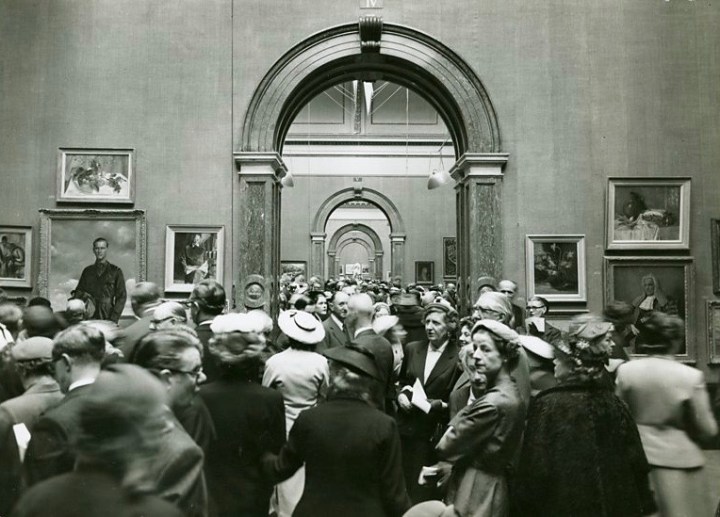
The Main Galleries of the Royal Academy of Arts during the Summer Exhibition, 1956 (unidentified photographer working for Keystone Press Agency Ltd. Photo credit: © Royal Academy of Arts, London)
◊ ◊ ◊ ◊ ◊
From the PMC:
A Year’s Art: The Royal Academy Summer Exhibition, 1769–2016
The Paul Mellon Centre for Studies in British Art, London, 29–30 September 2016
Proposals due by 17 June 2016
2018 will see the opening of a major exhibition devoted to the history of the Royal Academy’s annual Summer Exhibition. Provisionally entitled The Great Spectacle: The Royal Academy and Its Summer Exhibitions, 1769–2018, this display is planned to take place in what will be the Academy’s newly expanded and interconnected premises in Burlington House and Gardens. Forming part of the Academy’s 250th Anniversary celebrations, the exhibition will be curated by Mark Hallett and Sarah Turner of the Paul Mellon Centre, with the assistance of the Academy’s Per Rumberg and the PMC’s Jessica Feather.
Alongside the exhibition and its accompanying catalogue, the PMC members of the team are planning to develop an extensive, multi-authored online chronicle of the RA Summer Exhibition’s histories. This will take the form of a series of 250 short, illustrated texts—of around 1000 words each—that will focus on every individual exhibition in turn, beginning with the first such display, held in 1769. Featuring a wide range of scholarly and critical voices telling a multitude of stories about the exhibition, the chronicle will be developed in tandem with an ambitious digitisation programme that will place historic and contemporary summer exhibition catalogues online. This innovative project is designed to offer scholars, students, and exhibition-visitors with an intellectually lively online resource for research and learning, long after the exhibition itself closes. Whilst focusing on the Academy’s summer exhibitions, it will also contribute to the growing field of study on exhibition histories more broadly. As the longest running exhibition of contemporary art in the world, the Royal Academy Summer Exhibition offers an extremely rich focus for this area of research.
In advance of the 2018 Great Spectacle exhibition, the Paul Mellon Centre is organising and hosting a two-day event that is designed to highlight and develop new perspectives on the Academy’s display. The conference will take place on 29th–30th September 2016.
In the spirit of our planned online chronicle, the conference will be structured around groupings of short papers dealing with individual years in the exhibition’s history. It is designed to be fast-moving, provocative, and surprising, and to feature time both for speedy feedback and extended discussion. We invite proposals for 1000-word papers that, through focusing on an individual year, enable us to think afresh about the Royal Academy’s summer exhibition, and that do so from different art-historical perspectives. The premium on such papers will be to deliver pithy, refreshing, and original insights into the exhibition: to offer an illuminating art-historical snapshot, alighting on a particular work or artist, or a prominent theme to come out of an individual year.
We are especially keen to showcase new research into the histories of the exhibition and into its contemporary character, appeal, and function. We invite proposals that deal with the different kinds of objects that have been exhibited at the Academy, including sculpture, drawings, prints, and architectural models, as well as the paintings that have been the mainstay of the display since its inception. Proposals might focus on the summer exhibition as a venue of artistic competition and collaboration; on its status as an entertaining form of urban spectacle; on the interaction of works of art within its walls; on its fluctuating critical fortunes and its shifting status within the British art world; on the role of women artists within its history; on its position within the London social scene; on the function and impact of its selection and hanging committees; on its engagement with the themes of war, empire and celebrity; on the kinds of art-criticism it has generated; and on a wide range of other topics. We especially welcome applications from junior scholars and researchers, as well as from experienced academics, curators, critics and independent art-historians. Cross-disciplinary, comparative and collaborative studies are also very welcome.
Please submit proposals, of no more than 250 words, together with a short cv to Ella Fleming (efleming@paul-mellon-centre.ac.uk) by Friday, 17th June 2016. We will accept up to three proposals from individual applicants, and we would encourage multiple proposals to be on non-sequential years. Travel and accommodation will be provided for speakers travelling from outside the London area.
Call for Papers | Art and War
From H-ArtHist:
Art and War: New Perspectives
The Frick Collection, New York, 16 September 2016
Proposals due by 16 June 2016
The Frick Collection is pleased to invite submissions for Art and War, a symposium that will accompany the special exhibition Watteau’s Soldiers: Scenes of Military Life in Eighteenth-Century France. On view from July 12 to October 2, 2016, the exhibition presents a selection of Jean-Antoine Watteau’s little-known drawings and paintings of military life. In these works, Watteau eschews martial glory in favor of depicting more mundane aspects of life on the front: fatigue, boredom, simple diversions. Prompted by Watteau’s singular vision of war, The Frick Collection solicits 25-minute papers that consider the relationship between art and war in ways both direct and oblique, across all media, geographic regions, and time periods. We welcome a range of approaches that engage critically with the historical and theoretical problems posed by the relationship between art and war.
Questions to be addressed include, but are not limited to
• What representational pressures and aesthetic challenges has war created?
• Where have artists located themselves in, away from, or after ‘the fight’?
• How can art convey the experience of war—not only the violence of battle, but also its impact on everyday life?
• How has art glorified, condemned, or otherwise commented on war?
• What can we learn from examining this relationship in an age of perpetual war?
Please send a 250-word abstract and CV by Thursday, June 16, 2016, to Caitlin Henningsen (henningsen@frick.org) and Aaron Wile (wile@frick.org). Proposals from emerging scholars are particularly encouraged.
Call for Papers | HECAA Session at UAAC, 2016
Thanks again to Christina Smylitopoulos, HECAA is scheduled to be represented at this year’s UAAC Conference! Details and a full list of panels (65 in all) are available here»
◊ ◊ ◊ ◊ ◊
Universities Art Association of Canada / l’association d’art des universités du Canada
Université du Québec, Montréal, 27–30 October 2016
Proposals due by 24 June 2016
HECAA Open Session (Historians of Eighteenth-Century Art and Architecture)
The objective of this society is to stimulate, foster, and disseminate knowledge of all aspects of visual culture in the long eighteenth century. This HECAA open session welcomes papers that examine any aspect of art and visual culture from the 1680s to the 1830s. Special consideration will be given to proposals that demonstrate innovation in theoretical and/or methodological approaches. Please email proposals for 20-minute papers to Dr. Christina Smylitopoulos (University of Guelph), csmylito@uoguelph.ca.
Call for Papers | Understanding Material Loss
From the conference website:
Understanding Material Loss across Time and Space
University of Birmingham, 17–18 February 2017
Proposals due by 14 October 2016
 Understanding Material Loss across Time and Space is an innovative conference that will take place in 2017 at the University of Birmingham. Kate Smith, who works as Lecturer in Eighteenth-Century History, is organizing the conference to complement her current research on loss, lost property, and the making of modern Britain. Rather than focus solely on modern Britain, however, the conference seeks to consider the methodological and historical insights that might be revealed by utilizing loss as significant analytical framework across time and space, particularly when examining the material world.
Archaeologists, anthropologists, philosophers, literary scholars, sociologists and historians have increasingly come to understand the material world as an active and shaping force. Nevertheless, while significant, such studies have consistently privileged material presence as the basis for understanding how and why the material world has played an increasingly important role in the lives of humans. In contrast, Understanding Material Loss suggests that instances of absence, as much as presence, provide important means of understanding how and why the material world has shaped human life and historical processes.
Speculative and exploratory in nature, Understanding Material Loss asserts that in a period marked by ecological destruction, but also economic austerity, large scale migration, and increasing resource scarcity, it is important that historians work to better understand the ways in which humans have responded to material loss in the past and how such responses have shaped change. Understanding Material Loss asks: how have humans historically responded to material loss and how has this shaped historical processes? The conference will bring together a range of scholars in an effort more to begin to explore and frame a problem, than provide definitive answers.
Confirmed keynote speakers include
• Pamela Smith, History, Columbia
• Simon Werrett, Science and Technology Studies, UCL
• Maya Jasanoff, History, Harvard
• Jonathan Lamb, English, Vanderbilt
• Anthony Bale, English and Humanities, Birkbeck
• Astrid Swenson, Politics and History, Brunel
Understanding Material Loss seeks to uncover the multiple practices and institutions that emerged in response to different forms of material loss in the past and asks, how has loss shaped (and been shaped by) processes of acquisition, possession, stability, abundance and permanence? By doing so it seeks to gauge the extent to which ‘loss’ can be used as an organizing framework of study across different disciplines and subfields. Understanding Material Loss seeks papers from across a variety of time periods and geographies. Although open and speculative in nature, this conference will focus on three broad topics within the wider rubric of loss, in order to facilitate meaningful conversations and exchanges.
Using Materials
• How has the ‘loss’ of particular materials affected scientific practice, manufacturing, architectural design or development in the past?
• How have humans responded to the partial loss or decay of materials?
• How have ‘lost’ skills or knowledge affected the use of materials?
• How have humans re-appropriated or recycled seemingly damaged or obsolete materials?
Possessing Objects
• How have humans sought to maintain and mark the ownership of objects?
• How has the loss of possessions and property affected human mobility and constructions of identity?
• How have communities historically responded to the loss of particular objects? When and why have they sought to stave off the loss of things?
• Where, when and how have cultures of repair flourished?
• How has the loss of possessions and property (or the potential for loss) affected processes of production, consumption or financial stability?
Inhabiting Sites and Spaces
• When and why have particular sites or buildings been understood as destroyed or obsolete?
• How have past societies responded to the loss of particular sites?
• When and how have landscapes been actively purged of symbols and sites?
• How have past societies worked to rebuild or reclaim particular sites?
• What strategies did past societies develop to ensure the resilience of certain structures?
If you are interested in participating in the conference, please send proposals (250 words max per paper) for papers and panels to conference organizer Kate Smith (k.smith@bham.ac.uk) by Friday 14 October 2016. Papers should not exceed 20 minutes. Roundtable panels featuring 5–6 papers of 10 minutes each or other innovative formats are encouraged.
Thanks to Past & Present and the University of Birmingham for their generous support for the conference.










leave a comment