Call for Session Proposals | ASECS 2017, Minneapolis
Panel proposals are due this weekend:
2017 American Society for Eighteenth-Century Studies Conference
Minneapolis, 30 March — 2 April 2017
Session Proposals due by 15 May 2016
Proposals for panels at the at the 48th annual meeting of the American Society for Eighteenth-Century Studies, to take place in Minneapolis, are now being accepted. Please complete the form (available as a Word document) and email it to asecs@wfu.edu.
Please note that in accordance with the Handbook on the Annual Meeting, III. The Conduct and Procedures of Seminars [i.e. Sessions]; E. No person may present more than one paper at a single annual meeting or appear more than twice on the program excluding participants in plenary sessions and winners of the Innovative Course Design Competition. This means that in addition to presenting a paper, a person may also serve as either a session chair, a respondent, OR a panel discussant. A person who does not present a paper may serve in no more than two of these other capacities. It is not permitted for a session chair to present a paper in his/ her own session.
Please note also that in order to hold down the number of concurrent sessions, which has increased considerably over the last decade, the Executive Board has decided that requests for double sessions will no longer be entertained.
As a reminder, ASECS caucuses continue to be guaranteed two sessions and affiliate societies one session; regional societies are no longer guaranteed a session on the program unless they are meeting jointly with ASECS when it is in their region. Like individual members, affiliate societies, regional societies, and caucuses are encouraged to submit session proposals to be considered by the Program Committee.
Call for Papers | Warburg Postgraduate Symposium: Cultural Encounters
From the conference website:
Warburg Institute Postgraduate Symposium
Cultural Encounters: Tensions and Polarities of Transmission
from the Late Middle Ages to the Enlightenment
The Warburg Institute, London, 17 November 2016
Proposals due by 31 May 2016
The Warburg Institute will host its first postgraduate symposium on 17 November 2016. It will explore the concept of cultural encounters and focus particularly on their productive outcomes. We are interested, above all, in the dynamics of cultural change across time and space. The symposium will be multidisciplinary and will cover topics that fall into the unique classification system of the Warburg Library: Image, Word, Orientation and Action.
The aim of the symposium will be to map the diverse and intricate forces which have driven cultural encounters in the past and which also help define contemporary societies. Amongst the questions that we hope to address are: the degree to which productive outcomes can be seen as a conscious reception and reformulation of external ideas and models; resistances to exchange and in what form; the long-term implications of such encounters and their outcomes.
The symposium is intended for postgraduate students and early career researchers. It will bring together speakers from different backgrounds in the humanities and draw on a variety of disciplinary tools and methodologies. Submissions are invited across a wide range of topics represented by the global cultural interests of the Warburg Institute, including but not limited to:
• Artistic creations: forms, models, styles
• Literary productions and transmission of texts: translations, adaptations, copies
• Philosophy, rhetoric and transmission of ideas
• Personal encounters: Academies, universities and epistolary exchanges
• Encounters with the ancient past: reception, interpretation, visualisation
• Religious encounters, propaganda and politics
• Geographical discoveries: new continents, new cultures and animal species, etc.
• Scientific innovation: findings, theories, inner contradictions, etc.
Proposals for papers should be sent to warburg.postgrad@gmail.com by 31 May 2016:
• Maximum 300-word abstract, in English, for a 20-minute paper, in PDF or Word format
• One-page CV, including full name, affiliation, contact information
All candidates will be notified by 31 July 2016. Limited funding to help cover travel expenses is available. Attendance is free of charge.
Organized by Desirée Cappa, Maria Teresa Chicote Pompanin, James Christie, Lorenza Gay, Hanna Gentili, Federica Gigante, and Finn Schulze-Feldmann
Call for Papers | SAH 2017, Glasgow
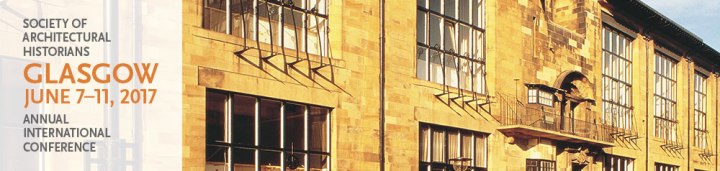
From SAH:
2017 Society of Architectural Historians Conference
Glasgow, 7–11 June 2017
Proposals due by 6 June 2016
The Society of Architectural Historians is now accepting abstracts for its 70th Annual International Conference in Glasgow, Scotland, June 7–11. Please submit an abstract no later than June 6, 2016, to one of the 32 thematic sessions, the Graduate Student Lightning Talks, or the open sessions. The thematic sessions have been selected to cover topics across all time periods and architectural styles. SAH encourages submissions from architectural, landscape, and urban historians; museum curators; preservationists; independent scholars; architects; and members of SAH chapters and partner organizations.
Please note that those submitting papers for the Graduate Student Lightning Talks must be graduate students at the time the talk is being delivered (June 7–11, 2017). Open sessions are available for those whose research does not match any of the themed sessions. Instructions and deadlines for submitting to themed sessions and open sessions are the same.
Submission Guidelines
1 Abstracts must be under 300 words.
2 The title cannot exceed 65 characters, including spaces and punctuation.
3 Abstracts and titles must follow the Chicago Manual of Style.
4 Only one abstract per conference by author or co-author may be submitted.
5 A maximum of two authors per abstract will be accepted.
Abstracts are to be submitted online at the SAH website.
A selection of sessions of particular relevance for scholars working on the eighteenth century are included below. See the call for papers for the full list.
◊ ◊ ◊ ◊ ◊
‘A Narrow Place’: Architecture and the Scottish Diaspora
Session Chair: Neil Jackson, University of Liverpool
This session, which is hosted by the Society of Architectural Historians of Great Britain, invites papers on Scottish architects who have made their mark outside their native country. Despite the Acts of Union of 1707, south of the border was, and still is, a separate country, and it has been in England that many Scottish architects, from James Gibbs to Norman Shaw and Basil Spence have built their best work. The colonies, and later the British Empire, attracted a disproportionate number of Scots: to America went Robert Smith who built Nassau Hall at Princeton University and who sat on the First Continental Congress of 1774, while to Canada, South Africa, Australia and New Zealand went others, either to official positions or simply to make a living. Most recently, in 2015, Kirsteen MacKay was appointed Government Architect in South Australia. “Scotland,” Robert Adam wrote in 1755, “is but a narrow place.” Was it just the opportunities offered elsewhere which, for so long, drew Scottish architects abroad, or something deeper—a need to atone for the supposed barrenness of their own country? Is there something in the Scottish architects’ character and education that allows them to be so peripatetic? What made Colen Campbell, Robert Adam and James Stuart, all resident in England, such propagandists of foreign architectures? Was it no more than informed patronage which brought Charles Cameron to the Moscow of Catherine the Great or encouraged James Stirling to design university buildings at Rice, Harvard, Cornell and UC Irvine—but only once in Scotland, at St Andrews? And could Kathryn Findlay ever have achieved in Scotland what she did in Japan? Papers which investigate any architectural aspect of the Scottish diaspora will be welcome.
◊ ◊ ◊ ◊ ◊
Architectural Ghosts
Session Chairs: Karen Koehler, Hampshire College, and Ayla Lepine, University of Essex
This session explores the concept of the ghostly in architecture. While the ‘ghost’ in architecture might refer to actual haunted places, it also refers to the unfinished, the remnant, the referenced, the remembered, and the ruined. How, when, and where do we find and interpret the ghostly in architecture? Whether it be the flicker of spatial remembrance like a passing sense of cold, the palimpsest of a former window on a solid brick wall, or a crumbling foundation overgrown in the woods—spirits, souls, traces, and the spaces in between abound in our experience of, and critical approaches to, architecture and its histories. The ghostly can complicate ideas about originality, temporality, authenticity, and the sacred. It may imply a process of design that could linger in uncanny twilight between the conscious and the unconscious. Moreover, might architectural ghostliness lure us towards nostalgia, utopia, and imagined histories? Architects haunted by various histories may be caught up in the ghostly too: the spectres of lost opportunities or ruined spaces, and, significantly, the persistent power of the past. The concept of the architectural phantom could equally imply spaces of the ephemeral—opening up possibilities of the architectural image in visual culture or performative practices. What can writers—from ancient dramas to gothic tales to modern critical theory—offer to the study of the ghostly in design? We are interested in papers that explore any aspect of the architectural ghost: the unfinished project, the troubled biography, the voices of the memorialized in monuments or crypts, the fragment and its imagined completion, or any case study or theoretical paradigm in which architectural apparitions, residues, shadows or wraiths might be found.
◊ ◊ ◊ ◊ ◊
Architecture and Carbon
Session Chairs: Jason Nguyen, Harvard University, and Marrikka Trotter, Harvard University
In the eighteenth century, the scientist René-Antoine Ferchault de Réaumur set about differentiating steel from cast iron. What separated them, he discovered, was their carbon content, and he praised the lower levels in steel for its artistic and industrial benefits. Later, John Ruskin lectured his Victorian audience that limestone was nothing but carbon, air, and lime: “the breath of the earth joining with the cold metals produced a thing that was a blessing to man.” Today, the element evokes images of damaging excess rather than the promise of a limitless resource. Creating a ‘carbon-neutral economy’ was the goal of the COP21 conference, which proposed leveraging taxes against greenhouse emissions. As these examples suggest, architecture’s entanglements with carbon range from materials science to ethical claims and cultural taboos. Yet even casual borrowings like the expression ‘the building block of life’ underscore carbon’s fundamental role in human existence. On the one hand, it is an essential component of all living assemblies, from DNA to the plants and animals making human life possible. On the other, as we plunder the carbon-rich remains of previous mass-extinctions, we risk precipitating our own. This panel seeks to probe architecture’s relationships with carbon in its multiple guises, across any period or region. We ask that papers attend to architecture’s engagement with nature in its elemental forms, preferring case studies to trans-historical speculation. How has the study, manufacturing, or use of carboniferous resources influenced architecture and its discourses? What are the stakes where the ‘organic’ or ‘sustainable’ are concerned? What avenues have been opened by non-carbon-based products like glass and silicon? How might these inquiries relate to larger discussions on nature and man’s place within it?
◊ ◊ ◊ ◊ ◊
Chinese Architecture and Gardens in a Global Context
Session Chair: Tracy Miller, Vanderbilt University
Although known as one of the world’s most distinctive cultural traditions, the architecture of China did not develop in isolation. Ongoing research in the field continues to break new ground regarding the complexity of the ‘architectures’ of traditional China and the ways in which they influenced, and were influenced by, the artistic and philosophical traditions of other regions. The goal of this panel is to provide a forum to discuss the influence of global networks of exchange on the development of the architecture China, broadly construed. Possible topics would include: the impact of non-native religious traditions, such as Buddhism and Islam, on the development of temple architecture; how conceptions of paradise and the exotic from South and West Asia inspired innovations in landscape garden design in the Chinese context; the influence of Chinese garden design and horticulture elsewhere in Eurasia and the US; and how concerns for sovereignty impacted the choice of architectural style in East Asia during periods of aggressive imperialism in the recent, and more distant, past. In an effort to foster lively discussion and introduce creative approaches to the examination of the role of China within global architectural history, the final panel will be composed of papers emerging from a variety of theoretical and methodological perspectives.
◊ ◊ ◊ ◊ ◊
Colour and Light in Venetian Architecture
Session Chairs: Andrew Hopkins, University of L’Aquila, and Deborah Howard, University of Cambridge
The session explores the ways in which architects in Venice manipulated colour and light. How did light reflected upward from water surfaces influence design decisions on canal facades? How was lighting adapted to the respective needs of coloured or whitewashed interiors? Shadows and darkness also deserve attention. That the facades of both major plague churches, the Redentore and the Salute, are almost permanently in shadow might have a symbolic meaning. The use of Murano glass chandeliers seen through large windows changed the city’s appearance at night, making Venetian palaces glow like lanterns. How were streets and campi lit after dark: did moonlight and starlight prove adequate in a less lightpolluted environment than today? In what ways were lighting and colour controlled or modified to create a particular religious effect? How were existing churches modified in the post-Tridentine era? How did the hanging of carpets and tapestries transform church interiors and palace facades on special occasions? How did the use of coloured materials change over time? Did the availability of marbles and glass mosaic condition the local demand for polychromy? Did the colours used in Venetian painting, and the flourishing trade in pigments, influence architectural patronage and practice? Did colour symbolism confer specific meanings on different marbles? What effect did the burgeoning phenomenon of architectural treatises—all printed in black and white— have on the perception of architectural colour from the sixteenth century onwards? How were changes to material colour perceived, such as the rebuilding in stone of the Rialto bridge rather than in wood? Can different colour choices be defined for different patronage groups? This session invites proposals on any dimension of the use of light and colour in the Venetian townscape, whether in terms of design, construction or meaning.
◊ ◊ ◊ ◊ ◊
Evidence and Narrative in Architectural History
Session Chairs: Michael Osman, University of California, Los Angeles, and Daniel M. Abramson, Tufts University
To write histories of architecture necessarily employs tools of rhetorical persuasion: what facts to select in support of an argument, and how to sequence events to tell a convincing story. Architectural historians, however, have generally not been self-conscious about these devices. What kinds of facts are deployed as evidence in architectural history? What kinds of stories do we tell to make sense of events? How have strategies for evidence and narrative evolved over time in architectural history? Nor have architectural historians usually explored the methods of evidence and narrative they share with other disciplines, and what may be particular to architectural history. Like other historians, for example, architectural historians take much of their evidence from textual archives. But photographs, drawings, buildings, and other material objects also support our arguments and stories. How are these materials selected and deployed as evidence in architectural history? How do they relate to techniques for developing evidentiary claims in other fields, such as science or law? This session, on the uses of evidence and narrative in the historiography of architecture, welcomes papers from all periods and all geographies. The aim is to focus on methodological questions in historical scholarship. Papers may focus on a particular text or work of an architectural historian; or within a group of texts and/or figures within a period in architectural history. Papers may also treat narrative and/or evidence in architectural history from a theoretical perspective, and in comparison with other disciplines. We are particularly interested in papers that point to specific problems of using evidence and narrative to position buildings, cities, and architectural techniques, in a broader account of historical change.
◊ ◊ ◊ ◊ ◊
Piranesi at 300
Session Chairs: Heather Hyde Minor, University of Notre Dame, and John Pinto, Princeton University
Giovanni Battista Piranesi (1720–1778), one of the most outstanding graphic artists of any age, made enduring contributions to both the representation of architecture and the narrative of its history. Through the alchemy of his etching needle, he gave expression to the mute poetry of Roman ruins. Piranesi also published a series of artfully structured volumes in which he orchestrated textual erudition and visual pyrotechnics to advance his polemical views on the history of architecture. Always a passionate advocate of the virtues of creativity and innovation over blind adherence to rules, Piranesi became a touchstone in the roiling Quarrel of the Ancients and Moderns. Piranesi’s polemical publications and extensive corpus of over one thousand prints extended his reach and exerted a powerful influence on architectural discourse that persists into our own day. Much new information relating to Piranesi has emerged in recent years, such as numerous drawings, archival documents, and the eloquent testimony of his surviving copper plates, which have recently been conserved. In the run-up to the three-hundredth anniversary of Piranesi’s birth in 2020, we propose a session that will provide a fresh view of Piranesi and his place in the history of architecture. We invite papers that address such themes as Piranesi’s representational strategies, his polemical vision of architectural history, his audience and reception, as well as how his ideas and his art have been taken up in more recent years.
◊ ◊ ◊ ◊ ◊
Graduate Student Lightning Talks
Session Chair: R. Scott Gill, University of Texas at Austin
The Graduate Student Lightning Talks provide graduate students with an invaluable opportunity to test their ideas, refine their thoughts, and enhance their presentation skills among a circle of empathetic and supportive peers. This session is composed of approximately 12 five-minute talks that allow graduate students to introduce their current research. We are seeking work in various forms, including a focused summation, concentrated case study, and methodological exegesis. The individual talks are divided into thematic groups with a short question and discussion period following each set of presentations. Graduate students are invited to submit a concise abstract (under 300 words). Authors/co-authors must be graduate students at the time the talk is being delivered (June 7–11, 2017). Preference will be given to doctoral students, but all graduate students are encouraged to apply, and the Lightning Talks co-chairs welcome geographic and institutional diversity.
Call for Papers | Entertaining the Georgian City
2016 Fairfax House Georgian Studies Symposium
Polite and Impolite Pleasures: Entertaining the Georgian City
Fairfax House, York, 21 October 2016
Proposals due by 29 July 2016
The Georgian era saw a great increase in the variety of entertainments available to an expanding and urbanising population, and it was in towns and cities that eighteenth-century cultures of recreation and leisure, both ‘high’ and ‘low’, were most developed. From theatrical performances and musical recitals, assemblies and dances, to race meetings, boxing matches, cock fights and hangings, Georgian urban life offered a dazzling and constantly changing kaleidoscope of polite and impolite pleasures.
In Georgian cities the lowest and the highest forms of entertainment were catered for along with everything in between, from the cultivated recreations of the nobility through the gentility of middle-class leisure to the earthier enjoyments of the ‘common folk’. New cultures of entertainment reflected changing patterns of work, mobility and social relations, and reflected developments in class, gender and the dynamics of personal and collective identity. The urban environment itself was affected by these changing cultures of entertainment. From London to provincial centres, industrial cities to market towns, new promenades, parks, streets and squares were developed, new theatres, assembly rooms and concert halls were built and embellished. And paralleling this brightly-lit and orderly world of polite pleasure was another, darker urban realm of more dubious diversions: prostitution and prize fights, the gambling stew and the drinking den.
This symposium, the fourth Fairfax House Symposium in Georgian Studies, aims to explore the theme of entertainment with particular reference to the concept of ‘polite and impolite pleasures’ in an urban context during the long eighteenth century (c.1680–c.1830). Contributions in the form of papers not exceeding 20 minutes in length are invited addressing relevant topics which may include, but are certainly not limited to:
• The city as a focus for polite and impolite entertainments
• Entertainment shaped by, and a shaper of, the Georgian city
• Urban/rural interaction in Georgian entertainments
• High and low in eighteenth-century urban entertainments
• Selling entertainments: publicity, advertising, industries of pleasure
• Questions of class, gender and identity in entertainment
• Entertainments: spectators and spectacle
• Policing pleasure in the city
Please send proposals of around 200 words, accompanied by a brief one-paragraph biography, to fairfaxhousesymposium@gmail.com by Friday 29 July 2016.
Call for Papers | NEASECS 2016, UMass Amherst
From NEASECS:
NEASECS Annual Conference
Translation, Transmission, Transgression in the Global Eighteenth Century
University of Massachusetts Amherst, 20–22 October 2016
Proposals due by 1 April 2016 / 15 May 2016
The annual meeting of NEASECS will be held at the UMass Amherst Campus Center. The theme is Translation, Transmission, Transgression in the Global Eighteenth Century. The conference will include a plenary address by Suvir Kaul from the University of Pennsylvania and a performance of Molière’s The Misanthrope; the registration fee will include two cocktail receptions, a banquet dinner on Friday night, and continental breakfasts.
Possible topics include translations, transmissions, and transgressions across cultures, languages, and literatures; across local and national borders; and across gender identities, racial identities, and class identities in the global eighteenth century. How do texts and ideas travel? Who and what determines when a translation or transmission crosses over into a transgression? Papers could address empire and colonialism, war, the slave trade, the book trade, Orientalism, and constructions of nation, nationality, and race. In keeping with NEASECS tradition, panels and papers devoted to elements of the long eighteenth century not directly related to the conference theme are also welcome.
Proposals for panels or roundtables should be uploaded to the online submission page by April 1. Organizers should submit a CV and a 100–200 word summary of the topic. Once a session has been approved, it will be posted to the conference website; individuals should submit abstracts and CVs directly to the organizer. Completed panels should be submitted to the organizing committee by May 15.
Individual paper proposals, including a CV and a 250-word abstract, should be uploaded to the online submission page by May 15. Individuals will be notified of the status of their proposals by June 15. Prior to submitting your individual proposal, please review the listing of approved panels on the ‘Approved Panels’ tab on the website. If you wish to join one of the approved panels, please email your paper proposal to the session chair directly before May 15.
◊ ◊ ◊ ◊ ◊
‘Approved panels’ include these, which may be of particular interest to art historians:
French Women Artists in England
Nadine Berenguier, University of New Hampshire (nsb@unh.edu)
Many French women artists left France and took up residence in England for extended periods of time during the long 18th century. Their reasons varied as much as their experiences abroad, but all were influenced by and influenced the culture in their new home. This panel will focus on women artists who became part of that migration, and how their British ‘séjour’ influenced them and their artistic endeavors and conversely what their impact was across the Channel.
Worldly Objects: Decorative Arts in the Long Eighteenth Century
Alden Cavanaugh, Indiana State University (alden.cavanaugh@indstate.edu)
This session welcomes papers that address the global decorative arts in the eighteenth century: that is, the intricate systems of transmission and translation that governed and created decorative objects, as well as the spaces in which those objects were displayed or used. Papers that use innovative or novel approaches in the interest of exploring decorative arts and/or interior design as manifestations of a transcontinental or global focus are particularly desirable. Potential topics could include, but are not limited to: Translations (or mistranslations) of styles, subject matter or narratives Trade, supply, or logistics Secondary markets Conceptions of Others (Chinoiserie, Turquerie, etc.) Fashions in decorative arts Marketing or production issues Economic realities related to decorative arts or interior decoration Lacquer, porcelain, glass, metalwork, jewelry, furniture, textiles or other material production Material exoticism Nationalistic impulses Objects of self-fashioning or personal maintenance Patterns of consumption.
Transpositions of Locke’s Essay in Eighteenth-Century France
Sarah Cohen, University at Albany, SUNY (scohen@albany.edu)
Even before it was first published in English in 1690, John Locke’s An Essay Concerning Human Understanding appeared in a nascent Epitome translated and published by Jean Le Clerc in his Bibliothèque universelle et historique of 1688. With the full work translated into French by Pierre Coste in 1700, Locke’s arguments for sensory based knowledge would steadily become a central theme both in the work of French philosophes such as Condillac and in transformations that took place in natural sciences and the arts. This session invites proposals for papers addressing any aspect of how Locke’s Essay was used, translated, or transformed by French intellectuals and artists in the long eighteenth century.
Call for Papers | Association of Print Scholars at CAA 2017, New York
Collaborative Printmaking across Cultures and Time
Association of Print Scholars Session at CAA, New York, 15–18 February 2017
Chair: Jasper van Putten, Harvard University
Proposals due by 31 March 2016
Printmaking, from its earliest to its most recent expressions, has generally been characterized by collaboration. This panel explores the impact of collaboration on the artistic practice of printmaking across various cultures and times. In the West, renaissance printmaking was characterized by divisions of labor that designated specific tasks of professionals. Designers, woodcutters, engravers, printers, and publishers indicated their respective role on the prints they helped produce with designations such as invenit [invented], delineavit [traced/delineated], or excudit [printed/published]. The production of Japanese woodcuts in the nineteenth century was similarly defined by collaboration and specialization. Generally, publishers commissioned drawings from artists, which were transferred to wood, cut, and printed by specialized craftsmen on behalf of the publisher. Collaboration also characterized much of the printmaking in the modern period, despite the emphasis on artistic individuality in this time. Artists like Édouard Manet, Pablo Picasso, and Robert Rauschenberg produced some of their most celebrated prints in collaboration with master printmakers. More recently, digital social networks have opened up completely new venues for artistic collaboration. As technology has made sharing of images and ideas faster and easier than ever before, it stands to reason that artistic collaboration also changes.
Scholars have studied the more famous collaborations in the history of printmaking in great detail. Still, the impact of collaboration on artistic practice is often overlooked. Blockbuster shows especially tend to focus on famous artists and neglect the vital contributions of other individuals. How did the contributions of craftsmen, patrons, publishers, and agents impact the prints they helped produce and disseminate? How was their relative input valued and remunerated? To what extent can we interpret prints as the products of networks of different makers? Answers to such questions will differ from time to time and from place to place. This panel seeks to further our understanding of collaborative printmaking by seeking submissions engaging these issues from any culture and era. Side-by-side, these papers will highlight commonalities and differences with the aim to obtain unexpected insights. Especially welcome are contributions that make use of network theory to account for the total range of actors involved in collaborations. Also of special interest are papers that engage the role of digital tools and social networks in facilitating collaborations in contemporary printmaking.
Please send an abstract of 250 words or less and a CV to Jasper van Putten (jaspervputten@me.com) and info@printscholars.org by March 31, 2016.
Call for Papers | Décor and Architecture
From H-ArtHist:
Décor and Architecture in the 17th and 18th Centuries:
Between Adherence and Autonomy / Entre union et séparation des arts
University of Lausanne, 24–25 November 2016
Proposals due by 30 May 2016
During the early modern period, décor was considered to be one of the most fundamental elements of architecture. Thanks to décor, architecture could elevate itself beyond simple masonry and claim a superior status. Décor was thus defined as a necessary prerequisite for architecture, rather than a marginal component. However, despite its privileged status, many authors mistrusted it, fearing the harmful effect which an uncontrollable proliferation of ornament would surely have on architecture. This conference aims to question how the relations between decor and architecture were defined and implemented in Europe in the 17th and 18th centuries.
Our perception of these relations has often been informed by teleological approaches: indeed, the radical ideas conveyed by certain 20th-century texts, which define décor as an unnecessary bi-product of architecture, have acted as a distorting prism. History of art, for its part, has often separated décor-related studies from architecture-related ones, suggesting a de facto rupture between these fields and potentially biasing our understanding of the artistic production of the early modern period by reducing its scope. As various case studies have shown, the conditions to which the invention of a décor was subjected varied greatly from one building to another. The architects’ prerogatives differed according to the circumstances and constraints imposed on them: while some were largely involved in the invention of the décor, others delegated its conception to artists or workmen.
The following questions—as well as many other similar ones—may be used as a framework for the presentations:
• The term ‘décor’ defines a vast field with no distinct boundaries, potentially covering everything from sculptures, stucco work, paintings, panelling, mirrors and furniture to architectural orders. How did theorists, artists, connoisseurs and patrons define the relations between décor and architecture? In what circumstances was it felt that décor had exceeded its mandate and thus presented a threat to architecture? Were all excesses systematically condemned?
To this discussion of theory can be added several practice-related questions:
• Who was in charge of the invention of a décor and what consequences could a possible sharing of tasks have on the architectural project? To what extent were theoretical principles implemented on the building site? Case studies focusing on architects, artists or workmen could question their part in the creation of a décor.
Finally, historiography raises its own issues:
• How have the discourses developed in the 17th and 18th centuries been understood and interpreted in later times? How has the reception of these discourses biased our perception of the relations between décor and architecture in the 17th and 18th centuries?
Paper proposals which exceed the set chronological limits may be taken into account by the scientific board, if they shed pertinent light on the questions raised in the conference. Papers will be 30 to 40 minutes long, followed by 15- to 20-minute discussions. Paper proposals of up to 300 words—accompanied by a brief résumé and list of publications—should be sent to Matthieu Lett (matthieu.lett@unil.ch) and Carl Magnusson (carl.magnusson@unil.ch) before 30th May 2016.
Organisers
Matthieu LETT (université de Lausanne, université Paris Ouest Nanterre La Défense)
Carl MAGNUSSON (université de Lausanne, The Courtauld Institute of Art)
Scientific Committee
Marianne COJANNOT-LE BLANC (université Paris Ouest Nanterre La Défense)
Alexandre GADY (université Paris-Sorbonne)
Dave LÜTHI (université de Lausanne)
Christian MICHEL (université de Lausanne)
Werner OECHSLIN (Eidgenössische Technische Hochschule Zürich)
Antoine PICON (Harvard University)
Katie SCOTT (The Courtauld Institute of Art)
Call for Papers | Seeing Through? The Materiality of Dioramas
From H-ArtHist:
Seeing Through? The Materiality of Dioramas, 1560–2010
University of Bern, 1–2 December 2016
Proposals due by 31 May 2016
Dioramas are at the crossroads of artistic and scientific practices. They bring together artists, scientists, and collectors, thus providing an opportunity to reflect on the polyvalence of these actors and the definition of their expertise. In 1822, Louis Daguerre coined the term ‘diorama’ when describing his theater. The word diorama means literally ‘seeing through’. In accordance with this etymology, dioramas embody a sense of transparency and life-likeness. In addition to providing theatrical and visual experiences, dioramas are multidimensional installations that incorporate paintings, objects, stuffed animals or mannequins. Habitat groups mixing taxidermy and painted backgrounds were designed for natural history museums, while anthropological dioramas were disseminated all over Europe during the second half of the nineteenth century. They were usually life-sized and site specific, but they could also be reduced to maquettes.
To date, these installations have been studied by scholars from various disciplines, mainly as side topics. Media historians have considered them primarily as proto-cinematic, whereas within the fields of anthropology, museum studies and postcolonial studies, they are generally analyzed as displays that reflect political taxonomies and stereotyped representations.
However, dioramas are not merely images or displays: they are also physical objects made of multiple materials, such as plaster, wood, paper, paint, glass, fur, wax, and metal. The discipline of art history thus provides us with the opportunity to approach the materiality of these installations. Indeed, dioramas are composite and hybrid things, created through cultural interaction and physical encounter. Multiple hands as well as various visions are involved in the process of their creation—and later on, during their conservation. Dioramas therefore allow for the study of contact zones and material exchanges between private and public spheres, as well as between Western and non-Western contexts. Finally, dioramas as objects of study within the field of art history enable us to address values such as authenticity and realism in various contexts.
Part 1 A Genealogy, 1560–1822
This session will explore the diorama’s prehistory before its ‘invention’ by Daguerre, starting with objects, installations, and machinery created for churches and theaters between the sixteenth and eighteenth centuries. Three-dimensional installations, such as groups gathering natural history specimen (taxidermic animals, skeletons) will be of greatest interest. Presentations may focus on wax museums, and more broadly on hyperrealistic figures that were displayed in groups and used for entertainment as well as for pedagogical or medical purposes. Early forms of panoramas, and diaphanoramas will also be of primary importance, such as the creations of the Swiss landscape painter Franz Niklaus König, first exhibited in Bern in 1811.
Part 2 Dioramania, 1822–1970
The second session will consider the numerous dioramas created during the nineteenth and twentieth centuries. Habitat Groups and anthropological dioramas became very popular in international fairs and museums until the mid-twentieth century. They were common in both Western and non-Western cultures, and were especially prominent in the Middle East. In some cases, dioramas were intended to represent national identities and in others, they became forms of resistance used, for instance, by African-American or Native American communities. The contributions to this section may explore the creation of specific sets of installations in fairs, museums, and public space, as well as the politics of dioramas.
Part 3 Re-appropriation, 1970–2010
As of the 1970s, state-sponsored museums created displays of traditional craftsmanship through life-size dioramas, such as the Dubai Museum or the Jewels and Costume Museum in Amman. Native American community centers, such as The Mashantucket Pequot Museum in Connecticut, have been using life-size dioramas since the late 1990s. They are also being reinterpreted by contemporary artists, as shown, for example, in the photographs of Hiroshi Sugimoto. In that perspective, the re-exhibition of dioramas would be a topic of interest. Finally, writing the history of dioramas today might also be a way to reframe the creation of artistic movements such at Surrealism or Dada, as well as the work of such artists as Marcel Duchamp, Edward Kienholz, and Joseph Cornel, by filling in important gaps in the history of art, and the history of installations.
Submissions
An abstract of approximately 500 words and a brief CV should be sent to Noémie Etienne (netienne@getty.edu) and Nadia Radwan (nadia.radwan@ikg.unibe.ch) by May 31. Responses will be given by June 30. The colloquium will be held in English.
Call for Papers | HECAA at CAA 2017, New York
Superpowers in the Global Eighteenth Century: Empire, Colonialism, and Cultural Contact
HECCA Session at the Annual Meeting of the College Art Association, New York, 15–18 February 2017
Chair: Tara Zanardi (Hunter College / CUNY)
Proposals due by 5 April 2016 (in order to meet CAA’s 18 April due date)
The long eighteenth century witnessed European countries vying for global command, from fighting over territories in quick skirmishes or lengthy wars, forming new colonial outposts, pirating cargo, outwitting trade regulations, funding scientific expeditions that fueled the creation of natural history museums and collections and the improvement of cartographic knowledge, enacting free trade policies, and instituting competing trading companies. With the inauguration of new commercial routes for maritime travel and trading strategies, all in an effort to proclaim oneself a superpower, the circulation of goods increased exponentially, making products of all kinds available to a wider audience. While Portugal and Spain had dominated world trade and exploration beginning in the sixteenth century, the Dutch and English soon followed on their heels. Not all competition for global domination happened abroad or at sea: Debates about luxury, the preference for foreign over locally-manufactured goods, women’s role as active consumers and tastemakers, slavery, colonialism, and enlightenment ideas about race emerged on European soil, often pitting one country against another. Outside of Europe, colonists experienced greater independence, which fueled the desire to break from European control.
Within this geopolitical context, this panel seeks papers that address artistic engagement with the broad concept of the European superpower in the long eighteenth century. How did artists both respond to and generate interest in the global and imperial rule? While many artists accompanied expeditions abroad, others could only imagine the world beyond—how were such experiences of contact (real or imagined) expressed in visual terms? How did expanding international networks and political desire for global authority inform artists’ understanding and perspective of empire? How did artists actively support or challenge imperial narratives? This panel particularly welcomes papers that explore the intersection of art and empire by utilizing new methodological approaches to the study of empire, that investigate understudied sites of imperial and colonial history, and that showcase novel forms of artistic expression that employ, directly or subtly, imperial themes.
If you would be interested in participating in this panel, please contact the chair at tarazanardi@yahoo.com, attaching your proposal (limited to 400 words) and a brief CV by April 5, 2016.
Call for Papers | HBA Sessions at CAA, 2017
Conflict as Cultural Catalyst in Britain
HBA Session at the Annual Meeting of the College Art Association, New York, 15–18 February 2017
Chair: Michael J K Walsh (Nanyang Technological University, Singapore)
Proposals due by 7 April 2016
Let me have war, say I; it exceeds peace as far as day does night: it’s spritely waking, audible, and full of vent. Peace is a very apoplexy, lethargy; mull’d, deaf, sleepy, insensible; a getter of more bastard children than war’s a destroyer of men.
–William Shakespeare, 1607, Coriolanus, Act IV Sc. V
This panel investigates the relationship between struggle and conflict (be it social, political, territorial, ideological etc) and artistic production in Britain and its empire. More specifically, ‘Conflict as Cultural Catalyst in Britain’ interrogates the contentious philosophical notion that art thrives in times of war, and expires in peace, and then asks whether art, as a form of social barometer, can anticipate / foreshadow conflict, or merely respond to it. How has cultural production derived from conflict been used to create specific social identities, national histories and contemporary concepts of memory in Britain and beyond? A range of historically and geographically diverse case studies is encouraged, spanning both the globe and the centuries.
If you would be interested in participating in this panel, please contact the chair at mwalsh@ntu.edu.sg, attaching your proposal, limited to 400 words, together with a brief c.v., by April 7th, 2016.
◊ ◊ ◊ ◊ ◊
Transglobal Collecting: Co-Producing and Re-visioning British Art Abroad
HBA Session at the Annual Meeting of the College Art Association, New York, 15–18 February 2017
Chair: Julie Codell (Arizona State University)
Proposals due by 7 April 2016
This session will focus on art collecting of British outside Britain. The study of art collecting has blossomed; studies of agents, dealers, collectors and auctions are subjects of recent conferences (three in London in 2016 alone) and publications. Art collecting, both as a form of reception and as a form of art production (e.g., theories of Walter Benjamin, Pierre Bourdieu, museology studies), created new contexts, meanings, audiences and interpretations for art. Collecting intervened into aesthetic, national, economic, hermeneutic and social valuations of art. This was even more dramatic and transformative when collectors of British art lived outside Britain. Panelists may consider questions such as (but not limited to): How was an artwork’s social and cultural functions re-defined/re-purposed by distant geographies? How did distant collecting blend local, national and global ideas and interests? Did transatlantic or colonial collecting have distinct cultural features, purposes and identities? Did collected British art affect production of local/indigenous art outside Britain and vice versa? How did collecting British art abroad shape museums and cultural exchanges abroad? How was art positioned to affect distant spectators culturally and nationally, and who constituted that public?
If you would be interested in participating in this panel, please contact the chair at julie.codell@asu.edu, attaching your proposal, limited to 400 words, together with a brief c.v., by April 7th, 2016.










leave a comment