Call for Articles | British Art Studies, Issue 4 (November 2016)
British Art Studies Issue 4 (November 2016)
Articles due by 1 June 2016
British Art Studies is a new online journal published by the Paul Mellon Centre for Studies in British Art, London, and the Yale Center for British Art, New Haven. The journal provides an innovative space for the best new research on British art. We encourage submissions on all aspects of British art, architecture, and visual culture, ranging across periods and geographies and are now soliciting content for our fourth issue, due to be published in November 2016, marking our first anniversary.
The digital platform of British Art Studies offers new opportunities for displaying images alongside text and multimedia content. The editors are open to proposals and ideas from authors to develop innovative and visually stimulating ways to publish art-historical scholarship online.
We invite submissions of scholarly articles (which are subject to a rigorous peer review process), as well as proposals for innovative special features for issue 4. Texts may range from 5000 to 8000 words, although the editors will also consider shorter pieces. It is recommended that articles are illustrated with between 5 to 10 images, but the editors will consider image requirements on a case-by-case basis. Articles should be submitted by email in Word format, together with a Word document containing low resolution accompanying images (where possible), as well as a list of proposed images and sources, as outlined in our style guide, available at britishartstudies.ac.uk. For special feature proposals, an abstract of no more than 500 words, together with images should be submitted for initial consideration by the editors. Final numbers of images, and the sourcing and commissioning media for articles accepted for publication, will be decided in consultation with authors on an individual basis. British Art Studies will endeavour to meet reasonable costs and copyright issues for illustrative materials essential to the argument of published texts. Please note we are not currently accepting proposals for special issues of collected essays.
Please forward submissions to Hana Leaper (journal@paul-mellon-centre.ac.uk) by 1 June 2016.
Call for Session Proposals | CAA in New York, 2017
From CAA News (22 January 2016). . .
105th Annual Conference of the College Art Association
New York, 15–18 February 2017
Proposals due by 18 April 2016
For the CAA 105th Annual Conference, CAA will change the format of the conference as we look to liven up the experience for all our members. The changes highlighted below are the result of a critical look at the event by the organization’s Annual Conference Committee.
• New time grid: All sessions will be ninety minutes in length, allowing for more sessions
• More types of submissions and therefore more ways to participate, such as complete session proposals, with participants chosen in advance; proposals to chairs, who will solicit speakers through a call for papers; and independent proposals of papers
• Individuals may participate in consecutive years, if their proposals are accepted
• Other Annual Conference Events (more information available here)
You can download and read the full report of recommendations by CAA’s Task Force on the Annual Conference. Please remember all participants will have to be members and registered for the conference for 2017.
Key Dates for the 2017 Conference
March 1 Call for Annual Conference session and paper proposals
April 18 Deadline for session and paper proposals
June 3 Annual Conference Committee meets to select sessions and papers
June 20 Notification sent regarding approved sessions
July 1 Call for Participation
July 1 Deadline for travel grant applications
August 30 Paper titles and abstracts due for sessions soliciting contributors
Mid-September Online conference registration opens
September 30 Deadline for chairs to choose speakers for sessions soliciting contributors
October 1 Deadline for Hot Topics session proposals
February 15–18 CAA 105th Annual Conference, New York
Affiliated Society Submissions
• One session per Affiliated Society will be accepted with a note of approval from the chair of the group; subsequent submissions may be submitted separately by individuals and require peer review by the Annual Conference Committee; these submissions will not be labeled as an Affiliated Society panel.
• Each Affiliated Society is still guaranteed one 90-minute session, as well as a business meeting, which will be tagged as an Affiliate Society meeting.
• Sessions should be submitted in the proposal submission process above.
Call for Papers | Romantic Legacies
From the Call for Papers and conference website:
Romantic Legacies
National Chengchi University (NCCU), Taipei, 18–19 November 2016
Proposals due by 15 May 2016
Keynote Speakers: Rachel Bowlby (Comparative Literature, Princeton University/English, University College, London) and Arthur Versluis (Religious Studies, Michigan State University)
In his seminal book The Roots of Romanticism (1999), Isaiah Berlin regards Romanticism as “the largest recent movement to transform the lives and the thoughts of the Western world.” Indeed, Romantic ideas and attitudes—embraced by Goethe, Hegel, Sade, de Staël, Rousseau, Baudelaire, Wollstonecraft, Wordsworth, Coleridge, Shelley, Beethoven, Schubert, Poe, Emerson, Thoreau, Dickinson, Turner, and Delacroix, to name but a few—not merely changed the course of history in the West in the late-eighteenth and nineteenth centuries but helped to fashion twentieth-century democracy, environmentalism, Surrealism, fascist nationalism, communist universalism, spiritualism, social liberalism, and so forth in the West as well as in the East. This two-day interdisciplinary conference aims to bring together academics from across the humanities and social sciences to explore the full spectrum of possible Romanticisms, the germination, maturation, and development of this heritage on both sides of the Atlantic and its afterlife in our global capitalist culture today.
We invite proposals for individual papers or collaborative panels from academics in the humanities and social sciences to reassess Romanticism and its legacies in different nations and disciplines. Possible topics may include, but are not limited to esotericism and spiritualism, emotion and neuroesthetics, Gothic and uncanny, imagination and memory, childhood, revolution and anarchy, geographies and the tourist gaze, romantic Victorians, romanticism as proto-modernism, romanticism and Abstract Expressionism, romanticism and empire, romanticism and its afterlife in the Far East, romanticism and Realism, the environmental humanities, romanticism and the inhuman, the Apocalypse, romanticism and the everyday, romanticism and world literature, the technological sublime, psychiatry and psychoanalysis, celebrity culture, gender performance, sensibility and social reform, solitude and sociability, the country and the city.
Proposals of no more than 300 words should be sent by 15 May 2016 via EasyChair. Should you have any questions or enquiries, please contact us at earn.nccu@gmail.com. We intend to produce an edited volume from the conference with a major academic publisher and a special issue for The Wenshan Review of Literature and Culture.
This conference is organised by the EARN (Enlightenment and Romanticism Network) in partnership with The Wenshan Review in the Department of English at NCCU.
Organising Committee
John Michael Corrigan (NCCU)
Yih-Dau Wu (NCCU)
Shun-liang Chao (NCCU)
Li-hsin Hsu (NCCU)
Jing-fen Su (NCCU)
Emily Sun (NTHU/Barnard College)
Alex Watson (Japan Women’s University)
Laurence Williams (University of Tokyo)
Call for Articles | Spring 2017 Issue of J18: Lifelike
◊ ◊ ◊ ◊ ◊
From J18:
Journal18, Issue #3 (Spring 2017) — Lifelike
Proposals due by 15 May 2016; finished articles will be due by 1 November 2016
During the eighteenth century, a range of artistic productions aimed to simulate motion and life, at the same time that individuals became ever more preoccupied with performing or embodying static works of art. This issue of Journal18 aims to explore such hybrid creations and the boundaries they challenged between animate and inanimate form, art and technology, nature and artifice, the living and the dead. Echoing contemporary discussions about vraisemblance and verisimilitude, as well as mimesis and imitation, in eighteenth-century artistic literature, these preoccupations also related to larger philosophical and scientific debates about matter, mankind and machines at a global level. What was considered ‘lifelike’ in the eighteenth century? How did artistic practices engage this notion and participate in redefining it?
Articles may focus on specific objects, such as automata created by Pierre Jacquet-Droz and others that imitated human acts of writing or harpsichord playing; hyperrealistic wax figures, sometimes displayed in groups, that were used for entertainment as well as pedagogical and medical purposes; ‘tableaux mécaniques’, or mixed-media paintings with motors on the back that enabled figures to move across their surfaces; and natural history materials, such as taxidermic animals, specimens or skeletons that were displayed in particular spaces. Other possible topics include the staging of collaborative tableaux vivants in eighteenth-century theaters, gardens, and salons; and related attempts to resurrect or animate ancient artifacts, as in Emma Hamilton’s ‘living statue’ performances. Articles that consider the eighteenth-century specificity of such artistic productions, introduce new methodological perspectives, or discuss relevant examples from outside of Europe are especially encouraged.
Proposals for #3 LIFELIKE are now being accepted. Deadline for proposals: 15 May 2016. To submit a proposal, send an abstract (200 words) and a brief CV to editor@journal18.org. Articles should not exceed 6000 words and will be due on 1 November 2016.
Issue Editors
Noémie Etienne, Getty Research Institute, Los Angeles
Meredith Martin, NYU and Institute of Fine Arts
Call for Papers | Copies of Paintings in the Iberian World
From H-ArtHist (which includes Spanish and Portuguese versions). . .
Copies of Paintings in Portugal, Spain, and the New World, 1552–1752
Fundação Gulbenkian, Lisbon, 11–12 October 2016
Proposals due by 29 April 2016
The artistic patrimony of Portugal, Spain, and the Latin American countries that once formed part of the Iberian empires includes a great number of pictorial copies made between the sixteenth and the eighteenth centuries. Although on a smaller scale, copies of paintings also circulated and were a part of the heritage of the African and Asian territories that had ties to the Portuguese and Spanish empires. These works have received little attention even though they constitute a valuable source for understanding artistic taste as well as the devotional preferences of Iberian and Latin American society in this period. At the same time, pictorial copies shed light on a number of art historical issues, including the means of diffusion of artistic models, stylistic trends, the kinds of referents available to local painters, and the dynamics of the art market and collecting. Although copies after works by Portuguese, Spanish, and Latin American artists existed, it is notable that copies of famous paintings by Italian and Flemish painters such as Raphael, Titian, Francesco Bassano, Rubens, and Van Dyck were far more abundant. The copies of non-Iberian art are a valuable testimony to the political, commercial, and cultural ties that existed between the Iberian territories and Italy and Flanders.
The international congress Copies of Paintings in Portugal, Spain, and the New World, 1552–1752 invites reconsideration of the topic of the copy in these territories over the course of these two centuries. The period covered begins in 1552, the year in which Antonio Moro arrived in Portugal, and ends in 1752, when the Royal Academy of Fine Arts of San Fernando was established in Madrid. To a certain extent, these events mark the beginning and end of the history of the copy during the early modern period in the Iberian world. This time period also includes the period of sixty years during which Portugal and Spain were unified under the same government owing to the turns of dynastic succession, the so-called period of the ‘two Philips’ (1580–1640). Leaving aside the conflicts that emerged from Iberian union, which would eventually lead to the Portuguese Restauração in 1640, this period saw a rise in the circulation and exchange of sources and ideas between Spanish and Portuguese artistic centers, a circumstance which may also have had repercussions for the production of pictorial copies.
The congress will be organized around the following four sessions:
1. The state of research: Projects completed or currently being undertaken on the copy in Iberia, Latin America and Asia. Artistic Literature and Copies
2. Case studies on Iberia, Latin America and Asia, 1552–1640
3. Case studies on Iberia, Latin America and Asia, 1640–1752
4. Technical research and study: the process of production, under-drawing, priming and grounds, conservation, technical analysis.
Members of the academic community are invited to submit their proposals for this conference before 29 April 2016. Please email abstract proposals (up to 20 lines), including a brief CV (1 page), to copimonarch@gmail.com. Papers will be accepted in Portuguese, Spanish, and English. The committee will inform of their selection to all the applicants in June 2016. A registration fee of 50€ will be required of all participants. The conference is unable to cover travel and accommodation costs for speakers. The organizers encourage interested parties to apply for outside aid from their respective institutions.
The selected speakers will have the option of submitting their papers for publication in a special issue of the journal Revista de História da Arte–Serie W, due to appear in 2017. Papers for publication will have to comply with the journal’s editorial guidelines, including peer review.
Further information on the conference will be available from April 29th 2016 at the conference website.
Organising Committee/ Comissão organizadora/ Comité organizador: Pedro Flor (Universidade Aberta de Lisboa), Susana Varela Flor (Universidade Nova de Lisboa), Luisa Elena Alcalá (Universidad Autónoma de Madrid), David García Cueto (Universidad de Granada) and Carla Mazzarelli (Università della Svizzera italiana)
Sponsored by the Instituto de História da Arte, Faculdade de Ciências Sociais e Humanas da Universidade Nova de Lisboa, the Spanish National Research Project COPIMONARCH (I+D HAR2014-52061-P) at the Universidad de Granada, and the Fundação Calouste Gulbenkian in Lisbon
A Cópia Pictórica em Portugal, Espanha e no Novo Mundo, 1552–1752
La copia pictórica en Portugal, España y el Nuevo Mundo, 1552–1752
Call for Papers | Architect-Designed Objects, 1650–1950
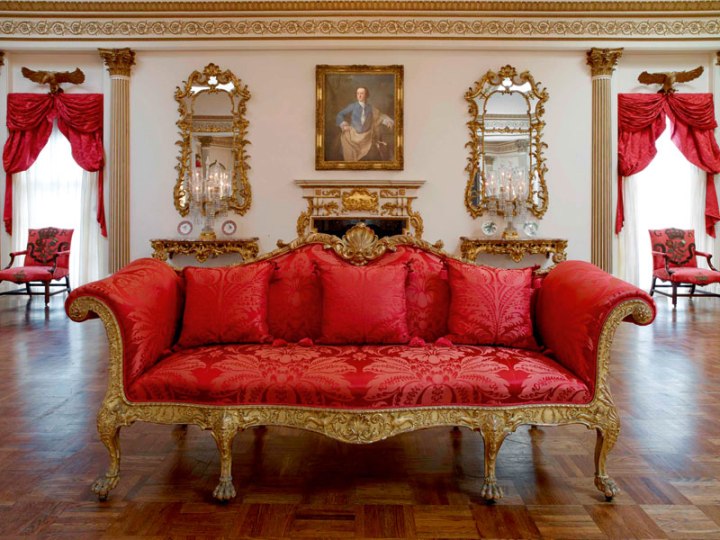
Designed by Robert Adam, made by Thomas Chippendale, The Dundas Sofa, commissioned 1764, made 1765, gilt pine and beech, with later silk upholstery (Museum of Fine Arts, Houston)
◊ ◊ ◊ ◊ ◊
From the MFAH:
A Sense of Proportion: Architect-Designed Objects, 1650–1950
Museum of Fine Arts, Houston, 23–24 September 2016
Proposals due by 15 June 2016 (extended from the original 1 June due date)
Rienzi, the house museum for European decorative arts of the Museum of Fine Arts, Houston, hosts the biennial symposium, A Sense of Proportion: Architect-Designed Objects, 1650–1950. The symposium aims to focus on objects that are the embodiments or extensions of an architect’s ideas or aesthetic. Scholars are asked to discuss objects made for particular spaces, objects used to explore new design sources and objects intended to be part of an integrated space. In short, why do objects that have been designed by architects look the way they do?
Rienzi houses a significant collection of European paintings, sculpture, furniture, porcelain, and silver from the mid-17th through mid-19th centuries. Built in 1953 as a residence and opened to the public as a house museum in 1999, Rienzi evokes fine European houses of the 18th century with architecture reminiscent of the Italian Palladian style, surrounded by period European decorative arts and paintings. Recently, Rienzi acquired the, elegant, nine-foot-long Dundas Sofa, designed by Robert Adam (1728-1792), renowned neoclassical architect of the 18th-century and made by the celebrated English furniture maker, Thomas Chippendale (1718-1779). It is from the only suite of furniture known to be a collaboration between these two masters.
Master’s and doctoral students as well as entry level and mid-career professionals are invited to submit a 400-word abstract outlining a 20-minute presentation, along with a CV, by June 1, 2016. Selected participants will be notified by July 15, 2016 and offered a $600 stipend for travel and lodging. All presentations are given Saturday, September 24, 2016, at the Museum of Fine Arts, Houston. The keynote lecture is held Friday evening followed by a reception at Rienzi.
Possible themes of investigation may include, but are not limited to:
• Interiors
• Design
• Architecture
• Dining
• Privacy
• Leisure Activities
• Etiquette
• Gender
• Costume
• Travel
• Technology
• Economics
◊ ◊ ◊ ◊ ◊
Keynote Address by Adriano Aymonino (University of Buckingham)
Museum of Fine Arts, Houston, Friday, 23 September, 5:00pm
Aymonino obtained his PhD at the University of Venice. His main academic interest is the reception of the classical tradition in the Early Modern period, with a particular focus on Britain. He has held postdoctoral fellowships at the Paul Mellon Centre for Studies in British Art of Yale University and at the Getty Research Institute. He is working on a revised edition of Francis Haskell and Nicholas Penny’s Taste and the Antique, as well as on a project tracing the impact of antiquarian publications on 17th- and 18th-century European art and architecture.
Call for Papers | Towards a Cultural History of the Decorator
From H-ArtHist:
Towards a Cultural History of the Decorator, 18th–20th Centuries
Institut national d’histoire de l’art, Paris, 7–8 October 2016
Proposals due by 1 April 2016
Organized by the Institut National d’Histoire de l’Art and Les Arts Décoratifs, this symposium will propose a reevaluation of the traditional history of Western styles from the late 18th to the late 20th century by examining the figure of the interior decorator. While the historiography has mostly focused on the logical chain of formal and technical innovations and the notion of avant-garde, this symposium will highlight the socio-economical context in which the work of the decorator was rooted. This approach sheds new light on the visual culture of certain generations or social groups at a specific moment in time. It also helps shape the definition of notions such as the collective gaze (oeil collectif) or visual tolerance, still under-studied, and provides clues to understanding the alternation of over-furnishing and soberness. This approach may also explain the numerous variations regarding, for example, the intensity of colour and light, or the occupation of space.
To contribute to this cultural history of the interior decorator, this symposium will give priority to trans-historical and interdisciplinary proposals over monographic approaches. Proposals which fit into one of the themes detailed below will retain our attention:
1. Identity of the Decorator
The decorator is generally associated with the figure of the architect in the 18th century, with the upholsterer in the 19th century, and the ensemblier in the 20th century. This session’s aim is to analyze and perhaps reconsider these categories.
2. Spaces
This will be the opportunity to think about the complex relationship between the decorator and the various spaces in which s/he works (public/private space, scenography, etc.).
3. Diffusion of the Work of the Decorator
This session will examine the numerous means available for the decorator to diffuse and promote his/her work. From pattern books to magazines, how have these media brought to light the decorator’s work? To which extent can the descriptions found in literature inform his/her work?
4. Fashion-Maker or Follower?
If the work of the decorator seems to epitomize the tastes of a class or a social category at a specific moment in history, the relationships between the decorator and the patron needs to be further examined in order to evaluate their respective role and responsibility in the
creation and diffusion of a trend.
The papers will be given either in French or English. Proposals in French or English, about 2000 characters (including spaces) should be sent by April 1st 2016 to the following persons:
• philippe.thiebaut@inha.fr
• etienne.tornier@inha.fr
• sebastien.quequet@lesartsdecoratifs.fr
Call for Papers | Books and the City
From H-ArtHist:
Books and the City
Maastricht, Netherlands, 23-24 June 2016
Proposals due by 1 March 2016
This symposium aims to investigate the relationships between books and urban spaces. Cities are complex networks that exist in a constant state of transformation. More than just the built environment of the metropolis, cities are constituted through a range of geographic, social, political and economic dynamics. Drawing together a range of interdisciplinary perspectives, the symposium seeks to investigate the ways in which these aspects of the city have been articulated by books, their production, distribution and collection.
Books and the City poses a number of questions: How has the city been represented in literature, travel guides, artists’ books, newspapers, prints, graphic novels or zines? How has the book been used to reflect, challenge or produce urban identities? To what extent is the book implicated in strategies of mapping, defining borders and city limits or articulating boundaries between the urban and suburban? What role have books played in constructing narratives about the history, memory or future transformations of the city? How do book collections, publishers and systems of distribution relate to notions of civic identity? How might the materiality of books and their preservation reveal the structures or concerns of city spaces and their communities? Papers exploring these questions and others are invited from artists, academics and professionals working across periods and geographies.
The symposium will be organized around sessions on
• Book history
• Artist’s books
• Representations of the city
• Travel
• Urban centers (London, Paris, etc.)
• Conceptions of space and time
• Books and city networks
• Circulation of books and reading practices in the city
These session themes are suggestions and are not an exhaustive list. The Books and the City symposium coincides with the Netherlands 2016 Year of the Book. Abstracts of 300 words (max) along with a short bio should be submitted to barbara.garrie@canterbury.ac.nz, p.fleskens@maastrichtuniversity and emilie.sitzia@maastrichtuniversity.nl by 1 March 2016. Panel proposals will also be considered.
Call for Papers | The Royal Palace in the Europe of Revolutions
The Royal Palace in the Europe of Revolutions, 1750–1850
Centre André Chastel, Paris, 28–29 October 2016
Proposals due by 1 May 2016
Organized by Basile Baudez and Adrián Almoguera
Since the publication of Nikolaus Pevsner’s History of Building Types in 1976, architectural historians have been alert to the importance of typologies for rethinking their discipline. As analyzed by Werner Szambien or Jacques Lucan, thinking through types allowed for the articulation of concepts of convenance, character and composition in both public and private commissions. Along with metropolitan churches and royal basilicas, in ancien régime Europe princely palaces represented the most prestigious program an architect could expect. For a period in which the divine right of kings was being called into question, however, what happened to the physical structures of royal or princely power, symbol of political authority and dynastic seats? Did the national models of the Escorial, Versailles, Het Loo or Saint James palaces still hold, even in light of new models made available through the publication of archeological discoveries in Rome or Split? The second half of the eighteenth and first half of the nineteenth century represent a moment of intense construction or reconstruction of the principal European palaces, from Caserta to Buckingham Palace, Saint-Petersburg to Lisbon, Versailles to Coblenz. This trend, addressed by Percier and Fontaine in their Résidences des souverains de France, d’Allemagne, de Russie, etc. (1833), took place in a Europe that was undergoing political developments that altogether changed the nature and symbolic structure of princely power.
This symposium, focused on Europe from roughly 1750 to 1850, aims to interrogate the manner in which architects and their patrons integrated the changing concepts of character in architecture and symbolic place of dynastic palaces, reconciling them with theory and/or practice through rethinking issues of distribution, construction, environmental situation, décor, function, reuse of interpretations of printed or drawn sources.
Submissions of 500 words (maximum) should be sent before May 1, 2016 to basile.baudez@gmail.com and af.almoguera@gmail.com.
Call for Papers | The Medium and the Message: European Architecture
From the University of Birmingham:
The Medium and the Message: Re-evaluating Form and
Meaning in European Architecture, 1400–1950
Barber Institute of Fine Arts, Birmingham, 1–2 July 2016
Proposals due by 1 April 2016
All buildings—whether polite, vernacular or somewhere in between—were initially informed by some kind of presiding idea or set of ideas. Some of these ideas presumed an audience (and are therefore part of the building’s rhetoric and essential to its intended ‘meaning’), while others did not (in being part, for example, of a production process, or allied with social and cultural contexts, and no more than that). All such ideas should concern the architectural historian, but the most engaging and historically resonant may well belong to the first category and also be ones that can be inferred and recovered from the buildings themselves. The architectural historian may also profit from a keener understanding of how the ideas initially underpinning a building may, in time, have become modified, or even eclipsed by associations of very different kinds.
The conference will investigate the ways in which ideas are conveyed by the physical and visual medium of architectural form. It will include case studies which will move us beyond explanations of architecture that borrow too liberally from literature and theory, and will thereby deepen our understanding both of the medium of architecture and of the construction and operation of architectural ‘meaning’. Moreover, by establishing or re-exploring the intellectual foundations sustaining the designs of certain key buildings, and by examining the ways in which they informed the physical realities of the buildings themselves, we hope to reinvigorate and enrich our understanding of significant moments in European architectural history.
We welcome papers that directly explore the relationship between message and medium through detailed historical case studies which directly address the agency of architecture itself in the conveying of meaning. Papers could tackle, for example, Filippo Brunelleschi’s innovative ‘Renaissance’ style of architecture; Inigo Jones’s Italianate classicism; Francesco Borromini’s departures from classical proprieties; complex stereotomy in French architecture of the early modern period; the new language and meanings of English Palladianism; the rarefied classicism of John Soane or Karl Friedrich Schinkel; form and association in the concrete architecture of Le Corbusier. In general, therefore, they will examine architecture’s expressive potential, through such topics as the materiality of buildings, the visual logic and implications of built form or the evocation (or not) of the historical past, and in relation to particular people, periods and places.
Papers should be of 20 minutes in length (followed by 5 or 10 minutes of questions). If you wish to apply, please write to Professor Anthony Geraghty (anthony.geraghty@york.ac.uk with the subject line Medium and Message), giving the subject and a brief synopsis (250 words) of your proposed topic. Please also specify your title and full name and your institutional affiliation (if any). The deadline for the submission of proposals is 1 April 2016, and we aim to have a decision on the acceptance of papers within 4 weeks of that date.
Convenors
David Hemsoll (University of Birmingham)
Anthony Geraghty (University of York)










leave a comment